SECTION II. KĀBUL666 (continued 4)
Annette Susannah Beveridge translation
Bābur’s phrase “I made him Khān” (f. 200b) recalls his earlier mention of what seems to be the same appointment (f. 10b), made by Abū-sa‘īd of Yūnas as Khān of the Mughūls; in each case the meaning seems to be that the Tīmūrid Mīrzā made the Chaghatāī Khān Khāqān of the Mughūls.
d. First attempt on Ḥiṣār.
After spending a short time in Qūndūz, Bābur moved for Ḥiṣār in which were the Aūzbeg sult̤āns Mahdī and Ḥamza. They came out into Wakhsh to meet him but, owing to an imbroglio, there was no encounter and each side retired (T.R. p. 238).
e. Intercourse between Bābur and Ismā‘īl Ṣafawī.
While Bābur was now in Qūndūz his sister Khān-zāda arrived there, safe-returned under escort of the Shāh’s troops, after the death in the battle of Merv of her successive husbands Shaibānī and Sayyid Hādī, and with her came an envoy from Ismā‘īl proffering friendship, civilities calculated to arouse a hope of Persian help in Bābur. To acknowledge his courtesies, Bābur sent Mīrzā Khān with thanks and gifts; Ḥaidar says that the Mīrzā also conveyed protestations of good faith and a request for military assistance. He was well received and his request for help was granted; that it was granted under hard conditions then stated later occurrences shew.
917 AH.-MARCH 31st 1511 to MARCH 19th 1512 AD.
a. Second attempt on Ḥiṣār.
In this year Bābur moved again on Ḥiṣār. He took post, where once his forbear Tīmūr had wrought out success against great odds, at the Pul-i-sangīn (Stone-bridge) on the Sūrkh-āb, and lay there a month awaiting reinforcement. The Aūzbeg sult̤āns faced him on the other side of the river, they too, presumably, awaiting reinforcement. They moved when they felt themselves strong enough to attack, whether by addition to their own numbers, whether by learning that Bābur had not largely increased his own. Concerning the second alternative it is open to surmise that he hoped for larger reinforcement than he obtained; he appears to have left Qūndūz before the return of Mīrzā Khān from his embassy to Ismā‘īl, to have expected Persian reinforcement with the Mīrzā, and at Pul-i-sangīn, where the Mīrzā joined him in time to fight, to have been strengthened by the Mīrzā’s own following, and few, if any, foreign auxiliaries. These surmises are supported by what Khwānd-amīr relates of the conditions [specified later] on which the Shāh’s main contingent was despatched and by his shewing that it did not start until after the Shāh had had news of the battle at Pul-i-sangīn.
At the end of the month of waiting, the Aūzbegs one morning swam the Sūrkh-āb below the bridge; in the afternoon of the same day, Bābur retired to better ground amongst the mountain fastnesses of a local Āb-dara. In the desperate encounter which followed the Aūzbegs were utterly routed with great loss in men; they were pursued to Darband-i-ahanīn (Iron-gate) on the Ḥiṣār border, on their way to join a great force assembled at Qarshī under Kūchūm Khān, Shaibānī’s successor as Aūzbeg Khāqān. The battle is admirably described by Ḥaidar, who was then a boy of 12 with keen eye watching his own first fight, and that fight with foes who had made him the last male survivor of his line. In the evening of the victory Mahdī, Ḥamza and Ḥamza’s son Mamak were brought before Bābur who, says Ḥaidar, did to them what they had done to the Mughūl Khāqāns and Chaghatāī Sult̤āns, that is, he retaliated in blood for the blood of many kinsmen.
b. Persian reinforcement.
After the battle Bābur went to near Ḥiṣār, was there joined by many local tribesmen, and, some time later, by a large body of Ismā‘īl’s troops under Aḥmad Beg Ṣafawī, ‘Alī Khān Istiljū and Shāhrukh Sl. Afshār, Ismā‘īl’s seal-keeper. The following particulars, given by Khwānd-amīr, about the despatch of this contingent help to fix the order of occurrences, and throw light on the price paid by Bābur for his auxiliaries. He announced his victory over Mahdī and Ḥamza to the Shāh, and at the same time promised that if he reconquered the rest of Transoxiana by the Shāh’s help, he would read his name in the khut̤ba, stamp it on coins together with those of the Twelve Imāms, and work to destroy the power of the Aūzbegs. These undertakings look like a response to a demand; such conditions cannot have been proffered; their acceptance must have been compelled. Khwānd-amīr says that when Ismā‘īl fully understood the purport of Bābur’s letter, [by which would seem to be meant, when he knew that his conditions of help were accepted,] he despatched the troops under the three Commanders named above.
The Persian chiefs advised a move direct on Bukhārā and Samarkand; and with this Bābur’s councillors concurred, they saying, according to Ḥaidar, that Bukhārā was then empty of troops and full of fools. ‘Ubaid Khān had thrown himself into Qarshī; it was settled not to attack him but to pass on and encamp a stage beyond the town. This was done; then scout followed scout, bringing news that he had come out of Qarshī and was hurrying to Bukhārā, his own fief. Instant and swift pursuit followed him up the 100 miles of caravan-road, into Bukhārā, and on beyond, sweeping him and his garrison, plundered as they fled, into the open land of Turkistān. Many sult̤āns had collected in Samarkand, some no doubt being, like Tīmūr its governor, fugitives escaped from Pul-i-sangīn. Dismayed by Bābur’s second success, they scattered into Turkistān, thus leaving him an open road.
c. Samarkand re-occupied and relations with Ismā‘īl Ṣafawī.
He must now have hoped to be able to dispense with his dangerous colleagues, for he dismissed them when he reached Bukhārā, with gifts and thanks for their services. It is Ḥaidar, himself present, who fixes Bukhārā as the place of the dismissal (T.R. p. 246).
From Bukhārā Bābur went to Samarkand. It was mid-Rajab 917 AH. (October 1511 AD.), some ten months after leaving Kābul, and after 9 years of absence, that he re-entered the town, itself gay with decoration for his welcome, amidst the acclaim of its people.1336
Eight months were to prove his impotence to keep it against the forces ranged against him,—Aūzbeg strength in arms compacted by Sunnī zeal, Sunnī hatred of a Shī‘a’s suzerainty intensified by dread lest that potent Shī‘a should resolve to perpetuate his dominance. Both as a Sunnī and as one who had not owned a suzerain, the position was unpleasant for Bābur. That his alliance with Ismā‘īl was dangerous he will have known, as also that his risks grew as Transoxiana was over-spread by news of Ismā‘īl’s fanatical barbarism to pious and learned Sunnīs, notably in Herī. He manifested desire for release both now and later,—now when he not only dismissed his Persian helpers but so behaved to the Shāh’s envoy Muḥammad Jān,—he was Najm S̤ānī’s Lord of the Gate,—that the envoy felt neglect and made report of Bābur as arrogant, in opposition, and unwilling to fulfil his compact,—later when he eagerly attempted success unaided against ‘Ubaid Khān, and was then worsted. It illustrates the Shāh’s view of his suzerain relation to Bābur that on hearing Muḥammad Jān’s report, he ordered Najm S̤ānī to bring the offender to order.
Meantime the Shāh’s conditions seem to have been carried out in Samarkand and Bābur’s subservience clearly shewn.1337 Of this there are the indications,—that Bābur had promised and was a man of his word; that Sunnī irritation against him waxed and did not wane as it might have done without food to nourish it; that Bābur knew himself impotent against the Aūzbegs unless he had foreign aid, expected attack, knew it was preparing; that he would hear of Muḥammad Jān’s report and of Najm S̤ānī’s commission against himself. Honesty, policy and necessity combined to enforce the fulfilment of his agreement. What were the precise terms of that agreement beyond the two as to the khut̤ba and the coins, it needs close study of the wording of the sources to decide, lest metaphor be taken for fact. Great passions,—ambition, religious fervour, sectarian bigotry and fear confronted him. His problem was greater than that of Henry of Navarre and of Napoleon in Egypt; they had but to seem what secured their acceptance; he had to put on a guise that brought him hate.
Khān-zāda was not the only member of Bābur’s family who now rejoined him after marriage with an Aūzbeg. His half-sister Yādgār-sult̤ān had fallen to the share of Ḥamza Sult̤ān’s son ‘Abdu’l-lat̤īf in 908 AH. when Shaibānī defeated the Khāns near Akhsī. Now that her half-brother had defeated her husband’s family, she returned to her own people (f. 9).
918 AH.-MARCH 19th 1512 to MARCH 9th 1513 AD.
a. Return of the Aūzbegs.
Emboldened by the departure of the Persian troops, the Aūzbegs, in the spring of the year, came out of Turkistān, their main attack being directed on Tāshkīnt, then held for Bābur.1338 ‘Ubaid Khān moved for Bukhārā. He had prefaced his march by vowing that, if successful, he would thenceforth strictly observe Musalmān Law. The vow was made in Ḥaẓrat Turkistān at the shrine of Khwāja Aḥmad Yasawī, a saint revered in Central Asia through many centuries; he had died about 1120 AD.; Tīmūr had made pilgrimage to his tomb, in 1397 AD., and then had founded the mosque still dominating the town, still the pilgrim’s land-mark.1339 ‘Ubaid’s vow, like Bābur’s of 933 AH., was one of return to obedience. Both men took oath in the Ghāzī’s mood, Bābur’s set against the Hindū whom he saw as a heathen, ‘Ubaid’s set against Bābur whom he saw as a heretic.
b. Bābur’s defeat at Kul-i-malik.
In Ṣafar (April-May) ‘Ubaid moved swiftly down and attacked the Bukhārā neighbourhood. Bābur went from Samarkand to meet him. Several details of what followed, not given by Ḥaidar and, in one particular, contradicting him, are given by Khwānd-amīr. The statement in which the two historians contradict one another is Ḥaidar’s that ‘Ubaid had 3000 men only, Bābur 40,000. Several considerations give to Khwānd-amīr’s opposed statement that Bābur’s force was small, the semblance of being nearer the fact. Ḥaidar, it may be said, did not go out on this campaign; he was ill in Samarkand and continued ill there for some time; Khwānd-amīr’s details have the well-informed air of things learned at first-hand, perhaps from some-one in Hindūstān after 934 AH.
Matters which make against Bābur’s having a large effective force at Kul-i-malik, and favour Khwānd-amīr’s statement about the affair are these:—‘Ubaid must have formed some estimate of what he had to meet, and he brought 3000 men. Where could Bābur have obtained 40,000 men worth reckoning in a fight? In several times of crisis his own immediate and ever-faithful troop is put at 500; as his cause was now unpopular, local accretions may have been few. Some Mughūls from Merv and from Kābul were near Samarkand (T.R. pp. 263, 265); most were with Sa‘īd in Andijān; but however many Mughūls may have been in his neighbourhood, none could be counted on as resolute for his success. If too, he had had more than a small effective force, would he not have tried to hold Samarkand with the remnant of defeat until Persian help arrived? All things considered, there is ground for accepting Khwānd-amīr’s statement that Bābur met ‘Ubaid with a small force.
Following his account therefore:—Bābur in his excess of daring, marched to put the Aūzbeg down with a small force only, against the advice of the prudent, of whom Muḥammad Mazīd Tarkhān was one, who all said it was wrong to go out unprepared and without reinforcement. Paying them no attention, Bābur marched for Bukhārā, was rendered still more daring by news had when he neared it, that the enemy had retired some stages, and followed him up almost to his camp. ‘Ubaid was in great force; many Aūzbegs perished but, in the end, they were victors and Bābur was compelled to take refuge in Bukhārā. The encounter took place near Kul-i-malik (King’s-lake) in Ṣafar 918 AH. (April-May 1512 AD.).
c. Bābur leaves Samarkand.
It was not possible to maintain a footing in Samarkand; Bābur therefore collected his family and train1340 and betook himself to Ḥiṣār. There went with him on this expedition Māhīm and her children Humāyūn, Mihr-jahān and Bārbūl,—the motherless Ma‘ṣūma,—Gul-rukh with her son Kāmrān (Gulbadan f. 7). I have not found any account of his route; Ḥaidar gives no details about the journey; he did not travel with Bābur, being still invalided in Samarkand. Perhaps the absence of information is a sign that the Aūzbegs had not yet appeared on the direct road for Ḥiṣār. A local tradition however would make Bābur go round through Farghāna. He certainly might have gone into Farghāna hoping to co-operate with Sa‘īd Khān; Tāshkīnt was still holding out under Aḥmad-i-qāsim Kohbur and it is clear that all activity in Bābur’s force had not been quenched because during the Tāshkīnt siege, Dost Beg broke through the enemy’s ranks and made his way into the town. Sairām held out longer than Tāshkīnt. Of any such move by Bābur into Andijān the only hint received is given by what may be a mere legend.1341
d. Bābur in Ḥiṣār.
After experiencing such gains and such losses, Bābur was still under 30 years of age.
The Aūzbegs, after his departure, re-occupied Bukhārā and Samarkand without harm done to the towns-people, and a few weeks later, in Jumāda I (July-August) followed him to Ḥiṣār. Meantime he with Mīrzā Khān’s help, had so closed the streets of the town by massive earth-works that the sult̤āns were convinced its defenders were ready to spend the last drop of their blood in holding it, and therefore retired without attack.1342 Some sources give as their reason for retirement that Bābur had been reinforced from Balkh; Bairām Beg, it is true, had sent a force but one of 300 men only; so few cannot have alarmed except as the harbinger of more. Greater precision as to dates would shew whether they can have heard of Najm S̤ānī’s army advancing by way of Balkh.
e. Qarshī and Ghaj-davān.
Meantime Najm S̤ānī, having with him some 11,000 men, had started on his corrective mission against Bābur. When he reached the Khurāsān frontier, he heard of the defeat at Kul-i-malik and the flight to Ḥiṣār, gathered other troops from Harāt and elsewhere, and advanced to Balkh. He stayed there for 20 days with Bairām Beg, perhaps occupied, in part, by communications with the Shāh and Bābur. From the latter repeated request for help is said to have come; help was given, some sources say without the Shāh’s permission. A rendezvous was fixed, Najm S̤ānī marched to Tīrmīẕ, there crossed the Amū and in Rajab (Sep.-Oct.) encamped near the Darband-i-ahanīn. On Bābur’s approach through the Chak-chaq pass, he paid him the civility of going several miles out from his camp to give him honouring reception.
Advancing thence for Bukhārā, the combined armies took Khuzār and moved on to Qarshī. This town Bābur wished to pass by, as it had been passed by on his previous march for Bukhārā; each time perhaps he wished to spare its people, formerly his subjects, whom he desired to rule again, and who are reputed to have been mostly his fellow Turks. Najm S̤ānī refused to pass on; he said Qarshī must be taken because it was ‘Ubaidu’l-lāh Khān’s nest; in it was ‘Ubaid’s uncle Shaikhīm Mīrzā; it was captured; the Aūzbeg garrison was put to the sword and, spite of Bābur’s earnest entreaties, all the towns-people, 15,000 persons it is said, down to the “suckling and decrepit”, were massacred. Amongst the victims was Banā’ī who happened to be within it. This action roused the utmost anger against Najm S̤ānī; it disgusted Bābur, not only through its merciless slaughter but because it made clear the disregard in which he was held by his magnificent fellow-general.
From murdered Qarshī Najm S̤ānī advanced for Bukhārā. On getting within a few miles of it, he heard that an Aūzbeg force was approaching under Tīmūr and Abū-sa‘īd, presumably from Samarkand therefore. He sent Bairām Beg to attack them; they drew off to the north and threw themselves into Ghaj-davān, the combined armies following them. This move placed Najm S̤ānī across the Zar-afshān, on the border of the desert with which the Aūzbegs were familiar, and with ‘Ubaid on his flank in Bukhārā.
As to what followed the sources vary; they are brief; they differ less in statement of the same occurrence than in their choice of details to record; as Mr. Erskine observes their varying stories are not incompatible. Their widest difference is a statement of time but the two periods named, one a few days, the other four months, may not be meant to apply to the same event. Four months the siege is said to have lasted; this could not have been said if it had been a few days only. The siege seems to have been of some duration.
At first there were minor engagements, ending with varying success; provisions and provender became scarce; Najm S̤ānī’s officers urged retirement, so too did Bābur. He would listen to none of them. At length ‘Ubaid Khān rode out from Bukhārā at the head of excellent troops; he joined the Ghaj-davān garrison and the united Aūzbegs posted themselves in the suburbs where walled lanes and gardens narrowed the field and lessened Najm S̤ānī’s advantage in numbers. On Tuesday Ramẓān 3rd (Nov. 12th)1343 a battle was fought in which his army was routed and he himself slain.
f. Bābur and Yār-i-aḥmad Najm Sānī.
Some writers say that Najm S̤ānī’s men did not fight well; it must be remembered that they may have been weakened by privation and that they had wished to retire. Of Bābur it is said that he, who was the reserve, did not fight at all; it is difficult to see good cause why, under all the circumstances, he should risk the loss of his men. It seems likely that Ḥaidar’s strong language about this defeat would suit Bābur’s temper also. “The victorious breezes of Islām overturned the banners of the schismatics.... Most of them perished on the field; the rents made by the sword at Qarshī were sewn up at Ghaj-davān by the arrow-stitches of vengeance. Najm S̤ānī and all the Turkmān amīrs were sent to hell.”
The belief that Bābur had failed Najm S̤ānī persisted at the Persian Court, for his inaction was made a reproach to his son Humāyūn in 951 AH. (1544 AD.), when Humāyūn was a refugee with Ismā‘īl’s son T̤ahmāsp. Badāyūnī tells a story which, with great inaccuracy of name and place, represents the view taken at that time. The part of the anecdote pertinent here is that Bābur on the eve of the battle at Ghaj-davān, shot an arrow into the Aūzbeg camp which carried the following couplet, expressive of his ill-will to the Shāh and perhaps also of his rejection of the Shī‘a guise he himself had worn.
I made the Shāh’s Najm road-stuff for the Aūzbegs; If fault has been mine, I have now cleansed the road.1344
g. The Mughūls attack Bābur.
On his second return to Ḥiṣār Bābur was subjected to great danger by a sudden attack made upon him by the Mughūls where he lay at night in his camp outside the town. Firishta says, but without particulars of their offence, that Bābur had reproached them for their misconduct; the absence of detail connecting the affair with the defeat just sustained, leads to the supposition that their misdeeds were a part of the tyranny over the country-people punished later by ‘Ubaidu’l-lāh Khān. Roused from his sleep by the noise of his guards’ resistance to the Mughūl attack, Bābur escaped with difficulty and without a single attendant1345 into the fort. The conspirators plundered his camp and withdrew to Qarā-tīgīn. He was in no position to oppose them, left a few men in Ḥiṣār and went to Mīrzā Khān in Qūndūz.
After he left, Ḥiṣār endured a desolating famine, a phenomenal snowfall and the ravages of the Mughūls. ‘Ubaid Khān avenged Bābur on the horde; hearing of their excesses, he encamped outside the position they had taken up in Wakhsh defended by river, hills and snow, waited till a road thawed, then fell upon them and avenged the year’s misery they had inflicted on the Ḥiṣārīs. Ḥaidar says of them that it was their villainy lost Ḥiṣār to Bābur and gained it for the Aūzbeg.1346
These Mughūls had for chiefs men who when Sa‘īd went to Andijān, elected to stay with Bābur. One of the three named by Ḥaidar was Ayūb Begchīk. He repented his disloyalty; when he lay dying some two years later (920 AH.) in Yāngī-ḥiṣār, he told Sa‘īd Khān who visited him, that what was “lacerating his bowels and killing him with remorse”, was his faithlessness to Bābur in Ḥiṣār, the oath he had broken at the instigation of those “hogs and bears”, the Mughūl chiefs (T.R. p. 315).
In this year but before the Mughūl treachery to Bābur, Ḥaidar left him, starting in Rajab (Sep.-Oct.) to Sa‘id in Andijān and thus making a beginning of his 19 years spell of service.
919 AH.-MARCH 9th 1513 to FEB. 26th 1514 AD.
Bābur may have spent this year in Khishm (Ḥ.S. iii, 372). During two or three months of it, he had one of the Shāh’s retainers in his service, Khwāja Kamālu’d-dīn Maḥmūd, who had fled from Ghaj-davān to Balkh, heard there that the Balkhīs favoured an Aūzbeg chief whose coming was announced, and therefore went to Bābur. In Jumāda 11 (August), hearing that the Aūzbeg sultan had left Balkh, he returned there but was not admitted because the Balkhīs feared reprisals for their welcome to the Aūzbeg, a fear which may indicate that he had taken some considerable reinforcement to Bābur. He went on into Khurāsān and was there killed; Balkh was recaptured for the Shāh by Deo Sult̤ān, a removal from Aūzbeg possession which helps to explain how Bābur came to be there in 923 AH.
920 AH.—FEB. 26th 1514 to FEB. 15th 1515 AD.
Ḥaidar writes of Bābur as though he were in Qūndūz this year (TR. p. 263), says that he suffered the greatest misery and want, bore it with his accustomed courtesy and patience but, at last, despairing of success in recovering Ḥiṣār, went back to Kābul. Now it seems to be that he made the stay in Khwāst to which he refers later (f. 241b) and during which his daughter Gul-rang was born, as Gul-badan’s chronicle allows known.
It was at the end of the year, after the privation of winter therefore, that he reached Kābul. When he re-occupied Samarkand in 917 AH., he had given Kābul to his half-brother Nāṣir Mīrzā; the Mīrzā received him now with warm welcome and protestations of devotion and respect, spoke of having guarded Kābul for him and asked permission to return to his own old fief Ghaznī. His behaviour made a deep impression on Bābur; it would be felt as a humane touch on the sore of failure.
921 AH.—FEB. 15th 1515 to FEB. 5th 1516 AD.
a. Rebellion of chiefs in Ghaznī.
Nāṣir Mīrzā died shortly after (dar hamān ayyām) his return to Ghaznī. Disputes then arose amongst the various commanders who were in Ghaznī; Sherīm T̤aghāī was one of them and the main strength of the tumult was given by the Mughūls. Many others were however involved in it, even such an old servant as Bābā of Pashāghar taking part (f. 234b; T.R. p. 356). Ḥaidar did not know precisely the cause of the dispute, or shew why it should have turned against Bābur, since he attributes it to possession taken by Satan of the brains of the chiefs and a consequent access of vain-glory and wickedness. Possibly some question of succession to Nāṣir arose. Dost Beg distinguished himself in the regular battle which ensued; Qāsim Beg’s son Qaṃbar-i-‘alī hurried down from Qūndūz and also did his good part to win it for Bābur. Many of the rioters were killed, others fled to Kāshghar. Sherīm T̤aghāī was one of the latter; as Sa‘īd Khān gave him no welcome, he could not stay there; he fell back on the much injured Bābur who, says Ḥaidar, showed him his usual benevolence, turned his eyes from his offences and looked only at his past services until he died shortly afterwards (T.R. p. 357).1347
922 AH.—FEB. 5th 1516 to JAN. 24th 1517 AD.
This year may have been spent in and near Kābul in the quiet promoted by the dispersion of the Mughūls.
In this year was born Bābur’s son Muḥammad known as ‘Askarī from his being born in camp. He was the son of Gulrukh Begchīk and full-brother of Kāmrān.
923 AH.—JAN. 24th 1517 to JAN. 13th 1518 AD.
a. Bābur visits Balkh.
Khwānd-amīr is the authority for the little that is known of Bābur’s action in this year (Ḥ.S. iii, 367 et seq.). It is connected with the doings of Badī‘u’z-zamān Bāī-qarā’s son Muḥammad-i-zamān. This Mīrzā had had great wanderings, during a part of which Khwānd-amīr was with him. In 920 AH. he was in Shāh Ismā‘īl’s service and in Balkh, but was not able to keep it. Bābur invited him to Kābul,—the date of invitation will have been later therefore than Bābur’s return there at the end of 920 AH. The Mīrzā was on his way but was dissuaded from going into Kābul by Mahdī Khwāja and went instead into Ghurjistān. Bābur was angered by his non-arrival and pursued him in order to punish him but did not succeed in reaching Ghurjistān and went back to Kābul by way of Fīrūz-koh and Ghūr. The Mīrzā was captured eventually and sent to Kābul. Bābur treated him with kindness, after a few months gave him his daughter Ma‘ṣūma in marriage, and sent him to Balkh. He appears to have been still in Balkh when Khwānd-amīr was writing of the above occurrences in 929 AH. The marriage took place either at the end of 923 or beginning of 924 AH. The Mīrzā was then 21, Ma‘ṣūma 9; she almost certainly did not then go to Balkh. At some time in 923 AH. Bābur is said by Khwānd-amīr to have visited that town.1348
b. Attempt on Qandahār.
In this year Bābur marched for Qandahār but the move ended peacefully, because a way was opened for gifts and terms by an illness which befell him when he was near the town.
The Tārīkh-i-sind gives what purports to be Shāh Beg’s explanation of Bābur’s repeated attempts on Qandahār. He said these had been made and would be made because Bābur had not forgiven Muqīm for taking Kābul 14 years earlier from the Tīmūrid ‘Abdu’r-razzāq; that this had brought him to Qandahār in 913 AH., this had made him then take away Māhchuchak, Muqīm’s daughter; that there were now (923 AH.) many unemployed Mīrzās in Kābul for whom posts could not be found in regions where the Persians and Aūzbegs were dominant; that an outlet for their ambitions and for Bābur’s own would be sought against the weaker opponent he himself was.
Bābur’s decision to attack in this year is said to have been taken while Shāh Beg was still a prisoner of Shāh Ismā‘īl in the Harāt country; he must have been released meantime by the admirable patience of his slave Saṃbhal.
924 AH.—JAN. 13th 1518 to JAN. 3rd 1519 AD.
In this year Shāh Beg’s son Shāh Ḥasan came to Bābur after quarrel with his father. He stayed some two years, and during that time was married to Khalīfa’s daughter Gul-barg (Rose-leaf). His return to Qandahār will have taken place shortly before Bābur’s campaign of 926 A.H. against it, a renewed effort which resulted in possession on Shawwāl 13th 928 AH. (Sep. 6th 1522 AD.).1349
In this year began the campaign in the north-east territories of Kābul, an account of which is carried on in the diary of 925 AH. It would seem that in the present year Chaghān-sarāī was captured, and also the fortress at the head of the valley of Bābā-qarā, belonging to Ḥaidar-i-‘alī Bajaurī (f. 216b).1350
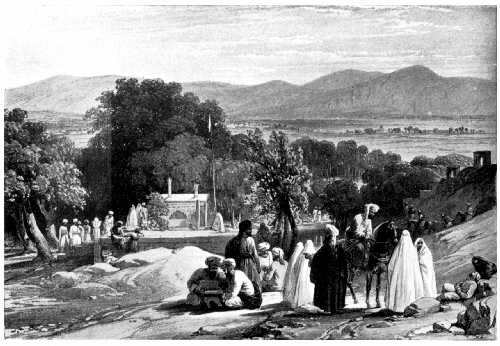
View from above Babur’s Grave and Shah-jahan’s Mosque.
925 AH.-JAN. 3rd to DEC. 23rd 1519 AD.1351
(a. Bābur takes the fort of Bajaur.)
(Jan. 3rd) On Monday1352 the first day of the month of Muḥarram, there was a violent earthquake in the lower part of the dale (julga) of Chandāwal,1353 which lasted nearly half an astronomical hour.
(Jan. 4th) Marching at dawn from that camp with the intention of attacking the fort of Bajaur,1354 we dismounted near it and sent a trusty man of the Dilazāk1355 Afghāns to advise its sult̤ān1356 and people to take up a position of service (qullūq) and surrender the fort. Not accepting this counsel, that stupid and ill-fated band sent back a wild answer, where-upon the army was ordered to make ready mantelets, ladders and other appliances for taking a fort. For this purpose a day’s (Jan. 5th) halt was made on that same ground.
(Jan. 6th) On Thursday the 4th of Muḥarram, orders were given that the army should put on mail, arm and get to horse;1357 that the left wing should move swiftly to the upper side of the fort, cross the water at the water-entry,1358 and dismount on the Fol. 217.north side of the fort; that the centre, not taking the way across the water, should dismount in the rough, up-and-down land to the north-west of the fort; and that the right should dismount to the west of the lower gate. While the begs of the left under Dost Beg were dismounting, after crossing the water, a hundred to a hundred and fifty men on foot came out of the fort, shooting arrows. The begs, shooting in their turn, advanced till they had forced those men back to the foot of the ramparts, Mullā ‘Abdu’l-malūk of Khwāst, like a madman,1359 going up right under them on his horse. There and then the fort would have been taken if the ladders and mantelets had been ready, and if it had not been so late in the day. Mullā Tirik-i-‘alī1360 and a servant of Tīngrī-bīrdī crossed swords with the enemy; each overcame his man, cut off and brought in his head; for this each was promised a reward.
As the Bajaurīs had never before seen matchlocks (tufang) they at first took no care about them, indeed they made fun when they heard the report and answered it by unseemly gestures. On that day1361 Ustād ‘Alī-qulī shot at and brought down five men with his matchlock; Walī the Treasurer, for his part, brought down two; other matchlockmen were also very active in firing and did well, shooting through shield, through cuirass, through kusarū,1362 and bringing down one man after another. Perhaps 7, 8, or 10 Bajaurīs had fallen to the matchlock-fire (ẓarb) before night. After that it so became that not a head could be put out because of the fire. The orderFol. 217b. was given, “It is night; let the army retire, and at dawn, if the appliances are ready, let them swarm up into the fort.”
(Jan. 7th) At the first dawn of light (farẓ waqt) on Friday the 5th of Muḥarram, orders were given that, when the battle-nagarets had sounded, the army should advance, each man from his place to his appointed post (yīrlīk yīrdīn) and should swarm up. The left and centre advanced from their ground with mantelets in place all along their lines, fixed their ladders, and swarmed up them. The whole left hand of the centre, under Khalīfa, Shāh Ḥasan Arghūn and Yūsuf’s Aḥmad, was ordered to reinforce the left wing. Dost Beg’s men went forward to the foot of the north-eastern tower of the fort, and busied themselves in undermining and bringing it down. Ustād ‘Alī-qulī was there also; he shot very well on that day with his matchlock, and he twice fired off the firingī.1363 Walī the Treasurer also brought down a man with his matchlock. Malik ‘Alī qut̤nī1364 was first up a ladder of all the men from the left hand of the centre, and there was busy with fight and blow. At the post of the centre, Muḥ. ‘Alī Jang-jang1365 and his younger brother Nau-roz got up, each by a different ladder, and made lance and sword to touch. Bābā the waiting man (yasāwal), getting up by another ladder, occupied himself in breaking down the fort-wall with his Fol. 218.axe. Most of our braves went well forward, shooting off dense flights of arrows and not letting the enemy put out a head; others made themselves desperately busy in breaching and pulling down the fort, caring naught for the enemy’s fight and blow, giving no eye to his arrows and stones. By breakfast-time Dost Beg’s men had undermined and breached the north-eastern tower, got in and put the foe to flight. The men of the centre got in up the ladders by the same time, but those (aūl) others were first (awwal?) in.1366 By the favour and pleasure of the High God, this strong and mighty fort was taken in two or three astronomical hours! Matching the fort were the utter struggle and effort of our braves; distinguish themselves they did, and won the name and fame of heroes.
As the Bajaurīs were rebels and at enmity with the people of Islām, and as, by reason of the heathenish and hostile customs prevailing in their midst, the very name of Islām was rooted out from their tribe, they were put to general massacre and their wives and children were made captive. At a guess more than 3000 men went to their death; as the fight did not reach to the eastern side of the fort, a few got away there.
The fort taken, we entered and inspected it. On the walls, in houses, streets and alleys, the dead lay, in what numbers! Comers and goers to and fro were passing over the bodies. Fol. 218b.Returning from our inspection, we sat down in the Bajaur sult̤ān’s residence. The country of Bajaur we bestowed on Khwāja Kalān,1367 assigning a large number of braves to reinforce him. At the Evening Prayer we went back to camp.
(b. Movements in Bajaur.)
(Jan. 8th) Marching at dawn (Muḥ. 6th), we dismounted by the spring1368 of Bābā Qarā in the dale of Bajaur. At Khwāja Kalān’s request the prisoners remaining were pardoned their offences, reunited to their wives and children, and given leave to go, but several sult̤āns and of the most stubborn were made to reach their doom of death. Some heads of sult̤āns and of others were sent to Kābul with the news of success; some also to Badakhshān, Qūndūz and Balkh with the letters-of-victory.
Shāh Manṣūr Yūsuf-zāī,—he was with us as an envoy from his tribe,—1369 was an eye-witness of the victory and general massacre. We allowed him to leave after putting a coat (tūn) on him and after writing orders with threats to the Yūsuf-zāī.
(Jan. 11th) With mind easy about the important affairs of the Bajaur fort, we marched, on Tuesday the 9th of Muḥarram, one kuroh (2 m.) down the dale of Bajaur and ordered that a tower of heads should be set up on the rising-ground.
(Jan. 12th) On Wednesday the 10th of Muḥarram, we rode out to visit the Bajaur fort. There was a wine-party in Khwāja Kalān’s house,1370 several goat-skins of wine having been brought down by Kāfirs neighbouring on Bajaur. All wine and fruit Fol. 219.had in Bajaur comes from adjacent parts of Kāfiristān.
(Jan. 13th) We spent the night there and after inspecting the towers and ramparts of the fort early in the morning (Muḥ. 11th), I mounted and went back to camp.
(Jan. 14th) Marching at dawn (Muḥ. 12th), we dismounted on the bank of the Khwāja Khiẓr torrent.1371
(Jan. 15th) Marching thence, we dismounted (Muḥ. 13th) on the bank of the Chandāwal torrent. Here all those inscribed in the Bajaur reinforcement, were ordered to leave.
(Jan. 16th) On Sunday the 14th of Muḥarram, a standard was bestowed on Khwāja Kalān and leave given him for Bajaur. A few days after I had let him go, the following little verse having come into my head, it was written down and sent to him:—1372
Not such the pact and bargain betwixt my friend and me, At length the tooth of parting, unpacted grief for me! Against caprice of Fortune, what weapons (chāra) arm the man? At length by force of arms (ba jaur) my friend is snatched from me!
(Jan. 19th) On Wednesday the 17th of Muḥarram, Sl. ‘Alā’u’d-dīn of Sawād, the rival (mu‘āriẓ) of Sl. Wais of Sawād,1373 came and waited on me.
(Jan. 20th) On Thursday the 18th of the month, we hunted the hill between Bajaur and Chandāwal.1374 There the būghū-marāl1375 have become quite black, except for the tail which is of another colour; lower down, in Hindūstān, they seem to become black all over.1376 Today a sārīq-qūsh1377 was taken; that was black all over, its very eyes being black! Today an eagle (būrkūt)1378 took a deer (kīyīk).
Corn being somewhat scarce in the army, we went into the Kahrāj-valley, and took some.Fol. 219b.
(Jan. 21st) On Friday (Muḥ. 19th) we marched for Sawād, with the intention of attacking the Yūsuf-zāī Afghāns, and dismounted in between1379 the water of Panj-kūra and the united waters of Chandāwal and Bajaur. Shāh Manṣūr Yūsuf-zāī had brought a few well-flavoured and quite intoxicating confections (kamālī); making one of them into three, I ate one portion, Gadāī T̤aghāī another, ‘Abdu’l-lāh the librarian another. It produced remarkable intoxication; so much so that at the Evening Prayer when the begs gathered for counsel, I was not able to go out. A strange thing it was! If in these days1380 I ate the whole of such a confection, I doubt if it would produce half as much intoxication.
(c. An impost laid on Kahrāj.)
(Jan. 22nd) Marching from that ground, (Muḥ. 20th), we dismounted over against Kahrāj, at the mouth of the valleys of Kahrāj and Peshgrām.1381 Snow fell ankle-deep while we were on that ground; it would seem to be rare for snow to fall thereabouts, for people were much surprised. In agreement with Sl. Wais of Sawād there was laid on the Kahrāj people an impost of 4000 ass-loads of rice for the use of the army, and he himself was sent to collect it. Never before had those rude mountaineers borne such a burden; they could not give (all) the grain and were brought to ruin.
(cc. Raid on Panj-kūra.)
(Jan. 25th) On Tuesday the 23rd of Muḥarram an army was Fol. 220.sent under Hindū Beg to raid Panj-kūra. Panj-kūra lies more than half-way up the mountain;1382 to reach its villages a person must go for nearly a kuroh (2 m.) through a pass. The people had fled and got away; our men brought a few beasts of sorts, and masses of corn from their houses.
(Jan. 26th) Next day (Muḥ. 24th) Qūj Beg was put at the head of a force and sent out to raid.
(Jan. 27th) On Thursday the 25th of the month, we dismounted at the village of Māndīsh, in the trough of the Kahrāj-valley, for the purpose of getting corn for the army.
(d. Māhīm’s adoption of Dil-dār’s unborn child.)
(Jan. 28th) Several children born of Humāyūn’s mother had not lived. Hind-āl was not yet born.1383 While we were in those parts, came a letter from Māhīm in which she wrote, “Whether it be a boy, whether it be a girl, is my luck and chance; give it to me; I will declare it my child and will take charge of it.” On Friday the 26th of the month, we being still on that ground, Yūsuf-i-‘alī the stirrup-holder was sent off to Kābul with letters1384 bestowing Hind-āl, not yet born, on Māhīm.
(dd. Construction of a stone platform.)
While we were still on that same ground in the Māndīsh-country, I had a platform made with stones (tāsh bīla) on a height in the middle of the valley, so large that it held the tents of the advance-camp. All the household and soldiers carried the stones for it, one by one like ants.
(e. Bābur’s marriage with his Afghān wife, Bībī Mubāraka.)
In order to conciliate the Yūsuf-zāī horde, I had asked for a daughter of one of my well-wishers, Malik Sulaimān Shāh’s son Malik Shāh Manṣūr, at the time he came to me as envoyFol. 220b. from the Yūsuf-zāī Afghāns.1385
While we were on this ground news came that his daughter1386 was on her way with the Yūsuf-zāī tribute. At the Evening Prayer there was a wine-party to which Sl. ‘Alā’u’d-dīn (of Sawād) was invited and at which he was given a seat and special dress of honour (khilcat-i-khāṣa).
(Jan. 30th) On Sunday the 28th, we marched from that valley. Shāh Manṣūr’s younger brother T̤āūs (Handsome) Khān brought the above-mentioned daughter of his brother to our ground after we had dismounted.
(f. Repopulation of the fort of Bajaur.)
For the convenience of having the Bī-sūt people in Bajaur-fort,1387 Yūsuf’i-‘alī the taster was sent from this camp to get them on the march and take them to that fort. Also, written orders were despatched to Kābul that the army there left should join us.
(Feb. 4th) On Friday the 3rd of the month of Ṣafar, we dismounted at the confluence of the waters of Bajaur and Panj-kūra.
(Feb. 6th) On Sunday the 5th of the month, we went from that ground to Bajaur where there was a drinking-party in Khwāja Kalān’s house.
(g. Expedition against the Afghān clans.)
(Feb. 8th) On Tuesday the 7th of the month the begs and the Dilazāk Afghān headmen were summoned, and, after consultation, matters were left at this:—“The year is at its end,1388 only a few days of the Fish are left; the plainsmen have carried in all their corn; if we went now into Sawād, the army would Fol. 221.dwindle through getting no corn. The thing to do is to march along the Aṃbahar and Pānī-mānī road, cross the Sawād-water above Hash-nagar, and surprise the Yūsuf-zāī and Muḥammadī Afghāns who are located in the plain over against the Yūsuf-zāī sangur of Māhūrā. Another year, coming earlier in the harvest-time, the Afghāns of this place must be our first thought.” So the matter was left.
(Feb. 9th) Next day, Wednesday, we bestowed horses and robes on Sl. Wais and Sl. ‘Alā’u’u-dīn of Sawād, gave them leave to go, marched off ourselves and dismounted over against Bajaur.
(Feb. 10th) We marched next day, leaving Shāh Manṣūr’s daughter in Bajaur-fort until the return of the army. We dismounted after passing Khwāja Khiẓr, and from that camp leave was given to Khwāja Kalān; and the heavy baggage, the worn-out horses and superfluous effects of the army were started off into Lamghān by the Kūnār road.
(Feb. 11th) Next morning Khwāja Mīr-i-mīrān was put in charge of the camel baggage-train and started off by the Qūrghā-tū and Darwāza road, through the Qarā-kūpa-pass. Riding light for the raid, we ourselves crossed the Aṃbahar-pass, and yet another great pass, and dismounted at Pānī-mālī nearer1389 the Afternoon Prayer. Aūghān-bīrdī was sent forward with a few others to learn1390 how things were.
(Feb. 12th) The distance between us and the Afghāns being short, we did not make an early start. Aūghān-bīrdī came back at breakfast-time.1391 He had got the better of an Afghān and had cut his head off, but had dropped it on the road. HeFol. 221b. brought no news so sure as the heart asks (kūnkūl-tīladīk). Midday come, we marched on, crossed the Sawād-water, and dismounted nearer1392 the Afternoon Prayer. At the Bed-time Prayer, we remounted and rode swiftly on.
(Feb. 13th) Rustam Turkmān had been sent scouting; when the Sun was spear-high he brought word that the Afghāns had heard about us and were shifting about, one body of them making off by the mountain-road. On this we moved the faster, sending raiders on ahead who killed a few, cut off their heads and brought a band of prisoners, some cattle and flocks. The Dilazāk Afghāns also cut off and brought in a few heads. Turning back, we dismounted near Kātlāng and from there sent a guide to meet the baggage-train under Khwāja Mīr-i-mīrān and bring it to join us in Maqām.1393
(Feb. 14th) Marching on next day, we dismounted between Kātlāng and Maqām. A man of Shāh Manṣūr’s arrived. Khusrau Kūkūldāsh and Aḥmadī the secretary were sent with a few more to meet the baggage-train.
(Feb. 15th) On Wednesday the 14th of the month, the baggage-train rejoined us while we were dismounting at Maqām.
It will have been within the previous 30 or 40 years that a heretic qalandar named Shahbāz perverted a body of Yūsuf-zāī and another of Dilazāk. His tomb was on a free and dominating height of the lower hill at the bill (tūmshūq) of theFol. 222. Maqām mountain. Thought I, “What is there to recommend the tomb of a heretic qalandar for a place in air so free?” and ordered the tomb destroyed and levelled with the ground. The place was so charming and open that we elected to sit there some time and to eat a confection (ma’jūn).
(h. Bābur crosses the Indus for the first time.)
We had turned off from Bajaur with Bhīra in our thoughts.1394 Ever since we came into Kābul it had been in my mind to move on Hindūstān, but this had not been done for a variety of reasons. Nothing to count had fallen into the soldiers’ hands during the three or four months we had been leading this army. Now that Bhīra, the borderland of Hindūstān, was so near, I thought a something might fall into our men’s hands if, riding light, we went suddenly into it. To this thought I clung, but some of my well-wishers, after we had raided the Afghāns and dismounted at Maqām, set the matter in this way before me:—“If we are to go into Hindūstān, it should be on a proper basis; one part of the army stayed behind in Kābul; a body of effective braves was left behind in Bajaur; a good part of this army has gone into Lamghān because its horses were worn-out; and the horses of those who have come this far, are so poor that they have not a day’s hard riding in them.” Reasonable as these considerations were, yet, having made the start, we paid no Fol. 222b.attention to them but set off next day for the ford through the water of Sind.1395 Mīr Muḥammad the raftsman and his elder and younger brethren were sent with a few braves to examine the Sind-river (daryā), above and below the ford.
(Feb. 16th) After starting off the camp for the river, I went to hunt rhinoceros on the Sawātī side which place people call also Karg-khāna (Rhino-home).1396 A few were discovered but the jungle was dense and they did not come out of it. When one with a calf came into the open and betook itself to flight, many arrows were shot at it and it rushed into the near jungle; the jungle was fired but that same rhino was not had. Another calf was killed as it lay, scorched by the fire, writhing and palpitating. Each person took a share of the spoil. After leaving Sawātī, we wandered about a good deal; it was the Bed-time Prayer when we got to camp.
Those sent to examine the ford came back after doing it.
(Feb. 17th) Next day, Thursday the 16th,1397 the horses and baggage-camels crossed through the ford and the camp-bazar and foot-soldiers were put over on rafts. Some Nīl-ābīs came and saw me at the ford-head (guẕar-bāshī), bringing a horse in mail and 300 shāhrukhīs as an offering. At the Mid-day Prayer of this same day, when every-one had crossed the river, we marched on; we went on until one watch of the night had passed (circa 9 p.m.) when we dismounted near the water of Kacha-kot.1398
(Feb. 18th) Marching on next day, we crossed the Kacha-kot-water; noon returning, went through the Sangdakī-pass and dismounted. While Sayyid Qāsim Lord of the Gate wasFol. 223. in charge of the rear (chāghdāwal) he overcame a few Gujūrs who had got up with the rear march, cut off and brought in 4 or 5 of their heads.
(Feb. 19th) Marching thence at dawn and crossing the Sūhān-water, we dismounted at the Mid-day Prayer. Those behind kept coming in till midnight; the march had been mightily long, and, as many horses were weak and out-of-condition, a great number were left on the road.
(i. The Salt-range.)
Fourteen miles (7 kos) north of Bhīra lies the mountain-range written of in the Z̤afar-nāma and other books as the Koh-i-jūd.1399 I had not known why it was called this; I now knew. On it dwell two tribes, descendants from one parent-source, one is called Jūd, the other Janjūha. These two from of old have been the rulers and lawful commanders of the peoples and hordes (aūlūs) of the range and of the country between Bhīra and Nīl-āb. Their rule is friendly and brotherly however; they cannot take what their hearts might desire; the portion ancient custom has fixed is given and taken, no less and no more. The agreement is to give one shāhrukhī1400 for each yoke of oxen and seven for headship in a household; there is also service in the army. The Jūd and Janjūha both are divided into several clans. The Koh-i-jūd runs for 14 miles along the Bhīra country, taking off from those Kashmīr mountains that are one with Fol. 223b.Hindū-kūsh, and it draws out to the south-west as far as the foot of Dīn-kot on the Sind-river.1401 On one half of it are the Jūd, the Janjūha on the other. People call it Koh-i-jūd through connecting it with the Jūd tribe.1402 The principal headman gets the title of Rāī; others, his younger brothers and sons, are styled Malik. The Janjūha headmen are maternal uncles of Langar Khan. The ruler of the people and horde near the Sūhān-water was named Malik Hast. The name originally was Asad but as Hindūstānīs sometimes drop a vowel e.g. they say khabr for khabar (news), they had said Asd for Asad, and this went on to Hast.
Langar Khān was sent off to Malik Hast at once when we dismounted. He galloped off, made Malik Hast hopeful of our favour and kindness, and at the Bed-time Prayer, returned with him. Malik Hast brought an offering of a horse in mail and waited on me. He may have been 22 or 23 years old.1403
The various flocks and herds belonging to the country-people were close round our camp. As it was always in my heart to possess Hindūstān, and as these several countries, Bhīra, Khūsh-āb, Chīn-āb and Chīnīūt1404 had once been held by the Turk, I pictured them as my own and was resolved to get them into my hands, whether peacefully or by force. For these reasons it being imperative to treat these hillmen well, this following Fol. 224.order was given:—“Do no hurt or harm to the flocks and herds of these people, nor even to their cotton-ends and broken needles!”
(j. The Kalda-kahār lake.)
(Feb. 20th) Marching thence next day, we dismounted at the Mid-day Prayer amongst fields of densely-growing corn in Kalda-kahār.
Kalda-kahār is some 20 miles north of Bhīra, a level land shut in1405 amongst the Jūd mountains. In the middle of it is a lake some six miles round, the in-gatherings of rain from all sides. On the north of this lake lies an excellent meadow; on the hill-skirt to the west of it there is a spring1406 having its source in the heights overlooking the lake. The place being suitable I have made a garden there, called the Bāgh-i-ṣafā,1407 as will be told later; it is a very charming place with good air.
(Feb. 21st) We rode from Kalda-kahār at dawn next day. When we reached the top of the Hamtātū-pass a few local people waited on me, bringing a humble gift. They were joined with ‘Abdu’r-raḥīm the chief-scribe (shaghāwal) and sent with him to speak the Bhīra people fair and say, “The possession of this country by a Turk has come down from of old; beware not to bring ruin on its people by giving way to fear and anxiety; our eye is on this land and on this people; raid and rapine shall not be.”
We dismounted near the foot of the pass at breakfast-time,Fol. 224b. and thence sent seven or eight men ahead, under Qurbān of Chīrkh and ‘Abdu’l-malūk of Khwāst. Of those sent one Mīr Muḥammad (a servant ?) of Mahdī Khwāja1408 brought in a man. A few Afghān headmen, who had come meantime with offerings and done obeisance, were joined with Langar Khān to go and speak the Bhīra people fair.
After crossing the pass and getting out of the jungle, we arrayed in right and left and centre, and moved forward for Bhīra. As we got near it there came in, of the servants of Daulat Khān Yūsuf-khail’s son ‘Alī Khān, Sīktū’s son Dīwa Hindū; with them came several of the notables of Bhīra who brought a horse and camel as an offering and did me obeisance. At the Mid-day Prayer we dismounted on the east of Bhīra, on the bank of the Bahat (Jehlam), in a sown-field, without hurt or harm being allowed to touch the people of Bhīra.
(k. History of Bhīra.)
Tīmūr Beg had gone into Hindūstān; from the time he went out again these several countries viz. Bhīra, Khūsh-āb, Chīn-āb and Chīnīūt, had been held by his descendants and the dependants and adherents of those descendants. After the death of Sl. Mas‘ūd Mīrzā and his son ‘Alī Asghar Mīrzā, the sons of Mīr ‘Alī Beg Fol. 225.viz. Bābā-i-kābulī, Daryā Khān and Apāq Khān, known later as Ghāzī Khān, all of whom Sl. Mas‘ūd M. had cherished, through their dominant position, got possession of Kābul, Zābul and the afore-named countries and parganas of Hindūstān. In Sl. Abū-sa‘īd Mīrzā’s time, Kābul and Zābul went from their hands, the Hindūstān countries remaining. In 910 AH. (1504 AD.) the year I first came into Kābul, the government of Bhīra, Khūsh-āb and Chīn-āb depended on Sayyid ‘Alī Khān, son of Ghāzī Khān and grandson of Mīr ‘Alī Beg, who read the khut̤ba for Sikandar son of Buhlūl (Lūdī Afghān) and was subject to him. When I led that army out (910 AH.) Sayyid ‘Alī Khān left Bhīra in terror, crossed the Bahat-water, and seated himself in Sher-kot, one of the villages of Bhīra. A few years later the Afghāns became suspicious about him on my account; he, giving way to his own fears and anxieties, made these countries over to the then governor Fol. 225b.in Lāhūr, Daulat Khān, son of Tātār Khān Yūsuf-khail, who gave them to his own eldest son ‘Alī Khān, and in ‘Alī Khān’s possession they now were.
(Author’s note on Sl. Mas‘ūd Mīrzā.) He was the son of Sūyūrghatmīsh Mīrzā, son of Shāhrukh Mīrzā, (son of Tīmūr), and was known as Sl. Mas‘ūd Kābulī because the government and administration of Kābul and Zābul were then dependent on him (deposed 843 AH.-1440 AD.)
(Author’s note to 910 AH.) That year, with the wish to enter Hindūstān, Khaibar had been crossed and Parashāwūr (sic) had been reached, when Bāqī Chaghānīānī insisted on a move against Lower Bangash i.e. Kohāt, a mass of Afghāns were raided and scraped clean (qīrīb), the Bannū plain was raided and plundered, and return was made through Dūkī (Dūgī).
(Author’s note on Daulat Khān Yūsuf-khail.) This Tātār Khān, the father of Daulat Khān, was one of six or seven sardārs who, sallying out and becoming dominant in Hindūstān, made Buhlūl Pādshāh. He held the country north of the Satluj (sic) and Sahrind,1409 the revenues of which exceeded 3 krūrs.1410 On Tātār Khān’s death, Sl. Sikandar (Lūdī), as over-lord, took those countries from Tātār Khān’s sons and gave Lāhūr only to Daulat Khān. That happened a year or two before I came into the country of Kābul (910 AH.).
(l. Bābur’s journey resumed.)
(Feb. 22nd) Next morning foragers were sent to several convenient places; on the same day I visited Bhīra; and on the same day Sangur Khān Janjūha came, made offering of a horse, and did me obeisance.
(Feb. 23rd) On Wednesday the 22nd of the month, the headmen and chauderis1411 of Bhīra were summoned, a sum of 400,000 shāhrukhīs1412 was agreed on as the price of peace (māl-i-amān), and collectors were appointed. We also made an excursion, going in a boat and there eating a confection.
(Feb. 24th) Ḥaidar the standard-bearer had been sent to the Bilūchīs located in Bhīra and Khūsh-āb; on Thursday morning they made an offering of an almond-coloured tīpūchāq [horse], and did obeisance. As it was represented to me that some of the soldiery were behaving without sense and were laying-hands on Bhīra people, persons were sent who caused some of thoseFol. 226. senseless people to meet their death-doom, of others slit the noses and so led them round the camp.
(Feb. 25th) On Friday came a dutiful letter from the Khūshābīs; on this Shāh Shujā‘ Arghūn’s son Shāh Ḥasan was appointed to go to Khūsh-āb.
(Feb. 26th) On Saturday the 25th of the month,1413 Shāh Ḥasan was started for Khūsh-āb.
(Feb. 27th) On Sunday so much rain fell1414 that water covered all the plain. A small brackish stream1415 flowing between Bhīra and the gardens in which the army lay, had become like a great river before the Mid-day Prayer; while at the ford near Bhīra there was no footing for more than an arrow’s flight; people crossing had to swim. In the afternoon I rode out to watch the water coming down (kīrkān sū); the rain and storm were such that on the way back there was some fear about getting in to camp. I crossed that same water (kīrkān sū) with my horse swimming. The army-people were much alarmed; most of them abandoned tents and heavy baggage, shouldered armour, horse-mail and arms, made their horses swim and crossed bareback. Most streams flooded the plain.
(Feb. 28th) Next day boats were brought from the river (Jehlam), and in these most of the army brought their tents and baggage over. Towards mid-day, Qūj Beg’s men went 2 miles up the water and there found a ford by which the rest crossed.
Fol. 226b.(March 1st) After a night spent in Bhīra-fort, Jahān-nūma they call it, we marched early on the Tuesday morning out of the worry of the rain-flood to the higher ground north of Bhīra.
As there was some delay about the moneys asked for and agreed to (taqabbul), the country was divided into four districts and the begs were ordered to try to make an end of the matter. Khalīfa was appointed to one district, Qūj Beg to another, Nāṣir’s Dost to another, Sayyid Qāsim and Muḥibb-i-‘alī to another. Picturing as our own the countries once occupied by the Turk, there was to be no over-running or plundering.
(m. Envoys sent to the court in Dihlī.)
(March 3rd) People were always saying, “It could do no harm to send an envoy, for peace’ sake, to countries that once depended on the Turk.” Accordingly on Thursday the 1st of Rabī‘u’l-awwal, Mullā Murshid was appointed to go to Sl. Ibrāhīm who through the death of his father Sl. Iskandar had attained to rule in Hindūstān some 5 or 6 months earlier(?). I sent him a goshawk (qārchīgha) and asked for the countries which from of old had depended on the Turk. Mullā Murshid was given charge of writings (khāt̤t̤lār) for Daulat Khān (Yūsuf-khail) and writings for Sl. Ibrāhīm; matters were sent also by word-of-mouth; and he was given leave to go. Far from sense and wisdom, shut off from judgment and counsel must people in Hindūstān be, the Afghāns above all; for they could not move and make stand like a foe, nor did they know ways and rules of friendliness.Fol. 227. Daulat Khān kept my man several days in Lāhūr without seeing him himself or speeding him on to Sl. Ibrāhīm; and he came back to Kābul a few months later without bringing a reply.
(n. Birth of Hind-āl.)
(March 4th) On Friday the 2nd of the month, the foot-soldiers Shaibak and Darwesh-i-‘alī,—he is now a matchlockman,—bringing dutiful letters from Kābul, brought news also of Hind-āl’s birth. As the news came during the expedition into Hindūstān, I took it as an omen, and gave the name Hind-āl (Taking of Hind). Dutiful letters came also from Muḥammad-i-zamān M. in Balkh, by the hand of Qaṃbar Beg.
(March 5th) Next morning when the Court rose, we rode out for an excursion, entered a boat and there drank ‘araq.1416 The people of the party were Khwāja Dost-khāwand, Khusrau, Mīrīm, Mīrzā Qulī, Muḥammadī, Aḥmadī, Gadāī, Na‘man, Langar Khān, Rauh-dam,1417 Qāsim-i-‘alī the opium-eater (tariyākī), Yūsuf-i-‘alī and Tīngrī-qulī. Towards the head of the boat there was a tālār1418 on the flat top of which I sat with a few people, a few others sitting below. There was a sitting-place also at the tail of the boat; there Muḥammadī, Gadāī and Na‘man sat. ‘Araq was drunk till the Other Prayer when, disgusted by its bad flavour, by consent of those at the head of the boat, ma’jūn was preferred. Fol. 227b.Those at the other end, knowing nothing about our ma’jūn drank ‘araq right through. At the Bed-time Prayer we rode from the boat and got into camp late. Thinking I had been drinking ‘araq Muḥammadī and Gadāī had said to one another, “Let’s do befitting service,” lifted a pitcher of ‘araq up to one another in turn on their horses, and came in saying with wonderful joviality and heartiness and speaking together, “Through this dark night have we come carrying this pitcher in turns!” Later on when they knew that the party was (now) meant to be otherwise and the hilarity to differ, that is to say, that [there would be that] of the ma’jūn band and that of the drinkers, they were much disturbed because never does a ma’jūn party go well with a drinking-party. Said I, “Don’t upset the party! Let those who wish to drink ‘araq, drink ‘araq; let those who wish to eat ma’jūn, eat ma’jūn. Let no-one on either side make talk or allusion to the other.” Some drank ‘araq, some ate ma’jūn, and for a time the party went on quite politely. Bābā Jān the qabūz-player had not been of our party (in the boat); we invited him when we reached the tents. He asked to drink ‘araq. We invited Tardī Muḥammad Qībchāq also and made him a comrade of the drinkers. A ma’jūn party never goes well with an ‘araq or a wine-party; the drinkers began to make wild talk and chatter from all sides, mostly in allusion to ma’jūn and ma’jūnīs. Bābā Jān even, when drunk, said many wild things. The drinkers soon made Tardī Khān mad-drunk, by giving him one full bowl after another. Try as we did Fol. 228.to keep things straight, nothing went well; there was much disgusting uproar; the party became intolerable and was broken up.
(March 7th) On Monday the 5th of the month, the country of Bhīra was given to Hindū Beg.
(March 8th) On Tuesday the Chīn-āb country was bestowed on Ḥusain Aīkrak(?) and leave was given to him and the Chīn-āb people to set out. At this time Sayyid ‘Alī Khān’s son Minūchihr Khān, having let us know (his intention), came and waited on me. He had started from Hindūstān by the upper road, had met in with Tātār Khān Kakar;1419 Tātār Khān had not let him pass on, but had kept him, made him a son-in-law by giving him his own daughter, and had detained him for some time.
(o. The Kakars.)
In amongst the mountains of Nīl-āb and Bhīra which connect with those of Kashmīr, there are, besides the Jūd and Janjūha tribes, many Jats, Gujūrs, and others akin to them, seated in villages everywhere on every rising-ground. These are governed by headmen of the Kakar tribes, a headship like that over the Jūd and Janjūha. At this time (925 AH.) the headmen of the people of those hill-skirts were Tātār Kakar and Hātī Kakar, two descendants of one forefather; being paternal-uncles’ sons.1420 Torrent-beds and ravines are their strongholds. Tātār’s place, named Parhāla,1421 is a good deal below the snow-mountains; Hātī’s country connects with the mountains and also he had made Bābū Khān’s fief Kālanjar,1422 look towards himself. TātārFol. 228b. Kakar had seen Daulat Khān (Yūsuf-khail) and looked to him with complete obedience. Hātī had not seen Daulat Khān; his attitude towards him was bad and turbulent. At the word of the Hindūstān begs and in agreement with them, Tātār had so posted himself as to blockade Hātī from a distance. Just when we were in Bhīra, Hātī moved on pretext of hunting, fell unexpectedly on Tātār, killed him, and took his country, his wives and his having (būlghāni).1423
(p. Bābur’s journey resumed.)
Having ridden out at the Mid-day Prayer for an excursion, we got on a boat and ‘araq was drunk. The people of the party were Dost Beg, Mīrzā Qulī, Aḥmadī, Gadāī, Muḥammad ‘Alī Jang-jang, ‘Asas,1424 and Aūghān-bīrdī Mughūl. The musicians were Rauḥ-dam, Bābā Jān, Qāsim-i-‘alī, Yūsuf-i-‘alī, Tīngrī-qulī, Abū’l-qāsim, Rāmẓān Lūlī. We drank in the boat till the Bed-time Prayer; then getting off it, full of drink, we mounted, took torches in our hands, and went to camp from the river’s bank, leaning over from our horses on this side, leaning over from that, at one loose-rein gallop! Very drunk I must have been for, when they told me next day that we had galloped loose-rein into camp, carrying torches, I could not recall it in the very least. After reaching my quarters, I vomited a good deal.
(March 11th) On Friday we rode out on an excursion, crossed the water (Jehlam) by boat and went about amongst the orchards (bāghāt) of blossoming trees and the lands of the sugar-cultivation. We saw the wheel with buckets, had water drawn, and asked Fol. 229.particulars about getting it out; indeed we made them draw it again and again. During this excursion a confection was preferred. In returning we went on board a boat. A confection (ma’jūn) was given also to Minūchihr Khān, such a one that, to keep him standing, two people had to give him their arms. For a time the boat remained at anchor in mid-stream; we then went down-stream; after a while had it drawn up-stream again, slept in it that night and went back to camp near dawn.
(March 12th) On Saturday the 10th of the first Rabī‘, the Sun entered the Ram. Today we rode out before mid-day and got into a boat where ‘araq was drunk. The people of the party were Khwāja Dost-khāwand, Dost Beg, Mīrīm, Mīrzā Qulī, Muḥammadī, Aḥmadī, Yūnas-i-‘alī, Muḥ. ‘Alī Jang-jang, Gadāī T̤aghāī, Mīr Khurd (and ?) ‘Asas. The musicians were Rauḥdam, Bābā Jān, Qāsim, Yūsuf-i-‘alī, Tīngrī-qulī and Ramẓān. We got into a branch-water (shakh-i-āb), for some time went down-stream, landed a good deal below Bhīra and on its opposite bank, and went late into camp.
This same day Shāh Ḥasan returned from Khūsh-āb whither he had been sent as envoy to demand the countries which from of old had depended on the Turk; he had settled peaceably with them and had in his hands a part of the money assessed on them.
The heats were near at hand. To reinforce Hindū Beg (in Bhīra) were appointed Shāh Muḥammad Keeper of the Seal and his younger brother Dost Beg Keeper of the Seal, together with several suitable braves; an accepted (yārāsha) stipend Fol. 229b.was fixed and settled in accordance with each man’s position. Khūsh-āb was bestowed, with a standard, on Langar Khān, the prime cause and mover of this expedition; we settled also that he was to help Hindū Beg. We appointed also to help Hindū Beg, the Turk and local soldiery of Bhīra, increasing the allowances and pay of both. Amongst them was the afore-named Minūchihr Khān whose name has been mentioned; there was also Naz̤ar-i-‘alī Turk, one of Minūchihr Khān’s relations; there were also Sangar Khān Janjūha and Malik Hast Janjūha.
(pp. Return for Kābul.)
(March 13th) Having settled the country in every way making for hope of peace, we marched for Kābul from Bhīra on Sunday the 11th of the first Rabī‘. We dismounted in Kaldah-kahār. That day too it rained amazingly; people with rain-cloaks1425 were in the same case as those who had none! The rear of the camp kept coming in till the Bed-time Prayer.
(q. Action taken against Hātī Kakar.)
(March 14th) People acquainted with the honour and glory (āb u tāb) of this land and government, especially the Janjūhas, old foes of these Kakars, represented, “Hātī is the bad man round-about; he it is robs on the roads; he it is brings men to ruin; he ought either to be driven out from these parts, or to be severely punished.” Agreeing with this, we left Khwāja Mīr-i-mīrān and Nāṣir’s Mīrīm next day with the camp, parting from them at big breakfast,1426 and moved on Hātī Kakar. As has been said, he had killed Tātār a few days earlier, and having taken possession of Parhāla, was in it now. Dismounting at the OtherFol. 230. Prayer, we gave the horses corn; at the Bed-time Prayer we rode on again, our guide being a Gujūr servant of Malik Hast, named Sar-u-pā. We rode the night through and dismounted at dawn, when Beg Muḥammad Mughūl was sent back to the camp, and we remounted when it was growing light. At breakfast-time (9 a.m.) we put our mail on and moved forward faster. The blackness of Parhāla shewed itself from 2 miles off; the gallop was then allowed (chāpqūn qūīūldī); the right went east of Parhāla, Qūj Beg, who was also of the right, following as its reserve; the men of the left and centre went straight for the fort, Dost Beg being their rear-reserve.
Parhāla stands amongst ravines. It has two roads; one, by which we came, leads to it from the south-east, goes along the top of ravines and on either hand has hollows worn out by the torrents. A mile from Parhāla this road, in four or five places before it reaches the Gate, becomes a one-man road with a ravine falling from its either side; there for more than an arrow’s flight men must ride in single file. The other road comes from the north-west; it gets up to Parhāla by the trough of a valley and it also is a one-man road. There is no other road on any side. Parhāla though without breast-work or battlement, has no assailable place, its sides shooting perpendicularly Fol. 230b.down for 7, 8, 10 yards.
When the van of our left, having passed the narrow place, went in a body to the Gate, Hātī, with whom were 30 to 40 men in armour, their horses in mail, and a mass of foot-soldiers, forced his assailants to retire. Dost Beg led his reserve forward, made a strong attack, dismounted a number of Hātī’s men, and beat him. All the country-round, Hātī was celebrated for his daring, but try as he did, he could effect nothing; he took to flight; he could not make a stand in those narrow places; he could not make the fort fast when he got back into it. His assailants went in just behind him and ran on through the ravine and narrows of the north-west side of the fort, but he rode light and made his flight good. Here again, Dost Beg did very well and recompense was added to renown.1427
Meantime I had gone into the fort and dismounted at Tātār Kakar’s dwelling. Several men had joined in the attack for whom to stay with me had been arranged; amongst them were Amīn-i-muḥammad Tarkhān Argkūn and Qarācha.1428 For this fault they were sent to meet the camp, without sar-u-pā, into the wilds and open country with Sar-u-pā1429 for their guide, the Gujūr mentioned already.
(March 16th) Next day we went out by the north-west ravine and dismounted in a sown field. A few serviceable braves under Wālī the treasurer were sent out to meet the camp.1430
(March 17th) Marching on Thursday the 15th, we dismounted at Andarāba on the Sūhān, a fort said to have depended fromFol. 231. of old on ancestors of Malik Hast. Hātī Kakar had killed Malik Hast’s father and destroyed the fort; there it now lay in ruins.
At the Bed-time Prayer of this same day, those left at Kalda-kahār with the camp rejoined us.
(r. Submissions to Bābur.)
It must have been after Hātī overcame Tātār that he started his kinsman Parbat to me with tribute and an accoutred horse. Parbat did not light upon us but, meeting in with the camp we had left behind, came on in the company of the train. With it came also Langar Khān up from Bhīra on matters of business. His affairs were put right and he, together with several local people, was allowed to leave.
(March 18th) Marching on and crossing the Sūhān-water, we dismounted on the rising-ground. Here Hātī’s kinsman (Parbat) was robed in an honorary dress (khil‘at), given letters of encouragement for Hātī, and despatched with a servant of Muḥammad ‘Alī Jang-jang. Nīl-āb and the Qārlūq (Himalayan?) Hazāra had been given to Humāyūn (aet. 12); some of his servants under Bābā Dost and Halāhil came now for their darogha-ship.1431
(March 19th) Marching early next morning, we dismounted after riding 2 miles, went to view the camp from a height and ordered that the camp-camels should be counted; it came out at 570.Fol. 231b.
We had heard of the qualities of the saṃbhal plant1432; we saw it on this ground; along this hill-skirt it grows sparsely, a plant here, a plant there; it grows abundantly and to a large size further along the skirt-hills of Hindūstān. It will be described when an account is given of the animals and plants of Hindūstān.1433
(March 20th) Marching from that camp at beat of drum (i.e. one hour before day), we dismounted at breakfast-time (9 a.m.) below the Sangdakī-pass, at mid-day marched on, crossed the pass, crossed the torrent, and dismounted on the rising-ground.
(March 21st) Marching thence at midnight, we made an excursion to the ford1434 we had crossed when on our way to Bhīra. A great raft of grain had stuck in the mud of that same ford and, do what its owners would, could not be made to move. The corn was seized and shared out to those with us. Timely indeed was that corn!
Near noon we were a little below the meeting of the waters of Kābul and Sind, rather above old Nīl-āb; we dismounted there between two waters.1435 From Nīl-āb six boats were brought, and were apportioned to the right, left and centre, who busied themselves energetically in crossing the river (Indus). We got there on a Monday; they kept on crossing the water through the night preceding Tuesday (March 22nd), through Tuesday and up to Wednesday (March 23rd) and on Thursday (24th) also a few crossed.
Hātl’s kinsman Parbat, he who from Andarāba was sent to Fol. 232.Hātī with a servant of Muḥ. ‘Alī Jang-jang, came to the bank of the river with Hātī’s offering of an accoutred horse. Nīlābīs also came, brought an accoutred horse and did obeisance.
(s. Various postings.)
Muḥammad ‘Alī Jang-jang had wished to stay in Bhīra but Bhīra being bestowed on Hindū Beg, he was given the countries between it and the Sind-river, such as the Qārlūq Hazāra, Hātī, Ghiyāṣ-wāl and Kīb (Kitib):—
Where one is who submits like a ra‘iyat, so treat him; But him who submits not, strike, strip, crush and force to obey.
He also received a special head-wear in black velvet, a special Qīlmāq corselet, and a standard. When Hātī’s kinsman was given leave to go he took for Hātī a sword and head-to-foot (bāsh-ayāq) with a royal letter of encouragement.
(March 24th) On Thursday at sunrise we marched from the river’s bank. That day confection was eaten. While under its influence1436 wonderful fields of flowers were enjoyed. In some places sheets of yellow flowers bloomed in plots; in others sheets of red (arghwānī) flowers in plots, in some red and yellow bloomed together. We sat on a mound near the camp to enjoy the sight. There were flowers on all sides of the mound, yellowFol. 232b. here, red there, as if arranged regularly to form a sextuple. On two sides there were fewer flowers but as far as the eye reached, flowers were in bloom. In spring near Parashāwar the fields of flowers are very beautiful indeed.
(March 25th) We marched from that ground at dawn. At one place on the road a tiger came out and roared. On hearing it, the horses, willy-nilly, flung off in terror, carrying their riders in all directions, and dashing into ravines and hollows. The tiger went again into the jungle. To bring it out, we ordered a buffalo brought and put on the edge of the jungle. The tiger again came out roaring. Arrows were shot at it from all sides1437; I shot with the rest. Khalwī (var. Khalwā) a foot-soldier, pricked it with a spear; it bit the spear and broke off the spearhead. After tasting of those arrows, it went into the bushes (būta) and stayed there. Bābā the waiting-man [yasāwal] went with drawn sword close up to it; it sprang; he chopped at its head; ‘Alī Sīstānī1438 chopped at its loins; it plunged into the river and was killed right in the water. It was got out and ordered to be skinned.
(March 26th) Marching on next day, we reached Bīgrām and went to see Gūr-khattrī. This is a smallish abode, after the fashion of a hermitage (ṣauma‘at), rather confined and dark. After entering at the door and going down a few steps, one must lie full length to get beyond. There is no getting in without a lamp. All round near the building there is let lie an enormous quantity of hair of the head and beard which men have shaved off there. There are a great many retreats (ḥujra) near Gūr-khattrī Fol. 233.like those of a rest-house or a college. In the year we came into Kābul (910 AH.) and over-ran Kohāt, Bannū and the plain, we made an excursion to Bīgrām, saw its great tree and were consumed with regret at not seeing Gūr-khattrī, but it does not seem a place to regret not-seeing.1439
On this same day an excellent hawk of mine went astray out of Shaikhīm the head-falconer’s charge; it had taken many cranes and storks and had moulted (tūlāb) two or three times. So many things did it take that it made a fowler of a person so little keen as I!
At this place were bestowed 100 mis̤qāls of silver, clothing (tūnlūq), three bullocks and one buffalo, out of the offerings of Hindūstān, on each of six persons, the chiefs of the Dilazāk Afghāns under Malik Bū Khān and Malik Mūsa; to others, in their degree, were given money, pieces of cloth, a bullock and a buffalo.
(March 27th) When we dismounted at ‘Alī-masjid, a Dilazāk Afghān of the Yaq‘ūb-khail, named Ma‘rūf, brought an offering of 10 sheep, two ass-loads of rice and eight large cheeses.
(March 28th) Marching on from ‘Alī-masjid, we dismounted at Yada-bīr; from Yada-bīr Jūī-shāhī was reached by the Midday Prayer and we there dismounted. Today Dost Beg was attacked by burning fever.
(March 29th) Marching from Jūī-shāhī at dawn, we ate our mid-day meal in the Bāgh-i-wafā. At the Mid-day Prayer we betook ourselves out of the garden, close to the Evening Prayer forded the Siyāh-āb at Gandamak, satisfied our horses’ hunger in a field of green corn, and rode on in a garī or two (24-48 min.).
After crossing the Sūrkh-āb, we dismounted at Kark and tookFol. 233b. a sleep.
(March 30th) Riding before shoot of day from Kark, I went with 5 or 6 others by the road taking off for Qarā-tū in order to enjoy the sight of a garden there made. Khalīfa and Shāh Ḥasan Beg and the rest went by the other road to await me at Qūrūq-sāī.
When we reached Qarā-tū, Shāh Beg Arghūn’s commissary (tawāchī) Qīzīl (Rufus) brought word that Shāh Beg had taken Kāhān, plundered it and retired.
An order had been given that no-one soever should take news of us ahead. We reached Kābul at the Mid-day Prayer, no person in it knowing about us till we got to Qūtlūq-qadam’s bridge. As Humāyūn and Kāmrān heard about us only after that, there was not time to put them on horseback; they made their pages carry them, came, and did obeisance between the gates of the town and the citadel.1440 At the Other Prayer there waited on me Qāsim Beg, the town Qāẓī, the retainers left in Kābul and the notables of the place.
(April 2nd) At the Other Prayer of Friday the 1st of the second Rabī‘ there was a wine-party at which a special head-to-foot (bāsh-ayāq) was bestowed on Shāh Ḥasan.
(April 3rd) At dawn on Saturday we went on board a boat and took our morning.1441 Nūr Beg, then not obedient (tā’īb), played the lute at this gathering. At the Mid-day Prayer we left the boat to visit the garden made between Kul-kīna1442 and the mountain (Shāh-i-kābul). At the Evening Prayer we went to the Violet-garden where there was drinking again. From Kul-kīna I got in by the rampart and went into the citadel.
(u. Dost Beg’s death.)
(April 6th) On the night of Tuesday the 5th of the month,1443 Dost Beg, who on the road had had fever, went to God’s mercy.Fol. 234.
Sad and grieved enough we were! His bier and corpse were carried to Ghaznī where they laid him in front of the gate of the Sult̤ān’s garden (rauza).
Dost Beg had been a very good brave (yīkīt) and he was still rising in rank as a beg. Before he was made a beg, he did excellent things several times as one of the household. One time was at Rabāt̤-i-zauraq,1444 one yīghāch from Andijān when Sl. Aḥmad Taṃbal attacked me at night (908 AH.). I, with 10 to 15 men, by making a stand, had forced his gallopers back; when we reached his centre, he made a stand with as many as 100 men; there were then three men with me, i.e. there were four counting myself. Nāṣir’s Dost (i.e. Dost Beg) was one of the three; another was Mīrzā Qulī Kūkūldāsh; Karīm-dād Turkmān was the other. I was just in my jība1445; Taṃbal and another were standing like gate-wards in front of his array; I came face to face with Taṃbal, shot an arrow striking his helm; shot another aiming at the attachment of his shield;1446 they shot one through my leg (būtūm); Taṃbal chopped at my head. It was wonderful! The (under)-cap of my helm was on my head; not a thread of it was cut, but on the head itself was a very bad wound. Of other help came none; no-one was left with me; of necessity I brought myself to gallop back. Dost Beg had been a little in my rear; (Taṃbal) on leaving me alone, chopped at him.1447
Fol. 234b.Again, when we were getting out of Akhsī [908 AH.],1448 Dost Beg chopped away at Bāqī Ḥīz1449 who, although people called him Ḥīz, was a mighty master of the sword. Dost Beg was one of the eight left with me after we were out of Akhsī; he was the third they unhorsed.
Again, after he had become a beg, when Sīūnjuk Khān (Aūzbeg), arriving with the (Aūzbeg) sult̤āns before Tāshkīnt, besieged Aḥmad-i-qāsim [Kohbur] in it [918 AH.],1450 Dost Beg passed through them and entered the town. During the siege he risked his honoured life splendidly, but Aḥmad-i-qāsim, without a word to this honoured man,1451 flung out of the town and got away. Dost Beg for his own part got the better of the Khān and sult̤āns and made his way well out of Tāshkīnt.
Later on when Sherīm T̤aghāī, Mazīd and their adherents were in rebellion,1452 he came swiftly up from Ghaznī with two or three hundred men, met three or four hundred effective braves sent out by those same Mughūls to meet him, unhorsed a mass of them near Sherūkān(?), cut off and brought in a number of heads.
Again, his men were first over the ramparts at the fort of Bajaur (925 AH.). At Parhāla, again, he advanced, beat Hātī, put him to flight, and won Parhāla.
After Dost Beg’s death, I bestowed his district on his younger brother Nāṣir’s Mīrīm.1453
(v. Various incidents.)
(April 9th) On Friday the 8th of the second Rabī‘, the walled-town was left for the Chār-bāgh.
(April 13th) On Tuesday the 12th there arrived in Kābul the honoured Sult̤ānīm Begīm, Sl. Ḥusain Mīrzā’s eldest daughter, the mother of Muḥammad Sult̤ān Mīrzā. During those throneless times,1454 she had settled down in Khwārizm where Yīlī-pārsFol. 235. Sult̤ān’s younger brother Aīsān-qulī Sl. took her daughter. The Bāgh-i-khilwat was assigned her for her seat. When she had settled down and I went to see her in that garden, out of respect and courtesy to her, she being as my honoured elder sister, I bent the knee. She also bent the knee. We both advancing, saw one another mid-way. We always observed the same ceremony afterwards.
(April 18th) On Sunday the 17th, that traitor to his salt, Bābā Shaikh1455 was released from his long imprisonment, forgiven his offences and given an honorary dress.
(w. Visit to the Koh-dāman.)
(April 20th) On Tuesday the 19th of the month, we rode out at the return of noon for Khwāja Sih-yārān. This day I was fasting. All astonished, Yūnas-i-‘alī and the rest said, “A Tuesday! a journey! and a fast! This is amazing!” At Bīhzādī we dismounted at the Qāẓī’s house. In the evening when a stir was made for a social gathering, the Qāẓī set this before me, “In my house such things never are; it is for the honoured Pādshāh to command!” For his heart’s content, drink was left out, though all the material for a party was ready.
(April 21st) On Wednesday we went to Khwāja Sih-yārān.
(April 22nd) On Thursday the 22nd of the month, we had a large round seat made in the garden under construction on the mountain-naze.1456
(April 23rd) On Friday we got on a raft from the bridge. On our coming opposite the fowlers’ houses, they brought a dang Fol. 235b.(or ding)1457 they had caught. I had never seen one before; it is an odd-looking bird. It will come into the account of the birds of Hindustan.1458
(April 24th) On Saturday the 23rd of the month cuttings were planted, partly of plane, partly of tāl,1459 above the round seat. At the Mid-day Prayer there was a wine-party at the place.
(April 25th) At dawn we took our morning on the new seat. At noon we mounted and started for Kābul, reached Khwāja Ḥasan quite drunk and slept awhile, rode on and by midnight got to the Chār-bāgh. At Khwāja Ḥasan, ‘Abdu’l-lāh, in his drunkenness, threw himself into water just as he was in his tūn aūfrāghī.1460 He was frozen with cold and could not go on with us when we mounted after a little of the night had passed. He stayed on Qūtlūq Khwāja’s estate that night. Next day, awakened to his past intemperance, he came on repentant. Said I, “At once! will this sort of repentance answer or not? Would to God you would repent now at once in such a way that you would drink nowhere except at my parties!” He agreed to this and kept the rule for a few months, but could not keep it longer.
(x. Hindū Beg abandons Bhīra.)
(April 26th) On Monday the 25th came Hindū Beg. There having been hope of peace, he had been left in those countries with somewhat scant support. No sooner was our back turned than a mass of Hindūstānīs and Afghāns gathered, disregarded us and, not listening to our words, moved against Hindū Beg in Bhīra. The local peoples also went over to the Afghāns. Hindū Beg could make no stand in Bhīra, came to Khūsh-āb, came through the Dīn-kot country, came to Nīl-āb, came on to Kābul.Fol. 236. Sīktū’s son Dīwa Hindū and another Hindū had been brought prisoner from Bhīra. Each now giving a considerable ransom, they were released. Horses and head-to-foot dresses having been given them, leave to go was granted.
(April 30th) On Friday the 29th of the month, burning fever appeared in my body. I got myself let blood. I had fever with sometimes two, sometimes three days between the attacks. In no attack did it cease till there had been sweat after sweat. After 10 or 12 days of illness, Mullā Khwāja gave me narcissus mixed with wine; I drank it once or twice; even that did no good.
(May 15th) On Sunday the 15th of the first Jumāda1461 Khwāja Muḥammad ‘Alī came from Khwāst, bringing a saddled horse as an offering and also taṣadduq money.1462 Muḥ. Sharīf the astrologer and the Mīr-zādas of Khwāst came with him and waited on me.
(May 16th) Next day, Monday, Mullā Kabīr came from Kāshghar; he had gone round by Kāshghar on his way from Andijān to Kābul.
(May 23rd) On Monday the 23rd of the month, Malik Shāh Manṣūr Yūsuf-zāī arrived from Sawād with 6 or 7 Yūsuf-zāī chiefs, and did obeisance.
(May 31st) On Monday the 1st of the second Jumāda, the chiefs of the Yūsuf-zāī Afghāns led by Malik Shāh Manṣūr were dressed in robes of honour (khil‘at). To Malik Shāh Manṣūr was given a long silk coat and an under-coat (? jība) with its buttons; to one of the other chiefs was given a coat with silk sleeves, and to six others silk coats. To all leave to go was granted. Agreement was made with them that they were not Fol. 236b.to reckon as in the country of Sawād what was above Abuha (?), that they should make all the peasants belonging to it go out from amongst themselves, and also that the Afghān cultivators of Bajaur and Sawād should cast into the revenue 6000 ass-loads of rice.
(June 2nd) On Wednesday the 3rd, I drank jul-āb.1463
(June 5th) On Saturday the 6th, I drank a working-draught (dārū-i-kār).
(June 7th) On Monday the 8th, arrived the wedding-gift for the marriage of Qāsim Beg’s youngest son Ḥamza with Khalīfa’s eldest daughter. It was of 1000 shāhrukhī; they offered also a saddled horse.
(June 8th) On Tuesday Shāh Beg’s Shāh Ḥasan asked for permission to go away for a wine-party. He carried off to his house Khwāja Muḥ. ‘Alī and some of the household-begs. In my presence were Yūnas-i-‘alī and Gadāī T̤aghāī. I was still abstaining from wine. Said I, “Not at all in this way is it (hech andāq būlmāī dūr) that I will sit sober and the party drink wine, I stay sane, full of water, and that set (būlāk) of people get drunk; come you and drink in my presence! I will amuse myself a little by watching what intercourse between the sober and the drunk is like.”1464 The party was held in a smallish tent in which I sometimes sat, in the Plane-tree garden south-east of the Picture-hall. Later on Ghiyāṣ the house-buffoon (kīdī) arrived; several times for fun he was ordered kept out, but at last he made a great disturbance and his buffooneries found him a way in. We invited Tardī Muḥammad Qībchāq also and
Mullā kitāb-dār (librarian). The following quatrain, written impromptu, was sent to Shāh Ḥasan and those gathered in his Fol. 237.house:—
In your beautiful flower-bed of banquetting friends, Our fashion it is not to be; If there be ease (ḥuzūr) in that gathering of yours, Thank God! there is here no un-ease [bī ḥuzūr].1465
It was sent by Ibrāhīm chuhra. Between the two Prayers (i.e. afternoon) the party broke up drunk.
I used to go about in a litter while I was ill. The wine-mixture was drunk on several of the earlier days, then, as it did no good I left it off, but I drank it again at the end of my convalescence, at a party had under an apple-tree on the south-west side of the Tālār-garden.
(June 11th) On Friday the 12th came Aḥmad Beg and Sl. Muḥammad Dūldāī who had been left to help in Bajaur.
(June 16th) On Wednesday the 17th of the month, Tīngrī-bīrdī and other braves gave a party in Ḥaidar Tāqi’s garden; I also went and there drank. We rose from it at the Bed-time Prayer when a move was made to the great tent where again there was drinking.
(June 23rd) On Thursday the 25th of the month, Mullā Maḥmūd was appointed to read extracts from the Qorān1466 in my presence.
(June 28th) On Tuesday the last day of the month, Abū’l-muslim Kūkūldāsh arrived as envoy from Shāh Shujā‘ Arghūn bringing a tīpūchāq. After bargain made about swimming the reservoir in the Plane-tree garden, Yūsuf-i-‘alī the stirrup-holder swam round it today 100 times and received a gift of a head-to-foot (dress), a saddled horse and some money.
(July 6th) On Wednesday the 8th of Rajab, I went to Shāh Ḥasan’s house and drank there; most of the household and ofFol. 237b. the begs were present.
(July 9th) On Saturday the 11th, there was drinking on the terrace-roof of the pigeon-house between the Afternoon and Evening Prayers. Rather late a few horsemen were observed, going from Dih-i-afghān towards the town. It was made out to be Darwīsh-i-muḥammad Sārbān, on his way to me as the envoy of Mīrzā Khān (Wais). We shouted to him from the roof, “Drop the envoy’s forms and ceremonies! Come! come without formality!” He came and sat down in the company. He was then obedient and did not drink. Drinking went on till the end of the evening. Next day he came into the Court Session with due form and ceremony, and presented Mīrzā Khān’s gifts.
(y. Various incidents.)
Last year1467 with 100 efforts, much promise and threats, we had got the clans to march into Kābul from the other side (of Hindū-kush). Kābul is a confined country, not easily giving summer and winter quarters to the various flocks and herds of the Turks and (Mughūl?) clans. If the dwellers in the wilds follow their own hearts, they do not wish for Kābul! They now waited (khidmat qīlīb) on Qāsim Beg and made him their mediator with me for permission to re-cross to that other side. He tried very hard, so in the end, they were allowed to cross over to the Qūndūz and Bāghlān side.
Ḥāfiz̤ the news-writer’s elder brother had come from Samarkand; when I now gave him leave to return, I sent my Dīwān by him to Pūlād Sult̤ān.1468 On the back of it I wrote the following Fol. 238.verse:—
O breeze! if thou enter that cypress’ chamber (ḥarīm) Remind her of me, my heart reft by absence; She yearns not for Bābur; he fosters a hope That her heart of steel God one day may melt.1469
(July 15th) On Friday the 17th of the month, Shaikh Mazīd Kūkūldāsh waited on me from Muḥammad-i-zamān Mīrzā, bringing taṣadduq tribute and a horse.1470 Today Shāh Beg’s envoy Abū’l-muslim Kūkūldāsh was robed in an honorary dress and given leave to go. Today also leave was given for their own districts of Khwāst and Andar-āb to Khwāja Muḥammad ‘Alī and Tīngrī-bīrdī.