SECTION II. KĀBUL666 (continued 5)
Annette Susannah Beveridge translation
(July 21st) On Thursday the 23rd came Muḥ. ‘Alī Jang-jang who had been left in charge of the countries near Kacha-kot and the Qārlūq. With him came one of Hātī’s people and Mīrzā-i-malū-i-qārlūq’s son Shāh Ḥasan. Today Mullā ‘Alī-jān waited on me, returned from fetching his wife from Samarkand.
(z. The ‘Abdu’r-raḥman Afghāns and Rustam-maidān.)
(July 27th) The ‘Abdu’r-raḥman Afghāns on the Gīrdīz border were satisfactory neither in their tribute nor their behaviour; they were hurtful also to the caravans which came and went. On Wednesday the 29th of Rajab we rode out to over-run them. We dismounted and ate food near Tang-i-waghchān,1471 and rode on again at the Mid-day Prayer. In the night we lost the road and got much bewildered in the ups and downs of the land to the south-east of Pātakh-i-āb-i-shakna.1472 After a time we lit onFol. 238b. a road and by it crossed the Chashma-i-tūra1473 pass.
(July 28th) At the first prayer (farẓ-waqt) we got out from the valley-bottom adjacent1474 to the level land, and the raid was allowed. One detachment galloped towards the Kar-māsh1475 mountain, south-east of Gīrdīz, the left-hand of the centre led by Khusrau, Mīrzā Qulī and Sayyid ‘Alī in their rear. Most of the army galloped up the dale to the east of Gīrdīz, having in their rear men under Sayyid Qāsim Lord of the Gate, Mīr Shāh Qūchīn, Qayyām (Aūrdū-shāh Beg?), Hindū Beg, Qūtlūq-qadam and Ḥusain [Ḥasan?]. Most of the army having gone up the dale, I followed at some distance. The dalesmen must have been a good way up; those who went after them wore their horses out and nothing to make up for this fell into their hands.
Some Afghāns on foot, some 40 or 50 of them, having appeared on the plain, the rear-reserve went towards them. A courier was sent to me and I hastened on at once. Before I got up with them, Ḥusain Ḥāsan, all alone, foolishly and thoughtlessly, put his horse at those Afghāns, got in amongst them and began to lay on with his sword. They shot his horse, thus made him fall, slashed at him as he was getting up, flung him down, knifed him from all sides and cut him to pieces, while the other braves looked on, standing still and reaching him no helping hand! On hearing news of it, I hurried still faster forward, and sent some of the household and braves galloping loose-rein ahead Fol. 239.under Gadāī T̤aghāī, Payānda-i-muḥammad Qīplān, Abū’l-ḥasan the armourer and Mūmin Ātāka. Mūmin Ātāka was the first of them to bring an Afghān down; he speared one, cut off his head and brought it in. Abū’l-ḥasan the armourer, without mail as he was, went admirably forward, stopped in front of the Afghāns, laid his horse at them, chopped at one, got him down, cut off and brought in his head. Known though both were for bravelike deeds done earlier, their action in this affair added to their fame. Every one of those 40 or 50 Afghāns, falling to the arrow, falling to the sword, was cut in pieces. After making a clean sweep of them, we dismounted in a field of growing corn and ordered a tower of their heads to be set up. As we went along the road I said, with anger and scorn, to the begs who had been with Ḥusain, “You! what men! there you stood on quite flat ground, and looked on while a few Afghāns on foot overcame such a brave in the way they did! Your rank and station must be taken from you; you must lose pargana and country; your beards must be shaved off and you must be exhibited in towns; for there shall be punishment assuredly for him who looks on while such a brave is beaten by such a foe Fol. 239b.on dead-level land, and reaches out no hand to help!” The troop which went to Kar-māsh brought back sheep and other spoil. One of them was Bābā Qashqa1476 Mughūl; an Afghān had made at him with a sword; he had stood still to adjust an arrow, shot it off and brought his man down.
(July 29th) Next day at dawn we marched for Kābul. Pay-aster Muḥammad, ‘Abdu’l-‘azīz Master of the Horse, and Mīr Khūrd the taster were ordered to stop at Chashma-tūra, and get pheasants from the people there.
As I had never been along the Rustam-maidān road,1477 I went with a few men to see it. Rustam-plain (maidān) lies amongst mountains and towards their head is not a very charming place. The dale spreads rather broad between its two ranges. To the south, on the skirt of the rising-ground is a smallish spring, having very large poplars near it. There are many trees also, but not so large, at the source on the way out of Rustam-maidān for Gīrdīz. This is a narrower dale, but still there is a plot of green meadow below the smaller trees mentioned, and the little dale is charming. From the summit of the range, looking south, the Karmāsh and Bangash mountains are seen at one’s feet; and beyond the Karmāsh show pile upon pile of the rain-clouds of Hindūstān. Towards those other lands where no rain falls, notFol. 240. a cloud is seen.
We reached Hūnī at the Mid-day Prayer and there dismounted.
(July 30th) Dismounting next day at Muḥammad Āghā’s village,1478 we perpetrated (irtqāb) a ma’jūn. There we had a drug thrown into water for the fish; a few were taken.1479
(July 31st) On Sunday the 3rd of Sha‘bān, we reached Kābul.
(August 2nd) On Tuesday the 5th of the month, Darwīsh-i-muḥammad Faẓlī and Khusrau’s servants were summoned and, after enquiry made into what short-comings of theirs there may have been when Ḥusain was overcome, they were deprived of place and rank. At the Mid-day Prayer there was a wine-party under a plane-tree, at which an honorary dress was given to Bābā Qashqa Mughūl.
(August 5th) On Friday the 8th Kīpa returned from the presence of Mīrzā Khān.
(aa. Excursion to the Koh-dāman.)
(August 11th) On Thursday at the Other Prayer, I mounted for an excursion to the Koh-dāman, Bārān and Khwāja Sih-yārān.1480 At the Bed-time Prayer, we dismounted at Māmā Khātūn.1481
(August 12th) Next day we dismounted at Istālīf; a confection was eaten on that day.
(August 13th) On Saturday there was a wine-party at Istālīf.
(August 14th) Riding at dawn from Istālīf, we crossed the space between it and the Sinjid-valley. Near Khwāja Sih-yārān a great snake was killed as thick, it may be, as the fore-arm and as long as a qūlāch.1482 From its inside came out a slenderer snake, that seemed to have been just swallowed, every part of it being Fol. 240b.whole; it may have been a little shorter than the larger one. From inside this slenderer snake came out a little mouse; it too was whole, broken nowhere.1483
On reaching Khwāja Sih-yārān there was a wine-party. Today orders were written and despatched by Kīch-kīna the night-watch (tūnqt̤ār) to the begs on that side (i.e. north of Hindū-kush), giving them a rendezvous and saying, “An army is being got to horse, take thought, and come to the rendezvous fixed.”
(August 15th) We rode out at dawn and ate a confection. At the infall of the Parwān-water many fish were taken in the local way of casting a fish-drug into the water.1484 Mīr Shāh Beg set food and water (āsh u āb) before us; we then rode on to Gul-bahār. At a wine-party held after the Evening Prayer, Darwīsh-i-muḥammad (Sārbān) was present. Though a young man and a soldier, he had not yet committed the sin (irtqāb) of wine, but was in obedience (tā’ib). Qūtlūq Khwāja Kūkūldāsh had long before abandoned soldiering to become a darwīsh; moreover he was very old, his very beard was quite white; nevertheless he took his share of wine at these parties. Said I to Darwīsh-i-muḥammad, “Qūtlūq Khwāja’s beard shames you! He, a darwīsh and an old man, always drinks wine; you, a soldier, a young man, your beard quite black, never drink! What does it mean?” My custom being not to press wine on a non-drinker, with so much said, it all passed off as a joke; he was not pressed to drink.
(August 16th) At dawn we made our morning (ṣubāḥī ṣubūḥī qīldūk).
(August 17th) Riding on Wednesday from Gul-i-bahār, weFol. 241. dismounted in Abūn-village1485, ate food, remounted, went to a summer-house in the orchards (bāghāt-i-kham) and there dismounted. There was a wine-party after the Mid-day Prayer.
(August 18th) Riding on next day, we made the circuit of Khwāja Khāwand Sa‘īd’s tomb, went to China-fort and there got on a raft. Just where the Panjhīr-water comes in, the raft struck the naze of a hill and began to sink. Rauḥ-dam, Tīngrī-qulī and Mīr Muḥammad the raftsman were thrown into the water by the shock; Rauḥ-dam and Tīngrī-qulī were got on the raft again; a China cup and a spoon and a t̤ambour went into the water. Lower down, the raft struck again opposite the Sang-i-barīda (the cut-stone), either on a branch in mid-stream or on a stake stuck in as a stop-water (qāqghān qāzūq). Right over on his back went Shāh Beg’s Shāh Ḥasan, clutching at Mīrzā Qulī Kūkūldāsh and making him fall too. Darwīsh-i-muḥammad Sārbān was also thrown into the water. Mīrzā Qulī went over in his own fashion! Just when he fell, he was cutting a melon which he had in his hand; as he went over, he stuck his knife into the mat of the raft. He swam in his tūn aūfrāghī1486 and got out of the water without coming on the raft again. Leaving it that night, we slept at raftsmen’s houses. Darwīsh-i-muḥammad Sārbān presented me with a seven-coloured cup exactly like the one lost in the water.
(August 19th) On Friday we rode away from the river’s bank and dismounted below Aīndīkī on the skirt of Koh-i-bacha where, with our own hands, we gathered plenty of tooth-picks.1487Fol. 241b. Passing on, food was eaten at the houses of the Khwāja Khiẓr people. We rode on and at the Mid-day Prayer, dismounted in a village of Qūtlūq Khwāja’s fief in Lamghān where he made ready a hasty meal (mā ḥaẓirī); after partaking of this, we mounted and went to Kābul.
(bb. Various incidents.)
(August 22nd) On Monday the 25th, a special honorary dress and a saddled horse were bestowed on Darwīsh-i-muḥammad Sārbān and he was made to kneel as a retainer (naukar).
(August 24th) For 4 or 5 months I had not had my head shaved; on Wednesday the 27th, I had it done. Today there was a wine-party.
(August 26th) On Friday the 29th, Mīr Khūrd was made to kneel as Hind-āl’s guardian.1488 He made an offering of 1000 shāhrukhīs (circa £50).
(August 31st) On Wednesday the 5th of Ramẓān, a dutiful letter was brought by Tūlik Kūkūldāsh’s servant Barlās Jūkī(?). Aūzbeg raiders had gone into those parts (Badakhshān); Tūlik had gone out, fought and beaten them. Barlās Jūkī brought one live Aūzbeg and one head.
(Sep. 2nd) In the night of Saturday the 8th, we broke our fast1489 in Qāsim Beg’s house; he led out a saddled horse for me.
(Sep. 3rd) On Sunday night the fast was broken in Khalīfa’s house; he offered me a saddled horse.
(Sep. 4th) Next day came Khwāja Muḥ. ‘Alī and Jān-i-nāṣir who had been summoned from their districts for the good of the army.1490
(Sep. 7th) On Wednesday the 12th, Kāmrān’s maternal uncle Fol. 242.Sl. ‘Alī Mīrzā arrived.1491 As has been mentioned,1492 he had gone to Kāshghar in the year I came from Khwāst into Kābul.
(cc. A Yūsuf-zāī campaign.)
(Sep. 8th) We rode out on Thursday the 13th of the month of Ramẓān, resolved and determined to check and ward off the Yūsuf-zāī, and we dismounted in the meadow on the Dih-i-yaq‘ūb side of Kābul. When we were mounting, the equerry Bābā Jān led forward a rather good-for-nothing horse; in my anger I struck him in the face a blow which dislocated my fist below the ring-finger.1493 The pain was not much at the time, but was rather bad when we reached our encampment-ground. For some time I suffered a good deal and could not write. It got well at last.
To this same assembly-ground were brought letters and presents (bīlāk) from my maternal-aunt Daulat-sult̤ān Khānīm1494 in Kāshghar, by her foster-brother Daulat-i-muḥammad. On the same day Bū Khān and Mūsa, chiefs of the Dilazāk, came, bringing tribute, and did obeisance.
(Sep. 11th) On Sunday the 16th Qūj Beg came.
(Sep. 14th) Marching on Wednesday the 19th we passed through Būt-khāk and, as usual, dismounted on the Būt-khāk water.1495
As Qūj Beg’s districts, Bāmīān, Kāh-mard and Ghūrī, are close to the Aūzbeg, he was excused from going with this army and given leave to return to them from this ground. I bestowed on him a turban twisted for myself, and also a head-to-foot (bāsh-ayāq).
(Sep. 16th) On Friday the 21st, we dismounted at Badām-chashma.Fol. 242b.
(Sep. 17th) Next day we dismounted on the Bārīk-āb, I reaching the camp after a visit to Qarā-tū. On this ground honey was obtained from a tree.
(Sep. 20th) We went on march by march till Wednesday the 26th, and dismounted in the Bāgh-i-wafā.
(Sep. 21st) Thursday we just stayed in the garden.
(Sep. 22nd) On Friday we marched out and dismounted beyond Sult̤ānpūr. Today Shāh Mīr Ḥusain came from his country. Today came also Dilazāk chiefs under Bū Khān and Mūsa. My plan had been to put down the Yūsuf-zāī in Sawād, but these chiefs set forth to me that there was a large horde (aūlūs) in Hash-naghar and that much corn was to be had there. They were very urgent for us to go to Hash-naghar. After consultation the matter was left in this way:—As it is said there is much corn in Hash-naghar, the Afghāns there shall be overrun; the forts of Hash-naghar and Parashāwar shall be put into order; part of the corn shall be stored in them and they be left in charge of Shāh Mīr Ḥusain and a body of braves. To suit Shāh Mīr Ḥusain’s convenience in this, he was given 15 days leave, with a rendezvous named for him to come to after going to his country and preparing his equipment.
(Sep. 23rd) Marching on next day, we reached Jūī-shāhī and there dismounted. On this ground Tīngrī-bīrdī and Sl. Muḥammad Dūldāī overtook us. Today came also Ḥamza from Qūndūz.1496
(Sep. 25th) On Sunday the last day of the month (Ramẓān), we marched from Jūī-shāhī and dismounted at Qīrīq-arīq (forty-conduits), Fol. 243.I going by raft, with a special few. The new moon of the Feast was seen at that station.1497 People had brought a few beast-loads of wine from Nūr-valley;1498 after the Evening Prayer there was a wine-party, those present being Muḥibb-i-‘alī the armourer, Khwāja Muḥ. ‘Alī the librarian, Shāh Beg’s Shāh Ḥasan, Sl. Muḥ. Dūldāī and Darwīsh-i-muḥ. Sārbān, then obedient (tā’ib). From my childhood up it had been my rule not to press wine on a non-drinker; Darwīsh-i-muḥammad was at every party and no pressure was put on him (by me), but Khwāja Muḥ. ‘Alī left him no choice; he pressed him and pressed him till he made him drink.
(Sep. 26th) On Monday we marched with the dawn of the Feast-day,1499 eating a confection on the road to dispel crop-sickness. While under its composing influence (nāklīk), we were brought a colocynth-apple (khunt̤ul). Darwīsh-i-muḥammad had never seen one; said I, “It is a melon of Hindūstān,” sliced it and gave him a piece. He bit into it at once; it was night before the bitter taste went out of his mouth. At Garm-chashma we dismounted on rising-ground where cold meat was being set out for us when Langar Khān arrived to wait on me after being for a time at his own place (Koh-i-jūd). He brought an offering of a horse and a few confections. Passing on, we dismounted at Yada-bīr, at the Other Prayer got on a raft there, went for as much as two miles on it, then left it.
(Sep. 27th) Riding on next morning, we dismounted below the Khaibar-pass. Today arrived Sl. Bāyazīd, come up by theFol. 243b. Bāra-road after hearing of us; he set forth that the Afrīdī Afghāns were seated in Bāra with their goods and families and that they had grown a mass of corn which was still standing (lit. on foot). Our plan being for the Yūsuf-zāī Afghāns of Hash-naghar, we paid him no attention. At the Mid-day Prayer there was a wine-party in Khwāja Muḥammad ‘Alī’s tent. During the party details about our coming in this direction were written and sent off by the hand of a sult̤ān of Tīrah to Khwāja Kalān in Bajaur. I wrote this couplet on the margin of the letter (farmān):—
Say sweetly o breeze, to that beautiful fawn, Thou hast given my head to the hills and the wild.1500
(Sep. 28th) Marching on at dawn across the pass, we got through the Khaibar-narrows and dismounted at ‘Alī-masjid. At the Mid-day Prayer we rode on, leaving the baggage behind, reached the Kābul-water at the second watch (midnight) and there slept awhile.
(Sep. 29th) A ford1501 was found at daylight; we had forded the water (sū-dīn kīchīldī), when news came from our scout that the Afghāns had heard of us and were in flight. We went on, passed through the Sawād-water and dismounted amongst the Afghān corn-fields. Not a half, not a fourth indeed of the promised corn was had. The plan of fitting-up Hash-naghar, made under the hope of getting corn here, came to nothing.Fol. 244. The Dilazāk Afghāns, who had urged it on us, were ashamed. We next dismounted after fording the water of Sawād to its Kābul side.
(Sep. 30th) Marching next morning from the Sawād-water, we crossed the Kābul-water and dismounted. The Begs admitted to counsel were summoned and a consultation having been had, the matter was left at this:—that the Afrīdī Afghāns spoken of by Sl. Bāyazīd should be over-run, Pūrshāwūr-fort be fitted up on the strength of their goods and corn, and some-one left there in charge.
At this station Hindū Beg Qūchīn and the Mīr-zādas of Khwāst overtook us. Today ma’jūn was eaten, the party being Darwesh-i-muḥammad Sārbān, Muḥammad Kūkūldāsh, Gadāī T̤aghāī and ‘Asas; later on we invited Shāh Ḥasan also. After food had been placed before us, we went on a raft, at the Other Prayer. We called Langar Khān Nīa-zāī on also. At the Evening Prayer we got off the raft and went to camp.
(Oct. 1st) Marching at dawn, in accordance with the arrangement made on the Kābul-water, we passed Jām and dismounted at the outfall of the ‘Alī-masjid water.1502
(dd. Badakhshān affairs.)
Sl. ‘Alī (T̤aghāī’s servant ?) Abū’l-hāshim overtaking us, said, “On the night of ‘Arafa,1503 I was in Jūī-shāhī with a person from Badakhshān; he told me that Sl. Sa‘īd Khān had come with designs on Badakhshān, so I came on from Jūī-shāhī along the Jām-rūd, to give the news to the Pādshāh.” On this the begs were summoned and advice was taken. In consequence of this Fol. 244b.news, it seemed inadvisable to victual the fort (Pūrshāwūr), and we started back intending to go to Badakhshān.1504 Langar Khān was appointed to help Muḥ. ‘Alī Jang-jang; he was given an honorary dress and allowed to go.
That night a wine-party was held in Khwāja Muḥ. ‘Alī’s tent. We marched on next day, crossed Khaibar and dismounted below the pass.
(ee. The Khiẓr-khail Afghāns.)
(Oct. 3rd) Many improper things the Khiẓr-khail had done! When the army went to and fro, they used to shoot at the laggards and at those dismounted apart, in order to get their horses. It seemed lawful therefore and right to punish them. With this plan we marched from below the pass at daybreak, ate our mid-day meal in Dih-i-ghulāmān (Basaul),1505 and after feeding our horses, rode on again at the Mid-day Prayer.
Muḥ. Ḥusain the armourer was made to gallop off to Kābul with orders to keep prisoner all Khiẓr-khailīs there, and to submit to me an account of their possessions; also, to write a detailed account of whatever news there was from Badakhshān and to send a man off with it quickly from Kābul to me.
That night we moved on till the second watch (midnight), got a little beyond Sult̤ānpūr, there slept awhile, then rode on again. The Khiẓr-khail were understood to have their seat from Bahār (Vihāra?) and Mīch-grām to Karā-sū (sic). Arriving before dawn, (Oct. 4th) the raid was allowed. Most of the goods of the Khiẓr-khailīs and their small children fell into the army’s hands; a few tribesmen, being near the mountains, drew off toFol. 245. them and were left.
(Oct. 5th) We dismounted next day at Qīlaghū where pheasants were taken on our ground. Today the baggage came up from the rear and was unloaded here. Owing to this punitive raid, the Wazīrī Afghāns who never had given in their tribute well, brought 300 sheep.
(Oct. 9th) I had written nothing since my hand was dislocated; here I wrote a little, on Sunday the 14th of the month.1506
(Oct. 10th) Next day came Afghān chiefs leading the Khirilchī [and] Samū-khail. The Dilazāk Afghāns entreated pardon for them; we gave it and set the captured free, fixed their tribute at 4000 sheep, gave coats (tūn) to their chiefs, appointed and sent out collectors.
(Oct. 13th) These matters settled, we marched on Thursday the 18th, and dismounted at Bahār (Vihāra?) and Mīch-grām.
(Oct. 14th) Next day I went to the Bāgh-i-wafā. Those were the days of the garden’s beauty; its lawns were one sheet of trefoil; its pomegranate-trees yellowed to autumn splendour,1507 their fruit full red; fruit on the orange-trees green and glad (khurram), countless oranges but not yet as yellow as our hearts desired! The pomegranates were excellent, not equal, however, to the best ones of Wilāyat.1508 The one excellent and blessed content we have had from the Bāgh-i-wafā was had at this time. Fol. 245b.We were there three or four days; during the time the whole camp had pomegranates in abundance.
(Oct. 17th) We marched from the garden on Monday. I stayed in it till the first watch (9 a.m.) and gave away oranges; I bestowed the fruit of two trees on Shāh Ḥasan; to several begs I gave the fruit of one tree each; to some gave one tree for two persons. As we were thinking of visiting Lamghān in the winter, I ordered that they should reserve (qūrūghlāīlār) at least 20 of the trees growing round the reservoir. That day we dismounted at Gandamak.
(Oct. 18th) Next day we dismounted at Jagdālīk. Near the Evening Prayer there was a wine-party at which most of the household were present. After a time Qāsim Beg’s sister’s son Gadāī bihjat1509 used very disturbing words and, being drunk, slid down on the cushion by my side, so Gadāī T̤aghāī picked him up and carried him out from the party.
(Oct. 19th) Marching next day from that ground, I made an excursion up the valley-bottom of the Bārīk-āb towards Qūrūq-sāī. A few purslain trees were in the utmost autumn beauty. On dismounting, seasonable1510 food was set out. The vintage was the cause! wine was drunk! A sheep was ordered brought from the road and made into kabābs (brochettes). We amused ourselves by setting fire to branches of holm-oak.1511
Mullā ‘Abdu’l-malik dīwāna1512 having begged to take the news of our coming into Kābul, was sent ahead. To this place came Ḥasan Nabīra from Mīrzā Khān’s presence; he must have come after letting me know [his intention of coming].1513 There wasFol. 246. drinking till the Sun’s decline; we then rode off. People in our party had become very drunk, Sayyid Qāsim so much so, that two of his servants mounted him and got him into camp with difficulty. Muḥ. Bāqir’s Dost was so drunk that people, headed by Amīn-i-muḥammad Tarkhān and Mastī chuhra, could not get him on his horse; even when they poured water on his head, nothing was effected. At that moment a body of Afghāns appeared. Amīn-i-muḥammad, who had had enough himself, had this idea, “Rather than leave him here, as he is, to be taken, let us cut his head off and carry it with us.” At last after 100 efforts, they mounted him and brought him with them. We reached Kābul at midnight.
(ff. Incidents in Kābul.)
In Court next morning Qulī Beg waited on me. He had been to Sl. Sa’īd Khān’s presence in Kāshghar as my envoy. To him as envoy to me had been added Bīshka Mīrzā Itārchī1514 who brought me gifts of the goods of that country.
(Oct. 25th) On Wednesday the 1st of Ẕū’l-qa‘da, I went by myself to Qābil’s tomb1515 and there took my morning. The people of the party came later by ones and twos. When the Sun waxed hot, we went to the Violet-garden and drank there, by the side of the reservoir. Mid-day coming on, we slept. At the Mid-day Prayer we drank again. At this mid-day party I gave wine to Tīngrī-qulī Beg and to Mahndī (?) to whom at any earlier party, wine had not been given. At the Bed-timeFol. 246b. Prayer, I went to the Hot-bath where I stayed the night.
(Oct. 26th) On Thursday honorary dresses were bestowed on the Hindūstānī traders, headed by Yaḥya Nūḥānī, and they were allowed to go.
(Oct. 28th) On Saturday the 4th, a dress and gifts were bestowed on Bīshka Mīrzā, who had come from Kāshghar, and he was given leave to go.
(Oct. 29th) On Sunday there was a party in the little Picture-hall over the (Chār-bāgh) gate; small retreat though it is, 16 persons were present.
(gg. Excursion to the Koh-dāman.)
(Oct. 30th) Today we went to Istālīf to see the harvest (khizān). Today was done the sin (? irtikāb qīlīb aīdī) of ma’jūn. Much rain fell; most of the begs and the household came into my tent, outside the Bāgh-i-kalān.
(Oct. 31st) Next day there was a wine-party in the same garden, lasting till night.
(November 1st) At dawn we took our morning (ṣubāḥī ṣubūḥī qīldūk) and got drunk, took a sleep, and at the Mid-day Prayer rode from Istālīf. On the road a confection was eaten. We reached Bih-zādī at the Other Prayer. The harvest-crops were very beautiful; while we were viewing them those disposed for wine began to agitate about it. The harvest-colour was extremely beautiful; wine was drunk, though ma’jūn had been eaten, sitting under autumnal trees. The party lasted till the Bed-time Prayer. Khalīfa’s Mullā Maḥmūd arriving, we had him summoned to join the party. ‘Abdu’l-lāh was very drunk Fol. 247.indeed; a word affecting Khalīfa (t̤arfidīn) being said, ‘Abdu’l-lāh forgot Mullā Maḥmūd and recited this line:—
Regard whom thou wilt, he suffers from the same wound.1516
Mullā Maḥmūd was sober; he blamed ‘Abdu’l-lāh for repeating that line in jest; ‘Abdu’l-lāh came to his senses, was troubled in mind, and after this talked and chatted very sweetly.
Our excursion to view the harvest was over; we dismounted, close to the Evening Prayer, in the Chār-bāgh.
(Nov. 12th) On Friday the 16th, after eating a confection with a few special people in the Violet-garden, we went on a boat. Humāyūn and Kāmrān were with us later; Humāyūn made a very good shot at a duck.
(hh. A Bohemian episode.)
(Nov. 14th) On Saturday the 18th, I rode out of the Chār-bāgh at midnight, sent night-watch and groom back, crossed Mullā Bābā’s bridge, got out by the Dīūrīn-narrows, round by the bāzārs and kārez of Qūsh-nādur (var.), along the back of the Bear-house (khirs-khāna), and near sunrise reached Tardī Beg Khāk-sār’s1517 kārez. He ran out quickly on hearing of me. His shortness (qālāshlīghī) was known; I had taken 100 shāhrukhīs (£5) with me; I gave him these and told him to get wine and other things ready as I had a fancy for a private and unrestrained party. He went for wine towards Bih-zādī1518; I sent my horse by his slave to the valley-bottom and sat down on the slope behind the kārez. At the first watch (9 a.m.) Tardī Beg broughtFol. 247b. a pitcher of wine which we drank by turns. After him came Muḥammad-i-qāsim Barlās and Shāh-zāda who had got to know of his fetching the wine, and had followed him, their minds quite empty of any thought about me. We invited them to the party. Said Tardī Beg, “Hul-hul Anīga wishes to drink wine with you.” Said I, “For my part, I never saw a woman drink wine; invite her.” We also invited Shāhī a qalandar, and one of the kārez-men who played the rebeck. There was drinking till the Evening Prayer on the rising-ground behind the kārez; we then went into Tardī Beg’s house and drank by lamp-light almost till the Bed-time Prayer. The party was quite free and unpretending. I lay down, the others went to another house and drank there till beat of drum (midnight). Hul-hul Anīga came in and made me much disturbance; I got rid of her at last by flinging myself down as if drunk. It was in my mind to put people off their guard, and ride off alone to Astar-ghach, but it did not come off because they got to know. In the end, I rode away at beat of drum, after letting Tardī Beg and Shāh-zāda know. We three mounted and made for Astar-ghach.
(Nov. 15th) We reached Khwāja Ḥasan below Istālīf by the first prayer (farẓ waqt); dismounted for a while, ate a confection, Fol. 248.and went to view the harvest. When the Sun was up, we dismounted at a garden in Istālīf and ate grapes. We slept at Khwāja Shahāb, a dependency of Astar-ghach. Ātā, the Master of the Horse, must have had a house somewhere near, for before we were awake he had brought food and a pitcher of wine. The vintage was very fine. After drinking a few cups, we rode on. We next dismounted in a garden beautiful with autumn; there a party was held at which Khwāja Muḥammad Amīn joined us. Drinking went on till the Bed-time Prayer. During that day and night ‘Abdu’l-lāh, ‘Asas, Nūr Beg and Yūsuf-i-‘alī all arrived from Kābul.
(Nov. 16th) After food at dawn, we rode out and visited the Bāgh-i-pādshāhī below Astar-ghach. One young apple-tree in it had turned an admirable autumn-colour; on each branch were left 5 or 6 leaves in regular array; it was such that no painter trying to depict it could have equalled. After riding from Astar-ghach we ate at Khwāja Ḥasan, and reached Bih-zādī at the Evening Prayer. There we drank in the house of Khwāja Muḥ. Amīn’s servant Imām-i-muḥammad.
(Nov. 17th) Next day, Tuesday, we went into the Chār-bāgh of Kābul.
(Nov. 18th) On Thursday the 23rd, having marched (kūchūb), the fort was entered.
(Nov. 19th) On Friday Muḥammad ‘Alī (son of ?) Ḥaidar the stirrup-holder brought, as an offering, a tūīgūn1519 he had caught.
(Nov. 20th) On Saturday the 25th, there was a party in the Plane-tree garden from which I rose and mounted at the Bed-time Prayer. Sayyid Qāsim being in shame at past occurrences,1520 we dismounted at his house and drank a few cups.
Fol. 248b.(Nov. 24th) On Thursday the 1st of Ẕū’l-ḥijja, Tāju’d-dīn Maḥmūd, come from Qandahār, waited on me.
(Dec. 12th) On Monday the 19th, Muḥ. ‘Alī Jang-jang came from Nīl-āb.
(Dec. 13th) On Tuesday the ... of the month, Sangar Khān Janjūha, come from Bhīra, waited on me.
(Dec. 16th) On Friday the 23rd, I finished (copying?) the odes and couplets selected according to their measure from ‘Alī-sher Beg’s four Dīwāns.1521
(Dec. 20th) On Tuesday the 27th there was a social-gathering in the citadel, at which it was ordered that if any-one went out from it drunk, that person should not be invited to a party again.
(Dec. 23rd) On Friday the 30th of Ẕū’l-ḥijja it was ridden out with the intention of making an excursion to Lamghān.
926 AH.-DEC. 23rd 1519 to DEC. 12th 1520 AD.1522
(a. Excursion to the Koh-dāman and Kohistān.)
(Dec. 23rd) On Saturday Muḥarram 1st Khwāja Sih-yārān was reached. A wine-party was had on the bank of the conduit, where this comes out on the hill.1523
(Dec. 24th) Riding on next morning (2nd), we visited the moving sands (reg-i-rawān). A party was held in Sayyid Qāsim’s Bulbul’s house.1524
(Dec. 25th) Riding on from there, we ate a confection (ma’jūn), went further and dismounted at Bilkir (?).
(Dec. 26th) At dawn (4th) we made our morning [ṣubāḥī ṣubūḥī qīldūk], although there might be drinking at night. We rode on at the Mid-day Prayer, dismounted at Dūr-nāma1525 and there had a wine party.
(Dec. 27th) We took our morning early. Ḥaq-dād, the headman of Dūr-namā made me an offering (pesh-kash) of his garden.
(Dec. 28th) Riding thence on Thursday (6th), we dismounted at the villages of the Tājiks in Nijr-aū.
(Dec. 29th) On Friday (7th) we hunted the hill between Forty-ploughs (Chihil-qulba) and the water of Bārān; many deer fell. Fol. 249.I had not shot an arrow since my hand was hurt; now, with an easy1526 bow, I shot a deer in the shoulder, the arrow going in to half up the feather. Returning from hunting, we went on at the Other Prayer in Nijr-aū.
(Dec. 30th) Next day (Saturday 8th) the tribute of the Nijr-aū people was fixed at 60 gold mis̤qāls.1527
(Jan. 1st) On Monday (10th) we rode on intending to visit Lamghān.1528 I had expected Humāyūn to go with us, but as he inclined to stay behind, leave was given him from Kūra-pass. We went on and dismounted in Badr-aū (Tag-aū).
(b. Excursions in Lamghān.)
(Jan. ...) Riding on, we dismounted at Aūlūgh-nūr.1529 The fishermen there took fish at one draught1530 from the water of Bārān. At the Other Prayer (afternoon) there was drinking on the raft; and there was drinking in a tent after we left the raft at the Evening Prayer.
Ḥaidar the standard-bearer had been sent from Dāwar1531 to the Kāfirs; several Kāfir headmen came now to the foot of Bād-i-pīch (pass), brought a few goat-skins of wine, and did obeisance. In descending that pass a surprising number of ...1532 was seen.
(Jan. ...) Next day getting on a raft, we ate a confection, got off below Būlān and went to camp. There were two rafts.
(Jan. 5th) Marching on Friday (14th), we dismounted below Mandrāwar on the hill-skirt. There was a late wine-party.
(Jan. 6th) On Saturday (15th), we passed through the Darūta narrows by raft, got off a little above Jahān-namā’ī (Jalālābād) and went to the Bāgh-i-wafā in front of Adīnapūr. When we were leaving the raft the governor of Nīngnahār Qayyām Aūrdū Shāh came and did obeisance. Langar Khān Nīā-zāī,—he hadFol. 249b. been in Nīl-āb for a time,—waited upon me on the road. We dismounted in the Bāgh-i-wafā; its oranges had yellowed beautifully; its spring-bloom was well-advanced, and it was very charming. We stayed in it five or six days.
As it was my wish and inclination (jū dagh-dagha)to return to obedience (tā’ib) in my 40th year, I was drinking to excess now that less than a year was left.
(Jan. 7th) On Sunday the 16th, having made my morning (ṣubūḥī) and became sober. Mullā Yārak played an air he had composed in five-time and in the five-line measure (makhammas), while I chose to eat a confection (ma’jūn). He had composed an excellent air. I had not occupied myself with such things for some time; a wish to compose came over me now, so I composed an air in four-time, as will be mentioned in time.1533
(Jan. 10th) On Wednesday (19th) it was said for fun, while we were making our morning (ṣubūḥī), “Let whoever speaks like a Sārt (i.e. in Persian) drink a cup.” Through this many drank. At sunnat-waqt1534 again, when we were sitting under the willows in the middle of the meadow, it was said, “Let whoever speaks like a Turk, drink a cup!” Through this also numbers drank. After the sun got up, we drank under the orange-trees on the reservoir-bank.
(Jan. 11th) Next day (20th) we got on a raft from Darūta; got off again below Jūī-shāhī and went to Atar.
(Jan....) We rode from there to visit Nūr-valley, went as far as Sūsān (lily)-village, then turned back and dismounted in Amla.
Fol. 250.(Jan. 14th) As Khwāja Kalān had brought Bajaur into good order, and as he was a friend of mine, I had sent for him and had made Bajaur over to Shāh Mīr Ḥusain’s charge. On Saturday the 22nd of the month (Muḥarram), Shāh Mīr Ḥusain was given leave to go. That day in Amla we drank.
(Jan. 15th) It rained (yāmghūr yāghdūrūb) next day (23rd).
When we reached Kula-grām in Kūnār1535 where Malik ‘Alī’s house is, we dismounted at his middle son’s house, overlooking an orange-orchard. We did not go into the orchard because of the rain but just drank where we were. The rain was very heavy. I taught Mullā ‘Alī Khān a t̤alisman I knew; he wrote it on four pieces of paper and hung them on four sides; as he did it, the rain stopped and the air began to clear.
(Jan. 16th) At dawn (24th) we got on a raft; on another several braves went. People in Bajaur, Sawād, Kūnār and thereabouts make a beer (bīr būza)1536 the ferment of which is a thing they call kīm.1537 This kīm they make of the roots of herbs and several simples, shaped like a loaf, dried and kept by them. Some sorts of beer are surprisingly exhilarating, but bitter and distasteful. We had thought of drinking beer but, because of its bitter taste, preferred a confection. ‘Asas, Ḥasan Aīkirik,1538 and Mastī, on the other raft, were ordered to drink some; they did so and became quite drunk. Ḥasan Aīkirik set up a disgusting disturbance; ‘Asas, very drunk, did suchFol. 250b. unpleasant things that we were most uncomfortable (ba tang). I thought of having them put off on the far side of the water, but some of the others begged them off.
I had sent for Khwāja Kalān at this time and had bestowed Bajaur on Shāh Mīr Ḥusain. For why? Khwāja Kalān was a friend; his stay in Bajaur had been long; moreover the Bajaur appointment appeared an easy one.
At the ford of the Kūnār-water Shāh Mīr Ḥusain met me on his way to Bajaur. I sent for him and said a few trenchant words, gave him some special armour, and let him go.
Opposite Nūr-gal (Rock-village) an old man begged from those on the rafts; every-one gave him something, coat (tūn), turban, bathing-cloth and so on, so he took a good deal away.
At a bad place in mid-stream the raft struck with a great shock; there was much alarm; it did not sink but Mīr Muḥammad the raftsman was thrown into the water. We were near Atar that night.
(Jan. 17th) On Tuesday (25th) we reached Mandrāwar.1539 Qūtlūq-qadam and his father had arranged a party inside the fort; though the place had no charm, a few cups were drunk there to please them. We went to camp at the Other Prayer.
(Jan. 18th) On Wednesday (26th) an excursion was made to Kind-kir1540 spring. Kind-kir is a dependent village of the Mandrāwar tūmān, the one and only village of the Lamghānāt Fol. 251.where dates are grown. It lies rather high on the mountain-skirt, its date lands on its east side. At one edge of the date lands is the spring, in a place aside (yān yīr). Six or seven yards below the spring-head people have heaped up stones to make a shelter1541 for bathing and by so-doing have raised the water in the reservoir high enough for it to pour over the heads of the bathers. The water is very soft; it is felt a little cold in wintry days but is pleasant if one stays in it.
(Jan. 19th) On Thursday (27th) Sher Khān Tarkalānī got us to dismount at his house and there gave us a feast (ẓiyāfat). Having ridden on at the Mid-day Prayer, fish were taken out of the fish-ponds of which particulars have been given.1542
(Jan. 20th) On Friday (28th) we dismounted near Khwāja Mīr-i-mīrān’s village. A party was held there at the Evening Prayer.
(Jan. 21st) On Saturday (29th) we hunted the hill between ‘Alī-shang and Alangār. One hunting-circle having been made on the ‘Alī-shang side, another on the Alangār, the deer were driven down off the hill and many were killed. Returning from hunting, we dismounted in a garden belonging to the Maliks of Alangār and there had a party.
Half of one of my front-teeth had broken off, the other half remaining; this half broke off today while I was eating food.
(Jan. 22nd) At dawn (Ṣafar 1st) we rode out and had a fishing-net cast, at mid-day went into ‘Alī-shang and drank in a garden.
(Jan. 23rd) Next day (Ṣafar 2nd) Ḥamza Khān, Malik of ‘Alī-shang was made over to the avengers-of-blood1543 for his evil deeds in shedding innocent blood, and retaliation was made.
(Jan. 24th) On Tuesday, after reading a chapter of the QorānFol. 251b. (wird), we turned for Kābul by the Yān-būlāgh road. At the Other Prayer, we passed the [Bārān]-water from Aūlūgh-nūr (Great-rock); reached Qarā-tū by the Evening Prayer, there gave our horses corn and had a hasty meal prepared, rode on again as soon as they had finished their barley.1544
TRANSLATOR’S NOTE ON 926 to 932 AH.-1520 to 1525 AD.
Bābur’s diary breaks off here for five years and ten months.1545 His activities during the unrecorded period may well have left no time in which to keep one up, for in it he went thrice to Qandahār, thrice into India, once to Badakhshān, once to Balkh; twice at least he punished refractory tribesmen; he received embassies from Hindūstān, and must have had much to oversee in muster and equipment for his numerous expeditions. Over and above this, he produced the Mubīn, a Turkī poem of 2000 lines.
That the gap in his autobiography is not intentional several passages in his writings show;1546 he meant to fill it; there is no evidence that he ever did so; the reasonable explanation of his failure is that he died before he had reached this part of his book.
The events of these unrecorded years are less interesting than those of the preceding gap, inasmuch as their drama of human passion is simpler; it is one mainly of cross-currents of ambition, nothing in it matching the maelstrom of sectarian hate, tribal antipathy, and racial struggle which engulphed Bābur’s fortunes beyond the Oxus.
None-the-less the period has its distinctive mark, the biographical one set by his personality as his long-sustained effort works out towards rule in Hindūstān. He becomes felt; his surroundings bend to his purpose; his composite following accepts his goal; he gains the southern key of Kābul and Hindūstān and presses the Arghūns out from his rear; in the Panj-āb he becomes a power; the Rājpūt Rānā of Chitor proffers him alliance against Ibrāhīm; and his intervention is sought in those warrings of the Afghāns which were the matrix of his own success.
a. Dramatis personæ.
The following men played principal parts in the events of the unchronicled years:—
Bābur in Kābul, Badakhshān and Balkh,1547 his earlier following purged of Mughūl rebellion, and augmented by the various Mīrzās-in-exile in whose need of employment Shāh Beg saw Bābur’s need of wider territory.1548
Sult̤ān Ibrāhīm Lūdī who had succeeded after his father Sikandar’s death (Sunday Ẕū’l-qa‘da 7th 923 AH.-Nov. 21st 1517 AD.)1549, was now embroiled in civil war, and hated for his tyranny and cruelty.
Shāh Ismā‘īl Ṣafawī, ruling down to Rajab 19th 930 AH. (May 24th 1524 AD.) and then succeeded by his son T̤ahmāsp aet. 10.
Kūchūm (Kūchkūnjī) Khān, Khāqān of the Aūzbegs, Shaibānī’s successor, now in possession of Transoxiana.
Sult̤ān Sa‘īd Khān Chaghatāī, with head-quarters in Kāshghar, a ruler amongst the Mughūls but not their Khāqān, the supreme Khānship being his elder brother Manṣūr’s.
Shāh Shujā’ Beg Arghūn, who, during the period, at various times held Qandahār, Shāl, Mustang, Sīwīstān, and part of Sind. He died in 930 AH. (1524 AD.) and was succeeded by his son Ḥasan who read the khut̤ba for Bābur.
Khān Mīrzā Mīrānshāhī, who held Badakhshān from Bābur, with head-quarters in Qūndūz; he died in 927 AH. (1520 AD.) and was succeeded in his appointment by Humāyūn aet. 13.
Muḥammad-i-zamān Bāī-qarā who held Balkh perhaps direct from Bābur, perhaps from Ismā‘īl through Bābur.
‘Alā’u’d-dīn ‘Ālam Khān Lūdī, brother of the late Sult̤ān Sikandar Lūdī and now desiring to supersede his nephew Ibrāhīm.
Daulat Khān Yūsuf-khail (as Bābur uniformly describes him), or Lūdī (as other writers do), holding Lāhor for Ibrāhīm Lūdī at the beginning of the period.
SOURCES FOR THE EVENTS OF THIS GAP
A complete history of the events the Bābur-nāma leaves unrecorded has yet to be written. The best existing one, whether Oriental or European, is Erskine’s History of India, but this does not exhaust the sources—notably not using the Ḥabību’s-siyar—and could be revised here and there with advantage.
Most of the sources enumerated as useful for filling the previous gap are so here; to them must be added, for the affairs of Qandahār, Khwānd-amīr’s Ḥabību’s-siyar. This Mīr Ma‘ṣūm’s Tārīkh-i-sind supplements usefully, but its brevity and its discrepant dates make it demand adjustment; in some details it is expanded by Sayyid Jamāl’s Tarkhān- or Arghūn-nāma.
For the affairs of Hindūstān the main sources are enumerated in Elliot and Dowson’s History of India and in Nassau Lees’ Materials for the history of India. Doubtless all will be exhausted for the coming Cambridge History of India.
EVENTS OF THE UNCHRONICLED YEARS
926 AH.-DEC. 23rd 1519 to DEC. 12th 1520 AD.
The question of which were Bābur’s “Five expeditions” into Hindūstān has been often discussed; it is useful therefore to establish the dates of those known as made. I have entered one as made in this year for the following reasons;—it broke short because Shāh Beg made incursion into Bābur’s territories, and that incursion was followed by a siege of Qandahār which several matters mentioned below show to have taken place in 926 AH.
a. Expedition into Hindūstān.
The march out from Kābul may have been as soon as muster and equipment allowed after the return from Lamghān chronicled in the diary. It was made through Bajaur where refractory tribesmen were brought to order. The Indus will have been forded at the usual place where, until the last one of 932 AH. (1525 AD.), all expeditions crossed on the outward march. Bhīra was traversed in which were Bābur’s own Commanders, and advance was made, beyond lands yet occupied, to Sīālkot, 72 miles north of Lāhor and in the Rechna dū-āb. It was occupied without resistance; and a further move made to what the MSS. call Sayyidpūr; this attempted defence, was taken by assault and put to the sword. No place named Sayyidpūr is given in the Gazetteer of India, but the Āyīn-i-akbarī mentions a Sidhpūr which from its neighbourhood to Sīālkot may be what Bābur took.
Nothing indicates an intention in Bābur to join battle with Ibrāhīm at this time; Lāhor may have been his objective, after he had made a demonstration in force to strengthen his footing in Bhīra. Whatever he may have planned to do beyond Sidhpūr(?) was frustrated by the news which took him back to Kābul and thence to Qandahār, that an incursion into his territory had been made by Shāh Beg.
b. Shāh Shujā‘ Beg’s position.
Shāh Beg was now holding Qandahār, Shāl, Mustang and Sīwīstān.1550 He knew that he held Qandahār by uncertain tenure, in face of its desirability for Bābur and his own lesser power. His ground was further weakened by its usefulness for operations on Harāt and the presence with Bābur of Bāī-qarā refugees, ready to seize a chance, if offered by Ismā‘īl’s waning fortunes, for recovery of their former seat. Knowing his weakness, he for several years had been pushing his way out into Sind by way of the Bolān-pass.
His relations with Bābur were ostensibly good; he had sent him envoys twice last year, the first time to announce a success at Kāhān had in the end of 924 AH. (Nov. 1519 AD.). His son Ḥasan however, with whom he was unreconciled, had been for more than a year in Bābur’s company,—a matter not unlikely to stir under-currents of unfriendliness on either side.
His relations with Shāh Ismā‘īl were deferential, in appearance even vassal-like, as is shewn by Khwānd-amīr’s account of his appeal for intervention against Bābur to the Shāh’s officers in Harāt. Whether he read the khut̤ba for any suzerain is doubtful; his son Ḥasan, it may be said, read it later on for Bābur.
c. The impelling cause of this siege of Qandahār.
Precisely what Shāh Beg did to bring Bābur back from the Panj-āb and down upon Qandahār is not found mentioned by any source. It seems likely to have been an affair of subordinates instigated by or for him. Its immediate agents may have been the Nīkdīrī (Nūkdīrī) and Hazāra tribes Bābur punished on his way south. Their location was the western border-land; they may have descended on the Great North Road or have raided for food in that famine year. It seems certain that Shāh Beg made no serious attempt on Kābul; he was too much occupied in Sind to allow him to do so. Some unused source may throw light on the matter incidentally; the offence may have been small in itself and yet sufficient to determine Bābur to remove risk from his rear.1551
d. Qandahār.
The Qandahār of Bābur’s sieges was difficult of capture; he had not taken it in 913 AH. (f. 208b) by siege or assault, but by default after one day’s fight in the open. The strength of its position can be judged from the following account of its ruins as they were seen in 1879 AD., the military details of which supplement Bellew’s description quoted in Appendix J.
The fortifications are of great extent with a treble line of bastioned walls and a high citadel in the centre. The place is in complete ruin and its locality now useful only as a grazing ground.... “The town is in three parts, each on a separate eminence, and capable of mutual defence. The mountain had been covered with towers united by curtains, and the one on the culminating point may be called impregnable. It commanded the citadel which stood lower down on the second eminence, and this in turn commanded the town which was on a table-land elevated above the plain. The triple walls surrounding the city were at a considerable distance from it. After exploring the citadel and ruins, we mounted by the gorge to the summit of the hill with the impregnable fort. In this gorge are the ruins of two tanks, some 80 feet square, all destroyed, with the pillars fallen; the work is pukka in brick and chunām (cement) and each tank had been domed in; they would have held about 400,000 gallons each.” (Le Messurier’s Kandahar in 1879 AD. pp. 223, 245.)
e. Bābur’s sieges of Qandahār.
The term of five years is found associated with Bābur’s sieges of Qandahār, sometimes suggesting a single attempt of five years’ duration. This it is easy to show incorrect; its root may be Mīr Ma‘ṣūm’s erroneous chronology.
The day on which the keys of Qandahār were made over to Bābur is known, from the famous inscription which commemorates the event (Appendix J), as Shawwāl 13th 928 AH. Working backwards from this, it is known that in 927 AH. terms of surrender were made and that Bābur went back to Kābul; he is besieging it in 926 AH.—the year under description; his annals of 925 AH. are complete and contain no siege; the year 924 AH. appears to have had no siege, Shāh Beg was on the Indus and his son was for at least part of it with Bābur; 923 AH. was a year of intended siege, frustrated by Bābur’s own illness; of any siege in 922 AH. there is as yet no record known. So that it is certain there was no unremitted beleaguerment through five years.
f. The siege of 926 AH. (1520 AD.).
When Bābur sat down to lay regular siege to Qandahār, with mining and battering of the walls,1552 famine was desolating the country round. The garrison was reduced to great distress; “pestilence,” ever an ally of Qandahār, broke out within the walls, spread to Bābur’s camp, and in the month of Tīr (June) led him to return to Kābul.
In the succeeding months of respite, Shāh Beg pushed on in Sind and his former slave, now commander, Mehtar Saṃbhal revictualled the town.
927 AH.—DEC. 12th 1520 to DEC. 1st 1521 AD.
a. The manuscript sources.
Two accounts of the sieges of Qandahār in this and next year are available, one in Khwānd-amīr’s Ḥabību’s-siyar, the other in Ma‘ṣūm Bhakkarī’s Tārīkh-i-sind. As they have important differences, it is necessary to consider the opportunities of their authors for information.
Khwānd-amīr finished his history in 1524-29 AD. His account of these affairs of Qandahār is contemporary; he was in close touch with several of the actors in them and may have been in Harāt through their course; one of his patrons, Amīr Ghiyās̤u’d-dīn, was put to death in this year in Harāt because of suspicion that he was an ally of Bābur; his nephew, another Ghiyās̤u’d-dīn was in Qandahār, the bearer next year of its keys to Bābur; moreover he was with Bābur himself a few years later in Hindūstān.
Mīr Ma‘ṣūm wrote in 1600 AD. 70 to 75 years after Khwānd-amīr. Of these sieges he tells what may have been traditional and mentions no manuscript authorities. Blochmann’s biography of him (Āyīn-i-akbarī p. 514) shews his ample opportunity of learning orally what had happened in the Arghūn invasion of Sind, but does not mention the opportunity for hearing traditions about Qandahār which his term of office there allowed him. During that term it was that he added an inscription, commemorative of Akbar’s dominion, to Bābur’s own at Chihil-zīna, which records the date of the capture of Qandahār (928 AH.-1522 AD.).
b. The Ḥabību’s-siyar account (lith. ed. iii, part 4, p. 97).
Khwānd-amīr’s contemporary narrative allows Ma‘ṣūm’s to dovetail into it as to some matters, but contradicts it in the important ones of date, and mode of surrender by Shāh Beg to Bābur. It states that Bābur was resolved in 926 AH. (1520 AD.) to uproot Shāh Shujā‘ Beg from Qandahār, led an army against the place, and “opened the Gates of war”. It gives no account of the siege of 926 AH. but passes on to the occurrences of 927 AH. (1521 AD.) when Shāh Beg, unable to meet Bābur in the field, shut himself up in the town and strengthened the defences. Bābur put his utmost pressure on the besieged, “often riding his piebald horse close to the moat and urging his men to fiery onset.” The garrison resisted manfully, breaching the “life-fortresses” of the Kābulīs with sword, arrow, spear and death-dealing stone, but Bābur’s heroes were most often victorious, and drove their assailants back through the Gates.
c. Death of Khān Mīrzā reported to Bābur.
Meantime, continues Khwānd-amīr, Khān Mīrzā had died in Badakhshān; the news was brought to Bābur and caused him great grief; he appointed Humāyūn to succeed the Mīrzā while he himself prosecuted the siege of Qandahār and the conquest of the Garm-sīr.1553
d. Negociations with Bābur.
The Governor of Harāt at this time was Shāh Ismā‘īl’s son T̤ahmāsp, between six and seven years old. His guardian Amīr Khān took chief part in the diplomatic intervention with Bābur, but associated with him was Amīr Ghiyās̤u’d-dīn—the patron of Khwānd-amīr already mentioned—until put to death as an ally of Bābur. The discussion had with Bābur reveals a complexity of motives demanding attention. Nominally undertaken though intervention was on behalf of Shāh Beg, and certainly so at his request, the Persian officers seem to have been less anxious on his account than for their own position in Khurāsān, their master’s position at the time being weakened by ill-success against the Sult̤ān of Rūm. To Bābur, Shāh Beg is written of as though he were an insubordinate vassal whom Bābur was reducing to order for the Shāh, but when Amīr Khān heard that Shāh Beg was hard pressed, he was much distressed because he feared a victorious Bābur might move on Khurāsān. Nothing indicates however that Bābur had Khurāsān in his thoughts; Hindūstān was his objective, and Qandahār a help on the way; but as Amīr Khān had this fear about him, a probable ground for it is provided by the presence with Bābur of Bāī-qarā exiles whose ambition it must have been to recover their former seat. Whether for Harāt, Kābul, or Hindūstān, Qandahār was strength. Another matter not fitting the avowed purpose of the diplomatic intervention is the death of Ghiyās̤u’d-dīn because an ally of Bābur; this makes Amīr Khān seem to count Bābur as Ismā‘īl’s enemy.
Shāh Beg’s requests for intervention began in 926 AH. (1520 AD.), as also did the remonstrance of the Persian officers with Bābur; his couriers followed one another with entreaty that the Amīrs would contrive for Bābur to retire, with promise of obeisance and of yearly tribute. The Amīrs set forth to Bābur that though Shāh Shujā‘ Beg had offended and had been deserving of wrath and chastisement, yet, as he was penitent and had promised loyalty and tribute, it was now proper for Bābur to raise the siege (of 926 AH.) and go back to Kābul. To this Bābur answered that Shāh Beg’s promise was a vain thing, on which no reliance could be placed; please God!, said he, he himself would take Qandahār and send Shāh Beg a prisoner to Harāt; and that he should be ready then to give the keys of the town and the possession of the Garm-sīr to any-one appointed to receive them.
This correspondence suits an assumption that Bābur acted for Shāh Ismā‘īl, a diplomatic assumption merely, the verbal veil, on one side, for anxiety lest Bābur or those with him should attack Harāt,—on the other, for Bābur’s resolve to hold Qandahār himself.
Amīr Khān was not satisfied with Bābur’s answer, but had his attention distracted by another matter, presumably ‘Ubaidu’l-lāh Khān’s attack on Harāt in the spring of the year (March-April 1521 AD.). Negociations appear to have been resumed later, since Khwānd-amīr claims it as their result that Bābur left Qandahār this year.
e. The Tārīkh-i-sind account.
Mīr Ma‘ṣūm is very brief; he says that in this year (his 922 AH.), Bābur went down to Qandahār before the year’s tribute in grain had been collected, destroyed the standing crops, encompassed the town, and reduced it to extremity; that Shāh Beg, wearied under reiterated attack and pre-occupied by operations in Sind, proposed terms, and that these were made with stipulation for the town to be his during one year more and then to be given over to Bābur. These terms settled, Bābur went to Kābul, Shāh Beg to Sīwī.
The Arghūn families were removed to Shāl and Sīwī, so that the year’s delay may have been an accommodation allowed for this purpose.
f. Concerning dates.
There is much discrepancy between the dates of the two historians. Khwānd-amīr’s agree with the few fixed ones of the period and with the course of events; several of Ma‘ṣūm’s, on the contrary, are seriatim five (lunar) years earlier. For instance, events Khwānd-amīr places under 927 AH. Ma‘ṣūm places under 922 AH. Again, while Ma‘ṣūm correctly gives 913 AH. (1507 AD.) as the year of Bābur’s first capture of Qandahār, he sets up a discrepant series later, from the success Shāh Beg had at Kāhān; this he allots to 921 AH. (1515 AD.) whereas Bābur received news of it (f. 233b) in the beginning of 925 AH. (1519 AD.). Again, Ma‘ṣūm makes Shāh Ḥasan go to Bābur in 921 AH. and stay two years; but Ḥasan spent the whole of 925 AH. with Bābur and is not mentioned as having left before the second month of 926 AH. Again, Ma‘ṣūm makes Shāh Beg surrender the keys of Qandahār in 923 AH. (1517 AD.), but 928 AH. (1522 AD.) is shewn by Khwānd-amīr’s dates and narrative, and is inscribed at Chihil-zīna.1554
928 AH.-DEC. 1st 1521 to NOV. 20th 1522 AD.
a. Bābur visits Badakhshān.
Either early in this year or late in the previous one, Bābur and Māhīm went to visit Humāyūn in his government, probably to Faizābād, and stayed with him what Gul-badan calls a few days.
b. Expedition to Qandahār.
This year saw the end of the duel for possession of Qandahār. Khwānd-amīr’s account of its surrender differs widely from Ma‘ṣūm’s. It claims that Bābur’s retirement in 927 AH. was due to the remonstrances from Harāt, and that Shāh Beg, worn out by the siege, relied on the arrangement the Amīrs had made with Bābur and went to Sīwī, leaving one ‘Abdu’l-bāqī in charge of the place. This man, says Khwānd-amīr, drew the line of obliteration over his duty to his master, sent to Bābur, brought him down to Qandahār, and gave him the keys of the town—by the hand of Khwānd-amīr’s nephew Ghiyās̤u’d-dīn, specifies the Tarkhān-nāma. In this year messengers had come and gone between Bābur and Harāt; two men employed by Amīr Khān are mentioned by name; of them the last had not returned to Harāt when a courier of Bābur’s, bringing a tributary gift, announced there that the town was in his master’s hands. Khwānd-amīr thus fixes the year 928 AH. as that in which the town passed into Bābur’s hands; this date is confirmed by the one inscribed in the monument of victory at Chihil-zīna which Bābur ordered excavated on the naze of the limestone ridge behind the town. The date there given is Shawwāl 13th 928 AH. (Sep. 6th 1522 AD.).
Ma‘ṣūm’s account, dated 923 AH. (1517 AD.), is of the briefest:—Shāh Beg fulfilled his promise, much to Bābur’s approval, by sending him the keys of the town and royal residence.
Although Khwānd-amīr’s account has good claim to be accepted, it must be admitted that several circumstances can be taken to show that Shāh Beg had abandoned Qandahār, e.g. the removal of the families after Bābur’s retirement last year, and his own absence in a remote part of Sind this year.
c. The year of Shāh Beg’s death.
Of several variant years assigned for the death of Shāh Beg in the sources, two only need consideration.1555 There is consensus of opinion about the month and close agreement about the day, Sha‘bān 22nd or 23rd. Ma‘ṣūm gives a chronogram, Shahr-Sha‘bān, (month of Sha‘bān) which yields 928, but he does not mention where he obtained it, nor does anything in his narrative shew what has fixed the day of the month.
Two objections to 928 are patent: (1) the doubt engendered by Ma‘ṣūm’s earlier ante-dating; (2) that if 928 be right, Shāh Beg was already dead over two months when Qandahār was surrendered. This he might have been according to Khwānd-amīr’s narrative, but if he died on Sha‘bān 22nd 928 (July 26th 1522), there was time for the news to have reached Qandahār, and to have gone on to Harāt before the surrender. Shāh Beg’s death at that time could not have failed to be associated in Khwānd-amīr’s narrative with the fate of Qandahār; it might have pleaded some excuse with him for ‘Abdu’l-bāqī, who might even have had orders from Shāh Ḥasan to make the town over to Bābur whose suzerainty he had acknowledged at once on succession by reading the khut̤ba in his name. Khwānd-amīr however does not mention what would have been a salient point in the events of the siege; his silence cannot but weigh against the 928 AH.
The year 930 AH. is given by Niz̤āmu’d-dīn Aḥmad’s T̤abaqāt-i-akbarī (lith. ed. p. 637), and this year has been adopted by Erskine, Beale, and Ney Elias, perhaps by others. Some light on the matter may be obtained incidentally as the sources are examined for a complete history of India, perhaps coming from the affairs of Multān, which was attacked by Shāh Ḥasan after communication with Bābur.
d. Bābur’s literary work in 928 AH. and earlier.
1. The Mubīn. This year, as is known from a chronogram within the work, Bābur wrote the Turkī poem of 2000 lines to which Abū’l-faẓl and Badāyūnī give the name Mubīn (The Exposition), but of which the true title is said by the Nafā’isu’l-ma‘āsir to be Dar fiqa mubaiyan (The Law expounded). Sprenger found it called also Fiqa-i-bāburī (Bābur’s Law). It is a versified and highly orthodox treatise on Muḥammadan Law, written for the instruction of Kāmrān. A Commentary on it, called also Mubīn, was written by Shaikh Zain. Bābur quotes from it (f. 351b) when writing of linear measures. Berézine found and published a large portion of it as part of his Chrestomathie Turque (Kazan 1857); the same fragment may be what was published by Ilminsky. Teufel remarks that the MS. used by Berézine may have descended direct from one sent by Bābur to a distinguished legist of Transoxiana, because the last words of Berézine’s imprint are Bābur’s Begleitschreiben (envoi); he adds the expectation that the legist’s name might be learned. Perhaps this recipient was the Khwāja Kalān, son of Khwāja Yaḥya, a Samarkandī to whom Bābur sent a copy of his Memoirs on March 7th 1520 (935 AH. f. 363).1556
2. The Bābur-nāma diary of 925-6 AH. (1519-20 AD.). This is almost contemporary with the Mubīn and is the earliest part of the Bābur-nāma writings now known. It was written about a decade earlier than the narrative of 899 to 914 AH. (1494 to 1507 AD.), carries later annotations, and has now the character of a draft awaiting revision.
3. A Dīwān (Collection of poems). By dovetailing a few fragments of information, it becomes clear that by 925 AH. (1519 AD.) Bābur had made a Collection of poetical compositions distinct from the Rāmpūr Dīwān; it is what he sent to Pūlād Sult̤an in 925 AH. (f. 238). Its date excludes the greater part of the Rāmpūr one. It may have contained those verses to which my husband drew attention in the Asiatic Quarterly Review of 1911, as quoted in the Abūshqa; and it may have contained, in agreement with its earlier date, the verses Bābur quotes as written in his earlier years. None of the quatrains found in the Abūshqa and there attributed to “Bābur Mīrzā”, are in the Rāmpūr Dīwān; nor are several of those early ones of the Bābur-nāma. So that the Dīwān sent to Pūlād Sult̤ān may be the source from which the Abūshqa drew its examples.
On first examining these verses, doubt arose as to whether they were really by Bābur Mīrānshāhī; or whether they were by “Bābur Mīrzā” Shāhrukhī. Fortunately my husband lighted on one of them quoted in the Sanglakh and there attributed to Bābur Pādshāh. The Abūshqa quatrains are used as examples in de Courteille’s Dictionary, but without an author’s name; they can be traced there through my husband’s articles.1557
929 AH.—NOV. 20th 1522 to NOV. 10th 1523 AD.
a. Affairs of Hindūstān.
The centre of interest in Bābur’s affairs now moves from Qandahār to a Hindūstān torn by faction, of which faction one result was an appeal made at this time to Bābur by Daulat Khān Lūdī (Yūsuf-khail) and ‘Alāu’d-dīn ‘Ālam Khān Lūdī for help against Ibrāhīm.1558
The following details are taken mostly from Aḥmad Yādgār’s Tārīkh-i-salāt̤īn-i-afāghana1559:—Daulat Khān had been summoned to Ibrāhīm’s presence; he had been afraid to go and had sent his son Dilāwar in his place; his disobedience angering Ibrāhīm, Dilāwar had a bad reception and was shewn a ghastly exhibit of disobedient commanders. Fearing a like fate for himself, he made escape and hastened to report matters to his father in Lāhor. His information strengthening Daulat Khān’s previous apprehensions, decided the latter to proffer allegiance to Bābur and to ask his help against Ibrāhīm. Apparently ‘Ālam Khān’s interests were a part of this request. Accordingly Dilāwar (or Apāq) Khān went to Kābul, charged with his father’s message, and with intent to make known to Bābur Ibrāhīm’s evil disposition, his cruelty and tyranny, with their fruit of discontent amongst his Commanders and soldiery.
b. Reception of Dilāwar Khān in Kābul.
Wedding festivities were in progress1560 when Dilāwar Khān reached Kābul. He presented himself, at the Chār-bāgh may be inferred, and had word taken to Bābur that an Afghān was at his Gate with a petition. When admitted, he demeaned himself as a suppliant and proceeded to set forth the distress of Hindūstān. Bābur asked why he, whose family had so long eaten the salt of the Lūdīs, had so suddenly deserted them for himself. Dilāwar answered that his family through 40 years had upheld the Lūdī throne, but that Ibrāhīm maltreated Sikandar’s amīrs, had killed 25 of them without cause, some by hanging some burned alive, and that there was no hope of safety in him. Therefore, he said, he had been sent by many amīrs to Bābur whom they were ready to obey and for whose coming they were on the anxious watch.
c. Bābur asks a sign.
At the dawn of the day following the feast, Bābur prayed in the garden for a sign of victory in Hindūstān, asking that it should be a gift to himself of mango or betel, fruits of that land. It so happened that Daulat Khān had sent him, as a present, half-ripened mangoes preserved in honey; when these were set before him, he accepted them as the sign, and from that time forth, says the chronicler, made preparation for a move on Hindūstān.
d. ‘Ālam Khān.
Although ‘Ālam Khān seems to have had some amount of support for his attempt against his nephew, events show he had none valid for his purpose. That he had not Daulat Khān’s, later occurrences make clear. Moreover he seems not to have been a man to win adherence or to be accepted as a trustworthy and sensible leader.1561 Dates are uncertain in the absence of Bābur’s narrative, but it may have been in this year that ‘Ālam Khān went in person to Kābul and there was promised help against Ibrāhīm.
e. Birth of Gul-badan.
Either in this year or the next was born Dil-dār’s third daughter Gul-badan, the later author of an Humāyūn-nāma written at her nephew Akbar’s command in order to provide information for the Akbar-nāma.
930 AH.—NOV. 10th 1523 to OCT. 29th 1524 AD.
a. Bābur’s fourth expedition to Hindūstān.
This expedition differs from all earlier ones by its co-operation with Afghān malcontents against Ibrāhīm Lūdī, and by having for its declared purpose direct attack on him through reinforcement of ‘Ālam Khān.
Exactly when the start from Kābul was made is not found stated; the route taken after fording the Indus, was by the sub-montane road through the Kakar country; the Jīhlam and Chīn-āb were crossed and a move was made to within 10 miles of Lāhor.
Lāhor was Daulat Khān’s head-quarters but he was not in it now; he had fled for refuge to a colony of Bilūchīs, perhaps towards Multān, on the approach against him of an army of Ibrāhīm’s under Bihār Khān Lūdī. A battle ensued between Bābur and Bihār Khān; the latter was defeated with great slaughter; Bābur’s troops followed his fugitive men into Lāhor, plundered the town and burned some of the bāzārs.
Four days were spent near Lāhor, then move south was made to Dībālpūr which was stormed, plundered and put to the sword. The date of this capture is known from an incidental remark of Bābur about chronograms (f. 325), to be mid-Rabī‘u’l-awwal 930 AH. (circa Jan. 22nd 1524 AD.).1562 From Dībālpūr a start was made for Sihrind but before this could be reached news arrived which dictated return to Lāhor.
b. The cause of return.
Daulat Khān’s action is the obvious cause of the retirement. He and his sons had not joined Bābur until the latter was at Dībālpūr; he was not restored to his former place in charge of the important Lāhor, but was given Jalandhar and Sult̤ānpūr, a town of his own foundation. This angered him extremely but he seems to have concealed his feelings for the time and to have given Bābur counsel as if he were content. His son Dilāwar, however, represented to Bābur that his father’s advice was treacherous; it concerned a move to Multān, from which place Daulat Khān may have come up to Dībālpūr and connected with which at this time, something is recorded of co-operation by Bābur and Shāh Ḥasan Arghūn. But the incident is not yet found clearly described by a source. Dilāwar Khān told Bābur that his father’s object was to divide and thus weaken the invading force, and as this would have been the result of taking Daulat Khān’s advice, Bābur arrested him and Apāq on suspicion of treacherous intent. They were soon released, and Sult̤ānpūr was given them, but they fled to the hills, there to await a chance to swoop on the Panj-āb. Daulat Khān’s hostility and his non-fulfilment of his engagement with Bābur placing danger in the rear of an eastward advance, the Panj-āb was garrisoned by Bābur’s own followers and he himself went back to Kābul.
It is evident from what followed that Daulat Khān commanded much strength in the Panj-āb; evident also that something counselled delay in the attack on Ibrāhīm, perhaps closer cohesion in favour of ‘Ālam Khān, certainly removal of the menace of Daulat Khān in the rear; there may have been news already of the approach of the Aūzbegs on Balkh which took Bābur next year across Hindū-kush.
c. The Panj-āb garrison.
The expedition had extended Bābur’s command considerably, notably by obtaining possession of Lāhor. He now posted in it Mīr ‘Abdu’l-‘azīz his Master of the Horse; in Dībālpūr he posted, with ‘Ālam Khān, Bābā Qashqa Mughūl; in Sīālkot, Khusrau Kūkūldāsh, in Kalanūr, Muḥammad ‘Alī Tājik.
d. Two deaths.
This year, on Rajab 19th (May 23rd) died Ismā‘īl Ṣafawī at the age of 38, broken by defeat from Sult̤ān Salīm of Rūm.1563 He was succeeded by his son T̤ahmāsp, a child of ten.
This year may be that of the death of Shāh Shujā‘ Arghūn,1564 on Sha‘bān 22nd (July 18th), the last grief of his burden being the death of his foster-brother Fāẓil concerning which, as well as Shāh Beg’s own death, Mīr Ma‘ṣūm’s account is worthy of full reproduction. Shāh Beg was succeeded in Sind by his son Ḥasan, who read the khut̤ba for Bābur and drew closer links with Bābur’s circle by marrying, either this year or the next, Khalīfa’s daughter Gul-barg, with whom betrothal had been made during Ḥasan’s visit to Bābur in Kābul. Moreover Khalīfa’s son Muḥibb-i-‘alī married Nāhīd the daughter of Qāsim Kūkūldāsh and Māh-chūchūk Arghūn (f. 214b). These alliances were made, says Ma‘ṣūm, to strengthen Ḥasan’s position at Bābur’s Court.
e. A garden detail.
In this year and presumably on his return from the Panj-āb, Bābur, as he himself chronicles (f. 132), had plantains (bananas) brought from Hindūstān for the Bāgh-i-wafā at Adīnapūr.
931 AH.—OCT. 29th 1524 to OCT. 18th 1525 AD.
a. Daulat Khān.
Daulat Khān’s power in the Panj-āb is shewn by what he effected after dispossessed of Lāhor. On Bābur’s return to Kābul, he came down from the hills with a small body of his immediate followers, seized his son Dilāwar, took Sult̤ānpūr, gathered a large force and defeated ‘Ālam Khān in Dībālpūr. He detached 5000 men against Sīālkot but Bābur’s begs of Lāhor attacked and overcame them. Ibrāhīm sent an army to reconquer the Panj-āb; Daulat Khān, profiting by its dissensions and discontents, won over a part to himself and saw the rest break up.
b. ‘Ālam Khān.
From his reverse at Dībālpūr, ‘Ālam Khān fled straight to Kābul. The further help he asked was promised under the condition that while he should take Ibrāhīm’s place on the throne of Dihlī, Bābur in full suzerainty should hold Lāhor and all to the west of it. This arranged, ‘Ālam Khān was furnished with a body of troops, given a royal letter to the Lāhor begs ordering them to assist him, and started off, Bābur promising to follow swiftly.
‘Ālam Khān’s subsequent proceedings are told by Bābur in the annals of 932 AH. (1525 AD.) at the time he received details about them (f. 255b).
c. Bābur called to Balkh.
All we have yet found about this affair is what Bābur says in explanation of his failure to follow ‘Ālam Khān as promised (f. 256), namely, that he had to go to Balkh because all the Aūzbeg Sult̤āns and Khāns had laid siege to it. Light on the affair may come from some Persian or Aūzbeg chronicle; Bābur’s arrival raised the siege; and risk must have been removed, for Bābur returned to Kābul in time to set out for his fifth and last expedition to Hindūstān on the first day of the second month of next year (932 AH. 1525). A considerable body of troops was in Badakhshān with Humāyūn; their non-arrival next year delaying his father’s progress, brought blame on himself.
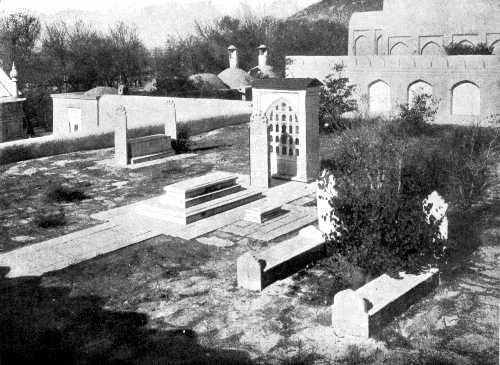
Babur’s Grave.
To face p. 445.
THE MEMOIRS OF BĀBUR