XIII. ASPECTS, CHIEFLY MILITARY, 1864-1865
Reading edition
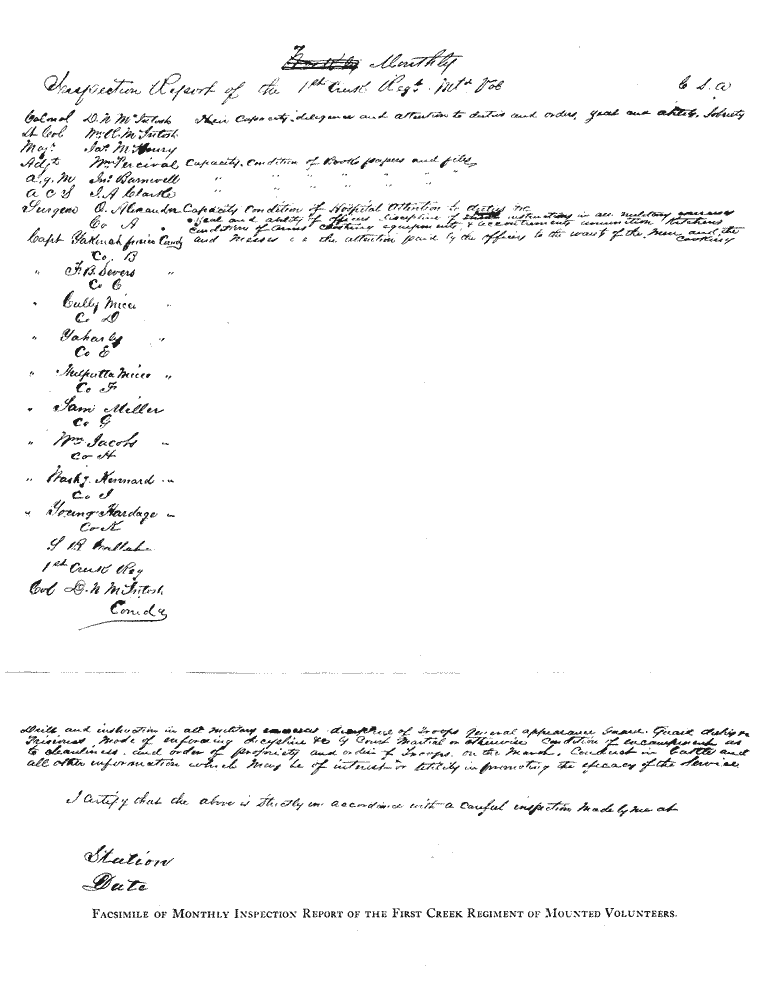
FACSIMILE OF MONTHLY INSPECTION REPORT OF THE FIRST CREEK REGIMENT OF MOUNTED VOLUNTEERS.
It seems a little strange that the Indians should so emphasize their national individualism at this particular time, inasmuch as six of them, the Choctaw, Chickasaw, Cherokee, Creek, Seminole, and Caddo, professing to be still in strict alliance with the Southern States, had formed an Indian confederacy, had collectively re-asserted their allegiance, pledged their continued support, and made reciprocal demands. All these things they had done in a joint, or general, council, which had been held at Armstrong Academy the previous November. Resolutions of the council, embodying the collective pledges and demands, were even at this very moment under consideration by President Davis and were having not a little to do with his attitude toward the whole Maxey programme.
as a separate department Indian Territory could not count upon the protection of the forces belonging to the Trans-Mississippi Department that was assured to her while she remained one of its integral parts. A distinct military district she should certainly be.
It was hoped that prospective Indian brigades would be a powerful incentive to Indian enlistment and so they proved. Moreover, much was expected in that direction from the reassembling of the general council at Armstrong Academy, and much had to be; for the times were critical. Maxey's position was not likely to be a sinecure. As a friend wrote him,
Northern Texas and the Indian Department have been neglected so long that they have become the most difficult and the most responsible commands in the Trans-Mississippi Department. I tremble for you. A great name is in store for you or you fall into the rank of failures; the latter may be your
Whereas, the final issue of the present struggle between the North and South involves the destiny of the Indian Territory alike with that of the Confederate States: Therefore,
Resolved, That we, the Cherokee Troops, C.S. Army, do
As a corollary to reorganization, the three brigade plan was now put tentatively into operation. It was, in truth, "a fine recruiting order," and Commissioner Scott, when making his annual rounds in August, was able to report to Secretary Seddon,
propaganda work he had no peer. At Fort Towson, his headquarters, he had set up a printing press, from which issued many and many a document, the purpose of each and every one the same. The following quotation from one of Maxey's letters illustrates the purpose and, at the same time, exhibits the methods and the temper of the man behind it. The matter he was discussing when writing was the Camden campaign, in connection with which, he said,
... In the address of General Smith the soldiers of Arkansas, Missouri, Texas, and Louisiana are specially named. The soldiers from this Territory bore an humbler part in the campaign, and although they did not do a great deal, yet a fair share of the killed, wounded, captured, and captured property and cannon can be credited to them. I had a number of General Smith's address struck off for circulation here, and knowing the omission would be noticed and felt, I inserted after Louisiana, "and of the Indian Territory," which I hope will not meet General Smith's disapproval.
I would suggest that want of transportation in this Territory will cripple movements very much....
During my absence General Cooper urged General McCulloch to help him in this particular; General M. replies he can do "absolutely nothing." I am not disposed to complain about anything, but I do think this thing ought to be understood and regulated. Supplies of breadstuffs and forage, as well as clothing, sugar, etc., all having to be drawn from beyond the limits of this Territory, a more than ordinary supply of transportation is necessary. To that for the troops must be added that made necessary by the destitute thrown on the hands of the Government and who must be taken care of. I do not expect General Smith to investigate and study the peculiar
characteristics of command here so closely as I have. He hasn't the time, nor is it necessary. In my opinion no effort should be spared to hold this country. Its loss would work a more permanent injury than the loss of any State in the Confederacy. States can be recovered—the Indian Territory, once gone, never. Whites, when exiled by a cruel foe, find friends amongst their race; Indians have nowhere to go. Let the enemy once occupy the country to Red River and the Indians give way to despair. I doubt whether many of the highest officials in our Government have ever closely studied this subject. It is the great barrier to the empire State of the South from her foe now and in peace. Let Federalism reach the Red River, the effects will not stop there. The doctrine of uti possidetis may yet play an important part.
supply trains were his objective, but not always. The refugees were coming back from Kansas and their new home beginnings were mercilessly preyed upon by their Confederate fellow tribesmen, who felt for the owners a vindictive hatred that knew no relenting.
Had the force at Fort Gibson been at all adequate to the needs of the country it was supposed to defend, such raids as Watie's would have been an utter impossibility. Thanks to Federal indifference and mismanagement, however, the safety of Indian Territory was
Great as Maxey's services to Indian Territory had been and yet were, he was not without his traducers and Cooper was chief among them, his overweening