← Table of contents
The American Indian as Participant in the Civil War

XI. INDIAN TERRITORY IN 1863, JANUARY TO JUNE INCLUSIVE

Reading edition
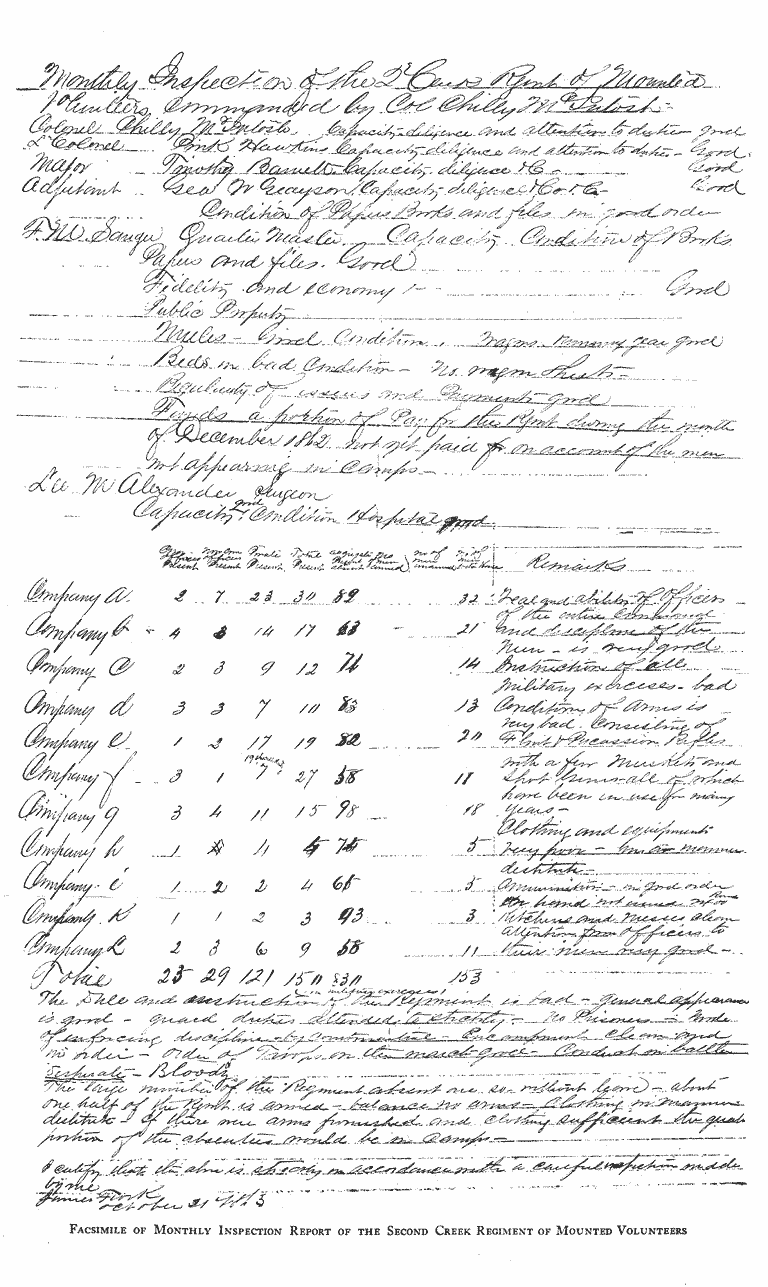
Illustration from The American Indian as Participant in the Civil War

FACSIMILE OF MONTHLY INSPECTION REPORT OF THE SECOND CREEK REGIMENT OF MOUNTED VOLUNTEERS.

Although fully realizing that it was incumbent upon him to hold Fort Smith as a sort of key to his entire command, Steele knew it would be impossible to

Indian Territory was really in a terrible condition. Late in 1862, it had been advertised even by southern men as lost to the Confederate cause and had been

The second regiment, after many vicissitudes, and after having gotten rid of its unmanageable elements, notably, the Osages and the Quapaws, had become a Cherokee and the third was largely so. That third regiment was Phillips's own and was the only one that could claim the distinction of being disciplined and even it was exposed occasionally to the chronic weakness of all Indian soldiers, absence without leave. The Indian, on his own business bent, was disposed to depart whenever he pleased, often, too, at times most inopportune, sometimes, when he had been given a special and particular task. He knew not the usages of army life and really meant no offence; but, all the same, his utter disregard of army discipline made for great disorder.

It was not the chief cause of disorder, however, for that was the unreliability of the regimental officers. The custom, from the first, had been to have the field officers white men, a saving grace; but the company officers, with few exceptions, had been Indians and totally incompetent. Strange as it may seem, drilling was almost an unknown experience to the two regiments that had been mustered in for the First Indian Expedition. To obviate some of the difficulties already encountered, Phillips had seen to it that the third regiment had profited by the mistakes of its forerunners. It had, therefore, been supplied with white first lieutenants and white sergeants, secured from among the non-commissioned men of other commands. The result had fully justified the innovation. After long and careful observation, Phillips's conclusion was that it was likely to be productive of irretrievable disaster and consequently an unpardonable error of judgment "to put men of poor ability in an Indian regiment." Primitive man has an inordinate respect for a strong

character. He appreciates integrity, though he may not have it among his own gifts of nature. "An Indian company improperly officered" will inevitably become, to somebody's discomfiture, "a frightful mess."

If any one there was so foolish as to surmise that the independent commands, northern and southern, would be given free scope to solve the problems of Indian Territory, unhampered by contingent circumstances, he was foreordained to grevious disappointment. Indian Territory had still to subserve the interests of localities, relatively more important. It would be so to the very end. In and for herself, she would never be allowed to do anything and her commanders, no matter how much they might wish it otherwise—and to their lasting honor, be it said, many of them did—would always have to subordinate her affairs to those of the sovereign states around her; for even northern states were sovereign in practice where Indians were concerned. General Steele was one of the men who endeavored nobly to take a large view of his responsibilities to Indian Territory. Colonel Phillips, his contemporary in the opposite camp, was another; but both met with insuperable obstacles. The attainment of their objects was impossible from the start. Both men were predestined to failure.

Foraging or an occasional scouting when the weather permitted was the only order of the winter days for Federals and Confederates. With the advent of spring, however, Phillips became impatient for more aggressive action. He had been given a large programme, no insignificant part of which was, the restoration of refugees to their impoverished homes; but his first business would necessarily have to be, the occupancy of the country. Not far was he allowed to venture within

it during the winter; because his superior officers wished him to protect, before anything else, western Arkansas. Schofield and, after Schofield's withdrawal from the command of southwestern Missouri, Curtis had insisted upon that, while Blunt, to whom Phillips, after a time, was made immediately accountable, was guardedly of another way of thinking and, although not very explicit, seemed to encourage Phillips in planning an advance.

The Cherokee Council assembled without the preliminary formality of a new election. War conditions

The legislative work of the Cherokee Council, partisan body that it was, with Lewis Downing as its presiding officer and Thomas Pegg as acting Principal Chief, was reactionary, yet epochal. It comprised several measures and three of transcendant importance, passed between the eighteenth and the twenty-first:

1. An act revoking the alliance with the Confederate States and re-asserting allegiance to the United States.

2. An act deposing all officers of any rank or character whatsoever, inclusive of legislative, executive, judicial, who were serving in capacities disloyal to the United States and to the Cherokee Nation.

His Indian soldiers loved him. They believed in him. He was able to accomplish wonders in training them. He looked after their welfare and he did his best to make the government and its agents of the Indian Office keep faith with the refugees. Quite strenuously, too, he advocated further enlistments from among the Indians, especially from among those yet in Indian Territory. If the United States did not take care, the Confederates would successfully conscript where the Federals might easily recruit. In this matter as in many another, he had Blunt's unwavering support; for Blunt wanted the officers of the embryo fourth and fifth regiments to secure their commands. Blunt's military district was none too full of men.

March was then as now the planting season in the Arkansas Valley and, as Phillips rightly argued, if the indigent Indians were not to be completely pauperized, they ought to be given an opportunity to be thrown once more upon their own resources, to be returned home in time to put in crops. When the high waters subsided and the rivers became fordable, he grew more insistent. There was grass in the valley of the Arkansas and soon the Confederates would be seizing the stock that it was supporting. He had held the line of the Arkansas by means of scouts all winter, but scouting would not be adequate much longer. The Confederates were beginning, in imitation of the Federals, to attach indigents to their cause by means of relief distribution and the "cropping season was wearing on."

At the end of March, some rather unimportant changes were made by Curtis in the district limits of his department and coincidently Phillips moved over the border. The first of April his camp was at Park Hill. His great desire was to seize Fort Smith; for he

realized that not much recruiting could be done among the Choctaws while that post remained in Confederate hands. Blunt advised caution. It would not even do to attempt as yet any permanent occupation south of the Arkansas. Dashes at the enemy might be made, of course, but nothing more; for at any moment those higher up might order a retrograde movement and anyhow no additional support could be counted upon. Halleck was still calling for men to go to Grant's assistance and accusing Curtis of keeping too many needlessly in the West. The Vicksburg campaign was on.

wonder, whether in joining the Confederacy, they had not made a terrible mistake, a miscalculation beyond all remedying.

To the Confederates, tragically enough, the Indian's tale of woe and of regret had a different meaning. The

ordinarily not strictly within the range of military cognizance.

Just and generous as General Steele endeavored to

be in the matter of attention to Indian necessities, his efforts were unappreciated largely because of evil influences at work to undermine him and to advance Douglas H. Cooper. Steele had his points of vulnerability, his inability to check the Federal advance and his remoteness from the scene of action, his headquarters being at Fort Smith. Connected with the second point and charged against him were all the bad practices of those men who, in their political or military control of Indian Territory, had allowed Arkansas to be their chief concern. Such practices became the foundation stone of a general Indian dissatisfaction and, concomitantry, Douglas H. Cooper, of insatiable ambition, posed as the exponent of the idea that the safety of Indian Territory was an end in itself.

be allowed to settle, on equal terms with the Cherokees, within the Cherokee country. The proposal, as construed by Taylor and his party, was nothing more or less than a suggestion that the Cherokees surrender their nationality, their political integrity, the one thing above everything else that they had sought to preserve when they entered into an active alliance with the Confederate States. So sordid was the bargain proposed, so unequal, that the thought obtrudes itself that a base advantage was about to be taken of the Cherokee necessities and that the objectors were justified in insinuating that Boudinot and his political friends were to be the chief beneficiaries. The Cherokee country was already practically lost to the Confederacy. Might it not be advisable to distribute the tribal lands, secure individual holdings, while vested rights might still accrue; for, should bad come to worse, private parties could with more chance of success prosecute a claim than could a commonalty, which in its national or corporate capacity had committed treason and thereby forfeited its rights. One part of the Cherokee protest merits quotation here. Its noble indignation ought to have been proof enough for anybody.

... We were present when the treaty was made, were a party to it, and rejoiced when it was done. In that treaty our rights to our country as a Nation were guaranteed to us forever, and the Confederate States promised to protect us in them. We enlisted under the banner of those States, and have fought in defense of our country under that treaty and for the rights of the South for nearly two years. We have been driven from our homes, and suffered severe hardships, privations, and losses, and now we are informed, when brighter prospects are before us, that you think it best for us to give part of our lands to our white friends; that, to defend our country and keep troops for our protection, we must raise and enlist them from

our own territory, and that it is actually necessary that they are citizens of our country to enable us to keep them with us. To do this would be the end of our national existence and the ruin of our people. Two things above all others we hold most dear, our nationality and the welfare of our people. Had the war been our own, there would have been justice in the proposition, but it is that of another nation. We are allies, assisting in establishing the rights and independence of another nation. We, therefore, in justice to ourselves and our people, cannot agree to give a part of our domain as an inducement to citizens of another Government to fight their own battles and for their own country; besides, it would open a door to admit as citizens of our Nation the worst class of citizens of the Confederate States ...

Notes in this chapter

Note 1 · Footnote 696: (return) It might as well be said, at the outset, that Cooper was not the ranking officer of Steele. He claimed that he was [ONote 2 · Footnote 697: (return) —Ibid., part i, 28; part ii, 862, 883, 909.Note 3 · Footnote 698: (return) Confederate Records, chap. 2, no. 270, pp. 29-30.Note 4 · Footnote 699: (return) Official Records, vol. xxii, part ii, 895, 909.Note 5 · Footnote 700: (return) —Ibid., part i, 30.Note 6 · Footnote 701: (return) Confederate Records, chap. 2, no. 270, p. 31.Note 7 · Footnote 702: (return) Official Records, vol. xiii, 51.Note 8 · ambition, consequently friction developed between him and his rival highly detrimental to the service to which each owed his best thought, hNote 9 · Conditions in Indian Territory, at the time Steele took command, were conceivably the worst that could by any possibility be imagined. The lNote 10 · Footnote 703: (return) Official Records, vol. xxii, part i, 30.Note 11 · Footnote 704: (return) Perhaps the word, army, is inapplicable here. Steele himself was in doubt as to whether he was in command of an army Note 12 · Footnote 705: (return) Confederate Records, chap. 2, no. 270, p. 36. See also, Steele to Anderson, January 22, 1863 [ibid., 50-51], which beNote 13 · Footnote 706: (return) Crosby's telegram, February first, to the Chief of Ordnance is sufficient attestation, "Many of Cooper's men have infNote 14 · Footnote 707: (return) The detention and the misapplication of funds by William Quesenbury seem to have been largely responsible for Steele'Note 15 · Footnote 708: (return) Official Records, vol. xxii, part ii, 6.Note 16 · maintain any considerable force there. He, therefore, resolved to take big chances and to attempt to hold it with as few men as his commissaNote 17 · The opening of 1863 saw changes, equally momentous, in Federal commands. Somewhat captiously, General Schofield discounted recent achievemenNote 18 · Footnote 709: (return) It seems unnecessary and inappropriate to drag into the present narrative the political squabbles that disgraced MissNote 19 · Footnote 710: (return) Yet both Blunt and Herron were, at this very time, in line for promotion, as was Schofield, to the rank of major-geneNote 20 · Footnote 711: (return) —Ibid., 6, 12, 95; Confederate Military History, vol. x, 195.Note 21 · Footnote 712: (return) —Ibid., 22.Note 22 · Footnote 713: (return) Britton, Civil War on the Border vol. ii, 18-19.Note 23 · conflict of interests.709 So petty was Schofield and so much in a mood for disparagement that he went the length of condemning the work of BNote 24 · In some respects, the reorganization decided upon by Schofield proved a consummation devoutly to be wished; for, within the reconstituted FiNote 25 · Footnote 714: (return) It is not very clear whether or not the constituents of the Indian Brigade were all at once decided upon. They are liNote 26 · Footnote 715: (return) —Ibid., 33.Note 27 · Footnote 716: (return) On the subject of the reduction of Schofield's command, see ibid., 40.Note 28 · Footnote 717: (return) Curtis to Phillips, February 17, 1863, ibid., 113-114.Note 29 · Fort Wayne,714 was almost immediately detached from the rest of Schofield's First Division and assigned to discretionary "service in the IndNote 30 · Indian Territory as a separate military entity came altogether too late into the reckonings of the North and the South. It was now a devastaNote 31 · Footnote 718: (return) Official Records, vol. xxii, part ii, 49.Note 32 · Footnote 719: (return) Confederate Military History, vol. x, 161, 162.Note 33 · Footnote 720: (return) Official Records, vol. xxii, part ii, 56-58.Note 34 · practically abandoned to the jayhawker. Scouting parties of both armies, as well as guerrillas, had preyed upon it like vultures. Indians, oNote 35 · The winter of 1862-1863 was a severe one. Its coming had been long deferred; but, by the middle of January, the cold weather had set in in rNote 36 · The Indian regiments of Phillips's brigade were soon reported720 upon by him and declared to be in a sad state. The first regiment was stillNote 37 · Footnote 721: (return) Official Records, vol. xxii, part ii, 61-62.Note 38 · Phillips's inability to progress far in the matter of occupancy of Indian Territory did not preclude his keeping a close tab on Indian affaiNote 39 · Footnote 722: (return) This remark would be especially applicable if the Colonel McIntosh, mentioned by Phillips, was Chilly, the son of WilNote 40 · Footnote 723: (return) Official Records, vol. xxii, part ii, 100.Note 41 · Footnote 724: (return) —Ibid., 85.Note 42 · Footnote 725: (return) —Ibid., 96-97.Note 43 · Footnote 726: (return) —Ibid., 100, 108.Note 44 · Territory; but the seed of treason had been sown and sown in fertile soil, in the heart of a McIntosh.722Note 45 · In January, 1863, Phillips took up again the self-imposed task of emissary.723 The unionist Cherokees, inclusive of those in the Indian BrigNote 46 · Footnote 727: (return) Official Records, vol. xxii, part ii, 101.Note 47 · Footnote 728: (return) —Ibid., 111-112.Note 48 · Footnote 729: (return) —Ibid., 115.Note 49 · had made regular pollings impossible. Consequently, the council that convened in February, 1863 was, to all intents and purposes, the selfsaNote 50 · Footnote 730: (return) Ross to Dole, April 2, 1863 [Indian Office General Files, Cherokee, 1859-1865, R 87]; Commissioner of Indian Affairs,Note 51 · Footnote 731: (return) Britton [Civil War on the Border, vol. ii, 27 conveys the idea that, while Phillips, truly enough, wished to enter thNote 52 · 3. An act emancipating slaves throughout the Cherokee country.730Note 53 · His detention in Arkansas was not at all to Phillips's liking. It tried his patience sorely; for he felt the crying need of Indian TerritoryNote 54 · Footnote 732: (return) Confederate Military History, vol. x, 166-168.Note 55 · The order that Blunt anticipated finally came and Curtis called for Phillips to return. La Rue Harrison, foraging in Arkansas,732 was whininNote 56 · Footnote 733: (return) Britton, Civil War on the Border, vol. ii, 26.Note 57 · Footnote 734: (return) A change had been resolved upon in March, E.V. Sumner being the man chosen; but he died on the way out [Livermore, StNote 58 · trains. Guerrillas and bushwhackers were everywhere and Phillips's command was half-starved. Smallpox733 broke out and, as the men became moNote 59 · As May advanced, the political situation in Missouri seemed to call loudly for a change in department commanders and President Lincoln, quitNote 60 · Footnote 735: (return) June 9, orders issued redistricting Schofield's Department of Missouri [Official Records, vol. xxii, part ii, 315].Note 61 · Footnote 736: (return) Confederate Records, chap. 2, no. 270, p. 34.Note 62 · Footnote 737: (return) Steele to Blair, February 10, 1863, ibid., 87-88.Note 63 · Footnote 738: (return) Steele to Anderson, February 8, 1863, ibid., 81-82.Note 64 · Footnote 739: (return) Duval to Cabell, May 15, 1863, ibid., 244-245.Note 65 · Footnote 740: (return) Steele to Cabell, March 19, 1863, ibid., 148.Note 66 · Footnote 741: (return) Steele to Anderson, March 22, 1863, ibid., 158.Note 67 · The inevitable clash between Schofield and Blunt was not long deferred. It came over a trifling matter but was fraught with larger meanings.Note 68 · The difficulties besetting Colonel Phillips were more than matched by those besetting General Steele. He, too, struggled on unaided, nay, moNote 69 · Footnote 742: (return) Steele to Anderson, April 3, 1863, Confederate Records, 179-180.Note 70 · Footnote 743: (return) For instance the officers of the First Cherokee regiment had a serious dispute as to the ranking authority among themNote 71 · nearly empty.742 It was not possible for him to furnish corn for seed or, finally, the necessaries of life to indigent Indians. Indian affaiNote 72 · Footnote 744: (return) "Your letter of May 6th, with letter of Black Dog enclosed, has been received and the enclosure forwarded to Lieut. GNote 73 · instructions from Richmond so he dealt with the natives as best he could.744 Small-pox became epidemic Footnote 743: (return) (cont.) No BoaNote 74 · Footnote 745: (return) Confederate Records, chap. 2, no. 270, p. 220.Note 75 · Footnote 746: (return) Steele to Anderson, May 9, 1863, ibid., 233-234.Note 76 · Footnote 747: (return) Same to same, March 1, and 3, 1863, ibid., 112-113, 113-114.Note 77 · among his men,745 as among Phillips's—and from like causes.Note 78 · Then General Steele had difficulty in getting his men and the right kind of men together. Lawless Arkansans were unduly desirous of joining Note 79 · Footnote 748: (return) Steele to Anderson, February 13, 1863, Confederate Records, chap 2, no. 270, p. 89.Note 80 · Footnote 749: (return) It was not true, apparently, that the Chickasaws were dissatisfied with Cooper. See the evidence furnished by themselNote 81 · Footnote 750: (return) Confederate Military History, vol. x, 134, footnote.Note 82 · Footnote 751: (return) Steele to Tandy Walker, February 25, 1863, Confederate Records, chap. 2; no. 270, p. 109.Note 83 · Footnote 752: (return) Crosby to Walker, March 11, 1863, ibid., p. 136. Steele thought that the Indians might as well be employed in a militNote 84 · out of odd battalions and independent companies.748 Cooper, in fact, seemed bent upon tantalizing Steele and many of the Indians were behindNote 85 · Footnote 753: (return) Steele thought it desirable to arrest all men, at large, who were subject to military duty under the conscript act, uNote 86 · Furloughs and desertions were the bane of Steele's existence.753 In these respects Alexander's brigade, Footnote 752: (return) (cont.) additNote 87 · Footnote 754: (return) Official Records, vol. xxii, part ii, p. 62.Note 88 · Footnote 755: (return) For correspondence with Alexander objecting to further furloughing and urging the need of promptness, see ConfederateNote 89 · Footnote 756: (return) The following are illustrations: "... Every exertion is being made and the Gen'l feels confident that the means will Note 90 · within which Colonel Phillips had detected traitors to the Confederate cause,754 was, perhaps, the most incorrigible.755 From department heaNote 91 · Footnote 757: (return) J.A. Scales to Adair, April 12, 1863, Official Records, vol. xxii, part ii, 821-822.Note 92 · Footnote 758: (return) Confederate Records, chap. 2, no. 270, p. 224.Note 93 · Footnote 759: (return) Holmes, as early as March, warned Steele that he would have to get his supplies soon from Texas. It would not be possNote 94 · without telling or lasting effect. The Confederate service in Indian Territory was honeycombed with fraud and corruption.757 Wastrels, despeNote 95 · Footnote 760: (return) Steele to Alexander, April 23, 1863, Confederate Records, no. 270, pp. 210-211.Note 96 · Footnote 761: (return) Duval to Colonel John King, June 30, 1863, ibid., no. 268, p. 110.Note 97 · Footnote 762: (return) Livermore, Story of the Civil War, part iii, book i, p. 255.Note 98 · Footnote 763: (return) Davis to Holmes, February 26, 1863, Official Records, vol. liii, supplement, 849-850.Note 99 · Footnote 764: (return) Davis to Holmes, January 28, 1863, ibid., 846-847.Note 100 · Footnote 765: (return) The necessity was exceedingly great. Take, for instance, the situation at Fort Smith, where the citizens themselves aNote 101 · Steele in despair cried out, "... it does appear as if the Texas troops on this frontier were determined to tarnish the proud fame that TexaNote 102 · The Trans-Mississippi departmental change, effected in January, was of short duration, so short that it could never surely have been intendeNote 103 · Footnote 766: (return) Davis to Garland, March 28, 1863, Official Records, vol. liii, supplement, 861-863; Davis to the Arkansas delegation,Note 104 · Footnote 767: (return) Hindman was not immediately recalled; but he soon manifested an unwillingness to continue under Holmes [ibid., 848]. Note 105 · Footnote 768: (return) Livermore, Story of the Civil War, part iii, book i, 85. Davis would fain have believed that so great a disaster had Note 106 · Footnote 769: (return) Perhaps, it is scarcely fair to intimate that the Trans-Mississippi Department was regarded as unimportant at this stNote 107 · Footnote 770: (return) Steele to Cabell, April 18, 1863, Confederate Records, no. 270, p. 199.Note 108 · political pressure was exerted in Richmond766 and the Arkansas delegation in Congress demanded Hindman's recall,767 Holmes's displacement, aNote 109 · Steele divined that the Federals would naturally make an early attempt to occupy in force the country north of the Arkansas River and beyondNote 110 · Footnote 771: (return) "You will order Colonel Stand Watie to move his command down the Ark. River to some point in the vicinity of Fort SmiNote 111 · Footnote 772: (return) Britton, Civil War on the Border, vol. ii, 37.Note 112 · Footnote 773: (return) Phillips to Curtis, April 26, 1863, Official Records, vol. xxii, part i, 314-315; Britton, Civil War on the Border, vNote 113 · Footnote 774: (return) "I am directed by the General Com'dg to say that he deems it advisable that you should move your Hd. Qrs. higher up tNote 114 · Footnote 775: (return) Britton, Civil War on the Border, vol. ii, 42.Note 115 · Footnote 776: (return) —Ibid., vol. ii, chapters vi and vii.Note 116 · Footnote 777: (return) Official Records, vol. liii, supplement, 469.Note 117 · Footnote 778: (return) —Ibid., vol. xxii, part i, 337-338; Confederate Records, chap. 2, no. 268, p. 34.Note 118 · brought up betimes within convenient distance of Fort Smith771 and with whom, in April, Phillips's men had two successful encounters, on theNote 119 · Through May and June, engagements, petty in themselves but contributing each its mite to ultimate success or failure, occupied detachments oNote 120 · Footnote 779: (return) Anderson, 20-21. Interestingly enough, about this time Cooper reported that he could get plenty of beef where he was Note 121 · Footnote 780: (return) Official Records, vol. xxii, part i, 348-352.Note 122 · Footnote 781: (return) Not all got their impetus there. The following letter although not sent, contains internal evidence that Cooper was cNote 123 · Footnote 782: (return) The following letter shows the nature of the Creek disaffection: DEAR GREAT FATHER: Sir, The wicked rebellion in the Note 124 · series and were nothing but fruitless demonstrations to seize the Federal grazing herds. A brilliant cavalry raid, undertaken by Stand WatieNote 125 · The refusal of the Creeks to charge was not, however, indicative of any widespread disaffection.782 SoNote 126 · Footnote 783: (return) Britton's account of the return of the Cherokee exiles is recommended for perusal. It could scarcely be excelled. SeeNote 127 · Footnote 784: (return) Certain proceedings of Carruth and Martin would seem to suggest that they were endeavoring to reap the reward of PhilNote 128 · honorably had Phillips been conducting himself with reference to Indian affairs, so promptly and generously had he discharged his obligationNote 129 · Footnote 785: (return) Without legislating on the subject, and without intending it, the Confederacy had virtually put into effect, a recommNote 130 · tale had been told many times of late and every time with a new emphasis upon that part of it that recounted delusion and betrayal. For quitNote 131 · Footnote 786: (return) Steele to Wigfall, April 15, 1863, Official Records, vol. xxii, part ii, 820.Note 132 · Footnote 787: (return) Steele's letter books furnish much evidence on this score. A large portion has been published in the Official RecordsNote 133 · Footnote 788: (return) "Enclosed please find a letter to Col. Adair, and a note from him forwarding it. I send it for the consideration of GNote 134 · General Steele, like many another, was inclined to think that the red men greatly over-estimated their own importance; for they failed to "sNote 135 · But it was a buffer, throbbing with life, and that was something Steele dared not ignore and could not if he would. With such a consciousnesNote 136 · Footnote 789: (return) The letter to Colonel W.P. Adair, written by one of his adjutants, J.A. Scales, April 12, 1863 [ibid., 821-822], is aNote 137 · Footnote 790: (return) Steele here presents certain phases of the embarrassment, "... The matter of feeding destitute Indians has been all tNote 138 · grievance789 against the Confederacy in their hearts. Protection against the oncoming enemy and relief from want were the things the IndiansNote 139 · Footnote 791: (return) Mory Kanard and Echo Harjo to President Davis, May 18, 1863, Official Records, vol. xxii, part ii, 1118-1119.Note 140 · Footnote 792: (return) Davis, in his message of January 12, 1863 [Richardson, Messages and Papers of the Confederacy, vol. i, 295] had reveaNote 141 · The kind of separate military organization that constituted Steele's command was not enough for the Indians. Seemingly, they desired the resNote 142 · Footnote 793: (return) June 6, 1863, Official Records, vol. xxii, part ii, 1120.Note 143 · Footnote 794: (return) June 24, 1863, ibid., 1122-1123.Note 144 · Footnote 795: (return) Steele's letter to Kirby Smith, June 24, 1863 [ibid., 883-884], gives some hint of its nature also.Note 145 · Footnote 796: (return) —Ibid., 1120-1122.Note 146 · boldly said that their country had "been treated as a mere appendage of Arkansas, where needy politicians and protégés of Arkansas members oNote 147 · The Cherokee complaint took the form of a deliberate charge of contemplated bad faith on the part of the Confederate government. E.C. BoudinNote 148 · Footnote 784: (return) (cont.) sold by a settler to the contractor and fed to the Indians. Jim Ned's band of wild Delawares, returning from Note 149 · Footnote 788: (return) (cont.) subject is one of grave importance. If a regiment of infantry could be spared to take post at this place and
Explore with AITake your curiosity a little further.

Reading settings