II. LANE'S BRIGADE AND THE INCEPTION OF THE INDIAN
Reading edition
mysterious influence with the temperate, humane, just, and so very much more magnanimous Lincoln, who, in the first days of the war, as in the later and the last, had his hours of discouragement and deep depression. For dejection of any sort, the wild excitement and boundless confidence of a zealot like Lane must have been somewhat of an antidote, also a stimulant.
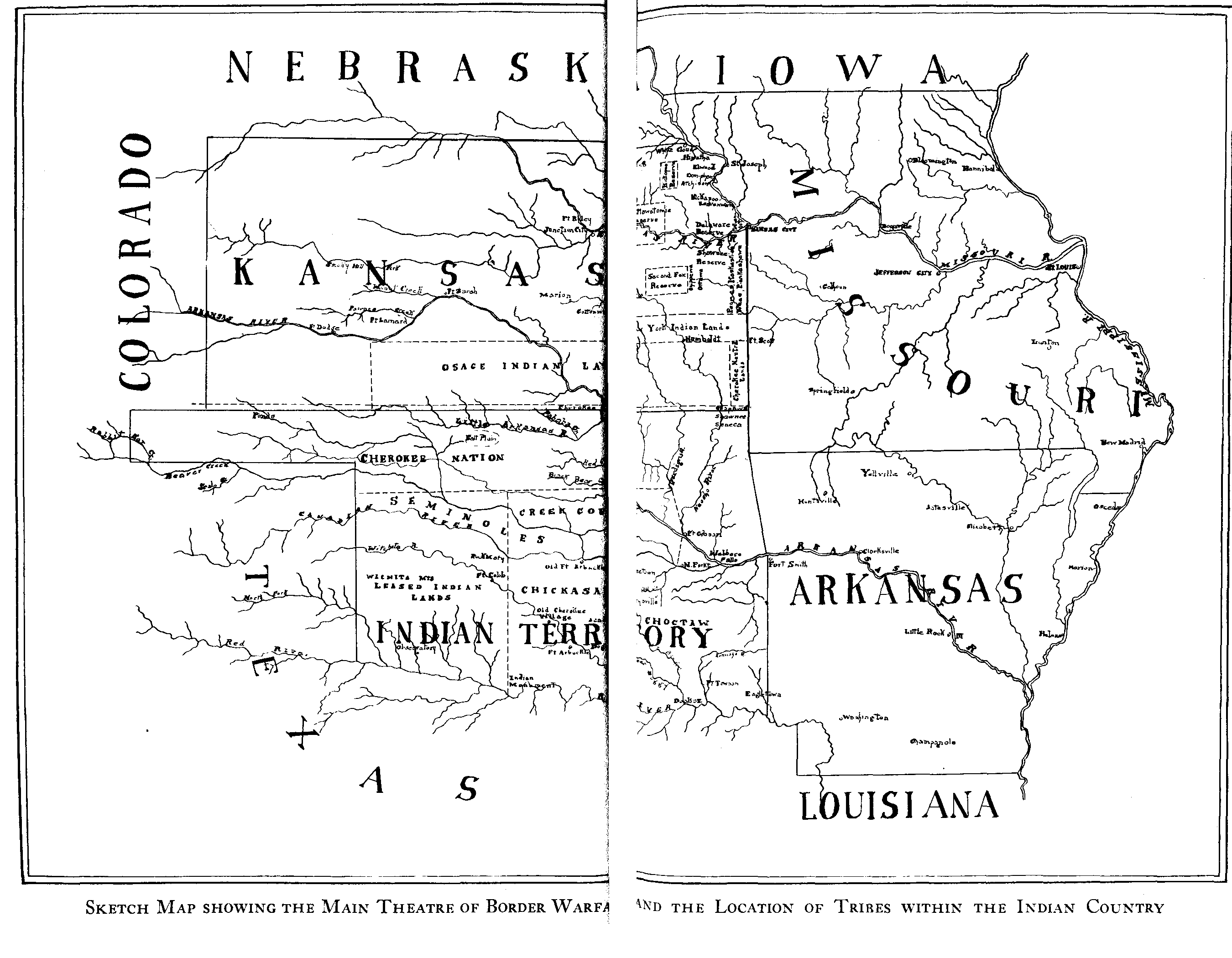
SKETCH MAP SHOWING THE MAIN THEATRE OF BORDER WARFARE AND THE LOCATION OF TRIBES WITHIN THE INDIAN COUNTRY
The same indifference towards the West that characterized the governing authorities in the South was exhibited by eastern men in the North and, correspondingly, the West, Federal and Confederate, was unduly sensitive to the indifference, perhaps, also, a trifle unnecessarily alarmed by symptoms of its own danger. Nevertheless, its danger was real. Each state gave in its adherence to the Confederacy separately and, therefore, every single state in the slavery belt had a problem to solve. The fight for Missouri was fought
on the border and nowhere else. The great evil of squatter sovereignty days was now epidemic in its most malignant form. Those days had bred intense hatred between Missourian and Kansan and had developed a disregard of the value of human life and a ruthlessness and brutality in fighting, concomitant with it, that the East, in its most primitive times, had never been called upon to experience. Granted that the spirit of the crusader had inspired many a free-soiler to venture into the trans-Missouri region after the Kansas-Nebraska bill had become law and that real exaltation of soul had transformed some very mercenary and altogether mundane characters unexpectedly into martyrs; granted, also, that the pro-slavery man honestly felt that his cause was just and that his sacred rights of property, under the constitution, were being violated, his preserves encroached upon, it yet remains true that great crimes were committed in the name of great causes and that villains stalked where only saints should have trod. The irregular warfare of the border, from fifty-four on, while it may, to military history as a whole, be as unimportant as the quarrels of kites and crows, was yet a big part of the life of the frontiersman and frightful in its possibilities. Sherman's march to the sea or through the Carolinas, disgraceful to modern civilization as each undeniably was, lacked the sickening phase, guerrilla atrocities, that made the Civil War in the West, to those at least who were in line to experience it at close range, an awful nightmare. Union and Confederate soldiers might well fraternize in eastern camps because there they so rarely had any cause for personal hostility towards each other, but not in western. The fight on the border was constant and to the death.
The leaders in the West or many of them, on both sides, were men of ungovernable tempers, of violent and unrestrained passions, sometimes of distressingly base proclivities, although, in the matter of both vices and virtues, there was considerable difference of degree among them. Lane and Shelby and Montgomery and Quantrill were hardly types, rather should it be said they were extreme cases. They seem never to have taken chances on each other's inactivity. Their motto invariably was, to be prepared for the worst, and their practice, retaliation.
tribe, the Osages were not very dependable at the best of times and now that they saw confusion all around
The disaster in its effect upon Lane was, however, little short of exhilarating. It brought him sympathy, understanding, and a fair measure of support from people who, not until the eleventh hour, had really comprehended their own danger and it inspired him to redouble his efforts to organize a brigade that should
As soon as Lane had definite knowledge that Price had turned away from the border and was moving northward, he determined to follow after and attack
Feeling between Robinson and Lane became exceedingly tense in October. Price was again moving
Lane's efforts towards securing Indian enlistment did not stop with soliciting the Kansas tribes. Thoroughly aware, since the time of his sojourn at Fort Scott, if not before, of the delicate situation in Indian Territory, of the divided allegiance there, and of the despairing cry for help that had gone forth from the Union element to Washington, he conceived it eminently fitting and practicable that that same Union element should have its loyalty put to good uses and be itself induced to take up arms in behalf of the cause it affected so ardently to endorse. To an ex-teacher among the Seminoles, E.H. Carruth, was entrusted the task of recruiting.
The situation in Indian Territory was more than
Boastful words those were and not to be made good until many precious months had elapsed and many sad regrettable scenes enacted. In early November occurred the reorganization of the Department of the West which meant the formation of a Department of Kansas separate and distinct from a Department of Missouri, an arrangement that afforded ample opportunity for a closer attention to local exigencies in both states than had heretofore been possible or than, upon trial, was subsequently to be deemed altogether desirable. It necessarily increased the chances for local patronage and exposed military matters to the grave danger of becoming hopelessly entangled with political.
for the Federal government to do something to attest its own competency. There was need for it to do that,
moreover, on recognizably loyal ground, causes for dissatisfaction among Kansas emigrant tribes to be
removed and drastic measures taken with the indigenous of the plains.
The appointment of Hunter to the command of the
Department of Kansas was open to certain objections, no doubt; but, to Lane, whose forceful personality had
impressed itself, for good or ill, upon the trans-Missouri region, it was, to say the least, somewhat
disconcerting, not because Lane was hostile to Hunter personally—the two men had long had a friendly acquaintance
The need for sending relief to the southern Indians, which, correctly interpreted meant, of course, reasserting authority over them and thus removing a menacing and impending danger from the Kansas border, had been one of Lane's strongest arguments in gaining his way with the administration. The larger aspect of his purpose was, however, the one that appealed to Commissioner Dole, who, as head of the Indian Bureau, seems fully to have appreciated the responsibility that
legitimately resented executive interference with his rights. His protest had its effect and he was informed that it was entirely within his prerogative to lead the expedition southward himself. He resolved to do it. Lane was, for once, outwitted.