← Table of contents
The American Indian as Participant in the Civil War

IV. THE ORGANIZATION OF THE FIRST INDIAN EXPEDITION

Reading edition

Among the manifold requests put forward by the refugees, none was so insistent, none so dolefully sincere, as the one for means to return home. It is a mistake to suppose that the Indian, traditionally laconic and stoical, is without family affection and without that noblest of human sentiments, love of country. The United States government has, indeed, proceeded upon the supposition that he is destitute of emotions, natural to his more highly civilized white brother, but its files are full to overflowing with evidences to the contrary. Everywhere among them the investigator finds the exile's lament. The red man has been banished so often from familiar and greatly loved scenes that it is a wonder he has taken root anywhere and yet he has. Attachment to the places where the bones of his people lie is with him the most constant of experiences and his cry for those same sacred places is all the stronger and the more sorrowful because it has been persistently ignored by the white man.
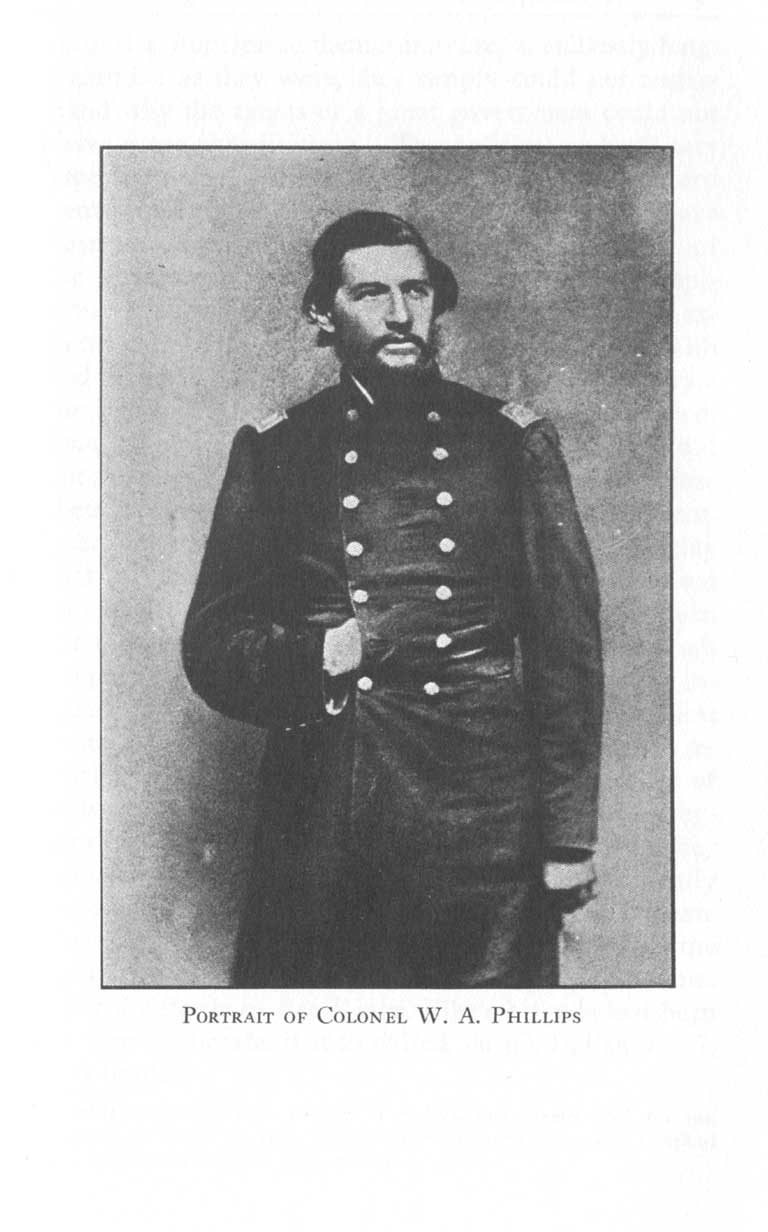
Illustration from The American Indian as Participant in the Civil War

PORTRAIT OF COLONEL W.A. PHILLIPS

seemed so hopeless to them miserable, so endlessly long. Primitive as they were, they simply could not understand why the agents of a great government could not move more expeditiously. The political and military aspects of the undertaking, involved in their return home, were unknown to them and, if known, would have been uncomprehended. Then, too, the vacillation of the government puzzled them. They became suspicious; for they had become acquainted, through the experience of long years, with the white man's bad faith and they had nothing to go upon that would counteract the influence of earlier distrust. And so it happened, that, as the weary days passed and Lane's brigade did not materialize, every grievance that loomed up before them took the shape of a disappointed longing for home.

Procure an order from the War Department detailing two Regiment of Volunteers from Kansas to go with the Indians to their homes and to remain there for their protection as long (as) may be necessary, also to furnish two thousand stand of arms and ammunition to be placed in the hands of the loyal Indians.

WAR DEPARTMENT,

WASHINGTON CITY, D. C, March 19, 1862. MAJ. GEN.H.W. HALLECK,

Commanding the Department of Mississippi:

General: It is the desire of the President, on the application of the Secretary of the Interior and the Commissioner of Indian Affairs, that you should detail two regiments to act in the Indian country, with a view to open the way for the friendly Indians who are now refugees in Southern Kansas to return to their homes and to protect them there. Five thousand friendly Indians will also be armed to aid in their own protection, and you will please furnish them with necessary subsistence.

Please report your action in the premises to this Department. Prompt action is necessary.

By order of the Secretary of War:

energy, not to mention money, had already been expended upon it.

General Orders, HDQRS. DEPARTMENT OF KANSAS, No. 2. Fort Leavenworth, Kans., May 5, 1862.

I. General Orders, No. 8, dated Headquarters District of Kansas, April 25, 1862, is hereby rescinded.

II. The instructions issued by the Department at Washington to the colonels of the two Indian regiments ordered to be raised will be fully carried out, and the regiments will be raised with all possible speed.

Disclaiming any idea of violating "Regulations" by an "Official Report" to you, permit me to communicate certain facts extremely embarrassing, which surround the Indian Expedition.

In compliance with your order of Ap'l 5th. I reported myself "forthwith" to the U.S. mustering officer at Ft. Leavenworth and was "mustered into the service" on the 18th. of April. I "awaited the orders from Genl Halleck" as directed but rec'd none. On the 20th. Ap'l I rec'd detailed

I have ordered Lieutenant-colonel Jumper with his Seminoles to march to and take Fort Larned, on the Pawnee Fork of the Arkansas, where are considerable stores and a little garrison. He will go as soon as their annuity is paid.

The Creeks under Colonel McIntosh are about to make an extended scout westward. Stand Watie, with his Cherokees, scouts along the whole northern line of the Cherokee country from Grand Saline to Marysville, and sends me information continually of every movement of the enemy in Kansas and Southwestern Missouri.

The Comanches, Kiowas, and Reserve Indians are all peaceable and quiet. Some 2,000 of the former are encamped about three days' ride from Fort Cobb, and some of them come in at intervals to procure provisions. They have sent to me to know

if they can be allowed to send a strong party and capture any trains on their way from Kansas to New Mexico, to which I have no objection. To go on the war-path somewhere else is the best way to keep them from troubling Texas ...

completion of the first regiment gave little concern. It was composed of Creeks and Seminoles, eight companies of the former and two of the latter. The second regiment was miscellaneous in its composition and took longer to

once they should be back in their own country. They begged that some assurance be given them of continued protection against the foe and in their legal rights. And, in the days of making preparations, they asked again and again for tangible evidence that white troops were really going to support them in the journey southward.

Weer to supersede him and for his own assignment to the Second Brigade of the expedition.

Notes in this chapter

Note 1 · Footnote 193: (return) And yet they did have their amusements. Their days of exile were not filled altogether with bitterness. Coffin, in a Note 2 · The southern Indians had not been so very many years in the Indian Territory, most of them not more than the span of one generation, but IndNote 3 · Footnote 194: (return) On their division into tribal encampments, see Kile to Dole, April 10, 1862 [Indian Office General Files, Southern SuNote 4 · Footnote 195: (return) They had their interview with Lane at the Planters' House while they were awaiting the arrival of Dole. Opoeth-le-yo-Note 5 · all the ills of the flesh would disappear and lost friends be recovered. The exodus had separated them cruelly from each other. There were fNote 6 · When Dole arrived at Leavenworth the latter part of January, representatives of the loyal Indians interviewed him and received assurances, hNote 7 · Footnote 196: (return) In addition to those referred to in documents already cited, the one, projected by Coffin's son and a Captain Brooks,Note 8 · So poignant was their grief at the continued delay that they despaired of ever getting the help promised and began to consider how they coulNote 9 · Footnote 197: (return) Halleck, however, had not desired the inclusion of Kansas in the contemplated new department because he thought that Note 10 · Footnote 198: (return) Official Records, vol. viii, 615-617.Note 11 · Footnote 199: (return) Thayer, Life and Letters of John Hay, vol. i, 127-128.Note 12 · Footnote 200: (return) Badeau, Military History of U.S. Grant, vol. i, 53, footnote.Note 13 · Closely following upon the Federal success of March 6 to 8, came numerous changes and readjustments in the Missouri-Kansas commands; but theNote 14 · Footnote 201: (return) Halleck to Stanton, March 28, 1862, Official Records, vol. viii, 647-648.Note 15 · Footnote 202: (return) —Ibid., 612Note 16 · Footnote 203: (return) —Ibid., 832.Note 17 · Footnote 204: (return) Those troops, about five thousand, were left under the command of George W. Deitzler, colonel of the First Kansas (ibNote 18 · Footnote 205: (return) Stanton to Halleck, March 26, 1862 [Official Records, vol. liii, supplement, 516].Note 19 · Halleck's plans for remodeling the constituent elements of his department were made with a thorough comprehension of the difficulties confroNote 20 · Footnote 206: (return) Lincoln to Halleck, March 21, 1862, Official Records, vol. liii, supplement, 516.Note 21 · Footnote 207: (return) Halleck to Stanton, March 26, 1862, ibid.Note 22 · Footnote 208: (return) "Deprecated" is, perhaps, too mild a word to describe Stanton's feeling in the matter. Adjutant-general Hitchcock is Note 23 · Footnote 209: (return) —Ibid., vol. liii, supplement, 519.Note 24 · Footnote 210: (return) —Ibid., vol. viii, 647-648.Note 25 · Footnote 211: (return) —Ibid., vol. liii, supplement, 519.Note 26 · Footnote 212: (return) Concerning the work, mapped out for Denver, see Halleck to Sturgis, April 6, 1862 [Official Records, vol. viii, 668] Note 27 · Footnote 213: (return) May 14, 1862 [ibid., vol. iii, part i, supplement, 249].Note 28 · Footnote 214: (return) —Ibid., vol. liii, supplement, 520.Note 29 · Footnote 215: (return) "It is stated that the commission of Gen. Sturgis is dated April 10 and that of Gen. Denver Aug. 14 and consequently Note 30 · the order for Denver's assignment to duty until further notice.206 Stanton, to whom Halleck applied207 for an explanation, deprecated208 theNote 31 · Footnote 216: (return) Jennison, so says the Daily Conservative, March 25, 1862, had been ordered with the First Cavalry to repair to HumbolNote 32 · Footnote 217: (return) Daily Conservative, February 18, 1862.Note 33 · Footnote 218: (return) Congressional Globe, 37th congress, second session, part i, 835, 878.Note 34 · Footnote 219: (return) Dole to Smith, March 13, 1862 [Indian Office Report Book, no. 12, 331-332].Note 35 · Footnote 220: (return) Coffin to Dole, March 3, 1862 [ibid., Consolidated Files, Southern Superintendency, C 1544 of 1862; Letters RegistereNote 36 · Footnote 221: (return) Daily Conservative, March 5, 1862.Note 37 · Footnote 222: (return) Commissioner of Indian Affairs, Report, 1862, 148.Note 38 · The elimination of Kansas as a separate department marked the revival of interest in an Indian expedition. The cost of supporting so huge a Note 39 · Dole's unmistakable earnestness carried the day. Within less than a week there had been promised222 him all that he had asked for and more, Note 40 · Footnote 223: (return) Two thousand was most certainly the number, although the communication from the War Department gives it as five.Note 41 · Footnote 224: (return) Dole to Halleck, March 21, 1862 [Indian Office Letter Book, no. 67, 516-517].Note 42 · Footnote 225: (return) —Ibid., 517-518.Note 43 · Footnote 226: (return) Official Records, vol. viii, 624-625.Note 44 · expeditionary force of two white regiments and two223 thousand Indians, appropriately armed. To expedite matters and to obviate any difficulNote 45 · L. THOMAS, Adjutant-general226Note 46 · Footnote 227: (return) Steele to Dole, March 27, 1862 [Indian Office General Files, Southern Superintendence, 1859-1862, S 537 of 1862].Note 47 · Footnote 228: (return) Robert B. Mitchell was colonel, first of the Second Kansas Infantry, then of the Second Kansas Cavalry. He raised theNote 48 · Footnote 229: (return) Connelley, Quantrilt and the Border Wars, 236 ff.Note 49 · Footnote 230: (return) Steele to Dole, March 26, 1862 [Indian Office General Files, Southern Superintendence, 1859-1862].Note 50 · Steele inferred from what passed at the interview with Halleck that the commanding general was decidedly opposed to arming Indians. Steele fNote 51 · A little perplexed but not at all daunted by Halleck's lack of cordiality, Steele proceeded on his journey and, arriving at Leavenworth, preNote 52 · Footnote 231: (return) Dole to Steele, March 21, 1862, Indian Office Letter Book, no. 67, 508-509.Note 53 · Footnote 232: (return) Official Records, vol. viii, 665.Note 54 · Footnote 233: (return) Dole's name might well be added to this list; for he had never lost his interest or relaxed his efforts. On the fifthNote 55 · Footnote 234: (return) Steele to Dole, April 7, 1862 [ibid., General Files, Southern Superintendency, 1859-1862, S 538 of 1862].Note 56 · Footnote 235: (return) Denver to Halleck, April 8, 1862 [Official Records, vol. viii, 679].Note 57 · Footnote 236: (return) Commissioner of Indian Affairs, Report, 1862, 148.Note 58 · Footnote 237: (return) "... I fear we shall have trouble in regard to the guns as many will take guns that will not go and whether they willNote 59 · once recovered, they were to be left in such shape as to be able to "protect and defend themselves."231Note 60 · Halleck's preoccupation, prejudice, or whatever it was that prevented him from giving any satisfaction to Steele soon yielded, as all thingsNote 61 · Footnote 238: (return) This was the query put to Dole by Steele in a letter of the thirteenth of April, which acknowledged Dole's of the thiNote 62 · Footnote 239: (return) Curtis to Halleck, April 5, 1862 [Official Records, vol. viii, 662].Note 63 · Footnote 240: (return) Sturgis, upon the receipt of orders of this date, assumed command of (cont.)Note 64 · in the event of its not appearing, should the Indian agents do?238Note 65 · The time was propitious for starting the expedition; for not the shadow of an enemy had been lately seen in the West, unless count be taken Note 66 · Footnote 241: (return) The Daily Conservative, for instance, rejoiced over this telegram from Sidney Clark of May 2, which gave advanced infNote 67 · Footnote 242: (return) General Sturgis assumed command, April 10, 1862 [Official Records, vol. viii, 683], and Denver took temporary charge Note 68 · Footnote 243: (return) Quoted from the Daily Conservative of May 20; but not with the idea of subscribing thereby to any verdict that would Note 69 · known. It soon revealed itself, however, and was hostile to the whole project that Dole had set his heart upon. Apparently that project, theNote 70 · The relieving of Denver from the command of the District of Kansas inaugurated242 what contemporaries described as "Sturgis' military despotNote 71 · Footnote 244: (return) Official Records, vol. xiii, 365.Note 72 · Footnote 245: (return) LE ROY COFFEE COUNTY, KANSAS, April 29th 1862. BRIG. GENL S.D. STURGIS, Fort Leavenworth Kansas Dear Sir: A Special MNote 73 · Footnote 246: (return) LEROY COFFEY CO., KANSAS, April 29th, 1862. SIR: Enclosed please find a communication from Brigadier General Sturgis Note 74 · Sturgis's policy with reference to the Indian Expedition was initiated by an order244, of April 25, which gained circulation as purporting tNote 75 · Footnote 247: (return) For an inferential appraisement of Ritchie's character and abilities, see Kansas Historical Collections, vol. iii, 35Note 76 · Footnote 248: (return) Ritchie to Dole, April 26, 1863 [Indian Office Miscellaneous Files, 1858-1863].Note 77 · Footnote 249: (return) The reëstablishment, considered in the light of the first orders issued by Blunt, those set out here, was decidedly iNote 78 · Footnote 250: (return) Almost simultaneously, Schofield was given independent command in Missouri, a similar surrender to local political prNote 79 · Footnote 251: (return) Official Records, vol. xiii, 368-369.Note 80 · Colonel John Ritchie247 of the inchoate Second Regiment Indian Home Guards did the same248.Note 81 · The reëstablishment249 of the Department of Kansas, at this critical moment, while much to be regretted as indicative of a surrender to poliNote 82 · Footnote 252: (return) The promotion of Blunt to a brigadier-generalship had caused surprise and some opposition. Referring to it, the DailyNote 83 · Footnote 253: (return) Official Records, vol. xiii, 370.Note 84 · Footnote 254: (return) Indian Office General Files, Southern Superintendency, 1859-1862, F 363 of 1862.Note 85 · By order of Brig. Gen. James G. Blunt,252Note 86 · THOS. MOONLIGHT, Captain and Assistant Adjutant-general.253Note 87 · The full extent, not only of Sturgis's failure to coöperate with the Indian Office, but also of his intention utterly to block the organizatNote 88 · Footnote 255: (return) The regiment, according to the showing of the muster roll, comprised one thousand nine men. Fifteen hundred was the mNote 89 · Footnote 256: (return) The remainder of the letter deals with the muster roll of the First Regiment Indian Home Guards, which was forwarded Note 90 · instructions from Adjt. Gen'l Thomas, authorizing me to proceed and raise "from the loyal Indians now in Kansas a Regiment of Infantry." I iNote 91 · At this point in my procedure a special messenger from Gen'l Sturgis reached this place with a copy of his "Order No. 8," a copy of which I Note 92 · Footnote 257: (return) Coffin to Dole, May 8, 1862, Indian Office General Files, Southern Superintendency, 1859-1862.Note 93 · Footnote 258: (return) Same to Same, May 13, 1862, ibid., Land Files, Southern Superintendency, 1855-1870.Note 94 · Footnote 259: (return) Dole to Coffin, May 20, 1862, ibid., Letter Book, no. 68, p. 252.Note 95 · Footnote 260: (return) "I visited the War Department today to ascertain what orders had been forwarded to you and your predecessor relative Note 96 · It soon developed that General Halleck had been equally at fault in disregarding the wishes of the government with respect to the mustering Note 97 · Footnote 261: (return) Daily Conservative, May 9, 1862.Note 98 · Footnote 262: (return) "... General Albert Pike retreated from the battle of Pea Ridge, Arkansas, a distance of 250 miles, and left his new-Note 99 · May 8 came the order from Adjutant-general Thomas, "Hurry up the organization and departure of the two Indian regiments,"261 which indicatedNote 100 · As a matter of fact, the need for hurry was occasioned by the activity of secessionists, Indians and white men, in southwest Missouri, whichNote 101 · Footnote 263: (return) These two letters from John Ross are offered in evidence of this. They are taken from Indian Office Miscellaneous FilNote 102 · Colonel Drew and his men, later converts to secessionism, had, for a good part of the time, contented themselves with guarding the Cherokee Note 103 · Footnote 264: (return) Cooper to Van Dorn, May 6, 1862, Official Records, vol. xiii, 823-824.Note 104 · Footnote 265: (return) Journal of the Congress of the Confederate States, vol. v, 285.Note 105 · Footnote 266: (return) Official Records, vol. xiii, 819-823.Note 106 · Footnote 267: (return) This situation, so eminently satisfactory to John Ross, did not continue long, however, and on May 10, the Cherokee PNote 107 · skirmishing. So kindly did the Indians take to that work that Colonel Cooper recommended264 their employment as out-and-out guerrillas. ThatNote 108 · ... The Cherokee267 and Creek troops are in their respective countries. The Choctaw troops are in front of me, in their country, part on thiNote 109 · Footnote 268: (return) Official Records, vol. xiii, 61-63; Britton, Civil War on the Border, vol. i, 281-282.Note 110 · Footnote 269: (return) Stand Watie's whole force was not engaged and he, personally, was not present. Captain Parks led Watie's contingent aNote 111 · Footnote 270: (return) Official Records, vol. xiii, 90-92, 94-95.Note 112 · Footnote 271: (return) —ibid., 92-94, 409. Watie, although not present, seems to have planned the affair [ibid., 95]. Lieutenant-colonel MilNote 113 · Footnote 272: (return) The progress in organization is indicated by these communications to the Indian Office: (a). The enrollment, organiziNote 114 · Stand Watie's scouting had brought him, April 26,268 into a slight action with men of the First Battalion First Missouri Cavalry at Neosho, Note 115 · Meanwhile, the organization of the Indian Expedition, or Indian Home Guard, as it was henceforth most commonly styled, was proceeding apace.Note 116 · Footnote 273: (return) Coffin to Dole, June 4, 1862, ibid., Neosho, C 1662 of 1862. See also Carruth to Coffin, September 19, 1862, CommissiNote 117 · organize, largely because its prospective commander, Colonel John Ritchie, who had gone south to persuade the Osages to enlist,273 was slow Note 118 · Footnote 274: (return) F. Johnson to Dole, April 2, 1862, Indian Office, Central Superintendency, Delaware, J 627 of 1862.Note 119 · Footnote 275: (return) The propriety of permitting the refugee Quapaws to "return to their homes by accompanying the military expedition" waNote 120 · Footnote 276: (return) Office letter of June 5, 1861.Note 121 · Footnote 277: (return) Mix to Branch, March 1, 1862, Indian Office Letter Book, no. 67.Note 122 · Footnote 278: (return) Coffin to Dole, February 28, 1862, ibid., General Files, Southern Superintendency, 1859-1862, C 1541 of 1862.Note 123 · Footnote 279: (return) Elder to Dole, May 16, 1862, ibid., Neosho, E 106 of 1862.Note 124 · Footnote 280: (return) Coffin was spending a good deal of his time at Leroy. Leroy was one hundred twenty-five miles, so Elder computed, froNote 125 · the fact that, at this most untoward moment, the Osages were being approached for a cession of lands, and partly to the fact that Indians ofNote 126 · Footnote 281: (return) Coffin complained that Elder neglected his duties. It was Coffin's intention to remove the headquarters of the SoutheNote 127 · Footnote 282: (return) Daily Conservative, May 10, 1862.Note 128 · Footnote 283: (return) Weer to Doubleday, June 6, 1862, Official Records, vol. xiii, 418; Coffin to Dole, June 17, 1862, Indian Office GenerNote 129 · Footnote 284: (return) Weer was one of the men in disfavor with Governor Robinson [Daily Conservative, May 25, 1862]. He had been arrested aNote 130 · Footnote 285: (return) Weer to Moonlight, June 6, 1862, Official Records, vol. xiii, 419.Note 131 · of Coffin281 were equally plausible and the request for transfer refused.Note 132 · The outfit for the Indians of the Home Guard was decidedly inferior. Opoeth-le-yo-ho-la wanted batteries, "wagons that shoot."282 His bravesNote 133 · Footnote 286: (return) Salomon was born in Prussia in 1826 [Rosengarten, The German Soldier in the Wars of the United States, 150]. He had dNote 134 · Footnote 287: (return) Official Records, vol. xiii, 371-372, 377.Note 135 · Footnote 288: (return) for an account of Doubleday's movements in April that very probably gained him the place, see Britton, Civil War on tNote 136 · Footnote 289: (return) Official Records, vol. xiii, 397, 408.Note 137 · The main portion of the Indian Expedition auxiliary white force had all this time been more or less busy, dealing with bushwhackers and the Note 138 · Footnote 290: (return) Doubleday to Moonlight, May 25, 1862, Official Records, vol. xiii, 397.Note 139 · Footnote 291: (return) Doubleday to Blunt, June 1, 1862, ibid., 408.Note 140 · Footnote 292: (return) General Brown reported on this matter, June 2 [ibid., 409] and June 4 [ibid., 414], as did also General Ketchum, JuneNote 141 · Footnote 293: (return) The idea seems to have obtained among Missourians that Doubleday was all this time inactive. They were either ignoranNote 142 · Footnote 294: (return) Doubleday to Weer, June 8, 1862 [ibid., 102]Note 143 · Footnote 295: (return) Doubleday reported to Weer that it was a pronounced success, so did Blunt to Schofield [ibid., 427]; but subsequent eNote 144 · Previous to his supersedure by Weer, Doubleday conceived that it might be possible to reach Fort Gibson with ease,290 provided the attempt tNote 145 · Footnote 296: (return) Weer to Moonlight, June 5, 1862, Official Records, vol. xiii, 418.Note 146 · Footnote 297: (return) —Ibid.; Weer to Doubleday, June 6, 1862, ibid., 418-419.Note 147 · Footnote 298: (return) Weer to Moonlight, June 13, 1862, ibid., 430.Note 148 · Footnote 299: (return) Same to same, June 7, 1862, ibid., 422.Note 149 · Footnote 300: (return) The destruction of the Indian Expedition was most certainly the occasion for the massing, notwithstanding the fact thNote 150 · cover of the darkness. Had unquestioned success crowned Doubleday's efforts, all might have been well; but, as it did not, Weer, who had arrNote 151 · Footnote 301: (return) Weer to Moonlight, June 13, 1862.Note 152 · Footnote 302: (return) Weer to Doubleday, June 6, 1862.Note 153 · Footnote 303: (return) Weer to Moonlight, June 13, 1862.Note 154 · Footnote 304: (return) On the twentieth, General Brown requested Salomon to send Doubleday to southwest Missouri [Official Records, vol. xiiNote 155 · Footnote 305: (return) —Ibid., 434.Note 156 · Footnote 306: (return) —Ibid., 441.Note 157 · Weer, therefore, went on ahead to the Osage Catholic Mission and ordered the Fort Scott troops to meet him there. His purpose was to promoteNote 158 · Weer's plans were one thing, his embarrassments, another. Before the middle of June he was back again at Leroy,303 having left Salomon and DNote 159 · Footnote 307: (return) The message, addressed to "Mutual Friend," was an assurance of the continued interest of the United States governmentNote 160 · Footnote 308: (return) "... You will assure all loyal Indians in the Indian Territory of the disposition and the ability of the Government oNote 161 · a confidential message307 to John Ross, and two special Indian agents, E.H. Carruth, detailed at the instance of the Indian Office, and H.W.Note 162 · Footnote 309: (return) "I have just returned from Humboldt—the army there under Col. Weer consisting of the 10th Kansas Regiment 4 Companys Note 163 · Footnote 310: (return) Weer took with him as white anxiliary "the Tenth Kansas, Allen's battery, three companies Ninth Kansas..." [Official Note 164 · Footnote 311: (return) Weer was disgusted with conditions surrounding his white force. This is his complaint, on the eve of his departure: "Note 165 · somewhat ludicrous in their uniforms,309 were not much behind their comrades of the Ninth and Tenth Kansas310 in earnestness and in attentioNote 166 · Towards the end of June, the various elements designed to comprise the First Indian Expedition had encamped at Baxter Springs312 and two briNote 167 · Footnote 272: (return) (cont.) as promised, and four companies of Osages, which the chiefs say they can raise, I think we shall succeed. Two
Explore with AITake your curiosity a little further.

Reading settings