Visiting Cards.
Reading edition
ARDS are the sign manual of society. Their use and development belongs only to a high order of civilization. They accompany us, as one writer has justly remarked, all the way from the cradle to the grave. They begin with engraved announcements of the birth of a child, then cards for its christening, and, later on, dainty little cards of invitation for children's parties, until, in due time, the girl crosses that line
"Where the brook and river meet Womanhood and childhood sweet,"
sets up a card of her own, and blossoms forth into a young lady.
They announce the gaieties, the pleasures, the anniversaries of life: they inquire for us during our illness and sorrow, they return thanks for our gifts and attentions, and, finally, they commemorate to our friends the last, sad earthly scene and ring the curtain down.
The stress laid by society upon the correct usage of these magic bits of pasteboard will not seem unnecessary when it is remembered that the visiting card, socially defined, means, and is frequently made to take the place of, one's self. It will be seen, therefore, that one of the first requisites for social success is to understand the language, so to speak, of the visiting card. With this end in view the following suggestions on the subject have been carefully arranged with due regard to brevity, accuracy and ease of reference.
Style of the Card.
The card should be perfectly plain, fine in texture, thin, white, unglazed and engraved in simple script without flourishes. Gilt edges, rounded or clipped corners, tinted surfaces or any oddity of lettering, such as German or Old English text, are to be avoided. A photograph or any ornamentation whatever upon a card savors of ill-breeding or rusticity. Have the script engraved always, never printed. The engraved autograph is no longer considered in good taste, neither are written cards as elegant as those that are engraved.
Size of the Card.
The regulation size, both in this country and England, for a lady's visiting card is three and one-half inches in length and two and one-half inches in width. This oblong form is most generally used, but there is an almost square shape, two and a half inches by three, also in favor, and especially used by unmarried ladies where the shortness of their name would be too much emphasized in the longer card. For instance: "Miss Ray" would be quite justified in choosing the square style, while "Miss Ethelinda Crane" or "Mrs. Algernon Spencer" would find the length of their names displayed to better advantage on the oblong card.
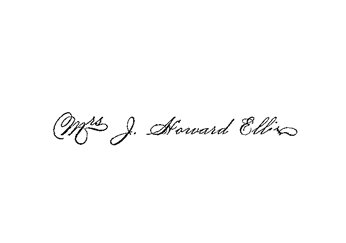
Cards for gentlemen are much smaller than those for ladies. This holds good in both England and America, where the required size is three inches one way by one inch and a half the other.
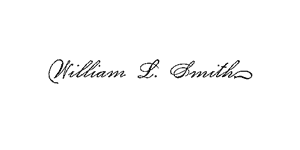
The largest card in use is the one sometimes adopted by the newly-married and engraved with their joint names. Thus:
Mr. and Mrs. Grant Trowbridge
may make use of a card four inches long by three and one-half in width, but a lady and her daughter, where their names appear together, should use the first-mentioned oblong size for ladies.
Engraving the Name.
Married ladies make a point of using their husband's name or initials upon their cards instead of their own, as:
Mrs. George B. Cleveland,
Or:
Mrs. G.B. Cleveland,
Instead of:
Mrs. Grace E. Cleveland.
It occasionally, however, happens that some lady, unwilling to so lose the identity of her own name, prefers this latter form. Or, if her family name be an old and honored one, she frequently retains it, thus:
Mrs. Grace Ethridge Cleveland.
But, though the married woman make use of her husband's name, she has no claim to his titles; so that while others may address her as "Mrs. Judge So and So," "Mrs. Dr. So and So," she must carefully avoid all such display. Let her be comforted, however, as her just pride in her husband's honors is easily gratified, since she is expected, on all formal occasions, to leave one of his cards, wherein his titles are set forth, with her own.
Occasionally a lady contents herself with having engraved upon her cards a simple:
Mrs. Courthope.
This, however, is unwise unless the name is a very uncommon one, and even then, should there be more than one branch of the family in the vicinity, the wife of the oldest member of the family only would have a right to make use of it.
Newly married couples frequently send out for their first cards the largest size mentioned engraved thus:
Mr. and Mrs. Holman B. Hunt.
Occasionally they preserve this custom throughout the entire first season. But this is all; from thenceforth husband and wife have their own separate cards. They may, however, be used at times throughout the married life to convey messages of sympathy, congratulation, or to accompany gifts.
Widows have always hesitated about exchanging the beloved and accustomed name upon their cards for their own signature. This, however, in many cases, is a necessity, especially where there is a son bearing the father's name. This is sometimes thought to be avoided by the use of the distinctive "Senior" or "Junior," a custom obviously wrong, since after the death of Francis Brown, Senior, Francis Brown, Junior, becomes at once Francis Brown, and his wife, Mrs. Francis Brown. Hence, while we have no such convenient title as "Dowager," the widowed Mrs. Francis Brown will be obliged to drop her husband's name in favor of her son's wife and thenceforth appear before the world as Mrs. Mary E. Brown. Where there are no children, or immediate relatives, change of title on the part of the widow is a mere matter of sentiment.
The black border upon a widow's cards should never be over a quarter of an inch in depth: more than this savors of ostentation rather than affliction.
Young ladies, especially if it is their first season in society, will find it the best form to have their names engraved upon the visiting card of their mother. Thus, if it is the eldest daughter:
Mrs. Wilfrid Ferguson. Miss Ferguson.
If a younger daughter:
Mrs. Wilfrid Furguson. Miss Ethel Furguson.
And if it should chance that two daughters "come out" in consecutive seasons both of their names are frequently engraved upon their mother's card, thus:
Mrs. Wilfrid Furguson. Miss Furguson. Miss Ethel Furguson.
Though it often happens that, for convenience sake, by the time the second rosebud is "out," the first has established a cardcase of her own. Yet as neither custom nor etiquette sanctions young girls in having cards of their own, a mother often continues to have the name of her young daughters engraved upon her own card.
Young ladies should always prefix "Miss" to their names, as:
Miss Alice Creighton Wright,
there being a certain forwardness about announcing one's self as:
Alice Creighton Wright.
Especially is this so among strangers, the prefix "Miss" carrying with it a certain quiet reserve and dignity.
The eldest daughter of a family announces herself upon her cards as "Miss Wright," unless there are several of the same name in town, while the others are respectively "Miss Alice Creighton Wright" and "Miss Ethel May Wright." Occasionally a card is used for sisters engraved as follows:
Misses Wright.
All pet names are to be avoided upon visiting cards and "Nettie Cranston" very properly becomes "Miss Annette Cranston" upon her cards.
Neither are initials good form for young ladies, though after an unmarried lady has reached a certain, or rather an "uncertain," age, she may, if she choose, be permitted to place upon her visiting cards:
Miss A.C. Wright.
If the young lady be motherless she often has her name engraved beneath that of her father, using not the smaller card of a gentleman but the first given oblong card for ladies. In England unmarried ladies, unless they have reached a very "uncertain" age indeed, follow the above fashion, and quite young ladies leave their chaperon's card as well. This fashion is often followed here, and when so done signifies that they will be inseparable for the season.
Address on Cards.
There is much question as to whether the address should be engraved on a lady's card, some very exclusive circles prohibiting it entirely on a young lady's card and questioning its use for a married lady, suggesting that in case a young lady desires to give her address to any particular individual it may be easily pencilled on one of her cards for the occasion, and that married ladies have the privilege of leaving one of their husband's, with engraved address, in connection with their own. This custom, while it may seem an over-nicety to those outside the great centers of metropolitan life, will be appreciated by all those to whom the "ins and outs" of city life are familiar. It should be said that while engraving the address is still a mooted question, except for young ladies, each individual is at liberty to use her own judgment on the question.
Cards for Gentlemen.
The size and style of a gentleman's card has been already given, but a few words as to name and titles will be necessary here. Custom, with reference to the cards that a man must carry, is considerably less arbitrary than towards women in the same respect. He may use his initials or his full name, as it pleases him. He may inscribe himself "Mr. John Smith," or simply "John Smith," and be quite correct in so doing, though just now there is a little inclination in favor of the more formal "Mr.," an English custom we do well in copying.
Military, not militia, naval and judicial titles, may always be used. Physicians and clergymen have the same privilege; honorary titles, however, should be avoided.
A private gentleman would have his card as: Mr. Howard Mason, 24 Union Square. If he were a club man, the club name, providing it were a very fashionable one, would take the place of the address, as: Mr. Howard Mason, Union League Club. For a military card: Captain Arthur Coleman, U.S.A. For a naval card: Admiral Porter, U.S.N. A medical man might use the following: George H. Harrison, M.D.
Some eminent men go to extreme simplicity, as, for instance, "Mr. Webster" being all that graced the cards of that celebrity.
It is hardly necessary to say that a business card should never be used as a visiting card. A gentleman carries his cards either in his pocket or in a small leather case sold for that purpose.
Cards for Receptions.
Cards used for receptions, lawn-tennis parties, afternoon teas, etc., in place of more formal invitations, have been fully described under "Invitations." One example will suffice here: Mrs. Lawrence Barrett, July 1st, at 4. p.m. The object of the entertainment being written in the corner of the engraved card.
Cards for receptions are a necessary convenience in this era of lengthy visiting lists. Without them there would be no possibility of leisure or of seeing one's friends at their own homes. The following is an example: Mrs. Emmons B. Churchill, Thursdays. Or: Thursdays, Three o'clock to five, may be substituted; the latter form, however, usually meaning that a simple afternoon tea will be served on the day mentioned.
A young lady never sends out a reception card in her own name alone, but her name is engraved upon her mother's card or that of her chaperon, thus: Mrs. Harold Gray; Miss Gray, Wednesdays, Four o'clock to seven. Or, in case of a chaperon: Mrs. George M. Jansen; Miss Alice LeVictoire, Wednesdays, Three o'clock to five.
Foreign Phrases.
There are a certain number of French phrases that custom has declared shall take the place of that "pure English undefiled" whereof Spenser wrote. In a few cases these chance to be shorter, more euphonious, and more directly to the point than the corresponding English phrase. For instance, the word "chaperon," so important in its signification at the present, has no adequate English translation. Below is given an alphabetical list of those phrases in most frequent use, together with the abbreviations that ofttimes serve in place of the full phrase:
French Phrases.Abbreviations.Translations.
Bal masque A masquerade ball.
Chaperon An older woman attending a girl in society.
Costume de rigueur Costume to be full dress.
Début First appearance.
Débutante A young girl making her first social appearance.
En villeE.V.In town or city.
Fête Champêtre A rural or outdoor entertainment.
Matinée A morning or daylight entertainment.
Matinée musicale A daylight musical entertainment.
Musicale Musical entertainment.
Pour dire adieuP.D.A.To say farewell.
Pour prendre congéP.P.C.To take leave.
Protégé One under protection.
Repondez s'il vous plaitR.S.V.P.Reply if you please.
Soirée An evening party.
Soirée dansante A dancing party.
Soirée musicale A musical entertainment.
The term en ville, when used in the place of "city," in addressing a note that is to pass through the postman's hands, is a needless and annoying affectation, since it is hardly to be expected that a knowledge of the French language forms one of the qualifications for a letter-carrier's position, and if delay ensues in delivery, the writer, not the carrier, is to blame.
P.P.C. Cards.
In the event of leaving town for a long absence, P.P.C. cards are frequently sent out. This is especially convenient where the length of one's visiting list renders the personal making of farewell calls an impossibility. The cards are sent out upon the eve of departure, and all persons receiving them are expected, upon the arrival of the absentee, to return the courtesy by cards (which may also be sent by mail) and by invitations. The ordinary engraved visiting card is used, and the initials P.P.C. (an abbreviation of the French phrase "to take leave") are written in capitals in the lower left hand corner of the card. P.D.A. (to say farewell) is occasionally used, but is not in general favor. If the address should happen to be engraved in the lower left hand corner, P.P.C. may be written in the lower right hand corner, either way being permissible at any time. The large card inscribed jointly with the name of husband and wife is frequently used in this connection. P.P.C. cards are especially appropriate where there are no calls due. If possible, unpaid personal calls should be answered in person on the eve of departure.
Turning Down the Corners.
This custom is almost out of date, and in consequence of the various interpretations liable to be given to the act, its disuse is a satisfaction to all parties concerned. To briefly explain the custom, a card turned down at the corner, or across one end, signifies that the call was made in person, and is sometimes very convenient when one wishes it distinctly understood that the card was brought in person, not sent; while one folded through the center denotes that the call includes all members of the family. A man should not turn down the corners of his cards.
Minor interpretations, such as which end or which corner is to be turned down on different occasions, even the surviving adherents of the custom do not pretend to agree upon.
How to Leave Cards.
In leaving cards follow the fashion of those who have paid you the same courtesy. If a call has been made upon you, return it by a call, as to return a personal visit by the sending of a bit of pasteboard would partake of the nature of a slight. If cards only have been sent you by a servant, return cards in the same manner by messenger or servant; if they were sent by mail, return by mail. If the cards of any of the gentlemen of a house are left, always leave the cards of any gentleman of your family in return.
Of course first calls should be made and returned in person, the card-leaving formalities coming later on. This rule is departed from only by a few ladies whom age, health, social or literary duties will excuse from making personal calls. These frequently permit themselves to send out cards in place of a first call, either accompanying them with, or immediately following them by an invitation to some entertainment. This attention should receive the same notice as a first call; cards should be sent in return, together with an answer to the invitation, if it is of a nature to require it, and a personal call must be made thereafter, unless it was simply an afternoon tea, and an invitation sent in return speedily as possible.
A lady leaves a card for a lady only, a gentleman leaves cards for the host and hostess of a house. Some authorities assert that a man making the first call of ceremony should, in addition to the first-mentioned cards, if none of the family are at home, leave another folded down through the center for the other members of the family. The folding, however, is questionable taste and the requisite number of cards would be better left in their original state. Cards should be left for the daughters of a house; if there are sons, a lady may leave one of her husband's for them also.
Number of Cards to be Left.
After this first visit of ceremony it is only necessary to leave one card at any following call throughout the season. As a rule in country towns but one card is left at any call, unless it is at the first calls of a bride, when, if her husband's name is not engraved upon her card, she leaves one of his with her own.
A gentleman and lady calling together and finding the mistress of the house, only, at home, would leave but one card, that of the gentleman for the master of the house. Finding no one at home, they would leave three cards, one of hers and two of his. A lady calling under the same circumstances would leave one of her own cards and two of her husband's.
When one lady calls upon another, if the hostess be at home she does not send in her card (unless she is an entire stranger), nor does etiquette strictly enjoin her to leave it in the hall, unless it is upon her hostess' reception day, when, on account of the large number of visitors, it would be difficult to remember all. It then becomes a very desirable custom for a lady to leave a card, together with two of her husband's. Also when the servant is somewhat dull of comprehension as to the name it will be well to send in a card to prevent mistakes. On reception days in very fashionable houses it is the custom to announce the guests by name as they enter the room, so that cards need not be sent in.
Never hand your own card to your hostess. If it be necessary, introduce yourself verbally, doing so quickly and clearly, and being sure to mention yourself, if a young lady, as "Miss."
Busy, elderly, and even young men are very prone to leaving their cards in the hands of mother, sister, wife, or any other lady of the house for distribution, though after an elaborate entertainment it is much more indicative of good breeding that a young man should pay his respects in person to his hostess.
Calls upon Young Ladies.
Young men in this country leave cards for the young ladies of a house, but they should always leave one at the same time for her mother or chaperon. In Europe they are never permitted to leave a card for a young lady at all. They call upon the mother or chaperon, and while they may offer to send for the young lady, she is never asked after.
If a gentleman, in calling where there are several young ladies, especially wishes to see one of the number, he may ask for her, but, before the call is over, should say he would be pleased to see the other ladies; more especially is there no excuse for ignoring the existence of the mother or chaperon of the young girl.
If a gentleman knows the ladies of the house well, it is not necessary for him to send in a card if they are at home, unless it be the first call of the season, when it is well to leave one in the hall. In a household consisting of two or more ladies not closely related a card should be left for each one.
When ladies are visiting in a house where the caller, whether man or woman, is unacquainted, he or she always leaves a card for the lady of the house and requests to see her: a request which she may not grant, but one which it would be a marked slight to omit.
In leaving a card for a friend visiting at a private house, never write her name upon it; depend upon the servant, or whoever opens the door, to remember for whom it is intended. This is only permissible when your friend is at a hotel. In doing this write the name above yours.
When a newly-married man sends cards immediately after his marriage to his bachelor friends it may be expected that he wishes to retain them as such in his new life. Upon the reception of these cards they are expected to call upon the bride at once.
How to Send Cards.
Cards sent by messenger are enclosed in a single unsealed envelope; sent by mail this envelope is enclosed within another and larger one which is sealed. Cards handed in at the door are received by the servant on a salver to prevent being soiled by handling.
When to Leave Cards.
First Calls of the season necessitate the leaving of cards. Let them be left quietly in the hall. This custom assists the lady of the house in revising her visiting list.
Letters of Introduction necessitate that those who have received courtesies in response to such, should, upon their departure, send P.P.C. cards to those that have thus remembered them.
A Change of Residence renders it desirable to send cards by mail to one's friends with the new address engraved thereon. However, should there be unpaid calls, the cards to these should be left in person.
The Return from an Absence, including any length of time, should be announced by sending out cards having the address and reception day engraved upon them. Where P.P.C. cards have been issued previous to departure these should always follow the return.
Preceding a Début. Previous to the date decided upon for the presentation of a débutante to the social world, the young girl's mother calls upon those of her friends whom she desires to be present upon the occasion and leaves them her own and her husband's cards, and, if she have grown sons, their cards also.
Reception Invitations to a full dress reception are preceded by a call by card upon all the acquaintances to whom the hostess may be indebted.
After Cards is the name applied to those that are sent to friends after a marriage and are engraved thus:
Mr. and Mrs. Charles E. Smith.
Later on, however, when the bride returns visits, she usually leaves her own card with her married name engraved upon it, thus:
Mrs. Charles E. Smith.
at the same time leaving her husband's separate card with her own.
Before Marriage, the bride expectant in paying her farewell calls, leaves her own separate card, together with that of her mother or chaperon, with all acquaintances she may wish to retain in her new life.
Entertainments and Calls.
After Entertainments, a card, in large cities, is sufficient, unless it be after a dinner or a wedding reception, when a personal call is made. If the wedding invitations have been to the church only, not including the gathering at the house, some most exclusive people send cards to the bride's parents, afterwards inviting the young people to their entertainments. But a dinner absolutely requires a personal call.
Even gentlemen, usually so remiss in such matters, are rather expected to leave a card in person after a dinner. Any invitation, however, coming from a new acquaintance, necessitates a personal call, unless the intercourse is not to be kept up. In towns and smaller cities, a personal call is made after entertainments of any size.
After a Tea a visit is paid and thus the visiting etiquette for a year is established. Before the season is over, however, the lady, if she expects to retain her position in society for the next season, must give a tea, or a series of teas, inviting all who have similarly honored her. This must be done before the season closes. Where the tea is not attended, cards should be sent to the house the same day.
Special Receptions, such as those dress affairs given once or twice in a season, require a personal card.
General Receptions, or "at homes," given in a series, the dates of which are all mentioned on one card, need neither cards nor calls in return. Your presence there is a call in itself. A card may be left in the hall upon the day of reception to assist the memory of the hostess.
Other Hints.
Ladies in a strange city, staying either with friends or at a hotel, are privileged to send cards, giving their address, to any acquaintances, either lady or gentleman, from whom they may wish to receive a call. If desirable, they may send a note in preference, giving date or hour when they will be at home.
Special Pursuits. Ladies having special pursuits, literary, or professional, often permit this fact to cover remission in social demands, in fact do not "visit" at all.
For a Son, upon his introduction to society here in America, there is very little display made. His entrée is usually very gradual, but if he has been closely kept at school his freedom from this is often announced by his mother leaving his card with her own when she makes her visits at the beginning of the season. This is taken as a suggestion that, in future, his name is to be included among the invited members of the family.
Cards for an unmarried gentleman should never be left by a lady, except in the case of his having given an entertainment at which ladies were present. In this case the lady of the house should drive to his door with her own cards and those of her family. Names of the young ladies should be engraved for the occasion upon the card of their mother or chaperon. The cards should be sent in by a servant. If a call is made upon a lady's regular reception day, it is rude to leave a card only, without entering and inquiring for the hostess. The time spent inside the house may be very brief, but even a few moments will satisfy the demands of etiquette, which without these would be rudely violated.
Cards may be made to accomplish so much of the multifarious duties of society that one can scarcely imagine the social world revolving safely upon its axis without their intervention. Far be it from any to look upon the custom as a hollow mockery, for, without the system of formal visiting, or calling, society as it now stands could not exist. Such, too, are the complexities of modern existence that life would be all too short for the fulfillment of its demands were it not for these useful bits of pasteboard that do so much of our work by proxy and dispose of our undesirable acquaintances so speedily by the simple cessation, on our part, of leaving cards at their door.
Various Cards.
Among the cards as yet not referred to in this department may be mentioned the following:
Cards of Congratulation, such as those sent the parents of a newly-betrothed couple upon the announcement of the betrothal; those sent the happy parents of a lately arrived son or daughter, etc. Cards of this description should be left in person, though it is not expected that you should enter and make a formal visit. The leaving in person, however, is a compliment.
Cards of Betrothal are distributed by the parents of the newly-engaged pair, leaving their cards with their own on all friends of the family. Individuals receiving these cards should call as soon as possible.
Cards of Courtesy are sent on many occasions. For instance, to a house where the children or youth of their family have been invited without including the elders. This is done in acknowledgment of the courtesy extended to their children. Again, a gift however simple, even flowers, should always be accompanied by a card of courtesy. The simple visiting card is usually sufficient, though a "Merry Christmas," "Happy New Year," or "Many happy returns of the day," may be penciled beneath the name. If there are many words to be written, however, a little note of courtesy is far better. (See Notes.) The recipient of the gift should answer by a note of thanks, never by a card simply. Cards should also accompany, or be attached to, flowers sent to a funeral, that the family may know friends remembered them in their sorrow.
Cards of Inquiry are frequently sent, or better still, left in person, at the homes of friends prostrated by severe illness, or by recent bereavement. These usually have the words, "To inquire," or "With kind inquiries," pencilled above the name. These are many times a source of relief during the weary days of convalescence, or the heavy hours of seclusion after affliction, when the voices of friends would be too hard to bear, but the thought of their loving remembrance yields a healing balm. In cases of bereavement the cards should be sent about one week after the sad occasion that called them forth.
Acknowledgment of Inquiry Cards.
Cards of Thanks are usually sent out in reply to these cards of inquiry, since the answering in any other fashion would prove too great a task. The regular visiting card may be used in this case, pencilling the words "With thanks for kind inquiries," or, "With thanks for the kind inquiries of Mrs. ——," beneath the engraved name; or cards especially engraved for the occasion may be substituted, thus: "Mrs. —— presents her sincerest thanks for recent kind inquiries." These may be sent by mail, but really should be carried by special messenger. Enclose in two envelopes. There is another method of acknowledging attentions during a period of bereavement, viz., the notice in the daily papers. This, however, does not usually meet with favor in large cities, but the example set by Mr. and Mrs. Secretary Blaine upon the death of their son, is, from its heartfelt pathos, worthy of imitation. The card appeared in all the Washington papers as follows:
"The sympathy of friends has been so generously extended to Mr. and Mrs. Blaine in the great grief which has befallen their household that they are unable to make personal response to each. They beg, therefore, that this public recognition be accepted as the grateful acknowledgment of a kindness that has been most helpful through the days of an irreparable loss."
Birth cards are frequently sent to all friends, at home and abroad, as soon as the child is named. One very pretty style now in mind read as follows: Ethel May Toucey, Half-past twelve o'clock, January 12, 1895. This was enclosed in two small envelopes and sent by mail. These are more especially useful for sending to friends at a distance.
Christening and Funeral Cards are considered in their respective departments. Families in deep mourning are not expected to send out return cards under the first year. Some prefer, however, to send cards of thanks very soon to those who have inquired, leaving ordinary visiting cards unanswered the usual length of time.
THE customs of society in regard to visiting or "calling," and the rules that govern these customs, are well worthy of our attention and care, since they in a great measure underlie and uphold the structure of our social life. No one, therefore, need consider these details trivial or of little account, since, according to Lord Chesterfield, "Great talents are above the appreciation of the generality of the world, but all people are judges of civility, grace of manner, and an agreeable address, because they feel the good effects of them as making society easy and pleasing."
Length of Visits.
Ceremonious visits should always be short, fifteen to twenty minutes being the outside limit, and a shorter time often sufficing. Even should the conversation become very animated, do not prolong your stay beyond this period. It is far better that your friends should regret your withdrawal than long for your absence. A lull in the conversation, a rising from her seat, or some pretext on the part of the hostess, or the arrival of a guest, all give an opportunity for leave-taking which should be made use of at once.
The Art of Leaving.
Cultivate the art of leaving; nothing will contribute more to your social success. It is said of so brilliant a woman as Madame de Staël that she failed lamentably in this particular, and, on the occasion of her visit to Weimar, made with the avowed intention of intellectually captivating the literary lions of the age, Goethe and Schiller, she made one fatal mistake, she stayed too long! Goethe wrote to Schiller: "Madame de Staël is a bright, entertaining person, but she ought to know when it is time to go!" It is also evident from her own statement that she did not know how to go. She lingered after she had started, and if this were an unpardonable sin on the part of so marvelous a woman, it is surely a capital crime on the part of ordinary mortals.
The art of leaving is more thoroughly understood by men than by women. The necessities of business life teach the value of time, and the press and hurry of city circles teach them the art of leaving quickly, so that a social call on the part of a business man is a model of good manners. When he has "had his say" and politely listened to yours, he takes his hat, says "good day," and is gone from your presence without giving opportunity for those tedious commonplaces of mutual invitations and promises to come again which seem a social formula with so many women.
When Ready to Leave, Go at Once.
Never say, "I must go," but, when you have finished your visit and rise to depart, go! Never permit yourself to be drawn into touching upon any subject at this critical moment that will necessitate lengthy discourse for yourself and hostess, or force upon you the awkward alternative of reseating yourself to finish the conversation. There is always a certain awkwardness in thus repeating the ceremony of leave-taking which may be avoided by a quick and graceful departure that leaves both host and guest with feelings of the utmost amiability toward one another.
On the other side it is necessary that the host and hostess supplement this laudable endeavor on the part of their guests in order that the departure may be gracefully accomplished. Never detain the visitor, who is attempting to leave, by protests, by inquiries, or by the introduction of new subjects. One writer very pertinently says: "The art of leaving on the part of the guest needs to be supplemented by the art of letting go on the part of the host."
First Calls.
There is, possibly, more difference of opinion on the subject of who shall make the first visit or call and when it shall be made, than almost any other point of etiquette. At the same time more importance is attached to it than to almost any other social question, and it touches more uniformly every phase of city or country life than any other canon of courtesy.
Neither neighborliness, nor good-Samaritan feeling, can exist without the civility of a call, and, when there is too great a hesitancy on the part of a resident to call upon the newcomer, one is reminded either of the priest or the Levite as they "passed by upon the other side," or is forced to recall the parvenue's dread of losing a footing in social circles.
Common sense and kindliness of heart are always to be relied upon in matters of this nature, and the initiative may safely be taken by those who have social position, age, or length of residence on their side. Of course in large cities the immense demands of social life give a certain immunity from anything like promiscuous calling to those whose circle of acquaintance has already grown beyond the limits of their time. In towns and villages, however, no such immunity exists, and a call may be easily made, or a card left, while, on the other hand, should the new acquaintance prove "pushing," or in any way obnoxious, one simply ceases to leave one's cards and the evil is done away with.
Many elderly ladies, and others whose time is very much occupied by social or other duties, excuse themselves from calling customs. Under such circumstances, they frequently send their cards, accompanied by an invitation, to newcomers younger in years, thus entirely omitting the personal visit. Such invitations, whether accepted or not, should be honored in the same manner as if preceded by a call.
If two people meet pleasantly at a friend's house and wish to continue the acquaintance so begun, let them not hesitate, should none of the before-mentioned distinctions exist, as to which should make the first visit. Still, it is ofttimes wise not to call too hastily upon the newcomer, especially in cities, where it is well first to be properly introduced, and further still to have some assurance that your acquaintance is desired by them as well. As before stated, priority of residence, age, or pre-eminence in social position, should properly be upon the side of the one making the first advances. If none of these exist, let the braver of the two break the social ice.
The etiquette of summer resorts demands that the owners of cottages call first upon renters, and afterward that both unite in calling upon later comers and arrivals at hotels or boarding houses. Of course, such intercourse is simply for the pleasure of the time being, and carries with it no responsibility of recognition in the future, unless such recognition should be satisfactory to both parties. It would be well for the "summer girl" and the "summer young man" to remember this canon whereby "society" guards the doors of its exclusiveness, enjoy the "good that the gods give" and expect no more.
Substitute for First Call.
In continental countries, and in cosmopolitan Washington, newcomers make the first advances themselves, leaving cards with those whom they wish to number among their acquaintances. Every one returns these cards, and invitations flow in upon the aspirant for social honors. This custom, unfortunately, does not hold good anywhere else in this country, though a polite expedient is sometimes adopted by persons entering upon life in a new city. This consists in the newcomer sending out her cards for several reception days in a month. These may be accompanied, or not, by the card of some friend well known in social circles, if such she have, to serve as voucher. If not, she relies upon her own merits and sends out her cards unaccompanied. According to the varied authorities recommending this course of action, those rudely ignoring this suggestion are few in number, and the lady is permitted at once to feel that she has commenced her social career.
Morning and Evening Visits.
Any visit made between the hours of twelve and six is to be looked upon as a morning visit, though there is a little difference in various cities with regard to the exact time. Where one expects to touch upon reception hours, from three to five is usually a safe limit. In country towns or the small cities, from two to five are the usual hours for paying visits. Evening visits should be made between the hours of eight and nine, and ordinarily should never extend in length beyond the hour of ten.
Sunday Visits.
Gentlemen are permitted to call upon lady friends, Sundays after church and Sunday evenings, business cares being their excuse for not availing themselves of the other days of the week. Of course, if there exists any known objection in the family to Sunday visiting all their friends are bound to respect it.
Reception Days.
If a lady have a known reception day, callers are bound, in common politeness, to make their visits, as far as possible, upon that day. If this is not done, either a card only should be left, or, if a personal visit is intended, particular instructions should be given to the servant to the effect that if "Mrs. Brown is otherwise engaged she is not to trouble herself to come down." For which thoughtfulness, "Mrs. Brown," if she be a busy woman, and troubled with many social cares, will cordially thank you.
Unfortunately, it often happens that many of our friends have the same reception day, and one's own "day" may conflict with that of one's nearest friend, so that, where the circle of acquaintance is large, much good nature, a few apologies and a great many cards are needed to safely balance the social accounts.
It is considered a rudeness to simply leave a card, when one happens to arrive upon a lady's reception day, without entering the room for a few moments' visit.
“Not at Home,” “Engaged.”
The simple and necessary formulæ of, "Not at home," or "Engaged," are more frequently questioned than any other social custom. Nevertheless their use is often a necessity, while, on the contrary, their abuse is to be regretted. No suspicion of an untruth need apply to either, for the phrase, "Not at home," is used with the accepted signification of, "Not at home, for the time being, to any visitors." If, however, conscience rebels against this so transparent fraud, there is always the alternative of "Engaged," which carries not the least suspicion of deception with it, but is somewhat less gracious to the ear.
Indeed, were it not for these safeguards, the woman of society must bid good-by to all opportunities for solitude, self-improvement, or the fulfillment of her own social duties.
The servant should be very carefully instructed each morning as to the formulæ to be employed through the day, or such portion of the day as the lady of the house shall require to herself. No lady, after a servant has informed her that the mistress of the house is "not at home," will question as to her whereabouts, or the probable length of her absence. If she should so far forget her dignity, the well-trained servant will answer all inquiries with a respectful, "I do not know, Madame," adding, if such be the case, "Mrs. Brown receives on Thursdays."
Should a servant show evident hesitation upon receiving your card, and say, "I will see if Mrs. Brown is in," enter the parlor, at the same time saying, "If Mrs. Brown is otherwise engaged, or going out, beg her not to trouble herself."
Never, except upon urgent necessity, insist upon pencilling a word or two upon a visiting card and sending it up, where a lady is "engaged," as a demand upon her attention. If a servant has said the lady is "not at home," she has a perfect right to refuse the message.
In suburban towns and small cities, where reception days are not common, the lady of the house must be very careful how and when she denies herself to visitors. Indeed, in all cases much discrimination must be shown in this respect, as great inconvenience may result, and some injustice be done, by an indiscriminate denial. But, as before said, in towns, it is better, if possible, to receive guests. Even if no servant is kept, the mistress can usually, by the exercise of a little care, keep herself neat and presentable. If at any time some slight alterations are necessary to the toilet, let the interval thus employed be very short.
Some one has said that it would be well for a lady having a reception day to devote a part of the morning of the same day to business calls, and to instruct her servants to inform all comers of this custom.
Visiting List.
It is well for all ladies having a large list of acquaintances to keep a carefully revised visiting list to assist their memories as to addresses, names of persons to invite, reception days of acquaintances, and, if possible, a list of their own ceremonious visits for the season, noting those that have been returned. The time thus expended is amply repaid by the convenience of reference and the avoidance of the possibility of making a second visit when the first is unreturned. Also this list serves as a basis for the visiting list of the next season; those having failed to return calls or cards being dropped from the new list.
Visits Between Ladies and Gentlemen.
A gentleman, as a rule, should not ask a lady for permission to call upon her. It is very easy for her, if she desires his company, to say: "I receive Thursdays," or, "I shall be at home Monday." It is a great discourtesy for a gentleman not to call at the time mentioned, or in a very few days, after being thus invited by a lady. Some gentlemen, if simply asked to "call sometime," will ask, "when may I have the pleasure of seeing you?" To this question a definite answer should be returned, if possible. Very young ladies do not thus invite gentlemen; the invitation coming from either father, mother, or chaperon.
A gentleman does not call upon a lady without some intimation of her wishes in the matter, unless he is the bearer of a letter of introduction, or is taken to her home by some friend sufficiently well acquainted to warrant the liberty. He may, however, seek an introduction through some mutual acquaintance.
Ladies may express regret at being out when a gentleman called; he also should regret the absence. If it should happen that a gentleman should call several times in succession and be so unfortunate as to miss the lady each time, it would be quite proper for her to write him a note, regretting her absence and appointing an evening when she would be at home for his next call. This would remove any feeling of annoyance on his part that perhaps her absence had been premeditated.
Gentlemen frequently call upon their married lady friends, doing so without the slightest appearance of secrecy and with full knowledge of all parties concerned. Indeed, the right of entrance to some of these pleasant home parlors is a great boon to the unmarried men of our cities. Ladies do not call upon gentlemen except professionally or officially, or, it may be, in some cases of protracted invalidism.
“Out of Society.”
It sometimes happens that a newly-married lady, or a newcomer in some city, through severe illness, a season of mourning, or devotion to home duties, finds herself, in a year or so, completely "out" of a society with which she had scarcely become acquainted. If she be timid and non-assertive, she will sink back dismayed at the prospect, but if energetic and aspiring, she will at once win her way back by giving a series of receptions, either formal or informal, to all her old-time friends; or, by entering into charities, or joining literary or musical clubs, she will quickly reinstate herself in the memory of society.
Conduct of the Hostess.
A hostess does not necessarily advance to receive her guests, simply rising and moving forward a step in order to shake hands (if she should so wish), remaining standing till they are seated, and, if possible, keeping the latest comer near her side. Gentlemen should always permit the lady to make the first advance in the matter of hand-shaking. It is her prerogative.
As the guests depart, the hostess does not accompany each one to the door, but rising, remains standing until the guests have quite left the room, when it is to be supposed they will be met by a servant. In country towns the hostess usually accompanies the guest to the door, if there are others present, excusing herself to them and remaining out of the room but a moment.
Entertaining Callers.
Where there are several guests in the room at once the hostess should try to make the conversation general and pay equal attention to all, save that for a few moments, the latest arrival engages her more intimately, or some guest of great intellectual or artistic genius may be honored among the rest, as a lion of the hour.
If you should chance to find, at once, in your reception room, two friends with whom you are upon equal terms of intimacy, treat them with the most absolute impartiality, being demonstrative toward neither, for there is too much truth in the saying that "there is always a feeling of jealousy on the part of each, that another should share your thoughts and feelings to the same extent as themselves." There are other occasions where the same care against wounding their feelings should be observed.
If there should be any preference with regard to seats, one suggestion is that a lady should be seated on a couch or sofa, unless advanced in years, when she should be asked to accept an easy chair; an elderly gentleman should be treated in the same manner. If a young lady should be occupying a particularly comfortable seat, she must at once arise and offer it to an older lady entering the room.
Should the hostess, upon the arrival of occasional visitors, be engaged upon work requiring any attention, she must at once relinquish it; but should it be light, ornamental, and not at all confining, she may continue it, if so requested. It would be well, however, to drop it at intervals, lest it appear as if there were more interest in the work than the visitor.
Refreshments are not offered to visitors unless it is a regular reception day with afternoon tea.
Conduct of the Guests.
If a visitor on entering the room finds that name or face has not been remembered by the hostess, let the difficulty be rectified by the guest pronouncing the name instantly and distinctly, the hostess, on her part, to remember names and faces. A bad memory is inconsistent with good manners. In very fashionable houses a servant announces the name of each guest as they enter, thus saving any confusion.
Should you find yourself ushered into a room where there are several inmates, all strangers, ask for the individual you wish to see and introduce yourself distinctly.
If your friend is at a hotel, wait in the parlor until the servant who carries up your card has returned to tell you whether you can be admitted. Never follow him as he goes to make the announcement. A little formality is the best preservative of friendship.
If, while you are paying a visit, other guests arrive, you should, providing your stay has been sufficiently long, arise so soon as they are quietly seated, make your adieus to your hostess, bow politely to the other inmates of the room and take your departure. If you should be calling upon a lady and meet a lady visitor in her drawing room, you should rise when that lady takes her leave.
The style of conversation should always be in keeping with the circumstances under which the visit is made. Common sense alone should teach us that where a short morning call is in question, light, witty and quickly-changed subjects only should be entered upon, the nature of the case plainly prohibiting discussions on many topics.
Gentlemen are expected not to use classical quotations before ladies without a slight apology and a translation, unless they are aware that the lady's educational training has made it possible for her to appreciate them. It would be well if they would use the same courtesy toward other men not gifted like themselves. For a general maxim, it may be here recommended not to air one's classical learning unnecessarily, lest it savor of pedantry.
Guests should greet their hostess cordially, but a bow is usually sufficient to include the others present.
Young ladies visiting a strange city should not receive calls from a gentleman without requesting the privilege from their hostess, and hostess and daughters should be introduced to him. Always avoid the slightest appearance of seeming to use your friend's house for a rendezvous.
Deference to Ladies.
A gentleman rises when ladies leave the room. Ladies bow if it is a gentleman, rising if it is a lady acquaintance, or a lady much older than themselves. A gentleman rises when ladies enter a room, but never offers them his chair unless there should be no other in the room.
A gentleman carries his hat and cane into the drawing room with him in making a visit. His hostess should no more offer to relieve him of them that she would take fan and handkerchief from the hands of her lady guests. If he wears an outer coat he leaves that in the hall; if there should be no hall the hostess may ask him to put it on a chair or in another room. His hat and cane he either holds if he chooses, or places beside him on the floor, never on a chair or other article of furniture. If he intends spending the evening, he can, if he choose, leave hat and cane in the hall. Gentlemen should never bring friends with them to call upon ladies unless they have first received permission from them so to do.
After escorting a lady on the previous evening the gentleman should make a call upon her the following day, if possible. Gentlemen should not consult their watches during a ceremonious visit. If some pressing engagement should render this necessary, they should offer both an apology and an explanation.
A gentleman, unless invited, should never seat himself beside his hostess, but should take the chair pointed out to him.
Gentlemen, in receiving other gentlemen, go to the door to meet them and furnish them with seats.
The man of the house should escort ladies to their carriage, should they call while he is at home. If it be raining or otherwise disagreeable, and they have their own coachman, they should, however, beg him not to trouble himself.
Gentlemen should decline an invitation to spend the evening when making a first visit; indeed, such an invitation should never be given.
A man is usually asked to repeat his visit by the mistress of the house, not by the daughters, or else it is given by their chaperon.
What Not to Do.
Do not, according to the author of "Don't," be in haste to seat yourself; one appears fully as well and talks better, standing for a few moments. A man should always remain standing as long as there are any women standing in the room. A man should never take any article from a woman's hands—book, cup, flower, etc.—and remain seated, she standing. This rule is an imperative one; he must always rise to receive it.
Do not take young children when making formal calls; the hostess will be in terror as to the fate of her bric-à-brac, and the mother in dread as to what her young hopefuls may say or do.
Do not take pet dogs with you into the drawing room. Their feet may be dusty, they may be boisterous in expressing their feelings, and besides, some people have a perfect aversion to dogs, so that your visit, thus accompanied, is likely to be far from pleasant.
Do not meddle with, nor stare at the articles in the room. Do not toss over the cards in the card receiver, if there be one, and, while your name is being announced, do not wander impatiently around the room handling everything within reach.
Do not loll about in your chair, if a gentleman (a lady scarcely needs this caution), keep your feet squarely in front of you, not crossing them; ladies would do well to heed this also. Do not torment pet dogs or cats, or tease the children. Do not call the length of the room if you wish to address any one, but cross the room and speak to him quietly. Neither should you whisper to some one of the company, twist or curl your thumbs or hands, or play with the tassels on the furniture or window curtains, or commit any of the thousand and one blunders that mark the underbred and nervous visitor and render his presence an unwelcome trial.
There are a few other rules that would seem unnecessary to mention here were it not that they are so constantly sinned against. Among others it may be suggested not to do anything disagreeable in company. Do not scratch the head or use a toothpick, earspoon or comb; these are for the privacy of your own apartment. Use a handkerchief whenever necessary, but without glancing at it afterwards, and be quiet and unobtrusive in the action as possible. Do not slam the door, do not tilt your chair back to the loosening of its joints, do not lean your head against the wall, as it will soil the papering; in short, do unto others as you would be done by.
Do not tell long stories, more especially if they are about yourself; do not argue; do not talk scandal, and be sure not to attack the religious beliefs of any one present. Do study the chapter on the "Art of Conversation," and cultivate, as much as possible, that self-repose of manner that is, above all things, a sign of the lady or gentleman.
The Reception-Room.
The arrangement of the reception-room itself has much to do with the pleasure of the visitor. Who does not remember those delightful parlors where the guests dropped into pleasant conversational groups as by magic, and contrast them mentally with those other chilly apartments where a sort of mental frost seems to settle over one's faculties and incapacitate them for use. Much of this may be avoided by a judicious arrangement of chairs and couches, just where people drop naturally into easy groups, or, for the time being, surround their hostess.
Propinquity is a great incentive to pleasant conversation, for there are few people that can talk the pretty nothings and sparkling witticisms, whereof parlor conversation properly consists, across space to people stranded against the opposite wall. Therefore let the hostess, who would have her symposiums remembered with delight, see to it that she has an abundance of chairs, both easy and light, easy ones for the refreshment of the weary in body and light ones that may be quickly moved when the spirit moves toward some other group.
A clever woman, to whom all social arts were long-solved problems, once said that she always observed how the chairs were left in a drawing room where several people had been sitting and put them in the same position next time. A group near the door where the casual caller will naturally drop into one and the hostess into another, without the least effort, will be placed in the best possible position for a little chat. Fulfill these conditions and your drawing room will be often filled and the fame of it will go abroad.
Formal calls, as a rule, are at best but a duty performed that brings a satisfaction in itself, but it sometimes happens that, as a reward for our well-doing, some word may be said, some friend may be met by a happy chance that is like a gleam of sunshine on a cloudy day.
THERE are certain rules to be observed in the writing of invitations that cannot be transgressed without incurring a just suspicion as to the degree of one's acquaintance with the laws and canons that govern our best society. For instance, Mrs. John Doe issues invitations for a ball or evening party; these, if issued in her own name or in the name of herself and daughter, or lady friend, would, very properly, find them "at home" on a certain evening. Should, however, the invitations be sent out in the name of herself and husband, then it is that "Mr. and Mrs. John Doe request the pleasure of Mr. and Mrs. Richard Roe's company" at a certain date. We will also find that Mr. Dick Roe is never "at home," but "requests the pleasure of your company."
To widely depart from any of these received canons of etiquette is to commit a decided solecism and to discover an utter unfitness for the desired social rank. Fortunately, there is no need, even for those not to the manor born, of displaying any ignorance in this matter when the simple consultation of a standard work on social etiquette will give the needed information and save the credit of the individual.
At first sight, it would seem a very easy thing to invite a friend to come to you at a given day and hour, and to accept or decline said invitation would appear a matter scarcely worth considering. This rash conclusion, however, disappears from view when it is recollected that the proper phrasing, the suitable signature, and the appropriate paper, are all matters of the nicest choice, and indicate with the most unerring accuracy the good or ill breeding of the parties interested.
From two to three persons only are invited from one family to the same entertainment, and, in the event of a small dinner party, two would be the limit. The invitations would be addressed, not to Mr. Coates and family, but one to "Mr. and Mrs. Coates," another to "The Misses Coates," or to "Miss Coates." If there are brothers, and they are to be invited, a separate invitation is required for each one of them; a single one addressed to the "Messrs. Coates" being considered in bad taste. To one son and one daughter a joint invitation may be extended in the name of "Miss Coates and Brother." On rather informal occasions where the family, and perhaps their guests also, are desired to be present, the invitation may be sent in the name of "Mr. and Mrs. James B. Coates and Party."
Note Paper for Invitations.
Note paper for invitations should be plain, unruled, heavy in texture, creamy-white in tint, and of a size to fold once to fit the large, square envelope of the same size and tint. Monogram, if used, or crests, if they may be rightfully claimed, should be stamped or embossed in white directly in the center of the upper portion of the sheet and on the upper flap of the inner envelope only. This envelope should bear the name simply of the invited guest, and is to be enclosed in a perfectly plain, somewhat larger envelope, which bears the entire address and protects the enclosure from the soil of frequent handling by postman or messenger.
Invitation Cards.
Invitation cards, if they are used, should be heavy, creamy-white, and of a size to fit the large, square envelope. Such a card is sufficiently large to contain any ordinary invitation, and should be enclosed, as above, in two envelopes.
Writing the invitation should receive the greatest care, especial attention being given to securing each phrase a line to itself. For instance, the names of host and hostess should never be separated, but given an entire line, the same rule applying to the names of the invited guests.
Invitations written in the third person should always be replied to in the third person, care being taken to permit no change of person from beginning to end of the note. This rule holds good in whatever person the invitation may have been written; regrets or acceptances must be sent in the same manner.
No one, nowadays, "presents his (or her) compliments" in giving or accepting an invitation; neither is "your polite invitation" any longer the best form. "Your kind," or "your very kind invitation," being the most graceful manner of acknowledging the courtesy extended.
Written Regrets.
Always, if possible, accept a first invitation if the new acquaintance is to be kept up. In case inexorable circumstances prevent this acceptance, the regret sent should explain these circumstances fully and be very cordially written; while the earliest opportunity must be taken of extending some courtesy in return.
Even should you not desire the acquaintance, your regrets should be courteous and cards should be left at the house in response to their civility. It is then at your own option whether or not to acknowledge the acquaintance farther.
Invitations can be written or engraved on the large cards, or small sheets of note paper, that are used for this purpose, though, on all formal occasions, engraved forms in clear, fine script are preferable, and for weddings absolutely necessary. If written, black ink should be invariably used.
A young lady never sends out invitations in her own name; instead, "Mrs. and Miss Hoyt" are "at home," or the name of the young lady's chaperon appears with her own, as: "Mrs. Haviland and Miss Hoyt, at home, etc."
Uninvited Guests.
Should it so happen that an uninvited guest finds, accidentally, his way into the festivities, let the strictest politeness mark his reception, neither word nor glance betraying the slightest surprise at the unexpected arrival.
Inviting Married People.
A married man should never be invited to an entertainment without his wife, nor a married woman without including her husband also in the invitation. An invitation erring in this particular should be looked upon as an insult, and should never be honored by an acceptance. This category, however, does not include gatherings, such as ladies' luncheons or gentlemen's game suppers, that are wholly confined to the members of one sex.
Dinners.
Ladies who give many dinner parties usually keep on hand the engraved invitation cards, with blanks left for the insertion of name and date. The invitation for a dinner party is always sent out in the name of both host and hostess, and the usual form is as follows:
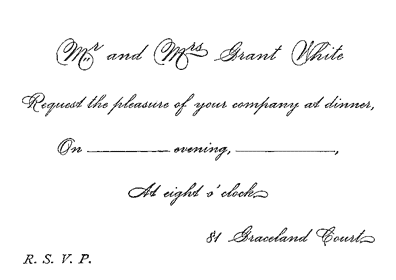
Mr and Mrs Grant White Request the pleasure of your company at dinner, On —— evening, ——, At eight o'clock. 81 Graceland Court. R.S.V.P.
The letters R.S.V.P. are simply the initials of the French words, Repondez s'il vous plait, meaning, "Reply, if you please."
Some very stylish people now use, in place of these letters, the English phrase: "The favor of answer is requested."
Written invitations, or those engraved for a single occasion, would read as follows:
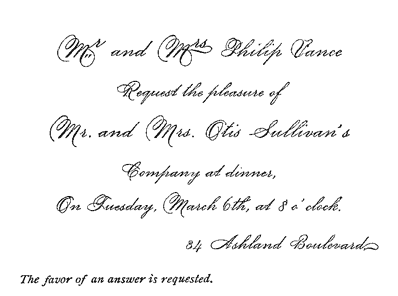
Mr and Mrs Philip Vance Request the pleasure of Mr. and Mrs. Otis Sullivan's Company at dinner, On Tuesday, March 6th, at 8 o'clock. 34 Ashland Boulevard. The favor of an answer is requested.
R.S.V.P. can be substituted for the last phrase, if desired. If the host be a widower with a young lady daughter, the invitation can be issued in the name of father and daughter, as: "Mr. and Miss Van Vleit, etc.," or, a lady and her daughter, under similar circumstances, would issue invitations in the name of "Mrs. Holt and Miss Holt."
Persons who make a point of strictly observing the usages of polite society are extremely careful, having received any invitation, to take immediate notice of it, according to proper form. This is only a courtesy due to the one who has sent the invitation, which should be accepted or declined promptly, in order that the hostess may know what to depend upon.
If the dinner party is given to introduce either a friend or some person of distinction, an extra card, inscribed as follows, is enclosed in the same envelope: To meet Mr. ——. Another form would be:
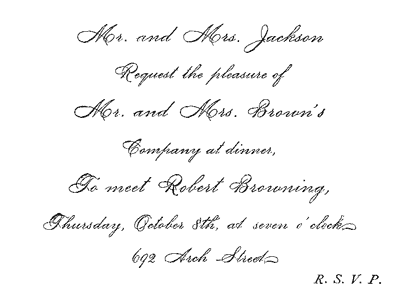
Mr. and Mrs. Jackson Request the pleasure of Mr. and Mrs. Brown's Company at dinner, To meet Robert Browning, Thursday, October 8th at seven o'clock. 692 Arch Street. R.S.V.P.
It is well, if the party is given in honor of some celebrated person, to give them the choice of several dates before issuing the general invitation, thus assuring yourself that no conflicting engagement will rob the entertainment of its bright, particular star. An invitation to a dinner is the highest social compliment that can be offered. It should be sent out about ten days in advance, and requires an immediate and positive answer, for it is to be supposed that the hostess wishes to make up her table at once. Both invitation and answer should be sent by messenger; all other invitations, and replies to the same, may be sent by mail. In London, however, where distances are so great, all invitations, without exception, are sent by post.
In case of an informal dinner, a verbal invitation is sometimes sent, one or two days beforehand, by a servant, and a verbal answer is given at the time. The principal objection against this method is that the date, having no written reminder, may be confounded with some other engagement. Where the affair is not too stately, an informal invitation, written in the first person, may be pleasantly exchanged between friend and friend. For instance:
My Dear Mrs. Roe:
My aunt, Mrs. LeFevre, of New York City, is here with me for a short stay, and Mr. Doe and I hope that you and Mr. Roe can give us the pleasure of your company at dinner, on Tuesday, October ninth, at seven o'clock, when, with a few other friends, we hope to pass a pleasant hour in your society.
Cordially yours,
Marian Doe
Mrs. Marian Doe, St. Caroline's Court.
Asking for Invitations.
Asking for invitations for one's visiting friends, while permissible on some occasions, such as requesting the favor of bringing a gentleman to a ball where dancing men are always at a premium, or an unexpected guest of your family to a reception or evening party, should never be resorted to when a dinner party is in question, for, to gratify the request would, in all probability, throw the whole of a carefully arranged table into disorder. This rule is only to be broken when the guest to be included is some really celebrated character whose addition to the company would compensate for the extra covers to be laid and the re-arrangements to be made before the unexpected guest can be accommodated. No one, however, should feel offense when a request of this nature is refused. The hostess, in all probability, had good and sufficient reasons for her course of action. Invitations for a married couple should never be requested.
Evening Parties, Balls and “At Homes.”
Invitations to these entertainments are issued in the name of the hostess only, and are sent out from ten days to two weeks in advance. Informal occasions, however, give very short notice, and it is well to use the word "informal" in the invitation, that guests may not put themselves to inconvenience as regards dress. It must be remembered that this term is too often misleading in its nature, and many a sensitive guest has been seriously annoyed by finding herself, after a too literal interpretation of the "informal" character of the entertainment, in a crowd of gay butterflies, a misuse of the word that should be seriously protested against.
Invitations to evening parties and private balls are less elaborate than formerly; the word "party" or "ball" is never used unless on the occasion of some public affair, such as a charity ball, but any especial feature of the evening may be mentioned in the invitation.
To an evening party where dancing may, or may not, be a feature of the entertainment, the following, either engraved or written on a small sheet of note paper, is a very good form:
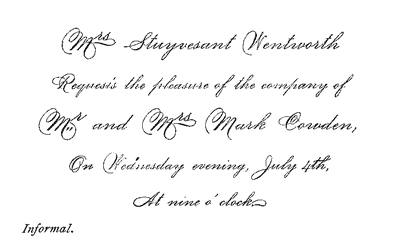
Mrs Stuyvesant Wentworth Requests the pleasure of the company of Mr and Mrs Mark Cowden, On Wednesday evening, July 4th, At nine o' clock. Informal.
All invitations are to be considered as "formal" unless the word "informal" appears on the card. If the card states that the entertainment is to be "informal," the invited guest is fully justified in considering it so, and dressing accordingly. Neither host, hostess, nor other guests can take any exception if the invitation is treated just as it reads.
If dancing is the feature of the evening, the same form may be used with the word "Dancing" added in the lower left hand corner. Or:
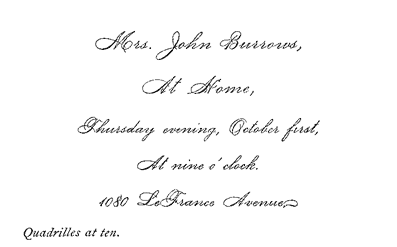
Mrs. John Burrows, At Home, Thursday evening, October first, At nine o'clock. 1080 LeFrance Avenue. Quadrilles at ten.
If the ball is at a public place, as at Delmonico's, in New York, the following form is appropriate, always making use, in case of so public an entertainment, of the host's name in connection with that of the hostess:
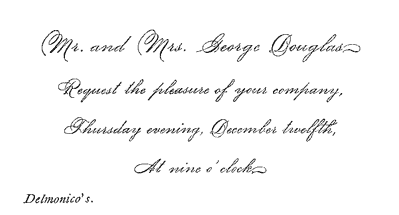
Mr. and Mrs. George Douglas Request the pleasure of your company, Thursday evening, December twelfth, At nine o'clock. Delmonico's.
Another form that would be equally appropriate is as follows:
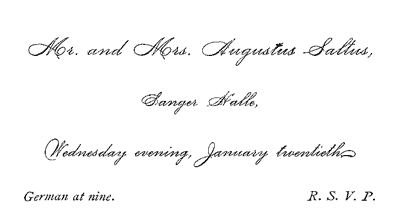
Mr. and Mrs. Augustus Saltus, Sanger Halle, Wednesday evening, January twentieth. German at nine. R.S.V.P.
If any of these occasions are intended to introduce a débutante, her card may be enclosed. If they are given in honor of a friend, or some celebrated individual, the following form is appropriate:
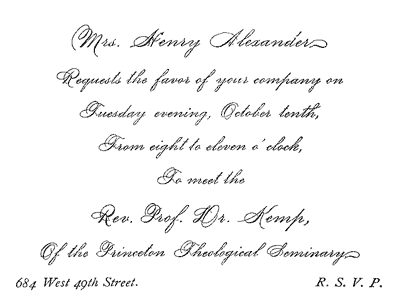
Mrs. Henry Alexander Requests the favor of your company on Tuesday evening, October tenth, From eight to eleven o'clock, To meet the Rev. Prof. Dr. Kemp, Of the Princeton Theological Seminary. 684 West 49th Street. R.S.V.P.
Or, if very formal, the name of the guest may be given first, as: To meet the Chief Justice of the United States and Mrs. Fuller. Mrs. Harold Courtright, At Home, from eight to eleven o'clock, Thursday, February seventh. R.S.V.P.
This same precedence may be given to the name of an honored guest in a dinner or other invitation. Still another form is where the name of the guest is written on a separate card, thus: To meet Mrs. Summerville. Enclose this in the same envelope.
For a club party the following may be used: The La Salle Club requests the pleasure of your attendance Wednesday evening, June eight, at nine o'clock. 555 West 51st Street. R.S.V.P.
A still more simple form for a party invitation is an "At Home" card filled out thus: Mrs. Don Carlos Porter, At Home, Tuesday evening, March fourth. 1021 Broadway. Cotillion at ten. R.S.V.P.
Masquerades.
The entire invitation for a masquerade may be engraved, or it may be written, with the exception of the word "Masquerade," which should be engraved on the card. For example:
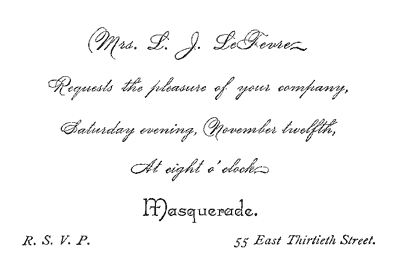
Mrs. L.J. LeFevre Requests the pleasure of your company, Saturday evening, November twelfth, At eight o'clock. Masquerade. R.S.V.P. 55 East Thirtieth Street.
Musicales, Soirées and Matinées.
Invitations to a Musicale are simply written on "At Home" cards, thus:
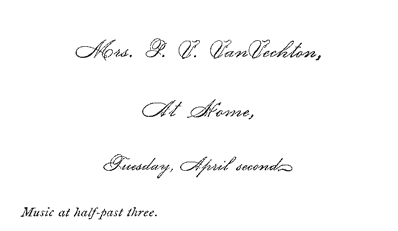
Mrs. P.V. VanVechton, At Home, Tuesday, April second. Music at half-past three.
Or: Mrs. P.V. VanVechton, At Home, Tuesday afternoon, April second, from half-past three to five o'clock. Matinée Musicale.
If the Musicale is to be an evening affair, and dancing is to follow the music, the following form of invitation may be used: Mrs. Herbert Hughes, At Home, Friday evening, January tenth, at eight o'clock. 200 Winchester Avenue. Music. Dancing at ten.
Precisely the same form is to be used in giving out invitations for a soirée, save that the word "soirée" is substituted for that of "Musicale" or "matinée musicale." It may be farther added that the term "matinée" applies exclusively to entertainments given in the morning, or at any time before dinner, a distinction to which our custom of late dinners gives a wide latitude, so that any entertainment up to eight o'clock in the evening may receive the name of matinée, notwithstanding the fact that drawn curtains and gas-lighted rooms may give all the semblance of night-time. "Soirée," however, is used only where an evening party of a semi-informal character is denoted.
Garden Parties.
Precisely the same form of "At Home" cards can be used for these entertainments, substituting the words "Garden Party" in the left hand corner and sending them out some two or three days in advance. Or, if a more formal affair is intended, use the following: Mrs. Waite Talcott requests the pleasure of the company of Mr. and Mrs. John Clay, on Monday, August fifth, at four o'clock. Garden Party. "The Oaks."
If it should be desirable to include the entire family in the invitation, the wording would be as follows:
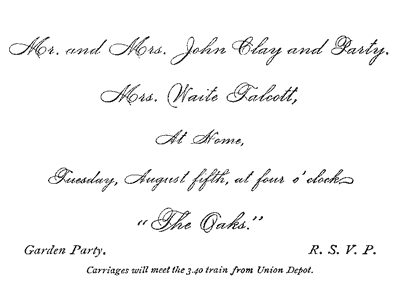
Mr. and Mrs. John Clay and Party. Mrs. Waite Talcott, At Home, Tuesday, August fifth, at four o'clock. "The Oaks." Garden Party. R.S.V.P. Carriages will meet the 3.40 train from Union Depot.
This clause to be added only when the party is to be given at some distance from the station. If preferred, these directions may be written on a separate small card and enclosed in the same envelope.
In this country we are not so accustomed to giving garden parties as people are in England, but a garden party may easily be made one of the most inviting and enjoyable of any.
Breakfasts, Luncheons and Suppers.
Breakfast invitations may be engraved or written upon a lady's visiting card, thus:
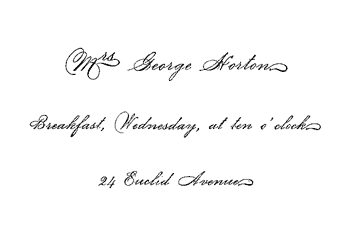
Mrs George Norton. Breakfast, Wednesday, at ten o'clock. 24 Euclid Avenue.
A written invitation is usually in the first person, and should read somewhat as follows:
Dear Mrs. Gracie:
I should be pleased to have the company of you and your husband at breakfast with us, Wednesday morning at ten o'clock.
Cordially yours,
Mrs. George Horton.
Gertrude Horton.
The invitations should be sent out a week or five days in advance, and should be answered at once.
Luncheons, in this country, are very apt to possess much of the formality of a dinner, and are written or engraved, according to the degree of stateliness that is to mark the occasion. Very formal invitations are sent out ten days or two weeks in advance, and are couched in precisely the same terms as a dinner invitation, save that the word "Luncheon" is substituted for "Dinner." Written invitations, also, follow the same plan as those written for dinners, and are not usually issued more than a week or five days in advance. Some ladies use their visiting card, thus: Mrs. Frank E. Wentworth. Luncheon, Wednesday, at one o'clock.
A later hour, say two o'clock, is usually adopted for a more formal affair. Replies should be sent at once that the hostess may be enabled to make up her table.
Teas and “Kettledrums.”
Teas and "Kettledrums," High Tea and Afternoon Receptions, have come to bear a strong resemblance one to another, in fact to infringe so much upon the same territory that it is very difficult at times to distinguish between them sufficiently to apply the appropriate name. A simple affair is announced thus by those ladies who have a regular reception day: Mrs. John St. John. Thursdays. Tea at five o'clock. 40 West 49th Street.
Or: Mrs. John St. John. Five o'clock tea. Thursday, February fifth. 40 West 49th Street.
The words "kettledrum" or "afternoon tea" are not to be used, and these cards may be sent by mail, enclosed in a single envelope. They require no answer. Where the lady has not a regular reception day and wishes to give an afternoon tea, an engraved card, like the following, is usually sent out: Mrs. Arthur Merrill. Miss Merrill. Monday, February third, from four to seven o'clock. 274 Chestnut Street.
In case of the hostess having no one to receive with her, her name would appear alone upon the card. The name of any friend may take the place of a daughter's. Such an entertainment partakes more of the nature of an afternoon reception, or high tea. It may be adapted also to other occasions, such as the introduction to one's friends of a guest who is to make a prolonged stay, as for instance: Mrs. Arthur Merrill, At Home, Monday, December seventh, from one until seven o'clock. To meet Mrs. Frances Elmer. 55 Vine Street.
Invitations like this and the one just above are to be enclosed in two envelopes, same as for dinners and sent out ten days or two weeks in advance.
Kaffee Klatsch.
This furnishes very much the same class of entertainment that is to be found at an afternoon tea, save that coffee is the predominating beverage. The invitation is precisely the same as for teas, simply substituting the words "Kaffee Klatsch."
Suppers.
For the evening supper, invitations are issued in some one of the forms presented for dinner parties, substituting the word "Supper." Answers should be returned at once.
Coming-out Parties.
These special festivities may take almost any form, so that the presentation of the blushing débutante may be at a dinner, ball, reception, evening party or afternoon tea; which latter custom has become very frequent of late. So much is this the case that it is somewhat to be reprehended as rendering afternoon teas too ceremonious in character. There is this in its favor, however; it relieves young girls from the strain incident upon a large party or ball. In some cases, the invitations preserve their usual form (whatever that may be) and the card of the débutante is enclosed in the same envelope. Even this distinction is sometimes wanting. Again, in the case of "At Homes" and "Teas," the name of the young lady is engraved beneath that of her mother; if it is the eldest daughter, the form would be: Mrs. Arthur Holt. Miss Holt.
A younger daughter, under the same circumstances, would pose as: Miss Edith May Holt.
Such cards do not need a reply, but the guest will remember to leave cards in the hall for the débutante as well as her mother or chaperon. It may be said here that, should it for any reason occur that the young lady is "brought out" under the wing of some friend instead of under her mother's care, the relative position their names will occupy on the cards is precisely the same, as: Mrs. D.G. Haviland. Miss Holt.
A more formal presentation would be in the style of an engraved note sheet:
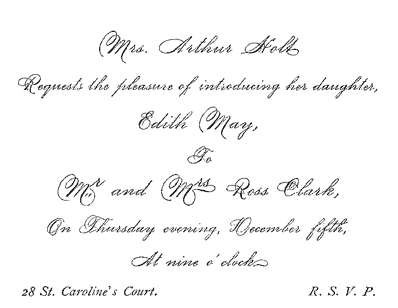
Mrs. Arthur Holt Requests the pleasure of introducing her daughter, Edith May, To Mr and Mrs Ross Clark, On Thursday evening, December fifth, At nine o'clock. 28 St. Caroline's Court. R.S.V.P.
This invitation, of course, implies a large evening party, reception or ball, and should be sent out ten days or two weeks in advance of the event.
Receptions.
Informal receptions and full-dress occasions of the same kind are announced somewhat differently. In the first case the affair partakes so closely of the nature of an afternoon tea that the same form of invitation is used: Mrs. Howard Post, At Home, Tuesday, October second, from four to seven.
If a series of receptions are planned the form would be: Mrs. Howard Post, At Home, Tuesdays in November, from four to six o'clock.
Full-dress receptions are frequently given both afternoon and evening, sometimes in the evening only. Invitations to these should be engraved on square cards or note sheets, and sent out two weeks previous to the reception day. A very good form is:
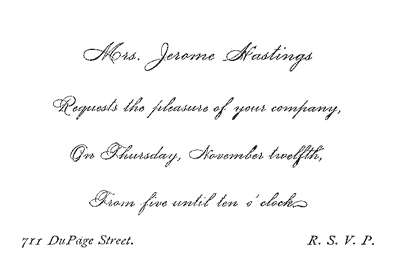
Mrs. Jerome Hastings Requests the pleasure of your company, On Thursday, November twelfth, From five until ten o'clock. 711 DuPage Street. R.S.V.P.
If a daughter or a friend is to assist in receiving, the invitation should include her name also: Mrs. Jerome Hastings, Miss Hastings, At Home, Thursday, November twelfth, from five until ten o'clock. 711 DuPage Street.
When the reception is given by a gentleman, and its object is to enable his friends to meet some distinguished guest, the following form is used: Mr. Howard Post requests the pleasure of the company of Mr. Alonzo Metcalf to meet General E.L. Bates. Union League Club. 100 Cedar Street. R.S.V.P.
Though some prefer placing the name of the honored guest first, according to the form given under dinner invitations. The answer should be:
Mr. Alonzo Metcalf accepts with pleasure Mr. Howard Post's kind invitation to meet General E.L. Bates.
Weddings.
Wedding invitations are issued two weeks in advance, sometimes earlier to friends at a distance, in order that they may lay their plans accordingly. They are engraved in fine script on small sheets of cream note, and the form most used for church weddings is as follows:
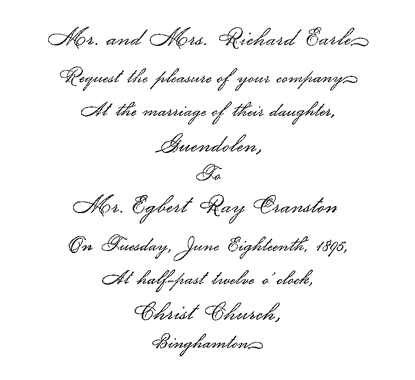
Mr. and Mrs. Richard Earle Request the pleasure of your company At the marriage of their daughter, Guendolen To Mr. Egbert Ray Cranston On Tuesday, June Eighteenth, 1895, At half-past twelve o'clock, Christ Church, Binghamton.
Still another form would give the daughter's name as "Miss Guendolen Earle."
There may or may not be a monogram on the sheet of paper, but, if used there, one to correspond must be placed on the inner envelope also. The envelope, however, may be stamped with a monogram and the paper left plain, this latter style being much in favor. Where the wedding is in church, it is usually followed by an after-reception, cards for which are engraved in some similar form to the following: Reception from one until three o'clock, 107 Washington Street. Or: At Home after the ceremony. 107 Washington Street.
A still more ceremonious invitation to the reception may be issued in the parents' name, and in the usual form of similar invitations, as: Mr. and Mrs. Richard Earle request the pleasure of your company at the wedding reception of their daughter, Guendolen, and Mr. Egbert Ray Cranston, Tuesday evening, June eighteenth, 1895, from nine to eleven o'clock. 107 Washington Street.
If there is reason to believe that the church will be crowded with uninvited guests, admission cards are engraved as follows: Christ Church. Please present this card to the usher. Tuesday, June eighteenth.
How Invitations are Sent.
Several of these cards are usually enclosed for distribution to friends of the invited and for the use of servants that have accompanied guests to the church. This custom is hardly necessary in country towns. All of the cards and the invitation are enclosed in one envelope superscribed with the name only of the person invited, and re-inclosed in another envelope bearing the full address. All formal invitations are to be enclosed in the two envelopes as above; less stately affairs requiring but one envelope; send by mail.
In England, wedding invitations are issued in the name of the mother of the bride only; here custom sanctions the use of the father's name as well. If the invitation is issued in the name of some other relative, then the word "granddaughter," "niece," etc., should be substituted for that of "daughter." If the future home of the young couple is decided upon, "At Home" cards also should be enclosed for all the invited guests that the bride desires to retain upon her visiting list. The following form is appropriate: Mr. and Mrs. Egbert Ray Cranston, At Home, Thursdays in September, from four until six o'clock. 48 Washington Street.
Or, in place of designating especial days, it may read: Mr. and Mrs. Egbert Ray Cranston, At Home, after September first. 48 Washington Street.
Where the list of acquaintances is very large it sometimes happens that a portion of the guests are invited to the church only. When this is the case the reception card is omitted from the envelope; but if a visiting acquaintance is to be maintained, "At Home" cards must be enclosed.
Wedding Invitations.
The home wedding is, perhaps, less stately in appearance, but, involving as it does, less care on the part of friends and less nervous strain on that of the bride, is frequently adopted. The invitations are precisely the same as for a church wedding, merely inserting street and number in place of designating the church, omitting, of course, the card of admittance and that for reception. The "At Home" card of the newly-married couple should always be enclosed lest doubt as to their new address prove perplexing to their friends.
Sometimes, where life is to be commenced in their own home, the wedded pair, soon after their establishment therein, send out "At Home" cards for a few evenings after this style: Mr. and Mrs. Egbert Ray Cranston, At Home, Tuesday evenings in September, from eight to eleven o'clock. 48 Washington Street.
Gatherings such as these partake of the nature of semi-formal receptions and present a delightful opportunity for welcoming friends to the new home, and at same time arranging a visiting list for the season, no one receiving a card to these entertainments that is not to be honored with a place thereon. These invitations are to be sent out after the return from the bridal tour, and, when thus used, the first-given "At Home" card is omitted in sending out the wedding invitation.
If the wedding is to be a morning affair from the church, followed by a breakfast, the first given invitation is issued and the following engraved card enclosed in the same envelope: Mr. and Mrs. Richard Earle request the pleasure of your company at breakfast, Tuesday, June twentieth, at half past twelve o'clock. 107 Washington Street.
"At Home" cards and cards to the church should be enclosed as before. The time should be carefully arranged so that not more than half an hour is allowed to elapse between the ceremony at the church and the reception or breakfast at the house.
A home wedding with a breakfast simply sends out the ordinary wedding invitation, indicating the hour and giving the street and number.
Sometimes, at a home wedding, it is desired that no one but relatives or very particular friends should be present at the ceremony. Under these circumstances the usual invitations are issued. Then, for the favored few, ceremony cards are enclosed, on which the words are engraved: Ceremony at half past eight.
"At Home" cards may be enclosed as before.
Where the wedding has been entirely private, the mother, or some other relative of the bride, frequently gives a reception upon the return home of the young couple, invitations to which are issued as follows: Mrs. Richard Earle, Mrs. Egbert Ray Cranston. At Home, Wednesday, September first, from four to ten o'clock. 107 Washington Street.
For an evening reception the form is a little different: Mr. and Mrs. Richard Earle request the pleasure of your company, Thursday, September second, from nine to eleven o'clock. 107 Washington Street. Enclosing the card of Mr. and Mrs. Egbert Ray Cranston.
Announcement Cards.
Announcement cards, where the wedding has been strictly private, are sent out after the following style: Mr. and Mrs. Richard Earle announce the marriage of their daughter, Guendolen, to Mr. Egbert Ray Cranston, Tuesday, November nineteenth, 1895. 107 Washington Street.
The before-given "At Home" cards may be enclosed, or the necessary information conveyed by having engraved in the lower left hand corner of the sheet of note paper: At Home, after December first, at 48 Washington Street.
Another form of announcement is also used: Egbert Ray Cranston. Guendolen Earle. Married, Tuesday, November nineteenth, 1895. Binghamton. With this form use "At Home" cards, or engrave the street and number in the lower left hand corner of the announcement card. This form is permissible in any case, but is more frequently employed where there are neither parents nor relatives to send out the announcement.
If the wedding should have taken place during a season of family mourning or misfortune, the bridegroom himself issues the following announcement: Mr. and Mrs. Egbert Ray Cranston, 48 Washington Street.
These cards are large and square, and in the same envelope with them is enclosed a smaller card engraved with the maiden name of the bride: Miss Guendolen Earle.
Wedding Anniversaries.
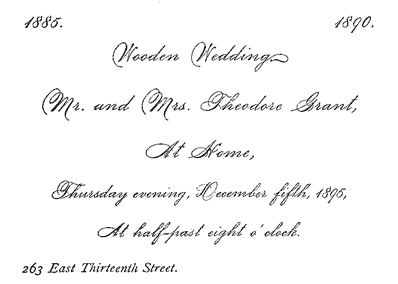
1885. 1890. Wooden Wedding. Mr. and Mrs. Theodore Grant, At Home, Thursday evening, December fifth, 1895, At half-past eight o'clock. 263 East Thirteenth Street.
In sending out invitations for the various anniversaries that pleasantly diversify the years of a long wedded life, the simplest form will always be found in the best taste. There are varied devices for rendering these invitations striking in effect, such as silvered and gilded cards for silver and golden weddings, thin wooden cards for the wooden wedding, etc., but good taste would indicate that none of these, not even gold and silver lettering (though this last is least objectionable of all), should be used. The large engraved "At Home" card, or the small sheet of heavy note paper, also engraved, are the most elegant.
“No Presents Received.”
The words, "No presents received," are sometimes engraved in the lower left hand corner of the note sheet, or card. A much-to-be-admired custom, since the multiplicity of invitations requiring gifts, is, in more cases than one, burdensome to the recipient.
Revise the Visiting List.
Now, that it has become the custom to engage the services of an amanuensis to direct the invitations for a crush affair by the hundred, it would be well for every hostess to frequently revise her visiting list, in order that the relatives of lately deceased friends may not be pained by seeing the dear lost name included among the invitations of the family; also, this care is necessary to remove the names of those who have recently departed from the city, and those whose acquaintance is no longer desired.
THE essence of all etiquette is to be found in the observance of the spirit of the Golden Rule. Perhaps in no one point is the "do unto others as ye would that they should do unto you," more applicable than in the prompt acknowledgment of either a formal or a friendly invitation. This acknowledgment may be either denial or assent, but whatever the form, it is requisite that the proffered courtesy should be answered by a prompt and decisive acceptance or refusal. This is a duty owed by an invited guest to his prospective host or hostess and one that should never be neglected.
Answering an Invitation.
In accepting or declining an invitation close attention should be paid to the form in which it is written and the same style followed in the answer. For instance: should the invitation be formal, the answer should preserve the same degree of formality; while a friendly invitation in note form should meet with an acceptance or regret couched in the same terms. Another rule to be rigidly observed is, that the acceptance or refusal must be written in the same person that characterized the invitation. For instance: if "Mr. and Mrs. Algernon Smith request the pleasure of the company of Mr. and Mrs. Joseph Bronson at dinner, etc.," with equal stateliness "Mr. and Mrs. Joseph Bronson accept with pleasure the kind invitation of Mr. and Mrs. Algernon Smith." To do otherwise would imply ignorance of the very rudiments of social or grammatical rules.
A friendly note of invitation, beginning somewhat after this fashion: "Mr. Smith and I would be pleased to have you and Mr. Brown, etc.," would be accepted or declined in the same fashion and person, as: "Mr. Brown and I accept with pleasure your kind invitation, etc." To answer such an invitation with a formal acceptance, or regret, written in the third person, as given above, would display profound ignorance of social customs.