Visiting Cards. (continued 4)
Reading edition
How to eat soup, or partake of grapes, and what to do with a cherry stone, though apparently trivial in themselves, are weighty matters when taken as an index of social standing. And it is safe to say that the young man who drank from his saucer, or the young woman who ate peas with her knife, would court the risk of banishment from good society.
In regard to the first essentials of table manners we are bound to consider the laying of the table, the manner of being seated thereat, the use of the napkin, the proper handling of those most invaluable implements, knife, fork and spoon, together with a short dissertation on those older implements, "Adam's knives and forks."
The Breakfast Table.
This first repast of the day should always be daintily and appetizingly spread, and the etiquette there observed, as at all other meals of the day, should be of a nature to render the observance on more stately occasions second nature to the members of the family. Children so trained will find little difficulty in after days as to their table etiquette.
The table itself should be spread with clean linen, first overlaying the surface with a sub-cloth of double canton flannel, felting, or a white blanket that has seen its best days of usefulness. This is done for the better appearance of the table linen, for the deadening of sound, and the protection of the table from the heated dishes. The table linen for home use need not be of the finest; cleanliness being, after all, the chief requisite.
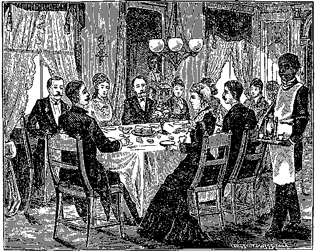
ETIQUETTE OF THE TABLE.
Before the mistress of the house stands the tray covered with a large napkin, or a prettily etched tray-cloth. This is filled with cups and saucers. The coffee-urn is at her right hand with cream, sugar, spoons, and waste-bowl convenient. In front of the master of the house is spread a large napkin with the corner to the center of the table. An ornamental carving cloth may be used in its place. On this is placed whatever dish of meat it is his province to serve. On the opposite side of the table dishes of bread and any hot breakfast rolls or gems balance one another. The dish of potatoes stands close to, and at the right of, the platter, ready to be served with the meat. Any other vegetable served at the same meal should be placed at the left of the platter.
Mats are wholly a style of the past. Where the dish is very hot, or liable to soil the cloth, fringed squares of heavy linen, etched or embroidered, take their place.
The castor, too, is banished from tables polite, and its place may be taken by a few flowers, or bits of vine, in a simple vase. The butter dish and the individual butters should be placed by the side of the one who is to serve it. Fancy sauce and vinegar cruets, and salts and peppers are grouped at each end of the table, sometimes on small trays of hammered brass.
Knives, Forks and Napkins.
Heated plates are placed before the carver, and the carving knife (well sharpened) and fork are placed, with their rest at his right. On any occasion when plates are laid at each place, turn them face up. To the right of the plate is the knife with edge turned from the person to use it. As to the fork, authorities differ, some contending that it should be placed on the right hand, and the knife next, with sharp edge turned from the user. This latter fashion is best at simple meals where but one knife and fork are used. Others contend that the fork should be laid at the left. This latter fashion should be followed where several knives and forks are necessary for an elaborate dinner.
The simply-folded napkin is at the left hand. The glass and individual butter plate are placed near the point of the knife. To avoid waiting where there is any haste, the butters may be filled before the family are seated.
If oatmeal, or any porridge, is to be served, the dish should be placed upon the table before the house mistress, together with the requisite number of small bowls, or saucers, in which she serves it, adding sugar and cream, or passing these, as seems best to her. Afterwards these plates and the dish itself should be removed, when the hot plates and the remainder of the breakfast should be brought in.
Where there is fruit, as is the case in very nice homes, it is to form a third course; all other dishes are to be removed before the fruit is placed upon the table, and each person provided with a small plate with a doily, or fruit napkin, laid upon it, a silver fruit knife, and possibly a finger-bowl set upon the doily; also a teaspoon or orange-spoon when oranges are on the table. If berries are served fruit saucers will be required. In busy homes the fruit is frequently placed upon the table at the beginning of the repast and served at its end without change of plates. Many persons prefer to begin their breakfast with fruit. The napery at breakfast may be colored if so desired.
The Dinner Table.
The dinner table for home meals is laid very much after the fashion of the breakfast table with the omission of the server. If there is to be more than one course, such as a salad, another fork must be added, in which case it will be best to place the forks at the left of the plate. If there is fish, another extra fork, or else the appropriate little fish knife and fork, is demanded. If a fork only is used, the flakes of fish may be pushed upon the fork by means of a bit of bread.
A half slice of bread should lie in, or beside, the folded napkin. The soup tureen is placed before the mistress of the house, together with the soup dishes. Into each of these she puts a ladle full of soup and passes it along. Where there is a servant to wait, he, or she, takes each dish from her hand and serves those at table, always passing to their left hand in so doing. When the soup is removed, the under plates should also be taken and hot plates brought in for the next course.
The meat is placed before the carver, dishes of vegetables flanking either side. The plates are filled and passed, or else handed around by a servant. Sometimes the meat only is put on the plates and the dishes of vegetables are passed from one to another at the table or handed around by a servant. Do not place a quantity of small vegetable dishes at each plate; it is too suggestive of hotel and restaurant life; peas and some other similarly cooked vegetables are an exception to this rule. Side dishes, such as pickles, etc., are placed on the table when it is first laid.
If a salad is to form the next course, all the dishes should be carried out, the meat being taken first, then the dishes of vegetables, after that, plates and butter plates. A tray is much better to transfer all articles except large platters. Never permit a maid to scrape the contents of one plate into another, with a clatter of knives and forks, and then triumphantly bear off the entire pile at once. The salad is to be eaten with a silver fork, and is served with rolls or biscuit. Where the home dinner is simple the salad is frequently served in small dishes and passed during the progress of the repast.
Before dessert is brought on, all table furniture should be removed save glasses and water bottle, and the cloth brushed free from crumbs with crumb-tray and napkin, or scraper, in preference to a brush, which is apt to soil the cloth. The dessert is then to be placed on the table and the mistress serves the pastry or pudding on small plates or saucers which are placed before her. Tea, coffee, or chocolate, may now be handed around, but never sooner. At a very ceremonious dinner they appear last of all.
If fruit is to follow the pastry, fruit plates, arranged as for breakfast, must be substituted for the dessert plates, as soon as the guests are done with these.
It is to be expected that each family will adapt the above outline to suit their own needs, omitting such features as they have neither time to devote to nor servants to accomplish. The ideas here given, however, are suitable as the nucleus of the most elaborate dinner, or may be simplified to fit the plainest repast.
The Supper Table.
The table for supper is laid very much after the general plan given for breakfast, with the exception of the oatmeal. If the tea is made at the table, which is the daintiest way, the other adjuncts of the tray must be supplemented by a dainty brass or bronze hot-water kettle swung over an alcohol lamp, and a pretty tea caddy. Lovely silver caddies, with lock and key, are to be had and make an appropriate wedding gift. A "cosy" or thick wadded cap for setting over the teapot, to keep the heat in, is another pretty essential, which may be made as ornamental as is liked. At supper cold meats are usually served, and cake is taken with the fruit, while vegetables, unless those served in salad form, are omitted.
The Lunch Table.
In cities, the lunch takes the place of the twelve o'clock dinner, just as the late city dinner replaces the supper, dear to country hearts.
The table for lunch is laid much like that for supper, the dishes being all placed at the table at one time, and the ladies of the family, for to them it is usually devoted, gathering around it without the formality of a servant.
Signs of Ill-Breeding.
The order of laying the table, and serving the dishes having been given, it now remains to give some information as to the conduct of those at the table. This is rendered more necessary from the fact that many well-dressed, and apparently well-bred people, sin so grievously against the simplest laws of table etiquette, as not only to display their own want of breeding, but to actually annoy those about them by their sins of omission and commission.
The most important table implements are knife, fork, and spoon, and with these we begin, in the order of their prominence.
The Fork.
The fork having, as one writer happily suggests, "subjugated the knife," demands our first attention. The subjugation of the knife is so complete in this country, England, France and Austria that any attempt to give the knife undue prominence at table is looked upon as a glaring offense against good taste. This aversion to the use of the knife probably arose first from the more agreeable sensation to the lips that is produced by the delicate tines of a fork in contrast to the broad blade of a knife. Also the fact that the steel of which knives were, and are still, to some extent, made, imparts, by contact, a disagreeable flavor to many articles of food.
In the use of the knife and fork daintiness should be cultivated. They should be held with the handles resting in the palms of the hands when cutting, or separating food; but, in conveying food to the mouth, the handle of the fork should not be kept against the palm, as to do so would give it an awkward appearance in lifting to the lips. Fork and knife should be held firmly but without any apparent exertion of strength.
Never strive to load the fork with meat and vegetables at the same time. To do so is to commit an offence against manners and digestion, and never push the food from the fork with the knife. Take upon the fork what it will easily carry and no more.
Oyster forks are usually provided when oysters on the shell are served. Either the right or the left hand may be employed in lifting them to the lips. The shell should be steadied with the other hand. The fork may be handled with either hand, the right being more generally used. It is well, however, to be trained in the use of both hands, thus avoiding the slight awkwardness attending the constant changing of the fork from one hand to the other.
THE CORRECT POSITION FOR HOLDING KNIFE AND FORK.
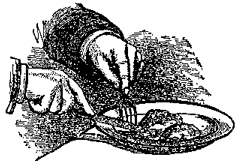
In using the fork in the left hand it should be lifted to the lips, tines pointing downward. The fork, which should convey but a very moderate amount of food, should always be carried to the mouth in a position as nearly parallel to it as possible. This does away with the thrusting motion and the awkward sweep of the elbow that is so annoying to the onlooker.
The fork is also used to convey back to the plate bits of bone or other substances unfit to swallow. Eject them quietly upon the fork and quickly deposit them upon the edge of the plate.
The softer cheeses are eaten with a fork. As to the harder varieties, some use the fork and others break with the fork and convey to the mouth with the fingers.
Use the fork to break up a potato on your plate; do not touch it with the knife. Ices, stiffly preserved fruits, etc., are all eaten with a fork. In fact, the fork is to convey all food to the mouth that is not so liquid in its nature as to require the use of a spoon.
The Spoon.
The spoon comes next as an article of importance at the table. Soups, all thinly cooked vegetables, canned and stewed fruits, peaches and cream, melons, oranges by some, very thick chocolate, Roman punch, and other dishes that common sense will dictate at the moment, are to be partaken of by its aid. One should drink tea and coffee, however, and not spoonful it. Use the teaspoon to gently stir up and dissolve the sugar in the cup, then lay it in the saucer and lift the cup to the lips by the handle. Never be guilty of leaving the spoon in the cup and compassing it with one or more fingers in carrying it to the lips.
In partaking of soup the spoon should be swept through the liquid away from the person, lifted to the mouth, and the soup taken noiselessly from the side of the spoon. In thus lifting any liquids from the further side of the dish, or cup, there is time for any drop adhering to the outside to fall in the dish before carrying to the lips.
Only to gentlemen possessed of a luxuriant mustache is it permitted to take soup from the point of the spoon, always providing they can do so skilfully and without an awkward use of the arm. The gold or silver spoons for after-dinner coffee are very small, as befits the dainty cups of egg-shell china.
The Knife.
Properly, the knife may be said to have no use at the table save to assist the fork in separating food into morsels fit for mastication. Never, no, never, permit it to be introduced into the mouth upon any occasion whatever. To do so is the height of ill-breeding.
Adam’s Knives and Forks.
There are a number of things that the most fashionable and well-bred people now eat at the dinner table with their fingers. They are: Olives, to which a fork should never be applied; asparagus, whether hot or cold, when served whole, as it should be; lettuce, which, when served in whole leaves, should be dipped in the dressing or in a little salt; celery, which may be properly placed upon the tablecloth beside the plate.
To these may be added strawberries, when served with the stems on, as they are in most elegant houses. Dip them in cream and then in sugar (sometimes sugar only is served), holding by the stem end and eating in one or more bites, according to size.
Bread, toast, and all tarts and small cakes; fruit of all kinds, except melons and preserves, which are eaten with a spoon; cheese, except the softer varieties; all these are eaten with the fingers, even by the most fastidious people. Even the leg, or other small piece of a bird is taken up daintily in the fingers of one hand at fashionable dinners.
Water cress is taken in the fingers. It is usually served upon a shallow dish or a basket, a fringed napkin covering bottom and sides. Artichokes, also, are eaten with the fingers. Lump sugar may be taken with the fingers, if no tongs are provided. If a plate of hot, unbroken biscuit is passed, one may be broken off with the fingers.
Napkin and Finger-Bowl.
Napkins vary in size, from the diminutive, fancy doily, for ornament rather than use, through all gradations, up to the largest sized dinner napkin. In using these do not spread over the entire lap, nor fasten under the chin bib-fashion, nor in the buttonhole, and, if a man, do not tuck in the vest pockets. All these are fashions which should have been outgrown in the nursery. Simply unfold and lay carelessly in the lap on one knee, use to wipe the lips lightly, or the finger tips when necessary.
Some very exquisite people manage to eject fruit seeds, or skins, or anything unfit to swallow, from the lips into the napkin, by pressing it against the mouth, then dropping them skilfully from its folds upon the plate. All such careful observances tend to remove, as much as possible, from the modern repast, the prosaic, and unromantic ideas suggested by the idea of eating.
Finger-bowls are brought on the table after the dessert is removed and before the fruit is served. They are usually placed before each individual on the fancy glass or china plate that is to be used for the fruit, a fancy doily being laid between the bowl and plate. Remove bowl and doily at once to the right hand side, leaving plate free for the fruit. This doily is frequently an elaborate article of fancy work, not for use but ornament. Hence, unless its place is taken by a fruit napkin or smaller napkin, as is sometimes done, passed around before dessert, the dinner napkin is used.
Avoiding Fruit Stains.
Some hostesses dislike to have fruit stains upon their elegant dinner napkins; hence, the custom of supplying smaller napkins at the beginning of dessert. This, however, cumbers the dinner with much serving and is not to be recommended. If done, the smaller napkins are to be passed around, and the large ones permitted to remain.
At the close of the dinner the napkin is not to be folded, but left lying loosely at the side of the plate. If a guest in the house, however, unless fresh napkins are supplied at every meal, they should be folded and placed in the napkin ring.
The rule for using napkins is that they be touched gently to the lips, and the finger-tips wiped daintily upon them, but as "nice customs courtesy to great kings," so, to those gentlemen possessing luxuriant mustaches, a greater freedom is permitted in its use.
The finger-bowls are to be two-thirds full of slightly warmed water, and a rose geranium leaf or a slice of lemon should float upon the surface of each. The fingers of one hand at a time are to be dipped in the water, rubbing the leaf or lemon between them to remove any odor of food, and then dried upon the napkin.
Sometimes, after partaking of meats, one may dip a corner of the napkin in the finger-bowl, and, allowing it to drop back of the dry portion of the napkin, wipe the lips with it. A gentleman is permitted to moisten and wipe his mustache in the same manner. Remember, always to exercise the greatest care not to have the operation a very visible one, as it is not particularly attractive to the onlooker.
A small glass of perfumed water is sometimes placed in the center of the finger-bowl for this purpose. Lift it to the lips and sip slightly, being careful not to have the appearance of taking it for a beverage, and immediately dry the lips upon the napkin.
While eating meats, etc., use the napkin before touching the lips to a glass, else the crystal edge may present a very disagreeable spectacle to one's neighbors.
General Table Etiquette.
In seating one's self at table, assume a comfortable position, neither so close as to be awkward, nor so far away as to endanger the clothing by dropping food in its passage from table to lips. Sit upright, and do not bend over to take each mouthful of food.
If a gentleman is accompanied by a lady, he should draw her chair out from the table, and, when she is seated, assist her in putting it back in position, unless in some public dining place, where this office will be assumed by a waiter.
On being seated, remove the roll, or piece of bread, from the napkin (the best form for this bread is in blocks four inches thick and about three inches long), unfold the napkin, lay it upon the knee, and quietly wait your turn to be served. Never handle, or play with, any articles on the table; it bespeaks ill-breeding. Never drum on the table with the fingers.
As soon as a bowl of soup, or a plate of oysters is offered you, begin, without any appearance of haste, to eat. This facilitates serving, as, by the time the last are served, the first will have finished their half-ladleful of soup (which is all that society allows) and the waiter may begin to remove the first course. The old custom of waiting until everyone was served before beginning is no long countenanced, since "soup is nothing, if not hot," and by waiting it is decidedly cooled.
Never, unless requested so to do, pass a plate on to a neighbor that has been handed to you. It is supposed that the carver knows what he intends for each guest. When dishes are passed, help yourself as quickly as possible, and never insist upon some one having it first. If a gentleman, you may help the lady next you from its contents, if she so desire.
Always take the food offered in a course. Quietly wait and talk while others eat, rather than call the attention of the table to your likes and dislikes, and disarrange the whole order of serving. If a gentleman, see that the lady you have brought down wants for nothing, and let the lady, on her side, take care not to entirely monopolize the attention of her escort.
How to Treat Waiters.
If, for any cause, the services of a waiter are desired, catch his eye quietly, and on his approach, state your own or the lady's wishes, in a low tone of voice. This same rule of conduct will apply to public places, where the knocking of spoons against cups, and other noisy attempts to gain the attention of a waiter cannot be too greatly discouraged.
Never thank a servant for passing any of the dishes or wines; that is his business; but for any personal service, such as picking up a fallen napkin, or replacing a dropped knife by another, it is proper to return a murmured "Thank you," not "Thanks."
A lady should never look up in a waiter's face while giving an order, refusing wine, or thanking him for any special service. This savors of familiarity, and should be avoided. A man, however, that is attentive will see that a lady has none of these things to do.
At table one may talk to one's neighbor on either side, or to those directly opposite, if the center decorations are not too high; but it is absolutely ill-bred to lean across an individual to converse with some one on the other side. Of course, at a small dinner, or at the family table, conversation is expected to be general. Never attempt to converse while the mouth is filled with food, and never have the mouth filled with food; it is bad both for manners and digestion.
Decline any dish passed that you do not wish with "Thank you, not any;" if by a waiter, "Not any," is sufficient. Do not enter into any explanations as to your tastes, nor the whys and wherefores of your refusal. That interests no one but yourself.
If wine is served, do not call the attention of everyone to the fact that you do not drink it. The table of a friend, to which you have had the honor of an invitation, is no place for a temperance lecture. Do not reverse the glass; it is a needlessly conspicuous act; simply motion the waiter away with your finger on the edge of the glass, or shake your head. Some, still more careful, allow a glass to be filled for them at first, and, by letting it stand untasted, show to the waiter that further offers are useless. If a lady does not wish more wine than remains in her glass, let her make a little motion of dissent when the waiter is about to replenish it, otherwise a good glass of wine is wasted. In drinking wine, lift the glass by the stem, instead of by the bowl. Young ladies, if they drink wine, had best content themselves with one glassful. "Rosebuds" should not indulge. The latest dictum declares that sparkling wines should be drunk at once and not sipped.
Sundry Rules and Hints.
Never display any hesitation in selecting food. If your host asks what part of a fowl you prefer, at once give your choice. To say you have none is an annoyance. Never tip the plate in order to dip up the last spoonful of soup. In partaking of soup, or imbibing any liquid, do so noiselessly. Be sure not to spread the elbows while using knife and fork. Keep them close to your side while cutting meats.
Never try to dispose of the last mouthful of soup, the last morsel of food. "It is not expected," says one writer, "that your plate should be sent away cleansed by your gastronomic exertions." On no account cool any drink or soup with the breath. Never pour tea or coffee into the saucer to cool it. Never drink from the saucer; it is an unpardonable sin.
With salads small knifes and forks are often furnished, where the salad is served uncut with dressing. Again, the uncut leaves are taken in the fingers and dipped in the salt or dressing. The roll is to be eaten with the salad.
Individual salts are an American fashion. If used, it is proper to take salt from them with the knife, if they are the open salts. In the most stylish circles great favor is shown to ample silver salières with their accompanying salt spoons or shovels. Salt, thus taken, should be deposited upon the left hand rim of the plate. The custom followed by so many of depositing little piles of salt on the tablecloth is very annoying to the hostess, as giving her table a shabby look during the removal of courses. Salt is the only condiment placed upon the table at a dinner; the others are passed with the course demanding their use. Neither is butter put upon the table at an elaborate dinner: the small square of bread or the roll furnished, are to be eaten without.
Use of Knife and Fork.
Peppers and salts are to be shaken with one hand. Never use the other to in any wise expedite the distribution of their contents.
Never cut up all the meat on your plate at once, in morsels fit for eating; to do so savors of the nursery. But, on the other hand, do not seem to be perpetually using your knife and fork at table. Be sure not to insert fork or spoon too far into the mouth. Never turn the spoon over in the mouth in the effort to free it entirely from its contents. Do not let the most adhesive of food betray you into this most disagreeable of habits. Take small mouthfuls and there will be less danger of this occurring. Handle knife and fork carefully, so as not to cause any unnecessary clatter at table.
Waiters pass all food to the left, and all dishes are removed at the left. Wine is passed at the right. All dishes that are being passed must be held low enough so that the guests can help themselves without difficulty.
When there is a waiter to remove the dishes from the table, the guests should never assist in the work by piling small dishes, etc., upon their plate. Simply place knife and fork upon the plate.
In passing the plate for a second helping, remove knife and fork and hold easily by the handles. Never ask for a second helping of soup, or of anything at a course dinner. At an informal repast, where there is but one principal dish, it is proper to pass the plate for more. A second helping of fish chowder is allowable, but not of soup.
Food should be masticated quietly, and with the lips closed. Drink all liquids without the slightest sound.
Never butter bread that is to be eaten with soup. To do this is only less vulgar than to thicken the soup with the crumbs of bread. Simply eat the bit of bread with the soup. Take the soup that is brought you, even if you do not care for it, so as not to interrupt the order of the dinner by a refusal.
Disgusting Habits.
Lift cups by the handles, and wineglasses by the stem, and do not tip them up, until almost reversed upon the face, in order to drain the last drop. It is not necessary, and really bad form to completely empty a wineglass.
Never pick the teeth at the table. Such habits are well calculated to disgust sensitive people, and should be performed in private as much as any other portion of our daily toilet.
Never rinse the mouth with the last mouthful of coffee, tea or water; nothing can be more disagreeable.
Bread should be broken by the fingers in pieces sufficient for mouthfuls, as it is needed. Never butter a slice and cut with a knife; butter each piece as needed. Butter should never be eaten in large quantities.
Cake is broken in bits and eaten from the fingers. Very rich, crumbly, or filled cake may be eaten with a fork; tarts also, unless they are of a nature to permit the use of the fingers, and pastry of all kinds, as well as puddings not too liquid in form.
Muffins can be eaten from the plate with a fork, or they can be torn apart, buttered, and eaten while held in the fingers, like toasted bread. Hot gems can be torn apart and partaken of in the same way. Never take one piece of bread or cake and then reject it for another.
If any little accident should occur at table, do not apologize for it; let it pass without note, and it will be apt to escape observation. If there should be anything accidentally spilled upon the cloth, the waiter should quickly remove the traces, and spread a fresh napkin over the soiled spot.
Fruits.
Apples are pared with a silver knife at table, and eaten in small sections from the fingers. There is often much time devoted to paring fruit by holding it on a fork, not touching it with the fingers. This is unnecessary, unless when a gentleman is preparing the fruit for a lady, or where the peach or pear is too juicy to do otherwise.
Grapes are plucked from their stems and the pulp squeezed into the mouth, while the fingers hold the skin which is then laid on one side the plate. This is far daintier than to put the fruit in the mouth and then eject the skin into the hand or upon the plate. Bananas are peeled and eaten from the plate with a fork. Oranges are skinned, divided into sections, and eaten from the fingers, rejecting the seeds into the hand. Some prefer, however, to cut the end of the orange and eat the pulp with a spoon. Pineapple is the only fruit that must be eaten with a knife and fork.
Silver knives and forks must always be used with fruits, as steel becomes colored by contact with the fruit juices and imparts a disagreeable flavor.
Green corn, in ear, is a stumbling-block, and perhaps one's best plan would be to conform to the custom of the table where you may be. In eating it directly from the ear hold it in one hand only. Some hostesses provide small doilies with which to hold the ear.
If a guest is pleased with any particular dish on the table, a delicate compliment upon its unusual excellence is always pleasing to the hostess.

THE evening party may be as elaborate or as simple an affair as the hostess may desire. In its elaborate form it only differs from the ball in the one respect that dancing may, or may not, be introduced as a feature of the entertainment, while a ball is given for the express purpose of dancing, and is always so understood.
Invitations.
Invitations for an elaborate evening party are sent out ten days or two weeks in advance and are issued in the name of the hostess alone. Husband and wife may be invited together, addressing the envelope to "Mr. and Mrs. John Doe;" and daughters, if there are several, may be included in one invitation as "The Misses Doe." Sons, if there be more than one, receive separate invitations, though they can be included in one as "Messrs. Doe." But friends, even though sheltered by the same roof-tree, must receive separate invitations. To invite "The Misses Doe and Roe," or "Messrs. Brown and Green," or even "Mrs. Doe and Family," would be in bad form. To invite the husband to any entertainment where there are ladies without including the wife would be a direct insult. Invitations may be sent by post or carried by messengers. (For forms see Department of "Invitations, Formal and Informal.")
Society is so complex, and there is so much ground to cover in picking up its relations that many ladies are tempted to pay off all social debts at once by giving one great crush of an entertainment and inviting all those to whom they are socially indebted. To all these one is tempted to say, "Don't." The labor is less and the pleasure greater where two or more smaller entertainments are given at different times.
A hostess is at liberty to invite only those to whom she is socially indebted, and members of a large social circle from whom she has not received recent hospitalities must not feel hurt at being left out. Where the family is large she may invite some members and not others, but should she courteously invite the entire group, it is a rule of society that never more than three members of the same family should accept an invitation to the same entertainment. Either accept or decline such invitations at once. (For proper forms see department of "Acceptances and Regrets.")
Receiving.
At a large evening party the arrangements for receiving guests, the dressing rooms, etc., and duties of the hostess in receiving, are the same as at a ball, and the supper served in the same fashion.
Ladies invited to help receive are not simply asked as a compliment to their friendship. It is not their sole duty to stand beside the hostess for the hour of coming and smile and shake hands with each guest and then see no more of them that evening. When a lady issues invitations for a large evening gathering she usually decides to ask some intimate friends "to receive with her."
If she expressed what she really meant, and what she supposes her friends understand, she will say: "Will you come and help me in the actual entertaining of the guests, for I shall have only time to stand at the door and say, 'How do you do;' 'Good-by.'" But no, she phrases it conventionally: "Will you come and receive with me?" And so they come in a flock and do nothing but "receive."
Should Make Every One Happy.
A woman who is invited "to receive" should arrive at the hour of the invitation, not one minute before, unless for some especial reason she is requested to do so by her hostess. She should remove her wraps and quietly join her hostess in the rooms below, where, probably, she will have a cup of hot bouillon brought to her at once and maybe a glass of wine. For a half hour or so she should stand with the hostess and only take upon herself the task of greeting, but, as the rooms begin to fill, she should leave her place and go slowly about the rooms, not talking and visiting with friends, and having a good time herself, but passing by the groups of gay and lively ones, who know every one and seek out the solitary and alone. To these is her especial mission, to make them known to some of her own intimates, whose friendship is so certain and so warm that it will stand this demand of introducing a stranger.
An acquaintance is not necessary for this giving of attention. A member of the receiving party may speak to any one in the room without even the form of introducing herself, although, if she sees after a few words that she is unknown she will bring her own name casually into the conversation, making no effort to do so. Any guest will feel flattered on being addressed by the ladies receiving.
Making Things Easy for the Hostess.
Another duty she owes is keeping her eyes on the hostess and seeing that she is never left alone for one single moment in her position by the door. One of the receiving party ought to be beside her constantly ready to execute any wish she may express, as, for instance, if she say: "I see Mrs. K. coming down the stairs; she is a perfect stranger; see that she meets a few—Mrs. Blank, especially." She will greet Mrs. K., chat a second, and quietly draw her to one side continuing the conversation all the time. Then seeing somebody near she will say: "I want you to know Mrs. So-and-So; come over here and let me introduce you." Then she may leave Mrs. K. and look after some other awkward one near, and, after a few minutes, taking some one else up to where Mrs. K. and Mrs. So-and-So still stand, make them known. If Mrs. So-and-So has a kind heart, by this time she will have made Mrs. K. acquainted with some one else. The lady receiving should keep an eye on Mrs. K., particularly if she seems to be afraid to move from one spot, as strangers sometimes are.
Meantime, another member of the receiving party notices that the hostess is alone, and she leaves her acts of mercy and returns to her post, ready to assist in any way. To have such a little group of friends transform themselves into willing slaves for the moment makes the art of entertaining no trouble or fatigue at all.
Think of the utter loneliness to the stranger of entering the drawing-room to be greeted by the hostess and handed down a long line of the receiving party and then left to "that bath of loneliness amidst the multitude," which has its terrors for us all. It is over such strays as this that the receiving party is supposed to have most careful oversight, since to the hostess comes small leisure for this duty.
Entertainment.
Before supper, cards, conversation, music are made use of to entertain the guests. When dancing is a feature, it does not begin until after supper, and while this amusement is in progress opportunity for conversation, games, etc., should be provided in other rooms for those who do not dance. Rules for going out to supper at a large party are the same as those at a ball.
Duties of the Guests.
If music is one of the features, try and suit its character to the company. Do not play classical music where it cannot possibly be appreciated, and, above all, attempt nothing that cannot be executed perfectly. In singing, let gentlemen remember that if it is an amusing song they are to render, it must be perfectly unexceptional in character. Ladies should bear in mind in singing that it is much better taste in large assemblies to avoid the purely sentimental order of songs, which, with the large number of beautiful compositions at our disposal, is easily done.
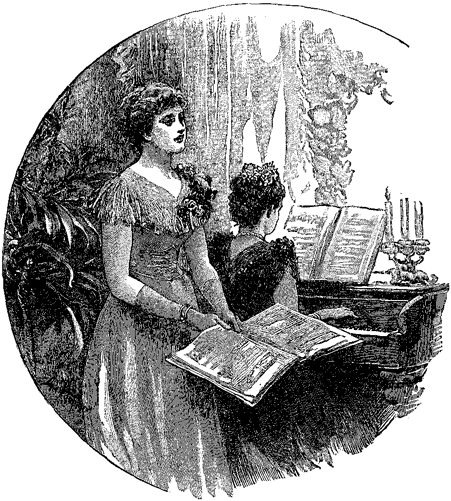
ENTERTAINING THE GUESTS WITH A SONG.
Observe scrupulous silence while others are playing and singing. If you possess any musical accomplishments, and are asked to contribute your share toward the entertainment of others, do so without waiting to be urged; or, if you decline, decline absolutely. Urging should not be resorted to by the hostess, which custom would soon cure a certain class of performers from the disagreeable habit of holding back for repeated solicitations. If you consent to play or sing, do not weary your audience. Two or three stanzas of a song, or four or five pages from a long instrumental piece are sufficient. If more is greatly desired it will always be called for.
Remember, it is only the lady of the house who has the right to ask you to play or sing, and to all other requests give a smiling refusal.
Beware of too Much Reserve.
Remember also, that, for the time being, owing to your mutual acquaintance with the host and hostess, you stand on a perfect equality with all the guests present and should, therefore, without further preliminaries, converse freely with any.
Never commit the blunder of stealing away to a side table, and there affecting to be absorbed in some volume of engravings, or finding some unlucky acquaintance in the room, fasten upon him or her for the entire evening. These are social crimes that no shyness can or should excuse.
Where the party is a small social gathering and various parlor games are resorted to for amusement, one should always join in when asked, even while not caring so to do. Exercise skill, appear pleased, and while, perhaps, not enjoying the evening greatly one's self, there will be at least the consciousness of having contributed to the happiness of others. In reality, there is no better field for employing the Golden Rule than in the whirl of social life—no wider field for unselfishness.
A superficial knowledge of the etiquette and rules that govern the various social games of cards will be found a great advantage in society, since, if one does not dance or play cards, he will be forced to content himself with other wall-flowers like himself. A gentleman should never let even urgent solicitation induce him to play for stakes at a party. There is a code of right and wrong beside which the code of society has no weight.
Hours of Arrival and Departure.
An evening party usually begins about nine p.m. It is supposed to end about midnight unless the devotees prefer to remain later. Some, who do not care for this amusement retire immediately after supper.
When to leave at a ball is a very elastic rule which varies to suit the circumstances of the case. To leave as soon after supper as may be or to stay until the ball is actually over, are equally correct courses to follow. Half past one is a very good time to depart. Here in this busy country where the gallants of the evening will be the business men of the morrow, earlier hours are usual than among the leisure classes of the Old World.
In retiring from a large party it is sufficient to bow politely when expressing the pleasure you have received. And if the hostess or host offer the hand, shake it cordially, but not too roughly.
An after call is required the same as after a ball or dinner party.
RECEPTIONS.
For informal receptions, invitations are most frequently written on the left hand corner of the hostess's visiting card: Mrs. Charles Grey, Thursday, from five to eight o'clock.
At an evening reception, the lady should be dressed in handsome home toilet, and receive standing. If several ladies receive together, their cards should be enclosed with the invitation. The simplicity of the occasion leaves the hostess the more time to devote to the enjoyment of her guests. Music, both vocal and instrumental, is a great addition to an evening reception.
Refreshments are generally served informally. The table should be set tastily in the dining-room, and supplied with coffee or chocolate at one end and a tea service at the other. Besides these, daintily prepared sandwiches, buns, cakes, ices and fruits are served. If the reception is very select, and the number of guests small, a servant presents a tray with tea, sugar and cream, while another follows with the simple refreshments that should accompany it.
A wedding reception, or a very elaborate evening reception, of course admits of much more ceremony, as well as more substantial refreshments, than small entertainments.
Ladies attend evening receptions in demi-toilette, with or without bonnets, and gentlemen in full morning dress.
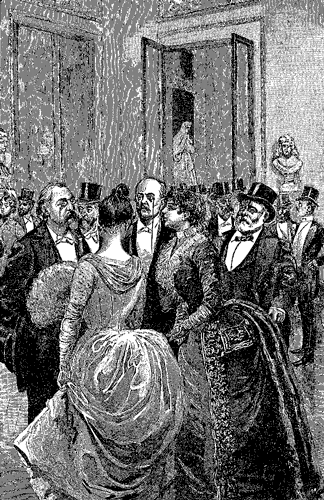
RECEPTION TO A DISTINGUISHED GUEST.
Invitations to evening receptions, lawn or musical parties are informal, but require an answer, as it is agreeable to every hostess to know the number of her expected guests.
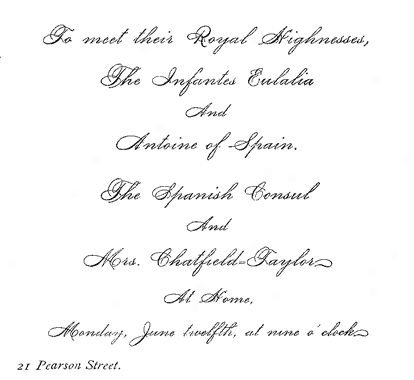
To meet their Royal Highnesses, The Infantes Eulalia And Antoine of Spain. The Spanish Consul And Mrs. Chatfield-Taylor. At Home, Monday, June twelfth, at nine o'clock. 21 Pearson Street.
If the reception is given in honor of some individual or celebrity the name of the honored guest should appear at the top of the invitation, as above fac-simile of cards issued by the Spanish Consul in honor of the Infanta of Spain during the Columbian Exposition.
Evening Receptions.
Evening receptions being simpler in detail and less expensive than parties, are becoming more fashionable every year, especially among people of literary and artistic tastes.
Guests calling, meet a select circle, among whom are usually poets, artists, and persons of elegant leisure, formality is readily broken, and the occasion is always one of pleasure.
The hour for leaving a reception is varied (anywhere from eleven p.m. to one a.m. being usual). Early hours are usual among those who have other engagements and who go on to other parties, remaining about half an hour at each one: thus, at crowded receptions the departures commence before the arrivals have ceased to be announced.
Morning Receptions or Matinées.
Of all the entertainments given during the daytime, luncheons, breakfasts, afternoon teas, kettledrums, etc., the morning reception, so-called, although it is given in the afternoon, is perhaps the most formal. Some hostesses adopt the French fashion of calling it a matinée, meaning any social gathering that is held before dinner, as any party is called in France a soirée.
There are many advantages in a morning party. It affords ladies who do not attend evening receptions the pleasure of meeting on a semi-formal occasion, and is also a well chosen occasion for introducing a new pianist or singer. For a busy woman of fashion a matinée, beginning at two and ending at four or half-past, which are the usual hours for these entertainments, is a most convenient time. It does not interfere with a five o'clock tea, or a drive, nor unfit her for a dinner party or evening entertainment. Convenient, however, as this hour is for ladies, it is quite the reverse for gentlemen, since the majority of them in America do not belong to the leisure class. Hence to avoid this inequality of the sexes, ladies often give these matinées on some of our national holidays.
When, as often happens, some great celebrity is to be presented to a large circle of friends, there is no more satisfactory form of entertainment to be afforded him than a morning reception. To this we may draw to meet him many men who could not be brought together at a late-hour, full-dress, evening entertainment. Authors, artists, clergymen, lawyers, statesmen, editors, doctors and capitalists, as well as cultivated society women, financiers and philosophers, can all be brought together in easy and friendly social intercourse.
But, if we hope to gather about us men of mind and distinction, we must not expect to be amused only, we must be amusing, we must offer some tempting equivalent; something that has the ring of pure gold, rather than the glamour of fashionable dress, dancing or music. So, with an Archbishop to entertain, we may hope to attract the distinguished clergy of the city; with a great author, other celebrities of the pen and pencil who will gladly come to greet him; and once drawn to a successful and brilliant assembly, they will be easily induced to return. Therefore, any lady who would make her home attractive to the best society must offer some higher stimulant than the glitter of fashion. For good society we need men and women who can talk. We need relaxation, and it is best sought in intercourse of abiding value with those whose lives differ from those of our own.
Correct Dress.
The invitations are written in the same form as those given for an evening entertainment, and although given by daylight, the rooms are frequently darkened and artificial illumination gives to the whole a festive air. The hostess may be dressed in demi-toilet, somewhat low at the throat if wished, and of the richest materials, but not in full evening dress, laces or conspicuous jewels. She may have friends to receive with her who will dress in the same demi-toilets. The guests wear reception dresses or handsome street dresses. Wraps are laid aside, but hats and gloves are kept on. Gentlemen wear full morning dress on all these occasions. Overcoats and umbrellas are left in the hall or dressing-room, but hats, if the stay is to be short, may be carried into the drawing-room.
Visitors do not usually remain more than half an hour, though, if the occasion is especially interesting, an hour or more is often spent. Conversation is indulged in, and guests listen to music, or whatever is provided for their entertainment. At an ordinary morning reception the refreshments are light, and served the same as at an evening reception. If, however, the occasion is unusually important, the collation is more abundant, and the service more formal.
Visitors leave cards to serve instead of the after call. Those who were invited but unable to attend, call within a few days. (For general forms of invitations see Department of "Invitations.")
Introductions are not expected to be general, except where the reception is given in honor of some one person, when, of course, all comers are presented to this guest. Morning parties given in small country towns are attended with less formality than in large cities, and introductions are general.
SUPPER PARTIES.
Some lover of this social repast says, "Suppers have always been invested with a peculiar charm. They are the most conversational, the most intimate and the most poetical of all entertainments. They are the favorite repast of men of letters, the inspiration of poets, and a form of hospitability eminent in history. Who has not heard of the petite soupers of the Regency and the brilliant minds there assembled?"
Suppers are the popular entertainment of gentlemen, and usually take some distinctive name, such as fish suppers, game suppers, wine suppers, and each has suitable supplies for the table.
Invitations to suppers may be given in person, by a friendly note, or writing on the card of the host or hostess: "Supper at 10 o'clock, Thursday, December 18th."
The very late city dinners have prevented supper parties from keeping their popularity, but there is no reason why in towns these should not be favorite entertainments.
The same service is proper at a supper as at a dinner, with the exception of soup plates. Oysters on the half-shell and bouillon served in cups are the first two courses. Then follows the usual order of dishes, such as sweetbreads and green peas, whatever game may be in season, salads of all kinds, then ices, fruits and coffee. It is not quite so heavy a repast as the elaborate dinner party. Games and salads are served together. If wine is used it is found on the table in handsome decanters. Three sorts may be served, such as Sherry or Madeira and Burgundy. Bread and napkin are beside each plate, or else the bread is passed after the guests are seated. Next, plain plates and cups of bouillon are served, with gold teaspoons. Then follow the other courses. The dishes are removed after each course as at a formal dinner. At the close of the supper a tiny glass of cordial is served to the gentlemen. Wines may be entirely omitted if against the principles, and mineral waters may be substituted. The table may be decorated as for a dinner party.
There is perhaps no entertainment where so much brilliant conversation and repartee is indulged in as at the "sit-down" supper.
Residents of large cities, possessing abundant means, can avoid trouble by ordering supplies from the professional caterer, but in the country home, where economy is an object, it devolves on the housekeeper to prepare the appetizing dainties for her entertainments. For the benefit of such, we give a few items that may be useful in arranging the menu. Any reliable work on cookery will give the directions for their preparation: Boned turkey, boned ham, deviled ham sandwiches, salmon salad, chicken salad, potted fish, fish salad, etc., etc.
A Simple Supper.
There is a much simpler supper possible to be offered by a hostess after the opera or theatre which may be made very charming and inexpensive. This is a desirable little "spread," since there are few people who can undergo the excitement of an evening at the opera, play, concert, or card party, without a feeling of hunger; and with many, unless this hunger is appeased a sleepless night will be the result; and as the excitement is usually so good an aid to digestion, no evil consequences may be feared.
This little supper is well set out with a few oysters, a pair of cold roast chickens, a boned turkey, or boned ham, and a dish of some kind of salad, and perhaps one sort of ice cream or ice and coffee. Oysters are invaluable for a supper. Scalloped or broiled, they can be used in place of chicken or turkey.
A Game Supper.
A game supper consists of wild fowls and fish, with jellies, ices and bon-bons, while a wine supper admits of almost every variety of luscious dishes, differing very little from dinner, except that the delicacies are all cold, and of course no vegetables are served. Fillets of game, boned turkey, cold ham, fish, salads, ices, jellies and creams, are suitable to this style of entertainment.
A Fish Supper.
When a fish supper is given, dishes are generally composed of the products of the sea or river. This is a fashionable mode of entertainment for the season of Lent. Salads, olives, pickles and sauces are served as relishes. Sweet desserts never accompany a fish supper, but fruits are an appropriate addition. Coffee must be given with all suppers.
BALLS, to distinguish them from other evening gatherings where dancing is one of the features of the evening, may be designated as parties given for the express purpose of dancing.
Balls should begin at about nine o'clock in the evening, and terminate at two or three in the morning. A private ball may be a very elaborate affair, from fifty to seventy-five guests being necessary to make the occasion enjoyable. Where the size of the ball-room will permit, many more are frequently bidden. Over-crowding should be guarded against, as ruinous to the toilets of the ladies, and the pleasure of all concerned. The invitations to very elaborate affairs are sometimes sent out from three weeks to one month in advance.
It is always proper for an invited guest to solicit an invitation for a young lady visitor, or some stranger of distinction, or for a young gentleman known to be a dancing man, and it is always permissible for the hostess, if she wish, to refuse such solicitations on the ground that her list is full, and no one should feel offended at such refusal. Should the request, however, be for the admission of an eligible, dancing man, it is rarely refused.
Never more than three from one family (the mother or chaperon excepted) should accept an invitation to a ball, or party, unless in the case of a ball, where two brothers, if they dance, may be accompanied by two sisters from the same family. Those who do not dance should refuse invitations to balls (chaperons excepted). The most brilliant man who does not dance is usually out of place in an entertainment given for that sole purpose.
The ball-room should be large; the floor well waxed, or covered with drugget, and an abundance of palms and potted plants set about to make cosy nooks just lighted by a shaded lamp. Cut flowers may be massed upon the mantels with gorgeous effect. If the stairway be of sufficient breadth, it should be bravely furnished forth with plants in bloom. If it should be a first-floor room and open into the cool dusk of a faintly lighted conservatory, then it is everything to be desired for the occasion. Good ventilation is an absolute necessity.
Invite at least one quarter more guests than can be comfortably accommodated, since about that number will fail, from different causes, to accept. If it is impossible to entertain with comfort all those to whom one is socially indebted, then it is better to divide the entertainment into two or three smaller gatherings, always leaving space for as many mothers of daughters, or other appointed chaperons, as may choose to attend and who should always be included in the invitations.
Sitting accommodations should be furnished for them, as well as for those who may not be dancing. All other furniture should be removed from the rooms.
Full-dress toilets are demanded for the occasion; flowers, jewels,
"The gloss of satin and the glimmer of pearls,"
should mingle in this festivity, the gayest of our social gatherings.
The ball-room should be brilliantly, and at the same time, softly illuminated, the lights coming chiefly from the sides.
General Arrangements.
In a large city it is necessary to provide an awning to extend from the carriage to the front entrance, thus screening guests from the crowd that usually gathers on such an occasion. A carpet should also cover the steps and walk to protect the ladies' gowns. A manservant in evening dress and white lisle gloves should be at the curbstone to assist ladies, who may have come unattended, in alighting, (providing they have no footman). He also provides each party with the number of their carriage, giving the same to the driver, in order that he may be ready when called. This same attendant also calls for the carriages upon the departure of the guests.
Another manservant, or a white-capped maid, waits at the door, which is opened without the bell being touched. This functionary receives the cards of the guests, and directs them to their respective dressing-rooms. These should be large and convenient as possible. Assistants should be provided with thread, needles and pins to rectify any accidents that may occur to the ladies' toilets, and to render every possible aid to them in making ready for the drawing-rooms. Duplicate tickets should also be in readiness; one to attach to each wrap and one to hand its owner. These precautions lessen the confusion and add to the comfort of all concerned.
Combs, brushes, and hairpins should be in abundance, while a powder-box and puff is not amiss. Cologne, camphor and ammonia should also be in the rooms for use in cases of sudden faintness. A couch in the room is also useful, and low chairs or ottomans, in case any of the ladies should wish to change their shoes.
The gentlemens' dressing-room should also be presided over by an attendant supplied with the same duplicate system of tickets and ready to render any called-for assistance.
Programs with the order of the dances and blanks for recording engagements for each, should be distributed to the guests as they enter the ball-room. To each card should be attached a small pencil.
Concerning the Music.
Good music is a prime necessity. An orchestra, even if it must be a small one, is needful for a ball. Four pieces are enough: violin, piano, violincello, or harp, and cornet. If more are desired, leave the choice to the leader, with whom the selections will have been carefully talked over beforehand, and who must be furnished with a copy of the dancing program.
The musicians should be concealed back of a group of flowering shrubs at the end of the hallway, or some other convenient nook or corner. If there should be a balcony, a shady bower can be constructed for them there, and by taking out the window frame they will be heard to perfection.
Never, even at a "small and early," depend, for the pianist, upon volunteer service from among the guests. In the first place, it is a tiresome and unwillingly performed service, and in the second, there are few amateurs who play dance-music with sufficient correctness to render dancing after their music a pleasure.
Refreshments.
At a ball elaborate refreshments are to be expected, and are usually served all the evening from a long table loaded with silver and glass and softly but brilliantly illuminated. No one is expected to sit down at such a supper, but the guests as they come in, a few at a time, are served by waiters in attendance.
Both hot and cold dishes are to be had; and substantial food, as well as all manner of sweets, should be furnished for an amusement that begets a most unromantic hunger. Small game birds may be served cold; the larger fowl hot. Boned turkey (cold) is especially liked. Game patés, oysters, cooked or raw, all manner of truffled dishes, and a variety of salads are served, while fruits, ices, confections, cakes, and so on, ad infinitum, do fitly furnish forth the feast.
If the German is to finish the evening, a separate, hot supper should be served at its close, and the all-night supper confined more exclusively to cold dishes, with the exception of hot drinks.
In case of a very spacious mansion, the hostess may, if she prefer, keep the supper-room closed until half-past twelve, or one, when she will give the word. Her husband should lead the way to supper with some lady to be especially honored. The hostess should not go out herself until she sees that every lady has been properly escorted, save in cases where she is to accompany some very distinguished gentleman who is present. In this case she delegates her authority either to a grown son, some other relative, or to some gentleman especially appointed, who takes her place in seeing that there are no forgotten wall-flowers left to blush unseen.
No gentleman should presume to offer the hostess his escort to the supper-room, this being an honor she confers at pleasure.
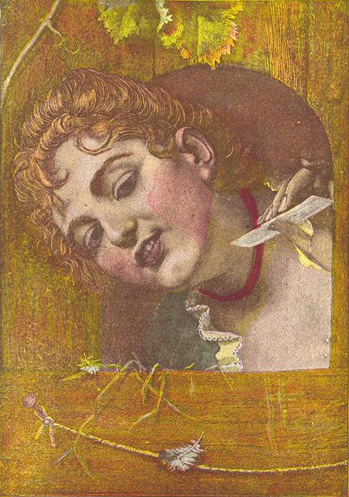
THE COQUETTE.
A small tea-room on an upper floor is very desirable at a large gathering. Here guests, ladies especially, can, unattended, seek the refreshment of a cup of tea, coffee, cocoa, or bouillon before descending to the drawing-rooms. Gentlemen, too, may escort their wearied partners to this haven for a moment's light refection and rest after dancing. Iced lemonade should also be served here, and the room never left without an attendant.
Many who do not care for a heavy supper, are wont to resort to this room, where tiny sandwiches, maccaroons, etc., should also be in readiness.
A smoking-room is frequently provided at large entertainments where the gentlemen may retire. Cigars, effervescent waters, and lemonade are furnished here, and sometimes stronger drinks. This last, however, is a question which every hostess must settle according to her own convictions. If wines are furnished, champagne and claret punch are the usual choice, and a trusted attendant should be at hand to serve them. Those who patronize this room will, if they wish to lay any claim to the name of "gentlemen," carefully refrain from the slightest over-indulgence in these cooling, but deceptive drinks.
If there should be no smoking-room set aside, gentlemen must never smoke in their dressing-room. To do so is especially thoughtless and impolite.
Host and Hostess.
In giving a ball the hostess, upon whom the greatest strain will fall, must be sure of her own physical and mental strength. To stand for two consecutive hours in one spot and receive each comer with the same sweet courtesy is a severe strain upon both.
Daughters, young lady relatives or ladies invited to receive, are usually at hand to support her. The host, if there be one, does not stand beside his wife to receive, but is usually not far away and should assist in making the occasion an agreeable one.
Sons of the house do not seek their own pleasure at such a time, but quietly endeavor, aided by the daughters or receiving ladies, to provide dancing and supper partners for all present. Sometimes two or three young men are appointed beforehand to attend to this duty.
The hostess, while richly dressed, should never show any desire by the elaborateness of her costume to outshine her guests.
Should an obtuse cabman, misled by some similarity of name or error in number (as may occur in large cities), permit a perplexed guest, perhaps a stranger, to drift across the wrong threshold, let it be a hospitable one. The hostess, though she may not be able to unravel the mystery, should be gracious and attentive.
Arrival and Departure.
The first move after leaving the dressing-rooms is for ladies to join their escorts and proceed to the drawing-rooms.
In going up or down stairs the gentleman always precedes the lady by several steps, unless they walk side by side. This rule holds good on every occasion. A lady, if she wishes the gentleman's assistance should take his right arm, thus leaving her right hand free to carry her train. Her bouquet or fan may be carried in the hand upon his arm.
Gentlemen and ladies never enter the room arm in arm, no matter what their relationship may be. A lady enters somewhat in advance of a gentleman accompanying her, but at the side of a maiden whom she chaperons. A mother precedes her daughter.
Do not offer to shake hands with the hostess as you bow, unless she makes the initiatory move, since where the number invited is large the process becomes somewhat wearisome. Many hostesses prefer to sweep a graceful courtesy as they receive their guests.
Do not remain chatting with the receiving party. A bow, and a simple exchange of kindly inquiries, is sufficient, when you should pass on immediately to leave room for others. A gentleman's next duty is to search out his host and exchange the courtesies of the evening with him. Any who may arrive late should at once search out both host and hostess to offer a belated greeting.
A stranger who has received an invitation through friends, should be introduced to both host and hostess and to any daughters of the house. If a gentleman, he should be sure to invite the ladies to dance.
At a large ball any formal leave-taking is unnecessary. To
"Fold your tents like the Arabs, And as silently steal away,"
is quite the thing. Do not make such a stir by your going as to call attention to your departure, apparently wishing others to take notice of it.
The Escort.
The escort of a young lady owes her attention beyond all others he may meet in the ball-room. He should assist her from the carriage, accompany her to the dressing-room door, and after due time return to escort her to the reception-room. He must be her partner in the opening dance and should also put his name down for the one immediately preceding supper, since it is expected that the gentleman dancing with a lady then will take her out to supper, and there see that all her wants are anticipated. If, for any reason, he cannot do this, he must see that she is suitably attended; a gentleman taking a lady into the supper-room must also escort her back to the ball-room and leave her wherever she may desire.
If there should be any seeming neglect he must see that she is provided with partners for as many dances as she may desire; never dancing himself unless she, too, is on the floor, or, if she prefer, sitting out the dance with some pleasant companion. He may introduce other gentlemen to her, after asking her permission.
It is his privilege to send her a bouquet for the occasion, and he first asks what the lady's costume is to be, in order to harmonize the color of the flowers with the shade of the dress, since it would be most annoying to send blue violets to be worn with a sea-green gown.
It is the lady's privilege to suggest the hour of departure. After seeing her safely within her own door he should leave; even if she asks him to enter he should politely refuse, remembering, however, to call upon her within two days.
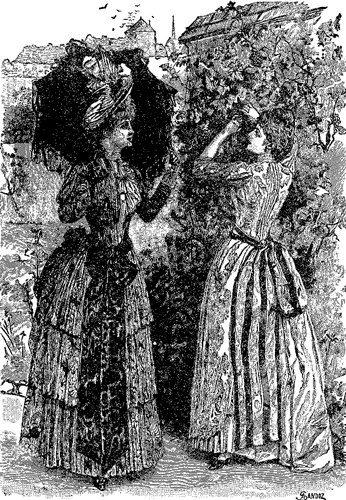
CONFIDENCES.
Receiving Ladies.
Ladies called upon to assist in receiving are not to consider their duties ended when they have supported the hostess through the trying hours of standing to greet her guests, but are supposed (though they too often fail in this) to mingle with the company, seeing that strangers and timid or non-attractive girls are not allowed to remain wall-flowers for any length of time. Bashful men, too, must not be left without partners, and all should be provided with escorts to supper.
These things are a part of the hostess' duty, but in a large entertainment it is quite beyond her power to attend to all the claims upon her time.
The sons of the house, and sometimes a few other especially deputized young men, must sacrifice their own preferences in order to give pleasure to others. If the number of ladies exceed that of gentlemen, these aids frequently take two out to supper.
Daughters of the house, together with receiving ladies and the hostess, do not go out to supper until the last guests are supplied with partners. However, should the hostess be expected to accompany some distinguished gentleman to the table, she will delegate her duties to another.
General Rules for Observance.
Gentlemen may introduce other men to ladies of their own family or to friends, first asking their permission or the permission of their chaperons. In case of a chaperon, the introduction is made first to her and then to the young lady, and the gentleman at close of the dance returns his partner to her chaperon.
Where the gentleman is well acquainted with the lady, a short promenade is often indulged in; but if the gentleman be a stranger to her, she should not expect this, for he may have another engagement, and will return her immediately to the side of her chaperon or some lady friend she may designate. In Europe this promenading is not allowed, the young lady being at once escorted back to her chaperon after dancing.
Supper being announced, a gentleman, having no other engagement, offers his arm to the lady with whom he may be talking or dancing and escorts her out, unless some previous partner arrives to claim her before his invitation is given. Once given, a lady is not free (unusual circumstances excepted) to decline it, even though she may have expected another to offer her the same attention. If she be accompanied by a chaperon, the elder lady is invited at the same time, and it is to her that his arm is offered, the younger lady walking by her side. For two ladies to each take an arm is not good form.
A gentleman requesting a lady for a certain dance, should never ask if she is engaged for it. He may request the pleasure or honor of her company for the next dance, and he will learn from her answer whether she be free, without compelling her to acknowledge at the last moment that she has been hitherto unsought.
Formality of Introductions.
The request for a dance should be accompanied by a bow on the part of the gentlemen. At its close he should thank her for the pleasure, and she should return this courtesy with a smile and bow, and a murmured "Thank you."
An introduction to a lady in the ball-room presupposes that the gentleman will dance with her or walk with her through one dance.
In England, where introductions are rarely given to those invited to an entertainment, a gentleman may ask any lady for a dance. She will probably accept, but he must not take this as the prelude to an after acquaintance. In America, however, it is necessary to ask some mutual friend to first request the favor of the lady, and then, if granted, give the introduction.
However, in case of any little accident, or sudden faintness, gentlemen should be quick to assist, bringing an iced drink, aiding to the dressing-room, or calling a carriage, as the case may be, without the formality of an introduction. A gentleman may also ask an older lady who seems left unattended at supper-time, if he may bring her some refreshments, and this without an introduction.
It is very bad form for gentlemen to stand about the ball-room, especially if there be a scarcity of dancing men present. Even if there is no one in the room for whom they particularly care, they should be unselfish enough to remember that dancing is almost the only active form of amusement in which the majority of ladies may participate.
A young man should ask the young ladies, daughters or relatives of the hostess, for their company in the dance early in the evening. A married gentleman should be general in his attentions in the ball-room. He should not dance more than once or twice with his wife, nor should he take her out to supper; but he must keep a quiet outlook over her comfort, and see that she is no wise lonely or neglected.
Attentions Paid to Ladies.
Neither should he confine his attentions in a marked manner to any one lady. It is ill-breeding to excite the comment sure to follow such a course. It is also bad form for any gentleman to confine his attentions to any one lady, or, as a rule, to ask her for more than two dances. Even engaged couples are not exempt from this law.
Gentlemen may put down their name on a lady's program for certain dances, and the engagement should never be forgotten. If, however, this lapse should occur, the humblest apology should follow, which the young lady, no matter how annoyed, should gracefully accept. Ill-humor is out of place in the ball-room.
If a lady from weariness, or any other cause, should wish to stop at any time in the dance, the gentleman must, without any comment, at once lead her to a seat, and remain with her until the set is finished, notwithstanding that she may, from a spirit of kindness, request him to seek another partner. Should she show symptoms of weariness, and be either too timid or too thoughtful for his enjoyment to ask him to take her from the floor, he should be quick to see, and to suggest that she rest for a moment.
Gloves form an important adjunct to a gentleman's toilet for a dancing party. Light colored gloves are always good form. Gentlemen are expected to wear gloves while dancing, since their ungloved hands would not only soil the delicate tints of the lady's gloves, but the slightest pressure of a warm, uncovered hand is liable to discolor the frail gauzes, or pale silks of their ball-room toilet.
It is not amiss to be provided with an extra pair of gloves which will be very useful should the first pair come to grief. Upon the same principle, two fresh handkerchiefs should be carried.
If dancing is not formally announced in the invitation, gentlemen will do well to provide themselves with gloves to be donned if that amusement is introduced in the course of the evening. Notwithstanding the royal indolence or whim of the Prince of Wales led him some time back to discard the use of gloves at evening parties, an example which many ultra-fashionables have followed, it still remains that gloves are both proper and necessary. If a gentleman attempts to dance without them he must hold his handkerchief in his hand in such a manner as to prevent its contact with the bodice of the lady's gown.
Loud talking and boisterous laughter are not to be tolerated. Scrupulously avoid stepping upon the train of a lady's gown. Apologize if it accidentally occurs, and if serious damage ensue from the awkwardness, beg the privilege of taking her to the dressing-room to have the damage repaired.
For Ladies.
Young ladies must never refuse to dance with one gentleman, and afterward give the same dance to a more favored suitor. Nothing so quickly speaks of ill-breeding as this course. Ball-room engagements should not be forgotten. Young ladies should never be so unwise as to appear on the floor at every dance.
Daughters of the hostess should not repeatedly appear upon the floor while other lady guests are neglected. Not their own pleasure, but the pleasure of the company should be their first care.
Ladies should not cross the ball-room alone. It invites attention. Ladies must not burden gentlemen (unless husband or near relative) with bouquet or fan to hold while they dance. Young ladies should not refuse a ball-room introduction to a gentleman without a sufficient reason, since to do so is always an embarrassment to the one asking it. Still a lady has the privilege of refusal and may not be pressed for a reason. Young chaperons should never dance while their protégés are unprovided with partners.
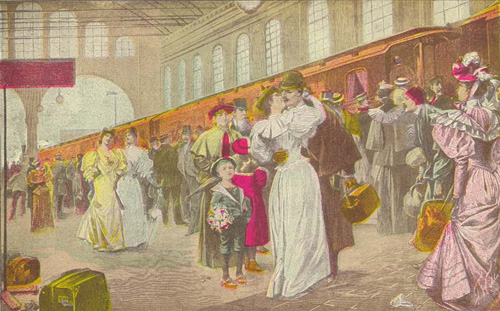
SCENE AT A RAILWAY STATION IN PARIS.
A lady removes at least one glove while partaking of supper. But when a cup of tea, or an ice, only is taken this is not necessary.
DANCING.
Pope says: "They move easiest who have learned to dance," and while the opinions of society are greatly divided on the subject of this amusement, it cannot be denied that there is much truth in the assurance that Locke gives us in his treatise on "Education:"
"Since nothing appears to me to give children so much becoming confidence and behavior as dancing, I think they should be taught to dance as soon as they are capable of learning it. For though this consists only in outward gracefulness of motion, ... yet it gives children manly thoughts and courage more than anything."
For the many, however, to whom these early advantages have not been given, while the dowry of a quick ear and natural grace has enabled them to "pick up" this social accomplishment, a few hints may be of use.
Dancing is really an art, and one that the gentleman especially should understand (since he takes the lead) before he ventures to ask a lady out upon the floor.
The gentleman should be very careful in the manner of holding his partner. He should give her proper support by putting his arm firmly around her, but not drawing her too close. Her right hand should be held in his left, the lady turning the right palm downward and almost straightening her right arm. The gentleman should bend his left arm slightly backward. The joined hands should be held steadily but kept away from the gentleman's body. To rest them upon his hip, is actual vulgarity. The gentleman's right shoulder and the lady's left, should be kept as far apart as the other shoulders, hence his right elbow must not be too much bent. The upper part of the body should be kept quiet, and the head held naturally, not turned one side, while the eyes are neither thrown up nor cast down in an affected style. Their steps should be in harmony and the gentleman must be very careful not to permit a collision with other couples.
At every slightest pause in the dance the gentleman should instantly drop his arm from the lady's waist. In these intervals it is proper to fan her if she desire it, and to enter into chatty conversation.
Gentlemen avoid all boisterous conduct in the dance, such as swinging a partner too rapidly, or lifting her too much from the floor. She, on her part, should dance lightly, never permitting her partner to carry her around, but performing her share well, or not dance at all.
The Most Desirable Dances.
In making up a dancing program, quadrilles should always find a place, since many can walk through its measures that will not undertake the more active dances. It also gives opportunity for the graceful curtsy which no lady should fail to learn, and can be enlivened with conversation.
To the alluring round dances, polka, schottische, waltz, etc., there are many who strongly object, but, danced in private homes and in most cases under the eye of the young girl's mother, there can be found nothing dangerously objectionable in this favorite amusement. The minuet is a stately, beautiful old dance that is sometimes introduced, enabling both old and young to join in its slow and gracious measure.
New steps, new changes and new dances, with the technical features of which it is not the province of this book to deal, are continually coming into vogue with each season. A few words, however, with regard to the general etiquette of that justly popular dance, the German, will be in place here. The German, called the "Cotillion" in France and in Germany, where it originated, is the most fascinating dance in social use. Balls at which it is to appear, signifying that fact in the invitations sent out are more elaborate in their arrangements, and are held to a later hour, since the earlier portion of the night is devoted to waltzing and other dances, and the German is not commenced until after supper.
Many leave before it begins, especially those who expect to make the tour of several balls and receptions during the night. A second and hot supper is usually served at its close, to those who participate in its measures. Be certain when the German is to be introduced that a sufficient number of men are invited to make the affair a success.
The leader of the cotillion is chosen by the hostess, and should be thoroughly familiar with all its figures, new and old; skilled to command, and prompt to bring order out of confusion; at the same time energetic and good tempered. As there will always be some in a German who do not understand it, the leader must be ready to help them out. Such parties should take their places near the end, and, in this way, will become familiar with a figure before it is their turn to dance.
No Favorites to be Allowed.
The leader will also see that gentlemen do not neglect some ladies for the pleasure of dancing frequently with more favored partners. In this he should be assisted by the hostess, and gentlemen should never disregard her quiet suggestion on this score. After all, "the ball-room is a more fitting field for a display of the Christian graces than most Evangelical people are willing to admit."
All those dancing the German must consider themselves as introduced, and each lady or gentleman is free to call "up" any participant for his or her partner. In fact it is desirable that they should do so, since by devoting themselves entirely to their acquaintance there is danger of some being debarred from the amusement. For these reasons the German is unsuited for a public ball, and fitted only for a private house where the invitation is expected to certify the character of the guest.
Varied and beautiful are the figures that may be adopted, but the scope of this book will not permit full instructions for its elaborate changes. One suggestion, however, is in point; do not choose those "romping" figures where the fun is liable to become too fast and furious for ball-room decorum. The figures requiring "properties," such as ribbons, flags, Japanese lanterns, aprons, mirrors, etc., should have all the necessary articles carefully provided beforehand.
During most of the figures, "favors" are distributed; flowers, amusing trinkets, or sometimes pretty little souvenirs are given. Rosettes, scarf pins, bangles, tiny flags, artificial butterflies, bon-bons in embroidered satin bags, badges, painted silk sachets, etc., are all appropriate. Tiny lanterns filled with perfume, and sometimes amusing toys will add to the fun of the occasion. It is better taste to give simple articles than to resort to the gifts of great value that some hostesses have bestowed, since such giving always suggests ostentation. Flowers alone are sometimes used and it is not necessary to make the favors a source of undue expense.
Regrets must be sent one's hostess if unable to attend a German, that the place may be filled. If a gentleman invites a lady especially as his partner for a German, he should send her a bouquet and if some unforeseen occurrence should prevent his attendance, he must at once send her an explanatory regret to that effect.
Private Balls Given in Public.
Many hostesses, feeling the inadequacy of their parlors to accommodate all the guests that they wish to invite at one time, without disagreeable overcrowding, have adopted the custom of giving their large entertainments at public assembly rooms. This custom, while it frees the hostess from much care, must also be deplored as depriving the gathering of that home atmosphere which is ever a safeguard.
The etiquette is the same as that of a private ball, and after calls are demanded within the same length of time. The decorations and arrangements resemble closely as possible those of a private house.
Public Balls.
Much of the etiquette given for Private Balls governs the conduct of those attending public entertainments of the same nature. Introductions, however, must be sought before any attentions are offered a lady, and there is much more care exercised in granting them than under a private roof. Gentlemen, too, use their own pleasure in the choice of partners, not having the courtesy of their hostess to regard in this respect.
Of course, Military, Charity and Civic Balls are under the charge of trustees and committees, who not only take charge of the convenience of the guests, but endeavor by all means within their power to regulate the social standing of those obtaining entrée to the assembly. In many of the large cities a board of lady patronesses add prestige and a certain home protection to the successful carrying out of a public ball of the highest order. It seems to supply the protection of a hostess to the fête.
A young girl, even if the omission be excused at a private ball, does not attend a public affair of this nature without a chaperon. Late hours are more especially objectionable at public balls than at a private house. One, or half-past, should find the adieux made.
A young lady, in refusing to dance with a gentleman, is not obliged to sit the dance out as she would be at the house of a mutual friend. She may, however, if she wish, do it in deference to his feelings.
MASQUERADES.
A few words with regard to masquerades will not be out of place here, with the one proviso added that they refer exclusively to private entertainments. Public gatherings of this nature should be shunned as questionable amusements, excepting, of course, any case where, from want of room, a lady may choose to give the entertainment in some public assembly-room instead of her own parlors. This course lends the protection of home to the charm of its veiled mysteries.
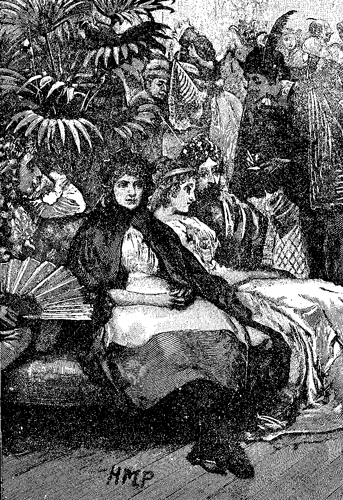
THE MASQUERADE ASSEMBLY.
A masquerade is an entertainment giving much trouble to both hostess and guests. Elaborate decorations are necessary in the ball-room. Invitations for it should be issued from three weeks to a month in advance, in order to give the guest time to choose and prepare the costume to be worn.
Some hostesses give their invitations for a fancy dress party only, omitting the feature of masks. In this they may act their own pleasure. In event of permitting masks they must be laid aside at supper hour.
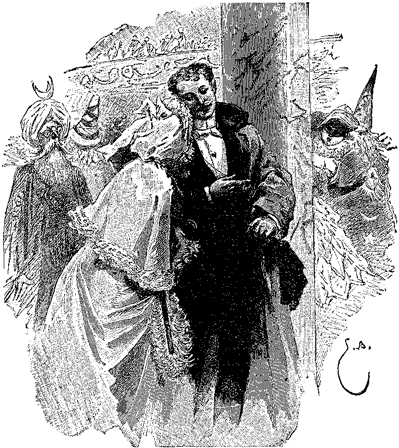
THE MASQUERADE.
Occasionally the hostess arranges a costume scheme for the entire fête beforehand, signifying to each guest the character, historical or imaginary, that it is her pleasure he shall, for the time being, personify. In this way the perfection and beauty of the ball-room are assured beforehand, and repetitions of time-worn characters prevented from appearing upon the floor.
Choice of Costumes.
Again, the hostess may content herself by selecting the costumes that she wishes a few particular friends to don, sufficient in number to form one or more quadrilles to open the ball. Each set must be carefully arranged as for instance, a court party, costumed after the time of Louis XIV. A group of Watteau Shepherds and shepherdesses, or a hunting party garbed after any chosen period, etc.
The remainder of the guests may be permitted to use their own taste in the selection of costumes. A full dress rehearsal of these especially arranged quadrilles should be held beforehand to ascertain the most satisfactory method of grouping the characters in each set.
Invitations to an entertainment of this nature are issued like those for ordinary balls, adding "Bal-masque" or "Fancy Dress Ball," down in the left hand corner. When the entertainment is to be very elaborate these words are given an entire line, extending through the center of the invitation. Occasionally the words, "Ordinary ball dress permitted," find a place upon the card, to the relief of those who prefer to appear in their own proper character.
The host and hostess in fancy dress, assisted by daughters or friends, all costumed, receive as in other balls, and the etiquette is in all ways similar. Some ladies, and gentlemen also, wear mask and domino over the regulation party dress, removing this when the others unmask.
Guests, as far as in them lies, should seek for originality in their costumes. Historical and mythological characters, personification of the powers and attributes of nature—as ice, snow, stars, planets, etc.—are always suitable. Standard works of fiction whose characters are familiar to all, as well as Mother Goose and Kate Greenaway, are always fruitful sources for characters. Accurateness should be sought after in carrying the costumes out.
[Etiquette of Ball Dress, Invitations, etc., may be found in their appropriate departments.]
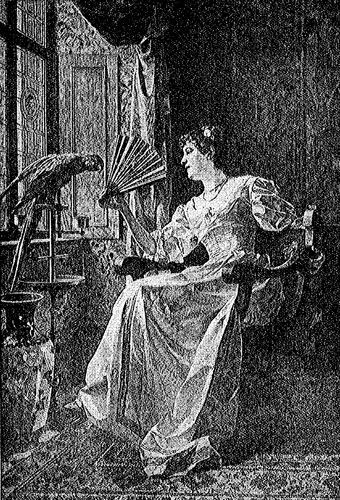
A SOCIAL CHAT.
A LEISURE HOUR IN THE PARK.




IN France almost any social gathering that occurs in the evening is called a soirée. Here in this country the term soirée is applied to an evening entertainment that partakes of the nature of an evening party, but is not quite so elaborate and means earlier hours both of arrival and departure.
Soirées, as a rule, offer some particular form of amusement, such as music, dancing, a reading; an interchange of bright ideas, such as a conversazione. It means also pretty evening dress, not elaborate, ball costume, and a supper. It attracts gentlemen, who appreciate the easy-going, early-houred soirée. That is, gentlemen who do not particularly care for the ball-room, and it is here we are sure to find wits and the aristocracy of intellect. In short, the very best elements of society are found in the elegant unpretentious soirée, where the intelligent woman of fashion has the tact to welcome and make at home the artist, the author, the professional man, and the man of business. The soirée has still another advantage: a lady can give one in a small house and with very little expenditure, and if she has the gift of entertaining, her gathering will always be sought after.
Suitable Dress.
Women, as before mentioned, wear pretty evening dress (not ball costume), and remove their bonnets, and in this way differing from matinées and from morning receptions, at both of which entertainments bonnets are worn. Men wear morning dress. (See Department of Dress.)
Receiving Guests.
For small evening parties, the host and hostess during the early part of the evening remain near the door to receive guests. Later they must mingle with the company to assist in entertaining. A late arrival, however, should be noted, though it is their place to search out their hostess and offer the greetings of the evening.
As guests enter the room the hostess should advance a step to meet them. Her words of greeting should be first addressed to the elder ladies of an incoming group, then the young ladies, lastly the gentlemen. The hostess should be perfectly at her ease, having apparently no thought beyond the reception rooms.
The Entertainment.
Where the entertainment is mixed, a little music is appropriate, a little dancing and a little card-playing. It is well to engage some one to play for the dancing, since guests usually do not care to preside at the instrument. A violin is a great addition.
If, however, the dancing is an afterthought, any gentleman who is a good pianist may offer his services to relieve any lady at the instrument.
The hostess should see that conversation does not lag. She must not interrupt an entertaining tête-à-tête, unless it last too long; but, if conversation languish between a couple thrown together, she should bring in a third person, or draw away one, while substituting another.
Invitations.
If invitations are issued a week or ten days in advance, the hostess has a right to expect that her guests should arrive on time, and carefully attired.