Visiting Cards. (continued 2)
Reading edition
An acceptance or regret, written in the first person, receives the signature of the writer, but one written in the third person remains unsigned. To sign it would produce a confusion of persons and be ungrammatical to the last degree. Another error to be avoided is that of beginning in this fashion: "I accept with pleasure the kind invitation of Mr. and Mrs. John Jones," this also producing a change of person altogether inadmissible. Neither must one be betrayed into the mistake of using the words, "will accept," thus throwing the acceptance into the future tense, when, in reality, you do accept, in the present tense, at the moment of writing.
Accepting a Dinner Invitation.
Incumbent upon us as it is to answer the majority of our invitations in either the affirmative or negative, there are degrees of necessity even here, for, sin as we may in all other particulars, there is an unwritten code like unto the laws of the Medes and Persians which declareth that the invitations to a dinner are not to be lightly set aside. First, an invitation to a dinner is the highest social compliment that a host and hostess can pay to those invited, and, second, the guests are limited in number and painstakingly arranged in congenial couples by the careful hostess. Judge, then, of her disappointment, when, at the last moment, some delinquent sends in a hasty regret leaving little or no time to fill that terror of all dinner-givers, that skeleton at the feast, an empty chair. One such failure is sufficient to ruin the most carefully-arranged table and is an injury to host and hostess that only the occurrence of some unforeseen calamity can justify.
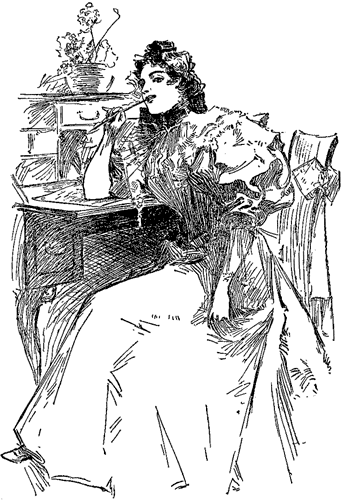
ANSWERING AN INVITATION.
In answering an invitation it is well to repeat the date, as: "Your kind invitation for Tuesday, May fifth." This will give an opportunity, if any mistakes have been made in dates, to rectify them at once. This caution it would be well to observe in answering any invitation.
Answer decisively as well as promptly. Do not, if there is a doubt as to your being able to attend, selfishly keep the lists open in your favor by suggesting that "You hope to have the pleasure," etc., or, if married, that "one of us will come." This is an injustice to those inviting you, who, to make a success of their entertainment, must know at once the number to be depended upon. Say "yes" or "no" promptly and abide by your decision. To do this will, in case of refusal, give time to fill your place at table.
Accepting a Dinner Invitation.
In accepting a dinner invitation the following form is very suitable. This, of course, presupposes that the invitation has also been written in the third person. (See Invitations.)
Mr. and Mrs. Harvey Pratt accept with pleasure the kind invitation of Mr. and Mrs. Paul Potter for dinner on Tuesday, December fifteenth, at eight o'clock. 24 Abercrombie Street. Wednesday.
A gentleman might respond thus:
Mr. Fremont Miller has much pleasure in accepting the very kind invitation of Mr. and Mrs. Paul Potter for dinner on Tuesday, December fifteenth, at eight o'clock. Union League Club. Wednesday.
To answer a formal invitation carelessly and familiarly is to show a degree of disrespect to the sender, but, if the invitation be in note form, first person, answer in same fashion, it being usually safe to follow the style of invitation in either accepting or refusing the proffered pleasure.
Never "present one's compliments" in response to an invitation. It is entirely out of date; neither should one say "the polite invitation of Mr. John Jones." All invitations are presupposed to be "polite." "Your kind" or "very kind invitation" is a gracefully-turned and amply sufficient phrase for all occasions.
Declining a Dinner Invitation.
An unexplained regret is often (as before mentioned) wounding to the feelings of a sensitive person, leaving at times the impression that one did not care to come. This can always be avoided by particularizing the cause of refusal. A plea of expected absence, a previous engagement to dine elsewhere, a recent bereavement, or sudden illness in the family, are each of them good and sufficient reasons for non-acceptance and should always be mentioned. Thus, in reply to a formal dinner invitation, a "regret" might be sent in the following terms:
Mr. and Mrs. Harvey Patten sincerely regret that, owing to the sudden illness of their daughter Eleanor they will be deprived of the pleasure of accepting the very kind invitation of Mr. and Mrs. Paul Potter for dinner on Tuesday, December fifteenth. 24 Abercrombie street. Wednesday.
This form of refusal will be found suitable for all formal occasions, varying the name of the entertainment and the cause for non-acceptance to suit the circumstances.
Persons in Mourning.
Invitations to those in mourning should be sent as a matter of course, except during the first few weeks of deep bereavement, when their sorrows are not to be intruded upon by the gayeties of the outer world. After this first season of sorrow, invitations, which neither custom nor their own feelings permit them to accept, should be sent, that they may know that they are not forgotten in their solitude.
To these there is always given the privilege of declining all invitations without any specified cause therefor, their black-bordered stationery showing all too plainly the sad reason that prompted their refusal. They should then send their cards (black-bordered) by mail enclosed in two envelopes. These will take the place of a personal call and should be the same in number. It may be mentioned here that while people in deep mourning are not usually invited to dinners or luncheons, it is customary for them to receive invitations to all weddings and other social gatherings, and though they may not accept, still it is gratifying for them to know that they are remembered in their seclusion.
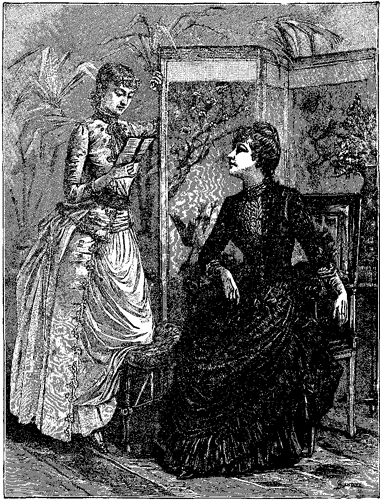
A LETTER OF CONDOLENCE.
Addressing the Answer.
The answer to an invitation should always be addressed to the person in whose name it is sent. If "Mr. and Mrs. Richard Roe request the pleasure," etc., address the answer to "Mr. and Mrs. Richard Roe." If "Mrs. Richard Roe is At Home" on a certain date, address the reply to her alone. In case of wedding invitations, address all answers to the parents of the bride, in whose name they are sent out, never to the bride, although she may be your only personal acquaintance in the family, the civility being due to the issuers of the invitation. This is customary in the case of all invitations.
Wedding Invitations.
Wedding invitations are usually thought to require no answer unless it be to a sit-down wedding breakfast. In this case the same exactness in reply and the same form is demanded as for a dinner invitation. If the invitation is extended to friends at a distance and presupposes an intention to entertain the recipients for any length of time, the obligation for speedy reply is equally necessary.
If the invitation is given by an informal note, as is the case with some very quiet weddings, an answer must always be returned and in the same note form. This attention is demanded by courtesy.
To a large crush wedding a regret, accompanied or not by a gift, may be sent if desired; an acceptance is not necessary. Where the invitations are to the church only, they are amply answered by sending or leaving cards at the house. To receive a card stating that the wedded pair will be "At Home" on certain dates, means that they desire to continue their acquaintance with the parties thus invited, who should either call in person or send cards promptly.
Wedding Anniversaries.
Anniversary invitations require an answer, thus giving a very pleasant opportunity for congratulating the happy couple. The following forms are suitable:
Mr. and Mrs. Arthur Cummings accept with pleasure the kind invitation of Mr. and Mrs. Kennet Wade for Thursday evening, October tenth, and present their warmest congratulations on their Silver Wedding Anniversary. 45 Church Street. Thursday.
For a refusal:
Mr. and Mrs. Arthur Cummings sincerely regret that, owing to an unexpected absence from town, they are unable to accept the very kind invitation of Mr. and Mrs. Kennet Wade for Thursday evening, October tenth, but beg to present to them their warmest congratulations on this occasion of their Silver Wedding Anniversary. 24 Church Street. Wednesday.
The same formulæ in answering will apply to any of the anniversary festivities.
Theater and Opera Parties.
These parties are frequently made up on rather short notice and the invitations are then sent to the house by special messenger who awaits the reply, which must be written at once, that the lady or gentleman giving the entertainment may be sure of a certain number to fill the box or stalls, engaged for the evening. Occasionally, when the party is given by a gentleman, he takes a carriage and gives out the invitations in person when a verbal answer is returned.
Luncheons and Suppers.
Invitations for these are written in the same form as for a dinner, merely substituting the word "luncheon" or "supper" for "dinner," and should be accepted or refused in precisely the same style. Answers also should be sent with the same promptness that the hostess may be certain of arranging her table satisfactorily.
Other Invitations.
Other invitations, aside from those already specified in this department, scarcely demand an answer, except they bear the words: "The favor of an answer is requested," or the initials, "R.S.V.P." Simple "at home" affairs never need an answer, though cards must always be sent, or left in person, immediately afterward. Garden parties, where they are held at any distance from the city and carriages are to be sent to convey the guests thither, always require an answer; this, however, is usually indicated upon the card.
Refusing After Acceptance.
Should it unfortunately occur, after accepting an invitation, that, by one of the sorrowful happenings so often marring our best laid plans, we are prevented from fulfilling our promise, let the regret sent be prompt, that your hostess, especially if the entertainment be a dinner or luncheon may possibly, even at the eleventh hour, be able to supply the vacancy. Make it explanatory as well, that she may feel positive that no mere whim has caused the disarrangement of her plans.
What Not to Do.
Never write the word "accepts," "regrets" or "declines" upon your visiting card and send in lieu of a written note. To do so is not only an insult to your hostess but a mark as well of your own ill-breeding. An invitation, which is always an honor and implies the best that your host is able to offer, should always receive the courtesy of a civil reply.
“COURTSHIP," according to Sterne, "consists in a number of quiet attentions, not so pointed as to alarm, nor so vague as not to be understood."
In this little quotation lies the spirit and the letter of all etiquette regarding courtship. The passion of love generally appearing to everyone save the man who feels it, so entirely disproportionate to the value of the object, so impossible to be entered into by any outside individual, that any strong expressions of it appear ridiculous to a third person. For this reason it is that all extravagance of feeling should be carefully repressed as an offense against good breeding.
Man was made for woman, and woman equally for man. How shall they treat each other? How shall they come to understand their mutual relations and duties? It is lofty work to write upon this subject what ought to be written. Mistakes, fatal blunders, hearts and lives wrecked, homes turned into bear-gardens, tears, miseries, blasted hopes, awful tragedies—can you name the one most prolific cause of all these?
If our young people were taught what they ought to know—if it were told them from infancy up—if it were drilled into them and they were made to understand what now is all a mystery to them—a dark, vague, unriddled mystery—hearts would be happier, homes would be brighter, lives would be worth living and the world would be better.
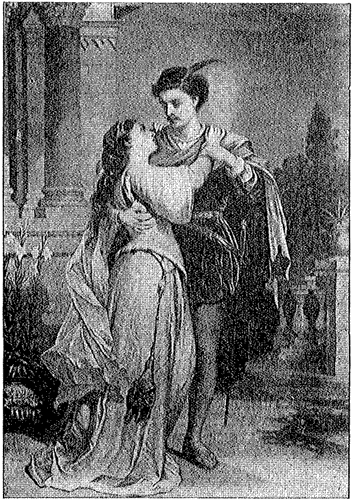
“Good Night! Good Night! Parting is such sweet sorrow, That I shall say good night till it be morrow.”
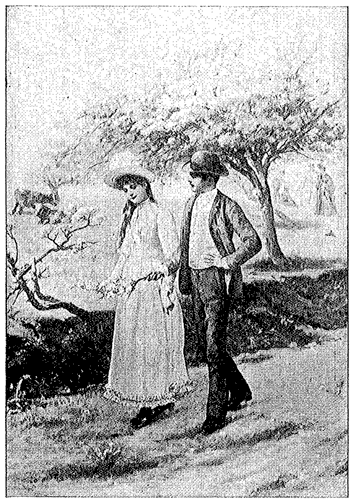
A POLITE ESCORT.
This is now the matter—matter grave and serious enough—which we have in hand. There are gems of wisdom founded on health, morality, happiness, which should be put within reach of every household in our whole broad land. It is a most important, yet neglected subject. People are squeamish, cursed with mock modesty, ashamed to speak with their lips what their Creator spoke through their own minds and bodies when he formed them. It is time such nonsense—nonsense shall we say?—rather say it is time such fatal folly were withered and cursed by the sober common sense and moral duty of universal society.
Courtship! Its theme, how delightful! Its memories and associations, how charming! Its luxuries the most luxurious proffered to mortals! Its results how far reaching, and momentous! No mere lover's fleeting bauble, but life's very greatest work! None are equally portentous, for good and evil.
Errors of Love-Making.
God's provisions for man's happiness are boundless and endless. How great are the pleasures of sight, motion, breathing! How much greater those of mind! Yet a right love surpasses them all; and can render us all happier than our utmost imaginations can depict; and a wrong more miserable.
Right love-making is more important than right selection; because it affects conjugal life for the most. Men and women need knowledge concerning it more than touching anything else. Their fatal errors show their almost universal ignorance concerning it. That most married discords originate in wrong love-making instead of selection, is proved by love usually declining; while adaptation remains the same.
Right courtship will harmonize natural discordants, much more concordants, still more those already in love; which only some serious causes can rupture. The whole power of this love element is enlisted in its perpetuity, as are all the self-interests of both. As nature's health provisions are so perfect that only its great and long-continued outrage can break it; so her conjugal are so numerous and perfect that but for outrageous violation of her love laws all who once begin can and will grow more and more affectionate and happy every day.
Any man who can begin to elicit any woman's love, can perfectly infatuate her more and more, solely by courting her right; and all women who once start a man's love—no very difficult achievement—can get out of him, and do with him, anything possible she pleases. The charming and fascinating power of serpents over birds is as nothing compared with that a woman can wield over a man, and he over her. Ladies, recall your love hey-day. You had your lover perfectly spell-bound. He literally knew not what he did or would do. With what alacrity he sprang to indulge your every wish, at whatever cost, and do exactly as you desired! If you had only courted him just right, he would have continued to grow still more so till now. This is equally true of a man's power over every woman who once begins to love him. What would you give to again wield that same bewitching wand?
How to Carry on Courtship.
Intuition, our own selfhood, is nature's highest teacher, and infallible; and tells all, by her "still, small voice within," whether and just wherein they are making love right or wrong. Every false step forewarns all against itself; and great is their fall who stumble. Courtship has its own inherent consciousness, which must be kept inviolate.
Then throw yourself, O courting youth, upon your own interior sense of propriety and right, as to both the beginning and conducting of courtship, after learning all you can from these pages, and have no fears as to results, but quietly bide them, in the most perfect assurance of their happy eventuality!
"What can I do or omit to advance my suit? prevent dismissal? make my very best impression? guarantee acceptance? touch my idol's heart? court just right?" This is what all true courters say.
Cultivate and manifest whatever qualities you would awaken. You inspire in the one you court the precise feeling and traits you yourself experience. This law effects this result. Every faculty in either awakens itself in the other. This is just as sure as gravity itself. Hence your success must come from within, depends upon yourself, not the one courted.
Study the specialties, likes and dislikes in particular, of the one courted, and humor and adapt yourself to them.
Be extra careful not to prejudice him or her against you by awakening any faculty in reverse. Thus whatever rouses the other's resistance against you, antagonizes all the other faculties, and proportionally turns love for you into hatred. Whatever wounds ambition reverses all the other feelings, to your injury; what delights it, turns them in your favor. All the faculties create, and their action constitutes human nature; which lovers will do right well to study. To give an illustration:
A Case to the Point.
An elderly man with points in his favor, having selected a woman eighteen years younger, but most intelligent and feminine, had two young rivals, each having more points in their favor, and came to his final test. She thought much of having plenty of money. They saw they could "cut him out" by showing her that he was poor; she till then thinking his means ample. All four met around her table, and proved his poverty. His rivals retired, sure that they had made "his cake dough," leaving him with her. It was his turning-point. He addressed himself right to her affections, saying little about money matters, but protesting an amount of devotion for her to which she knew they were strangers; and left his suit right on this one point; adding:
"You know I can make money; know how intensely I esteem, admire, idolize, and love you. Will not my admitted greater affection, with my earnings, do more for you than they with more money, but less love?"
Her clear head saw the point. Her heart melted into his. She said "yes." He triumphed by this affectional spirit alone over their much greater availability.
Manifesting the domestic affections and virtues, a warm, gushing friendly nature, fondness for children and home, inspires a man's love most of all, while evincing talents by a man peculiarly enamors woman.
Relations, you shall not interfere, where even parents may not. Make your own matches, and let others make theirs; especially if you have bungled your own. One such bungle is one too many.
The parties are betrothed. Their marriage is "fore-ordained" by themselves, its only rightful umpires, which all right-minded outsiders will try to promote, not prevent. How despicable to separate husbands and wives! Yet is not parting those married by a love-spirit, equally so? Its mere legal form can but increase its validity, not create it. Marriage is a divine institution, and consists in their own personal betrothal. Hence breaking up a true love-union before its legal consummation, is just as bad as parting loving husband and wife; which is monstrous. All lovers who allow it are its wicked partakers.
Choice of Associates.
The first point to be considered on this subject is a careful choice of associates, which will often, in the end, save future unhappiness and discomfort, since, as Goldsmith so truthfully puts it, "Love is often an involuntary passion placed upon our companions without our consent, and frequently conferred without even our previous esteem."
This last most unhappy state of affairs may, to a great extent, be avoided by this careful choosing of companions. Especially is this true on the part of the lady, since, from the nature and constitution of society, an unsuitable acquaintance, friendship, or alliance, is more embarrassing and more painful for the woman than the man. As in single life an undesirable acquaintance is more derogatory to a woman than to a man, so in married life, the woman it is who ventures most, "for," as Jeremy Taylor writes, "she hath no sanctuary in which to retire from an evil husband; she may complain to God as do the subjects of tyrants and princes, but otherwise she hath no appeal in the causes of unkindness."
First Steps.
To a man who has become fascinated with some womanly ideal, we would say, if the acquaintanceship be very recent, and he, as yet, a stranger to her relatives, that he should first consider in detail his position and prospects in life, and judge whether or not they are such as would justify him in striving to win the lady's affections, and later on her hand in marriage. Assured upon this point, and let no young man think that a fortune is necessary for the wooing of any woman worth the winning, let him then gain the needful introductions through some mutual friend to her parents or guardians.
If, on the other hand, it is a long acquaintance that has ripened into admiration, this latter formality will be unnecessary.
As to the lady, her position is negative to a great extent. Yet it is to be presumed that her preferences, though unexpressed, are decided, and, if the attentions of a gentleman are agreeable, her manners will be apt to indicate, in some degree, the state of her mind.
Prudence, however, does, or should, warn her not to accept too marked attentions from a man of whose past life she knows nothing, and of whose present circumstances she is equally ignorant.
Character.
There is one paramount consideration too often overlooked and too late bewailed in many a ruined home, and that is the character of the man who seeks to win a woman's hand. Parents and guardians cannot be too careful in this regard, and young women themselves should, by refusing such associates, avoid all danger of contracting such ties. Wealth, nor family rank, nor genius, availeth aught if the character of the man be flawed.
Let parents teach their daughters and let girls understand for themselves that happiness, or peace, in married life is impossible where a man is, in any wise, dissipated, or liable to be overcome by any of the fashionable vices of the day. Better go down to your grave a "forlorn spinster" than marry such a man.
Disposition.
As to temper or disposition, the man or woman can easily gain some insight into the respective peculiarities of another's temperament by a little quiet observation. If the gentleman be courteous and careful in his attentions to his mother and sisters, and behave with ease and consideration toward all women, irrespective of age, rank, or present condition, she may feel that her first estimate was a correct one. On the other hand, should he show disrespect toward women as a class, sneer at sacred things, evince an inclination for expensive pleasures in advance of his means, or for low amusements or companionship; be cruel to the horse he drives, or display an absence of all energy in his business pursuits, then is it time to gently, but firmly, repel all nearer advances on his part.
As to the gentleman, it will be well for him also to watch carefully as to the disposition of the lady and her conduct in her own family. If she be attentive and respectful to her parents, kind and affectionate toward her brothers and sisters, not easily ruffled in temper and with inclination to enjoy the pleasures of home; cheerful, hopeful and charitable in disposition, then may he feel, indeed, that he has a prize before him well worth the winning.
If, however, she should display a strong inclination towards affectation and flirtation; be extremely showy or else careless in her attire, frivolous in her tastes and eager for admiration, he may rightly conclude that very little home happiness is to be expected from her companionship.
Trifling.
A true gentleman will never confine his attentions exclusively to one lady unless he has an intention of marriage. To do so exposes her to all manner of conjecture, lays an embargo on the formation of other acquaintances, may very seriously compromise her happiness, and by after withdrawal frequently causes her the severest mortification. Hence a gentleman with no thought of marriage is in honor bound to make his attentions to ladies as general as possible.
Still more reprehensible is the conduct of the man who insinuates himself into the affections of a young girl by every protestation and avowal possible, save that which would be binding upon himself, and then withdraws his attentions with the boastful consciousness that he has not committed himself.
Again, the young lady who willfully, knowingly, deliberately, draws on a man to place hand and heart at her disposal simply for the pleasure of refusing him and thus adding one more name to her list of rejected proposals, is utterly unworthy the name of woman.
Etiquette of Making and Receiving Gifts.
On the question of gifts there is a point of etiquette to be observed. Gentlemen, as a rule, do not offer ladies presents, save of fruits, flowers, or confections; which gifts, notwithstanding that a small fortune may be lavished upon their purchase, are supposed, in all probability from their perishable character, to leave no obligation resting upon the lady.
Should the conversation, however, turn upon some new book or musical composition, which the lady has not seen, the gentleman may, with perfect propriety, say, "I wish that you could see such or such a work and, if you will permit, I should be pleased to send you a copy." It is then optional with the lady to accept or refuse.
Should a gentleman persist in offering other gifts there must be no secrecy about it. She should take early opportunity of saying, in the presence of her father and mother, "I am very much obliged to you for that ring, pin (or other gift) which you were so kind as to offer me the other day, and I shall be happy to accept it if Papa or Mamma does not object." If the lady is positive in her objections to receiving gifts, it is easy to say, "I thank you for the kindness but I never take expensive presents;" or, "Mamma never permits me to accept expensive presents." These refusals are always to be taken by the gentleman in good part. Where a present has been unadvisedly accepted, it is perfectly proper for the mother to return it with thanks, saying, "I think my daughter rather young to accept such expensive gifts."
After an engagement is formally made the etiquette of gifts is somewhat altered, though even then expensive presents, unless it be the engagement ring, are not in the best taste. These should be reserved for the marriage gifts.
Proposals of Marriage.
The proposal itself is a subject so closely personal in its nature that each man must be a law unto himself in the matter, and time and opportunity will be his only guides to success, unless, mayhap, his lady-love be the braver of the two and help him gently over the hardest part, for there be men and men; some who brook not "no" for an answer, and some that a moment's hesitation on the part of the one sought would seal their lips forever.
A woman must always remember that a proposal of marriage is the highest honor that a man can pay her, and, if she must refuse it, to do so in such fashion as to spare his feelings as much as possible. If she be a true and well-bred woman, both proposal and refusal will be kept a profound secret from every one save her parents. It is the least balm she can offer to the wounded pride of the man who has chosen her from out all women to bear his name and to reign in his home. A wise woman can almost always prevent matters from coming to the point of a declaration, and, by her actions and her prompt acceptance of the attentions of others, should strive to show the true state of her feelings.
A gentleman should usually take "no" for an answer unless he be of so persevering a disposition as to be determined to take the fort by siege; or unless the "no" was so undecided in its tone as to give some hope of finding true the poet's words:
"He gave them but one tongue to say us, 'Nay,' And two fond eyes to grant."
On the gentleman's part, a decided refusal should be received as calmly as possible, and his resolve should be in no way to annoy the cause of all his pain. If mere indifference be or seem to be the origin of the refusal, he may, after a suitable length of time, press his suit once more; but if an avowed or evident preference for another be the reason, it becomes imperative that he should at once withdraw from the field. Any reason that the lady may, in her compassion, see fit to give him as cause for her refusal, should ever remain his inviolable secret.
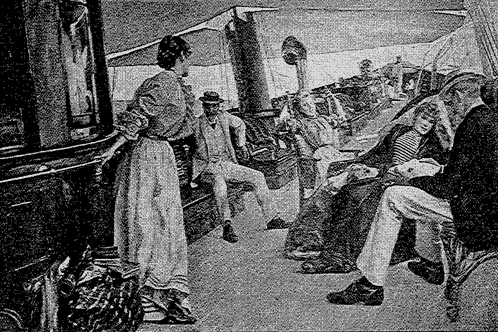
SOCIAL PASTIME ON RETURN VOYAGE.
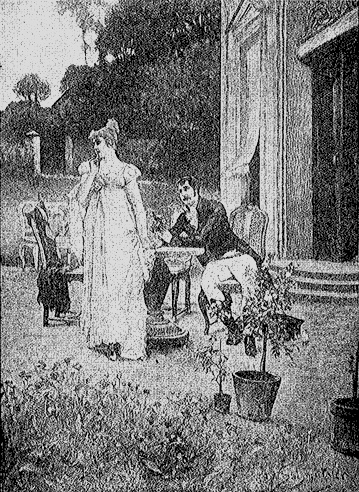
DECLINED WITH REGRETS.
As whatever grows has its natural period for maturing, so has love. At engagement you have merely selected, so that your familiarity should be only intellectual, not affectional. You are yet more acquaintances than companions. As sun changes from midnight darkness into noonday brilliancy, and heats, lights up, and warms gradually, and as summer "lingers in the lap of spring;" so marriage should dally in the lap of courtship. Nature's adolescence of love should never be crowded into a premature marriage. The more personal, the more impatient it is; yet to establish its Platonic aspect takes more time than is usually given it; so that undue haste puts it upon the carnal plane, which soon cloys, then disgusts.
Unbecoming Haste.
Coyness and modesty always accompany female love, which involuntarily shrink from close masculine contact until its mental phase is sufficiently developed to overrule the antagonistic intimacies of marriage.
Besides, why curtail the luxuries of courtship? Should haste to enjoy the lusciousness of summer engulf the delights of spring? The pleasures of courtship are unsurpassed throughout life, and quite too great to be curtailed by hurrying marriage. And enhancing or diminishing them redoubles or curtails those of marriage a hundredfold more. A happy courtship promotes conjugal felicity more than anything else whatever. A lady, asked why she didn't marry, since she had so many making love to her, replied: "Because being courted is too great a luxury to be spoilt by marrying."
No man should wait to make his pile. Two must acquire a competence conjointly, in order fully to really enjoy it together. This alone can give full zest to whatever pleasures it produces.
A formal proffer of marriage naturally follows a man's selection and decision as to whom he will marry. Consent to canvass their mutual adaptations implies consent to marry, if all is found satisfactory; yet a final test and consummation now become necessary, both to bring this whole matter to a focus, and allow both to state, and obviate or waive, those objections which must needs exist on both sides; including any improvements possible in either.
How to Deal with Objections.
The best time to state and waive or remove all objections, seeming and real, not already adjusted, is at his proposal, and her acceptance. A verbal will do, but a written is much better, by facilitating future reference. A long future awaits their marriage; hence committing this its initial point to writing, so that both can look back to it, is most desirable. And he can propose, and she accept, much better when alone, and they have all their faculties under full control, than verbally, perhaps, when excited. Those same primal reasons for reducing all other contracts to writing obtain doubly in reference to marriage.
You who fear awkwardness on paper, remember that true human nature always appears well, even when poorly dressed. A diamond is no less brilliant because set in clay. Mode is nothing, reality everything. All needed to appear well is to feel right, and express naturally what is felt. Saying plainly what you have to say, is all required.
The acceptance or rejection should also be unequivocal, or any contingencies stated, and waived if minor, but if they can neither be obviated nor compromised, should terminate their relations, that both may look elsewhere. If any bones of contention exist, now is the time to inter them finally, and to take the initiatory steps for perfecting both in each other's eyes. Bear in mind that as yet your relations are still those of business merely, because neither has acquired or conceded any right to love or be loved. Without pretending to give model letters of proposal, acceptance, or rejection, because varying circumstances will vary each ad infinitum, the following may serve as samples from which to work:
"Much Esteemed Friend: As we have agreed to canvass our mutual adaptations for marriage, and my own mind is fully made up, a final decision now becomes necessary.
"What I have learned of and from you confirms that high opinion of you which prompted my selection of you, and inspires a desire to consummate it. Your pleasing manner and mode of saying and doing things; your intelligence, taste, prudence, kindness, and many other excellencies, inspire my highest admiration.
"Will you let me love what I so much admire?
"But my affections are sacred. I can bestow them only on one who reciprocates them; will bestow them upon you, if you will bestow yours on me; not otherwise; for only mutual love can render either happy. I can and will love you alone, with all my heart, provided you can and will love only me, with all of yours. Do you accord me this privilege, on this condition, for life, forever? I crave to make you my wife; to live with and for you, and proffer you my whole being, with honest, assiduous toil, fidelity to business, what talents I possess, and all I can do to contribute to your creature comforts. Do you accord me this privilege, on this condition? May I enshrine you as queen of my life?
"Say wherein you find me faulty, or capable of improvement in your eyes, and I will do my utmost, consistently with my conscience, to render myself worthy and acceptable to you.
"I wish some things were different in you—that you had better health, arose earlier, were less impulsive, knew more about keeping house, etc.; yet these minor matters sink into insignificance in comparison with your many excellences, and especially that whole-souled affection obviously inherent in you.
"Deliberate fully, for this is a life affair, and if, in order to decide judiciously, you require to know more of me, ask me, or —— and ——. Please reply as soon as you can well decide.
"Decline unless you accept cordially, and can love me truly and wholly; but if you can and will reciprocate my proffered affection, say yes, and indicate your own time and mode of our marriage. Meanwhile, with the highest regards, I am, and hope ever to remain,
"Yours truly,
"A.B."
A true woman could give a better answer than the following, which does not claim to be a model. It is hardly time yet for a gushing love-letter, or we would not profane this sacred subject by making the attempt; yet should like to receive one in spirit somewhat as follows:
"Dear Sir: Your proffer of your hand and heart in marriage has been duly received, and its important contents fully considered.
"I accept your offer: and on its only condition, that I reciprocate your love, which I do completely; and hereby both offer my own hand and heart in return, and consecrate my entire being, soul and body, all I am and can become, to you alone; both according you the 'privilege' you crave of loving me, and 'craving' a like one in return.
"Thank Heaven that this matter is settled; that you are in very deed mine, while I am yours, to love and be loved by, live and be lived with and for; and that my gushing affections have a final resting-place on one every way so worthy of the fullest reciprocal sympathy and trust.
"The preliminaries of our marriage we will arrange whenever we meet, which I hope may be soon. But whether sooner or later, or you are present or absent, I now consider myself as wholly yours, and you all mine; and both give and take the fullest privilege of cherishing and expressing for you that whole-souled love I find even now gushing up and calling for expression. Fondly hoping to hear from and see you soon and often, I remain wholly yours forever,
"C.D."
Sealing the Vow.
The vow and its tangible witnesses come next. All agreements require to be attested; and this as much more than others as it is the most obligatory. Both need its unequivocal and mutual mementos, to be cherished for all time to come as its perpetual witnesses. This vow of each to the other can neither be made too strong, nor held too sacred. If calling God to witness will strengthen your mutual adjuration, swear by Him and His throne, or by whatever else will render it inviolable, and commit it to writing, each transcribing a copy for the other as your most sacred relics, to be enshrined in your "holy of holies."
Two witnesses are required, one for each. A ring for her and locket for him, containing the likeness of both, as always showing how they now look, or any keepsake both may select, more or less valuable, to be handed down to their posterity, will answer.
Your mode of conducting your future affairs should now be arranged. Though implied in selection, yet it must be specified in detail. Both should arrange your marriage relations; say what each desires to do, and have done; and draw out a definite outline plan of the various positions you desire to maintain towards each other. Your future home must be discussed: whether you will board, or live in your own house, rented, or owned, or built, and after what pattern; or with either or which of your parents. And it is vastly important that wives determine most as to their domiciles; their internal arrangements, rooms, furniture, management; respecting which they are consulted quite too little, yet cannot well be too much.
Family rules, as well as national, state, corporate, financial, must be established. They are most needed, yet least practiced in marriage. Without them, all must be chaotic. Ignoring them is a great but common marital error. The Friends wisely make family method cardinal.
A Full Understanding.
Your general treatment of each other now especially requires to be mutually agreed upon. Each should say, "I should like to treat and be treated by you thus, but not so; and let you do this but not that;" and both mutually agree on a thousand like minor points, better definitely arranged at first than left for future contention; each making requisitions, conceding privileges, and stipulating for any fancies, idols, or "reserved rights."
Differences must needs arise, which cannot be adjusted too soon. Those constitutionally inherent in each should be adjusted in love's early stages; it matters less how, than whether to your mutual satisfaction. Or if this is impossible, "agree to disagree;" but settle on something.
A concessionary spirit is indispensable, and inheres in love. Neither should insist, but both concede, in all things; each making, not demanding sacrifices. The one who loves most will yield to oblige most. What course will make both happiest should overrule all your mutual relations.
Write down and file all. Your present decisions, subject to mutual changes and amendments, will become more and more important for future reference, as time rolls on, by enabling each to correct both; for our own changes make us think others have changed. A mutual diary is desirable; for incidents now seemingly trivial, may yet become important.
Important Trifles.
See or correspond with each other often. Love will not bear neglect. Nothing kills it equally. In this it is most exacting. It will not, should not, be second in anything. "First or nothing," is its motto. Meet as often as possible. After its fires have once been lit, they must be perpetually resupplied with their natural fuel; else they die down, go out, or go elsewhere; and are harder to rekindle than to light at first.
A splendid young man, son of one of New England's most talented and pious divines, endowed with one of the very best of organisms, physical and phrenological, having selected his mate, and plighted their mutual vows, being the business manager of a large manufactory, and obliged to defend several consecutive lawsuits for patent-right infringements, neglected for weeks to write to his betrothed, presupposing, of course, that all was right. This offended her ladyship, and allowed evil-minded meddlers to sow seeds of alienation in her mind; persuade her to send him his dismissal, and accept a marriage proposal from another.
As he told his mournful story, he seemed like a sturdy oak riven by lightning and torn by whirlwinds; its foliage scorched, bark stripped, limbs tattered, even its very rootlets scathed; yet standing, a stern, proud, defiant, resolute wreck. A gushing tear he manfully tried but failed to suppress. His lips quivered and voice faltered. Perceiving his impending fate, he seemed to dread his future more than present; and hesitated between self-abandonment, and a merely mechanical, objectless, business life. In attempting his salvation, by proffering advice to the "broken-hearted," he respectfully but firmly declined; deliberately preferring old-bachelorship, with all its dearths, of which he seemed fully conscious. He felt as if he had been deeply wronged.
Yet was not he the first practically to repudiate? He suffered terribly, because he had sinned grievously, not by commission, but omission. He felt the deepest, fullest, manliest love, and revelled in anticipations of their future union, but did not express it; which was to her as if he had not felt it; whereas, had he saved but one minute per week to write lovingly, "I long to be with you, and love you still," or, "Business does not, cannot diminish my fondness," he would have saved her broken vows, and his broken heart.
Mingling other enjoyments with love, by going together to picnics and parties, sleigh-rides and Mayings, concerts, and lectures, marvellously cements the affections.
Love Feeds on Love.
Meet in your most attractive habiliments of mind and person. French ladies will see their affianced only when arrayed in their best toilet. Yet mental charms vastly surpass millinery. Neither can render yourselves too lovely.
Express affectionate fondness in your visits and letters; the more the better, so that you keep it a sentiment, not debase it by animal passion. It is still establishing its rootlets, like young corn, instead of growing. Allow no amatory excitement, no frenzied, delirious intoxication with it; for its violence, like every other, must react only to exhaust and paralyze itself by its own excesses.
Affianced young man, life has its epochs, which revolutionize it for good or bad. You are now in one. You have heretofore affiliated much with men; formed habits of smoking or chewing tobacco; indulged in late suppers; abused yourself in various ways; perhaps been on sprees. Now is your time to take a new departure from whatever is evil to all that is good and pure. Break up most of your masculine associations; and affiliate chiefly with your affianced. Be out no more nights. Let your new responsibilities and relations brace you up against their temptations; and, if these are not sufficient, your prospective spouse will help. No other aid in resisting temptation and inspiring to good equals that of a loving, loved woman.
Break off from your cronyisms, clubs, societies, all engagements except such as mean imperative, cold-blooded business. Your new ties furnish an excellent excuse. All your spare time and small change are wanted for her. To give to bad habits the time and money due to her and setting up in life, is outrageous. Bend everything to your new relations, them to nothing. Now's your time to turn over a new leaf, and turn all the angles, corners and right-about faces needed.
Affianced maiden, you have some departures to take and corners to turn. Your life has till now been frivolous, but has now become serious. You have no more need of toilet fineries; for "your market is made," and you have work on hand far more important, namely, fitting yourself for your new duties. Find out what they demand of you, and set right about making a premium wife and mother. Both begin life anew. Forgetting the past, plant and sow now what you would gather and become always.
The Best of all Possessions.
Woman is man's choicest treasure. That is the most precious which confers the most happiness. She is adapted to render him incomparably happier than any other terrestrial possession. He can enjoy luscious peaches, melting pears, crack horses, dollars and other things innumerable; but a well-sexed man can enjoy woman most of all. He is poor indeed, and takes little pleasure in this life, be his possessions and social position what they may, who takes no pleasure with her. All description utterly fails to express the varied and exultant enjoyments God has engrafted into a right sexual state. Only few experiences can attest how many and great, from infancy to death, and throughout eternity itself. All God could do He has done to render each sex superlatively happy in the other. Of all his beautiful and perfect work, this is the most beautiful and perfect. Of all his benignant devices, this is his most benign. All the divine attributes, all human happiness, converge in male and female adaptations to mutual enjoyments.
Each is correspondingly precious to the other. Man should prize many things, yet woman is his pearl of greatest price. He should preserve, cherish, husband many life possessions, but woman the most. He has many jewels in his crown of glory, but she is his gem-jewel, his diadem. What masculine luxury equals making women in general, and the loved one in particular, happy?
The Source of Miseries.
Beginning and conducting courtship as this chapter directs, avoiding the errors and following the directions it specifies, will just as surely render all superlatively happy as sun will rise to-morrow. Scan their sense. Do they not expound nature's love-initiating and consummating ordinances? Are they not worthy of being put into practice? Discordants, can you not trace many of your antagonisms and miseries to their ignorant violation? Parents, what are they worth to put into your children's hands, to forewarn them against carelessly, ignorantly, spoiling their marriage? Young ladies, what are they worth to you, as showing you how to so treat your admirers as to gain and redouble their heart's devotion? Young men, what are these warnings and teachings worth to you? God in his natural laws will bless all who practice, curse all who violate them.
The conduct during engagement on the part of the gentleman should be marked by the utmost courtesy toward and confidence in the woman of his choice; a state of feeling which she should fully reciprocate.
In public their behavior toward one another should not be markedly different from that displayed by them toward other men and women of their acquaintance; save that the bridegroom-elect should be on the watch that not the slightest wish of the lady be unfulfilled.
As for the lady, while she is not expected to debar herself from accepting the customary courtesies extended by the gentlemen of her acquaintance, a slight reserve should mark her conduct in accepting them. At all places of amusement or entertainment she should appear either in the company of her fiancé, or that of some relative.
She should never captiously take offense at her fiancé's showing the same attention to other ladies that she, in her turn, is willing to accept from other gentlemen, and she should take the same pains to please his taste in trifles that he does to gratify her slightest wish.
This does not mean, though, that in the selfishness and blindness of love—and love is very blind and selfish sometimes—she is to shut herself up to his companionship at all times, excluding him from the family circle of which he is so soon to become a member, and "pairing off" on all occasions, thus rendering both the mark for silly jestings.
How to Cherish Love.
But, in sober matter-of-fact, that little ring of gold does not mean utter blindness. It does not mean that she is to devote her evenings exclusively to the chosen one, ignoring her family entirely. It does not mean that she is to accept valuable presents of all kinds at his hands, to expect him to give up all his friends for her sake, nor to confide all the secrets of the household to his keeping, but, as one wise woman says, to "guard herself in word and deed; hold his love in the best way possible; tie it firmly with the blue ribbon of hope, and never let it be eaten away by the little fox who destroys so many loving ties, and who is called familiarity."
Neither is this counsel to be deemed over-cautious, since, alas! even "engagements" are sometimes broken in this uncertain world, and surely there is no womanly woman that would not in such an event reflect gladly, as she took up her life once more at the old point, that she had remembered these things.
A domineering, jealous disposition on either side before marriage is not the best possible guarantee for after happiness, and if these traits are clearly shown during an engagement, the individual who escapes from such thraldom before it is too late has shown conclusively that discretion which is, at times, the better part of valor.
Conduct Toward Parents.
The gentleman should exercise some tact in regard to his conduct toward the family of his betrothed. Marked attention should be shown toward the lady's mother. He should accommodate himself as much as possible to the wishes, habits and ways of the household, and not being, as yet, a member of the family, he should not presume to show an intrusive familiarity of conversation.
The lady, on her part, should strive to show consideration, friendliness, and a desire to please the parents of her husband-that-is-to-be. Thus both will unite in the endeavor to overcome that loving jealousy so natural on the part of those who see the claims of another grown paramount in the heart of one of their number, and feel that these new links are fast becoming stronger than ties of blood and relationship.
The respective families should meet these advances with all kindness, and should also endeavor, in view of the new union pending between them, to make, if this be necessary, one another's acquaintance as soon as convenient.
Length of Engagements.
Engagements should not be entered upon prematurely, a certain degree of acquaintanceship proving no mean preparation for an arrangement of this nature. But when an engagement is once formed it should not, in the majority of cases, be of an undue length. This is a matter to be settled by the wishes or the circumstances of the contracting parties.
It is oftimes the measure of wisdom, where the obstacle is lack of fortune, to risk some degree of deprivation, rather than submit to a long-protracted engagement; the man, as head of the new home, finding a fresh motive for ambitious striving, and both parties being preserved from that coolness of feeling too attendant upon years of waiting. No homes are happier than those constructed on the principle of economy and patient effort.
Broken Engagements.
Not unfrequently does it occur that circumstances arise that render the dissolution of an engagement inevitable, and, as such a course, unless mutual, of necessity involves an injury to the feelings of one party, great care and delicacy should be employed in approaching the subject.
If the occasion should arise on the lady's side, it must be remembered that she is not bound to declare any other reason than her own sweet will. It is better, however, for reasons to be frankly given, that the step may not be attributed to mere caprice on her part. On the side of the man the reasons must be strong, indeed, that can justify him in breaking a solemn engagement sought of his own free will, and urged by him upon the object of his choice. By thus releasing himself he not unfrequently leaves the lady in an embarrassing position before the public, not to mention the possible injury that may be inflicted upon the deepest feelings of her heart.
If the cause should arise from any fault on the part of the lady, a man of honor will ever preserve the strictest silence on the subject. If from sudden failure in his own fortunes he should feel himself in duty bound to relinquish his hope of present happiness lest he selfishly drag another down to penury, let the reason be carefully and clearly explained.
At the conclusion of an engagement let every gift, including the engagement ring, and all photographs and letters that have been exchanged between the two, be promptly returned by each that as little as possible may remain to remind of the days that are done. It is especially a point of honor on the gentleman's part to retain nothing that the lady may have given, or written, him.
Etiquette of Married Life.
Marriage, to the elect, may be fitly termed a state of grace, but without a close observance of all the courtesies that tend to uplift everyday life in some degree above the narrowness of mere existence it may but too easily become what the old cynic declared it to be when he wrote, "Marriage is a feast in which the grace is sometimes better than the dinner."
Mutual confidence and mutual respect are the two principal factors in the case. Without these there can be none of that harmony so necessary to happiness in the state matrimonial. And not only this, but they should strive to be mutually entertaining.
The pains they took during their engagement to be agreeable to one another at a time when they were by no means entirely dependent upon themselves for companionship, would surely not be amiss in rendering pleasant the years, and it may be decades of years, during which they must be to a great extent dependent upon each other for entertainment. The young man who spent so much time at the home of a certain lady that he was finally asked why, if he was in love with her, he did not marry her, uttered a sad truth when he answered, "Ah, but where then should I pass my evenings?" A reflection upon the agreeableness of married life that might easily be avoided by the exercise of care and tact on both sides.
The Art of Agreeableness.
Philip Gilbert Hammerton, in his Intellectual Life, wisely suggests: "A married couple are clearly aware that, in the course of a few years, their society is sure to become mutually uninteresting unless something is done. What is that something? Every author who succeeds, takes the trouble to renew his mind by fresh knowledge, new thoughts. So, is it not at least worth while to do as much to preserve the interest of marriage?"
The wife who dresses for her husband's sake, who reads that she may qualify herself for conversation with him, who makes him the chief end of her cares, and the husband who brings home from the outside world some of its life and animation to share with her, who has a loving interest in all that she has done for his pleasure, and, if wealth be a stranger at their door, stands ready to lift the heaviest burdens from her shoulders, have solved for themselves the problem of married happiness, and found it to be a condition wherein every joy is doubled and every sorrow halved.
Duty Toward One Another.
Let the wife have no confidant as to the little shortcomings of her husband, over which love, as well as pride, should draw a sheltering veil. Never listen to an unkind tale of his past or present mistakes, and count all those who would seek thus to destroy your peace of mind as your bitterest enemies. Let the husband in his turn remember that an unkind or slighting word spoken of his wife, touches his own honor to the quick, and be instant in resenting the words that should never have been spoken in his presence.
Another point to be remembered in view of the duty of husband and wife toward one another, is with reference to attending church or entertainments. The wife has, in all probability, left a home where the different members of the household were ready to accompany each other whenever occasion served, and young friends were planning many a pleasant outing, and now she is wholly dependent upon her husband for all of these things. Let her beware, under these circumstances, of allowing herself to attend church, lecture, or any other evening entertainment, in the company of well-meaning friends. For the husband, once seeing that his wife can attend these places without his assistance, will soon, if such be his disposition, remain selfishly home at all times, or, if otherwise inclined, still more selfishly find his amusement in places widely foreign to his wife's happiness or peace of mind. The carelessness of many well-meaning men in this respect is the cause of very much unhappiness that might be wholly avoided by a little consideration as to the utter dependence of the wife upon her husband for all these recreations.
Home Attire.
This is a subject that it should be unnecessary to touch upon, but, unfortunately, too many bright, pretty, carefully-dressed girls degenerate into careless, fretful, untidy and illy-clad young wives, whose presence is anything but a joy forever to the individuals who must face them across the family board for three hundred and sixty-five days in every year. And it is this careless young woman who is first to complain that "John does not care for me in the least, now we are married," while John is very apt to think, "If Carrie would only take just a little of the pains to please me now that she did six months ago, how much happier we would be." And John is quite right about it. This very carelessness on the part of wives has marred the happiness of more than one new home. The ribbon, the flower, the color that "John likes" and the smile that crowns all are magical in their effects.
Then let John always remember to bring to this home a pleasant face, from which business cares are driven away, and a readiness to please and be pleased, that meets the wife's attempts half way, and the evening meal will be made delightful by pleasant chat, which should never consist of a résumé of the day's tribulations, but should turn on subjects calculated to remove from the mind all trace of their existence, and thus will they arise at its close better and happier for the hour that has passed.
Household and Personal Expenses.
One of the chief sources of unhappiness in married life is the strife arising from the vexed question of home and personal expenses. In the first place, the husband frequently fails in regard to openness with regard to his business concerns and profits; thus the wife, entirely ignorant as to what amount she may safely spend, errs too often on the side of extravagance, finding too late, when a storm of reproach descends upon her innocent head, where and how she has sinned.
Then, too, it is often a sore trial to the wife's pride to ask for the money necessary to keep her own wardrobe in repair. Especially is this the case when, before marriage, she was in receipt of her own money, earned by her own hands. It seems to her that her husband ought to see that she has need of certain articles, and the very fact that he does not, leads her to the false supposition that he has ceased to care for her, while he, if there was any thought about it in his mind, would say, "Why doesn't she ask for money if she wants it? She knows I will give it to her if I have it."
All these troubles would be avoided if married couples early came to a definite understanding on this subject, and a certain sum were set aside which the wife was to receive weekly for household expenses, her personal wants to be supplied from such surplus as she may be able to save from out this sum, or in some other way provided for by a stated amount, both of which sums should be under her exclusive, unquestioned control.
Some simple system of accounts should then be kept and regularly gone over together on every quarter. A mutual agreement thus established on the money question, much annoyance and much extravagance may be prevented. It is not too much to suggest that, perhaps, it might not be amiss to present an account of the husband's expenses also, at these quarterly reckonings.
Above all things, never let the wife, from a weak desire to gratify her own personal vanity, enter upon some extravagant purchase, the amount of which she must conceal from her husband, and (vainly often) strive to pay in small amounts saved or borrowed. The result is usually exposure, sometimes disgrace, pecuniary loss and loss of esteem in the husband's eyes. Perfect confidence is the only basis upon which happiness can be safely founded.
A Pleasant Disposition.
Cultivate, on both sides, a disposition to restrain all unseemly exhibitions of temper. Hysterics and prolonged and repeated fits of tears soon lose their effect, and, at the last, a half-pitying contempt is their only result. Let all conversation be refined in its tone. The force of example in this respect carries with it a silent, impressive power that is not easily resisted and lapses therefrom involve a loss of this influence that cannot be easily estimated.
Profanity, too, is a deadly foe in the household and any wife that permits her husband to swear in her presence, either to herself, or concerning others, lessens her own self-respect each time it occurs. That profanity can be repressed, has been shown her by the fact that, no matter how long the previous engagement may have lasted, no word of such import escaped the man's lips in her presence, and surely the woman chosen to be head of his home is no less worthy of his respect than was the girl he wooed.
The habit of indulging in cutting or harsh remarks is one to be guarded against. Mutual politeness should be exercised by both husband and wife, and in all cases watch should be set over the mouth, and the door of the lips well kept.
Boarding Versus Home Life.
The tendency in all large cities, at this present time, points toward fashionable boarding-houses, or expensive lodging-houses, as the nuclei round which the newly-married most do congregate.
It may be that the wife is utterly unused to the care of a house (in which case the sooner she learn the art, the happier for both parties) or, perhaps, the financial resources of the husband are unable to support the drain consequent upon furnishing a home that shall gratify the foolish pride of the wife. But, whatever the cause, the effects are the same, and are to be found in the utter unfitness of women adopting this manner of existence for any of the serious duties of life that, sooner or later, come upon all who wear this mortal garb.
Then, too, in the idle, censorious, gossiping, novel-reading life that flourishes in this hothouse existence, the seeds of lifelong misery are not infrequently sown.
Let a home, then, however small, be one of the first considerations in beginning the married life, and let the adding to, and the beautifying of, this precious possession be the duty and the privilege of the years to come.
To the wife, in her housewifely rôle, belongs the care of overseeing or accomplishing with her own hands, the varied duties that go to secure the daily well-being of the home. She must see that the rooms are bright, neat, and cosily arranged; that the meals are appetizingly and punctually served, and be herself neatly and tastefully attired to preside at the table.
Due allowances are to be made for the amount of manual labor she has been obliged to perform with her own hands, still, by care and tact a woman can always maintain a certain degree of neatness.
Let the husband, on his part, bring into the home cheerfulness, with a quick remembrance of all those little attentions that go so far toward making up the sum of earthly happiness. Let him see that, to the best of his ability, the home wants are provided for, and be not forgetful to lend the help of his stronger hand wherever needed. (Read carefully other hints in department of Home Etiquette.)
Never demand of your wife more than you are willing to give. If you desire to be received with smiles, enter the house with a cheerful mien, and you will find there are few women who are not willing to give measure for measure, and even a little more than they receive of kindly attention. For a wife will usually shine, like the moon, by reflection, and her happiness will always reflect your own.
IN discussing the important subject of etiquette as connected with weddings and wedding anniversaries, it may be mentioned here that the forms for invitations to all occasions of this sort, and acceptances and regrets of the same, card-sending, etc., have been fully treated in their respective departments. The observances immediately preceding, during, and following the ceremony, are now to receive consideration.
Paying for the Cards.
The form, size and use of these important bits of pasteboard having been before stated, it only remains for us to say here that all the expenses relative to their purchase and distribution are to be borne solely by the parents or other guardians of the bride. To have it otherwise implies a lack of delicacy on the part of the bride, and lays upon her a certain amount of obligation which every right-minded girl would desire, above all things, to avoid. Hence when the parents are financially unable to incur the expense, good taste demands that all display be abandoned and the couple be quietly married in the presence of the family only.
The bride should always remember that until the fateful words are spoken that make the twain one flesh, she has no claim whatever on the purse of her future husband, and conduct herself accordingly.
Hence it is that a very plain trousseau is more commendable to the self-respect of the wearer, than the elaborate outfittings, toward the purchase of which the groom-expectant has largely contributed, and which, in case of the oft-recurring "slip twixt the cup and the lip," must weigh heavily upon the maiden's pride.
Even the "after cards" are usually ordered by the parents with the others, and paid for at the same time. If, however, they are ordered after marriage, they are paid for by the groom.
There is only one exception to the rule of the bride's parents paying for the wedding cards, and this occurs when the wedding ceremony is performed quietly in church and the reception, for some reason, is held at the home of the groom's parents, in which case they, as the entertainers, properly pay for, and issue, the cards of invitation.
The groom, in England, always pays for the carriage that conveys himself and bride to the station after the ceremony and reception are past, but in this country the fashionable father usually claims the privilege of sending them on this first stage of their married life in his own carriage. However, the groom buys the ring and a bouquet for the bride, furnishes dainty presents for the bridemaids, remembers the best man and the ushers, pays the clergyman's fee, the size of which is to be regulated only by his inclination, or the length of his purse-strings, and furnishes the marriage license.
Naming the Day.
This privilege belongs by right to the lady herself, but, in reality, the business engagements of the groom, and the time when he can best leave for the bridal tour have much to do in settling the exact date for which the invitations shall be issued. In very fashionable circles it is the mother that names the day of her daughter's marriage.
Time was when during the two weeks, or longer, elapsing between the issuing of the invitations and the occurrence of the wedding, the bride-expectant was not to be seen in public, nor by chance callers at the house, a custom which still prevails to some extent, but is superseded in the most fashionable circles by a series of especial entertainments given during this interval.
It frequently happens that one, or each, of the bridemaids entertains the bride and other bridemaids at a lunch or dinner, either informally or on a large scale. Some married friend of the family may give a large farewell dinner to Miss —— and her bridemaids; and the bride herself, or her mother, may give a rehearsal dinner. Ordinary invitations, however, are not to be accepted.
If the presents are not to be exhibited at the wedding reception, the bride frequently gives an informal tea the day before to her lady friends for the purpose of displaying them. She should also, for her health's sake, take a daily drive.
Announcing the Engagement.
An engagement is now frequently announced in rather a formal manner. This, however, is not usually done until a short time previous to the marriage itself. Sometimes it comes out in the society papers immediately after it has been made known to the kinfolk and intimate friends. Felicitations follow as a matter of course.
Sometimes a dinner-party is given by the parents of the bride-elect and the announcement is made by the host just before leaving the table. Congratulations follow. Sometimes notes are written by the young lady or her mother in announcement.
If the families of the contracting parties have been strangers heretofore it is expected that the gentleman's family will make the first call. Any friends that choose may give entertainments in honor of the couple.
The lady does not make any ceremonious calls after this announcement has been made, it being supposed that before this occurs she shall have left cards upon all her friends. If no formal announcement is made the bride-to-be must, before invitations are issued, leave cards with her friends and acquaintances. In the city she need not enter to make a personal call, in the country she will probably find it necessary so to do.
Wedding Gifts.
There is much to be said for and against the custom of wedding presents. And while the fact remains that they too often become the vehicle for an expenditure so uncalled-for as to encroach upon vulgarity in its excess, another fact still exists, that the simple remembrances of friends are very grateful to the bride, who, perhaps, is bound for a distant home where every loving token will recall a well-known face.
Then remember your friends on their wedding day, wisely, and according to their tastes and your own resources, for:
"Policy counselleth a gift, Given wisely and in season, And policy afterward approveth it, For great is the power of gifts."
By those so desiring, the words, "No presents," or "No presents received," may be engraved in the left hand corner of the card. This is often a relief to many of the guests, and, at the same time does not prevent the very intimate friends, as well as members of the family, from sending quietly such gifts as they may choose, which, of course, are not exhibited.
Where presents are to be given they are frequently sent some time in advance, and the bride often takes much pleasure in arranging them for exhibition in some upstairs room. Each article is accompanied by the card of the giver; these are removed or not, as may be desired before exhibition.
The bride acknowledges the reception of each gift by a graceful little note of thanks. Some of them doubtless will come from persons unknown to her, friends of the groom, and to these she must be especially prompt in returning her acknowledgments.
List of Invitations.
Making up the list of invitations should be attended to carefully. The engaged couple should carefully prepare their respective lists and the mother of the bride should attentively scan names, for from this is to be made up the future visiting list of her daughter, and she cannot but hesitate at burdening her at the outset of her new life with a host of calling acquaintances, hence is forced to exclude every ineligible name; a cutting painful but oftimes necessary.
Ushers.
The duties of the ushers in a church wedding are very important. At large weddings as many as half a dozen, or more, ushers are sometimes needed to manage the great number of guests. They usually appoint one of their number as head usher, and to him falls the duty of deciding on the space to be reserved for near relatives, which is to be divided from the remainder of the church by white ribbons. He makes sure that the organist is in place, indicates the approach of the bridal party that the Wedding March may greet them, and instructs the other ushers as to their respective duties.
Ushers must escort guests to their seats, and as relatives of the groom are seated on the right of the main aisle, or center of the church, and those of the bride on the left, it is proper for an usher to ask any one with whom he may be unacquainted whether their relationship is to the bride or groom.
In escorting guests to their seats an usher gives his right arm to a lady. A gentleman who may be in her company should follow after.
The guests assembled, part of the ushers should leave the church at once and drive to the bride's residence in order to be there to receive the bridal party upon their return.
“The Best Man.”
The "best man" is usually an intimate friend or relative of the groom. He drives to the church with him, stands by his side at the altar-rails while he awaits the approach of the bride, and, stepping back, it is he that holds the groom's hat during the ceremony and hands it to him at its close. To him is confided the payment of the wedding fee, and if there is a marriage register he signs as a witness. He then drives by himself to the bride's home, reaching there in time to receive the bridal party and to assist the ushers in the presentation of guests to the newly-married couple. He also makes the necessary arrangements about their departure, secures the tickets, and, if their destination is to be kept a secret, to him alone is it confided.
It occasionally happens that there are as many groomsmen as there are bridemaids, but this is the exception and the "best man" takes their place.
The ushers frequently form, two and two, and precede the bridal party up the aisle.
Bridemaids.
The number of these is optional, from one to twelve being allowable. Four, six or eight are usually chosen. Unmarried sisters of the bride and groom are frequently selected. Custom emphatically declares that they must be younger than the bride. For an elder sister thus to officiate would be extremely inappropriate.
Indeed, the favored fashion of the present time is for little tots, all the way from three or four to eight, clad in bewitchingly quaint and picturesque costumes and crowned by the largest of Gainsboro' hats, to precede the bridal couple to the chancel. In addition to these, the bride is followed by a chosen number of bridemaids as well, but often the children are all. Frequently they carry baskets of flowers, and, preceding the newly-made wife in her progress down the church aisle, they scatter the blossoms in her pathway.
Sometimes this order is changed, and children rise in groups from seats near the front, and, preceding the bridal cortège to the door, scatter flowers before them. Children selected for this purpose should be under ten. Young boys, selected from among relatives, are sometimes dressed as pages and accompany the bride as train-bearers.
Bridemaids usually consult the bride as to their toilets, and each other as well, that there may be no unfortunate combinations of color to mar the effect of the whole. They usually dress in colors, unless the bride choose some faint tint for her costume; then it is customary for them to wear pure white, and sometimes the whole group are clad in spotless purity.
The bridemaids' gowns are walking length, as a rule, and they wear large, picturesque hats, overshadowed with plumes or adorned with flowers, and carry huge bunches, or baskets, of fragrant blossoms. Wealthy brides, who have some special fancy to carry out, often provide the gowns for their maids. Historic styles are frequently chosen, making every gown after the exact mode of the epoch selected, but adopting a different color for each.
Where there is but one bridemaid, if she be escorted at all, which is not always done, it should be by some friend, not the "best man," whose duties in attendance on the groom are all-sufficient.
Bridemaids should not refuse the proffered honor, if possible for them to accept. If, after acceptance, unforeseen circumstances should occur to prevent participation in the festivities, no time should be lost in sending a regret and full explanation, so that her place may be supplied in time to prevent disarrangement of the entire plan.
A Church Wedding.
A church wedding is more picturesque and solemn than any other form of celebrating the marriage rite and the etiquette of all full-dress affairs of this nature is essentially the same.
The groom drives first to the church, accompanied by his "best man" and enters either vestry or church parlor. The relatives, the mother of the bride and the bridemaids now drive to the church in carriages, closely followed by the carriage of the bride and her father.
By this time it is supposed that the carpet and awning, if it is a city church, are in place, the invited guests assembled, and the bridal procession immediately forms, entering the church and passing up the aisle to the strains of the wedding march. In England a lovely innovation is made on this threadbare custom by having a chorus of boy-voices sing an epithalamium, or wedding ode, during their progress. This custom has found its way here in some ritualistic churches where the vested choir march, two and two, at the head of the bridal procession, singing as they march. Sometimes as high as forty, and even seventy, in number swell the cortège.
The order of progression is as follows: first the ushers, (unless there are choristers to take the lead) who march up the aisle by twos, keeping step with the music, then, if there are child-bridemaids, they follow in the same order. Some brides have two, some four or six of these dainty dots of maids. The children are followed by the grown bridemaids, also two by two. Sometimes children alone fill the place, there being no grown maids. The maids, both children and grown folk, are arranged according to their height and the harmony of color in their gowns.
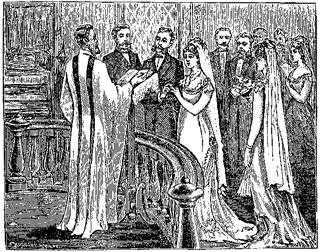
THE MARRIAGE CEREMONY.
After them comes the bride leaning on the right arm of her father. It sometimes happens that she walks up the aisle alone, and again that she is accompanied by some male relative who is to take a father's place in giving her away. Occasionally young brothers, mere boys in age, are permitted to assume this touching duty.
At the altar steps the ushers separate and pass to the right and left, the bridemaids also separate in a similar manner, leaving space for the bridal couple. The groom, having come from the vestry, accompanied by the "best man," should be standing in readiness to advance, take the bride by her right hand and turn to the clergyman, who proceeds with the marriage formula sanctioned by his faith.
At that point in the service where the question is asked, "Who giveth this woman to be married to this man?" the father, or whoever takes his place, should bow, and then in a moment leave the group and seat himself beside the bride's mother in the front pew at the left.
In a ritualistic church the bride and groom at once kneel before the officiating clergyman, who will signify to them at what point of the service to rise. Hassocks should be provided for the occasion.
The first bridemaid, or maid of honor, takes her stand close to, and slightly back of, the bride, that she may be ready to take her bouquet, if she has one, remove her glove, or, as is the better custom in this day of many-buttoned gloves, to turn back the neatly-ripped glove-finger that the ring may be adjusted, and to hold her bouquet or prayer-book when necessary. In the meantime, it is the "best man" who hands the ring to the clergymen in readiness for use.
After the Ceremony.
The service over, which may or may not have been accompanied by low, slow music, the clergyman shakes hands with and congratulates the newly-wedded couple (kissing being no longer permissible), the groom draws the bride's right hand within his left arm and conducts her to the carriage, taking the center aisle if the church have one; if not, taking the opposite from that by which they entered, the bride, her veil over her face, neither recognizing nor paying the slightest apparent heed to any one in the church. The organ peals forth, the procession re-forms and follows to the door, first the bridemaids, next the ushers. If there have been choristers, they lead the line, chanting as before, until their voices die out of hearing in the vestibule. Often, too, the child-bridemaids precede the couple as they leave the church, scattering flowers before them, the whole forming a very pretty pageant to the eye. The church may have been richly decorated with flowers and potted plants.
Where there is but one bridemaid or maid of honor, as she is then called, she attends to all the duties necessary, but the bridal procession is shorn somewhat of its fair proportions.
The vestibule reached, certificate or church register signed, the bride is cloaked, and, entering a carriage with her husband, is quickly driven home, the guests remaining in their seats until the cessation of the wedding march, when they, too, enter their carriages. Meanwhile the "best man" takes the shortest route possible to the same destination in order to assist the head usher, who with, perhaps, some of the other ushers, is supposed to be already there, in receiving the bridal party and guests as they reach the house. The remaining ushers busy themselves in assisting the bridemaids to their carriages and speeding them onward that they, if possible, may reach the house in time to receive the bride and groom.
If the church wedding be in the evening the same order will be observed, save that the gentlemen wear evening dress.
The Reception.
At the house the ushers introduce the guests to the newly-married couple who, together with the bridemaids, form a group to receive the good wishes of the company. The parents of the bride stand a little apart from this party and receive the felicitations of their guests in behalf of their daughter's welfare. The parents of the groom, if present, form part of this group.
If the company is very large it is well to divide the centers of attractions by placing the young couple in one room and the parents in another, thus compelling a freer circulation of the guests, who else would crowd the bridal party to suffocation.
The house may be profusely decorated with flowers, and the rooms though daylight reign without, may have been carefully darkened only to be re-illuminated by the softer radiance of waxen candles or shaded gas jets.
Refreshments.
The banquet may be as elaborate as desired, but is usually served in the refreshment room from the buffet, guests repairing thither at any time where they are served by attendants, ushers seeing that ladies unattended by gentlemen are invited to partake and properly served.
Tea or coffee is not considered a necessity, though, in compliance with tastes that do not yield easily to fashion's decree, it is usually to be had, but in winter bouillon, in cups, is usually offered. Wine, of course, depends upon the scruples of the entertainers. Salads, lobster, salmon, etc., birds and dainty rolled sandwiches, do duty for meats. Fancy cakes, such as maccaroons, kisses, etc., are always offered, together with ices. The variety of other cakes is always at the option of the hostess, save the regulation rich black fruit, or groom's cake, and the bride's snowy loaf. These are necessities, and if the bride so far conform to the old custom of "cutting the cake" as to make one incision therein with a wonderful silver knife, "ye ancient superstition" is satisfied, and the work of cutting it and packing in dainty boxes to be carried home, if this be wished, is deputed to attendants. These boxes are deposited in some convenient place within reach of the departing guests.
When there are a number of elderly guests it is generally thought best to set two or more small tables in the refreshment-room, or an ante-room, where they may be comfortably accommodated with seats, and one of the ushers should see that they are so seated and promptly served.
Rehearsals.
In view of the complicated arrangements made necessary for the proper carrying out of a fashionable church wedding, and in consideration of the large number of people involved in the ceremony and the necessity of each one being in the right place at the right moment, in order to prevent confusion, it will be seen that some preparation is necessary before all can act in concert.
The needed drill is usually given by an exact rehearsal of the entire affair, to give which, the whole party meet at the church and rehearse, so to speak, their respective parts; the forming into procession, the parting right and left at the chancel and the re-forming to return to the vestibule, being all gone through with to the sound of music, until every part of the long procession moves like clockwork.
The grouping of the bridemaids, the appointed duties of maid of honor and "best man," even to the smallest details, are all made perfect, until even the principal actors in the scene can retire without fear of any disaster to come.
This rehearsal is frequently made the occasion of a rehearsal dinner, given by the mother of the bride, at which the intimate participants of the wedding-to-come entertain and refresh themselves.
The Wedding Breakfast.
Wedding breakfasts are an exclusively English fashion, but are gradually creeping into favor here. The breakfast does not differ from the ordinary reception, save that it is usually at an earlier hour and is more frequently a "sit-down affair."
The guests all go into the refreshment room at the same time, even though it sometimes happens that the assembly is so large that no one but the bridal party and immediate relatives are provided with seats at small tables. In this case, the gentlemen help the ladies and themselves from a long table in the center of the room, the whole affair, under these circumstances, being simply a cold collation. Gentlemen leave their hats in the hall; ladies retain bonnet and gloves.
After the usual greetings to the bridal pair and a few minutes general conversation, the repast is announced and the guests proceed to the appointed room in the usual fashion—bride and groom, bride's father and groom's mother, groom's father and bride's mother, "best man" and maid of honor, other bridemaids and gentlemen appointed, usually ushers, etc.
A "stand-up" breakfast has many things in its favor. It is more easily served than one where all the guests are seated at a table that, in everything but name, is a dinner table; it is less formal and therefore pleasanter, and far more guests can be accommodated. The refreshments are the same as for a reception.
Departure.
After mingling with the guests for a short time the bride quietly withdraws to don her traveling garb, and soon descends the stairway. She is met at the foot by her bridemaids, who part and form in line on either hand, through which dainty pathway she passes to join the groom.
Quick good-bys are said, the carriage is entered and whirls rapidly away, followed by showers of rice and cast-off slippers, and the pretty scene is ended.
Home Weddings.
Home weddings are attended with much less trouble, fatigue and expense than fashionable church weddings. The clergyman enters the room and stands facing the people; the bridal couple follow and stand facing him. Hassocks are provided for kneeling, if desired. The father, or some near male relative, stands ready, in sight of the clergyman, to give away the bride. He should simply bow his affirmation when the question is asked.
There are many additions that may be made to this simple ceremony, such as a troop of pretty children holding white ribbons each side to mark the path the bridal pair must walk to reach the minister, while the sweet strains of a hidden band of musicians may accompany their footsteps.
Floral decorations, within limits, are beautiful and appropriate, but where they are so lavishly displayed as to remind more of the florist's bill than the beauty of the blossoms, their effect is lost in a certain vulgarity that attends all too-visible evidences of outlay.
One pretty idea is to carry out the fancy of having one kind of flower, massed according to the chosen design, serve for the decorations, at flower weddings; for example, rose weddings, lily weddings, daffodil weddings, etc. The design itself is according to the taste of the florist or the family, and is a subject changing so easily with the season or the fashion as to merit no mention here.
The supper may be as elegant an affair as one chooses to make it. If served by caterers, all care is removed from the hostess as to possible accidents, and she is left free to entertain her guests.
At evening weddings the company remains late or not, according to the hour of the bride's departure. Sometimes dancing is arranged as one of the evening's amusements. If so, the bride may, if she choose, open the first quadrille with the "best man." Should she do this, the groom is expected to dance with the first bridemaid.
The bride can slip away at any time, to reappear in traveling costume, and bidding a quick farewell, disappear from the company, who, after this, begin to disperse.
One most pleasant custom, English in its origin, should not be forgotten; it is that of remembering all the servants with some little gift as a souvenir of the occasion.
Invitations to Church Weddings.
There is a good deal of dispute in regard to the etiquette of acknowledgment of a card for a church wedding. Some high authorities assert that the invitation is so general and means so little particular attention that no notice need be taken of it except in the regular line of future visits to the bride and to the bride's mother. But one of our American social oracles declares that a card is obligatory at the hour of the wedding, if one cannot attend, and that if the house address is unknown, this card should be sent to the church. If this is necessary, most people err woefully, for few non-attendants send the card.
For church weddings everything pertains to formality, and the invitation as well as the ceremony is impressive in all details. The names of the parents heading the invitation are now more often written in full, thus insuring a good-looking line at the top of the note. The line, "request the honor of your presence," almost invariably appears on a church invitation with "honor" spelled with a "u."
The names of bride and groom are separated by the little word "to," although some consider "and" quite as proper.
The omission of the prefix "Miss" from the daughter's name is customary on an invitation but should never occur when the bride is a sister, cousin or niece of the people issuing the invitations. If a widow is re-marrying, she uses the prefix "Mrs." with her Christian names and the surname of her deceased husband. If the bride is an orphan, with no one to issue the invitations for her, the heading reads, "The honor of your presence is requested," etc. When the bride has more names than one it is customary to use all.
The address of a well-known church is generally omitted, although it is frequently a convenience for out-of-town friends to know it. Names of churches ending with "s," as Saint Thomas, are written with an apostrophe "s"—thus, Saint Thomas's.
Dress for the Occasion.
The Bride's Dress may be as elegant as desired, or as simple, but it is to be hoped that the custom of using pure white in the composition of the toilet will not be superseded by any passing freak of Dame Fashion's for softly tinted bridal robes. This innovation should be stoutly resisted by all brides-to-be. If the white robe is simple in material, a simple style should be chosen for the making; richer goods allow of more elaboration. The bride wears no jewels, and the typical orange-blossoms and myrtle are supposed to crown her brow. As a fact, however, other white flowers, such as roses, lilacs, lilies-of-the-valley, are more frequently chosen.
Where the wedding decorations are of one flower exclusively, that blossom alone figures in the bridal wreath and bouquet. Some High Church brides carry an ivory or silver-bound prayer-book in preference to flowers; thus associating it with the most sacred vows of their life and hoping to preserve it as an heirloom in the family.
White shoes and gloves are to be worn with this toilet. The best taste prescribes a high corsage for the bridal costume, and sleeves either to the elbow or longer, in either case to be met by the long kid gloves. This gives a certain modesty to the toilet that is in keeping with the occasion. By many brides who expect to wear their bridal costume to after evening entertainments, the wedding gown is frequently supplied with two corsages; the high for the wedding day and the low for evening wear.