Visiting Cards. (continued 5)
Reading edition
The form of the invitation is similar to an "At Home," as: Mrs. Emmons van Zant, At Home, Thursday, June sixteenth, at eight o'clock. 2040 Westmoreland Street.
Duty of Guests.
The hostess may ask her guests to sing or play; but, if they refuse, it is bad taste to urge them. The hostess, if she plays or sings, may favor the guests with a single selection after others have been heard. It is well for amateurs to master a few pieces that they can render without the notes. This relieves one of that time-worn excuse—"I haven't my notes." This is also the case with those who sing. By ceasing to urge performers, the company will be freed from much of that repeated, coy refusal that only needs sufficient coaxing to comply.
When a lady is asked to play or sing, the gentleman nearest her should at once escort her to the piano, remaining near her while she plays, and turning the music, if he be competent. He will also take charge of her fan, bouquet and gloves, and when the music is finished, he will again offer his arm for her return to her seat. At the same time he will thank her for the pleasure she has given himself and the company. Other guests, together with the hostess, should also express their gratification. Never comment on the quality of the instrument. Never offer to turn the sheets of instrumental music unless familiar with the notes.
When any one is playing or singing, let the company preserve silence, and if they should converse, let it be in the lowest tones. To interrupt a performer is the worst possible taste. Instrumental performers have as much right to expect the courtesy of silence as vocalists. The hostess has the privilege of indicating, to a noisy group, by a gesture, her desire for silence. Those who will talk should at least withdraw from the immediate vicinity of the instrument. If asked to play an accompaniment, do so, not to display your own accomplishments, but so as to afford the best possible support for the singer.
MUSICALES.
A musicale, or a musical reception, is a difficult entertainment. A program must be arranged, and sufficient amateur performers secured to make a success of the affair. Herein comes the difficulty, amateurs, after a very unwilling consent has been wrung from them and their name and selection placed upon the program, are so little to be depended upon. Would that there could be found some way of oiling the machinery at a musical entertainment and of soothing the ruffled feelings of a hostess when those most depended upon to render assistance withdraw at the last moment for some vague reason. When one firmly refuses at the first to appear upon the program, no offence can be taken, but to withdraw for any but the most urgent reason is an actual breach of etiquette.
For this reason, those hostesses whose purses are of sufficient length, are driven to employ professional assistance upon these occasions. Another objection to amateur performers is the semi-professional jealousy existing between them as to precedence on the program.
Performers should arrive punctually, and while the order of the program should be followed as far as possible, no one should be offended at being asked, when it is necessary to play or sing out of the order agreed upon.
Arranging the Program.
If the musicale is to be entirely professional, much trouble will be saved by seeking some prominent musician, and with him arrange the program, and letting him act for the hostess in the matter.
A professional artist should not be kept beyond the time agreed for, neither should he be urged to render selections entirely different, or largely in excess of those arranged for. The hostess should express her pleasure, and may request some little favor. Applause is allowable, but it must be within limits.
A courteous reception must be accorded to all performers by those who desire their talents. The hostess should see that the piano is carefully tuned and not keyed too high.
It is customary to commence with a piece of instrumental music, followed by solos, duets, quartets, etc., with instrumental music between.
A successful musicale can be held with the piano alone for music, an accompanist, and a tenor and soprano of note, but very often a violin is added, and sometimes a mandolin orchestra and four or more singers vary the program. Professional singers and musicians usually leave when their numbers are over, in order to protect their throats from night air and the strain of conversing.
Guests should arrive early so that the confusion of entrance and taking seats will be over before the music begins. If late, they should wait until the number then in progress is finished before taking their places. The singular impression, so common everywhere, that at all society gatherings it is much more genteel to appear late upon the scene than at the time appointed, has less reason to justify it when a musicale is the entertainment than at any other entertainment or society event, except a dinner. Music, interrupted by noise, is a failure. The cards of invitation are after this fashion:
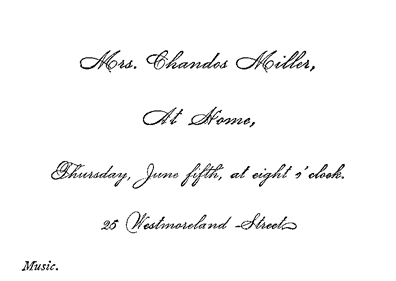
Mrs. Chandos Miller, At Home, Thursday, June fifth, at eight o'clock. 25 Westmoreland Street. Music.
The programs are usually written instead of printed, and are sometimes hand-painted and ribbon-bedecked, and again they are engraved on dainty cards. They are frequently enclosed with the invitations.
If dancing is included, this is the formula:
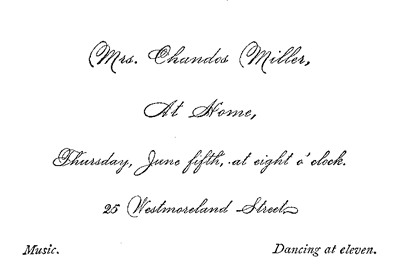
Mrs. Chandos Miller, At Home, Thursday, June fifth, at eight o'clock. 25 Westmoreland Street. Music. Dancing at eleven.
If the musicale is for afternoon, it partakes of the nature of the matinée. Bonnets are to be worn. Refreshments are not necessarily served. The afternoon is often selected when noted stars are to sing, since their time is taken up in the evening. The evening musicale, however, is a more brilliant affair.
Replies are to be sent to these invitations, since for any entertainment when all are to be seated, it is a convenience to know the number of the guests.
The drawing-room is cleared of the greater part of its furniture, and, if dancing is to follow, the carpet is covered with canvas, or removed, if there is a hard wood floor. Camp chairs are provided for the guests.
Arrangement of Performers and Guests.
The seating arrangements should present a clear space for the performers. Too close proximity is not conducive to tranquility on the part of the singer, and also spoils the tone effect. Professional singers insist upon sufficient space. Remove all ornaments of breakable china and bric-à-brac from the vicinity of the piano, which should be bare of cover, and admit of the lid being easily raised and lowered. A bowl of cracked ice, some tumblers, and a pretty jug of water should be placed upon a table near the piano. Good ventilation should be ensured. A reading or recitation can be introduced into a musical program with good effect, and a long program should be divided by a recess for conversation, and to permit those to retire who do not wish to remain to the end.
If dancing follows, the camp chairs are removed, or placed where they can be used. Supper is also served before the dancing. Cigars, matches and ash trays are usually found in the library by the gentlemen, or the cigars are placed in the cloak room to be smoked on the journey home. Either plan, or their omission altogether, is eminently proper.
A day musicale calls for morning dress for men, and a visiting or walking toilet for women. An evening affair, with dancing, calls for evening dress for both.
LAWN PARTIES.
"A green lawn, a few trees, a fine day, and something to eat are really all the absolute requirements of a garden party." If true, this places the pleasant mode of entertaining our friends in the power of many people of moderate means. In remote country localities these parties are very delightful, particularly if city friends are guests for the Summer.
When properly conducted, a garden party may be given with very little trouble, and made very simple and informal, but if desired may be made elaborate and ceremonious.
When only neighbors are to be entertained, a hasty invitation, so as to be sure of fine weather, may be sent two or three days in advance, but when guests are expected from any distance it is customary to send invitations eight or ten days in advance, as suitable preparations must be made.
These invitations are usually engraved on handsome, plain note paper, and may be in this form:
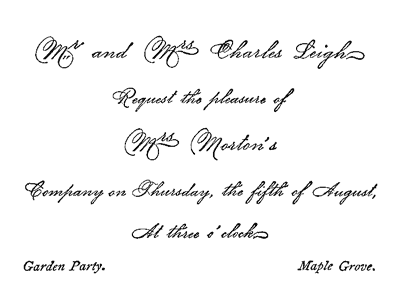
Mr and Mrs Charles Leigh Request the pleasure of Mrs Morton's Company on Thursday, the fifth of August, At three o'clock. Garden Party. Maple Grove.
When guests are to come by rail it is well to send a card stating the hours at which trains arrive and leave the station. Then if carriages are to meet the train, on a card enclosed might be printed: Carriages will meet the 3.30 train from Union Depot.
A lady, also, may invite her friends to a garden party by sending her visiting card with "Tennis" or "Garden Party" written in the lower left hand corner, and day and hour in the lower right hand corner, or under her name. It is well sometimes to specify the time of closing.
At a garden party the hostess receives her guests on the lawn, or in the garden, wearing her hat and gloves. But guests should always be invited to the house to take off their wraps, or arrange their toilet if desired. Of course, a maid servant should be in the dressing-room to attend their wants.
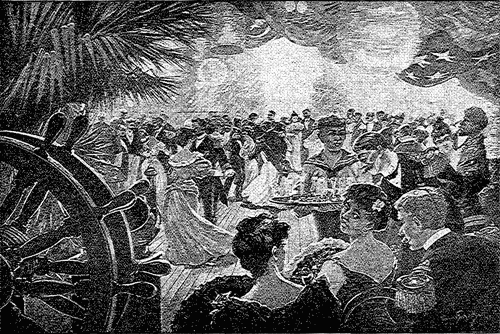
A NAVAL BALL ON SHIPBOARD.
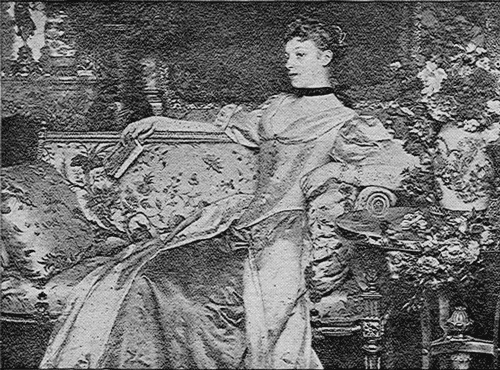
AN ABSORBING STORY.
The thoughtful hostess will take care to have everything in readiness for the comfort and entertainment of the company. Rugs should be laid on the grass for the accommodation of those not accustomed to standing on the ground, and easy chairs provided for delicate or aged ladies who may be present, so all may enjoy the party without fear of the consequence.
Amusements to be Provided.
Much tact is required to properly entertain guests at a garden party, and prevent them from wandering aimlessly about the grounds. Ample amusements must, therefore, be provided.
The lawn tennis ground must be in perfect order, croquet sets in readiness, archery tools supplied, as well as arrangements for all kinds of suitable games made. Music is a very delightful addition to the pleasure of such an occasion, and should always be had, when practicable.
Ladies wear hats or bonnets at a garden party, and should dress otherwise appropriately. If a plain, informal affair, the dress should be simple and becoming, and if games like lawn tennis or archery are among the amusements, light flannel dresses are suitable. But if invited to a ceremonious lawn party, where style will prevail, handsome though simple toilets are required. Picturesque costumes may be made very effective on the grass and under the trees, and ladies of taste have a fine field for displaying it upon such occasions.
Many very fashionable people conduct the garden party in the style of an afternoon tea, receiving and entertaining their guests in the open air until ready to serve refreshments, when all are invited to the dining-room to partake of them. This mode is very convenient and quite pleasant, though it divests the occasion of much of the novelty and charm belonging to it.
When the refreshments are to be served in the garden or lawn, of course the dishes must all be cold, and may consist of salads, patés, pressed meats, Charlottes, jellies, ices, cakes, lemonade and iced tea. A cup of hot tea should always be in readiness in the kitchen for those ladies desiring it.
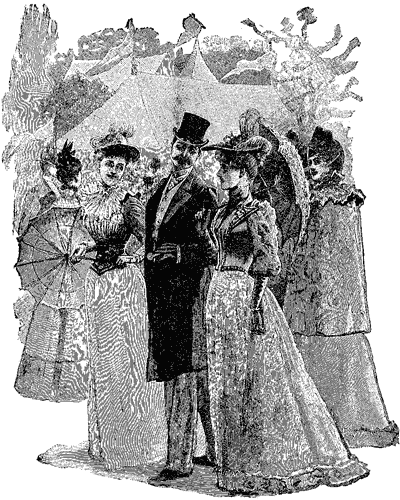
A LAWN PARTY.
Servants should be well trained when in attendance to prevent confusion. Dishes, knives, forks and spoons should be removed when used, and put in baskets or trays in readiness for them, and a fresh supply brought to replace them.
Tables and Refreshments.
Numbers of small tables, with pretty, fancy covers, and colored napkins, should be set around under trees, near fountains and other suitable places, with camp-stools for the accommodation of guests when partaking of refreshments.
Servants should to be very careful in going from place to place with dishes to be served never to spill or drop the contents on ladies' dresses.
Gentlemen may help the ladies, if they prefer, and wait on themselves, requiring the servants only to remove the dishes and replenish the pitchers with lemonade, milk or water.
Fruits, pineapples, strawberries, raspberries, peaches and grapes are served at garden parties, and should be of the finest quality.
Ices are a very acceptable addition to an outdoor entertainment, being light and refreshing for warm weather; they are served in fancy paper cups, laid on ice plates.
For ladies desiring to give garden parties, the following bill of fare will be found sufficient:
Cold Rolls. Mixed Sandwiches. Brown Bread. Pickled Tongue. Paté de foie gras. Jellied Chicken. Cold Birds. Lobster Salad. Charlotte Russe. Biscuit. Glacés. Fancy Cakes. Fruits. Lemonade. Iced Tea. Strawberry Acid.
In England the refreshments are always served in a marquee (large tent) on the lawn.
For such outdoor entertainments foods that require little use of knife and fork should be chosen; sandwiches should never be made of sliced meats as they are awkward to handle. Crusts should be trimmed off, and the filling shredded or grated to a paste, and highly seasoned. For the same reason hot drinks should be dispensed with as far as possible. Glasses are to be filled but two-thirds full. None of these precautions are necessary when the refreshments are served indoors.
For the out-of-doors feast a number of small tables should be provided; cover with fancy cloths and on them place piles of plates alternating with folded napkins, breadbaskets, or trays heaped with sandwiches and buttered tea biscuit, baskets of fancy cakes, and plenty of reserve napkins. Have some of the assistants pass these, beginning with the plates, and to the maidservants leave the service of tea, coffee, cream and sugar (when these are given) and other drinkables.
By this time the gentlemen who first assisted will have been served and the maids can turn their attention to the ices. Ice cream can be served as above, and ices in glass cups; after this the maids can gather up the dishes in baskets. A caterer may be called upon to furnish the feast, in which event all trouble will be spared the hostess. Do not use the best glass and china at these entertainments; the danger of breakage is too great.
At many gatherings a special table is supplied for the gentlemen, where soda-water, claret cup, and sometimes wines are served. The men help themselves, but a manservant is present to supply fresh glasses, etc. This table depends entirely upon the principles of the hostess. If no hours are mentioned, the guests usually disperse about dusk, unless dancing is provided for those who wish to stay and enjoy it.
Seats.
The business of providing seats is a comparatively trifling affair when there are to be young people present, who prefer clean turf or the piazza steps to any more luxurious lounging place. For the older guests, less unconventional accommodations may be devised. Light rockers, camp chairs, wooden or wicker settees are pretty, and in harmony with the rustic nature of the reception. It is well, also, to have rugs or strips of carpet laid about, for the benefit of those who dread the dampness that some imagine rises from the ground even in the midst of the most obstinate drought. Cushions are invaluable at such times, whether used as footstools for the more delicate guests, to soften porch steps, or to convert stumps and grassy knolls into divans, for those who like low seats, but yet have a due regard for their bones or dresses.
A charming, and thoroughly rustic style of seat, can be formed of dry, sweet hay. Tossed up in generous piles, to make couches, or heaped against the trunks of trees to simulate arm chairs, they provide resting places that are not only luxurious, but uncommon. The costliest upholsterer can furnish no chairs or sofas more softly padded or more deliciously perfumed than these. With rugs or shawls thrown over them, to guard the garments of their occupants from any possible injury from moisture or from crushed insects, they are all that the most fastidious could demand.
Hammocks, also furnished with cushions, are always comfortable and picturesque, while screens are valuable additions to the furniture of this open-air drawing-room. Covered with cretonne, felt or paper of any shape and size, these are almost indispensable for shielding from draughts in breezy weather, or sheltering from obtrusive sunlight on a sultry day.
Lawn Parties for Charity.
In case of a charitable object, the refreshments are disposed of at reasonable prices. In this case the menu should be restricted to a few articles. Berries, ice cream and cake are frequently sufficient; coffee can be added. Dainty buttonhole bouquets should also be provided and sold to the gentlemen for prices in advance of their value. Afterward, with the piazza for a stage, a little program of music, singing and recitations can be carried out.
At any garden party, music and singing are in order, and at very grand affairs, paid musicians of note are engaged. Orchestras also are frequently somewhere on the grounds.

A BREAKFAST or a luncheon is somewhat less formal than a dinner and, hence, so much the more delightful.
The breakfast party includes both gentlemen and ladies while, as a rule, the luncheon is an entertainment given to ladies. The invitations to a breakfast may be written, engraved or verbal. If a large number of guests are invited to meet some distinguished stranger, engraved invitations are issued.
Five days or a week's notice is usually considered sufficient, but if distinguished wits and scholars are to be secured, it is well to give a longer period, since their time, always in demand, should be bespoken well in advance. A reply to the invitation is a necessity, because the hostess wishes time, in case of non-acceptance, to secure another guest.
Where the breakfast is less stately in character, an informal note, written by the hostess, in the first person, is a pleasant method, or simply written on the lady's visiting cards under the name in this form: Breakfast, Tuesday, ten o'clock, February fifteenth.
Artificial light is out of place, and sunshine should flood the apartment, while a certain airiness and daintiness should pervade the table appointments, quite the opposite of the elaborate display that characterizes the dinner party. Flowers should form the decorations of the table. Breakfast parties are a very convenient mode of social entertainment for those whose limited means will not admit of a more extensive display of hospitality.
Ten o'clock is the usual hour, though it may be as late as twelve, thus differing from the luncheon, which is never earlier than one.
Breakfast parties are a favorite reunion with literary people, who generally take the morning hours for leisure, leaving brain work until later in the day. Sidney Smith said he liked breakfasts, "because no man was conceited before one o'clock in the day."
In serving breakfast the bill of fare, unless for special occasions, should never be elaborate, but rather dainty and attractive, as the appetite usually needs tempting at this early hour; fewer courses of a more delicate variety should be served than at other meals. The hostess dispenses the coffee, tea and chocolate from the head of the table; the substantials are set in front of the host, who may help the plates and hand them to the waiter to serve; the vegetables and other dishes may be handed from the side table.
Concerning the Viands.
It is well-bred to serve the breakfast with as little formality as possible, and with as few attendants; one servant, a maid, or man servant is sufficient unless the party is unusually large.
If grape-fruit be used for a first course, or orange skins filled with juice, a wreath of smilax on each plate makes a pretty decoration.
A breakfast should invariably begin with fruit, followed by a course of eggs. This latter is one of the essentials, and offers a greater variety than is perhaps known outside of France. A Spanish omelette, if properly made, is a thing to be treasured among the "pleasures of memory." Stuffed eggs, or hard boiled eggs cut in slices, with a bechamel or white sauce, are appropriate and generally liked. A fish course, an entrée, one meat, a salad and a sweet course should follow next in order, concluding with coffee. The entrée and the meat may form one course, if a slice of duck with olives, fried chicken or some such dish be selected.
Ices of all kinds are entirely out of place at a breakfast. An omelette soufflée, peaches with cream, or best of all a fruit salad, are within the proprieties. This last never fails to call forth enthusiastic appreciation. It is simply made, and keeps perfectly for two or three days. Half a dozen oranges should be peeled, leaving no particle of the white adhering, and then cut in small pieces. Half a ripe pineapple, broken with a fork into bits and sugared to taste, and four bananas sliced, are mixed with the oranges, and the whole put on ice for three or four hours. This will be found a dish rivalling the ambrosia of high Olympus.
With the first course of fruit, finger-bowls are in readiness, but are removed at its close. Hot breads and breakfast cakes are always suitable, and oatmeal, carefully cooked and served with thick cream and powdered sugar, often follows the fruit. The closing course should be hot cakes served with honey or maple syrup.
If there are ladies present, or the hostess presides, the coffee, chocolate, etc., are poured by her, and after the first course she asks the guests when they will have it served.
The following will be found an acceptable bill of fare for an ordinary breakfast party. It can of course be varied to suit the convenience and taste of housekeepers.
Bill of Fare for Breakfast.
Melons. Grapes. Oranges. Fried Perch with Sauce Tartare. Young Chickens with Cream Gravy. Saratoga Potatoes. Poached Eggs on Toast. Broiled Quails. Baked Mushrooms. Tomatoes or Celery. Bread and Butter. Crackers. Hot Cakes. Coffee. Tea. Chocolate.
If a butler serves at a breakfast he does not wear full dress as at a dinner.
Wedding Breakfast Menu.
A menu that would be easy to prepare for a wedding breakfast would be two hot dishes consisting of chicken croquettes, lobster cutlets, oyster patties or creamed oysters. Everything else might be cold and as follows: salad, either chicken or lobster, pickled oysters, a small wedding cake, little cakes for the bridemaids, Charlotte russe and coffee. The table decorations should either be all white, or the colors used in the bridemaids' costumes. Let the waitresses be dressed in white.
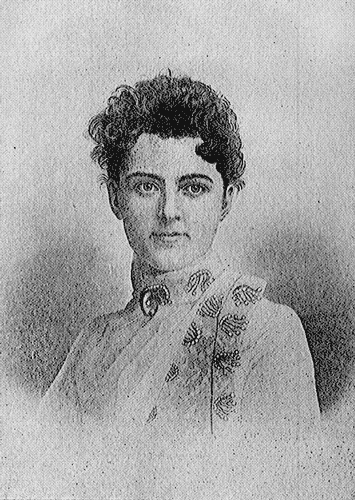

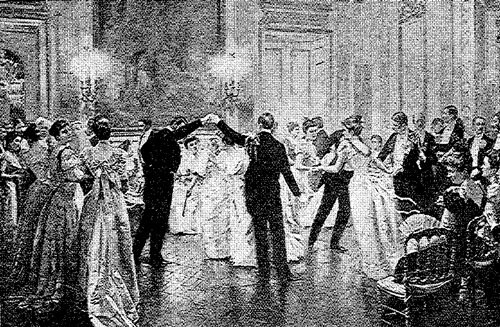
THE COTILLION.
The simplest costume is in good taste for breakfast parties. Men wear morning dress, and ladies handsome but plain street costumes. Gloves are removed before going to the table. Bonnets are kept on.
Each gentleman is given the escort of a lady. The host conducts the lady who is the most distinguished guest to the table, and the hostess follows last with the gentleman whom it is desired to honor particularly.
Upon entering the dining-room the ladies are assisted to their seats, and the gentlemen then follow, and the meal is served. The signal for rising from the table is given by the hostess, with a smile and simple bow, and all proceed to the parlor, exchange a few pleasant remarks, and take their leave.
For informal breakfasts no after-call is expected, but for ceremonious entertainments of this kind the same observance of the rules of etiquette are required as for dinners and large parties.
Guests should not remain more than half an hour after leaving the table, and many do not even return to the drawing-room.
A Bachelor Breakfast.
If a breakfast has been given by a gentleman to ladies and gentlemen, the lady who chaperons it and presides as hostess, receives all the attentions of a lady in her own home. The host calls upon her soon after the event, and also calls upon his lady guests. Gentlemen usually give their breakfasts at fashionable hotels or restaurants.
A Golden-Rod Breakfast.
This is a pretty country entertainment. It can be given out of doors under wide-spreading trees. For the one in mind, great roots of golden-rod were dug up and transplanted into jardinières (stone jars in this case) and a hedge of the nodding yellow plumes placed all about.
The carpet was of checkered sunshine and shade, and the green canopy of the leaves made the scene a perfect one. The guests, arriving at ten o'clock, were ushered into the rustic breakfast room. Four tables were used. On one pure white damask napery was enlivened by low baskets of maidenhair fern, and sprays of the same delicate plant tied with baby ribbon of green gave a cool look to the whole. The largest table was resplendent with cut glass vases filled with golden-rod. White asters gave a hint of autumn's snow to the third table, and the ingenuity of the hostess found pleasure in decorating the remaining one with the delicate grasses and rich-colored small fruits of autumn. Gold-banded china, cut glass and silver, which had been in the family for three generations, supplemented the floral charms of the tables.
Choice Blending of Colors.
Autumn and yellow were the main ideas which guided the selection of the menu for this golden-rod breakfast. Everything possible was in the yellow tint or rich golden brown. With plenty of cream and fresh eggs and the fresh fruits of the farm to work with the menu was an easy one to furnish. Ices served in the shape of tiny melons and cakes decorated with frosted sugar. As a memento of the feast each guest retained her name card which bore a spray of pressed golden-rod fastened with narrow yellow ribbon, and on it in golden script a verse with some thought suggested by autumn or the flower.
Tiny garden hats of yellow straw, filled with golden-rod, accompanied the name cards. The golden-rod in itself proved a veritable gold mine as a help to conversation. Discussions as to whether or not it should be chosen as the national flower; descriptions by travelers of where they had seen it growing best, bright quotations of favorite authors leading to discussions of poems or books by these authors, anecdotes of travel all followed each other and naturally, led by the clever hostess who, in her quaint gown of yellow, with golden-rod in her belt and a spray tucked close to the wide tortoise shell comb which held her golden hair, looked like the personification of the flower she had honored at her breakfast.
Wine at a breakfast is optional. If used, two varieties are enough, and should be in keeping with the principal dishes; claret, sherry, Burgundy are suitable.
LUNCHEONS.
A luncheon is usually an entertainment given by a woman to women. From whatever cause, luncheon parties are rapidly gaining popularity among us. Macaulay wrote, "Dinner parties are mere formalities, but you invite a man to breakfast because you want to see him," and the same may apply to luncheon parties for ladies, these being almost exclusively their affair.
Invitations to small luncheons are usually very informal, and may be written in the style of a familiar note of friendship; or a visiting card may be used, underneath the name of which is simply written: Luncheon at one o'clock, Thursday, January eight.
The repast may be elaborately made up of salads, oysters, small game, chocolate, ices and a variety of dishes which will destroy the appetite for dinner, or it may simply consist of a cup of tea or chocolate, thin sliced bread and butter, chip beef or cold tongue, but there is the same opportunity to display good taste and a well-appointed table as at a grander entertainment.
Ladies attend formal luncheons in very elegant street or carriage costumes. They wear rich and becoming bonnets, which they do not take off. They appear with gloves, removing them when seated at the table.
The toilet of the hostess may be as elegant as she wishes, anything, in fact, short of an actual evening costume.
Luncheons of ceremony are sometimes given in honor of distinguished guests, or upon special occasions, instead of dinners, and may then be very stylish affairs. Flowers should be artistically arranged, both for the adornment of the parlor and dining-room and the table more sumptuous, though always dainty; broiled delicacies, such as do not require carving, take the place of joints, and too rich dishes, with salads, oysters, croquettes and ices; bouillon is very generally served at large or small lunches, as is also chocolate with whipped cream.
Tea is not expected to be present on these occasions. Coffee, served without cream after luncheon in the prettiest little cups the hostess can muster, is generally at hand.
The table may be decorated with flowers and fruit as a centerpiece, around which should be placed glass dishes of fancy cakes, and bon-bons.
At very formal luncheons each dish is served as a separate course. Instead of coffee being served in the drawing-room, as after dinner, the hostess dispenses it at the luncheon table.
The invitations to fashionable, elaborate luncheons should be handsomely engraved after the following style:
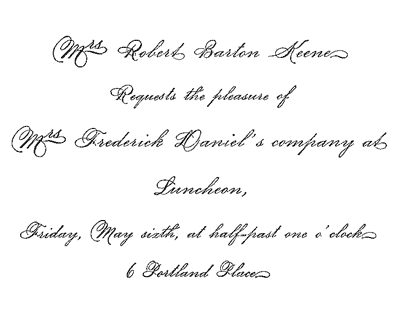
Mrs Robert Barton Keene Requests the pleasure of Mrs Frederick Daniel's company at Luncheon, Friday, May sixth, at half-past one o'clock. 6 Portland Place.
The toilets of the ladies attending should be elegant, and always appropriate to the occasion.
The hostess usually leads the way to the table, keeping the most distinguished guest at her right, the others following and seating themselves as they choose. Guests are not expected to remain longer than half an hour after they return to the parlors.
Calls are a polite acknowledgment after receiving hospitalities, and should be made within a few days after the entertainment.
If gentlemen are invited, and the master of the house is present, the guests proceed to the dining-room in the same order as at a formal dinner party. If the luncheon is given in honor of some particular individual, this fact should appear upon the invitation. The following is a good form:
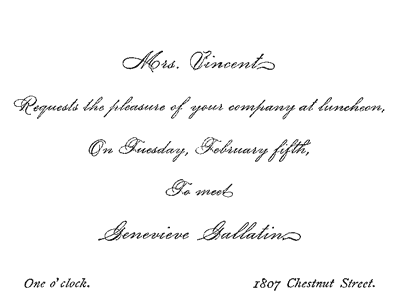
Mrs. Vincent Requests the pleasure of your company at luncheon, On Tuesday, February fifth, To meet Genevieve Gallatin. One o'clock. 1807 Chestnut Street.
The rooms are usually darkened for an elaborate luncheon, and artificial lighting resorted to. Wax candles are the most pleasing, their radiance having a softening effect.
Nowadays there are candles in the market warranted not to drip, and made not wholly of wax, but of some composition which burns brilliantly and slowly. They average eight to the pound, and cost something like twenty-five or thirty cents a pound. No light is so satisfactory or so becoming as candlelight. When the great question of illumination and flowers is settled, there remains one more opportunity for individual taste, for bon-bons, salted almonds and olives may be disposed here and there in small dishes of cut glass or silver.
The usual hour at which to take leave after luncheon is three o'clock, and, unless pressed to do so, luncheon guests should not remain beyond this hour, thus avoiding any inconvenience to a hostess in the matter of her afternoon engagements. Of course, the hour of leaving depends on the hour at which the luncheon is given.
Luncheon Refreshments.
The refreshments must not be heavy, for the reason that many of the guests may be expecting to attend a dinner or evening party that same day. If a butler serves at a luncheon he does not wear full dress, as at a dinner party.
Only light wines are offered at a ladies' luncheon, and more frequently none at all. Mineral waters and pure water are supplied.
Entering the Dining-Room.
Ladies who are intimate with the hostess often arrive half an hour before the time set for the luncheon and chat with the hostess. Usually there is no formality in entering the dining-room. The hostess leads the way with the honored guest, if there be one, on her right. The ladies go down together, talking as they go. If there are gentlemen present, they follow. Once there, they seat themselves at random, with the exception of the host and hostess, who seat themselves at the head and foot of the table.
Again, it may happen that the guests, when they reach the table, find name cards at each plate to designate the place to occupy. These often are simple bits of pasteboard with a gilded edge which the hostess buys and writes thereon her guests' names. This is especially the case if other favors are given.
Where the luncheon is very informal the entire menu frequently consists of cold dishes, such as boned turkey, boned ham, raw oysters, salads of all kinds, chickens, fruits, fruit salad, Bavarian cream, or other creams, fancy cakes, paté de foie gras, etc. The coffee is hot. Let the hand of the caterer be kept as much as possible out of luncheon.
Lunch or Luncheon.
There has been much questioning as to the distinction between the words "lunch" and "luncheon," which are often used interchangeably. The latest and best definition would be, that a lunch is a meal to be partaken of informally by the members of a household, at midday or before going on some pleasure excursion. Luncheon, on the contrary, signifies a form of entertainment given after breakfast and before the evening dinner hour. It is a meal of compliment and more frequently extended to ladies alone.
The invitations given for a luncheon are issued on the same principle as those for a breakfast. A young performer, vocalist or elocutionist, is often introduced at a luncheon.
Luncheon Favors.
Favors for a luncheon may be very elegant, or only simple and pretty. A single rose laid at each plate is frequently all that is given. Name cards are often made to serve as souvenirs. A very new and pretty design for a name card is made of a plain white or cream square envelope, painted with a dainty design of violets.
Where the name is to be seen, an opening like that of a picture frame is cut through the face of the envelope, a line of narrow gilding finishing the edge. The name of the guest is written on a plain card and put inside the envelope so as to show through the opening.
Some other small graceful flower in place of the violet is sometimes painted on it with good effect; and if one color, as yellow, for instance, predominates in the table decoration, a design of jonquils or buttercups is chosen.
A cardboard rest is tied in at the top of these envelope cards by a narrow ribbon caught through two little slits in the envelope over the one in the rest itself. They are then stood around the table like dainty little picture frames, which in reality they are, making the most charming souvenirs when taken home and a small photograph substituted for the card with the name on it.
Some quaint and pretty conceit is always sought after for favors. Too expensive articles suggest a desire for display. Painted satin bags or other fancy receptacles, filled with choice confectionery, are always acceptable, especially at a ladies' luncheon. If the satin bag can be turned into an opera bag, so much the better. Tiny baskets, purchased for a trifle, and metamorphosed by means of a little gold paint, and a bow of ribbon on the handle, into dainty flower-holders, are also pretty. Hand-painted book covers are suitable, and, again, fans are much admired. Those of Japanese style can be bought reasonably.
Favors for gentlemen, such as fancy pocket pincushions, small coin purses, scarfpins, sleeve-buttons, etc., are more useful than ladies' favors, but not so ornamental on the table. A pair of oars, artistically carved, are appropriate for the athletic-minded. Silk handkerchiefs with initials are also proper. Little silver bonbonnières are nice for women, and silver matchboxes for men.
Some Betrothal Luncheons.
The bride-elect entertains her girl friends at luncheon, and revives all the old innocent superstitions to add merriment and interest to the occasion, notable among them the ring baked in the cake, the chance recipient of which will be first to wear the orange blossoms.
One of the prettiest of these luncheons was given on occasion of the announcement of the betrothal of the young hostess, and a veritable "feast of roses" was the result. As was proper, everything was couleur de rose—even the light in which the guests saw each other shone through dainty candle shades formed wholly of pink silk rose petals.
The central epergne, holding a luscious mass of bridemaids' roses, was laid on a circle of filmy, transparent "bolting cloth," the edge of which was embroidered with a wreath of pink roses of natural size and varied shades. Even the salt was contained "in the heart of a rose"—tiny little porcelain affairs—originally intended for candlesticks, but now appropriately used for the symbol of hospitality.
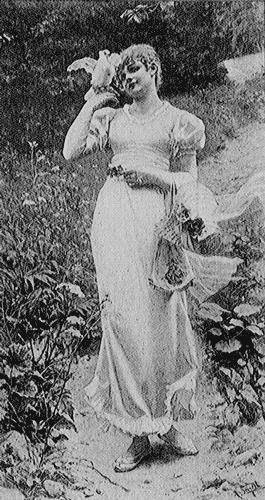
FREE FROM THE RESTRAINTS OF SOCIETY.
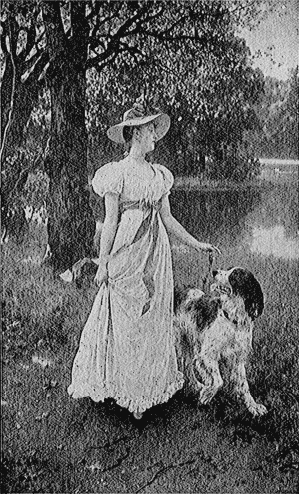
OUT FOR HEALTHFUL EXERCISE.
Dresden cupids, in pretty and artistic poses, held dishes filled with candied rose leaves and heart-shaped cakes covered with pink icing.
A wreath of paper roses surrounded the drop-light above the table; the ladies' names were written on rose-petals (of cardboard), the sorbet was in the form of pink roses and flavored with the cordial parfait amour, while the ice cream repeated the design, and was served in a garden hat of straw-colored candy wreathed with natural roses. The human flowers around the table against such a background of "sweetness and light" made the scene one to be remembered.
Blue and White Tableware.
A contrast to the foregoing (which was, perhaps, rather suggestive of languors and luxury) was a dainty, prim little luncheon, where the table decorations were all of the soft delf, blue and white.
The centerpiece held bluets and "marguerites," that carried one's thoughts far afield, and brought memories of flower-scented breezes and of joys, healthful, pure and vivifying.
The service was entirely of blue and white delf china, and the quaint candelabra, of like material, were decorated with crimped paper candle shades repeating the same colors. Under the dish holding the flowers was a square of linen embroidered in blue. The design was an exact copy of that on the china.
The candlelight merely illuminated the little shades and added to the effectiveness of the decorations, but its pale beams were lost in the sunshine that streamed into the room and lighted up the intelligent faces of the women about the table.
Each guest read on the reverse side of her name card a little rhyming assurance of her welcome. For instance:
"If wishes were dishes, These should be so rare, You would vow that you never Had tasted such fare! "If wishes were riches, A feast should be spread That would tempt old Lucullus To rise from the dead. "But, since wishing is vain, Take the will for the deed, And the warmest of welcomes I offer instead."
A Dresden Luncheon.
A Dresden luncheon is a dainty and flowery style of entertainment for springtime, that is considered a more perfect combination of the exquisite and the elegant than any artistic gathering yet seen. The keynote is the blending everywhere upon the table of the delicate Dresden china colors, blue, pink, yellow and violet.
The fine flowers seen upon the royal china are scattered in embroidery over the linen centerpiece; on this stands a Dresden bowl holding an old-fashioned nosegay of pink rosebuds, hothouse daisies with their yellow centers, pansies and heliotrope. These are tied loosely together with a bow of blue ribbon, which gives the needed touch of that color, unless one is able to get natural forget-me-nots or some other fine blue flowers, like scillas. A few airy and smaller bunches of the same flowers, in little cut-glass stands, are placed about the table. The candelabra have pink rose shades.
The finger-bowl mats are embroidered to match the Dresden flower centerpiece, and floating in the water of the bowls are the different flowers—a few rose petals in one, a daisy in another and a pansy in another until each has one. Every cup, saucer, plate or dish used is of Dresden china, the greater the variety of their shapes the prettier.
The ice cream is served in small satin cases, in the different pale colors, blue, pink, violet and yellow. When boxes in these colors cannot be procured plain white is used. On the top of each is tied a little bunch of satin flowers composed of tiny pink rosebuds, blue forget-me-nots, a daisy, a bit of heliotrope, or a few violets.
At the place of each guest is a name card, done in the Dresden design. The cards are made of water-colors paper and the design painted in water-color. The color of the painted ribbon bows in the designs given varies in the different cards in blue, pink, yellow and violet, and where the loop ends extend over the edge they are cut out, making the ribbon look more realistic.
The sign of all Dresdenware from the royal factories is the tiny blue crossed swords on the reverse or bottom of the dish, without which no piece is genuine; so on the back of the cards one must be sure to paint the sword sign in just the right shade of old blue, thus making complete the idea of a veritable feast of royal Dresden.
CONCERNING TEAS.
The distinction between five o'clock teas, kettledrums, afternoon receptions and high tea, is not very clearly drawn. Strictly speaking, the afternoon or morning reception is the most formal, and has been dwelt upon in a former chapter.
High Tea.
This is really the evening supper, which has also been described in detail, although sometimes the "high tea" is spread for an earlier hour than the supper, say seven or eight o'clock. The ladies come in visiting costume, and the gentlemen in morning dress in country towns. In cities, sometimes, dress coats and light gowns are considered essential. Guests are expected to spend the evening.
Where there are two rooms, such as dining-room and parlor, or two parlors, the tables can be laid in one room, while the guests are assembling in the other. Often, however, the hostess can command but one large room in which to entertain her friends. In this case, the little tables can be brought in by a servant and spread in the presence of the guests without the least breach of propriety. After the meal is over, the dishes are quickly carried out on trays and the tables either taken from the room or left where they stand for cards or any of the many pencil-and-paper games that are pleasant at such gatherings.
One waitress, if quick and deft, can readily wait on a dozen people, especially if all the necessary articles for changing the courses, plates, silver, etc., are arranged on a side table in the room or outside the door.
There are many attractive menus that can be suggested for teas, but the following seems to demand as little home labor for satisfactory results as any other. The word tea, by the way, is something of a misnomer, as at these entertainments the beverages are almost invariably coffee or chocolate, or both, tea being left entirely out of the question.
Menu.
Bouillon. Bread. Crackers. Celery. Pickled Oysters. Chicken Salad. Peanut Sandwiches. Olives. Salted Almonds. Chocolate. Coffee. Ice Cream. Fancy Cakes. Fruit.
Serve the bouillon in cups, and be sure that it is very hot. Have a thin slice of lemon floating on the surface of each cup. Pass crackers (the Zephyr or Snowflake brands are best,) with this, and choice blanched celery. If the tables are set before the guests arrive, it is well to have a couple of short stalks of celery laid at each plate and spare that amount of waiting. Have each cup and saucer set in a plate, and take all three pieces off at once. Either tea or coffee cups may be used, and it is, of course, unnecessary to have them match.
The pickled oysters, with not too much liquor, may either be served on the same plate with the salad or separately. Glass or china dishes may hold the salad and oysters. Forks should be used with this course. The sandwiches must be neatly piled on fringed napkins on bread plates, and must be passed several times, and the olives and salted almonds may fill small glass dishes. The olives may be helped with a fork or spoon or with the fingers, the almonds may be served with spoons. The coffee and chocolate should be poured out at a side table, and sugar and cream passed with them to each person.
The ice cream should also be served off the table and passed in the plate or saucer from which it is to be eaten. The cakes should be prettily arranged in a cake dish with a doily under them. The fruit should be placed on a flat salver, as high piled dishes are apt to be top-heavy and difficult to pass. Oranges, bananas, grapes, the last cut into rather small bunches, make a pretty array. Each guest must be supplied with a fruit plate, doily, finger-bowl, fruit-knife and fork or spoon. Souvenirs are sometimes given, or attractive menu cards are used.
Five O’clock Teas, or “At Homes.”
Some ladies make it a point to be "at home" almost every day at a certain hour, and serve tea or coffee in their drawing-rooms, accompanied by either wafers, maccaroons, fancy cakes, or small delicate sandwiches, and perhaps bouillon for masculine callers.
Such a lady who is bright and interesting, who gives a warm welcome, yet does not bind any one to a longer stay than the conventional ten minutes, is sure of drawing about her a delightful circle of acquaintances, men and women alike being pleased to drop in on their way home from the city, or from more pretentious gatherings.
This is the afternoon tea in its simplest form. In London afternoon tea is universal. If you are calling anywhere in the latter part of the afternoon, tea and thin bread and butter will be offered you as a matter of course, or if it has already been handed round, you will be asked if you have had your tea, and if not a fresh supply will be immediately brought.
If bread is thin enough, butter fresh, cake good, and tea and coffee perfection, you have provided all that is necessary. In warm weather ices or strawberries could be added. In England you will very seldom be given more than this at the best houses, and in Italy, where the afternoon receptions are the most agreeable entertainments imaginable, you will never be offered anything more than dainty little cakes, chocolate and tea. These slight refreshments are usually served in the simplest way. The hostess herself, or if the guests are numerous a white-capped bonne or two, pours out the tea and chocolate and the men of the party hand it to the ladies. Often the children of the house flit to and fro, carrying cups of tea or plates of cake, and everybody talks to everybody else. There will be the best pictures on the walls or the easels, often the best music from people the world knows well, and a reception thus simple in point of refreshment, but rich in the pleasures of art, is a memorable delight.
Still other ladies are at home on some one afternoon in each week, and announce that fact on their cards under their names as follows: Thursdays in February. Tea at Four O'clock. Or, if for a single occasion, it may read thus: Four O'clock Tea. Tuesday, February Fifth. Or, Mrs. George Green, Five O'clock Tea. Tuesday, January Fifth. 47 Sussex Place. Or, Mrs. George Green. Thursdays. Four to Seven. 47 Sussex Place. The year, or p.m., should not appear on the card.
These invitations require no answer, and no after calls, since really it is nothing more than a grand calling day. Those who cannot attend, call as soon as convenient, and those who come leave cards in the hall. Walking or carriage costumes are worn. Men wear morning dress. The hostess dons a handsome reception gown, never an evening dress. The young ladies who assist her are prettily clad in fabrics that suit the season, but which must not suggest ball toilet.
The simple refreshments served must be the very best of their kind. This style of afternoon tea is suitable for city or suburban life.
The Five O’clock Tea Table.
Beginning with the table itself, it may be a small oval, circular or hexagon shape. Any one of these is preferable to a square one. If the surface of the table is highly polished and it is preferred not to cover it entirely, a handsome square or round centerpiece doily, which is only a dinner centerpiece, is used, or a teacloth a yard square may prettily and wholly veil it.
For the actual furnishing of the table there are required a tea caddy, teapot, a hot water kettle, a cosy, a wafer or cracker dish, two or three pretty cups and saucers, cream jug and sugar bowl.
To measure the tea with a spoon is not considered quite so correct, and so redolent of the old-time flavor as to use the cup-cover of the caddy, "one fill to a brew." A glass mat may be provided to set the hot teapot upon, and the spoons are laid loose upon the table.
Cups should hold more than an actual thimbleful, though they need not hold a pint, and should bear some relation to the laws of gravitation in their poise upon the saucer. They should have a smooth rim. A fluted edge is a most uncomfortable finish for a drinking vessel. The wafer-basket may be silver, china or cut glass.
For the winter months many hostesses have introduced a variety on the menu of the five o'clock tea table. Tea is a doubtful beverage in many hands, and is wholly abjured by many women as injurious to the complexion, hence a big, egg-shaped urn, beneath which a tiny alcohol jet burns, is set up in the corner of the drawing-room. The urn is filled with chicken bouillon, served piping hot in small silver cups, and with an invigorating dash of sherry for those who prefer it so. With the bouillon are served platters of toasted water biscuit that have been sparingly buttered and lightly sprinkled with salt. Sometimes, in place of salt, a powdering of cheese is grated over the hot cracker, and for a relish at five o'clock nothing could be preferable to this light, warm repast. Men, it is well to remark, heartily advocate the change from insipid tea to the invigorating hot bouillon.
Pages.
The special innovation for the benefit of women are two drawing-room pages. These are small, well-trained little boys in buttons, livery or done up in stippers, white linen and turbans, who at intervals of fifteen minutes carry about among the callers large lacquer trays, on which are spread violets and rose leaves, crystallized and salted nuts with ginger. One is supposed to scoop up a few of the confections or nuts as the pages pass.
Receiving Friends.
Those friends invited to pour tea or chocolate also come at the hour named, and after removing their wraps seat themselves at their particular tables, or at their end of the one long table. It is their duty to dispense, besides the cups that cheer, words and smiles that cheer also to every one who comes, no matter whether they know them or not. Usually they can do much to make it lively for all in their immediate vicinity. If the afternoon is a long one and guests numerous several of the receiving party volunteer to relieve those at the urns, and they spend an hour pleasantly about the rooms and beside the hostess.
These are the kindly things expected of a woman who accepts an invitation "to receive," and when she has done them gracefully and prettily she is a social "sister of mercy."
If the number of guests is small the hostess herself frequently serves, with perhaps her daughter or some friend, to assist.
The Eatables.
The tea, with its pretty equipage, is placed on the table by her side; sometimes chocolate is provided, and occasionally a crystal pitcher of milk for any who may desire it. Some very thin sandwiches (rolled ones are better), a silver basket of sweet biscuit and one of mixed fancy cakes, form an all-sufficient menu. A small cluster of flowers in a slender vase and the table is complete.
Friends greet one another, drink a social cup of tea, chat a little, and that is all. Formal leave-taking is not expected.
Sliced lemon should be at hand for any who prefer the creamless, sugarless Russian tea with a slice of lemon floating on its amber tide.
Some ladies invite several young girls to help serve and entertain, and, in the eyes of the masculine half of creation, this adds greatly to the beauty of the picture; for ever since tea became famous in our society, men have found much to admire in a girl who can serve it gracefully.
A kettledrum and an elaborate five o'clock tea are precisely the same form of entertainment. The term "kettledrum" is not very frequently used.
Some of the guests at "at homes" have so little judgment in the matter of departure that experience never serves them in good stead. They are nervous and vacillating when they should be neither; they linger and know not how to get themselves gracefully away, and usually succeed in making an abrupt exit. They know the right moment at which to leave, but fail to put this knowledge into practice. "Almost think it is time to go now," or "I wonder whether I ought to say good-bye or wait until some one else comes in."
The regulation conventional time for a call on an "at home" day is about twenty minutes, but this can be lengthened out to half an hour or forty minutes, circumstances being favorable, or shortened to ten minutes when the position is distinctly unfavorable to a longer stay.
“Bringing Out” a Débutante.
The "bringing out" of a débutante at an afternoon tea has become, because of its simplicity, a favorite method. It affords opportunity to invite a number of young "rosebuds" to cluster about her, and it does not subject the "bud" to the ordeal of a ceremonious, or large, ball.
The débutante's name will be engraved below that of her mother, on at "At Home" card.
If she be the eldest daughter, her name is written Miss Manning. If she have elder sisters, it is Miss Amy May Manning.
No answer is expected to these cards, but each recipient will note the especial significance of the occasion by leaving cards in the hall for her as well as her mother, and, if the invitation be not accepted, they will send or leave cards within a few days, for both her and her mother.
An elaborate afternoon tea is often given in honor of some stranger, when the cards will read as follows: Mrs. James Ladd, At Home, Tuesday, March Tenth, from Four until Seven o'clock, to meet Mrs. Gordon Bennet. 5 South Fiftieth street.
This would indicate a daytime, but not usually a day-lighted assembly, and means flowers, gaslight and music; elaborate costumes as may be without infringing on actual evening dress, and refreshments, all too abundant for those who expect a dinner to follow.
Ladies leave outer wraps in hall, or dressing-room, but do not remove their bonnets. Gentlemen who expect to spend but a few moments, carry their hats with them into the drawing-room.
The table is made attractive with beautiful linen, china, and silver, and salads and oysters, ices and cake turn this entertainment from a simple afternoon tea into a "high tea." The tea-room is never deserted, and, although servants are in attendance, there are young girls to pour the tea and add the charm of their presence to the hour.
Dancing even is suggested by the enchanting waltz music that floats from some hidden nook, and a hostess with a sufficiently spacious home often provides a room for this amusement, gentlemen and ladies who wish to participate, disposing of their wraps in the dressing-room.
Gentlemen Visitors.
These occasions usually capture more men than any other daytime gathering. They attend in Prince Albert (frock) coat, neat scarf, faultless gloves, perfect-fitting shoes, and unexceptionable hat. They need not remain long, they need not talk much, and they are sure to find some few that they recognize; and besides, in the best society, the theory of non-introduction gives each person the privilege of conversing with anyone present. Yet, hostesses who are strong in their social positions are not afraid to introduce people who meet under their roof, or to express pleasure that you took the time to call. Such a hostess brightens and warms the atmosphere, and the busy, tired man, who does not usually enjoy such affairs, will enjoy coming to her house and will come again.
How to Leave.
When the drawing-room is crowded it is possible to leave without saying adieu to the hostess, and good form does not necessitate the hostess to ask anyone to call again.
An Afternoon Tea-Saucer.
A convenience that any victim of the afternoon tea will appreciate is a tray or elongated saucer, oval in shape. At one end is a rest made of gold wire, in which the cup stands. The other is quite large enough to allow of serving sandwiches, biscuit, or even a bit of salad without burdening the guest with a second object to hold. The cup stands firm in its place. Not even the jostling common in a crowded room will displace it or endanger that breakage which so often follows a crush. The tray is easily held in one hand, and the other is free to handle fork or spoon without inconvenience of the smallest sort.
Pretty teapots for the five o'clock tea table are of rosewood in a pinkish brown and in the usual olive coloring. The handles of the lids are butterflies, and a butterfly is on the handle used for pouring. Some of these elegant little pots are overlaid with a tracery of silver. Teapots intended for Easter favors are of brown porcelain in the form of a chicken with the mouth doing duty for the spout.
“Pink and Blue Teas.”
These have been a great "fad," and while not quite so popular, are pretty enough to deserve mention. A table is too often confused in its arrangement of color on account of its changes of courses. This can be entirely done away with by adopting some simple color scheme. A luncheon, or tea, is easier to serve in this fashion because of its simpler menu.
Amber and white will harmonize with celery, salads, ices and other articles needed at a luncheon. The yellowish white, full of sunlight, harmonizes with amber and can be followed up to deepest bronze. Amber glasses, creamy damask, all the tints from white to bronze, can be used in the dishes. Apricots heaped on amber dishes, ices tinted in harmony, and a great mass of white roses for a center ornament, are appropriate.
Another beautiful effect is to do away with the cloth and let the polished wood of the table set the keynote of color. An oak table, with its rich yellows and browns and its lurking suggestions of green, would afford a color scheme with which all shades of amber, bronze and yellow would blend. Bon Silène or Malmaison roses would also be in harmony with the other decorations.

COFFEES are so exactly like teas, with the exception that coffee is the reigning beverage, that extended description is unnecessary. The invitations are precisely the same as for teas, simply substituting the word, "Coffee," or "Kaffee Klatsch" in the corner of the card instead of "Tea." The German term, "Kaffee Klatsch," is frequently used. This, literally translated, would be "Coffee Chat" or "Gossip." The entertainment is of German origin, and was adopted to fit the fiction that the stronger sex, of whom the lateness of the hour captures many a willing or unwilling victim, do not revel in tea.
Chocolataire.
This is rather a new entertainment. Its novelty lies in the fact that the beverage served is chocolate, and that chocolate enters into all the refreshments served, such as chocolate wafers, etc. A chocolate lemonade will be a nice addition in hot weather, chocolate bon-bons being passed in dainty silver bon-bon baskets.
The cards are the same as for "Teas" and "Coffees," simply substituting the word "Chocolataire" or "Chocolate" in the left hand corner.
If this is used, as it sometimes is, for a church or charitable entertainment, cards are not issued, but it is simply announced through the usual channels as a "Chocolataire," and numerous other refreshments all containing chocolate in some form can be dispensed, chocolate ice cream, chocolate cake, etc.
Theater parties may be made into very elaborate entertainments, or they may be simple and quietly arranged. Ladies and families often give these parties as an easy method of repaying their social debts.
But the theater party is the entertainment, par excellence, dear to bachelor hosts, especially those who have no homes of their own to which they may invite guests, and wish to return some of the many courteous hospitalities of which they have been the recipients.
In one of these elaborate affairs the host first secures some popular lady to chaperon the party. Then he calls upon his florist, makes arrangements with some famous restaurant and pays a visit to the box-office of some theater where a new play is to be brought out in ten days or two weeks.
Invitations for Theater Parties.
He then gives the invitations in person to the selected number of his lady friends, not less than six, not more than fifteen, explaining to the mothers who will chaperon the party and what gentlemen he has invited. These must number the same as his lady guests and will have been chosen from among the most eligible of his friends.
The rendezvous will be at the restaurant where dinner will be served at six o'clock. The young ladies attended by father, brother or a maid, come in carriages and the coachman is told at what hour to return. This is usually half past twelve or one o'clock.
The dinner will be served in a sumptuously decorated, private dining-room, and by eight o'clock the party are en route in carriages for the play. Each lady is first supplied with exquisite corsage and hand bouquets by an attentive maid.
Boxes are engaged at the theater, or in case of large parties, the front row of the balcony. Programs printed on scented satin are frequently placed in front of each chair and serve as souvenirs of the occasion. When the play is over the party returns in carriages to the same restaurant where an elegant supper is laid.
Frequently each lady finds costly souvenirs at her plate. Each gentleman acts as escort through the evening to whatever lady he has been assigned by the host. At the appointed hour carriages call for the ladies and the gentlemen escort them thereto. If some male relative come, he does not accompany her home, but if it is the maid only, he is expected so to do.
The young ladies and gentlemen must call upon the chaperon within a few days and the host calls upon the mothers to express thanks for the pleasure of the daughter's attendance. The men invited must each call within three days upon the especial lady to whom they devoted their time during the evening, or if this is impossible, leave a card.
A simpler form of this entertainment is where the host calls upon each proposed guest, and if the invitation is accepted, leaves two entrance tickets, and one for some male relative who must accompany her. The party meet in the box, where the host and a lady chaperon greet them. After the theater supper is served at some fashionable resort, or perhaps at the home of some friend, where dancing occasionally follows the supper. After calls are expected.
These parties are sometimes given by a lady, when the invitations are sent by informal notes in her own name, and a six o'clock dinner laid in her own home precedes the opera. After the entertainment the guests return in carriages to the house where a little supper is served, and perhaps some dancing varies the program.
Occasionally this entertainment takes the form of a matinée party of ladies only, who adjourn at its close to the hostess's home for a supper.
Dress for the Opera.
When a gentleman invites a lady to the opera, he should tell her what part of the house they are to occupy. If it is a box she must at least wear a light opera cloak, even if she does not array herself in full evening dress. However, evening toilet, no bonnet and beautifully dressed hair, are the correct thing. At an opera matinée, elegant visiting dress and dainty bonnets are always worn. If a gentleman is to escort a lady to the opera in any of the public conveyances she must wear street toilet.
Picnic Parties.
Picnics and excursions are delightful summer entertainments. But it is essential that whoever goes on a picnic should possess the power to find "sermons in stones, books in the running brooks, and good in everything;" know how to dress, know where to go, and above all, know what to carry to eat.
A very great variety of food should be avoided, also soft puddings and creamy mixtures of any sort, which persistently "leak out." Plain, substantial food, simple and well-cooked, should ever be chosen, with a few sweet and simple dainties to top off with. This can be divided up among the party by the one who is most executive, with the ladies to furnish the substantials and the gentlemen the beverages. The men assume the expenses of the boats or other conveyances.
Paraffine paper is indispensable in wrapping up the viands, which are much more wisely carried in boxes, than baskets, as the former can be thrown away, and the fewer the burdens on the home-coming the better. A rubber coat or mackintosh is also a necessity, for no matter how warm the day, there is a risk of sitting out in the woods on the bare ground. This can be easily managed in a shawl strap. It is best not to carry a tablecloth, but if something is preferred to spread upon the ground, a strip of enameled cloth is the most satisfactory thing, and whatever is spilled upon it can be easily cleaned off. Japanese napkins take the place of linen, and wooden plates, which can be thrown away, are most desirable, like those which the bakers use for pies.
There are several important items which must not be forgotten, and among them are hand-towels and soap, combs, hand-mirror, thread, needle and thimble, a corkscrew and a can opener.
What to Eat.
There should be a clear understanding at the outset what eatables each one is to bring. One girl may promise to furnish a certain proportion of the rolls or sandwiches, and another, part of the cake. Others may promise cold or potted meats, sardines, stuffed eggs, Saratoga potatoes, olives, pickles, fruit, lemonade and cold coffee. Salad may easily be carried if the lettuce and chicken or lobster are arranged in a dish set in a basket, and the dressing contained in a wide-mouthed bottle or pickle jar. The best way to transport lemonade, if fresh water can be readily procured at the picnic grounds, is to take the lemon juice and sugar in a jar, adding the water after the party reach their destination. Apollinaris water is excellent for lemonade. The coffee and milk should have been put together before leaving home, but the sugar is carried separately.
Tongue and Sandwiches.
To begin with the substantials, a cold roast, a boiled tongue, deviled eggs, are simple and tasty. The roast may be sliced off before going, and carefully wrapped up, but the tongue should be carried whole and cut up when required, or it is apt to become dry. The eggs are easily prepared, being hard boiled, cut lengthwise, the yolks taken out, mixed in a bowl with pepper, salt and mustard, and a few drops of Worcester and put back again in the whites.
Different kinds of sandwiches may be served. For one time there may be finger-rolls, split, the inside hollowed out and filled with chopped chicken or tongue, and the two sides tied together with the narrowest of ribbon. Again, bread and butter, cut wafer thin and rolled, may appear. Sweetbread sandwiches, sardine sandwiches, egg sandwiches, are delicious and easily prepared variations upon the everlasting ham and tongue. Very dainty sandwiches are made of two thicknesses of thin bread and butter, with a layer between of cream cheese and chopped water cress. The fruit should be heaped in a basket or arranged as a centerpiece with the flowers.
Ice cream may be taken to a picnic without much additional trouble. The brick molds can be so packed by a confectioner in a pail of ice that there will be no danger of the cream melting. For this, of course, wooden plates are not available, but china saucers will have to be transported. For the sweets some plain cake and bon-bons, and a box of crystallized ginger are all-sufficient. Cold tea, with lemon and ice, is certainly the most refreshing and satisfactory.
If more side dishes are preferred, there are olives, salted peanuts or pecans, gherkins, radishes or club-house cheese and wafers to choose from, and if berries in season are desired, they are best carried in a glass preserve jar.
If one person gives a picnic, she should expect to furnish all the food, the means of transportation for her guests, the plates, glasses, knives, forks and napkins—in short, to defray all the expenses of the trip. This is apt to prove a rather expensive proceeding, if there are many guests invited, but it is a very pretty style of entertaining for those whose means permit them to indulge in it. A "Basket Picnic" is a more general affair, where each member of the party supplies a quota of the provisions. Some one person undertakes the charge of the party, and invites such people to join it as she thinks would make it a success. The girls usually provide the refreshments.
Chaperons.
It might seem needless to say that there should always be a chaperon on picnic parties if it were not that even in this day there appears, in some places, to be a lack of proper understanding of this subject. Dwellers in large cities see matters in a clearer light, and a young man who is thoroughly versed in points of etiquette will not think of inviting a young lady to accompany him to the theater without also requesting her mother or a married friend to join them. In the same manner he asks a chaperon to go with them when he escorts a young lady to a ball or party.
When a number of young people get off together, they are apt, without the least intention of impropriety, to let their spirits carry them away and lead them into absurdities they would never commit in a graver moment. If a chaperon is bright and cheery, sympathizing in the enjoyment of the young people, and avoiding making her presence a bar upon innocent gayety, she need be no drawback to the pleasure of the expedition. On the contrary, most young men and women will feel a security and sense of comfort from having some one along to take the responsibility of the conduct of the party that they could never know were there no chaperon present.
It is a good rule, if possible, to have an equal number of persons of each sex on a picnic. This is especially desirable if the party is to be on the water, in rowboats, where each boatload must be evenly divided. The hostess or projector of the party may arrange in whose escort each girl is to go, or this may be left to the young people themselves.
A Marshmallow Toast.
This is exclusively a girl's entertainment. A very pretty one was given to about twenty girl friends. The guests were invited in the afternoon from two until six o'clock. A large room had its furniture removed and in its stead were placed small tables, which contained trays holding marshmallow candies, skewers and lamps. The mallows were toasted and eaten after a little supper. Tables were spread prettily with white linen and decorated with flowers. The supper was arranged as follows:
Oyster Patties. Buttered Bread. Sandwiches. Salad with French Dressing. Assorted Cakes. Chocolate. Toasted Marshmallows.
The young girls had a delightful time and the entertainment was simple and inexpensive.
Roof Parties.
Roof parties are the very latest diversion which the girl who stays in town is enjoying. They are the very jolliest entertainments imaginable, and the best part of them is that one can go in any sort of an outing suit without feeling de trop. Even the dwellers in the big apartment houses are able to give these high-in-the-air festivals, and they have become very popular from the fact that they are so informal and delightfully novel.
If your roof is spacious and walled in by a high parapet so much the better, for, of course, one can always imagine danger if there be only a narrow coping about the edge.
Pick out a night when the clerk of the weather will be polite enough to give moon and stars and soft southern breezes. Then cover the surface of the roof with rugs or else stretch a matting over the tin. Improvise couches upon boxes covered with rugs, or bring up a couple of cots and pile cushions upon them.
Palms and plants placed about always add to the effect, and if you wish the place to look like a little bit of fairy land hang Chinese lanterns on strings stretched about the edge, and when they are lit they will look remarkably pretty. If the roof be provided with ledges between your own and your neighbors, the bricks can be spread with napkins and refreshments arranged thereon.
Almost any sort of menu is permissible, but salads, sandwiches, olives, ice cream and liquid refreshments of all kinds are always in order.
Bachelor’s Parties.
Bachelors who live in apartments are giving "Dutch" parties on roofs, and in those cases the refreshments consist of beer and ale served from the wood, rye bread and cheese sandwiches, sausages cooked in a chafing-dish and Rhine wine in the cup.
Roof parties can be so elaborate that they will cost quite as much as a more pretentious function, but they are more enjoyable when they are simply gotten up. One was given in a fashionable part of the city, and the aid of the caterer and the decorator had been utilized in such a manner as to produce the effect of a gorgeous al fresco reception. A gaily striped awning was stretched across the part of the roof where the edibles were spread upon a table loaded with flowers. A carpet was spread for a dance at one side with only the stars for a canopy. About the entire roof and reaching far up in a pyramid of light there were lanterns lit by electric lamps fastened within. There was a pleasant breeze blowing, and these many swaying colored lights produced a beautiful effect. Rich rugs carpeted the roof surface, and flags were draped about the high coping.
This party was given on the roof of a large hotel and was such a success that a number of similar ones were arranged for.
A Flower Party.
Another young girls' entertainment is a "flower party"—an appropriate name, as the writer once attended one where all the young ladies wore snowy gowns, each beautifully adorned with the wearer's favorite flower. A large silver salver filled with sprigs of flowers awaited the young men in the reception-hall, and upon his entrance each selected according to his fancy a flower from the waiter and sent it up the decorated staircase to find its mate and the young lady wearing the matching one met him on the landing, pinned his chosen flower to the lapel of his coat and became his partner for the evening.
Bicycle Teas.
With the bicycle comes the bicycle tea. In the large cities these teas have been given for charity and have been great successes. But there is no reason why any girl may not give an attractive bicycle tea and make it very original. Sandwiches in the shape of tennis rackets, with an olive steak in the center for a ball, are among the novelties. Sandwiches in the shape of a wheel and a saddle might easily be cut. Bicycle lanterns, which resemble glowworms, should furnish decoration. If possible, a bicycle tea should be given out of doors, where outing costumes would not be incongruous.
A Barn Party.
There is a big, red barn on a fine old farm, that is easily reached by city friends, and there, every year, is given an autumn revel in the shape of a genuine "barn dance." The mow is filled with sweet smelling hay and the cattle, stalled, are below. The big center floor is cleared and swept and reswept and chalked to make it fit for dancing feet. The decorations for the dance consume much time, and into them the hostess throws many a loving thought. Pumpkins form the chief theme. In flower-like or hideous forms as jack-o'-lanterns they hold posts of honor on rafter and beam.
The lanterns used are the regular farm lanterns, though the walk through the old-fashioned garden to the barn is outlined by the fancy Japanese lanterns. Ears of corn tied by fluttering ribbons, the husks turned back to show the golden ears, cornstalks, golden-rod, milkweed, woodbine and clusters of purple grapes are all worked into the decorations.
The young folks learn by previous experiences not to wear perishable finery at the barn dance, and the girls all come in pretty wash-dresses that will stand a good romp. Music is furnished by an old darkey fiddler, not violinist, who plays "Money Musk," "Fisher's Hornpipe," "Ole Dan Tucker" and any number of plantation melodies.
The supper, of course, is the best part of the dance to hungry city-bred people. Hot coffee is served in bright new tin-cups, for these young people mimic harvesters; there is fried chicken, cold ham, potato salad, rolls with golden country butter that melts in one's mouth, plenty of fresh milk, pumpkin and apple pie, with cottage cheese, ginger cakes and doughnuts, and even cider for those who wish.
The dance is always given during the full harvest moon and the stone wall which bounds the orchard, the old farm wagons, the grain bins and even the low apple trees furnish flirtation nooks for lovers. One year the barn dance was also a potato roast. Huge fires were built on the lawn, and during the intermission the crowd gathered around the fires and roasted potatoes. This time, too, the dance was made a house party, and the girls were stowed away in the farmhouse while the boys enjoyed tents and the big haymow. Is it any wonder that the pretty hostess' friends call her barn dance the big event of the year?
Bachelor Women and their Entertainments.
The bachelor women in their cosy little city apartments, or even their one apartment, refuse to be debarred from the pleasure and privilege of giving the little entertainments so dear to the heart feminine. They not only give the most charming little "teas" and "coffees," but they are past masters in the use of the chafing dish and those who have feasted with them will no longer deem that liveried service and stately rooms are necessary to the proper receiving of one's friends.
After all, "the highest hospitality is in giving what one has." Hawthorne and his wife never forgot the little American studying art in Rome, who, in her tower room, reached by many flights of stairs, made tea before their eyes, and took from a cupboard the cake and crackers that made her feast. Neither will the world forget her, since she it was, who, in the "Marble Faun," is the Hulda who fed the doves from the tower.
A Sandwich Spread.
A sandwich spread is another entertainment easily given by a "bachelor maid." This is a meal at which everything, barring the tea and coffee, is served in the form of a sandwich. Not until one has tried does one realize to what excellence and variety this form of viand lends itself. Deviled ham sandwiches, egg sandwiches, cheese sandwiches, lettuce sandwiches, potted ham, potted fish, potted cheese sandwiches, pineapple sandwiches, peanut sandwiches, cucumber sandwiches, tomato sandwiches, walnut sandwiches, oyster sandwiches and so on indefinitely. Any modern cookbook will furnish the formulas for all these and more.
"He or she," says one writer, "who partakes, forgets the presence of the folding bed and gas stove; of the curtained china cupboard in friendly proximity to the writing desk or easel. There is no paint on the artist's fingers, and the newspaper woman wears as pretty a gown as any woman could wish."
Private Theatricals.
The etiquette of invitations is the same for Private Theatricals, as for musicales. Simply substituting the word, "Theatricals," "Charades," or "Tableaux," whichever it is to be, in the left hand corner of the card. The same observances as to arranging the seats, toilettes of the guests, etc., are requisite, and performers should be equally careful not to fail at the last moment in taking their part. In reality they should be more so, since the failure of one performer might ruin the entire play.
A drama entails more expense and care than characters and tableaux. A host or hostess should never take leading part unless it be especially urged upon them by the others, and even then it is not best, first, because the entertainers should never eclipse their guests, and, second, they should be free for a general oversight of the whole affair, ready to settle disputed points and find missing stage "properties." An effort should be made to assign, as nearly as possible, acceptable and suitable parts to all.
Those invited should display willingness to take parts assigned them, even if not the most important in the cast. All cannot be Romeos or Juliets. There are minor parts to play on all stages. Learn the part given you thoroughly, and do your best to make the play a success. If sickness or unavoidable accident intervene, inform the hostess at once that she may be able to supply a substitute for the part.
Guests indulge in conversation between the acts, and the music of an orchestra often fills the pause.
A carpenter is usually called in to build the temporary stage, or a curtain is fitted to rise and fall in the archway between two parlors; the first parlor being used for the audience room and the second one for stage, with dressing-room in the rear. A private billiard-room, also, can be used to good advantage. At the conclusion of the play, supper is served, and social conversation and dancing follow.
A Social Evening.
There are many ways of making pleasant entertainments out of these informal gatherings. Such an evening may last from nine to twelve o'clock. Where impromptu dancing is resorted to, as it so often is, another hour is sometimes added. If dancing be excluded, games, music, cards, or recitations should take its place. If neither card-playing, nor dancing is permitted, the supper usually becomes the feature of the evening.
When friends are invited to pass an evening socially with cards and music, refreshments are always served. They can be placed upon the dining-room table, and the company invited to partake of them. They should consist of sandwiches or cold meats and rolls, and cakes and coffee or chocolate, or only cakes, ices and lemonade can be served. The best dishes the china closet affords should be used.
Or, the supper can be made an elaborate "sit-down" banquet. If the long table is not sufficient for all, the guests can be served in relays. The table should be prettily decorated. There are different forms of home parties, such as birthday celebrations, where gifts and toasts are in order, house-warmings, or a church party.
When the supper is served in relays the hostess had better wait until the last table, and circulate about among those guests who have not yet been served. Some appointed lady can serve as hostess at each table. The elder guests should be seated at the first. Sometimes small tables are scattered about the rooms to accommodate those who cannot find place at the large table, thus all are served at once.
Where neither card-playing nor dancing are indulged in, it becomes necessary to find some other amusement. Impromptu charades are sure to break the ice. A shadow party also, where any amount of sport can be had with a darkened room and a tightly stretched sheet illuminated from the rear, whereon shadows can be cast for guessing. There are also a great many interesting games of which enough can be furnished for an entire company.
Authors’ Parties
Are also amusing entertainments, but they must be arranged for beforehand. It is usual to take the works of one author and give out the characters to be represented to each one, that repetitions may be prevented. Then the guessing that will follow when the company are all together, and the conversation that naturally ensues on literary subjects, ensures the success of the party.
Firelight Parties
Are pleasurable affairs. There is no light furnished except by an open fire. The guests sit around in a circle and tell stories. Each one is provided with a bunch of twigs, or fagot to be thrown on the fire, the guest being expected to sing a song, tell a story, give a recitation, or otherwise amuse the company while his fagot burns.
Conversaziones.
These gatherings, as the name signifies, are devoted entirely to conversation, and are supposed to be chiefly gatherings of literary and scientific people. Where one especially fine conversationalist is the star of the evening, one or two lesser lights should be invited to share with him the honors of the occasion.
A Country Dinner.
A summer dinner in the country has many pleasant features peculiar to itself. Chief among these is its lack of formality, and city guests are always pleasurably entertained at the country dinner table. A good cook and a competent waitress are necessities.
The flowers that ornament the table must partake of the field and forest rather than suggest the city hothouse. Slender, light, glass vases and rose-bowls are best for the light grasses, field flowers and garden blossoms. Pretty, modern, inexpensive china is sufficient for a country dinner, and not too much silverware should be used.
Light, clear soups should form the first course (mock turtle or ox-tail soup is not in order). The roast should be carved away from the table. Plenty of fresh vegetables should be prepared, that being one of the privileges of country life. Delightfully fresh salads are also at command of the suburban householder; and if the dining-room be cool and large, and therewith the grace be given of a beautiful view, what greater gift can the gods grant!
Let the housekeeper forbear to serve hot puddings or heavy pastries. Fruit tarts, the freshest of fruits with great glass pitchers of country cream, cold custards, gelatine creams of all kinds and ice cream are always satisfactory; and many substitute for the heavy roast the lighter dishes of broiled fish, chicken, or chops. A cold boiled ham on the sideboard adds another dish to the board.
Etiquette of Card Playing and Games.
There is a certain etiquette to be observed in playing all social games. In card-playing especially this is a necessity. In the first place, it is the hostess who proposes the game. In the second, no one who refuses should be urged to join in the amusement. They may have conscientious scruples, and respect should be shown their principles. Unless, however, this be the reason, no one should refuse to play from mere caprice when their presence is required to make up a table.
New packs of cards should be provided by the hostess. Playing for money, even the smallest amount, should be strictly avoided. It is unfit for the home parlor.
Those who do not understand playing should not join a set unless especially urged, as their ignorance is apt to spoil the pleasure of the others. The fingers should not be wet to deal the cards. Partners should never exchange signs. Let every one play his best and not act indifferent to the game.
Do not talk on all manner of topics; it disturbs those who enjoy the game.
Do not criticise, nor hurry other players.
Never lose temper over a game.
To cheat is extremely ill-bred.
If you have a poor partner manifest no annoyance.
Never reflect upon the playing of your opponents.
Those who have played together so much that they understand one another's play should not be partners in general company.
Never manifest anger at defeat, nor undue exultation at winning.
These rules, many of them, apply to all other social games, both outdoors and in.
Outdoor Amusements.
Coaching parties are delightful. They give much latitude for gay, pretty costumes, and there are few brighter pictures than that of a tally-ho coach as it dashes along the city boulevards and over the country roads to the music of jingling chains and winding horns.
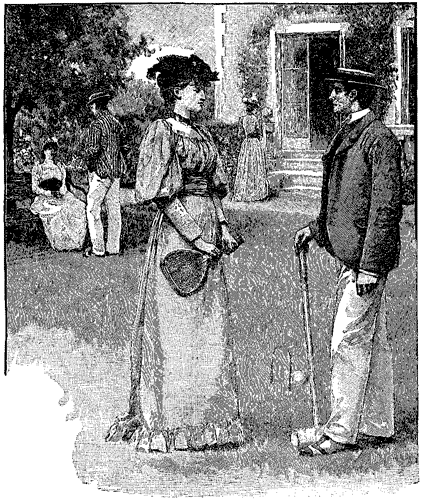
OUTDOOR SPORTS.
Appetites are sharpened by the long drive, and hampers must be well packed with substantial viands. Potted meats, all manner of sandwiches, game pies, cold birds, and substantial beef and tongue, will be sure of appreciation.
(See "Dress," etc., for suitable attire.)
Hunting Parties.
Hunting is very little favored by ladies on this side the water, though it is occasionally indulged in by a few. The enthusiasm, however, of a ride to hounds is much dampened by the knowledge that an anise-seed bag, instead of a fox, furnishes the scent over which the hounds give eager tongue. Those who attempt to hunt must be at home in the saddle.
(See "Dress," etc., for appropriate attire.)
Archery, Lawn Tennis and Croquet.
These popular games have their own etiquette, rules, dress, etc., so thoroughly established that all devotees of these sports understand the routine without giving it place here.
Never dispute, or show any temper over the outcome of any game.
Boating and Yachting.
Many ladies are quite expert with the oars, and boating, when not overdone, is a healthful and pleasant amusement. When gentlemen are with a party of ladies, one of them should step in the boat to steady it, while another "assists" the ladies in. See that their dress is so arranged that they will not get wet. Inexperienced rowers should learn before joining a party.
The stroke oar is the seat of honor. It may be offered to a guest. Ladies should wear short dresses, free from encumbering draperies, heavy shoes, and a hat with a broad brim. Heavy gloves, if they intend rowing, should be worn.
Yachting is a delightful and rather dangerous amusement. Ladies wear warm wool dresses that water will not injure, made short in the skirt, and jaunty of cut, with sailor-like emblems for adornment. No young lady should go out alone with a gentleman either yachting or rowing. In yachting especially a boat is sometimes becalmed for hours and even all night. A party composed entirely of young people should have a chaperon.
Children’s Parties.
The celebration of children's birthdays and other little anniversaries by means of parties, is a pleasant custom and one worthy of observance. Such red-letter days are long remembered by the little ones.
The invitations are issued in the children's own names, and may be written or engraved. Usually they are written upon small note sheets and enclosed in small envelopes. If the invitation is for a Christmas-tree, or an Easter-egg hunt, a tiny tree, or a colored egg, may ornament one corner of the sheet.
The form varies hardly at all: Miss Gertrude Hall requests the pleasure of Miss Clara Winship's company, on Wednesday, June twentieth. From three until five o'clock. 3 Madison Avenue.
These invitations should be carefully and promptly answered in the same form as given and in the third person. (See "Invitations," etc.)
This teaches the little host or hostess the gravity of their position as entertainers, and impresses the little guests with the importance of their behavior. Also giving them an early lesson in the etiquette of social life.
If it is a birthday party, a birthday cake will be the chief feature, and it is a pretty fancy to have it decorated with as many tiny wax candles as there are years in the child's life in whose honor the party is given. These tapers may be placed around the cake, or put in tin tubes and sunk into the top of the cake. Light them just before the little guests are called out to the table.
At the close of the supper the child whose birthday it is, blows out the candles, and, if old enough, cuts the cake and passes it.
Presents are sometimes brought by the guests, but it is not best to encourage this fashion.
Dancing or games may follow the supper, and older persons should constantly superintend the amusements to see that the merriment does not flag, nor the little folks become too boisterous.
At an Easter party, dainty little egg-shaped boxes, filled with bon-bons, may be placed at each plate, or else hidden in a room from which the lighter articles of furniture have been removed, and the children permitted to search for them. The hunt is the chief pleasure.
If it is a Christmas party the tree is the source of interest, and often a make-believe Santa Claus adds to the merriment of the occasion. The refreshments should be simple but fanciful. Make the table bright as possible—snowballs, cornucopias, lady-fingers, assorted cakes, love-knots, sandwiches (fancy), crystalized fruits, tarts, sliced tongue, pressed veal, thin bread and butter, rolled and tied, ice cream in molds, and one large heavily-frosted cake. A host of flowers, and the table is complete. Lemonade for a drink, or perhaps hot chocolate.