Visiting Cards. (continued 3)
Reading edition
The Veil is usually of thin, sheer tulle, as this is most becoming to the face, but those brides who can display fine old point on this occasion will be very apt so to do. If the bridal costume is to be worn on any other occasion, it must be divested of orange-blossoms and worn without the veil.
The above-described costume is appropriate for either a morning or evening wedding. Brides, who are married in traveling costume, should wear a bonnet rather than a hat.
The Groom's Dress is decided by the hour at which the wedding takes place. If it is in the evening, the conventional evening dress is imperative. Black suit, dress coat, low-cut waistcoat, white tie, white or pale pearl-colored gloves, thin patent leather shoes and possibly a white flower in the buttonhole, constitute proper costume.
Morning Costume.
At a morning wedding, that is, one taking place at any hour between ten and seven (before which time a dress suit can by no possibility appear) full morning costume is worn by the groom. This consists of a dark frock coat, dark waistcoat and lighter trousers; a stiff hat, a light scarf and gloves if desired. The gloves should be light but not evening tints; pale tan or gray being suitable. The Groomsmen's Dress is decided by the hour and by the dress of the groom, of which it is a faithful copy.
The Usher's Dress follows the same law as that of the groomsmen, save that if wedding favors are worn it is by the ushers only. The other gentlemen present will find it well to copy the same styles, save that those only who are immediately connected with the ceremony are expected to wear white gloves.
The Bridemaid's Dress has been already described.
Friends in Mourning are expected to lay aside their somber robings for this hour. Even the widowed mother is bound to don either a pale gray, or a deep purple, costume for the occasion, the presence of black at so joyous a moment always casting a certain shadow over the party.
The Traveling Dress. This is occasionally worn by brides who do not wish to incur the haste and annoyance of changing their costume before leaving for the bridal tour. This is done at times even when the ceremony is performed in church, but is almost always resorted to where the wedding is quiet. Sometimes this dress is as elaborate as is at all consistent with good taste for traveling, and when this is the case it is usually exchanged for the regulation traveling gown at the first stopping place in their journey. More frequently, and more appropriately, the plain tailor-made suit, with gloves and hat in harmony, is made to do duty. In any case where the bride chooses to wear a traveling costume, even should the ceremony be performed in the evening, the groom will wear a morning costume.
A Quiet Wedding.
To many people the idea of so much splendor and ceremony on the occasion of their marriage has in it something distasteful, and to others the physical weariness thereby incurred is almost an impossibility. In this case the quietest of ceremonies may be chosen. It may take place in church if the bride desire this further seal of solemnity set upon the service, with parents and one or two friends for witnesses; or at home with the family and clergyman only present, the bridal couple being driven from thence directly to the depot if the stereotyped wedding tour is to follow.
Re-marriage.
A widow, re-marrying, no matter how youthful she may be, is prohibited from wearing the white gown, veil and orange-blossoms of the bride. Neither may she surround herself with a bevy of bridemaids. Her wedding, to be absolutely correct, should be quietly solemnized and her garb a traveling dress.
Still, if she should wish, she may wear the most elegant of tinted silks, the most elaborate in make-up, and have a large and elegant assembly to witness her marriage and participate in its festivities, but no bridemaids are allowable.
At a church wedding she should be attended by her father, brother, other male relative, or some friend. She should always remove the first wedding ring from her finger before the service and not again assume it. Invitations to the marriage of a widow are engraved with her whole name, maiden and married, thus: Elizabeth Stuart Fielding.
If she have sons or unmarried daughters at the time of her second marriage she should prefix their last name to her new one on all ceremonious occasions in which they also are interested, thus: Mrs. Stuart Fielding Grant and Miss Fielding, At Home. 20 Grosvenor Square.
The Ring.
The fourth finger of the left hand, counting from the thumb, is the finger upon which the engagement and wedding rings are worn. The engagement ring varies in extravagance according to the means of the groom, and has almost always a set of some description; the wedding ring is always the same, a plain, round-edged band of gold. Initials and dates may be engraved in both.
The engagement ring is usually worn afterward as a guard for the wedding ring. As to its setting there is a wide latitude given wherein all the pretty conceits and superstitions attached to precious stones may be exercised at will. The German consider pearls unlucky for brides, as significant of tears. Birth-month stones may be used, even the fateful opal losing its power for harm when worn by an October maiden. The turquoise is perhaps the favored of precious stones for this purpose. The old Persian proverb says that "He that hath a turquoise hath a friend." Its known power of turning pale under certain climatic influences has invested it in story with the power of not only warding off evil influences, rendering its wearer constant and assuring success in love, but still more of revealing by a certain pallor of coloring, coming danger or the existence of inconstancy in its wearer. It is also said that in case of a fall the turquoise takes all injury upon itself; the stone being fractured and the owner being uninjured. Add to this the item that the stone must be a gift, not a purchase, to possess these marvelous powers, and it will be seen that it is admirably suited to adorn an engagement ring. The diamond is another very appropriate stone for this purpose, either solitaire or in cluster.
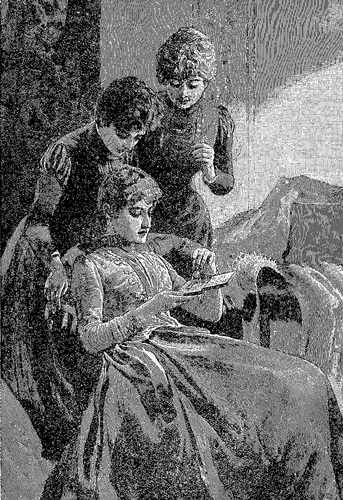
THE WEDDING GIFT.
Reception Days.
It is necessary for the bride to include her new address with her wedding invitations, unless, as is still more "chic," cards for several reception days are issued after her return. These dates being fixed, it is then that first calls may be made upon her at her new residence with the happy certainty of finding her at home.
At these quiet, informal receptions, she receives simply as a member of society, wearing usually a rich, dark silk without any reminders of her recent bridehood.
WEDDING ANNIVERSARIES.
The wedding anniversaries are numerous, but only a few of these are habitually observed. Paper, wooden, tin, crystal, silver and golden are the favorite ones, the others being so rare as to hardly merit being included in the list.
The following complete list of the anniversaries, with the respective dates of their occurrence, may be useful for reference:
First AnniversaryPaper Wedding.
Second AnniversaryCotton Wedding.
Third AnniversaryLeather Wedding.
Fifth AnniversaryWooden Wedding.
Seventh AnniversaryWoolen Wedding.
Tenth AnniversaryTin Wedding.
Twelfth AnniversarySilk and Linen Wedding.
Fifteenth AnniversaryCrystal Wedding.
Twentieth AnniversaryChina (sometimes Floral) Wedding.
Twenty-Fifth AnniversarySilver Wedding.
Thirtieth AnniversaryPearl Wedding.
Thirty-Fifth AnniversaryCoral Wedding.
Fortieth AnniversaryRuby Wedding.
Forty-Fifth AnniversaryBronze Wedding.
Fiftieth AnniversaryGolden Wedding.
Sixty-Fifth AnniversaryCrown-Diamond Wedding.
Seventy-Fifth AnniversaryDiamond Wedding.
It may be well to mention here that the twentieth anniversary is considered unlucky to celebrate, or even to mention.
The manner of sending out invitations and accepting and refusing the same has been fully described in the proper department, and a few words only will be necessary as to the gifts and entertainment suitable on such occasions.
Tin and Paper Weddings and some other of the earlier anniversaries are usually occasions for happy frolics, and merry jests as to the form the gifts will take, though the paper wedding gives place for the presentation of elegant books, and a supply of fashionable stationery that is sufficient to fill the family needs for a long space of time.
Suitable Presents.
The Wooden Wedding is a little more expensive in its demands, and the gifts range from elegant suites of carved furniture down to dainty bits of hand-carving in the shape of panels and placques; and from rolling-pin and potato-masher all the way up to oaken mantles, rich with all manner of ingenious fret-work of design.
The Crystal Wedding may also show forth a glittering array of gifts both ornamental and useful.
The Silver Wedding is, perhaps, the most important of all the wedding anniversaries. This arises partly from the fact that it is most generally observed, partly because of the value of its gifts, and, more than aught else, because the date of its observance finds the happy pair still in the enjoyment of comparative youth and with length of days still before them. In the matter of presents it is almost impossible to go amiss, since there is scarcely an article of use or ornament from dining-room to reception-room and from the library desk to my lady's toilet table, that has not been made a thing of beauty and a joy forever by the silversmith's art.
The Golden Wedding, from the advanced age at which it occurs, has an element of sadness in its celebration. The aged couple who stand so near the brink of separation can have little of bridal joy as they look back to the day when they stood before the altar in the first flush of youth, with life before them, or as they look forward to the shortened span of years that links them to their loved ones here. The gifts that are laid before them should be fitly wrought of gold, since their love has been as gold tried in the furnace of life.
If the family means are insufficient for numerous valuable gifts, let all the friends "club" together and purchase some fitting souvenir for the occasion. Golden-rod forms an appropriate floral decoration.
But, after all, the chief idea and the pleasure of this anniversary is the gathering together of as many as possible of the relatives that yet remain to greet the pair at this, the golden milestone of their life's journey.
Speeches and Congratulations.
The Diamond Wedding occurs so seldom, and is so much like the others in the manner, if not the matter of its gifts, as to scarcely require mention here.
The entertainment at these anniversary celebrations is very much the same as at weddings or other gatherings. The refreshments may be served at tables, or a "stand up" collation given. In this latter case, there should be one or two tables set for the elders of the party.
At Silver and Golden Weddings presentation speeches are frequently made by some friend, and at golden anniversaries a regular program is oftentimes carried out. Anniversary poems are read, "The Hanging of the Crane" recited, congratulatory telegrams from absent friends are announced, and any old acquaintances present that can be persuaded to say a few words of "ye olden times" are pressed into service. Good taste, however, would seem to prevent any repetition of the marriage service on such an occasion.
Cards in acknowledgment of bridal presents are worded in the following fashion: Mr. and Mrs. George H. Brandon express sincere thanks to —— for the beautiful wedding gift. June 18th. 62 West 126th street.
An ultra-fashionable bride, supplying herself with several packages of these stereotyped acknowledgments, has nothing to do but fill in the name of the sender and thus avoid infinite labor.
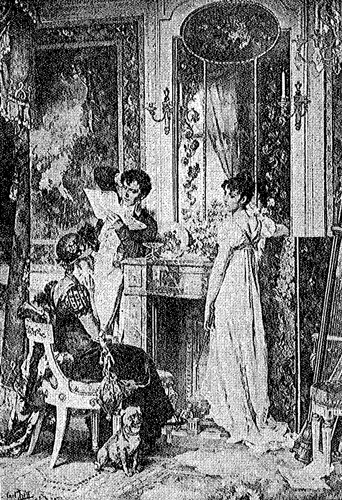
AN UNSEASONABLE CALL.
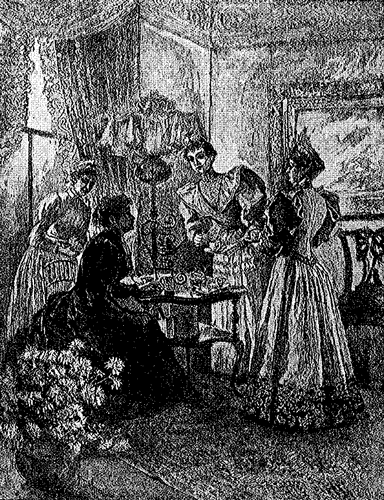
A FIVE O’CLOCK TEA.
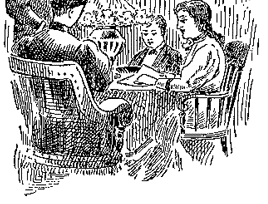
GOOD manners are a plant of slow growth, and one that should be cultivated in the home circle.
"Give a boy address, and it opens palaces to him," says Emerson, and nowhere is this address, "this habit of encounter," so easily gained as within the walls of home. There his character is formed for life.
Good breeding, in reality, is but the outcome of "much good sense, some good nature, and a little self-denial exercised for the sake of others, with a view to obtain the same indulgence from them."
These words of the scholar, Chesterfield, learned as he was in worldly lore, and satisfied of the expediency of such observances from a selfish standpoint, are but another, and more selfish, rendering of the Golden Rule, whose value as a rule of action in life is apparent.
Courtesy, it must be conceded, is not only pleasant, but profitable in all places, and at all times, but more especially in the home circle are its virtues most brilliantly set forth.
Courtesies of Married Life.
"Marriage very rarely mends a man's manners," is a sadly true statement of the playwright Congreve, and one whose truth touches women also as concerning the marriage state.
If the slight formalities that are the bulwarks of love as well as friendship, many forbearances, and more of the small, sweet courtesies of life, were but permitted to blossom forth like unexpected flowers beneath the family roof-tree, fewer unhappy marriages would catalogue their miseries in the divorce court.
The man who takes off his hat as politely to his wife when he parts from her on the street as he would to his lady acquaintance of yesterday; who opens the door for her to enter; who would no more speak harshly to her than to any other lady, is very likely to retain her first affection and to add to it that sweeter, closer love that comes of knowledge and companionship.
What Women Admire.
Women admire fine manners and graceful attentions. The man who never forgets their tastes; who remembers wedding anniversaries and birthdays; is interested in their pursuits, and ready with an appreciative word of praise, is the man that claims their admiration by virtue of thoughtfulness and consideration.
This man, too, would be far more apt to hold a woman's affection than the best and most upright of his sex, who is thoughtless and indifferent, not of her physical comfort, but of all her pet fancies and sentiments, who never saw her new gowns, and is profoundly neglectful of all those trifles, light as air, which go far toward making up the sum of woman's happiness or misery.
What Men Desire.
Hepworth Dixon, on being asked what men most desire in a wife, and what quality held them longest, unhesitatingly replied, "That she should be a pillow." Then, noting the inquiry thus suggested, he went on to say: "What a man most needs is that he should find in his wife a pillow whereon to rest his heart. He longs to find a moment's rest from the outer whirl of life, to win a ready listener that sympathizes where others wound." And she whose eyes are flattering mirrors, whose lips console and soothe, will find that she has secured a hold upon the heart of her husband, that the embodiment of all the virtues of her sex could not secure, were she wanting in this sympathetic tact.
Sweet-tempered people are the joy of the world. Their civilities, their self-sacrifice, their thoughtfulness for others it is that oils the wheels of domestic life. People who, according to the old phrase, have "tempers of their own," are not, at the best, agreeable companions. We may respect their good qualities, but we are apt to give them a wide berth where possible. But when they are inmates of our own households, the evil spirit must be confronted and exorcised if possible.
Many a wife has, by exercising her own self-control, subdued and shamed a tyrannical, evil-tempered husband into a better disposition, but never by argument, dispute, or anger on her part.
Many a husband, too, has by the firmness and sweetness of his own temper, won his young, impatient wife, tried by the half-understood cares of her new existence, to evenness of spirit and control of temper. "It is impossible to be cross where Charlie is," said one young wife, taken from a home where self-control had never been taught. "I am always ashamed of it afterward."
Fault-Finding.
"Take us the foxes, the little foxes that spoil our vines," and of the insidious foxes that spoil the tender fruitage of the household vine, a fault-finding disposition is most dangerous.
A quick, ungovernable temper is not as destructive to household peace and comfort as the nagging, carping, fault-finding spirit that sees good in nothing. A temper that is like a tornado in its violence at least clears the air as it passes, and is usually followed by quick repentance and ready reparation. But the fault-finding, nagging, suspicious temperament is a veritable foe in a man's own household.
Where no word of praise is heard, no commendation follows the best-intentioned efforts, but the ceaseless nagging, the ever recurring criticism meets one at every turn, it is not strange if the ties of affection are too often strained even to breaking.
Temper proceeds from, and is an indication of the character. It is inherited, even as features are; but, like features, it may be modified by culture and training, and a temper thus conquered becomes a very desirable possession.
Home Conversation.
Educate yourself, as a wife, to keep up with the times sufficiently to be at least a companionable conversationalist. Read the papers, read late books; endeavor to be as entertaining to your husband as you were to your husband-elect.
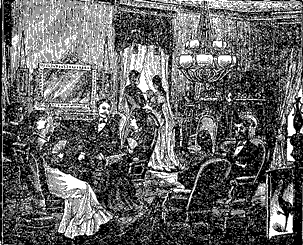
ETIQUETTE OF THE DRAWING-ROOM.
As a husband, share your knowledge of the activities of life with your wife, who, from the very nature of her occupation is excluded from much of its exciting whirl. Read together, talk together of art, of music, of literature, of the stirring events of the outer world, and put afar the evil day when topics of mutual interest shall have been worn so threadbare that the average man and women must feel a strange desire to fall asleep directly dinner is over.
Then, too, the children hunger for new ideas, and one of the greatest educational advantages they can enjoy is to listen daily to the conversation of intelligent people. Too many parents who are bright and entertaining abroad are dull and uninteresting in their own households, to the great detriment of their children and to their own loss of intelligent companionship in one another.
"What little Jack learneth not, the same neither learneth great John." There is a truth in this old saying that the parents and guardians of children would do well to ponder in their hearts, for it is a well substantiated statement that the first ten years of a child's life stamp upon his character the imprint for good or ill-breeding. Thus is spared the after struggle on their part to attain the grace and self-possession that should have been theirs by birthright.
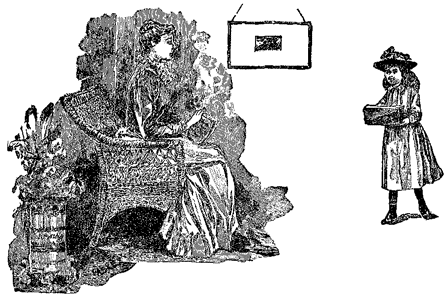
SUNSHINE AT HOME.
Children are naturally imitative, hence the value of example over precept. The children of courteous parents will imbibe courtesy as naturally and unconsciously as the growing plant absorbs oxygen from the air and sunlight that bathes its leaves and petals.
Softly modulated tones should mark the words spoken to a child, and reproof carries an added weight when lowered tones convey the rebuke. Even a baby before it can speak recognizes shades of meaning in the tones the mother utters, and is soothed by the one and startled by the other.
Kindliness, politeness of the parents one towards another, are the first steps toward training children in the acquirement of good manners. Gentleness and sweetness of manner can be taught at the cradle far more surely than from the school-room desk, and when baby has learned to preface its little wants with "please," and Master Four Years-old to run and open the door for mamma, or mamma's visitors, or to give up the easiest chair without being asked, the firm foundation has been laid for courteous behavior in after life.
And so on, all through the school years, boys and girls may be so taught to respect one another's possessions, letters, feelings, and to discriminate closely between meum and tuum after such wise that they will be made better husbands, better wives, better citizens, for all their days.
Slang and Exaggerations.
By our own speech it is that we are sure to be judged, for,—
"'Tis only man can words create, And cut the air to sounds articulate By nature's special charter. Nay, speech can Make a shrewd discrepance 'twixt man and man. It doth the gentleman from the clown discover; And from a fool the great philosopher. As Solon said to one in judgment weak:— 'I thought thee wise until I heard thee speak.'"
And if we talk with flippancy and exaggeration, load our sentences with slang phrases, and preface and punctuate them with oft-repeated expressions of "Say!" "Well!" "You know," "Do tell," and so on, ad infinitum, all wisdom, or propriety of speech will be lost.
It is difficult to believe in the refinement of a girl who permits her fresh young lips to utter the slang of the bar-room hanger-on, the gambler and the street gamin.
Equally difficult is it to believe in the absolute truthfulness of one who declares to you that the heat of a lovely June day is "simply awful" or "perfectly terrible," from sheer wonder as to what terms she would use to characterize the intense heat of some sweeping fire.
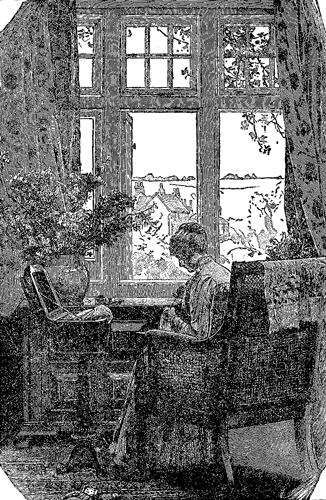
THE INDUSTRIOUS HOUSEWIFE.
Again, it is hard to understand the taste of one who informs you gravely that "the chicken salad was too lovely for anything!" or the last evening's sunset was "perfectly elegant!" The Websterian definition of "elegant" being "polished, stylish, refined, etc.," it is to be wished that all perpetrators of like sins could meet the punishment a young lady once dealt to a gentleman who remarked with great effusion: "This moonlight is perfectly elegant!" To this observation she answered with gravity, "Yes, it really is very stylish!"
Let, therefore, all who strive for the grace of good breeding, men and women, boys and girls alike, "set a watch over their lips and keep the door of their mouth," for "words have wings, and so soon as their cage, the mouth, is opened, out they fly and mount beyond our reach, and past recovery."
Some Do’s for Girls.
The following hints for girls, each prefaced by the auxiliary "Do," will prove a safe guide, not only for the girls but for any of their elders who may choose to follow them.
Do answer your letters soon after they are received, and do try to reply to them with some relation to their contents; a rambling, ill-considered letter is a satire upon your education.
Do, when you talk, keep your hands still.
Do observe; the faculty of observation, well cultivated, makes practical men and women.
Do attach as much importance to your mind as to your body.
Do be natural; a poor diamond is better than a good imitation.
Do try to remember where you put your gloves and cardcase; keep the former mended and the latter filled.
Do recollect that your health is more important than your amusements; you can live without one, but you'll die early without the other.
Do try to be sensible; it is not a particular sign of superiority to talk like a fool.
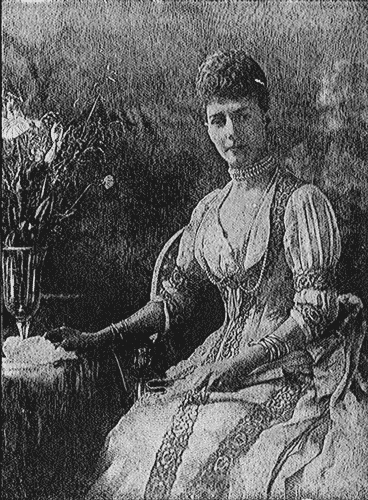
THE PRINCESS OF WALES.
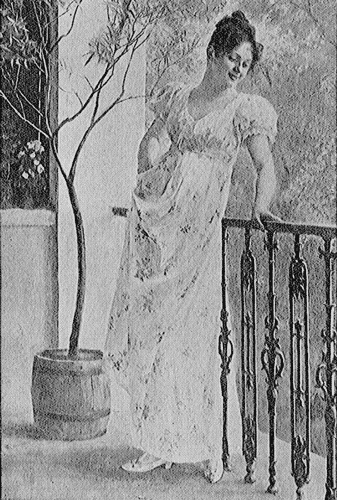
A SOCIETY BELLE—“CALL AGAIN.”
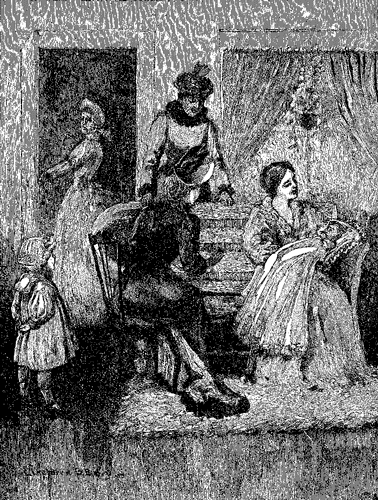
A CALL FROM BABY’S ADMIRERS.
Do be ready in time for church; if you do not respect yourself sufficiently to be punctual, respect the feelings of other people.
Do get up in time for breakfast.
Do avoid causes of irritation in your family circle; do reflect that home is the place in which to be agreeable.
Do be reticent; the world at large has no interest in your private affairs.
Do cultivate the habit of listening to others; it will make you an invaluable member of society, to say nothing of the advantage it will be to you.
Do be truthful; do avoid exaggeration; if you mean a mile say a mile, not a mile and a half; if you mean one say one, and not a dozen.
Young Ladies, Take Heed.
Do, sometimes, at least, allow your mother to know better than you do; she was educated before you were born.
Do sign your full name to your letters.
Do learn to say "No."
Do, if you have brothers, try to gain their confidence, to be interested in their sports, to cultivate their manners, not by censure, but by the force of your own example.
Do laugh, girls, not boisterously, not constantly, but clearly and pleasantly, but don't giggle. If girls from fourteen to eighteen could only understand the vulgarity of continually putting their heads together and giggling, as if the whole world was a supremely ridiculous affair, about which they must chuckle, and whisper, when in truth their own actions are the one thing ridiculous, they would refrain from such unmitigated nonsense.
Do be exquisitely neat in your attire. Beware of the lawn dress, the light kids, the collar, the laces that are worn once too often.
Do be careful about giving away your photographs, especially to men. You would hardly like to hear the comments that are sometimes passed upon them. If you cannot learn to say "No," refrain from displaying them to your gentleman friends.
Some Do’s for Boys.
As for boys, there are a few "Do's" for them to consider if they would become that noblest work of God, a true man, a gentleman.
Do respect your father and mother and give them their proper titles at all times. To call them "the Governor" and "the old lady," does not in the least add to your supposed manliness, but rather displays a very unmanly fear on your part that people might suppose you were in some degree under their authority; not only an unmanly, but a foolish fear, since no one is fit for authority until he has first learned obedience.
Do learn to respect women. Never speak slightingly of their worth, nor trifle with their name. Learn the lesson now, and you will find its value in your manhood.
Do treat your sisters and your girl schoolmates in a gentlemanly manner. You have no idea how much it will add to your own appearance.
Do guard against a profusion of slang that would do credit to a pickpocket.
Do be determined not to use profane expressions in the presence of ladies, children, or ministers, or anywhere else.
Do keep your lips from uttering coarse and unclean things that you would blush to have overheard by mother or sister. More than this, do not listen to them from the lips of others. A pure-minded boy will be a pure-minded man.
Do take care of your various belongings; do not expect mother or sisters to pick up your necktie, your gloves, your schoolbooks, your hat, from as many different places as there are articles, and put them properly away. It is quite as necessary for boys or men to have some neatness in their habits as for girls or women. Do learn to help yourself occasionally. It is quite possible that you should be able to arrange a necktie, comb your hair, or get the articles together for a fresh toilet without calling some one to your assistance. Quite possible and vastly convenient for other members of the household.
Do close the doors without slamming; don't tear the house down.
Do lower your voice sometimes; everyone is not deaf.
Do be neat in personal appearance; collars, handkerchiefs and cuffs, should be spotlessly clean, and hands and finger nails receive careful attention.
Do not fail to use three brushes every day—the tooth-brush, the clothes-brush and the blacking-brush.
Do break yourself of disagreeable personal habits. Do not yawn in people's faces, lounge in your chair, scratch head or person, or clean finger-nails when others are present.
Do not forget to use your handkerchief, and that quietly as possible.
Do decide that temperate habits are more manly than intemperate ones, and don't think that it is one of your "rights" to smoke cigarettes.
Do learn to say "No," to lead sometimes instead of always following.
Do be careful of your manners. Remember that as the twig is bent, so the tree is inclined, and that the polished boy will be the polished man. Polish, it is to be understood, is not inconsistent with strength, but rather adds to it. The strongest machinery is of the finest polish, and the Damascus blade is of the surest mettle.
Do be sure to give up your seat in omnibus or car to a lady. Even if she be not sufficiently grateful, you have shown your good breeding.
Do remember to remove your hat when you enter a house, private office, hotel elevator (if ladies are present), when you bow to a lady or when you offer to assist a lady.
Do lay these "do's" up in your memory and practice them in your lives.
Guard the Voice.
A harsh voice, or shrill, high-pitched tones, are a source of discomfort to all who hear them. Nothing gives a more favorable impression of good breeding than a voice, musical, clear, low in its key, and careful in its articulation.
George Eliot, who had a face of extreme plainness, possessed a low musical voice that had a perfect fascination for the listener. At times such a voice is the gift of nature, but usually it requires careful cultivation, and the earlier the age at which this cultivation begins, the surer and the simpler is the price of success.
Children can be early taught not to raise their voices shrilly to demand attention, but to speak softly and gently at home, and then their "company voice" will possess a natural quality. Train the tones softly and sweetly now, and they will keep in tune through life.
Those whose early education in this respect has been neglected will win success only at the price of eternal vigilance. A few lessons in voice culture will work wonders in training the ear to appreciate the different keys, the voice to acquire lower and richer tones, and the articulation to become clear and distinct.
Even where there are serious vocal defects, such as stammering, lisping, etc., they can be relieved by some good teacher of voice-culture. Indeed, some attention to the culture of voices ought to become a necessary part of education. A low, sweet voice is like a lark's song in heart and home, and the self-control necessary to always keep it at this harmonious level, exercises a most salutary influence over mind and temper.
How to Treat Servants.
A large proportion of the domestic economy in many households is left entirely in the hands of servants, and on the good or ill behavior of these servants depends the comfort of the home, and the behavior of the servants depends very greatly upon the behavior of their employers toward them. The manner even of addressing servants in this country is rather important, offense being so readily taken at what is deemed disrespect.
Men servants may be addressed by their last name without any prefix. If they have been in the family a long time the first name may be used, if desired. In addressing servants that are perfect strangers it can be generally managed without the use of any name. In writing to them address without prefix, as, Robert Johnson.
Do not be insolent towards, or demand too much of, servants. They have very much the same feelings of pride that the house-mistress has, and the less those feelings are wounded the better help they will render.
Do not reprimand them before guests. Nothing so injures their self-respect or so tends to make them careless. Whatever the blunder, be apparently unmoved in the presence of your guests. Save all reproof until their departure. Have a perfect understanding of the work you would have them perform, if you would have them accomplish it satisfactorily. Ignorance never yet made a good master or mistress, and always puts a premium on incompetency on the part of employés.
Have Rules and Enforce Them.
Require all house servants to be quiet in their movements, not to slam doors or rattle china. Impress upon them the importance of dressing neatly. Teach them to treat all comers with politeness; to answer the door-bell promptly and to thoroughly understand whatever rules you may have about being "engaged" or "not at home."
If reproof is to be administered or orders, given, it is much better that the servant be called upstairs to receive them, than for the house mistress to descend to the kitchen. This will insure an opportunity should dispute arise of dismissing the employé to the kitchen with but loss of dignity on her part; while, if it is in the kitchen that the difference of opinion may arise, the house-mistress must herself leave the field.
Insist upon systematic arrangement of the week's work, and punctuality in carrying out its details. Explain carefully to all newly-engaged servants the routine of the house and expect them to conform to it. Be mild but firm in exercising authority, and servants will respect you and your rules.
If there is a housekeeper, all these details will be committed to her hands, and she has need to be competent, compelling respect, to be fitted for the position. Teach servants not to expect fees from your visitors.
Respect all their privileges. See that their evenings out, and their precious Sunday afternoons are not encroached upon. Give them all the needed opportunity to attend their own place of worship. See that children of the family are respectful toward them, not disturbing them at their work; prefacing their requests with "please," and thanking them for any favor.
Rights of Others.
Respect the rights of all members of the household. Remember that each one has a perfect right to open his or her own correspondence. No difference if one is ready to confide the contents of the letter the moment it is read, there is still a pleasure in opening one's own correspondence.
Respect the belongings of another, no matter how close the relationship. The careful member of the family suffers at seeing his belongings misused and destroyed by the careless one. Discourage borrowing among the members of a family. Teach each one to have all necessary articles of their own and to care for them properly.
Guests in a family should also be very careful in this respect. Boxes, drawers, or any repositories of any kind, should be scrupulously respected. Private papers, even if not protected by lock and key, should not be glanced at. A due observance of these rules, while making home life pleasanter, might in after years lead to a little less tampering with the larger rights of law and property, for "manners are but the shadows of great virtues."
JEAN PAUL RICHTER, in his great work on education (Levana), intimates that we scarcely realize the momentous possibilities that lie all about us folded up in the heart of childhood, as the blushing petals of the beauteous blossom yet to be lie folded close within the sheltering calyx.
"Do you know," he queries, "whether the little boy who plucks flowers at your side may not one day, from his island of Corsica, descend as a war-god into a stormy universe to play with hurricanes for destruction, or to purify and plant the world with harvests?" And just because we do not know the extent of these possibilities, children must be carefully trained to fill whatever post or province may be theirs in the time to come.
Now, they are in our hands to mold as we will; then, they will be the masters, and much of the character of their sway will depend upon the guidance of the present. Viewed in this light, the manners and the morals of children, closely associated as they are, become of the greatest importance to the world.
Power of Example.
Teach the embryo man or woman, in the nursery, the traits, the habits, the customs of the best etiquette, and you have stamped upon them, at an age when the character is impressible as wax, not only the outer semblance, but, in a great degree, the inner reality, of a true man or woman.
Let the children grow up in a home where rude gestures, or ill-tempered words are unknown, where truthfulness, kindliness, forgetfulness of self and careful consideration of others, permeates the very atmosphere, and they will go forth into the world armed with the integrity in which all men may trust, the polish that will win them admiration, and the true refinement that will render their friendship elevating.
See, also, that there is perfect unanimity between the parents as to the government and instruction of the children in the household, and, if any difference should arise, it should be settled in private. Children, being strongly imitative, are best taught by example. Never reprove unless absolutely necessary, and never let the voice rise excitedly to ensure obedience. By keeping your own voice low and calm, you do much toward lowering the key of their high-pitched, childish treble, and soothing the troubled waters of their souls.
Keeping Promises.
Never permit yourself to threaten where you do not perform; children are quick to learn the value of your promises, and place very accurate estimates, in their own minds, as to what their parents will, or will not do under given circumstances. Absolute truthfulness can never be taught a child by precept, when by constant example he is taught that the word of his parents has little or no value in his own case, so far as threats and punishments, or even rewards, extend. If a punishment is the penalty for a broken law, see that it is inflicted; if a reward is promised, be sure that it is given.
Enjoin upon children strict justice in their dealings one with another, even in their games, never allowing the stronger to impose upon the weak, but teaching forbearance and tenderness in all their actions.
Talebearing.
Discourage, as far as possible, all talebearing in the home, and, as a rule, do not listen to complaints, and long recitals of injuries received from little playfellows. Care in this respect will nip in the bud the tendency toward exaggeration and talebearing that so early develops in a child, and so soon matures into the "gossip" of riper years. This demand for exactitude in childish statements will pave the way for strictly truthful declarations in the more important affairs of later life, redounding thus to the lasting benefit of the individual and the community.
Truthfulness.
The least approach toward prevarication, or concealment of their childish misdemeanors, should be treated as a grave fault. To prevent, as far as possible, all attempts at disguising the truth, penalties for faults should rarely be of so severe a nature that the little transgressor resorts to evasion through fear of the consequences.
Respectfulness.
Children should be taught to be respectful toward their parents and others older than themselves, to be polite towards those of their own age, and very thoughtful for the comfort of the sick and weak. Respect must also be shown toward servants and dependants, and no unnecessary demands made upon their time or services.
Obedience.
Prompt obedience should always be demanded of a child, and the spirit of murmuring and questioning firmly repressed. None can command except they have first learned to obey.
Do not allow children to tease, nor, having once refused on good and sufficient ground, suffer your consent to be gained by siege. Make your refusal final, but do not refuse thoughtlessly, or for mere caprice. The wishes of a child are as real to him as those of grown people are to them.
Manner of Address.
Rudeness and abruptness must never be tolerated in the manners of a child. "Yes," and "no," in reply, and "what?" in interrogatory, are uncouth and disagreeable in sound. "Yes, sir," "Yes, ma'am," and "What, ma'am," are much better substituted, but even these are open to criticism. English etiquette relegates "Sir" and "Ma'am" to the use of servants, save in case of addressing the higher nobility when "Sir" is sometimes used.
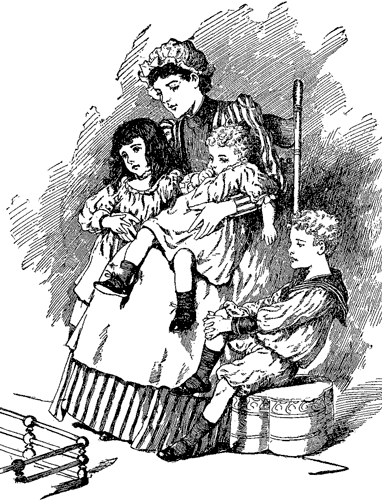
THE NURSERY.
The better and more graceful etiquette of the day would teach a child to say, "Yes, mamma," "No, papa;" or a student at school to address the teachers as, "Yes, Prof. Stanley," "No, Miss Livingstone." If they fail to understand a remark, a quick, "Beg pardon," or, "I beg your pardon," or even, "I did not understand," can soon be taught to even childish lips and never be forgotten as they advance to maturity. The use of "Please," and "Thank you," or, "I thank you," (never the thankless "Thanks,") should be early impressed upon their minds.
Teach them never to speak of grown people without prefixing "Mr.", "Mrs.", or "Miss," to their name. It is very objectionable for a child to fall into the habit of saying "Brown did so and so," instead of, "Mr. Brown, etc." Insist, too, that at school they shall never say "Teacher," but address their preceptor by his proper name.
Impress upon children that they must answer politely when spoken to, but strictly repress any tendency on their part toward questioning visitors at the house. Here let it be added, for the benefit of their elders, that nothing can be a surer evidence of ill-breeding than for a grown person to question a child in regard to his family affairs.
Interrupting Conversation.
Never permit children to interrupt the conversation of their elders, and see, as a preparation for this, that among the little ones themselves, one who has a story to tell is permitted to finish without an impatient brother or sister breaking in with his, or her, version of the same tale. See that each has his turn and many of the noisy disagreements of the playroom will thus be done away with.
Insist, too, upon the lowering of each eager little voice, and a long step will have been taken toward doing away with the high-keyed voices and the all-talking-together habits that afflict so many of their elders.
See, too, that the children, while not allowed to interrupt the conversation of grown persons, receive in some degree the same consideration from them. In other words, let the children talk sometimes, and listen to them sincerely and respectfully. There is no better way to train a child in courtesy than to observe toward it the most scrupulous politeness, and a child whose own conversation is respected can be easily taught to respect the conversation of others, and to know when to talk and when to be silent.
This habit of listening, inculcated in childhood, will do much toward forming agreeable members of society in after years. If a guest should converse with a child for a moment, watch that it does not make itself tiresome by engaging his or her entire attention.
“Showing Off.”
Never "show off" children to visitors. It fosters in them a feeling of vanity, and is often very tedious to the persons upon whom it is inflicted, it being barely possible that your own estimate of their brilliancy is not shared by outsiders.
Neither should strangers be allowed, under any circumstances, at home or abroad, to tease a child "just for fun." Its angry answers may be amusing, but the practice is one that works irreparable injury to the child. As soon as this tendency is discovered in a visitor, send the child quietly, but firmly, from the room, remarking casually, when it is gone, "that children are apt to be troublesome when they talk too much."
Reproof Before Others.
Never, unless it is absolutely unavoidable, reprove a child in the presence of strangers. To do this injures their feeling of self-respect. It is an annoyance to the visitor also. While it frequently happens that a word of timely admonition is necessary, all extended reproof should be left until alone with the child.
Cleanliness and Order.
Insist upon cleanliness in dress, and teach the children early that their hair should be combed, their teeth and finger-nails clean, and their clothing fresh and neat upon all occasions.
Teach the boys that their shoes should be polished and free from dust, and their clothes thoroughly brushed. Slippers should be furnished boys for house wear, and the importance of using a doormat before entering should be early impressed upon both girls and boys. Teach them also order and care as to their personal belongings, and the lessons of neatness thus early inculcated will be of untold value in their after life.
Home Hints.
Cultivate in children the habit of assuming pleasing attitudes. Do not let them constantly lounge about over chairs, couches and tables, and their company manners will not then be a terror in the house. Teach them the proper use of a handkerchief, and insist that they observe it.
Instruct them what to do with their hands and feet, never twisting the former, or swinging the latter. Never permit them to scratch the head or person, to clean ears or finger nails, or to use a toothpick in public. Teach them to suppress a yawn or to conceal the mouth with the hand.
Do not let them pass in front of people in a room, or, if from the arrangement of the furniture it is impossible to avoid so doing, let them ask to be excused.
If they should accidently tread upon the toes, or otherwise disturb a guest, teach them at once to apologize with an "Excuse me," or, "I beg your pardon." Do not permit them to slam doors, or to shout up and down stairs. Never allow requests or messages to be called from one end of the house to the other; insist upon a child coming into the room with whatever he or she may have to say.
Impress upon boys and girls not to stare at others, nor to take any apparent notice of personal peculiarities, deformities, or oddities of dress or demeanor. Teach the children always to play a fair game upon the playground, and not to lose their tempers over any little difference of opinion that may arise during its course.
Do not allow them to be cruel in their treatment of animals; to do so, is to deliberately teach them habits of cruelty for a lifetime and render them brutal in disposition.
“Visiting.”
Children should not be allowed to "visit" other children solely upon the request of the children. The invitation should come from the parents. Otherwise great annoyance may result from such unconsidered calls.
Do not take children while making formal visits. They are often an annoyance, and always a check upon conversation. If they must be taken, do not allow them to meddle with anything in the room, nor to interrupt the conversation. Neither should they be permitted to handle the belongings, or finger the attire, of callers at the house. Do not take them to art galleries, artist's or sculptor's studios, and never allow them to meddle with goods in stores.
Slang, Profanity, Intemperance.
Slang should be eliminated, as much as possible, from the household vocabulary. Boys should be taught that profanity, or vulgarity in expression, far from being manly, only lowers them in the estimation of all sensible people.
It should also be early impressed upon them that there is danger in the use of liquor in any form, as well as folly in falling into the tobacco habit.
At Table.
Punctuality at the table should be taught first of all. The little table observances so necessary to refinement of manner should be early inculcated. Table manners (see proper department) should be taught at the earliest age that the child is capable of appearing at the table. The proper use of knife, fork, spoon and napkin should be impressed upon their minds from the first, and much after annoyance will be saved.
Teach them to eat quietly without any noise of mastication, swallowing or drinking being audible. Insist upon their sitting still while waiting to be served and not to play with knife, napkin ring or other small articles on the table.
Insist upon their breaking bread, instead of cutting it, and never to pick up one piece of bread or cake from the plate and then exchange it for another.
Teach them to eat fruit properly, to use finger bowls, if such are provided, and to keep their lips closed as much as possible while eating. Teach them to pass a pitcher with the handle toward the one served, and not to eat with one hand and pass some article with the other.
See that they do not eat too fast—both health and appearances being considered in this item—and that they do not talk with their mouths full. Teach them to turn away their heads and cover their mouth with their hand, if obliged to cough, sneeze or yawn at table, and, as soon as possible, require them to suppress these exhibitions. Never let them pick their teeth at the table, or lounge upon it with their elbows while eating.
Leaving the Table.
If children must leave the table before the meal is over, they should ask to be excused, and should never rise with their mouth full. When they have once left the table, do not, as a rule, permit them to return, for a child soon falls into the habit, if permitted, of leaving the table to play, and returning to complete his meal.
Teach children not to complain of the food set before them; but, at the same time, if a child has known likes or dislikes, they should be, to a certain extent, gratified, since, to some delicately constituted temperaments, a compelled partaking of some obnoxious dish is a real torture. Teach them also to acquire a liking for as large a variety of food as possible. In after life, on many occasions, this may be a great convenience.
In conclusion, let it be added that the Department on Home Etiquette should be read in connection with this, especially the section devoted to children. See to it carefully that children are not taught one code of manners for company use, and permitted to exercise no manners for home use.
“MAN is essentially a dining animal. Creatures of the inferior races eat and drink; only man dines!" And he should do it properly.
"To invite a friend to dinner," says Brillat Savarin, "is to become responsible for his happiness so long as he is under your roof."
If, therefore, any lady would entertain her friends in the best manner that her means permit, it will be well for her to understand the routine of the table herself, and never trust entirely to the skill of an ordinary cook. It is hardly to be expected that she should understand the preparation of each dish, but she must be capable of judging it when served. If she distrusts her own power of arranging a menu, and seeing it properly carried out, the dinner should be ordered from the best of caterers. Then, with full assurance of perfect cookery, and faultless service, one may prepare one's list of favored guests with a peaceful conscience and a mind free from care.
Invitations.
Forms of invitations suited to all classes of dinners, have been given at length in the department devoted to that subject, and acceptances and regrets for the same carefully explained, together with the obligation upon every one to answer all such invitations at once, either in the affirmative or negative. Since a dinner is, in all respects, so important a social event that the least one can do is to signify immediately one's course of action, Sidney Smith was not so far out of the way when he burlesqued the solemnity of the occasion, and the aversion that all dinner-givers have to an empty chair, when he wittily wrote: "A man should, if he die after having accepted an invitation to dinner, leave his executors a solemn charge to fill his place."
Host and Hostess.
The hostess is expected to put her guests, as much as possible, at their ease. She must encourage the timid, and watch the requirements of all. No accident must ruffle her temper. In short, she must, for the time, be that perfect woman who is—
"Mistress of herself though china fall."
She must not seem to watch her servants; she must not scold them. Her brow must remain smooth through all embarrassing hitches, her smile be bright and quick, her attentions close and complimentary to her guests.
On the host devolves the duty of drawing out any of the guests with whose particular specialties he is acquainted, and his manners, too, must at least simulate ease, if he have it not. Let host and hostess refrain from boasting of the price of any article of food upon the table.
Whom to Invite.
All the tact and good breeding at the command of the hostess should be exercised, first in choosing, then in arranging, the guests to be present. Not too many are to be bidden to the ordinary dinner; six, eight and twelve are desirable numbers, and four frequently forms the cosiest party imaginable.
The reason of thus arranging for even numbers arises from the fact that, in a mixed dinner party, it is well to have as many ladies as gentlemen. The conversation will then be prevented from dropping into long, or heated, discussions, both of which are destructive of pleasure. It will also be found pleasant to invite the young, and those of more advanced years, together for an occasion of this sort.
Large parties may be made very enjoyable, but where there are more than eight or ten at table general conversation becomes impracticable. Twenty-four, and even thirty, guests, however, when well selected, may make a very brilliant and successful gathering. Too brilliant a conversationalist is not always a desirable acquisition, since he may silence and put in the shade the remainder of the company to an extent that is hardly agreeable even to the meekest among them.
A small dinner of one's most intimate friends is easily arranged. An eminent artist, author, musician, to pose as chief guest, renders it always easy to select among one's other acquaintances a sufficient number who would be pleased with, and pleasing to, this bright, particular star. Or, if it be a bride, or a woman of fashion, to whom the courtesy is to be extended, it is equally easy to find a sufficient number of guests of similar social standing and aspirations to make the occasion a success.
There is also the satisfaction of knowing that, as one cannot possibly invite all of one's dear five hundred friends to a little dinner, no one can be offended at being left out, thus rendering it easy to choose one's list to fit the circumstances.
Do not invite more guests than there is room to comfortably seat. Nothing so spoils a dinner as crowding the guests.
Seating the Guests.
Since, at no social entertainment are the guests so dependent upon one another for mutual entertainment as at a dinner, both by reason of its smallness and the compactness of arrangement, it will be seen that an equal care devolves upon the hostess in seating as in inviting her guests.
The most tedious of one's friends can be tolerated at a party where it is possible to turn to others for relief, but to be chained for two or three hours, with the necessity upon you of talking, or trying to talk, to the same dull or conceited individual that the fates have unkindly awarded as your companion, is a severe social strain upon equanimity of soul.
Hence, each hostess should strive to so arrange her guests that like-minded people should be seated together, and people with hobbies should either be handed over to those likewise possessed, or into the hands of some sympathetic listener, thus securing the pleasure of all.
Known enemies should be seated as far apart as possible, and, in reality, should never be invited to the same dinner. If this should inadvertently happen, they must remember that common respect for their hostess demands that they recognize one another with ordinary politeness.
Laying the Table.
Much has been said upon this subject in the department of "Table Etiquette," and as laying the table formally for a state affair approaches so nearly the proper setting of the home table, much will be found there that is available upon this important topic.
The table, which, since the introduction of the extension, is no longer the cosy round form which brought the guests so comfortably near one another, should be first covered with heavy felting, or double Canton flannel. Over this is to be laid the heaviest, snowiest damask cloth that the linen closet affords. This should have been faultlessly laundried, and is accompanied by large, fine napkins matching the cloth in design. These should be very simply folded, and without starch, and are laid just beyond the plate toward the center of the table. Square is the best form for folding, and each should contain a small thick piece of bread in its folds. This should be about three inches long and at least an inch thick. This is to be eaten with the soup, not crumbed into it. A roll sometimes takes its place. Some hostesses have the bread passed in a silver basket.
A plate is furnished each place, large enough to contain the Majolica plate for raw oysters. Of course a small plain plate may be used for these, but those designed for the purpose are much more elegant. A tiny, fancy salt is provided for each place (see farther in "Table Etiquette").
Two knives, three forks, and a soup spoon, all of silver, are placed at each plate. Some dinner-givers place the knives, forks, and spoon, all on the right side of the plate, excepting the small, peculiarly-shaped oyster fork, which is placed at the left, it having been decided that raw oysters shall be eaten with the fork in the left hand, prongs down.
Still other hostesses place the knives and spoon at the right hand, the forks at the left, the oyster fork diagonally, with the prongs crossing the handles of the others, the law of their arrangement being nowise immutable in its nature.
Silver, glass, and china, should all be of the brightest. At the right hand of each guest should be placed an engraved glass for water. To make certain that these are in line all around, it is well to measure with the hand from the edge of the table to the tip of the middle finger and there place the glass; following this rule around the entire circumference. This glass, if wine is used, gives a center, round which the vari-colored wineglasses may be grouped.
A Well-Furnished Sideboard.
The sideboard should contain relays of knives, forks, and spoons, in rows; glasses, dinner plates, finger bowls standing on the fruit plates, as well as any other accessories that may be needed. At another sideboard, or table, the head waiter, or the butler, does the carving. If the room is small, this last may be relegated to hall or pantry.
In luxurious houses the sideboards are often devoted to bewildering displays of rare china, and cut glass, but in more modest domiciles they are used simply for the needs of the hour.
Water carafes (water bottles) are placed between every two or three guests. The table should be laid in time,—thus, if the dinner is to be at seven, all things should be in readiness on table and sideboard at six o'clock; this course preventing the slightest confusion. If the dinner napkins are to be changed for smaller ones, these also should be laid in readiness. All the cold dishes, salads, relishes, condiments, etc., should also be on hand.
The most elegant tables frequently have a long mat, or scarf, of ruby, or some other colored plush, with fringed and embroidered ends, laid the entire length down through the center of the table. This affords a charming contrast to the snowy napery, and sets the keynote of color for the floral decorations. The center decorative pieces are now no longer high, thus rendering a glimpse of the person opposite almost impossible, but are low and long.
A mirror, framed in silver, may be set in the center of one of these plush mats; and upon this artistically arranged floral decorations are placed to be reflected in its polished depths. Where massive silver table-wares are heirlooms in the family, they are used, despite their height. Center pieces that are recent purchases, are usually of glass, cut and jewelled, until their brilliancy is a marvel in the lamplight.
Table Decorations.
Where the resources of the dinner-giver are limited, the simple decoration of a few flowers arranged in a fanciful basket, or a rare old bowl filled with roses, is sufficient, and is far more indicative of taste and breeding than many of the set floral pieces fresh from the florist's hand, and speaking more eloquently of the size of his bill, than of taste or appropriateness.
The fancy of the hour, and a pretty one it is, is for massing one variety of flower for decorative purposes. Banks of crimson roses down the center of the snowy cloth, or great clusters of vivid red flowers, can be very effectively employed. Shells may be filled with flowers and used as a table decoration. A large one in the middle, and a smaller one on each side, has a pleasing effect. At each plate a small bouquet of flowers may be laid, those for the gentlemen arranged as buttonholes.
In choosing the flowers for decorations, avoid those blossoms having a heavy fragrance, such as the tuberose, jasmines, syringas, as their penetrating odor is productive of faintness in some, and is disagreeable to many, while roses, lilies, lilacs, and many other delicately-scented blossoms, are pleasant to all.
Naturalness is to be aimed at in these decorations, and set floral pieces are in bad taste at a private dinner. Though hundreds of dollars may have been spent in the fleeting loveliness of flowers, the effect to be aimed at is naturalness rather than display. A border of holly, or ivy leaves freshly gathered, may be sewed around the plush scarf through the center of the table, and is a beautiful decoration, far outshining gold embroidery and lace.
Harmonize the color of this scarf with the decorations of the dining-room. Blue, however, or green, does not light up well, while ruby, or some other red, brings out the effect of glass, china, and silver to the best advantage. Old gold, or olive-brown, is also very pretty. The dining-room should be carpeted to deaden the sound of footsteps.
Lighting the Table.
Gas is, perforce, the most common, but not by any means the most æsthetic means of table illumination, because of its heating and glaring qualities. Wax candles are extremely pretty with tissue shades to match the prevailing tint of the other decorations, besides giving an opportunity for displaying all manner of pretty conceits in candelabra. About twenty-six candles will, all other conditions being favorable, light a table for twelve guests. Much depends, however, on whether the dining-room is finished in light or dark woods as to the number of candles required. Very carefully filled and carefully cared-for lamps of pretty designs are also, especially in country places, an admirable method of lighting the table.
Serving the Dinner.
There are two methods of performing this most important function of the entire dinner, namely, service à la Russe, and the American service. The first named, the Russian service, is universally adopted in all countries at dinners where the requisite number of sufficiently well-trained servants are to be had.
This service, which consists in having all articles of food carved, and otherwise prepared, and brought to the guests separately by waiters, or footmen, as they are called in England at private tables, has the advantage of leaving the host and hostess free to converse with their guests. It also has another advantage of presenting the table, as the guests enter the room, free from dishes, save the oyster plates, glass, silver, flowers, and perhaps at the two ends of the board, Bohemian glass flagons, of ruby-red, containing such decanted wines as do not need icing.
The table also, being so carefully cleared at the end of each course, should present about the same faultless appearance at the close of the feast as at its beginning. The guests being seated at their respective places, Majolica plates containing raw oysters on the half-shell, or otherwise, with a piece of lemon in the center are, if not already in place, immediately put before each guest. The roll, or piece of bread, should be at once removed from the folds of the napkin, and the servants, when all are seated, pass red and black pepper. The oyster plates are then removed and plates of soup follow, dished from a side table by the head waiter, and served by two others, who pass down opposite sides of the table carrying each two dishes. Where two kinds of soup are provided, each guest is given the choice.
How the Dishes are to be Passed.
The servants, in passing the dishes, begin with the guest upon the right hand of the master on one side of the table, ending with the mistress of the house. Upon the other side they begin with the guest upon her right and end with the host. As one servant passes the meat or fish, another should follow, bearing the appropriate sauce or vegetable that accompanies it.
The servants should wear thin-soled shoes, step lightly, be ungloved, and always have a small-sized damask napkin wrapped around the thumb of the right hand, as dexterity in handling the dishes requires that they should extend the thumb over the edge of the dish.
They should pass all dishes at the left of the guests, that their right hand may be free to take them. Wines only are excepted, these being always poured at the right. Servants should never lean across any guest at table in order to reach or pass an article.
In passing an entrée (ongtray), which is simply a dish served in the first course after fish, the dish should be supplied with a silver spoon and fork and held low enough so that the guests can help themselves easily. Entrées follow the roasts sometimes, as well as, or instead of, coming after fish. Sweetbreads and croquettes come under this head. These require hot plates.
The soup removed, which should be done quickly as possible, fish should be immediately served, together with whatever vegetables form the accompaniment. When these plates are removed the roast meats are served on hot plates. One vegetable is usually served with each meat course, and occasionally some vegetable forms a course by itself. This, however, only lengthens out the repast, and is not to be recommended.
A fresh plate is served with each course, it being the rule that no two meals should be eaten from the same plate.
Serving the Different Courses.
Game forms the next course, with such sauces and accompaniments as are desired. The salad follows and usually forms a course by itself, accompanied by crackers, or thinly buttered half slices of brown bread. These are usually passed in a silver breadbasket.
Roman punch, when it is served, comes between the roasts and the game, thus preparing the palate for the new flavor. Cheese follows the salad sometimes, and sometimes accompanies it. Then the ices and sweets. When the ices are removed, the desert plates, overlaid with a dainty doily, upon which is set a finger-bowl, are passed, and the fruits appear. Confections are then served, to be followed with black coffee in tiny after-dinner coffee-cups, which are passed on a salver, together with lump sugar, and small gold or silver spoons; no cream. The strong, French Café et noir, or black coffee, is always used.
If liquors are served they come in here, a decanter of Cognac being frequently handed around with the coffee.
Jellies for the meats, relishes such as olives, celery and radishes; all the sharp sauces and condiments which are to be used during the meal, are on a sideboard, together with a silver breadbasket containing a reserve of bread.
The butler should have some means of signalling for anything wanted by means of a bell that rings in the kitchen, also of letting the cook know when it is time to send up another course.
Guests, while not expected to ask for second helpings of any course, are always permitted to ask for renewed supplies of bread, water or champagne when wished.
All dishes are to be removed quietly, and either placed in a dumbwaiter or given in charge of a maidservant just outside the door. If it is necessary to have any dishes or silver used again, they must be cleansed out of sight and hearing of the guests, as also no odor of cookery must reach the dining-room. Large, flat baskets must be in readiness to transport the china and silver to the kitchen.
To wait at a large dinner the attendants should average one to every three people: hence, it will be well for the small household to engage outside attendance. Very skilful servants have been known to successfully attend to as many as six guests, but one must be sure of this beforehand.
The Menu.
It will be seen after a perusal of this that the order of the formal, modern dinner à la Russe, is very much as follows: Oysters, soup, fish, roast, entrées, Roman punch, game, salad and cheese, dessert, fruits, sweets, coffee. To make this clearer, one bill of fare will be given as an example, always remembering that the number of courses may be lessened in order to suit the taste or purse of the host. Many courses are not a necessity, but the finest quality and the best of cookery should mark each dish served.
Every dinner should begin with soup, to be followed by fish, and include some kind of game. To this order there is no repeal, since "soup is to the dinner," says De la Regnier, "what the portico is to the building or the overture is to an opera." From this there is never any deviation.
A standard bill of fare for a well-regulated dinner is as follows:
Oysters on the Half-shell. Mock Turtle Soup. Salmon with Lobster Sauce. Cucumbers. Chicken Croquettes. Tomato Sauce. Roast Lamb with Spinach. Canvas-back Duck. Celery. String Beans served on Toast. Lettuce Salad. Cheese Omelet. Pineapple Bavarian Cream. Charlotte Russe. Ices. Fruits. Coffee.
Each course may be served on dishes different from the other courses; also fancy dishes, unlike any of the rest, may be used to pass relishes, such as olives, and add greatly to the beauty of the table service. Suitable sets for fish and game, decorated in accordance, are greatly to be admired.
Menu holders are frequently very pretty, and upon the menu card itself much taste and expense are sometimes lavished. Still it is not considered good taste to have them at every plate, for the reason that it savors too much of hotel style. The guests are expected to allow their glasses to be filled at every course. If it is something for which they do not care, they may content themselves with a few morsels of bread and a sip or two of water until the next course is served. The host should always have a menu at his plate, that he may see if the dinner is moving properly in its appointed course.
Favors.
Very pretty favors besides flowers are frequently laid at the ladies' plates to serve as souvenirs of the occasion. The location card or name card may be very beautifully painted. Other articles, such as decorated Easter eggs of plush, velvet, or satin handkerchief holders, fans, painted satin bags, etc., are all in good taste. Each of them, if possible, is made to open and disclose some choice confection. They may be ordered in quantity from some house dealing in such articles, or many of them can be prettily and inexpensively devised at home by any one having sufficient time and taste. Baskets of flowers, with bows of broad satin ribbon tied on one side the handle, are also suitable for both ladies and gentlemen.
Gentlemen's favors are usually useful, such as scarf pins, sleeve buttons, small purses, etc.
Wines, and How to Serve Them.
Fortunately, since more than once the first lady in our land, for the time being, has proven to us by example that the stateliest of dinners may be wineless, it is far from necessary that wine should be served. Still, if wines are to be used, they should be brought on correctly, each wine having its proper place in the varied courses of a dinner, as each note has its fit position in a chord of music.
By long-established custom certain wines have come to be taken with certain dishes. "Sherry and Sauterne," as given by a very good authority, "go with soup and fish; Hock and Claret with roast meats; Punch with turtle; Champagne with sweet breads or cutlets; Port with venison; Port or Burgundy with other game; sparkling wines between the meats and the confectionery; Madeira with sweets; Port with cheese; Sherry and Claret, Port, Tokay and Madeira with dessert."
Red wines should never be iced, even in summer; Claret and Burgundy should always be slightly warmed (left in a warm room is sufficient). Claret-cup and Champagne are iced (some epicures object to this). Cool the wines in the bottles. To put clear ice in the glasses is simply to weaken the quality and flavor of the wine, and, as a matter of fact, to serve wine and water.
The glasses for the various wines are usually grouped at the right of the plate, and as different styles and sizes are used for different wines, it is well for the novice to be accustomed to these in order to avoid the awkwardness of putting forward the wrong glass. High and narrow, also very broad and shallow glasses, are used for Champagne; large, goblet-shaped glasses for Burgundy and a ruby-red glass for Claret; ordinary wineglasses for Sherry and Madeira; green Bohemian glasses for Hock; and large, bell-shaped glasses for Port.
Port, Sherry and Madeira are decanted. Hock and Champagne appear in their native bottles. Claret and Burgundy are handed around in a claret jug. In handing a bottle fresh from the ice-chest the waiter wraps a napkin around it to absorb the moisture.
Coffee and liquors should be handed around when the dessert has been about a quarter of an hour on the table. After this the ladies usually retire, a custom that has happily fallen into disrepute, the coffee being served without the liquors, and ladies and gentlemen partaking of it together. Roman punch is served in all manner of dainty conceits as to glass, imitations of flowers, etc.
Never allow servants to overfill the wineglasses. Ladies never empty their glasses, and usually take but one kind of wine. This is especially true of young ladies, who, very often, do not taste their one glass.
Gracefully Declined.
If wine is not desired from principle, merely touching the brim of the glass with the finger-tip is all the refusal a well-trained servant needs. A still better plan is to permit one glass to be filled and allow it to stand untasted at your plate. In responding to a health, it is ungracious not to, at least, lift the glass and let its contents touch the lips.
Never make your refusal of wine conspicuous. Your position as guest in no wise appoints you a censor of your host's conduct in offering wine at his table, and any marked feeling displayed on the subject would simply show a want of consideration and good breeding.
A dinner given to a person of known temperance principles is often marked, in compliment, by an entire absence of wine.
If there is but one wine served with a simple dinner, it should be Sherry or Claret, and should be in glass decanters on the table. The guests can help themselves; the hostess can offer it immediately after soup.
The announcement of dinner is given as quietly as possible. The butler, or head waiter, who should be in full evening dress, minus gloves, quietly says, "Dinner is served," or, as in France, "Madame is served." Better still, he catches the eye of the hostess and simply bows, whereupon she immediately rises, and the guests following her example, the order of the procession to the dining-room is formed at once. The waiters, aside from the head one, are usually in livery.
Order of Precedence.
In the matter of going out to dinner the host takes precedence, giving his right arm to the most honored lady guest. If the dinner is given in honor of any particular guest, she is the one chosen, if not, any bride that may be present, or the oldest lady, or some visitor from abroad. The other guests then fall in line, gentlemen having had their partners pointed out to them, and wherever necessary, introductions are given. The hostess comes last of all, having taken the arm of the gentleman most to be honored. In the dining-room no precedence is observed after the host, save that the younger couples draw back and allow their elders to be seated. Precedence of rank is not as common here as in Europe.
On entering the door, if it is not wide enough to permit of two entering abreast, the gentleman falls back a step and permits the lady to enter first. All remain standing until the hostess seats herself, when the guests find their places, either by means of name cards at their plates, or by a few quiet directions, the gentlemen being seated last. The highest place of honor for gentlemen is at the right of the hostess, the next, at her left, and for ladies at the right and left of their host.
The hostess should never eclipse her guests in her toilet, and neither host nor hostess should endeavor to shine in conversation. To draw out the guests, to lead the conversation in pleasant channels, to break up long discussions, and to discover all possibilities of brilliancy in the company around their board, should be their aim.
The hostess must never press dishes upon her guests, but they are permitted, if they wish, to praise any viand that has pleased them. The hostess must appear to be eating until all the company have finished, and her watchful eye must see that every want is supplied. At the close of the repast the hostess slightly bows to the lady at the right of the host, when all the guests rise and return in order to the drawing-room.
Where gentlemen remain around the table for that fraction of an hour,—
"Across the walnuts and the wine,"
all rise, and the gentlemen remain standing until the ladies leave the room. The gentleman who had the honor of escorting the hostess into the table, walks with her to the door; here she pauses to allow the host's companion to pass through, when the host, who has escorted her thither, returns to the table, the other gentlemen following his example. The hostess is the last lady to leave the room, whereupon her escort closes the door and returns to the table, where the gentlemen group themselves carelessly at one end of the table, for that half hour of conversation and cigars. Where wine is not used the gentlemen frequently remain behind for smoking, and some hosts immediately withdraw with them to the smoking-room. Coffee is frequently served in the drawing-room, where the ladies have had their little chat after the return thither of the gentlemen.
Informal and Easy.
The hostess, assisted by a daughter, or a young lady friend, usually pours the beverage, and the gentlemen pass it around to the ladies, thus forming the most delightfully informal groups for conversation. Sugar is passed by a servant, or else the hostess drops two or three lumps of it in each saucer, a sugar bowl, with sugar tongs, standing beside her. Cream is not the correct thing for after-dinner coffee.
Very many hostesses, however, prefer to have coffee and fruits finish the table menu, after which the entire party retire to the drawing-room, where, for the half or three-quarters of an hour preceding their departure, soft music from some hidden orchestra may be permitted to fill the air with harmony. Occasionally, a little programme is arranged of music and song, to fill this interval. But, in many cases, and wisely, conversation is the preferred entertainment.
French Terms.
Good taste now dictates that the bill of fare, where one is printed or written, should be couched in the "King's English," yet, one is so frequently thrown in positions where a knowledge of the French terms so often used in such cases is somewhat of necessity, that a short glossary of the same may be useful:
MenuBill of fare.
Café et noirBlack coffee.
Café au laitCoffee with milk.
A dinner begins with,
HuitresOysters.
Followed by,
PotageSoup,
Hors d'œuvresDainty dishes,
PoissonFish,
EntremetsVegetables,
RotiRoast,
EntréesDishes after roast,
GibierGame,
SaladesSalads,
Fruits et dessertFruits and dessert,
FromageCheese,
CaféCoffee.
Right or Left Arm?
This is a disputed question, for the solution of which each party gives valid reasons. Most gentlemen prefer to give the right arm, since the seating of the lady is at the right side always; but many, to preserve the feudal significance of the custom that bade the good knight keep his sword arm free for defence, if need be, offer the left. Since, too, dinner gowns have usually a train to be managed as best it may, ladies also prefer the tender of the left arm, as that leaves their own left arm free to manage the trailing, silken folds. The right arm, however, has the balance of favor, though gentlemen are bound to follow the example of their host as he precedes them to the dining-room.
Further Hints.
Members of families should never be seated together. This rule has no exceptions. A gentlemen should never forget the wants of the lady under his charge, but the lady should remember not to monopolize his attention exclusively. The gentleman is supposed to be particularly attentive to the lady at his right, to pass the lady on his left anything with which she may be unsupplied, and to be agreeable to the lady opposite.
He will, even if a young man, feel it a mark of respect when he is invited to take an elderly lady down, but if the hostess is careful for the happiness of her guests, he will probably find a young lady at his left hand. In selecting the number of guests, care should be taken that it is not such as shall bring two ladies or two gentlemen together. Odd numbers will do this, while even will not.
American Dinner Services.
The American dinner service is much more simple, and is the one usually adopted in modest establishments in this country. One well-trained maid should be able to render all the assistance required at the table. Given the before-mentioned maid, a lady can, with previous management, give a dinner as elegantly, and perhaps with more perfect hospitality, than where the whole affair is relegated to the hands of an experienced caterer.
In laying the table the same manner of arrangement is to be observed as for dinner à la Russe, save that there are more dishes on the board and the decorations are placed with a view to leaving all the space possible.
Celery is now served in low, flat dishes, and these, together with olives and various relishes, may be placed on the table in all manner of dainty, ornamental dishes. Large spoons for the next course are also supplied.
Oysters are in place when the guests enter the room, and the servant sometimes passes brown bread to eat with them; this is cut thin, buttered and folded. After passing this it is replaced on the sideboard; water is then poured, when, beginning with the oyster plate of the guest at the right of the host, she removes it, and the others, as rapidly as possible, leaving the under plate.
Soup tureen, ladle, and plates, or bowls, are then placed before the hostess and the maid, standing at her left hand, takes the plates one by one, and passes them at the left hand of guests. This accomplished, the tureen is removed, and the host, having finished his soup, is ready for the fish, which is placed before him together with hot plates, and potatoes in some form, accompanied or not by a salad.
Directions to Waiters.
The servant then proceeds to remove the soup-plates and the plates beneath. By this time the host has divided the fish, and, standing at his left hand, the maid takes the plates as he fills them, and passes them, serving first the guest at his right. A piece of fish, a potato, and a little fish sauce, are placed on each plate. If both salad and potato are served at the same course, place the salad dish before the hostess and let her serve it upon small, extra plates or dishes. If salad alone is served, it is usually placed upon the plate with the fish.
The fish-platter should now be removed. The plates may also be taken when it is seen there is no more need of them, beginning with those first served, as it is presumed they will have first finished, since it is etiquette for each guest to begin eating so soon as the plate is placed before him.
The next course is the roast. While the host is carving this, one or more varieties of vegetables are set at hand. Portions of the meat and the accompanying vegetable are placed on the same plate, and the servant passes them in the same order as before, and immediately follows them with the second or third vegetable dish, if two kinds have been placed on the plate. This is where the gentleman sitting next the lady on the host's right can help her and then himself, afterwards moving it as she passes the plates, so that the other gentlemen can do likewise.
If a double course is served, which is hardly advisable, save at very large dinners, the lighter dish is placed before the hostess, and the servant presents each plate to her for a portion before passing it. After this the courses do not move so rapidly and the maid remains standing a little back at the left of the hostess' chair where she can easily observe the slightest signal. The hostess signs when the plates are to be removed, and the principal dishes are allowed to remain until the course is finished.
In removing courses no piling up of dishes should be allowed. One plate in each hand is all that can be conveniently managed. After the fish, if other forks are not on the table, they must be supplied for the next course. After the plates are removed, the roast and smaller dishes follow.
Salads and Desserts.
Sherbet, or wines, are served here, if at all. The game, or poultry, comes next, salads or jelly accompanying it. The salad is placed before the hostess. If salad is served in a separate course, it is usually accompanied by cheese, and sometimes by small pieces of brown bread, thinly buttered and folded.
This course finished, everything is removed from the table—plates, dishes, relishes, etc.—crumbs brushed, and the principal dessert-dish placed before the hostess together with every requisite for serving it. The maid then passes the tart or pudding same as the other dishes, taking two plates at a time, and beginning with the two ladies on right and left of host, taking the others in order.
Each person, on receiving a plate in any course, begins to eat, since this facilitates the serving of the dinner and gives warm dishes to all. The maid, during this course, quietly arranges the fruit-plates, finger-bowls, and the after-dinner coffees and tiny spoons upon the sideboard, when she is ready to remove the dishes, and place the fruit-plates in position. The coffees are then put at each guest's right, unless they are to be served afterward in the drawing-room, and the dinner service is virtually ended.
If wine is offered, it is served between the courses, the host helping the lady at his right, and asking the gentleman next to do the same, and so on around the table.
Both host and hostess should have been able to keep up an interest in the conversation at table, and not to betray the slightest anxiety as to the success of the affair. Host or hostess should never make disparaging remarks as to the quality of dishes; and still less should they refer to their costliness, and should know beforehand as to the edge of the carving-knife, as the use of a steel is not permissible.
The foregoing rules will be found to embody the simplest and most correct method of serving a dinner à la American.
Dinner Dress.
Ladies dress elegantly, and in any manner, or color, that fancy or becomingness may dictate. Corsages, however, while open at the neck in either square, or heart-shaped fashion, are not as low-cut as for a ball-dress, while the sleeves are usually of demi-length. Gloves are always worn, and not removed until seated at the table. They are not resumed afterward unless dancing follows.
Very young ladies wear less expensive toilets of white or delicately tinted wools, or light-weight silks.
Gentlemen are expected to wear the conventional evening dress. To be gloved or not to be gloved is a vexed question with them. It is well to be provided with a pair of light gloves, and let your own self-possession and the example of others decide for you at the moment. A gentleman faultlessly gloved cannot go far wrong.
Coming and Going.
Promptness in arriving is a virtue, but remember that you have no claim upon the time of your host or hostess, until ten or fifteen minutes before the hour appointed, and, if you inadvertently arrive too soon you should remain in the dressing-room until very near the hour.
Departure is from half to three-quarters of an hour after the repast, and no matter what the entertainment, eleven o'clock should find every dinner guest departed.
Functions.
The practice of calling the ordinary reception, ball, party or dinner a "function" is simply a bad habit. It comes to us from England, where a confusion of ideas has made this word the popular synonym for any social happening. The error in England is perhaps pardonable, for the reason that very many of the society performances there are actually functions, and in course of time the unlearned and the careless have come to call every society performance a function. The royal "drawing-rooms" (so-called) are functions, and the Lord Mayor's dinner is a function—in fine, that is a function which is "a course of action peculiarly pertaining to any public office in church or state."
The receptions and dinners which, in his official capacity as President of the World's Fair, Mr. Higinbotham gave were functions. But the receptions, dinners, high teas, given by people holding no official position whatsoever, do not partake of the nature of "functions."
Dinner Favors.
Favors may be simple or elaborate, as the purse of the giver may dictate. Appropriateness and simplicity, however, show better taste than the extraordinary vagaries in which some indulge.
Among the really admirable selections which are offered by dealers of many sorts, nothing is better than the bonbonnières shown by confectioners of the higher grade. They are delightful in color, exquisite in design, and while they are made into receptacles for sweets for the time being, they can later be turned to a dozen more permanent uses. One design which is, perhaps, the most elegant of all, takes the form of an opera bag. It is made of the heaviest cream-white silk and has embroidered on it in dainty ribbon work forget-me-nots, tiny rosebuds, or jessamine. At the top it is finished with the popular extension clasp of fine burnished gilt, and when in use as a favor is lined with tinted paper and filled with the finest chocolates or with candied violets.
Slippers, too, are seen, and, while not of glass, are suggestive of Cinderella's tiny foot. They are crocheted of fine colored cord, are stiffened and molded over a form, then fitted with a bag of silk and tied with ribbons of the same shade. Like the bags, they are made the excuse of sweets, and, like them, they add to the decorative effect, for they stand in coquettish fashion before each cover and challenge the admiration inspired in the prince of fairy legend.
Books and "booklets" are much in vogue and make as acceptable favors as any that can be desired if only selected with judgment and with care. Small volumes of verse bound in vellum are always good. Single poems from any one of the recognized poets put up in artistic booklet form are as nearly perfect as favors can be. Book covers, too, are good, and some bookmarks are shown that are excellent both in color and in their evident ability to withstand the usage they are sure to get if they are allowed to do any service at all.
One clever hostess who gave a dinner, and who handles her brush unusually well, devised a book cover and leaflet combined that proved a great success. She had the covers made in the regulation size of pale sage chamois skin and added the decoration herself. She painted each in the flower that the guest loved best, for her feminine friends, and each in some convenient design for the men, and across the corner was the name of each in quaint gold letters. She folded heavy parchment paper in booklet form, and with her brush wrote in silver bronze selections from the wit and wisdom of the ages. Then she slipped the miniature books within the covers and left the brilliant thoughts that they contained to start the conversational ball. Her dinner was pronounced a great success, and it was remarked by many that there was none of that awkward silence which so often precedes the soup.
THE minutiæ of table etiquette offers to onlookers the best evidence of good or ill-breeding, and in the graceful observance thereof is displayed all the "difference between dining elegantly and merely consuming food," for it is at the table that the ill-bred and the well-bred man are most strongly contrasted.