Visiting Cards. (continued 6)
Reading edition
The good breeding learned, the opportunities of impressing upon children the beauty of self-denial and politeness, and of teaching them to dispense, and to receive hospitalities, and to restrain that tendency toward favoring certain playmates, so strong in childhood, will more than repay for the trouble of preparing the feast. Never permit the party to extend to late hours, and never overdress the little folks. White is always suitable for girls, and jacket suits for boys under the age for long trousers.



ANNOUNCEMENT Cards are frequently sent out to all friends immediately upon the arrival of a little heir or heiress. These cards are variously worded. One seen by the writer was as follows:
Arrived: In Los Gatos, Sunday morning, November third, eighteen hundred and ninety-five, Florence Wescott. Weight, ten pounds; blue eyes and sound lungs. She sends greeting to all her friends.
A simpler one would be: Greeting: Edith May Toucey, November 1, 1895. Weight, 9½ pounds.
These cards received (or even if they are omitted), the lady friends and acquaintances call and leave cards with kind inquires or send them by a servant. Gentlemen do not call, but they are expected to see the happy father and inquire after mother and child.
When the mother is ready to receive friends she sends out cards to all that have called "with thanks for kind inquiries," written beneath her name, or issues invitations for a candle or christening party.
The Christening.
The baptism or christening is performed according to the rites of whatever church the parents may be members of. If the ceremony is performed in church, personal fancy has very little play, though it is almost a law that flowers shall cluster about the place where little ones are brought for dedication.
If the occasion is to be further celebrated by festivities at the house they may take whatever form is most agreeable. When the christening is held at the house and guests are invited, it is customary to defer the ceremony until the mother is ready to take the part of hostess; usually until the child is a month or six weeks old.
Invitations are issued for an afternoon or early evening reception. They may be written or engraved, and are issued in the name of both parents, thus: Mr. and Mrs. James Gray request the pleasure of your presence at the Christening of their son at half-past four o'clock, Wednesday, May tenth. 12 Madison Avenue.
Or: Mr. and Mrs. John Thurston request the honor of Mr. and Mrs. Brown's presence at the Christening of their daughter on Thursday, May 11th, at three o'clock. Reception from two to five, 150 Delaware Place. Sometimes the words, "No presents expected," are added to the invitation.
Attendance at the Ceremony.
These invitations are promptly answered, and those who attend should wear a reception dress. The solemnity of the occasion should be recognized by the appearance, previous to the hour named, of all who expect to be present. Those who cannot be in time to witness the ceremony should defer their arrival until a sufficient time has elapsed to allow of its completion.
A temporary font is placed in a central position. This is best arranged by banking up the top of a small round table with mosses, smilax and delicate ferns, while the top, outside the rim of the bowl holding the china basin containing the water, is a mass of white flowers.
The drawing-room may be decorated with blossoms, and vocal or instrumental music is usually provided. Hired musicians are sometimes engaged. See that the selections are suitable to the sacred character of the occasion. Friends are sometimes asked to give two or three vocal selections.
At the appointed time the father and mother stand before the clergyman at the font and receive their child from the nurse or some friend; the godparents range themselves on either side, and the clergyman proceeds with the service. If the parents are able, the clergyman is usually given a handsome fee on these occasions.
Congratulations are offered the father and mother, and the baby, robed elaborately, then becomes the center of attraction for a few moments, until the host leads the way to the refreshment table which is bountifully spread as for a reception.
A toast in the child's honor is often given at this time by one of the sponsors. Guests shortly disperse. After calls are made, or cards left, within ten days. Sometimes relatives only are invited to these parties. When the christening is held in church, the party is set for some hour of the same day.
Godfathers and Godmothers.
In selecting godparents or sponsors, relatives are often given precedence and very close friends come next. Be careful in the choice, as from these godparents is to be expected much good counsel and kindly aid in the future. In all old countries this relationship is expected to last for a lifetime, and the godparents are supposed to watch over the religious growth of the child and see that in due time he is brought forward for confirmation, or for union with the church in some other manner.
A boy is expected to have two godfathers and one godmother; a girl one godfather and two godmothers. A note is sent to each person selected as sponsor asking him to assume that friendly office. This request should never be refused except for good and sufficient reason.
Godparents usually make a present to the child, generally in the form of some suitable silver article. Among the very wealthy, especially if the child bears the godfather's name, very valuable presents are often made, these generally taking the form of checks for large amounts.
Candle Party.
The modern candle party is given when the child is about six weeks old, and is quite a separate affair from the christening, the church having objected in some cases to having the two celebrated at the same time. Candle parties, simply in the nature of a name-festival, are frequently given when the christening is not observed.
Invitations are sent out one week in advance, and are in the following form: Mr. and Mrs. Brown request your company, Wednesday afternoon, at three. Candle. 125 Vancouver Street. No presents expected.
The words, "no presents," need not prevent any who wish from making a gift, but relieves those who may not be prepared.
The phrase, "Candle Party," is somewhat difficult to define, but the name and the custom have come down from olden times. It used then to be the habit to serve all who called with inquiries and congratulations on the arrival of a little stranger, with a kind of spiced gruel, flavored with rum or Madeira, and known as "candle." This was served in china cups having two handles, so they could be passed from one to another. These were called "candle cups," and are much prized heirlooms in more than one old family. This ceremony was then observed when the child was three days old; now the "candle party" is celebrated when it is at least six weeks old.
The mother receives her guests in some elaborate house gown, the baby in robes of state is on exhibition for a short time, and the guests are served with "candle" in the form of an oatmeal gruel, long and slowly boiled with raisins and spices, and fine old Madeira or rum added at the last until the beverage is "to the Queen's taste."
Christening Gifts.
When the announcement cards of a baby's birth are sent out, very many friends of the family interpret this as an opportunity for making a present to the new arrival. This is not a new social custom, for its origin goes back to the time of the Chaldean shepherds, when wise men of the East journeyed to the stable cradle to present their gifts of frankincense and myrrh.
The most sensible plan in this case, and, in fact, in all gift making, is to consult the condition of the recipient as well as the purse of the giver. If the parental purse is a little slim, gifts that are useful are generally the best to give. Dainty gowns, embroidered flannels, coach rugs, things that every baby needs.
The least expensive and simplest gifts and always of use, are the lace pin, shoulder pin and chained buttons in gold. Three pins connected by delicate gold chains are very much in demand, and a studding of turquoise of pearl adds much to their beauty. The dear little silver-backed brushes and powder boxes have always been favorites.
One exquisite present from a point of sentiment and value was recently presented to a girl. Each of her father's groomsmen sent a five-dollar gold piece to the goldsmith, who melted them down and transformed them into a gold chain and locket. The locket bore the monogram of the baby and the initial letter of each groomsman's name.
Dainty Presents for the Newcomer.
Another tiny new woman received from her grandmother a spoon which was made of little bits of silver melted down. A silver piece taken from the pocket of a dead aunt, two or three bits left in the purse of the grandfather, who had died; a bit of a broken spoon used by the baby's own mamma—these and other souvenirs of the family history made the gift spoon something far out of the ordinary.
One of the most magnificent and costly gifts in silver that is given to the baby is the entire food set, consisting of plate, bowl, pitcher, knife and fork, spoon and napkin ring. These sets come in cases and range in prices ordinarily from $50 to $150, though some very elaborate ones may be ordered which go far into the hundreds.
A very pretty and surely most interesting gift that could be sent to a baby is a baby diary in which the principal events of the little one's life can be entered by the mother and kept in after years as a record of those marvelously interesting days of babyhood.
A certain very sensible woman usually deposits a small sum of money in bank and presents the bank book to her little new friend, thus laying the foundation for future habits of economy and thrift.
Some Birthday Superstitions.
Monday's child is fair of face. Tuesday's child is full of grace. Wednesday's child is born for woe. Thursday's child has far to go. Friday's child is loving and giving. Saturday's child must work for a living. But the child that is born on the Sabbath day, Is bonny and happy and wealthy and gay.
CONFIRMATION.
In the Episcopal, Lutheran and Roman Catholic churches, "Confirmation is the sequel of baptism." Here comes in one of the duties of the godparents, and should the child become orphaned, or should its parents by reason of carelessness, or irreligion, neglect this important matter, the church holds the godparents in a large measure responsible that these children be brought before the Bishop for confirmation.
Some weeks prior to the arrival of the Bishop, persons desirous of admission to the church present their names to the clergymen, and classes are formed of instruction and preparation for the solemn event.
The ceremony of the confirmation service is in accordance with the forms of the church in which it is observed. The only uniformity being in the garb of the young candidates. This for the girls is always gowns of purest white, with gloves and shoes to match. White bound prayer-books should be carried, and in the Roman Catholic and the Lutheran churches white veils and wreaths crown the young heads. For the youths, black suits, black ties and gloves are the proper thing.
GRADUATION.
With the important event of graduation ends the three great ceremonies of youth. The church and the school have both set their seal upon the young man and maiden, and the business world and the social world are waiting to receive them.
In the matter of dress for this important event, the young man is supposed to confine himself to conventional black with white tie. The young girl is usually in white, with gloves, shoes, hose and fan to match.
This, however, depends upon the taste of the class, as they expect to dress alike, and often select some other delicate shade of color for the class costume.
Avoid all Extravagance.
There is one thing to be remembered—that is, that too much extravagance should not be displayed in the selection and adornments of the gown for the occasion. In the first place, simplicity is the prerogative of youth. In the second, it is bad taste to overload a young schoolgirl with expensive materials and lavish ornaments. In the third, there will always be found in every graduating class one or more students to whose purse the expenses incident upon the school course have been a heavy drain, and to whom compliance with the style of dress worn by other members of the class will mean a serious strain upon the home exchequer, or the incurring of a debt for the future, while to dress as their purse affords requires more self-denial than an outsider realizes. The slights, the sneers of insolent classmates have driven more than one sensitive soul to solitude and tears, and clouded what should have been the bright beginning of life with sorrow and anger.
Directors of schools have more than once striven to do away with this abuse of the occasion by prescribing the dress to be worn, but with poor success, since sumptuary laws are not kindly received in this free country.
Now, the remedy lies in the hands of the girls themselves, and with their parents. Let it be once understood that such a display is the mark of social parvenus, of the newly-rich, and the custom will cease to exist.
Friends bring flowers to the place of graduation which are sent up, either by the ushers, who are chosen among intimates of the classmates, or by tiny boys dressed as pages. These floral offerings have come to be so extensive that the stage is often banked with the beautiful blossoms. Here, too, is another abuse. To those who have few friends, and less money, the absence of these remembrances is often so marked as to cause many a heartache.
Cards with the donor's name and the words, "Congratulations," or "Graduation Congratulations," penned in one corner, are tied with narrow ribbons to these gifts. Presents of a more substantial nature are also sent up; books, watches, jewels, etc., and have a more lasting remembrance than the fleeting blossoms. One of the prettiest floral gifts seen on an occasion of graduation was a graceful ship, white sailed, and lovely, all of fragrant flowers, and full freighted with the hopes and prayers for the young legal graduate, who was sole son of the house.
Carriages convey the graduates to and from the hall, and a class reception is supposed to finish the long round of the gaieties of "Class Week."


THE great sorrow brought upon a family by the death of a loved one renders the immediate members of the family incapable of attending to the necessary arrangements for the funeral. The services of an intimate friend, or a relative, should, therefore, be sought. He should receive general instructions from the family, after which he should take entire charge of the arrangements, and relieve them from all care on the subject. If such a person cannot be had, the arrangements may be placed in the hands of the sexton of the church the deceased attended in life, or of some responsible undertaker.
The expenses of the funeral should be in accordance with the means of the family. No false pride should permit the relatives to incur undue expense in order to make a showy funeral. At the same time, affection will dictate that all the marks of respect which you can provide should be paid to the memory of your beloved dead.
Funeral Invitations.
In some parts of the country it is customary to send notes of invitation to the funeral to the friends of the deceased and of the family. These invitations should be printed, neatly and simply, on mourning paper, with envelopes to match, and should be delivered by a private messenger. The following is a correct form, the names and dates to be changed to suit the occasion:
"Yourself and family are respectfully invited to attend the funeral of David B. Jones, on Tuesday, March 18, 189-, at 11 o'clock a.m., from his late residence, 1926 Amber Street, to proceed to Laurel Hill Cemetery."
Where the funeral is from a church, the invitation should read:
"Yourself and family are respectfully invited to attend the funeral of David B. Jones, from the Church of the Holy Trinity, on Tuesday, March 18, 189-, at 11 o'clock a.m., to proceed to Laurel Hill Cemetery."
Where such invitations are sent, a list of persons so invited must be given to the person in charge of the funeral, in order that he may provide a sufficient number of carriages. No one to whom an invitation has not been sent should attend such a funeral, nor should those invited permit anything but an important duty to prevent their attendance.
When the funeral is at the house, some near relative or intimate friend should act as usher, and show the company to their seats.
Showing Respect for the Dead.
Preserve a decorous silence in the chamber of death—speak as little as possible, and then only in low, subdued tones.
The members of the family are not obliged to recognize their acquaintances. The latter show their sympathy by their presence and considerate silence.
As the coffin is borne from the house to the hearse, gentlemen who may be standing at the door or in the street remove their hats, and remain uncovered until it is placed in the hearse.
The pall-bearers should be chosen from among the intimate friends of the deceased, and should correspond to him in age and general character.
With regard to sending flowers, the wishes of the family should be considered. If you are uncertain upon this point, it is safe to send them. They should be simple and tasteful.
Letters of condolence are sent to those in bereavement by their intimate friends. We append a few forms that will be helpful to all persons who wish to express their sympathy with the bereaved.
To a Lady on the Death of her Husband.
Cleveland, O., June 6, 189-.
Dear Mrs. Walrod:
Though I know that no words of mine can bring comfort to your sorely tried heart, yet I can not refrain from writing to you to express my deep and heartfelt sympathy in your affliction.
Knowing your husband as intimately as I did, I can understand what a blow his death is to you. He was a man whose place will not be easily filled in the world; how impossible to fill it in his home!
You are, even in your loss, fortunate in this. He left behind him a name unsullied, and which should be a priceless legacy to his children and to you. His life was so pure and his Christian faith so undoubted, that we may feel the blessed assurance that he has gone to the home prepared for those who love and faithfully serve the Lord Jesus.
This should comfort you. You have the hope of meeting him one day in a better and a happier union than the ties that bound you here on earth. He waits for you, and reunited there, you will know no more parting.
I pray God to temper your affliction and give you strength to endure it. May He, in His own good time, give you the peace that will enable you to wait with patience until He shall call you to meet your loved one in heaven.
Sincerely yours,
Walter Bailey.
Mrs. Lydia Walrod, New York.
To a Friend on the Death of Her Sister.
Geneva, N.Y., May 4, 189-.
My Dear Nellie:
The melancholy intelligence of your sister's death has grieved me more than I can express, and I beg to render you my heartfelt sympathy. Truly we live in a world where solemn shadows are continually falling upon our path—shadows that teach us the insecurity of all temporal blessings, and warn us that here "there is no abiding place." We have, however the blessed satisfaction of knowing that death cannot enter that sphere to which the departed are removed. Let hope and faith, my dear friend, mingle with your natural sorrow. Look to that future where the sundered ties of earth are reunited.
Very sincerely yours,
Sarah Clark.
To Miss Nellie Barton, No. 4 Beacon Place, Boston.
To a Friend on the Death of His Brother.
Chicago, July 12 189-.
Dear Mr. Ames:
In the death of your brother, you have sustained a misfortune which all who had the pleasure of knowing him can feelingly estimate. I condole with you most sincerely on the sad event, and if the sympathy of friends can be any consolation under the trying circumstance, be assured that all who knew him share in your sorrow for his loss. There is, however, a higher source of consolation than earthly friendship, and, commending you to that, I remain,
Yours sincerely,
Jerome C. Hoover.
G.H. Ames, St. Louis.
To a Friend on the Death of Her Child.
Atlanta, Ga., November 17, 189-.
My Dear Blanche:
I feel that a mother's sorrow for the loss of a beloved child cannot be assuaged by the commonplaces of condolence, yet I must write a few lines to assure you of my heartfelt sympathy in your grief. There is one thing, however, that should soften the sharpness of a mother's agony under such a bereavement. It is the reflection that "little children" are pure and guileless, and that of such is the kingdom of heaven. "It is well with the child." Much sin and woe has it escaped. It is treasure laid up in a better world, and the gate through which it has passed to peace and joy unspeakable is left open so that you, in due time, may follow. Let this be your consolation.
Affectionately yours,
Maud Trowbridge.
To Mrs. Blanche Norton, New Haven, Conn.
To a Friend on a Sudden Reverse of Fortune.
Louisville, Ky., June 5, 189-.
My Dear Friend:
Hackneyed phrases of condolence never yet comforted a man in the hour of trouble, and I am not going to try their effect in your case. And yet let me say, in heartfelt earnest, that I was deeply pained to hear of your sudden and unexpected reverse of fortune. Misfortune is very hard to bear, when it falls upon one, like a flash of lightning from a clear sky, without any warning. But do not be discouraged. When Senator Benton saw the work of many years consumed in ten minutes, he took the matter coolly, went to work again, and lived long enough to repair the damage. So I hope will you. There is no motto like "try again," for those whom fate has stricken down. Besides, there are better things than wealth even in this world, to say nothing of the next, where we shall neither buy nor sell.
If I can be of any assistance to you, let me know it, and I will help you as far as I am able.
In the meantime, cheer up, and believe me as ever,
Yours sincerely,
James Sterling.
H.R. Drayton, Covington, Ky.
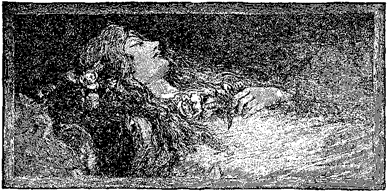
“SHE ENTERED ON UNTROUBLED REST.”
THERE is no surer mark of a well-bred man or woman than proper and dignified conduct in public. The truly polite are always quiet, unobtrusive, considerate of others, and careful to avoid all manifestations of superiority or elegance.
Loud and boisterous talking, immoderate laughing and forward and pushing conduct are always marks of bad breeding. They inevitably subject a person to the satirical remarks of the persons with whom he is thrown, and are perhaps the surest means of proclaiming that such a person is not used to the ways of polite society.
Etiquette in Church.
It is the duty of a well-bred person to attend church regularly on Sunday.
In entering the church you should pass quietly and deliberately to your pew or seat. Walking rapidly up the aisle is sure to disturb the congregation.
If you are a stranger, wait in the lower part of the aisle until the sexton or ushers show you a seat, or you are invited to enter some pew.
A gentleman should remove his hat as soon as he enters the inner doors of the church, and should not replace it on his head after service until he has reached the outer vestibule.
In accompanying a lady to church, pass up the aisle by her side, open the pew door for her, allow her to enter first, and then enter and seat yourself beside her.
Should a lady desire to enter a pew in which you are sitting next the door, rise, step out into the aisle, and allow her to enter.
Once in church, observe the most respectful silence except when joining in the worship. Whispering or laughing before the service begins, or during service, is highly improper. When the worship is over, leave the sacred edifice quietly and deliberately. You may chat with your friends in the vestibule, but not in the hall of worship. Remember, the church is the house of God.
Should you see a stranger standing in the aisle, unnoticed by the sexton or usher, quietly invite him into your pew.
You should see that a stranger in your pew is provided with the books necessary to enable him to join in the service. If he does not know how to use them, assist him as quietly as possible. Where there are not books enough for the separate use of each person, you may share yours with an occupant of your pew.
In attending a church of a different denomination from your own you should carefully observe the outward forms of worship. Stand up when the congregation do, and kneel with them. A Protestant attending a Roman Catholic church should be careful to do this. It involves no sacrifice of principle, and a failure to do so is a mark of bad breeding. Whatever the denomination, the church is devoted to the worship of God. Your reverence is to Him—not to the ministers who conduct the worship.
To be late at church is an offence against good manners.
Gentlemen will not congregate in groups in front of a church, and stare at the ladies as they pass out.
In receiving the Holy Communion both hands should be ungloved.
Etiquette of Fairs.
Fairs are generally given in aid of a church or some charitable purpose. At such fairs ladies serve the tables at which articles are offered for sale.
Ladies should not use unfair or unladylike means to sell their wares. Do not importune a gentleman to buy of you; and do not charge an extortionate price for a trifling article. A young man may not have the courage to refuse to buy of a lady acquaintance; but his purchase may be beyond his means, and may involve him in serious embarrassment.
Visitors to a fair should make no comments upon the character or quality of the articles offered, unless they can offer sincere praise.
Do not dispute the price of an article offered for sale. If you cannot afford to buy it, decline it frankly. If you can, pay the sum asked, although you may think it exorbitant, and make no comment.
A gentleman must remove his hat upon entering the room in which a fair is held, although it be a public hall, and remain uncovered while in the room.
Flirting, loud or boisterous talking or laughing, and conspicuous conduct, are marks of bad breeding.
When a purchaser offers a sum larger than the price asked for the article, return the change promptly. Some thoughtless young ladies consider it "a stroke of business" to retain the whole amount, knowing that a gentleman will not insist upon the return of the change. To do this is simply to be guilty of an act of gross ill-breeding.
A lady may accept any donation of money a gentleman may wish to make at her table. The gift is to the charity, not to her; and the gentleman pays her a delicate compliment in making her the means of increasing the receipts of the fair.
Etiquette of Shopping.
In visiting a store for the purpose of examining the goods or making purchases, conduct yourself with courtesy and amiability.
Speak to the clerks and employés of the store with courtesy and kindness. Do not order them to show you anything. Request them to do so in a polite and ladylike or gentlemanly manner. Give them no more trouble than is necessary, and express your thanks for the attentions they may show you. In leaving their counter, say pleasantly, "Good-morning," or "Good-day." By treating the employés of a store with courtesy, you will render your presence there, welcome, and will receive all the attention such conduct merits.
Should you find another person examining a piece of goods, do not take hold of it. Wait until it is laid down, and then make your examination.
To attempt to "beat down" the price of an article is rude. In the best conducted stores the price of the goods is "fixed," and the salesmen are not allowed to change it. If the price does not suit you, you are not obliged to buy, but can go elsewhere.
Pushing or crowding at a counter, or the indulgence in personal remarks, handling the goods in a careless manner, or so roughly as to injure them, lounging upon the counter, or talking in a loud voice, are marks of bad breeding.
Never express your opinion about an article another is purchasing, unless asked to do so. To say to a customer about to make a purchase that the article can be bought cheaper at another store, is to offer a gratuitous insult to the clerk making the sale.
You should never ask or expect a clerk engaged in waiting upon a customer to leave that person and attend to you. Wait patiently for your turn.
It is rude to make unfavorable comparisons between the goods you are examining and those of another store.
Have your parcels sent, and so avoid the fatigue of carrying them.
It is best to buy for cash. You can always buy cheaper in this way. If you make bills, however, pay them promptly. Make no bill you are not sure of paying at the time promised by you. Avoid debt as the greatest curse of life.
Etiquette of the Theatre, Opera and Concert.
A gentleman, desiring a lady to accompany him to the opera, theatre, or other place of amusement, must send her a written invitation not later than the day previous to the entertainment. It must be written in the third person, upon white note-paper of the best quality, with an envelope to match. The lady must send her reply immediately, so that should she be unable to accept, the gentleman may secure another companion.
Should the lady accept the invitation, the gentleman must secure the best seats within his means. To ask a lady to accompany you to a place of amusement, and incur the risk of being obliged to stand during the performance, is to be inexcusably rude to her. Should the demand for seats be so great that you cannot secure them, inform her at once, and propose another occasion when you can make this provision for her comfort.
In entering the hall in which the entertainment is given, a gentleman should walk by the side of the lady until the seat is reached. If the width of the aisle is not sufficient to allow this, he should precede her. As a rule, he should take the outer seat; but if this is the best for seeing or hearing, it belongs to the lady.
The habit of leaving ladies alone during the "waits," and going out to "get a drink," or "to speak to a friend," is indicative of bad manners. A gentleman escorting a lady to a place of amusement is bound to remain by her side to the end of the entertainment.
Between the Acts.
At the opera it is customary for ladies and gentlemen to leave their seats, and promenade in the lobbies or foyer of the house during the intervals between the acts. The gentleman should always invite the lady to do so. Should she decline, he is bound to remain with her.
A gentleman accompanying a lady is not bound to give up his seat to another lady. His duty is solely to the lady he accompanies. He cannot tell at what moment she may need his services, and must remain where she can command them.
It is rude to whisper or talk during a performance. It is discourteous to the performers, and annoying to those of the audience around you, who desire to enjoy the entertainment.
To seek to draw attention to yourself at a place of amusement is simply vulgar.
It is in especial bad taste for lovers to indulge in any affectionate demonstrations at such places.
A gentleman must see that the lady accompanying him is provided with a programme. If at the opera, he must also provide her with a libretto.
Applause is the just due of the deserving actor, and should be given liberally. Applaud by clapping the hands, and not by stamping or kicking with the feet.
Upon escorting the lady back to her home, the gentleman should ask permission to call upon her the next day, which request she should grant. She should, in her own sweet way, cause him to feel that he has conferred a genuine pleasure upon her by his invitation.
A gentleman who can afford it should always provide a carriage on such occasions. If his means do not permit this, he should not embarrass himself by assuming the expense. If the evening be stormy, he should not expect the lady to venture out without a carriage.
A gentleman should call at the lady's house in full time to allow them to reach their destination before the commencement of the entertainment.



YOUR conduct on the street should always be modest and dignified. Loud and boisterous conversation or laughter and all undue liveliness are improper in public, especially in a lady.
When walking on the street do not permit yourself to be so absent-minded as to fail to recognize your friends. Walk erect and with dignity, and do not go along reading a book or a newspaper.
Should you stop to speak to a friend, withdraw to the side of the walk with him, that you may not interrupt the passing of others. Should your friend have a stranger with him, apologize to the stranger for the interruption. You must never leave your friend with whom you are walking to speak to another without first asking him to excuse you.
In walking with a lady on the street, give her the inner side of the walk, unless the outside is the safer part, in which case she is entitled to it. Your arm should not be given to any lady except your wife or a near relative, or a very old lady, during the day, unless her comfort or safety require it. At night the arm should always be offered; also in ascending the steps of a public building. A gentleman should accommodate his walk to that of a lady, or an elderly or delicate person.
When a lady with whom a gentleman is walking wishes to enter a store, he should open the door, permit her to pass in first, if practicable, follow her, and close the door. He should always ring door bells or rap at a door for her. A gentleman should never pass in front of a lady, unless absolutely necessary, and should then apologize for so doing.
Should a lady ask information of a gentleman on the street, he must raise his hat, bow, and give the desired information. If unable to do so, he must bow and courteously express his regrets.
In crossing the street, a lady should gracefully raise her dress a little above her ankle with one hand. To raise the dress with both hands is vulgar, except in places where the mud is very deep.
A gentleman meeting a lady acquaintance on the street should not presume to join her in her walk without first asking her permission. It may not be agreeable to her, or convenient that her most intimate friend should join her. She has the right, after granting such permission, to excuse herself and leave the gentleman whenever she may see fit; and a gentleman will never take offense at the exercise of such a right. If it is inconvenient for a lady to accept the gentleman's company, she should frankly say so, mentioning some reason, and excusing herself with friendly courtesy. Gentlemen give place to ladies, and to gentlemen accompanying ladies, in crossing the street.
If you have anything to say to a lady whom you may happen to meet in the street, however intimate you may be, do not stop her, but turn round and walk in company; you can take leave at the end of the street.
Etiquette of the Street.
When you are passing in the street, and see coming toward you a person of your acquaintance, whether a lady or an elderly person, you should offer them the wall—that is to say, the side next the houses. If a carriage should happen to stop in such a manner as to leave only a narrow passage between it and the houses, beware of elbowing and rudely crowding the passengers, with a view to get by more expeditiously. Wait your turn, and, if any of the persons before mentioned come up, you should edge up to the wall, in order to give them the place. They also, as they pass, should bow politely to you.
When two gentlemen accompany a lady in a walk, she should place herself between them, and not unduly favor either. A gentleman meeting a lady friend accompanied by another gentleman should not join her unless satisfied that his presence is agreeable to both parties.
A lady should not venture out upon the street alone after dark. By so doing she compromises her dignity, and exposes herself to indignity at the hands of the rougher class. When a lady passes the evening with a friend, she should make arrangements beforehand for some one to come for her at a stated hour. If this cannot be done, or if the escort fails to come, she should courteously ask the host to permit a servant to accompany her home. A married lady may, if circumstances render it necessary, return home alone. An unmarried lady should never do so.
Should your host offer to accompany you himself, decline his offer, politely stating that you do not wish to give him so much trouble; but should he insist upon it, accept his escort. In the case of a married lady, the husband should always come for her. He is an ill-bred fellow who refuses to render his wife such attention. A lady, upon arriving at her home, should always dismiss her escort with thanks. A gentleman should not enter the house, although invited by the lady to do so, unless for some especial reason.
Evading a Long Talk.
Never offer to shake hands with a lady in the street if you have on dark gloves as you may soil her white ones.
If, when on your way to fulfil an engagement, a friend stops you in the street, you may, without committing any breach of etiquette, tell him of your appointment, and release yourself from a long talk; but do so in a courteous manner, expressing regret for the necessity.
A lady does not form acquaintances upon the street, or seek to attract the attention of the other sex, or of persons of her own sex. Her conduct is always modest and unassuming. Neither does a lady demand services or favors from gentlemen. She accepts them graciously, always expressing her thanks.
A gentleman will not stand on the street corners, or in hotel doorways, or club windows, and gaze impertinently at ladies as they pass by. This is the exclusive business of loafers, upon which well-bred men will not trespass.
Do not shout to your acquaintances from the opposite side of the street. Bow, or wave your hand, or make any courteous motion; but do it quietly and with dignity. If you wish to speak to them, cross the street, signalling to them your desire.
A lady walking with two gentlemen should not take an arm of each; neither should a gentleman walk with a lady on each arm, unless at night, in coming from a place of amusement or passing through a crowd.
In walking with a lady who has your arm, should you have to cross the street, do not disengage your arm and go around upon the outside unless the lady's comfort renders it necessary.
In walking with a lady, where it is necessary for you to proceed singly, always go before her.
ETIQUETTE OF RIDING.
The etiquette of riding is very exact and important. Remember that your left when in the saddle is called the near-side, and your right the off-side, and that you always mount on the near-side. In doing this, put your left foot in the stirrup; your left hand on the saddle; then, as you take a spring, throw your right leg over the animal's back. Remember, also, that the rule of the road, both in riding and driving, is, that you keep to the right.
Never appear in public on horseback unless you have mastered the inelegancies attending a first appearance in the saddle, which you should do at a riding-school. A novice makes an exhibition of himself, and brings ridicule on his friends. Having got a "seat" by a little practice, bear in mind the advice conveyed in the old rhyme—
"Keep up your head and your heart, Your hands and your heels keep down, Press your knees close to your horse's sides And your elbows close to your own."
In riding with ladies, recollect that it is your duty to see them in their saddles before you mount. And the assistance they require must not be rendered by a groom; you must assist them yourself.
The lady will place herself on the near side of the horse, her skirt gathered up in her left hand, her right on the pommel, keeping her face toward the horse's head. You stand at its shoulder, facing her, and stooping, hold your hand so that she may place her left foot in it; then lift it as she springs, so as to aid her, but not to give such an impetus that, like "vaulting ambition," she loses her balance, and "falls o' the other side." Next, put her foot in the stirrup and smooth the skirt of her habit—then you are at liberty to mount yourself.
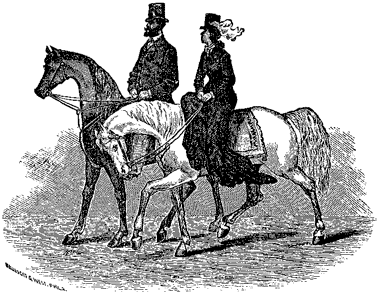
THE PROPER POSITION OF A LADY AND GENTLEMAN IN RIDING.
Keep to the right of the lady or any ladies riding with you.
Open all gates and pay all tolls on the road. Never, under any circumstances, allow a lady to attend to any duty of this kind while under your escort. You must anticipate her every need, and provide for it; making her comfort your first thought.
If you meet friends on horseback, do not turn back with them; if you overtake them, do not thrust your company upon them unless you feel assured that it is agreeable to them for you to do so.
If you are on horseback and meet a lady who is walking, and with whom you wish to speak, dismount for that purpose, and lead your horse. To put her to the inconvenience of straining after and shouting to you, would be a gross breach of manners.
If you enter a carriage with a lady, let her first take her place on the seat facing the horses. Enter a carriage so that your back is toward the seat you are to occupy; you will thus avoid turning round in the carriage, which is awkward. Take care that you do not trample on the ladies' dresses, or shut them in as you close the door.
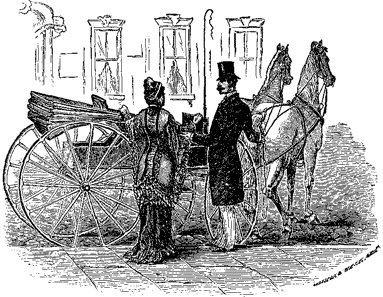
MODE OF ASSISTING A LADY INTO A CARRIAGE.
The rule in all cases is this: you quit the carriage first and hand the lady out.
You may properly speed your horse in driving with a lady, but remember that it is vulgar to drive too fast; it suggests the idea of your having hired the "trap" from a livery stable, and is in every respect ungentlemanly.
The carriage or buggy should be driven close to the sidewalk, and the horses turned from the sidewalk, so as to spread the wheels away from the step. The gentleman should then alight, quiet the horses, and hold the reins in his right hand as a guard against accidents. The lady should, in leaving the carriage, place her hands on the gentleman's shoulders, while he should place his under her elbows. Then, with his assistance, she should spring lightly to the pavement, passing him on his left side to avoid the reins which he holds in his right. In driving, the gentleman must place a lady on his left. This leaves his right arm free to manage his horses.
A gentleman should not drive fast if the lady accompanying him is timid, or objects to it. He should consult her wishes in all things, and take no risks, as he is responsible for her safety. Above all, he should never race with another team. Such conduct is disrespectful to the lady who accompanies him.
THE ETIQUETTE OF BOATING.
There are certain customs and usages in connection with this interesting pastime that deserve to be noted and observed.
Gentlemen unaccustomed to the management of a boat should never venture out with ladies. To do so is foolhardy, if not criminal. Great care should be taken not to overload a boat. The frequent boating accidents that happen are in most instances due either to overloading, or to the inexperience of the man at the oars. Men who cannot swim should never take ladies upon the water.
Assisting Ladies to Their Seats.
When the gentlemen are going out with the ladies, one of them steps into the boat and helps the ladies in and seats them, the other handing them down from the bank or pier. When the ladies have comfortably disposed themselves, and not before, the boat may be shoved off. Great care must be taken not to splash the ladies, either in first dipping the oars or subsequently. Neither should anything be done to cause them fright.
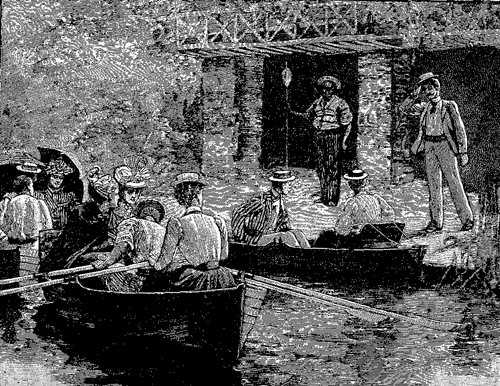
A BOATING PARTY.
Who Should Row.
If a friend is with you, he must be given the preference of seats. You must ask him to row "stroke," as that is the place of honor.
If you cannot row, do not pretend you can. Say right out that you can't, and thus settle it, consoling yourself with the pleasant reflection that your confession entitles you to a seat by the side of the ladies and relieves you from the possibility of drowning the whole party.
A Popular Exercise.
Rowing has become a great fad among the ladies in recent years, and it is to be commended as a wholesome and vigorous exercise. But it should be indulged only on quiet rivers or on private lakes. If ladies venture into more frequented waters, they must at least have the protection of a gentleman. And in all cases they must wear costumes proper for the exercise, which requires freedom of movement in every part. Corsets should be left at home, and a good pair of stout boots should complete an equipment in which a skirt barely touching the ground, a flannel shirt and a sailor hat are the leading features. Rowing gloves should protect the hands.
The ordinary rowing costume for gentlemen is white flannel trousers, white rowing jersey and a straw hat. Peajackets are worn when their owners are not absolutely employed in pulling the oar.
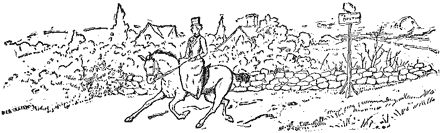
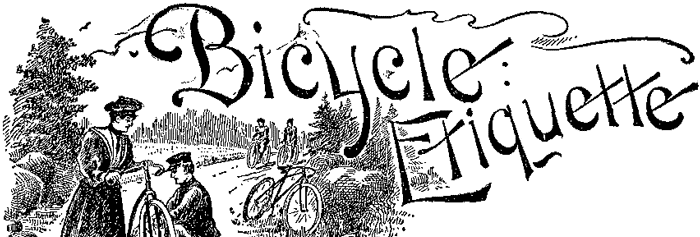

CYCLING having taken such a mighty grasp upon the land, it has naturally followed that an etiquette of cycling should be established, and that it should be well established and rigidly regarded by society.
There are the details of meeting, mounting, right of way and various other points which are carefully observed and give the desired air of fashionable righteousness, without which, for many people, the pleasure of meeting in a social way on one's wheel would be but legendary.
It is distinctly understood in the first place that "cycling" is the correct word; the up-to-date woman dares not speak of bicycling nor of wheeling.
A Cycler’s Guide.
If in town, the early hours of the morning are chosen for a ride through the park. This is on the same principle that it is considered good form for a young woman to drive only in the morning, that is, when she herself is the whip. In the country the rules, both as regards cycling and driving, are not as rigid. The maiden, however, who is a stickler for form, does all her cycling in the hours which come before noon—unless there be a special meet, a bicycle tea, for instance, or a spin by moonlight.
Neither is it correct for a young woman to ride unaccompanied. In the matter of chaperons we are becoming almost as rigid as the French, who scarcely allow a young girl to cross the street, to say nothing of shopping or calling, without being accompanied by an elder woman, her mother, relative, or a friend, as a chaperon.
During the past few years there has been a tendency in America toward a closer imitation of all French etiquette which has brought in its train a strict construction of the duties of a chaperon.
Maids Do Duty.
The unmarried woman who cycles must be chaperoned by a married lady—as every one rides nowadays, this is an affair easily managed. Neither must the married woman ride alone; failing a male escort, she is followed by a groom or a maid.
A woman is very fortunate if among her men or women servants, one knows how to ride a bicycle. Ladies occasionally go to the expense of having a servant trained in the art.
A Man’s Duty.
If one possesses such a commodity as a brother or a husband, he can always be made useful on a cycling excursion. Never is a man better able to show for what purpose he was made than upon such occasions.
The man's duty to the woman who rides might be made the text for a long sermon; but long sermons are never popular; therefore, it may be better to state briefly that he must always be on the alert to assist his fair companion in every way in his power—he must be clever enough to repair any slight damage to her machine which may occur en route, he must assist her in mounting and dismounting, pick her up if she has a tumble, and make himself generally useful and incidentally ornamental and agreeable.
He rides at her left in order to give her the more guarded place, as the rule of the road in meeting other cyclers is the same as that for a carriage, to turn to the right. In England, the reverse is the case.
Assisting the Lady.
In mounting, the gentleman who is accompanying a lady holds her wheel; she stands on the left side of the machine and puts her right foot across the frame to the right pedal, which at the time must be up; pushing the right pedal causes the machine to start and then with the left foot in place, the rider starts ahead—slowly at first, in order to give her cavalier time to mount his wheel, which he will do in the briefest time possible.
When the end of the ride is reached, the man quickly dismounts and is at his companion's side to assist her, she, in the meantime, assisting herself as much as possible. This is done—that is, dismounting in the most approved style—by riding slowly, and when the left pedal is on the rise, the weight of the body is thrown on it, the right foot is crossed over the frame of the machine, and, with an assisting hand, the rider easily steps to the ground.
In meeting a party of cyclists who are known to each other and desire to stop for a parley, it is considered the proper thing for the men of the party to dismount while in conversation with the ladies.
As to the furnishings of the bicycle, to be really complete, it must be fitted out with a clock and a bell, luggage carrier and a cyclometer, the latter being an absolute sine qua non to the woman who cares for records. From five to six lessons are always considered necessary before one can master even the details of riding.
On the Road.
On the road the woman who wishes to ride à la mode has to know a number of little things that are overlooked by another woman, just as the smart set have a code for riding and driving that is as inexorable as that they should not eat with their knives or put sugar on oysters. Society insists on an upright position, with, of course, no attempt at racing pace. It also frowns upon constant ringing of the bell—that will do for the vulgar herd who delight in noise. The well-informed wheelwoman keeps eye and ear alert and touches her bell rarely. She dresses daintily and inconspicuously—effaces herself, in fact, as much in this exercise as she does in all public places.
Very gallant escorts use a towrope when accompanying a lady on a wheeling spin. These are managed in various ways; one consists of an India-rubber door-spring just strong enough to stretch a little with the strain, and about six feet of shade cord. One end is attached to the lady's wheel at the lamp bracket or brake rod by a spring swivel, and the other end is hooked to the escort's handle bar in such a way that he can set it free in a moment, if necessary. When he has finished towing he drops back to the lady's side, hanging the loose end of the cord over her shoulder, to be ready for the next hill. A gentle pull that is a bagatelle to a strong rider is of great assistance to a weak one up hill or against a strong wind.
For Protection Against Dogs.
Every bicyclist in the land will rise up and call the inventor of the ammonia gun for dogs blessed. Nothing is more annoying to the rider than to have a mongrel dog barking at his pedals and scurrying across his pathway in such close proximity to the front wheel as to be a constant reminder of a possible "header." The gun is calculated to make an annoying dog sneeze and sniff away all future ambitions to investigate the pace of a rider. It is said to be a perfect instrument in every way. The advantages enumerated for it are: Positively will not leak; has no spring to press or caps to remove, and will shoot from five to twelve times from fifteen to thirty feet with one loading.
A Few Don’ts for Cyclers.
Don't try to raise your hat to the passing "bloomer" until you become an expert in guiding your wheel.
Don't buy a bicycle with down-curve handles. It is impossible to sit erect and hold that kind of a handle.
Don't go out on a bicycle wearing a tail coat unless you enjoy making a ridiculous show of yourself.
Don't travel without a jacket or loose wrap, to be worn while resting. A summer cold is a stubborn thing.
Don't allow a taste for a bit of color in your make-up to tempt you to wearing a red or other gay-colored cap.
Don't get off the old gag about "that tired feeling" every time you stop by the roadside for a little breathing spell.
Don't absent yourself from church to go wheeling, as you and your bicycle are welcome at most houses of worship.
Don't leave your bicycle in the lower hallway of your flat-house for the other tenants to fall over in the dark.
Don't believe the farmer boy who says that it is "two miles to the next town." It may be two, four, six or twelve.
Don't be more than an hour passing a given point, although wheeling on a dusty road is honestly conducive to thirst.
Don't smile at the figure others cut astride their wheels, as it is not given you to see yourself as others see you.
Don't coast down a strange hill with a curve at its bottom. There is no telling what you will meet when it is too late.
Don't ride ten miles at a scorching pace, then drink cold water and lie around on the grass, unless you are tired of life.
Don't try to carry your bike downstairs under your arm. Put it on your shoulder, or you will come to distress.
Don't laugh the watchful copper to scorn because your lamp is burning brightly. He can afford to wait his time to laugh.
Don't dress immodestly or in the costume of a track sprinter. Sweaters worn like a Chinaman's blouse are almost indecent.
Don't forget that the modern law of the road requires you to turn out to the right in passing another bicycle or other vehicle.
Women’s Bicycle Rides.
"Women who ride bicycles should make it a law with themselves never to ride after a feeling of weariness comes over them," said a well-known physician. "I just came from visiting a woman who tried to ride around the city last Sunday. It was the fourth time she had ever ridden a wheel out of doors. She got half way around, came home, in street cars and a carriage, and has been sick in bed ever since. She ought to be an example to all women who ride. For those who are beginning, especially, and in a measure for all women, there is a great danger in overdoing. Some women ride centuries, it is true, but they are men in strength. No ordinary woman should start out before knowing how far she is going. Ordinarily, though, they ride twice as far as they ought. They start out and ride away from home until they get tired.
"Then they have to ride back, getting more and more exhausted with every turn of the wheels. No ordinary woman who rides once or twice a week should go more than ten miles at a trip. That is perhaps an hour's ride, that may be easily extended to an hour and a quarter before that distance is covered, and if she does not feel fresh and in a glow when she stops, she may be certain that she has ridden too long. Naturally there is that healthy tired feeling which any one recognizes after athletic exercise, but it is quite different from and never to be mistaken for the weariness which comes from too much exertion and straining of the nerves and muscles. Very few women have ever been injured on a bicycle who kept to this rule and limited their riding to nominal distances."
Length of the Ride.
"This limit of distance, which is designated by the feeling of weariness, is only a little more important than the limit of speed which the female frame is capable of undergoing under healthy exercising rules. Whether a man can ride at full speed for a long distance and still retain his good health is a doubtful question. It is certain, however, that no woman can keep up a high rate of speed for even a generous portion of a mile and not create the beginning of injuries. The added strength required to increase speed even a little after a certain amount of power has been expended is out of all proportion to the results. There is no relaxation of the muscles between revolutions of the pedals, nor any let up on the nervous and muscular strain while the speed lasts. The heart is far more taxed than one realizes at the moment, and that species of tingling or numbness in the nerves and muscles which often results is only a sign that they have both been overtaxed."
Properly used, a wheel is certainly a promoter of health. It develops muscles that are seldom, if ever, otherwise used. It gains for women that ideal condition of the flesh so prized by sculptors and artists, namely, a firm, solid tissue when the muscles are flexed, and a softness of an infant with muscular relaxation. It develops the entire torso and limbs, it renders one's nerves like steel and is a splendid antidote for headaches.
An exceedingly smart and yet thoroughly practical cycling costume is known as the "Londonderry," and is made in gray-green hopsack, a soft fabric which lends itself admirably to the full folds of the ample knickerbockers, which form a most important part of this costume. The "Londonderry" coat is made with long and very full basques, which form a kind of skirt when on the machine, and which, nevertheless, do not interfere in the least with the rider's freedom of action. This coat is prettily braided with black, and fastened with big black buttons. It is so arranged in front that it can be worn either with a shirt or over a double-breasted vest of cloth or leather.
Skirts are an Abomination.
A renowned lady writer says: "In the first place let me condemn the skirt—not from prejudice, but from experience. Skirts, no matter how light, how trim, how heavy, are both a nuisance and a danger. A nuisance because they are always subject to entanglement in the wheel; because they fly up with every breeze and motion; because they have not the chic appearance of the properly made bloomer, and because, if they are weighted, like a riding habit, they make so much more to carry against the wind. And breeze makes weight.
"They are a danger because with the constant pumping of the pedals the knee is required to raise too great a weight; this bears upon the body just below the back of the hips, giving backache; often more serious troubles. I wouldn't wear a skirt. I had one torn off me by the wheel; but I rode with them long enough to give a just comparison of the merits of skirts versus bloomers.
"Riding suits should be of fine, light weight, navy blue or black material, made with bloomers, and the blouse with tailor-made jacket. I wear the sweater myself in preference, because it is not so apt to leave one subject to changes of temperature. The Alpine hat of Tam O'Shanter is au fait for street, with leggings to match the bloomers and jacket, and low shoes made broad on the ball of the foot. All bicycle shoes should be broad on the ball, because the pedaling is done with the ball, not with the under curve, as so many think. Doeskin gloves are best for ordinary riding. Bloomers should be made to fasten at the left side of the back, which leaves room for a pocket on the right side. Tinted leggings should always match the hat and gloves.
"Tell the ladies to have their saddles built high and wide in the back, sloping away and downwards in front; and that if they pedal properly there is no reason why bicycling should not be a healthful, moral, modest and permanent form of exercise. For, mark it," she added, as a parting sally, "the wheel has come to stay."
A Pace Indicator.
A man who rides for health and pleasure and not to race or score centuries says that his plan is never to go so fast that he must breathe through his mouth. As long as his nostrils can supply sufficient air he knows that he is not over-exerting himself. As soon as he feels an inclination to breathe through his mouth he slackens his pace.
Don’t Dodge a Bicycle.
Before bicycling will ever become a success a meeting must be called for the purpose of allowing the wheelmen and the pedestrian to arrive at some understanding. "I am in favor of a convention or something of that sort," said a prominent wheelman to a reporter.
As it is now, a rider comes down the street and sees ahead of him at a crossing a man or woman who is supposed to be endowed with reasonable intelligence. This person is in the act of crossing the street. He looks up, sees the rider coming and stands still right in the middle of the street. Of course, he is mentally calculating his chances for getting across safely.
In the meantime, the rider is getting closer and closer and is in a study equally as profound as to what the person is going to do. The pedestrian takes a step forward, takes another glance up the street, stops, starts back, makes an effort to reach the pavement, stops again, starts forward, stops.
Of course, by this time the cyclist is almost at a standstill and is also zigzagging from one side to the other, waiting and muttering. The pedestrian seems to give up all possibility of escape, faces the rider, both arms extended, jumps from one foot to the other, and the two collide. The cyclist is thrown to the ground, his wheel twisted, and he gets the blame.
And how easily all this can be avoided! Let the pedestrian, instead of performing all these trying evolutions, merely walk along as though there was nothing behind him, keep his course, and the cyclist will know what to do. He will turn his wheel to one side and slide past with perfect ease and safety. On the crossings let a man walk along as though there were not a bicycle in the state, and the wheelman will judge his course accordingly. He has control of his wheel and is as anxious not to collide as the other fellow.


CLUB life in all large cities is becoming so important a factor of social life that no book on etiquette would be complete without some notice of its varied features.
The membership of the smaller social clubs is chosen solely for the purpose of social enjoyment, and they frequently blackball names that are brought up for membership simply from the standpoint of some member to whom the one proposed may not be personally agreeable. If an applicant is blackballed once, his friends should not persist in introducing his name again.
In the larger clubs, where the members are never all thrown together at any one time, no one should blackball a name from a personal standpoint.
If any one, however, is aware of some blemish in the character of the candidate for admission, he has good grounds for objection.
Observing the Rules.
A new member of a club should at once acquaint himself with the rules and regulations that govern the organization and govern himself accordingly. The courtesy that obtains in the home is to be observed in the club-rooms.
Opinions of others should be respected, and exciting discussions, or disturbing topics of conversation, are to be avoided there, as they should be in the home circle. Remember that every one has the same right to his preconceived opinions as you have to yours.
Treat all books, papers and other club property with due care. Never take any article away from the club-house. Never monopolize any one article to the exclusion of others.
When there are certain rooms appointed for smoking, confine yourself to them when indulging in the weed. In the reading-room observe the same respect for the readers that you would wish observed toward yourself, only another rendering of the Golden Rule which is at the foundation of all good manners. While there converse very little, and that in a low tone of voice.
Do not look upon the servants of the club as your private property, and never send them on personal errands without first obtaining the consent of the manager. Never expect undue attention from the waiters. Do not take dogs into club-rooms; they are liable to destroy furniture, and everyone may not appreciate them as much as you do.
Morning dress is worn at the club. In the evening a dress suit may be worn if desired, but morning costume is equally appropriate. Hats should be removed at luncheon or dinner.
Gentlemen will refrain from much mentioning of the names of ladies while in the club-rooms, or from indulging in scandal. Serious ill-feeling is often aroused in this manner. Many men refuse to listen to anything of the kind, and will retire if any such subject is brought up.
Introduction of Friends.
Some clubs have cards for introducing visitors, as:
VISITING CARD.
Columbia Club, 420 Madison Square.
Admit Mr. ____________________________
Introduced by Mr. ____________________________
Club members are at liberty to introduce friends at their respective clubs, but care should be exercised in this respect, since they must vouch for their friends' behavior, and in many cases are held responsible for the debts they may contract. It is not at all necessary that such a guest should be formally presented to any of the officials, nor to many of the members, unless in the case of some guest whom the club would delight to honor.
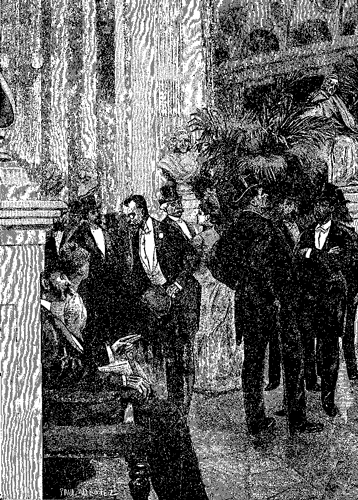
RECEPTION AT THE CLUB.
The guest of a club is expected to conform to all rules of the association while enjoying its hospitalities, but he may also avail himself of all its privileges, with the exception that he is not permitted to introduce another stranger. A gentleman about to leave town, and who has been entertained at a club, leaves his card in a sealed envelope for the gentleman who introduced him.
Ladies' clubs are now coming to the front in such profusion as to make it necessary to give them some notice. The same general rules of etiquette apply to them as to a club of men. As a rule, women's clubs have some especial feature, some object to call them into being.
The most usual form that the club activities assume is that of literary work of some kind, either as a gathering of literary women, or simply a gathering of women for some particular form of literary study. They usually give club banquets and club luncheons, but rarely attain to the dignity of a café.
Barring Out Disputed Questions.
The temper of the meetings depends very largely on the kind of organization that holds them, whether, for instance, as in the case of Sorosis, it is a club of refined and educated women, of literary and artistic pursuits and tastes, or whether it is one for reform, as temperance, suffrage, social purity, or religious development and work. The members of Sorosis, when in session, are well-bred, if not always clear-headed and reasonable. Religious gatherings of women are seldom other than of good temper, and quiet in their tone.
Political meetings and sectarian meetings are apt to be turbulent. This fact has been recognized by some women's clubs, Sorosis, for example, and they will not permit the subjects to be discussed or introduced in any way at meetings.
The various business womens' and working girls' clubs are instituted for the sole purpose usually of furnishing good lunches at the noon hour at reasonable rates, and combine this feature with pleasant reception and lounging rooms, and often with various literary and business courses of study.
There is one Ladies' Suburban Club—the Alexandra—the most exclusive of London's women clubs. It is also the most successful. No individual of the other sex above the age of twelve is admitted beyond the doormat. Husbands, fathers, and brothers, are all ruthlessly excluded from within its sacred precincts. It furnishes an admirable center for shopping operations, and for lunches, teas, etc. It possesses the advantages of bedrooms, let at the most reasonable rate, so that girls and young married women can spend a night or two in town without any trouble to chaperons or maids. Women friends, of course, may be admitted into the club, and servants and tradespeople interviewed. It is named for the Princess of Wales, and no one who has not been presented to the Queen is eligible to membership.
There is also a Ladies' Suburban Club in Chicago that partakes of the same features, save that it is not founded upon quite so aristocratic a basis, and the suburban woman heartily appreciates its benefits. No more does she wander aimlessly up and down the streets while awaiting a home-bound train. She has a resting place of her own within easy reach of the shopping district, one where she can be made presentable for matinée or theater. Here, on one floor, she finds hairdressers, manicurists, a café, a woman ready to repair damaged garments; and should she miss the last train, comfortable sleeping-rooms, where she can spend the night quietly. There, the club-shopper is ready to attend sales and do all manner of purchasing—from ordering funeral flowers to selecting a good seat at the theater, while the club nursery is responsible for all children left there. Their membership hails from many states.
Presiding at a Woman’s Club.
The average woman is not so well qualified to preside over meetings in which continual interruptions are occurring, through the members rising to points of order, and other questions of privilege, because, unlike the average man, she has not given much attention to the study of parliamentary law.
The rules for conducting a meeting do not admit of any personal feeling or individual taste on the part of the presiding officer. On the contrary, there is a code of rules expressly laid down to guide and regulate such matters.
The presiding officer is not supposed to control the opinions of the members, but merely to direct them. She should be in entire sympathy with the objects of the meeting, and have a full and complete understanding of all its aims, objects and purposes. This latter is a very important consideration. Members, and especially new ones, are constantly asking for information, and unless the presiding officer can furnish it briefly and at once, delays are sure to occur, and the meeting be anything but pleasant or satisfactory to the other members present.
Order of Business.
Having been chosen to preside, the first duty is to call the meeting to order. If it is a first meeting, the objects for which it is called should then be stated clearly, but in as few words as possible. If it is not a first meeting, but a regular or constituted one, the presiding officer should have the roll of members called by the secretary. The minutes of the last meeting should then be read. Next, the presiding officer should appoint her committees for the session; or, if it is a regular meeting, the reports of the various committees appointed at the previous session should be heard. Next, the regular business should be taken up, and having been disposed of, the presiding officer should allow the introduction of any new business that may properly come before the meeting.
It is of the utmost importance that a presiding officer should be possessed of good eyesight, so as to be able to perceive a member as soon as she rises. There must be no hesitation or nervousness about a presiding officer. She must be ever on the alert, with all her faculties about her. She must be broad-minded, liberal, and clear-visioned, with a readiness to instruct the members when any mistakes are made, and always willing to grant the full liberty of debate to all; for out of the widest differences will come the very best conclusions after full and fair discussion.
WOMEN are our only leisure class. This has been so often repeated that it scarcely matters to whom the credit of the saying must be given.
In this country the burden of social work rests upon women, while in all European countries, men, young and old, statesmen, officials, princes, ambassadors, make it one of the duties of life to visit, leave cards and take up all the numerous burdens of the social world.
Here it is the lady of the house that does all this. Husbands, fathers, sons, are all too much engrossed in the pursuit of business or pleasure to spend time in these multifarious cares. Mrs. John Sherwood says: "They cannot even spend time to make their dinner calls. 'Mamma, please leave my cards,' is the legend written on their banners."
Influence of Women.
The wonderful influence of women of culture and fashion, with their "happy ways of doing things" in the political, as well as the social world, is as great now in Washington as it ever was in Paris, in the palmiest days of the Imperial Salon.
The graces and the courtesies of life are in their hands. It is women who create society. It is women from whom etiquette is learned, not from association with men. The height of a stage of civilization can always be measured by the amount of deference paid to woman. The culture of a particular man can be gauged by his manner when in the company of ladies.
Primitive man made women do all the hard work of life, bear all the burdens, eat of the leavings, and be the servants of the tribe.
Civilized man, on the other hand, gives precedence to woman in every particular. He serves her first, he gives her places of comfort and safety, he rises to assist her at every opportunity, and we measure his culture by sins of omission, or commission, along this line.
Thus, all these small observances not only conduce to the comfort of woman, but they refine and do away with the rough and selfish side of man's nature, for without this refining contact with gentle womanhood, a man will never lose the innate roughness with which nature has endowed him.
It is women, as before said, who create etiquette, and Burke tells us that "manners are of more importance than laws." A fine manner is the "open sesame" that admits us to the audience chamber of the world. It is the magic wand at whose touch all barriers dissolve.
Effect of Cultured Manners.
"Give a boy address and accomplishments and you give him the mastery of palaces and fortunes wherever he goes. He has not the trouble of earning or owning them; they solicit him to enter and possess."
Whatever enjoyment we obtain from our daily intercourse with others is through our obedience to the laws of etiquette, which govern the whole machinery of society, and it is largely to women with their leisure, and their tact, that we must look to create and sustain the social fabric.
"To know her is a liberal education," was the stately compliment once paid a woman, and there are women left to whom it still applies.
As Emerson says in his essay upon "Manners:" "Are there not women who inspire us with courtesy; who unloose our tongues, and we speak; who anoint our eyes, and we see? We say things we never thought to have said. For once, our walls of habitual reserve vanished and left us at large; we were children playing with children in a wide field of flowers. Steep us, we cried, in these influences for days, for weeks, and we shall be sunny poets and write out in many colored words the romance that you are."
The successful society woman has a genius for leadership. She molds and makes what she will of her surroundings. She undervalues the talents of no one; she rather draws out and makes the most of every one with whom she comes in contact.
She is quiet, she is reposeful, she has the tact that puts every one with whom she meets at ease, and, above all, she is sympathetic. A judiciously expressed sympathy with our fellow-beings is one of the highest attributes of our nature.
"Unite sympathy to observation and the dead spring to life." It is tact to so express that sympathy as not to seem aware of the weakness that we would support and conceal from others. Madame Récamier had this gift of hidden sympathy, this power of drawing out the best that was in those who approached her. To this gift it was that she owed that power over all men which survived her wonderful beauty.
A Sympathetic Nature.
It was not her wit, for with this she was not so greatly endowed; it was not alone her beauty, for the eminent men and women of the day followed her when, blind and poor, she sought the solitude of the abbey; but it was the delicate tendrils of her sympathy and the steadfastness of her friendship that drew towards her all hearts, and molded and welded her company of followers into one of the most perfect and powerful social circles that has ever surrounded any society leader.
Many an awkward situation has been saved by feminine tact. There was the cabinet-member's wife who drank out of her finger-bowl because her guest, a senator, had done so. And the general's wife who, when a clumsy tea drinker smashed a priceless cup, picked up another of the fragile affairs and crushed it between her fingers with a "They do break easily, don't they?" And the woman who, when M. Blanc was mistaken at an English garden party for a page, replied, "Well, M. Blanc is a page—of history."
This tact is in great measure a natural gift, but it can be cultivated, and is well worth the trouble. Nothing can be so utterly painful in society as the tactless person who is perpetually "doing those things which he ought not to have done, and leaving undone those things which he ought to have done."
The art of conversation, too, is worth cultivating. A woman, noted among her friends for her delightful letters and as delightful gifts of conversation, was asked how she managed it.
"Frankly," was the reply, "I strive for it. When I see in a book or hear anywhere a happy phrase, or a telling sentence, I make a mental note of it, and watch for an opportunity to incorporate it in my own speech or written word. I don't mean I appropriate other folks' ideas in wholesale fashion, but I do steal or utilize their knack of expression. Another point I make is never to permit myself to speak carelessly, that is, slovenly, any more than I let my hair be untidy or my gowns mud-stained. It does not seem to me frivolous or bestowing too much care on trifles to take this small pains for my betterment. I pin a flower on my dress for a bit of color, or adjust a bow where I know it is becoming; why should I not apply the decorative idea to my speech?"
Power through Repose.
Cultivate repose of manner. Be calm and restful. Do not fidget. Command of the tongue is a valuable accomplishment to cultivate. Many a young girl is actually fidgety, because she thinks to be a success she must be "full of life" and always "on the go." She wants to be bright and vivacious. If such is her temperament and her vivaciousness comes spontaneously it is perhaps attractive, though it is very likely to get tiresome.
Nine out of ten women would be twice as attractive if they would learn to keep still and thus gain the full social value of this ability. Especially is this true of young girls. When a young man is introduced, why plunge at him with a volley of phrases? An effect is made twice as quickly if his look is met with steady, quiet eyes, a few words spoken in a gentle, sincere voice, and a chance given him. Presumably, he requested the introduction, and so, probably, he has something to say. Anyway, he is likely to have, if you are serene and quiet.
A habit of repose will save from many a blunder. When a man, one does not remember, plunges into a conversation, the habit of repose enables one to keep an unmoved and quiet demeanor until something is said that will "place" him. To be in a hurry to speak is to betray oneself, and embarrassment ensues on both sides.
This command of quiet is also a protection against tiresome, talkative, people. It enables one to preserve an air of kindly attention, while one's thoughts, free and untrammeled, roam at their own sweet will, drifting back just in time to utter an appreciative affirmative, or negative.
A Good Listener.
This repose of manner is a boon to the shy and awkward man, who, under its influence, actually acquires some confidence in himself, which is simply impossible when he is bombarded with a volley of vivacious conversation.
Learn to be a good listener, a sympathetic and interested listener, and the majority of people will pronounce you "interesting." If the partner assigned you at a dinner party seems to have no topic in common with your thought, strive to find out what does interest him; a few skillful questions, and he is launched on a tide of talk, at his ease, even brilliant, and all that is needed on your part is to appear interested. Whether you understand the subject, or care for it, is another question; you have established your place in that man's estimation, and he will ever thereafter have a word of praise when your name is mentioned.
There are women who are themselves not fluent, and who enjoy being talked to, to be spared the trouble of "making conversation." With these women it is the ready talker who finds favor. But there is another class of women quite as large who love to talk, and to them the good listener is welcome; therefore, let the man who wishes to talk choose his audience with discretion.
Madame Récamier liked to be talked to, and was so sympathetic a listener that the careful student of her times is forced to conclude that was one of the chiefest of her charms, but he would have been a bold man who would have interrupted the flow of Madame de Staël's eloquence.
Men are less inclined to certain forms of etiquette than women. Not that they would be less polite, but, as a rule, they do not attach so much importance to the little niceties of life, and they are too prone to lack in certain courtesies which a society man should practice.
How Men are Spoiled.
This process of spoiling begins with the mothers, and ends with the young women. Women pride themselves upon being independent, and the result is that the men naturally fall back and let them wait upon themselves. Women take the lead, women plan entertainments and excursions, women tolerate neglect, and all of this spoils the men. Be a woman first and last, and exact all these little courtesies for the sake of your sex.
Says a well-known lady: "I remember a thing that impressed me very much, and made me ashamed of my own sons whom I have always waited upon, I am sorry to say. We had as guests a gentleman, wife and son, the latter about thirteen. In the morning there was a parade; the gentleman and his wife went, while I stayed at home with another relative. The boys came in to luncheon, and then as I was going up-town, Harry, our visitor, put up his wheel, brushed his clothes, and announced that he was ready to escort me. I assured him that we did not need him, to run along with the other boys, but he would not hear of it. He opened the gates, carried my umbrella, and stayed with me until he saw me safe at home. I complimented him to his mother, but she assured me that he would never have thought of doing anything else, for when the father could not accompany her, Harry had been taught to do so. I had always assured my boys that I could take care of myself, but I wish now I had made them take care of me."


THIS chapter is devoted to the gathering up of the fragments that remain from all the other departments that cannot be rigidly classified, and yet are useful to remember.
There are many minute points of etiquette which, although not extremely important, often serve as a source of embarrassment to uninitiated persons, and upon which information that can be relied upon is desired.
Who Bows First?
Whether the lady or gentleman should bow first is a point where many differ. That the lady should bow first, most authorities agree in declaring. This acts as a safeguard to a lady, permitting her to drop an undesirable acquaintance, as a failure to bow would be considered the "cut direct." But some ladies are forgetful of faces, and some are near-sighted, thus preventing ready recognition of others; so that, while this custom might apply to introductions given at a ball, still, a bow hurts no one, and an undesirable acquaintance is easily dropped without this rudeness. Hence it would seem that, whichever one recognizes first, the other ought to have the privilege of bowing without breaking this social law, which is better observed in the spirit than in the letter.
“Lady” or “Gentleman?”
These terms have come to be used so continuously, and sometimes so meaninglessly that they bid fair to crowd out the sweet, strong words, "man" and "woman," and a revulsion of taste has swept in that goes nigh in some "sets" to utterly swamp the "lady" and "gentleman." Either extreme is a mistake.
There is a right and wrong use of these terms; for example, one says to one's servants, or to one's children, "I expect some ladies to visit me to-morrow," while later, referring to them in conversation with a friend, one may say, "they are women of exquisite culture." A matron may speak of young ladies as "girls," but if she be not intimate, "young ladies," is more usual, or she may address them collectively as "young women."
Misuse of the Term “Lady.”
The term "lady" has been more abused than that of "gentleman." The words "fore-lady," "sales-lady," "wash-lady," have rendered it ludicrous when one thinks of contrasting it with the terms, happily never used, of "fore-gentleman," "sales-gentleman," etc.
Formal consideration asks "if the ladies are at home," and refined custom requires it. But to express the graces and endowments of a woman, it is her womanliness that is emphasized. "She is a gracious, sweet-tempered, kindly woman." The same distinction applies to the use of the term "gentleman," or "man."
Says one writer, giving some examples of the use of these words: "A polite host would say, 'The men are looking for some ladies who would enjoy a game of tennis,' or, 'I can promise the young ladies a pleasant time, for there will be a great many dancing men present.' One gentleman says to another, in expressing his admiration, Miss Blank is my ideal of a lovely and lovable woman' (he does not say 'lady'), but in the same breath he may add, 'Let us join the ladies (not 'women') on the balcony.'"
One should always say "she is such a sweet old lady," rather than "she is such a sweet old woman."
Much might be said in this regard, but after all, exact discrimination of the proper term at the proper time must be left somewhat to the personal judgment of each man and woman.
The leading business and professional men owe their success, in great measure, to their graciousness in business manners. It is well, from many points of view, to form the habit of treating all, rich and poor, men and women, with uniform courtesy. The pleasant business man draws the largest custom. The polite professional man secures the best clientage.
Pay bills and drafts promptly, or else explain satisfactorily to your creditor when you will be able to meet the obligation. If your word has always been as good as your bond, in nine cases out of ten he will grant the extension of time desired.
Keep appointments to the moment. If unable to do so, send a messenger to explain. Finish your business promptly and then leave. Time is money. Never misrepresent goods, nor allow others in your employ so to do.
Enclose a stamped envelope for reply when asking for information that is to benefit yourself solely. Answer letters of inquiry promptly. Do not display curiosity in regard to business matters that do not concern you, nor try to examine the books or private papers of another. Be polite to all employés. They will give much better service.
Business Forms are always useful, hence we furnish some that are in constant use:
A Promissory Note.
$300.
Chicago, Ill., November 5, 189-.
Ninety days after date I promise to pay to Charles Chapman, or order, at the Second National Bank, Three Hundred Dollars, value received.
Martin Voorhees.
If it is intended to draw interest that should be added, thus, "with interest at six per cent."
A Joint Note.
$200.
Salida, Col., December 2, 189-.
Three months after date we jointly promise to pay Howard Crosby, or order, Two Hundred Dollars, value received.
Grace Harding. George Harding.
A Receipt on Account.
$500.
San Mateo, Cal., November 1, 189-.
Received of George Woods, Five Hundred Dollars, on account.
Frank James.
A Receipt in Full.
$200.
Louisiana, Mo., October 31, 189-.
Received of John Jenkins, Two Hundred Dollars, in full for all demands up to date.
James Higgins.
Form for a Bill.
New York, December 3, 189-.
Mr. John Henson.
To James Carroll, Dr.
To 10 pounds coffee, @ 30c$3.00
To 20 pounds sugar, @ 5c1.00
To 2 pounds lard, @ 18c.36
To 1 pound tea, @ 60c.60
$4.96
What and What Not to Say.
Don't say "I feel good," for "I feel well."
Don't say "these kind," but "this kind."
Don't say "not so good as," for "not as good as."
Don't say "between three," but "among three."
Don't describe an unusual occurrence as "funny," unless something comic is meant. Strange, peculiar, unique, odd, are better expressions.
Don't say a garment "sets good," but it "fits well."
Don't say "had rather," "had better," for "would rather," "would better."
Don't speak of articles of diet as "healthy," but as "healthful" or "wholesome."
Don't say "fix my gown," "fix this room," but "arrange my gown," "the room." The best authorities rarely use fix, except to indicate stability or permanence. You don't fix the house, you repair it.