Visiting Cards. (continued 9)
Reading edition
Draperies.
The new swinging portières that have appeared have a handsome swinging crane fastened to the wall near the ceiling, upon which a portière or curtain is suspended. This can then be swung back against the wall or swung out to make a cozy corner or to shut off one portion of a room from another. These swinging portières can in many cases be made to take the place of screens and often fit with great advantage where a fixed portière of the old sort could not be used.
The handsome cranes are of course more or less expensive, but a home-made substitute will answer the purpose very well. It is not exactly home-made, however, for the services of a blacksmith may have to be called in to bend the three-eighths inch iron rod into shape for use. The ends are bent to fit into screw eyes or other sockets fastened to the wall, upon which this improvised crane can be swung. The portière is suspended from the iron rod by rings.
Denim is one of the best of all fabrics for a portière in rooms constantly used. It may be washed out and will look quite as well as new. If you want a variety put one entire width in right side out, and split another and join to the first section, putting the side pieces wrong side out. Sew the seams, then fell them and featherstitch the outside of the seams in colored linen. Then with a teacup or saucer draw some circles, intersecting or lapping at one edge. Work these with linen in short stitches and make eccentric lines or spider-web lines from the central design. The edges may be hemmed or featherstitched or done in buttonhole and cut out in scallops. It is better to have the edge of the facing instead of making a turned-in hem.
Then denim, as a floor covering, wears far better than low-cost matting and never becomes disagreeably faded; for, being made for hard usage, it but takes a quieter tone when other blues would surely fade into unpleasant, soiled-looking hues.
Some Useful Bits of Furniture.
A settee table of oak has an adjustable top, which can be turned over by the removal of two pegs, making a high back to the bench, whose deep seat is utilized as a household linen closet. These tables are in great demand where the saving of space is an object and come in various sizes. They can be purchased without the top and used as a window seat. One in a pretty studio of a woman artist in New York was most artistically treated. It was painted a dull green. The back and the lid of the seat were upholstered in an effective gold colored tapestry drawn over a padding of hair and held down by gimp and gilt nails, making a most artistic seat or table, as its use for either was required. Another one was stained green, and on the back and lid of the seat was used natural toned burlap, with stenciled griffins in dark brown as a decoration.
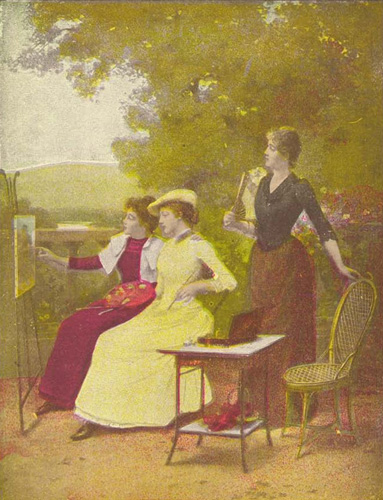
A PAINTING FOR HOME DECORATION.
These tables may be treated in various ways to suit their surroundings. It is suggested in The Decorator and Furnisher that one stained the natural oak and upholstered in green rep, turcoman, corduroy, burlap or denim would be most attractive, or for green, substitute brown in the same materials and put on with dull brass nails, making an effective seat for a hall.
Another, painted white and enameled, would be charming in a blue and white dining-room. Upholster in dark blue denim with white nails, and fill with a number of pretty pillows in various designs of blue and white, and one of vivid scarlet to give a warm touch, which is needed in these coldly decorated rooms.
The lovely liberty chintzes in dark blue and white, and sometimes yellow, red and white on blue, are good to use on these settees, which are first painted black.
A Hanging Desk.
The economy of space necessary in apartment living has brought about the evolution of some remarkable pieces of furniture that may be useful in small houses anywhere.
The writing desk may be included in the list of household wonders directly attributable to the necessity of fitting that most useful household article in a six by ten apartment. When closed, it really occupies the very smallest amount of room imaginable, and for the young students' use, or in flat bedrooms, where space is at a premium, it is unique and valuable.
The material may be oak or such wood as one fancies. Pine enameled in white or black is as good, so long as it matches the woodwork or furniture of the room. Two strips of the wood, each two inches by three feet, are attached to the wall by long screws. Across the top of these are placed three shelves about five inches wide, supported by brackets of brass. Between the two upper ones partitions are glued in to form pigeonholes.
From four to six inches from the lower end of each of the strips of wood is firmly placed a strip about two inches wide, to which is hinged the shelf that forms the desk. This is upheld when open by brass chains, and is thus made firm. When it is desired to close it, it is merely shut to the wall, the chains falling into place. The ledge upon which the lid is hinged forms a firm place for the inkstand and other necessary fitments of a desk.
Against the wall, between the supporting strips, may be fixed a Japanese panel or some tapestry or silk, as taste may dictate. A picture can be so fastened to the panel as to form a good letter or cardholder.
The whole affair is simple and easily managed. Any good carpenter will make the necessary woodwork for a very small sum.
A Window Desk.
One of the most convenient and altogether satisfactory contrivances quite in the power of a woman to manipulate is a window desk.
Take a board about fifteen inches wide and saw it the length of the window sill. Put small iron hinges on it and screw it to the sill, so that it can hang down against the under wall when desirable.
Tack a narrow strip of wood under the board, near the front edge. Resting on the floor and wedged under this cleat there is a prop of planed wood, slender and neat looking. You can put a beading around the board, with small brads and stain it cherry or some other color.
The sill holds pens, pencils and inkstands, and a large blotter laid on the board, is a most desirable writing pad. This idea comes from an art student in Paris, who dotes on her window desk.
It will be found useful in the nursery as a place for pasting pictures, drawings, etc., and when done can be swung down and out of the way.
A Hall Chest.
A pretty hall chest is one of the things that may be successfully produced at home. In a seaport town, the chest of some ancient mariner is easily procured; otherwise, one of similar style and make must be fashioned for you by a carpenter. As it need only be made of soft wood the cost is not great. After it has left the carpenter's hands it may be decorated with the applied ornamentation in scroll design, which is now obtainable ready to put on, and afterward treated to a coat of stain.
Old oak is the most satisfactory, or it may be ebonized, if preferred. Polished brass corners and hinges may be added, and a row of brass nails set around the edge with good effect. The convenience of these chests for hall use has been accepted. They beautifully conceal rubbers, mackintoshes, a storm shawl and various unsightly but useful impedimenta of the hall rack, and if, in addition, a seat is desired, a strip of dark leather with a light pad beneath it may be set on with brass nails across the middle of the lid.
Cozy Corners.
They are so easy to arrange. Have your carpenter make a double right-angle bench, with a high, straight back. The seat must be two and a half feet wide, and the top of the back five feet from the floor. This now looks like an ungainly three-sided square, or rather oblong, for it is better to have one side somewhat longer than the others. The wood should be stained cherry or oak, to match the other furniture in the room, and oiled and polished so as to be smooth and of rich appearance; or, use hard wood, black walnut, ebony, mahogany.
The seat and inside back may be thickly and prettily upholstered, and then piled high with pillows, or, the wood having been nicely finished, the upholstery may cover the seat only. Be sure and have the seat made low, otherwise the Cozy Corner will be uncomfortable, its name will be belied, and no one will hie to what might have been the favorite seat in the room.
Now, where shall we place the corner? Put it in the space next to the grate fire, and since you have had this place in view, the side to fit in there should be made the requisite number of feet and inches so as to actually fit.
Placed in this part of the room, two sides of the corner are against the wall, but the third side presents a bare and uninviting appearance. This may be avoided by suspending a silk or gauze hanging close to its side, in the same way that the back of an upright piano is often screened. The seats should be piled with sofa pillows, and in the inclosure a few hassocks would not be found amiss.
The word cozy suggests warmth and pleasantry, as well as comfort. Therefore, this corner is always by the fire, and those occupying it are presumably cheery and happy.
It is just the place to rest in, just the place to read in, just the place for you and your dearest friend to chat in, just the place to play a game in, as bags, balls, etc., could easily be tossed from one seat to the other; just the place to lay plans in, for you are in no hurry to move, and so your plans, not being hurriedly completed, would be more apt to prove satisfactory; just the place to nap in, just the place to frolic in. Indeed, just the place to add to our already comfortable homes if we would have them one remove nearer the ideal home than they now are.
Plenty of Pillows.
All cosy corners and all couches are incomplete without numberless pillows of all sorts, shapes and sizes.
A serviceable pillow, and one that can be laundered, is of blue denim, with a band of Irish point embroidery running around the four sides of the square with the edge toward the center. A ruffle of denim with a narrow embroidered insertion to match the edge, completes this sensible head-rest.
An Indian silk pillow is always pretty, and is pleasant next to the face when one is lying down.
An open-work scrim with rows of ribbon placed upon the plain stripes, made over a contrasting color of silk, with ruffle of sheer lace over the color of the pillow, is effective and bright looking.
Any one who is fond of an Oriental effect can have it in the pillow by sewing silks and satins hit and miss, as in making an old-time rag carpet, then having it woven with black linen chain.
One who is expert with crochet needle can have a creation worthy of handing down for ages to come. Crochet a number of artistic wheels or medalions of knitting silk in a golden yellow shade; join together, making a square the size of the pillow desired. Place this lace cover over a contrasting shade of yellow, finishing the edges with yellow silk pompons placed close together.
Yellow cheese cloth perfectly plain on both sides, with two ruffles of the same and a fullness of lace between, makes a dainty and inexpensive pillow; the under ruffle being six inches, lace ruffle five inches, and the top ruffle of cheese cloth three inches in width.
For the woman whose tastes run to the elegant, a pillow of silk-faced velvet and satin ribbon is grateful. A novel pillow is the clover pillow, but to carry out the idea as originally designed one must await the coming of the season when clover is at its fullest and sweetest blossom. Then gather the large red clover heads. Take as many as would fill a large washtub, sprinkle a pound of fine salt over them, and stir them well, about once a day, until they are thoroughly dried, without falling to pieces. This is the filling for a pillow made of white linen duck, embroidered with a straggling design of clover.
The convenient and ornamental floor pillow is especially adapted for the summer home, the piazza, the lawn or the lounging-room. The frame, which is made of good springs enclosed in a strong linen covering, is on casters, and can be readily moved from place to place. Covered with Bagdad stripes, tapestry, or any artistic material, it makes a Christmas present that would please the most fastidious taste.
A Corner Closet.
Lack of closet room in a house is a fruitful theme for complaint in these days of contracted space. Architects there are who are willing to sacrifice every consideration, not excepting internal utility, for picturesque outside effects.
In such cases recourse must be had to wardrobes, but as these are expensive, the busy fingers of the housewife must be depended upon to improvise substitutes. If there is a corner in the room with sufficient space (sometimes the architect denies us this small boon) it may be utilized in the manner herewith described.
Two strips of wood as long as you desire and four inches wide by one inch thick are screwed in the angle of the wall about six feet from the floor; boards are cut off to fit in the corner and resting on these strips; this will form the roof. A brass or wooden rod is then run across the front of this board from wall to wall and from which the curtain is suspended by rings. Cretonne, chintz or printed cotton, will make a good list to choose from, and are inexpensive. One may screw upon the underside of the roof and on the cleats as many hooks as are required, and, if desired, a shelf may be introduced about fifteen inches below the roof, and on that attach the hooks. Such an emergency closet will often be found a great convenience, and the cost will be trifling. It will be well to stretch a piece of muslin or paper across the upper side of the roof to keep out the dust.
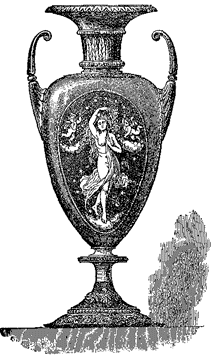
REPLICA OF A GRECIAN VASE.
A home-made Japanese cabinet may be readily made of the common materials found about the house, such as boxes of hard or soft wood. The smoother the boxes, the better; but they can be planed, if they are not.
The shelves are so arranged as to accommodate the different sizes of Japanese bric-à-brac. The small cabinet in the upper left-hand corner is simply a smooth bit of the board, finished with two ornamental hinges, either brass or bronze. The escutcheon is of the same. The circular panel can be either of Lincrusta, bronzed, or to make it a little more unique, a circular hole can be cut in the door, and a pretty blue Japanese plate inserted, held in place at the back, and the door lined. The supports are easily obtained by a visit to a factory where they have a turning lathe. The ornamental finish at the bottom is of lightly carved wood, if one can do these things, or a strip can be purchased at a carpenter shop or wall paper store. Still another way out of the difficulty is to get just the length of Lincrusta and tack it on neatly.
Before the hinges and escutcheon are put on, the staining should be done, and the simplest way out of the difficulty is to purchase Pik-Ron, stain whatever color or wood you require, then afterward give it a coat of varnish, coach varnish giving a durable finish that is heavy and beautiful, or the whole cabinet may be covered with the stamped Japanese cotton goods in gilt and colors, each shelf being covered before being put in place, and the uprights gilded or stained. Still again, if the work is of pine, it may be stained a rich bronze, and left with dead finish, which is a very fair imitation of Japanese woodwork.
Piano Decoration.
An upright piano should be placed with its back to the room. This position is not only good from a decorative standpoint, but a performer likes to be shielded by the instrument. Here are enumerated various graceful ways to cover the polished bareness of this musical instrument.
To hang a square of tapestry over the back from a brass rod is exceedingly striking. If possible, let the painted subject relate to music or sentiment, and have it sufficiently large to cover the surface of the piano.
If the tapestry is very fine work its surface should be unspoiled by additions. Across the top of the piano lay a scarf of Liberty silk, or another painted panel. The only bric-à-brac that combines with this drapery is a pair of candelabra, the quainter in style the better.
Algerian stripes, Bagdad tapestry or Persian prints make good backgrounds. Their cost is $1.25 a yard, and width fifty inches. With this as a foundation many schemes may be carried out. Bas-relief heads in plaster can be swung on it without injuring the wood of the piano. Medallions of Beethoven, Mozart or Wagner can be purchased for $1 each. A long panel of cherubs goes well, or a line of Delft or Japanese plates.
A low settle has a comfortable resting place underneath this. Either a box seat upholstered in dark, contrasting stuff, or one of the $4.50 green wooden settles, sold to artists, would serve. A number of cushions placed on the seat against the piano add to the coziness and grace of the decoration.
Lighting.
Rooms should be lighted from the sides, if possible. The great central chandeliers, casting their downward shadows, age every face in the room by emphasizing every line, and bringing out every defect sharply.
Decorating.
In decorating a room a harmony of the shades of one color should be used. Beware of spotty effects. It should really, according to Edmond Russell, "be conceived, as a piece of music is, in a certain key. There should be sympathy and harmony. Even the pictures should be chosen with as much regard to their surroundings as to their individual merits."
Another important item in the decoration of the home is considering the choice of ground tones with reference to the complexion of its hostess. Guests appear there but casually. She is always there, and no one should elect to occupy a room, whose color tones either totally efface what little color one may possess, or else, by an exaggeration of natural ruddiness, be made a rival of the setting sun.
The effect of color upon the appearance is so important that every change of color, changes not only the color of the skin, but that of the hair and eyes as well.
Edmond Russell once studied a room with reference to complexions, mixing his paints to a relative hue with the general tone of complexions, making it duller and grayer, so that standing near it the skin looked clear and fresh beside it.
"I made the tone," he said, "a little greener and colder than flesh, so that one looked lighter and warmer and was enriched by the contrast. Any who stood in front of that wall looked five or ten years younger than they were."
In using a flower, or other design, for a frieze or dado, they should be conventionalized. This term is used to signify the modification of a real object with its surroundings. The more formal they are the better; no attempt at shading or perspective is necessary, and the square and compass should be used as much as possible in their designing.
In decorating a room, a dark floor is the beginning, and the walls grow lighter as the ceiling is approached. The richest effects should be congregated at the mantel, with the fire as its central object.
"The ability to combine is a rare one." Ruskin writes truly that, "one rarely meets even an educated person who can select a good carpet, a wall paper, and a ceiling, and have them in harmony." There is too much of a temptation to adopt beautiful things simply because they are beautiful, without pausing to consider the weightier matter of their eternal fitness, or remembering that a thing intrinsically beautiful in itself may become hideous by inharmonious proximity or combination with another beautiful object.
Home of the Soul.
A mystic German writer calls a house, properly ordered, the "home of the soul," carrying out the idea that the house in which an orderly soul lives, is only an expansion of the body built and adorned out of her passing experiences. "All sorts of delicate affinities establish themselves between her and the lights and shadows of her abode; the particular picture on the wall; the scent of flowers at a particular window until she seems incorporated into it."
In other words, one's environments, as one's dress, must be in harmony with their individual type, or a permanent discord will result; for instance, Emma Moffett Tyng speaks of a "pond-lily type of woman, soft color, gray blue eyes, pale brown eyes," appealing to her as to the "effect" of the gorgeous, redecorated interior of her home, with flames of color in hangings and rugs, and "her Egyptian gown with its glow and glint of purple and gold. All these things were artistic and beautiful, and perfect in their relations to each other," but in their relation to her nothing could have been worse. The woman, herself, was eclipsed, obliterated. "A Cleopatra, dark and flashing, would make the picture complete. But such a colorless woman needs repose in her surroundings; the low tones of blue and gray, the palest flush of the sunset heavens."
Some Lovely Rooms.
Edmond Russell has treated two rooms exquisitely. A gold and ivory parlor, tinted, walls and ceiling in a grayish white with a greenish tinge, and this is mottled with gold flecked lightly over the surface. The broad frieze is adorned in free, simple style with leaves and blossoms of magnolia. Everything in this room should be light and delicate in color. The soft gold and ivory would be nullified by heavy walnut window casings; red and green carpet, red or blue plush furnishings, or vivid hangings would ruin the effect. Pictures in such a room should be preferably water-colors with pale gray mats, and gold or white frames. Oil paintings are only permissible when dreamy and vaporous in tint. Light, delicate colors in upholstery, creamy madras for curtains. The carpet may be a little darker, verging on some of the delicate, woody browns. Any bric-à-brac should be in pale shades of yellow or rose.
The tender lights of this room seem to clear and soften the complexion of the occupants.
Another is a dining-room of copper, bronze and terra cotta shades. A pale tint of copper to the background overlaid with dashes of bronze and strong copper color. The frieze is a succession of pine boughs, lightly fringed with their needles. Above the sideboard is a panel representing magnolia blossoms, and their heavy polished leaves, with brown in stem and shadows. The effect of this color scheme is to give a suggestion of warmth and cheer. The gold and copper used in flecking the wall are merely the two shades of the common bronze powder.
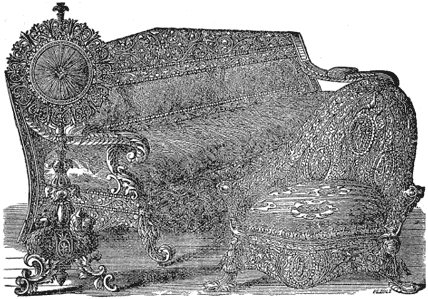
RICH PIECES OF FURNITURE.
Still another nest of a sleeping-room comes to mind, a creation of Moscheles. Floor covered with white bearskin rugs, furnished with a delicate tint of robin's-egg blue. Toilet table strewn with every imaginable luxury in old ivory and silver. Panels in the wardrobe and doors filled with paintings by Burne-Jones, classic figures given the preference.
These rooms are given as examples of harmony of coloring. Great expense is not always necessary to secure this artistic harmony. Money goes a long way, but good taste and ingenuity will go just as far, with a minimum of expenditure.
There is a little room, a symphony in green and gold, created by one girl's taste, a pale seafoam green that is delightful to the eye. The woodwork, banded with a narrow strip of gilt, is of this color, and the enterprising young woman painted it all with her own hands. The curtains at the three windows are of the freshest and purest white muslin, prettily ruffled. They are the kind that always look as if they had just been laundered and they are tied back with pale green ribbons that make them look the more exquisitely neat. The floor is covered with plain matting, which particularly recommended itself, by the way, because it was inexpensive.
As to Furniture.
Every article of furniture in the room is of the prevailing green and there are no off shades, for they were all painted from the same can of paint. The bedstead was nothing but common pine, made to order at the factory, and it is of a quaint design that originated in the same fertile brain that is responsible for all the rest of the perfect appointments. The headboard is in the shape of a shield and there is painted thereon a spray of wild roses to bring to the sleeper over whom they bend sweet dreams of perpetual summer time. And the white counterpane and snowy pillows in the setting of green and gold make it a most inviting place of repose.
The chairs were resurrected from the débris in the family attic. There are two heavy old-fashioned ones of curly maple, and they are cushioned with a brocaded green and gold material that exactly match the green of the furniture. Then there is a comfortable little rocking chair cushioned with the same material and painted in green with many stripes of gold.
But it is the dressing table that is the most charming of all the unique devices that make the room attractive. It was a battered old washstand at first, but now it is a work of art. It is painted, of course, in green and gilt, and there is a spray of wild roses on the front. Above it is a green and gilt framed mirror with a spray of the favorite wild roses again overhanging the top part. Over mirror and washstand and all is draped a canopy of white muslin. Among the other articles that find place on the table is a little fairy lamp with a shade of green tissue paper that gives the softest light imaginable.
A comfortable green window seat in the corner is well supplied with pillows covered in green and gold brocade, and up and around the window there clambers an old English ivy.
There is an oddly fashioned bookcase in another corner. You would never guess it, of course, but it was constructed out of two dry goods boxes. It is painted green inside and out and fitted up with four shelves. A green silk curtain hangs from a brass rod, and about the edge of the bookcase is a gilt cornice. The top is covered with bric-à-brac.
For pictures there is an etching or two on the wall in green and gold frames, and you have a room the very sight of which is cool and refreshing, and which cost its owner some time and some planning, but very little money.
Pictures.
Be careful of the pictures and their relations to the walls. Rooms should rather be a setting for a beautiful moving picture of the shifting groups of people in it.
Too much gilding, too many gaudy oil paintings attract the eye and distract the mind.
There is a simple picture in my room, red curtains, a white-robed child kneeling, that is all, but everything in it harmonizes, and it harmonizes with the furnishings of the room, and my eye is often drawn toward it.
One authority objects to portraits as a decoration. "Their presence, if at all impressive, is too stimulating."
Picture frames should never be so gorgeous as to distract the mind from the picture. "Frames are to protect the picture and relate it to the walls."
Group etchings together and put engravings in the portfolio. Over low bookcases pictures should be large, and in this form they give a style to the room. Water colors look admirable if treated in this manner, and if two bookcases are put together so as to form one, divide the pictures by a bracket, on which place a jar of some unique pattern.
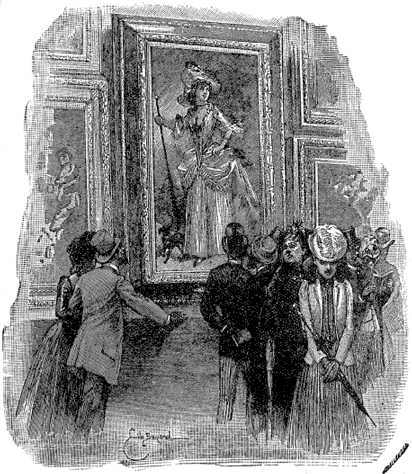
SELECTING PAINTINGS FOR HOME DECORATION.
Small rooms require medium-size pictures, which can be hung one above the other, and three may even be placed on line with good effect. For an ideal head in oil the frame should be of broad gilt. Hang it in a good light, and on one side group two small water-color pieces in the fashionable white band frame. For an oblong picture a small sketch under it looks well equipped.
A very large and beautiful picture sometimes sets the keynote of color for the apartment. Otherwise, subordinate them as decorations to the colorings of the room, as in the ivory and gold room.
In a room where there are to be many pictures, give rather a neutral color to the walls, merely as a picture background. Where there are finely decorated walls pictures are rather out of place, since one decoration spoils the effect of the other.
Mottoes.
The motto, whose revival is noted in the above title, is the expression in architecture of some sentiment suitable to the place to which it is applied. It is more frequently and more noticeably in domestic architecture than elsewhere that the motto is found. Scarcely a country house of sufficient size to boast a hall and fireplace but announces in script or text a welcome to all guests or some appreciation of the comforts of its four walls. The favorite place for this motto is over the fireplace, either above or below the mantel shelf, and of all the old ones, "East or west, home is best," with its variety of expressions, is the favorite. "A man's house is his castle."
"Home is the resort Of love, of joy, of peace."
"A man's best things are nearest him;" "Our house is ever at your service;" "You are very welcome;" "Take the goods the gods provide thee"—any one of these will as appropriately welcome the stranger as the friend.
Over the mantel of one's private room the restful motto, "Duty done is the soul's fireside," may find appropriate place.


begin at the beginning: to insure a good complexion strict attention must be paid to the diet. Wholesome, well-cooked food must be eaten; regular exercise in the open air is another point, and the body must be bathed three hundred and sixty-five times a year. It may be considered almost supererogatory to remark that not any amount of cerates, washes or powders will cover or obliterate blotches, pimples and blackheads caused by unwholesome food or uncleanly habits. We may not be able to afford elegantly-appointed bath-rooms, but we all can indulge in a daily bath.
A quick and simple method for the busy housekeeper, which need only occupy a few moments, is as follows: buy a yard of coarse Turkish toweling, and make of it two mittens. Have a bowl of warm water, in which dissolve some borax. This is soothing to tired nerves, besides rendering the skin soft and white. When ready, slip on one of the mittens, wet it thoroughly, rub well with soap, and quickly wash the body all over. All the impurities of the body are now on this mitten. Lay it to one side. Put on the other mitten, and wash the body again. The mittens may be washed and hung to dry, ready for the next bath. Rub the skin briskly with a rough towel until it glows.
If this treatment is followed daily, with a tub-bath weekly, you will not complain of those tired, nervous headaches, your face will lose its sallowness, and your walk will gain in sprightliness. Here let us say, for the benefit of those who are obliged to live in rented houses, or who have no facilities for a bath-room, that a folding bathtub is now offered. It folds up somewhat after the manner of a folding bed. When closed it looks like a cabinet, and is nicely finished in oak. In connection with it is a tank and heating apparatus. The water may be heated with gas, kerosene or gasoline.
Lemon juice, diluted, is a famous whitener for the skin, as are all vegetable acids, such as tomato, cucumber and watermelon. Oftentimes something is needed to heal as well as whiten. For this, take two tablespoonfuls of oatmeal and cook it with enough water to form a thin gruel, strain, and when cool add to two tablespoonfuls of the gruel one tablespoonful of lemon juice. Wash the face with this at night, allowing it to dry on the skin. This is excellent for a shiny face.
Another very soothing preparation to use at night is made of one ounce of glycerine, half an ounce of rosemary (fluid), and twenty drops of carbolic acid. This is excellent for any irritation of the skin, and also for prickly heat. The face must always be well washed with water and pure soap before applying any of these preparations. If the skin is oily, bathe with diluted camphor (a teaspoonful to a pint of water), but it is injurious to a naturally dry skin.
Treatment for a Rough Skin.
A wash for a rough face is two ounces of water, one ounce of glycerine, one ounce of alcohol, and half an ounce of gum of benzoin, to be dissolved in the alcohol first. Apply at night. For wrinkles—do we see some of you looking interested?—take some clippings of sheep's wool and steep in hot alcohol. It is said that the grease thus obtained is identical with an element found in the human bile. I know that if rubbed on the skin it not only removes but prevents wrinkles, making the skin soft and pliable. These remedies all have the merit of being harmless, which cannot be said of all cosmetics.
Let us give one more recipe, and that is for brightening the eyes. When you are tired and warm, and your eyes are dull, take a cloth and wring it out of very hot water, as hot as you can bear it. Lie down for ten minutes with this cloth spread over your burning face and tired eyes. You will be surprised to see how the tired lines will fade out and how the eyes will shine, and when your "dearest" comes home he will pay you a compliment which will more than reward you.
Reducing Flesh.
The real mode of life and diet should be changed if the fat would be reduced. If necessary, procure a pair of scales and weigh the different foods that are taken into the system. Reduce the diet then to about four ounces of starch or sugar material per day, one and a half ounces of fat, taken chiefly in the form of butter, and about six or seven ounces of albuminous food, such as lean meat or fish. This is the minimum that should be resorted to, and the patient can take more of each at first and reduce the diet gradually to this point. The proportion of the different food compounds, however, with the exception of figs, dates, grapes and nuts, should also be eaten daily, and one-third of a pound of some of the following vegetables: asparagus, turnips, cucumbers, parsley, watercress, celery, kale or cabbage. Fluids have a fattening tendency, and they must be taken in small quantities.
The drinking should be confined to tea, coffee or water, and never should be taken at mealtime, nor within one hour of a meal. This is peremptory, for food will produce fat much quicker and surer when watered by some good beverage.
Refreshing Sleep.
What is the correct method to pursue in preparing for a trip into dreamland, for there is a right as well as a wrong way? The business of disrobing should be so systematized that attending to all the little niceties included in the process will become, after a while, second nature. There is something more to be done, let us assure you, in addition to putting your hair up in curl-papers and dabbing a bit of cold cream on your face, if you would wake up in the morning looking as fresh as a rose. In the first place, do not put off these important preparations until you are so heavy-lidded that you are ready to give everything belonging to the toilet the go by. And now for the first step. Early in the evening your sleeping apartments should be thoroughly aired by dropping the window from the top and raising it at the bottom.
The current of fresh air is especially important when the room has been, as so many sleeping apartments are, in constant use all day. Ten minutes will be quite sufficient for toning up the atmosphere. Now close the window and allow the room to become thoroughly warmed, that you may not experience a chill while taking a rub down. Prepare a big bowl of tepid water, into which you sprinkle a small quantity of ammonia or borax. Take a Turkish towel, which is much better than a sponge, wring it out as dry as possible, and, grasping a corner in each hand, give the spine a vigorous rubbing. Have at hand another Turkish towel, and as you bathe the body in sections, dry as quickly as possible.
From the points of your rosy toes to the curve of your soft throat you are a blushing model of the charming effects of the bath. When finished, slip over your head a soft little shirt, high neck and short sleeves (a white silk or lisle thread is the best), the rosy skin beneath giving it the appearance of being lined with pink silk. Then comes the nightrobe, and next the pajama or lounging robe, which may be of anything, from flannel to eider down.
Tuck your feet into a pair of bedroom slippers, and you are ready to attend to minor details. Never think of retiring in any article of clothing which you have worn during the day. Such a barbarous custom has nothing whatever in common with health and refinement. Neither is it well to discard everything but your nightgown, for it is exceedingly dangerous to chill the system by night draughts.
How to Take Care of the Eyes.
Avoid sudden changes from darkness to brilliant light.
Avoid the use of stimulants and drugs which affect the nervous system.
Avoid reading when lying down or when mentally and physically exhausted.
When the eyes feel tired rest them by looking at objects at a long distance.
Pay special attention to the hygiene of the body, for that which tends to promote the general health acts beneficially upon the eye.
Do not depend on your own judgment in selecting spectacles.
Old persons should avoid reading much by artificial light, be guarded as to diet and avoid sitting up late at night.
After fifty, bathe the eyes morning and evening with water so hot that you wonder how you stand it; follow this with cold water that will make them glow with warmth.
Do not give up in despair when you are informed that a cataract is developing; remember that in these days of advanced surgery it can be removed with little or no danger to vision.
Never read in bed or when lying upon the sofa. Sit with your back to the light as much as possible. Attend to your digestion. Do not work longer than two hours without closing your eyes and resting them for five minutes. If your eyes are weak, bathe them in water to which a little salt and a little brandy have been added.
The Hair and How to Take Care of It.
If the hair has that soft, glossy look that tells of regular care, and if it is well kept, with every pin in its place, you may rely upon it that its owner possesses the instinct of ladyhood.
Each hair has tiny prongs or tentacles, something like those on the cockle bur, which catch the dust; hence the especial need of brushing. At a lady's school in England, some twenty years ago, the girls were required to brush their hair for fifteen minutes daily in the long dressing-room, and they were timed at this exactly as if it were any other exercise.
Occasionally the hair and the scalp need washing, as the face, though less often if the brushing be carefully attended to. When, however, it begins to seem dirty, give it a good shampooing. Wash both hair and scalp thoroughly in a washbowl of warm water in which has been dissolved a tablespoonful of powdered borax; then rinse it well in clear warm water; you will be surprised sometimes at the complexion of the water.
Many women dread the shampooing because of their liability to take cold in the process. Let such a person choose a room where the air is warm and dry. After wiping the hair thoroughly dry with towels, and pinning a fresh one around the neck and shoulders, let her get some one to come and make a breeze with a large palm-leaf fan upon her hair while she is engaged in carefully disentangling it with a brush and comb, occasionally giving the scalp a little vigorous rubbing if it begins to feel chilly. The fanning greatly hastens the drying process. Another plan is to lie down with the hair spread out on cushions in the sunshine. Be sure to get it thoroughly dry before putting it up.
An Excellent Head Covering.
A very pleasant step, though not a necessary one, next to take is to have a little thin silk mob-cap (of some pretty shade of silk, so that it is becoming rather than disfiguring, if needful, to wear about the home), lined, and thickly wadded with cotton-batting, well powdered with heliotrope or some other delicate sachet powder (these come in ten or fifteen-cent packages), and wear this from one to three hours. Here, again, those thousands of minute tentacles come into play; they catch and retain (one would almost think they close over them) the atoms of the perfume when they are thus freed from dust, and when the hair is soft and light in its new cleanness—and it is astonishing for how long a time the hair will retain that faint, delicate aroma which is so truly lovely in a woman's hair; and all to be obtained in so simple and innocent a way as with this little mob-cap, put on at the right time.
A good rule for ensuring the regular brushing of the hair, which may be taught to children (and perhaps good for busy women also), is to brush the hair with fifty long strokes both at morning and at night.
Much also depends upon the brush. Let it not be stiff enough to hurt the scalp. Choose a brush of medium stiffness, with bristles long and close together, and nowhere will it pay better, "in the long run," to give a good price for a good article than in a woman's hairbrush which she proposes to use as described above.
Do not use a fine-tooth comb. Frequent washing will remove the dandruff in all cases, and without the injury caused to the scalp by the fine comb.
It is also well to clip the ends of the hair regularly once a month, keeping it smooth and even, besides, as is thought by some stimulating the growth and keeping it in a more healthy condition.
Perseverance in this treatment will give the hair a fine natural gloss, and a healthy tone. It will tend to prevent its falling out, and will also help to preserve its natural color much longer than if it were neglected.
"Show me a woman," said a wise matron the other day, "though she be in the busiest farmer's kitchen in America, who may always be found with her hair neatly and carefully arranged and with a fresh linen collar, and I will show you a lady in mind and manners. Those two points always settle the rest in my opinion!"
Recipe for the Complexion.
A mixture for preserving the complexion, easily made at home, is as follows: take a wineglassful of the best French orange flower water. Add a tiny pinch of carbonate of soda and two teaspoonfuls of glycerine. Melt a piece of camphor the size of a pea and three teaspoonfuls of cologne water and add to the orange flower water. Shake the whole for five minutes. Apply to the face every night.
Care of the Lips.
The Cupid's bow in dainty curves has always been symbolical of a perfect mouth, and lips most kissable have never been represented as other than pink and perfect.
No other portion of the face, however, so quickly responds to symptoms of ill-health in the body as do the lips. Fever blisters are the disfiguring reminders of a cold; dry, broken or bloodless lips show that one is out of sorts, even more certainly than heavy eye or dejected mien, and it is a woman's duty to endeavor to restore them to their soft, rich redness, which is the outward and visible sign of good health.
To do this the general system must be toned up, diet regulated, and a regular house-cleaning gone into; but there are certain defects of the lips that can be overcome without all this trouble, because they arise from a woman's own fault. Many of us, from nervousness, or habit, have a way of biting our lips which will surely result in swelling, bruise or dryness that is both uncomfortable and unpleasant to look at.
Therefore, the first step is to break off so pernicious a practice by watching one's self very carefully. Next, anoint the poor, bruised members with some healing salve of a pure make.
Do not, however, think to cure chapped lips by anointing them after being out in the air. The time for treatment is before the mischief is done, putting on a little cold cream every time you start out for a walk, which you will find highly beneficial and will keep your lips in winter just as sweet and rosy as when the milder zephyrs of summer rule the air.
Remedies for the Lips.
A writer whose knowledge of such subjects is beyond question says that glycerine and rose water should never be used to soften the lips, as this remedy has one great drawback, namely, that it induces the growth of superfluous hair, a warning which all women will gladly heed, for no one desires to pose as a bearded lady. When cold sores appear rub them with cold cream, being careful not to break them, and they will soon disappear.
The reason that they usually cling so long is, that they are tampered with by rubbing or biting, and therefore cannot have a chance to heal properly, as they would if left alone. The same writer who warns us against glycerine and rose water is a strong advocate of hot water, and affirms that there is scarcely any ailment that will not succumb to its healing virtues. Therefore, with cold cream and hot water one should be able to present to the world a pair of rosy lips free from any unsightly blemishes.
Smoothing Out the Wrinkles.
Wrinkles are, of course, the special detestation of every woman, and when they begin to make their appearance, one of the most perplexing questions is as to how they can be removed, or at least the evil hour of their coming be put off for a time. There has recently been a good deal of nonsense printed in various channels as to this subject, and one of the most cherished fads is that the steaming of the face will remove them. This is one of those half-truths which are simply deceit and disappointment.
Wrinkles appear because the fine muscles of the face lose their tone, the tissue shrinks, and the skin fits itself to the depressions which are thus left. It is a mistake to suppose that wrinkles can be wholly eradicated, especially those which are due to advancing years. Let us "grow old gracefully" and accept the inevitable with the best grace possible. A cheerful disposition will do wonders toward lighting up the face and making one's friends forget or overlook entirely the signs of advancing years. But wrinkles frequently come on prematurely, and prove extremely vexatious. It is unquestionably true that a proper, thorough and careful course of face massage will do a good deal to help things, where the skin has become dull and lifeless, as will especially happen in cases of general decline or ill health.
From two to four times during each twenty-four hours the face should be gently but systematically rubbed, the best method being to employ a fine towel or a bit of red flannel. The finger ends answer very well, but it is quite difficult to use them without weariness. It will be noticed after a few days that the skin is gaining in tone and vigor, when the degree of vigor employed may properly be increased.
Bad air is one of the most potent causes of wrinkles and the remedy, of course, is the getting of good air. Excellence of the highest degree may not be attainable; if not, let us get the best we can. With good air should come good living and plenty of nutritious food, especially that which has fat-producing qualities.
Massage of the face is well recommended, using a light, gentle, circular motion of the fingers, while much may be done by cultivating flexibility and voluntary motions of the muscles of the face, especially those affecting the wrinkled portions. And it may not be amiss, though it be a delicate matter, to suggest that an overworked, thankless, hopeless life will inevitably wrinkle the fairest face with furrows that no agency this side of the grave can remove, till the cause shall have been lifted.
The Feminine Waist.
We have already had occasion to discuss the question of small waists and the abuse of proportions that tight-lacing frequently entails. We have only to consider now the caprices of fashion with regard to length. Sometimes this fickle goddess sends our waists up under our arms, and then a reaction sets in, and they lengthen gradually till the points and basques of our bodices reach very nearly to our knees. Of the two extremes, the more sanitary, as well as the more artistic, is the former, but these considerations have little effect on the arrangements of fashion.
The weight of clothing should hang as little as possible from the waist. Many women believe that it is better that it should come from the hips than from the shoulders, but the testimony of all medical men is clear and indisputable on this subject. Nor is it upon hygienic grounds alone that this is objectionable. This weight from the hips destroys all freedom of movement, just as the tight corset deprives the body of all the suppleness and flexibility given it by nature.
The belt is, on a perfect figure, an interruption to harmonious lines that could well be dispensed with. On an imperfect figure it is excusable, when associated with a form of bodice that seems to require to be confined, such as the loosely plaited or gathered bodice sometimes worn. Over a tight bodice the belt has no reason for being, and is absurdly out of place. For this and also sanitary reasons we feel inclined to condemn it.
Beautiful Arms.
Beautiful arms are a powerful weapon in the armory of beauty; but though most women appreciate to the full the charm of this possession, the fact remains that in America undeveloped arms are the rule, and rounded, dimpled symmetry the exception. Lately, however, the gymnasium is producing charming arms.
Exercise is essential to the development of the arms: exercise, that is, of the arms themselves. Gymnastic exercises that bring the muscles of these into play should be, as far as possible, encouraged in girls, as tending not only to their improvement in this particular, but as being beneficial to the general health.
Arms disproportionately large as compared to the rest of the frame are, on the other hand, at least equally disagreeable with those we have been discussing. Very large arms carry with them a suggestion of coarseness that is unpleasant as associated with a woman. It is, as we have said before, impossible to give the exact proportions which one portion of the human frame should bear to the rest. The ideal arm, however, should gradually decrease in size from the shoulder to the wrist, the outlines being marked by those inward curves which are also noticeable in well-formed shoulders. The wrist should be slender without being thin, the bone at the outer side being well covered and indicated rather by dimples than otherwise.
There is an old rule for measurement that approaches accuracy in some degree. We give it for what it may be worth, advising our readers not to pin their faith to it too implicitly. Twice round the thumb, once round the wrist; twice round the wrist, once round the neck; twice round the neck, once round the waist.
The roundest arms in the world fail to be beautiful if they are red. There are beautiful white arms, brown arms, copper-colored arms, and even black arms, but beautiful red arms are not. This fault is seldom to be found with the arms of ladies, which are so constantly kept covered as to be protected from the influences of weather. It is characteristic of a cook, a dairymaid, a housemaid, a field-hand, to have red arms, and it is probably from this association that they have fallen into such extreme disrepute.
The use of violet-powder may be condoned when it modifies the contrast between red arms and white evening dresses. The application being only temporary, it can only very slightly affect the well-being of the pores, but it should be very carefully used, or it will come off on the coat sleeves of the partners of the red-armed one.
When the arms are very thin the sleeves should not be too tight, though, as a rule, thin arms do not look at all badly in tight sleeves. When the arms are too long, their apparent length may be diminished by crossway trimmings on the sleeve. When, on the contrary, the arms are disproportionately short, a lengthwise trimming will remedy the defect. The sleeve of to-day is a blessing in disguise for ladies with thin arms.
The leg-of-mutton (gigot) sleeve was invented to conceal defects in the arm, and to make the waist appear small by contrast with the size of the sleeves. Puffs at the shoulder give grace and delicacy to the neck and head. The pagoda sleeves, copied from the Chinese, being wide and open, cause the hands to appear smaller by contrast with the aperture from which they emerge; but when the sleeve is exaggeratedly large and wide, the effect of the contrast is lost, the sleeve losing itself in, and mingling with, the rest of the draperies. The epaulette worn some years ago is useful as giving width to narrow shoulders. The Louis XV., or sabot sleeve, tight to the elbow, and ending in a frill of lace, is perhaps the most becoming of all sleeves to a really pretty arm, while the sleeve open to the shoulder is the most trying to a defective outline.
Treatment for the Hands.
The hands of growing girls are often red and clumsy, and girls who are beginning to take thought of their appearance are sometimes in despair about them, not being aware that they will grow whiter and whiter with every year. The ideal hand is white, certainly, but not dead white. It should have a dash of healthy flesh-tints. The tips of the fingers and the portions that surround the palm should be tinged with pink. The fingers should taper towards the nails, the most approved shape for which is the "filbert," so called from its resemblance to the oval form of the nut of that name, and the similarity of the direction of the lines of the nail to those on the wood of the nut.
Scissors and Nail-brush.
The appearance of white spots on the nails is caused by knocks or blows. To obviate the appearance of such spots the hands must be taken care of and the nails disturbed as little as possible. When the nails become stained or discolored, a little lemon juice is the best agent to employ as a corrective. It is equally valuable in discoloration of the skin.
The care of the nails, should be strictly limited to the use of the knife or scissors to their free border, and of the ivory presser to their base, to prevent the adhesion of the free margin of the scarf-skin to the surface of the nail and its forward growth upon it. The edge of scarf-skin should never be pared, nor surface of the nail ever scraped, nor should the nails be cleaned with any instrument whatever except the nail-brush.
There is no rule for the management of the nail of greater importance than that which prescribes the pressing back of the edge of the scarf-skin which forms the boundary of the base of the nail. This margin is naturally adherent to the surface of the nail, and has a tendency to grow forward with it and become ragged and attenuated. When allowed to do so, the ragged edge is apt to split up into shreds, and these projecting from the surface, are pulled and torn, and often occasion a laceration of the skin and a painful wound. The occurrence of these little shreds, denominated agnails, may be effectually prevented by the regular use of the presser once or twice a week. It must be used with gentleness.
The following is said to be an excellent preparation for making the hands white; and as it cannot possibly injure them, we give it a place here. Take as much scraped horseradish as will fill a tablespoon; pour on it half-a-pint of hot milk. Use it before washing, allowing it to dry on the hands before applying the water. Redness and chapping are sometimes caused by the hands being imperfectly dried. The greatest care should be taken in drying them, more especially in cold weather, and when the hands are exposed to cold winds.
If the hands become rough from any cause, the following may be applied with good effect: Half fill a basin with fine sand and soap-suds, as hot as can be borne. Brush and rub the hands thoroughly with hot sand. The best is flint sand, or the powered quartz sold for filters. It may be used repeatedly by pouring the water away and adding fresh. Rinse the hands in a warm lather of fine soap, then clean cold water. While they are still wet, put into the palm of each hand a very small piece of almond cream and rub it all over them. This, again, forms a strong lather. After drying the hands, rub them in dry bran or powdered starch till every atom of moisture is absorbed, and finish by dusting off the bran or starch. This will make the hands very soft and smooth.
To Cure Burning of the Skin.
Occasionally the hands and face become red and flushed while the feet are cold. This very uncomfortable state of things may be effectually remedied by bathing the feet in hot water with a tablespoonful of Kretol in it. This will frequently be found an immediate cure for headache, but must not be attempted just before going out in cold or damp weather. A simple remedy is to wash the face and hands in very warm water, as hot as can be borne. This will frequently dispel the burning sensation and induce a cooler condition of the skin.
A slice of raw potato rubbed well into them will remove stains from the fingers and hands. Lemon juice is also effective in this way, and, if not used immoderately, may be applied without fear of evil consequences. For chapped hands and lips the following will be found efficacious: Equal quantities of white wax (wax candle) and sweet oil; dissolve in these a small piece of camphor; put it in a jam crock, and place it upon the hob till melted. It must be kept closely covered. It should be applied to the hands after washing, and previous to drying them.
A few drops of glycerine poured into the palms of the hands after washing, and rubbed all over them before drying with a towel, is perhaps the best and simplest remedy for chapping; but if good soap is always used, and the hands well dried and protected by warm gloves against the cold, the chapping will be prevented, which is preferable to the very best cures.
Remedy for Chilblains.
Chilblains may be cured very speedily by rubbing into them morning and evening as much spirits of turpentine as they will absorb. This must not be applied to broken chilblains, but if taken in time it will prevent their breaking. The water in which potatoes have been boiled is an excellent remedy for chilblains on feet or hands. These members should be put into the water while it is as hot as can be borne. The same specific applies equally to what are called "whitlows," or "felons" a gathering in the region of the finger-nail that is extremely painful, and to which some are constitutionally liable.
When the feet are large, the owners should never be tempted into wearing any but the very plainest boots and shoes. Ornamentation of any kind makes the foot look larger. Even a pretty foot looks its best in a perfectly plain satin slipper, with only a small rosette with buckle on the toe. This rosette must not, however, be permitted to the large foot. It may, certainly, be worn on the place intended for the instep, when that ornamental rise in the outline of the foot is totally absent. Lines of white stitching on the boot make it look larger than it really is. The best boot for a large foot is one in which the toe-cap comes well up on the foot. Its lines are thus broken up, and the apparent length diminished. A pretty foot, on the contrary, looks better in a boot that has no toe-cap, the "upper" of which is made all in one. This displays to advantage the beautiful outline of the foot, and the gentle but decided curve of the instep.
The possessors of large feet should be particularly careful to have their boots perfectly cleaned and very glossy. The feet look much smaller when this is the case than when the boot has a rim of mud around the sole and a shadow of dust upon the uppers. Where the instep is defective or totally absent, a pretence at one may be made by blacking that portion of the sole of the foot that is immediately adjacent to the heel. This causes a kind of optical illusion which is favorable to the flat-footed.
Patent leather is a most objectionable material for wearing upon the feet. Through it ventilation is absolutely impossible. So much for the sanitary part of the subject; and as to convenience, this is as much in the shade as sanitation, for patent leather "draws" the feet much more than any other kind. Of late, ladies and children have begun to borrow this material from gentlemen, but as much smaller shoes can be worn with comfort in any other kind of leather, it is not likely to become universally popular. Large feet should never be clad in satin.
Foot-Wear.
The fit of the stocking is almost as essential to the perfection of the foot as that of the boot or the shoe itself. It should be large enough to allow freedom to the toes, and not so large as to wrinkle on the foot. In a well-fitting stocking the foot can be more accurately measured than otherwise, and the comfort of the foot is sadly impeded by an ill-fitting one.
The feet should be bathed every morning, and for those who walk much, a daily change of stockings is advisable. This daily change is more than advisable, it is necessary, for persons who suffer from perspiring feet. Regular washing of the feet preserves their strength and elasticity, and helps to keep them in shape. At least once a week they should be washed in hot water, with plenty of soap, rubbing them with a ball of sandstone, which will be found a very useful article for toilet purposes, also a tablespoonful of Kretol in the water. The nails should then be carefully pared, and, in drying the feet, much friction should be used in order to stimulate the skin to healthy action.
When corns appear, they may be accepted with resignation as lifelong acquaintances. Seldom, indeed, do they quit the victim, who has invited them by ill-advised pinchings and squeezings. All that one can do is to keep them under control by constant care. The treatment recommended is the same as that used for warts—viz., to pare the hard and dry skin from the tops, and then touch them with the smallest drop of acetic acid, taking care that the acid does not run off the wart upon the neighboring skin, which would occasion inflammation and much pain. This should be done once or twice a day with regularity.
We should, no doubt, easily get rid of all our corns if we could make up our minds to do without shoes, or even to wear them of such a large size as would prevent all pressure upon the corn. This disagreeable effect results quite as often from badly made boots as from injudiciously tight ones.
There is a particular knack to be observed in paring a corn. It should be cut in such a manner as to excavate the center, while the hardened sides are left to protect the more sensitive portion against the pressure of the boot. When the corn is small and yet young, the best application is a piece of soft buff-leather spread with adhesive plaster and pierced in the center with a hole of exactly the size of the summit of the corn. There are two varieties of corn, the hard and the soft. The latter occurs between the toes, and is quite as painful as, and less easily guarded against, than the hard variety.