Visiting Cards. (continued 8)
Reading edition
For a young girl, a simple dress of wool goods in white, or pale becoming tints, is all that is necessary. Open it slightly at the throat, soften it with a little lace, show the pretty arms in a demi-sleeve, and it is far more suited to her youth than an over-elaborate gown.
If the dinner is held by daylight and the men wear morning dress the ladies must confine themselves to high-cut gowns turned in slightly at the front and fastened with a simple pin of gold enamel, with, perhaps, a single gem at its heart.
Traveling Notes.
A dress for traveling should be plain and serviceable; a tint should be chosen that does not show soil or dust. A duster, an ulster or over-garment of some kind made of pongee silk, linen or whatever material is in vogue, should be worn to protect the costume from smoke and dust.
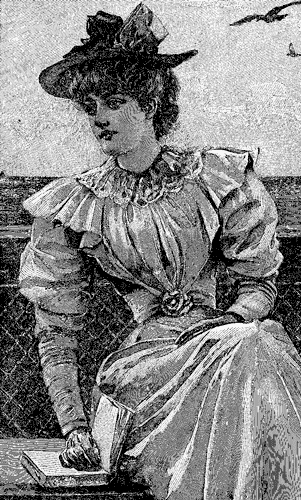
TRAVELING COSTUME.
The hat should be plain and a veil worn to shield the eyes from cinders when traveling by railway. A pair of slightly smoked spectacles are very good for this purpose. Carry an extra wrap and a hand-satchel to hold the needed toilet articles. Let everything else go in the trunk. A woman burdened with "big bundle, little bundle, bandbox and umbrella," is a burden to herself and a terror to others. Let the satchel contain a flask of some invigorating toilet water—Florida, lavender or whatever is most refreshing, with a soft sponge to bathe the face, hands and wrists, and thereby many a headache can be warded off. If traveling in a sleeping coach, a larger valise should be carried and ought to contain a pretty loose gown of dark silk or wool to serve as a slumber robe, since clad in this one may safely venture from berth to dressing-room without exciting observation.
The rule for traveling dress is that there should be nothing about a lady to attract attention, but this is relaxed in case of ladies traveling a short distance for a brief visit, who are privileged to wear the dress that suits their purpose.
Bridal Dress.
The conventional bridal dress is pure white, whether the material be satin, silk or muslin. It may be made trained or walking length. If a veil is worn the gown is cut en train. White satin slippers must be worn and white gloves. Rip the fourth finger of the left-hand glove ready for the ring; the maid of honor will turn this back at the proper moment. Natural flowers are carried and a wreath is worn with a veil. The veil should sweep to the edge of the train and may be simply a cloud of sheerest tulle or filmy lace worth a king's ransom. It may be worn over the face or not, as fancy dictates. Sometimes a white leather or pearl bound prayer-book is carried instead of the bouquet. This custom has the advantage of having the prayer-book as a memento of the occasion, while the flowers wither. A young girl, known to the writer, carried with her to the altar the same prayer-book that her mother before her had carried on her wedding day.
The wedding dress, no matter what its material, must be cut high in the neck and with long sleeves. This in deference to the fact that a marriage is not simply a gala occasion, but the turning point for weal or woe in the bride's life, and a solemn sacrament of the church, and not to be celebrated in the garb of frivolity.
Where flowers are worn, orange blossoms are particularly appropriate, though no German maiden would think of donning the bridal veil without its attendant myrtle wreath. Any white flowers, however, are appropriate.
Where jewels are worn the choice is absolutely confined to pearls and diamonds (not in too great profusion). Instead of flowers, the veil is sometimes fastened with a star or sunburst of diamonds.
Widows, no matter how youthful, are not privileged to wear the white bridal robe, the veil, nor the orange blossoms. However, the most exquisitely delicate tints may be chosen for their adornment.
If the marriage is private and the bride leaves immediately on her wedding trip she can be married in her traveling suit. At other private weddings, where no trip is taken, the bride usually wears a pretty reception or visiting costume of silk or wool, choosing some color that will be appropriate for after-wear.
The bride's mother, whether the wedding be at home or in church, wears an elegant reception gown. Even if she be in deep mourning she lays aside its sombre shades for this one hour. Invited guests should also avoid mourning garb.
Bridemaid’s Dress.
The bridemaids' dresses are often all of white, but frequently colors are chosen, sometimes all alike; again, two by two of different hues. The material of these gowns must be much less expensive than that of the bride's. Their bouquets or baskets of flowers may be either white or colored. They sometimes wear lovely picture hats with broad brims and drooping plumes.
What Wedding Guests Wear.
If the wedding reception is held in the evening, full evening dress is worn; reception gowns being suitable for the elder ladies. (See "Ball Dress.") Where children are present, the girls are dressed in sheer muslin or lace over silk slips, and adorned with fluttering ribbons. The boys in fanciful costumes, such as pages' suits, etc. If it is a morning reception, rich visiting or promenade costumes should be worn, small dress bonnets and white gloves.
Ordinary Evening Dress.
This applies to small parties at home or with friends, to receiving calls at home or in making an evening call. It should be appropriate to the season. Pretty wool goods, exquisitely made, in winter; organdies, grenadines and mulls for summer; laces, a modest bit of jewelry or a simple flower, and one is sufficiently well-gowned.
If the gathering is a little more formal, reception dresses may be worn by the matrons, while the young ladies garb themselves as for receiving at an afternoon tea.
If gloves are worn at all on such an occasion they must be light colored. They are really unnecessary, unless the taste of that especial "set" is very strongly in their favor. If in doubt, it is well to go furnished with a pair for use in case one finds all the guests gloved, and has not the moral courage to remain the exception.
Dress for Church.
Well-bred people attend church in simple costumes, free from display. These may be of rich materials, but they are quiet in color and make. Jewelry, other than a simple pin, should not be used; earrings, of course, if one is in the habit of wearing them, but not diamonds. The church is not the place to flaunt elegant attire in the face of less fortunate worshipers in the "I-am-richer-than-thou" style that marks the parvenu.
Receiving Calls.
A lady with regular days for receiving calls wears a reception dress as before described. Casual callers she receives in her morning or afternoon house dress. Her morning dress, if she superintends her household affairs, should be plain and neat, and be so protected by cap and apron that by doffing these, she will be presentable in a moment.
Where there are no household cares, a daintier morning dress may be adopted, but let it be suitable to the occasion, not some old, half-worn finery revamped for the occasion. If visiting, a still richer gown may be worn, and for a late breakfast at a watering place one may be quite luxurious.
Calling or Visiting Costume.
For morning calls dress quietly in promenade costume. Wear light-colored gloves unless in deep mourning. If driving, carriage dress may be worn. For day receptions the dress may be more elaborate and the bonnet more "dressy."
By not carefully distinguishing between the gowns for different occasions and over-dressing at all times, women lose all the advantages of contrast in style. If lace and silk are worn indiscriminately, what is there left for the full dress function?
Walking Dress.
This should be plain—tailor-made is the best—walking length, and of good material. "Fussy" styles should not be chosen for street wear, and the hat or bonnet should be rather plain and harmonize with the gown.
Carriage Dress.
There is much more latitude for display permitted by the carriage dress. Rich materials, elegant wraps, costly furs, are all allowable here.
Coaching parties, too, have grown to be occasions for most gorgeous costuming. Every hue of the rainbow is to be seen as the lofty tally-ho rolls past, until, so great has become the license of color and richness of material, that the "four hundred" are calling a halt, and soberer tints are beginning to mark this amusement.
Do not wear too many fluttering ribbons, especially if occupying that coveted position—the box seat. It does not add to the skill and accuracy of the driver at a critical moment to have a fluttering ribbon cut like a whip-lash across his eyes.
Dress for Lent.
This should be the sort of gown most appropriate and becoming to the attitude of repentance. The gowns, of course, are simple, quiet affairs. Symphonies in gray, poems in black and white, must, says one writer, "reflect in their construction as well as color the soberness of the event which they will grace. A train is always admissible for the Lenten robe—that is, if it is for house wear. Otherwise the skirt must be short—quite short enough, indeed, to give one's churchwomen a glimpse of a dainty gray or black walking boot."
Any of the heliotrope, mauve or pansy shades, also, are appropriate expressions of the sorrow of the fashionable woman, thus giving a color scheme capable of the most exquisite effects. White cashmere is well suited for the house; and very little draperies, but long, straight lines, give the sought-after effect, and thus the dainty chrysalis rests during the forty days that precede the unfolding of the gorgeous wings of the Easter butterfly.
Dress for Riding.
The riding-habit should be made of broadcloth or some other suitable cloth. The skirt should be weighted by sewing shot in the lower edge of the left-hand breadths. Equestrian tights should be worn. The habit is sometimes worn over another dress-skirt, when, in case of dismounting or accident, the habit-skirt can be slipped off and the rider still left properly attired.
Very long skirts are not worn. The habit should fit perfectly and button to the throat. Linen collar, a pretty tie and linen cuffs are worn, and a leather glove with gauntlet. The hat should be plain, and of the prevailing fashion.
Lawn Parties.
The dress for these occasions has been already described; sufficient here to say it should be light and graceful, and the bonnet or hat ornamental and effective.
Picnics and Excursions.
Light-weight wool goods, or heavy cotton or linen material that will wash and not tear easily, is most suitable for these occasions. Linen or cotton duck is very serviceable.
Croquet, Archery, Skating, Etc.
All of these semi-athletic games call for bright, pretty costumes, short enough to give the freedom of movement necessary to excel in the game. For summer out-of-door games, pliable gloves should be worn, and a hat to protect the eyes from the sun. For skating, rich, warm materials, fur trimmings, fur caps, and warm, furred gauntlets should be worn.
Bathing Dress.
Bathing calls for a costume of some material that will not cling to the form when wet. Flannel is appropriate, and a heavy quantity of mohair also makes a successful dress, as it resists water and has no clinging qualities. An oil-silk cap should be worn over the hair. The cut of the dress should be modest; the costume loose and full, and it should be made with a skirt. The neck should be cut quite high.
Yachting Dress.
This is a pretty, nautically devised and ornamented suit, made of warm materials and those that will stand sea water.
Dress for Gentlemen.
The subject of dress, while not so complex for a man as for a woman, must still receive a certain amount of care at his hands, for no gentleman can possess complete disregard of reigning styles without thereby sacrificing a certain amount of dignity in the estimation of his associates.
As far as the cardinal points of the toilet extend, a man is bound by the same laws of exquisite neatness that are incumbent upon a woman. The same care of teeth, finger-nails, hands and hair is necessary. Don't neglect the small hairs that sometimes project from the nostrils and the apertures of the ears. Use a small pair of scissors.
A gentleman will have spotless collars, cuffs and handkerchiefs, irreproachable gloves, nicely blackened shoes and thoroughly brushed clothes. Hair oil must never be used; it is ill-bred.
Clothes of plain colors are always in good taste, and so is pure white linen. The fancy dotted and striped collars, cuffs and bosoms, so often worn, are not as good taste.
Jewelry should be used very sparingly. Utility should be apparent in the articles worn. Watch chain, sleeve buttons and studs (one or three, as liked) are necessary. Where one stud is used, the stone, though not conspicuous for size, should be a very fine one. A scarf pin is sometimes worn, and one ring is allowable, but not too large or showy. Don't use quantities of perfumery, it is very bad taste.
Keep a dressing-gown for use in the dressing-room or the sick-room. It is not a proper garment for the table or the sitting-room.
Wear the hat properly and squarely upon the head. Wear a coat at all proper times—in the sitting-room, drawing-room, and at table.
Lastly, a gentleman avoids all conspicuous styles of dress, and confines himself to quiet colors and well-fitting, well-cared-for garments.
Evening Dress for Gentlemen.
The evening dress for gentlemen varies very little from year to year, and the time of wearing it varies not at all. From "dusk to dawn," in other words, a gentleman wears a dress suit during the same hours that a lady wears an evening dress.
Gentlemen's evening dress consists of black trousers, a low-cut black or white vest, dress or "swallow-tail" coat, and white necktie. The linen must be immaculate. A young man wears a standing collar; an elderly man, if he choose, may wear his favorite style, with due deference to the reigning style. One or three studs adorn the bosom.
Properly speaking, white or very light kid gloves are a part of evening dress, but to say whether or not they shall be worn always at a formal dinner is hardly safe. If worn, remove them at the table; but at a ball they are indispensable. On all doubtful occasions it is well to be provided with a pair, to use if wished.
Evening dress is to be worn at balls, large dinners, parties and the opera. It is never worn at church, save in case of an evening wedding. It is never worn anywhere on Sunday. In a small town a dress suit on any occasion is apt to seem an affectation. Never wear a dress suit anywhere before six o'clock in the evening.
"A gentleman never looks more thoroughly a gentleman than in an evening dress," says one writer on etiquette, and it is well for those to whom the occasion is liable to come to learn to wear one gracefully and easily.
In France a dress suit is worn upon nearly all festive occasions. In England the same customs prevail for its use as in our own country.
Morning Dress for Gentlemen.
Black cutaway, or Prince Albert coat (frock coat), black vest, white in summer, light-colored trousers, silk or some other style of stiff hat, and a black necktie. A light coat is never worn with black trousers. This morning dress is worn at church, morning receptions, informal parties, garden parties, when making calls, and at places of amusement.
Wedding Dress for Gentlemen.
At morning weddings, that is, all weddings before six o'clock, the gentlemen, bridegroom, best man, and all, wear morning dress with light-colored ties. If gloves are worn, light-colored ones must be selected. If there is a formal reception held in the evening, evening dress and white or very pale gloves may then be worn. At an evening wedding, evening dress is expected.
Gloves for Gentlemen.
Gentlemen wear gloves when walking, riding, or driving, at church and all places of amusement, when making calls, and at receptions, balls and evening parties. White or very pale tints for balls and weddings; delicate tints for evening parties; any shade preferred for the other occasions.
General Hints.
A silk hat should only be worn on appropriate occasions. Worn with a rough business suit, or on a picnic or mountain ramble, it is in the worst possible taste. It should appear only with frock coats, dress coats and a fine quality of cloth.
Felt or straw hats should be worn with short coats or business suits.
The mourning weed, conventionally speaking, is worn only on a silk hat; but there is no good reason why those who wish to wear mourning for lost friends should always be in dress of ceremony so to do.
Diamonds should not be worn during business hours by men who are obliged to stand behind counters or engage in any toil.
Business suits should never be worn to an evening party in the city, though in small country gatherings they might be permissible.
Even various styles of outing suits are allowable in some of the informal gatherings at summer resorts.
"Nice customs courtesy to great kings," or to occasions.
Evening Suit for Boys.
This is black cloth with the rough surface that is seen in the material used for grown-up, evening clothes. His trousers are the proper width and show a slight but not too pronounced crease. His waistcoat is cut low, and over it he wears an Eton jacket of black cloth that is accentuated by the deep white linen collar which turns over it, and which is attached, like his cuffs, to his immaculate white shirt.
He scorns all jewelry but a little watch and the white enamel buttons that are in his shirt. His silk hat has a lower and a somewhat broader crown than that made for an older gentleman.
A suit like this is worn by a boy from the time he is twelve until he is eighteen, and then he is supposed to assume the regulation evening dress worn by men.
“LETTERS are the memory of friendship," and are to be reckoned among the chief links in the social chain that binds parent and child, lover and sweetheart, friend and friend, in harmonious accord.
A letter may, from a business point of view, make or mar the fortunes of its sender, while none the less surely, from a social standard, will our epistles approve or condemn our claim for consideration. Every position in life, and every occasion which may arise therein, demand more or less exercise of our epistolary powers, and while but few can hope for the grace, the wit, the repartee that sparkle in the missives of a de Staël, a Récamier, a Walpole, a Macaulay, every one can and should learn to write a clear, concise, intelligent, appropriate letter.
A Rare Accomplishment.
To do this properly is a social accomplishment, and one of the greatest boons that education confers. A graceful note, a kindly, sparkling letter, are each the exponent of a true lady or gentleman, though it must be confessed, since our country furnishes no so-called "leisure class," the art of letter-writing has, in great measure, fallen into feminine hands, the cares of business and professional life ofttimes preventing the sterner half of creation from mere friendly exercise of the pen. It is among women, therefore, that we will find in the present, as we have found in the past, the best and most fluent of correspondents.
A certain dread of letter-writing, however, seems to haunt a large class of people. This dread, arising either from imperfect education, a lack of practice or a fear of "nothing to say," can be overcome in great measure by careful study of the few main requisites of the art, as embraced in style, orthography, forms to be adopted and stationery to be used for certain occasions.
The Style,
of course, is a subtle something inherent in each individual, not to be entirely done away with in any case, but to be improved by a careful study of good models, such, for example, as the letters of the above mentioned authors. To read the best prose writers also cannot fail to work an improvement. For instance, the writer once, after an enthusiastic study of Taine, was rewarded by the assurance from a literary correspondent that her letters were thoroughly "Tainesque" in style.
By judicious reading and carefully taking thought, an abrupt style may be softened and more graceful, flowing sentences substituted for its short, sharp phrases; while a redundant style, by the same care, may be pruned of its exuberance.
The chief charm of a letter consists in it being written naturally and as one would talk. "We should write as we speak, and that's a true familiar letter which expresseth a man's mind as if he were discoursing with the party to whom he writes," says Howell, and, ancient as the words are, no better advice can be given to-day.
Write easily, and never simply for effect; this gives a constrained, stilted style that will soon cool the correspondence. Let your thoughts flow as they would were you conversing with your friend, but do not gossip; give friendly intelligence only when certain of its truth. This will not seem too much when it is remembered how written words sometimes rise up in judgment against their authors when the spoken words would long since have been forgotten. A lapse of time will brush the bloom from our sentences and nothing can bring back again the tender grace that transfigured the over-sweetness of some little written sentiment, or redeem it from the realm of the bombastic in our eyes to-day. Then "let your communications be, not exactly 'yea and nay,' but do let them be such that you would not fear to hear them read aloud before you, for more than this 'cometh of evil.'"
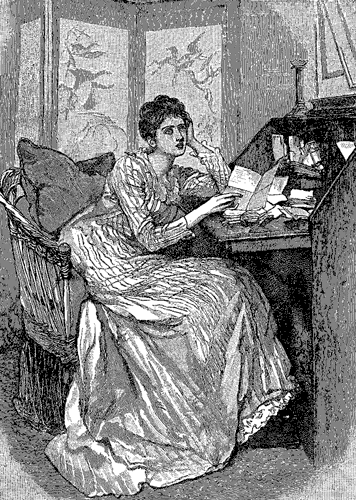
“THESE ARE MY KEEPSAKES.”
Grammar and Orthography.
These should receive most careful attention. "A great author is one," according to Taine, "who, having passions, knows also his dictionary and grammar." And a good letter-writer, as well, must "know his dictionary and grammar" to render his missives presentable.
Grammatical errors are almost unpardonable, and a misspelled word is an actual crime in these days of dictionaries. Punctuation and capitalization, too, must be looked after, and the whole letter give evidence of thought and care on the writer's part.
Handwriting, Paper and Ink
are all of importance, and etiquette has prescribed certain formulas for these adjuncts of a good letter, that, however the vagaries of fashion may invade the outer borders of the realm epistolary, are always correct and in good style.
The paper in best taste is thick, white or creamy-tinted, unruled and of such a size as to fold once for fitting square-shaped envelopes, creamy-white like the paper. Never use envelopes so thin in quality as to permit the writing to be seen through from the outside. The square envelope is not a necessity; the slightly oblong is also used, the paper being folded twice to fit this size.
This paper would be suitable and in perfect style in any portion of the civilized world, and on any occasion, and no one with any pretensions to good breeding should be found unsupplied. This is an item in which we cannot afford to economize, for one judges a lady or gentleman, unconsciously, by the contents of his or her writing desk, as exemplified by the letters sent from their hands.
Monograms are not entirely "out," but they are only used by those to whom their own especial design, through long use, has come to seem almost a part of themselves. All fleeting fancies in stationery should be passed by on the other side, or, at most, left to the wayward tastes of "sweet sixteen," or to some few whose very eccentricities are part of their fame. Sarah Bernhardt, for instance, uses blue paper framed in a pale gray line on the top of the page, and the flap of the envelope is a tragic mark, above which her initials are traversed by a scroll bearing her motto, "Quand même." She is as exact, however, in the formulas of her letters as any dowager of the old school. The Royal Highnesses of England use the paper and square envelopes before described; initials, monograms and crests are left to foreigners and outsiders, and the Orléans family, of France, are severely plain in their choice of stationery.
INCORRECT MODE OF HOLDING THE PEN. PROPER MODE OF HOLDING THE PEN. CORRECT POSITION OF THE HAND.
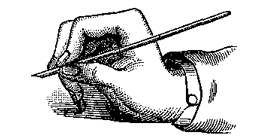
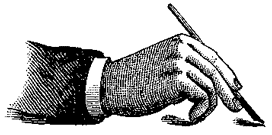
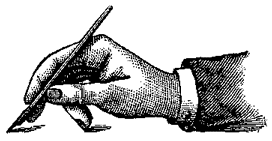
Given the correct paper and envelopes and plain, jet-black ink (no other tint should ever be used), the penmanship must next be considered. It is very well for Madame Bernhardt to write an elegant, graceful hand that is absolutely impossible to decipher, and for General Bourbaki to indite his epistles in a microscopically minute script, but less important people will do well to render their chirography as perfect and legible as possible, and not to flourish.
Avoid always too near an approach to the clerkly, commercial hand. A talented foreigner once remarked to the writer upon his astonishment at the predominance of this hand in America. "I do not like it," he said; "the clerk sends me in my rates, the landlord my bill, and the young lady her reply to my invitation, all in that same commercial hand. There is no individuality, no character, in such writing." And there was too much reason in his remonstrance. We are not quite "a nation of shopkeepers," and there is no reason why this business handwriting should so permeate all classes of society.
The lines should be straight, and as ruled paper is not permissible in formal notes, invitations or punctilious correspondence, savoring too nearly of the school-room and the counting-house, some little practice may be necessary to keep the lines even. Should this prove impossible, let a sheet of paper with heavily ruled black lines that will show through the writing paper, be kept in the desk and slipped beneath the page as a guide. It may also be inserted in the envelope to keep the superscription or address perfectly straight.
The lines should be rather far apart, and the fashionable hand just now is not the pointed English style, but somewhat verging on the large, round hand of the last century; the ladies, as a rule, indulging in a rather masculine style.
PROPER POSITION OF A LADY IN WRITING.
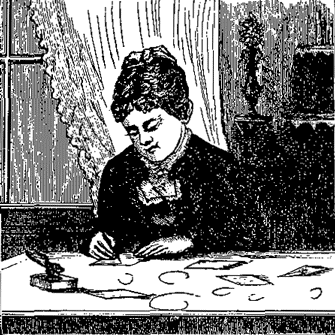
Thin foreign note paper may be used for letters abroad, unless the most formal. This is usually ruled. So is the commercial note used for business letters.
These forms answer for ladies and gentlemen alike. There is no particular objection to gentlemen using in their informal friendly letters, business note with printed letter head, but for ceremonious occasions they must be bound by the foregoing forms.
Very faintly perfumed paper is the prerogative of the ladies. Gentlemen are denied this privilege and a lady avails herself of it with discretion, selecting a favorite odor and adhering closely to it, so that correspondents could tell her missives with closed eyes, by their very fragrance.
Where black-edged paper and envelopes are used by persons in mourning, the width of the black border varies according to the nearness of the deceased relative or the length of time since the loss, though some never use more than the narrowest line of black, while others still, with the most perfect propriety, discard it altogether. Its use is a matter of taste simply, and must cease so soon as the mourning garb is dropped. Never be guilty, however, of writing a letter of congratulation on black-edged paper, even if in mourning; use plain white for this purpose. At the same time, it is never necessary to write a letter of condolence on black-bordered paper, unless the writer himself is in mourning.
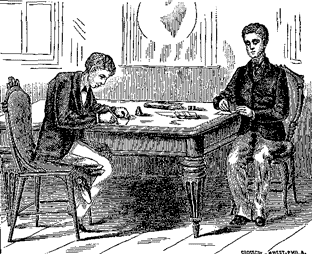
IMPROPER POSITION. PROPER POSITION.
The careful writing of a note or letter is a mark of respect to the recipient, and blots, erasures and mended words should never be permitted to disfigure it. Erasing cannot be done without marring the entire page and a mended or rewritten word is an offense to the eye. To copy the letter afresh is the only real remedy, and those who value their own standing will not grudge the pains spent in the composition of a letter that shall be a credit to the writer and a pleasure to the receiver.
This comes under the general recommendation of doing everything you do as it ought to be done. There should be no slipshod way of writing a letter by which you are to be judged.
Figures and abbreviations are often used. Few numerals are allowable, except the dates, the street number and the hour of the day. Very large sums of money are also stated in figures unless they begin a sentence, when all numbers must be written out fully. Figures are also preferable in uneven sums of money too long to be written with one, or at most two words; per cent., as well, is rulable in figures. Degrees should be either written "75°," or "seventy-five degrees." Fractions, given alone, should be in words, and all other numerals occurring in a letter must follow the same rule, except quotations from stock and market reports. For extra precaution, sometimes sums of money are written, followed by figures representing the same, in parenthesis.
Common Abbreviations.
Abbreviations proper to social and formal letter-writing are few in number. Honorary titles, such as Dr., Prof., Hon., Rev., Messrs., Esq., Capt., etc., are usually abbreviated as above, though very good authorities advocate, and with much reason, the use of the full word "Reverend," as also the titles "Honorable" and "Professor." The scholastic titles are also abbreviated by the proper initials, as A.M., M.D., LL.D., following the name. The names of months, of states, the words "County" and "Post Office," when used on the superscription are also abbreviated.
The use of A.M., M., P.M., to mark the divisions of the day, technical abbreviations, and the usual e.g., i.e., viz., etc., are too familiar to the users to need mention. Further than the above, brevity is not always the soul of wit.
The letter itself, as a whole, is now to be considered, and to facilitate its writing there should be some one corner in every home devoted to this purpose. The incentive to letter-writing is always damped, the happy thought we would send our friend takes flight, if we must find the pens upstairs, the paper down, the ink bottle in the pantry, empty or not, as the case may be, and our patience wherever it may be after the search is ended.
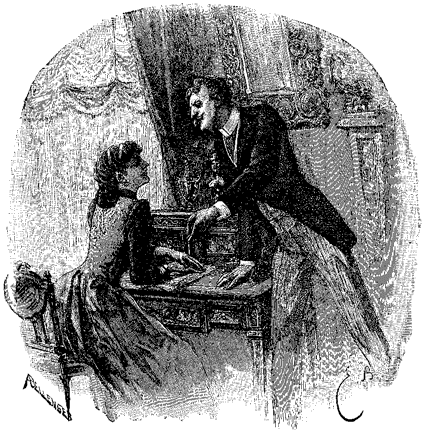
A SCRAP OF A LETTER.
Letters would be more frequently written, more punctually answered, and half the unreasonable dread of writing done away with, were this matter attended to properly. Let the writing desk stand in some well-lighted corner of sitting, dining, or "mother's" room, and let it be stored with all articles necessary to the exigencies of correspondence. Should the desk prove beyond the depth of the family purse, then let its substitute be found in a firm, good-sized table or stand, with a drawer where necessary supplies may be kept. Two or more sizes of note paper, unruled, with envelopes to match, for the elders of the household; writing tablets and commercial note, together with plain envelopes, for the school-children and everyday uses; a good dictionary, a tray with pen rack and inkstand thereon, and a goodly supply of pens, will complete a corner that will do more toward the family education in good breeding and culture than any other expenditure that can be made, and will render letter-writing the pleasure it should be, instead of the dread it too often is.
If one possesses a permanent address, street, number and city may, with great propriety, be engraved on the paper at the top of the sheet. If this is not done the address should always be written clearly on all letters. It is too much to expect one's friends to remember the private addresses of all their correspondents, and time is too precious to be spent searching out some missing letter in quest of street or number, in default of which more than one letter has gone unanswered.
The date of a letter, month, day, year and city is first in place. This should be written on one line, beginning, according to length, more or less near the center of the sheet and ending at the right-hand margin. In business letters, unless the printed letter head fixes the place, this line should not be more than one-quarter down the page; while in social or formal letters it should be one-third the distance down. If it should be desirable to give the county also, the date may be allowed to occupy two or more lines, as follows:
Mendota, La Salle Co., Ill., May 29, 189-.
In the same manner a city number and address may be given:
309 Post Street, Ottawa, Ill., January 30, 189-.
In writing from hotels, the following form should be adopted:
The Arlington, Binghamton, N.Y., October 3, 189-.
Some, in polite letter-writing, prefer to give the address at the conclusion rather than the beginning of the letter. Under these circumstances the prescribed form would be:
Truly your friend, Mary N. Prescott.
Franklin Grove, Lee Co., Ill., January 14, 189-.
There are several ways of writing the figures that compose the date of a letter. Many business men and others use this form, 1-2-189-, or, 1/2/9-, for January 2, 189-. Others still would write as follows: Jan. 2nd, 1896. Taste and habit will decide the matter for each. To give the name instead of the number of the month is, perhaps, more elegant.
The address, supposing it to be a business letter would come next in order, beginning at the left-hand margin, and our letter would stand thus:
Tipton, Iowa, April 1, 189-.
Mr. William H. Hill, 307 Wall Street, New York.
The salutation is a matter wherein there is great latitude of usage. In conformity with custom, some title is to be used in addressing correspondents, and this title differs greatly in accordance with the degree of acquaintance, or friendship, with the party addressed. It should always begin at the left of the page. In the business letter just above, the form might be as follows:
Tipton, Iowa, April 1, 189-.
Mr. William H. Hill, 307 Wall Street, New York.
Dear Sir: (or, Sir:)
Or, if there should be a firm name, the address would be as follows:
Messrs. Williams & Hill, 307 Wall Street, New York.
Dear Sirs: (or, Sirs:) (or, Gentlemen:)
Again, if wished, the salutation might be omitted and the address made to serve as title. Another form is this:
Mr. William H. Hill, 307 Wall Street, New York. Mr. Hill:
The following form, though causing an unpleasant repetition of the name, is often adopted in business letters to unmarried ladies, probably to escape the problem that the choice of Miss or Madam offers to so many:
305 Beacon Street, Boston, Mass., February 10, 189-.
Miss Mary Wright, Cherry Valley, Ill. Miss Wright:
Or, omitting the name, the simple address may be used. However, there need not be the slightest difficulty in addressing an unmarried lady, even should she be in her teens, as "Madam," or "Dear Madam," it being a general term as applicable to women without regard to age or condition, as "Sir" is to their brethren. This will be easily seen when it is recollected that it is a derivation from ma dame, my lady, and since our language is deficient in any equivalent term to the pretty French Mademoiselle, or the German, Fräulein, and, as "Dear Miss" is obsolete, we must be content to utilize "Madam" on all necessary occasions. There is another form much used where the address is omitted:
305 Michigan Avenue, Chicago, July 10, 189-.
Miss Halstead. Dear Madam:
Or, if on friendly footing, simply: Dear Miss Halstead:
If two young ladies are to be addressed, the term "Misses" should be used, as:
Havana, Ill., February 20, 189-.
Misses Taylor & Watson, Stenographers, 159 Church Street, Rockford, Ill. Mesdames:
The "Mesdames" may be omitted and the address used alone, but its addition indicates more polish. The translation is "My Ladies." Some substitute for it, simply "Ladies," which is quite proper.
The prefix "Dear" may be omitted wherever desirable, but never write "My dear Miss Halstead," "My dear Madam," or "My dear Sir," unless intimately acquainted.
In writing a social letter the address is omitted or added at close of the letter. A gentleman in private or professional life would be addressed as:
Frederic Guy, Esq. Dear Sir: (or, Sir:)
Or,
Hon. Frederic Guy. Dear Sir: (or, Sir:)
Respectfully yours, John Graceland.
The use of titles will be explained farther on, but here it may be said that two titles are very seldom given to the same individual at once. For instance, never write Mr. Fred. Guy, Esq., nor Hon. Mr. Fred. Guy. There are some exceptions to this rule, as where the Rev. Mr. Churchill and the Hon. Mr. Brice are addressed under circumstances where their Christian name is unknown, and where a married lady makes use of her husband's title, as: Mrs. Capt. Jones; Mrs. Judge Snyder, and where the Rev. Prof. Dr. Kemp shows by his titles the weight of his learning. Never deny an individual the titles that are rightfully his. They show that he has fought and conquered men, or books, to win them, and they are the well-earned meed of his endeavor. But never, if you have titles, be guilty of bestowing them on yourself; leave that for others.
A gentleman writing to a married lady would address her in friendly correspondence as, "Dear Mrs. French," or, "My dear Mrs. French." To an unmarried lady, "Dear Miss French," or "My dear Miss French." A lady addresses a gentleman in the same fashion, as "Dear Mr. Courtney," or "My dear Mr. Courtney," or "Dear Dr. Courtney."
The Proper Salutation.
Nearer degrees of intimacy, of course, formulate their own laws in this regard, but even here, be it said, that discretion may be exercised to advantage. It will also be observed that if the word "dear," or any like term, begins the salutation it is capitalized; otherwise, not. Thus: "My dear Friend;" not "My Dear Friend." Authorities on etiquette differ somewhat on this score, different works in the author's possession taking exactly opposite sides, the weight of evidence, however, falling on the form given here.
The complimentary conclusion, "Yours truly," "Very truly yours," "Very respectfully," etc., should begin about the middle of the page on the next line below the body of the letter. The first word only should be capitalized, and the expression followed by a comma. The signature should come on the line below and end at the right-hand margin of the page. The address also is sometimes, especially in social notes given at the conclusion, where it should begin, one or two lines below the signature, at the left-hand margin of the page, occupying two or more lines, according to its length, as:
Dear Miss Lothrop:
In reply to your kind note, I would say, etc.
Cordially yours,
Marion Kent.
2 Arcade Court, Chicago, Ill., October 5, 189-.
Another very formal style would be:
21 Delaware Place, Buffalo, N.Y., June 1, 189-.
Dear Miss Lothrop: In reply to your kind note, etc.
Truly yours,
George Harland.
To Miss Julia Lothrop, 110 Beacon Street, Boston, Mass.
The conclusion of a letter gives the writer fully as much latitude of style as the salutation. Some graceful little phrase should follow the subject-matter of the letter and lead up to the conclusion, thus:
I am, with love to the family, and remembrances to all my friends,
Yours cordially,
Mary Roe.
Salutation and conclusion should always correspond in formality or friendliness with one another, thus: Mr. John Bright. Sir: would appropriately conclude with: I am, sir, Respectfully yours, Frank B. Folsom.
A friendly letter beginning: Dear Bright: or, My dear Bright: would terminate thus: Cordially yours, Frank B. Folsom.
Other forms for closing business letters are: I am, respectfully, James Ross. Or, Respectfully, James Ross.
These forms do away with the personal pronoun "Yours," which, although custom has in reality rendered it a pure formality, still retains a certain meaning in the minds of some, as the man, who, in a long correspondence with his wife-that-was-to-be, never signed a letter otherwise than "Truly yours." "What more could I be," he queried, "than hers truly, body and soul?" and with this feeling could their married life have been other than it was, beautiful to look upon?
Never abbreviate the conclusion to "Yours, etc.;" it has too much the careless, thankless sound of "Thanks," and neither can be sufficiently condemned.
Letters beginning, My dear Margaret: or, My dear Daughter: might end, respectively: Ever yours, or, Your friend, Jane Brown. And, Your affectionate mother, Gertrude Mason.
A gentleman, writing to a lady, could say: Very sincerely (or respectfully) yours, P.H. Gould. Or, Yours, with sincere regard, Henry Grayson.
The address need not be added unless the acquaintance is very slight. At times a more elaborate closing is desirable and graceful, as when the correspondent is very much higher in station, or older in years, or you have been the recipient of some great favor at his or her hands:
I am, dear madam, with the most profound esteem,
Yours sincerely, James Talbot.
Or, to a gentleman, under like circumstances:
I have the honor to be, sir, Yours most respectfully, James Talbot.
Such closings as "Obedient, humble servant," are quite too much for Republican simplicity, and even in writing to no less a dignitary than the President:
To The President,
Sir:
Very respectfully,
James Talbot,
really fulfills all requirements, though one may consult his own taste in making use of the two complimentary conclusions given above.
A lady in writing to a stranger should always suggest whether she is married or single. This will prevent mistakes and annoyance, and can be done in two ways: Respectfully, (Miss) Frances Clayton. Or, more elaborately: Respectfully, Frances Clayton. Address, Miss Frances Clayton, 21 St. Caroline's Court, Chicago.
A lady never signs herself as Mrs. Helen B. Hayes, or Miss Gertrude Vance, without, at least, putting the titles in a parenthesis. Primarily, a woman is Helen Hayes or Gertrude Vance, and should sign herself as such. The "Miss" or "Mrs." signifies simply an incident in her existence, and is added, as it were, in a note, to prevent mistake on the part of others. A failure to observe this rule indicates a lack of culture. Neither does a gentleman ever sign himself Mr. Brown, but George G. Brown, or G.G. Brown.
Use of the Husband’s Name.
A married lady should always be addressed by her husband's name preceded by "Mrs.," except in case of well-known names, such as Mrs. Potter Palmer, or Mrs. Isabella B. Hooker. A widow is no longer called by her husband's given name, but reverts to her own christened cognomen, preceded by "Mrs." Thus, Mrs. James H. Hayes in her widowhood is, to every one, Mrs. Helen B. Hayes. An exception to this would be in the case of such well-known names as Abraham Lincoln, or James G. Blaine, where custom grants the widow the right to bear the beloved title.
The superscription or address should be written plainly (if speedy delivery is expected) upon the lower half of the envelope, the flap being at the top. The title and name form one line with about an equal space at each end. The writing should be just below the middle of the envelope. The street number, the name of the city and the state each form a separate line, one below the other, and each should begin a little to the right of the one above, so that the last line will approach nearly to the lower right-hand corner of the envelope. The county or number of post office box may be given in the lower left-hand corner. Where there is no street number the county, or even the box number, may be written directly beneath the name of the town.
The stamp should be invariably placed squarely and right-side up in the upper right-hand corner. A request for return in a given time may be written, if necessary, in the upper left-hand corner.
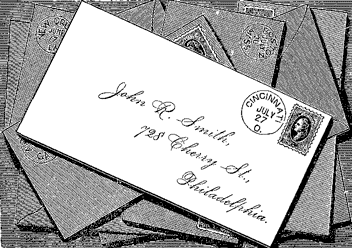
THE PLACE FOR STAMP AND SUPERSCRIPTION.
A physician is addressed thus: Dr. Albert Young, Watseka, Iowa. Or, Albert Young, M.D., Watseka, Iowa.
In addressing the wife of a doctor the following formula may be used: Mrs. Dr. Albert Young, Watseka, Iowa.
The strictest etiquette, however, would involve writing: Mrs. Albert Young, care of Dr. Albert Young, Watseka, Iowa.
Either of the above forms may be taken for addressing the wife of a professor, an army or United States official, a minister or a legal dignitary, always remembering that the longer is more elegant, as: Mrs. Melville B. Fuller, care of the Hon. Melville B. Fuller, Chief Justice of the United States, Washington, D.C.
The President, however, would be addressed: To the President, Executive Mansion, Washington, D.C.
This is the simplest form, and as such, in the best taste, but it is sometimes written: To the President of the United States, Honorable Grover Cleveland.
"His Excellency" was formerly used in addressing the President and the Governors of States, but it is largely abandoned as inconsistent with the lack of titles in our country. The same rule is observed in writing to the Governor of a State: To the Governor, Gubernatorial Mansion, Springfield, Ill. Or, To the Governor, Robert P. Morton, Albany, N.Y.
A member of the Cabinet: To the Honorable, the Secretary of the Interior, Washington, D.C. A State official has the following address: Dr. John C. Wyatt, Secretary of the State Board of Charity, Springfield, Ill. In addressing one person in care of another the form would be: Mrs. John Draper, Grand de Tour, Ill. Care Dr. I.S. Prime.
A note to be delivered by a friend is always unsealed and usually addressed: Miss Florence Warden, Vassar College, Poughkeepsie, N.Y. Kindness of Mr. G.A. Rhodes. A still better form is to simply use the address of the person without farther preamble.
Always fold a letter sheet so that the opening lines face the reader on unfolding.
Punctuation Marks.
Punctuation and capitalization are very necessary matters in the art of letter-writing, but in these days of common schools, and all but compulsory education, it is to be supposed that some knowledge of these important facts will have been gained. It will not be amiss, however, to mention a few of the most necessary rules.
The four chief punctuation points are the comma, semicolon, colon, period. In the days of our grandmothers children were taught to "mind their stops," with this rule for a guide: "Count one at a comma, two at a semicolon, three at a colon, and four at a period, or 'full stop.'"
In punctuating the date, address, closing and superscription of a letter, certain rules are necessary. One of these is that a period follows all abbreviations, such as those of title, state and county, and separates and follows all initials, whether abbreviations of names or titles; while the slight pause occurring between such abbreviations is marked by a comma, and the end of the date, like the end of a sentence, is closed by a period; for example: 540 West Main St., Galesburgh, Ill. Or, Poughkeepsie, N.Y., Jan. 10, 189-.
A colon suggests something more to follow, hence in the salutation of a letter we find a colon at the end, signifying that the body of the letter is yet to come, as: "Dear Sir:" or, where the communication begins on same line of salutation, we find both colon and dash, as: "Dear Madame:—Yours of," etc.
Commas are used frequently to divide long complex sentences, and the sentence is somewhat further broken by the use of the semicolon between its more decided sections. Abraham Lincoln once said: "I throw in a semicolon whenever I am at a loss what pause to use; it always fits."
The complimentary close of the letter is followed by a comma and the signature by a period. A period also separates and follows two or more initials, as: Yours truly, (Mrs.) Adeline D.T. Whitney.
Writing the Superscription.
A very long complimentary conclusion should be punctuated like a sentence, as: I am, dear madam, with the most profound esteem, Yours truly, James Talbot.
The superscription on the envelope is to be punctuated according to the above given rules. An interrogation point (?) should be used at the end of all questions. It is in truth, as the small boy said, "A little crooked thing that asks questions." The exclamation point (!) expressing astonishment, the dash and parenthesis, need only be employed by those thoroughly understanding their use. Quotation marks (" ") should always be placed at the beginning and end of words quoted from another; slang, or any fashionable "fad" if written, should be quoted.
As for capitals, one should begin every sentence, all names of persons and places, all appellations of the Deity, the first word of every line of poetry, and show themselves in the pronoun "I," and the exclamation "O."
Sealing wax is to be used, or not, as inclination directs, but neatness and skill are necessary in its use, or an unsightly blotch will result, than which the self-sealing envelope is far preferable. A heavy cream-white envelope sealed with a large, perfect seal of rich red, or bronze-brown wax with a clear monogram or initial stamped thereon, is always pleasing to the eye. To very slightly oil the seal will prevent it adhering to the wax and thereby spoiling the impression. In a foreign correspondence, the self-sealing envelopes are better since in tropical countries the great heat often melts the wax, and it is always liable, during transportation in the holds of vessels, to become cracked and loosened from the paper by the weight of other goods, and close packing in the hold.
Final remarks are scarcely necessary, but it might be suggested that it is rather fashionable to write one's full name, as more elegant than initials. A lady never signs herself simply by initials. Mary Creighton Cutter should so write her name, or, at least, Mary C. Cutter. Never M.C. Cutter. A gentleman is privileged to do this in business or formal letters, but in any others, instead of L.B. Bancroft he is Lucius Bright Bancroft or Lucius B. Bancroft.
Points to be Remembered.
Margins are no longer a necessity even in the most formal letters. Sometimes in writing a long, friendly, not formal, letter, instead of utilizing one side only of the paper, it is written across the sheet upon the first and fourth pages, and then lengthwise upon the second and third, though of course it is perfectly correct to write upon the pages consecutively.
Tautology, or a continued repetition of the same word, is a disagreeable and inelegant fault in writing, as: "If John will come home, we will all come, but if he fails to come, we will not come until he can come also."
One other point remains to touch upon: Any one that has ever glanced at the "Correspondence Column" of any paper will see how often young women ask if it is proper to write to gentlemen who have requested the favor of corresponding with them, and which should write first. This point is rightfully one that should be settled by the mother or other guardian of the girl; but let it be said here that while this is the only country in the world where a so-called "friendly correspondence" is or can be carried on between young men and young women with, or without, any particular object in view, even here it is well to be careful. Girls are sometimes a little too confidential, and all men are not gentlemen, outward polish notwithstanding. A friendship too easily won or too fully expressed is not always prized, and while manly men are supposed never to boast of the number of their correspondents, yet club-room walls, could they speak, would stamp many a man as less than a gentleman.
Titles.
The proper use of titles forms an important item in letter-writing. The slightest hesitancy on this point shows a lack of culture on the part of the writer that lowers him at once in the eyes of the recipient.
The ordinary social titles used are simple and familiar. These are: Mrs., Madam, Miss, for women; Mr., Esq., Messrs., Sir, for men, and Master for boys.
Of course, in writing to an acquaintance, while the outer address retains all its formality, the commencement will be whatever is warranted by the degree of friendship between the parties.
Domestic Titles.
By the constitution of the United States it is provided that no titles of nobility shall be granted by the government. Neither shall a person holding a governmental office accept any title from any king, prince or foreign state, except express permission be given by Congress. The President of the United States and the Governor of Massachusetts are the only citizens possessing as officials a title by legislative act. This title is the same: "Excellency." Governors of other states are given this title by courtesy only. However, this title may be omitted at discretion, and indeed the simpler form given is far more suited to our Republican simplicity of manners.
The following list will be found a complete guide in the use of all honorary titles sanctioned by custom in the United States:
Ambassadors, Foreign, to the United States, are addressed officially by the titles recognized in their own countries, and if they have no title, as "Mr. ——," followed by title of office. United States ambassadors to foreign countries, officially as "Mr. ——" or "Hon. ——," followed by title of office. There are but four ambassadors sent out by the United States, the ministers to Russia and England having been but lately invested with that title.
The Hon. John Jones, United States Ambassador to the United Kingdom of Great Britain and Ireland, or to the Court of St. James.
Archbishop (Roman Catholic)—Letters addressed: "The Most Reverend ——, D.D., Archbishop of ——."
Associate Justices—Addressed with: "Hon.," name and name of office, but spoken of as "Mr. Justice ——."
Bishop—Addressed: "The Right Reverend ——, D.D., Bishop of ——." The address of Protestant Episcopal and Roman Catholic Bishops is precisely the same. Bishops of the Methodist Episcopal Church are addressed as the "Reverend Bishop ——, D.D."
Cabinet Members—Addressed as: "Honorable," usually contracted to "Hon.," as: Hon. James Johnson, Secretary of State, Washington, D.C.
Cardinal (Roman Catholic) is addressed in writing, and spoken of as: "His Eminence ——, Cardinal (Bishop, Priest, or Deacon, according to rank) of the Holy Roman Church," spoken to as, "Your Grace."
Chief Justice—Addressed as: "Hon. Chief Justice of the Supreme Court of the United States."
Chief Justice's Wife—Addressed as: "Mrs. Chief Justice ——," by virtue of a social custom that is largely observed. This custom does not extend to daughters.
Clergymen—Addressed as: "The Rev. ——," spoken to as, "Mr. ——." If a doctor of divinity, addressed as, "—— ——, D.D.," or "The Reverend ——, D.D.," and spoken to or of as, "Dr. ——."
College Degrees.—All recipients of regular or honorary degrees should be addressed by name followed by abbreviation of degree: A.B., A.M., Ph.D., M.D., D.D., as "—— ——, A.B."
Congress, members of—Addressed: "Hon. ——, M.C."
Esquire.—Justice of the peace, as well as some grades of lawyers, are addressed in writing and spoken of as "——, Esq." Any gentleman may be so addressed, but "Mr." is preferable.
Government—Official communications from—Always begin "Sir."
Governor.—May be addressed as "His Excellency the Governor of ——." Spoken to, "Your Excellency." See, also, other forms given before.
Governor's wife is by courtesy addressed, "Mrs. Governor ——." This usage does not apply to daughters.
Judges—Addressed by courtesy with the title, "Honorable," contracted to "Hon.," and the name of the office usually follows, as: "Hon. ——, U.S. Senate."
Legislature, members of.—Address as, "Hon. ——," followed by name of office.
Mayor.—"The Hon. Mr. ——, Mayor of ——."
Minister, American—Addressed as: "Hon. ——, American (or U.S.) Minister to France."
Municipal Councils, members of.—Courtesy grants the title "Honorable."
Officers of Army and Navy.—Addressed by name, followed by title of highest rank attained, and, if in command of a military division, naval squadron or station, or on retired list, by a signification of the fact, as: "—— ——, Major General U.S.A., Commanding Military Division of the Atlantic;" "—— ——, Rear Admiral U.S.N., Commanding European Squadron;" "—— ——, General U.S.A., Retired."
President.—Addressed as "His Excellency the President of the United States." Spoken to as, "Your Excellency."
President's Wife.—Addressed by courtesy, "Mrs. President ——." Usage does not apply to daughters.
LORD CHESTERFIELD says in those inimitable letters to his son, that "style is the dress of thoughts, and let them be ever so just, if your style is homely, coarse and vulgar, they will appear to as much disadvantage as your person, though ever so well proportioned, would if dressed in rags, dirt and tatters."
So true is this that graceful commonplaces, either spoken or written, are far more apt to produce a pleasing impression than weightier matter awkwardly uttered, or uncouthly expressed. Hence, the length and familiarity of the friendly epistle should never be carried into the short, concisely worded business letter, while the social note, though brief, should differ greatly in its gracefully turned phrases from the formal note of acceptance, regret, application, or introduction.
The following forms are to be looked upon, not as copies, but chiefly as suggestions that may be used to solve some doubtful point.
Social and Friendly Letters.
These are less subject to rule than any other class, and the models here given are simply to show how flowing and easy the style may be between friend and friend, or how gracious and instructive from parent to child. In the friendly letter great freedom of detail is allowable, especially among near relatives. "You do not tell me half enough," writes H.H. from Europe. "I even want to know if the front gate is off its hinges." But do not render a friendly letter so long as to tax the patience of the reader. "Samivel Veller" discovered one of the secrets of letter-writing when he made that famous love letter of his short, "so she vill vish there vos more of it." Neither railing, nor fretfulness, nor too great egotism, is wise in letter-writing, for written words have a sad fashion of outlasting the mood in which they were penned, nay, even the hand that penned them.
Letters of Introduction.
These are left unsealed, that the bearer may be permitted to read the contents. They are brief, so that if read in the presence of the person introduced, the slight embarrassment may be shortened as much as possible. They usually contain a reference to the occupation or character of the individual in order that some slight clue may be given to the recipient in beginning a conversation, and usually conclude with some pleasant, complimentary phrase.
One simple form would be:
Evanston, January 1, 189-.
My dear Miss Kimberlin:
This letter will introduce to you my friend, Mr. Otis Van Orin, a member of the Corps of Civil Engineers, to be located near your home for several months during a partial survey of the new railroad. May I not be assured that you will extend to him some of the hospitalities of your delightful home, thus being to him that "friend at court" so desirable to the stranger in a strange land? Trusting that this will be the case, I am,
Very sincerely yours,
Charles H. Calcraft.
Another, from a mother introducing her daughter to an old friend, would read:
Waterbury, Conn., March 10, 189-.
Dear Frances:
My daughter Madge will present this letter in person, as she is about to enter school in your town for a several years' course of study. Under these circumstances, and in memory of our own lifelong friendship, may I not ask that you will help her to forget some of the sorrow of this, the first parting her happy, young life has known? Trusting that you will do this for the sake of auld lang syne,
I am, as ever, your friend,
Margaret M. Blatchford.
Mrs. Frances H. Page, Portland, Me.
A still briefer form would be:
Baltimore, Md., November 20, 189-.
Dear Denton:
My friend, Louis Ross, will present this note. Any kindness you may show him will confer a favor upon
Yours truly,
Frank P. Breckenridge.
To Mr. James Denton, Ottumwa, Ill.
The envelope to a letter of introduction should be addressed as follows:
Mr. James Denton, Ottumwa, Ill.
Introducing Mr. Louis Ross.
Letters of introduction should not be sent indiscriminately, as no one has a right to force a possibly undesirable acquaintance upon a friend, while, at the same time, the individual asking such a favor should be thoroughly convinced that he is entitled to the privilege. Letters of introduction, where they are between ladies, may be left by the caller, together with her card. She must not, however, ask to see the lady of the house, who is expected, shortly after the receipt of such a missive, to call in person, and should endeavor, during her stay, to include her in a portion of her social plans for the season; circumstances, of course, governing the extent to which these attentions should be carried.
A gentleman, in presenting a letter of introduction to a lady, may, if she should be at home, make his first call when sending in his letter and card, whereon should be designated his hotel or place of residence. If this should not be the case, she will answer by sending her card with her reception day engraved upon it, or, if that be too far distant, a note, stating when he may call, should be sent; it may also be expected that her husband, son or brother will call upon him and offer what civilities are at command. Even should neither card nor note be sent, it is still permitted him to call once more. His responsibility ceases here, and if no attention follows he may conclude his friend has overstepped the limits of a slight acquaintance in giving him the letter of introduction.
A Letter of Recommendation
to some position or appointment is very much the same as one of introduction. Its reception, however, does not necessitate social attentions. The form is very simple:
644 Broadway, New York, November 22, 189-.
Dear Mr. Hill:
Recognizing, as I do, that your position in commercial circles will give your influence great weight, I take it upon myself to introduce to you Mr. Philip Palmer, a graduate of one of the best business colleges in New York City, and a young man of integrity and capacity. Any recommendations which you can grant him will be looked upon as a favor by
Your friend,
Milton Jones.
To William Hill, Elmira, N.Y.
A general letter of introduction, intended for the perusal of strangers, would read somewhat as follows:
To whom it may concern:
This is to certify that the bearer of this letter, Miss Marietta Hope, was graduated with high honors from Vassar College, and has since taught in the schools of this city. As her principal for a number of months, I can truthfully recommend her as capable of filling any position for which she may apply.
James H. Blanchard, Principal of Livingston School, New York City.
Letters of Condolence
should be written very soon after the occurrence of the sorrowful event, and, while brief, should not be cold and formal; neither should they touch the opposite extreme, and, by dwelling with maddening iteration upon the fresh sorrow, harrow anew the stricken soul of the mourner. The occasion should never be seized upon as a text for a sermon on resignation, nor should frequent reference be made to various like bereavements suffered by the writer. These comparisons only wound, for "there is no sorrow like unto my sorrow," has ever been the cry of the stricken soul. And when friends have done their little all, each mourner still feels the truth of Lowell's lines:
"Condole if you will, I can bear it, 'Tis the well-meant alms of breath, Yet all of the preachings since Adam Cannot make Death other than Death."
Yet friends cannot deny themselves the privilege of a few loving words, and a letter on the loss of a beloved daughter might be as follows:
Cape May, June 1, 189-.
My dear Mrs. Sutherland:
I cannot resist my desire to write you a few words of love and sorrow; only a few, for my heart is full and words seem very weak. Thank God, my friend, for the nineteen beautiful years that ended that morning in May.
If you could but know how sweet and tender a recollection she has left enshrined in the hearts of her friends, and all the loving, gracious utterances that are offered to her memory! It is well with Alice in heaven; that it may be well with you on earth, in the days that are to come, is the prayer of
Your loving friend,
Marie.
To a friend who has sustained a financial loss might be written:
Tonawanda, N.Y., November 12, 189-.
My dear Blake:
The first announcement that I had of your severe financial loss was through the morning paper. I can only express my sorrow at the event and my indignation over the falsity of the cashier in whom you placed so much confidence.
Hoping that you have employed the best of detective skill, and that you will succeed in recovering a portion, at least, of the sequestrated funds, I am,
Yours sincerely,
George G. Parsons.
Mr. Fletcher Blake, President of the First National Bank, Aurora, Minn.
It must be remembered that letters of condolence, unlike those of congratulation, are not expected to receive an early answer, and, in case of very deep affliction, may remain seemingly unnoticed, save perhaps, after a time, by cards of thanks.
Letters of Congratulation
should be sent immediately upon the occurrence of the fortunate event that calls forth congratulatory wishes; they should be brief, gracefully worded and contain no mention of other matter. The occasions in life that call forth such missives are numerous: birthdays, engagements, marriages, anniversaries, business successes, etc., each, or all, should win some congratulatory notice. The formal congratulation is in set terms, usually written in the third person, and may be used between individuals but slightly acquainted; for example:
Mr. and Mrs. Stuart congratulate Mr. and Mrs. Fielding upon the successful conclusion of Mr. Harold Fielding's college course and express the pleasure with which they listened to the delivery of his eloquent oration on Commencement Day.
81 St. Caroline's Court, July 1, 189-.
This, in common with all congratulatory letters, should be replied to at once, and, wherever any missive is written in the third person, the reply must follow the same fashion. An appropriate answer for the above form would be:
Mr. and Mrs. Fielding unite in sending thanks to Mr. and Mrs. Stuart for kindly praise awarded their son Harold on the late important event in his life, and also for the exquisite flowers they sent to grace the occasion.
891 Michigan Avenue, July 2, 189-.
A friendly congratulation in the first person is less stately, as, for instance, one friend might congratulate another upon his marriage:
Georgetown, D.C., January 10, 189-.
Dear Jack:
"And so they were married and lived happy ever after," of course. At least, that is what you and Mrs. Julia anticipate at this present time, and is what I, knowing you both, do confidently predict. Accept my heartfelt congratulations, and believe me
Your true friend,
Richard Doe.
To John Myers, Esq., Yankton, Da.
Answer to the foregoing might be:
Yankton, Da., January 20, 189-.
Dear Dick:
Julia and I received your congratulations with pleasure, my only regret being that I cannot return them in kind.
"Gather roses while ye may, Old Time's a-flying."
A word to the wise, etc., and let me speedily have occasion to felicitate you in like manner.
Your friend and well-wisher,
John Myers.
Mr. Richard Doe, Georgetown, D.C.
It should be mentioned here that while one congratulates a gentleman upon his engagement, or marriage, and may congratulate his parents upon the same occasion, it is inadmissible to congratulate a lady on a similar event, or to extend the congratulations to her parents. Well-bred mothers have been known to resent this solecism keenly. You may, and indeed are expected to, offer to her, and her parents, all manner of good wishes for future happiness, but be sure not to congratulate.
Almost any success, or pleasant happiness in life, may be made the subject of a congratulatory letter, but a multiplicity of forms is unnecessary here.
Proposals, Engagements, “Naming the Day,”
and other letters of this description are important affairs that may all be transacted through the medium of correspondence, but it is to be hoped that a matter so closely personal will quicken the imagination and inspire the pen of the dullest swain.
Let him woo his Dulcinea swiftly and tempestuously, as King Hal wooed Kate, or let him serve twice seven years as Jacob served for Rachel, but let him never search out printed forms whereby to declare his passion; nor fit the measure of his love to the lines of the "Model Letter-Writer." As to "naming the day," 'twere a wordless lover indeed who could not say, as the poet says:
"Sun comes, moon comes, Time slips away. Sun sets, moon sets, Love, fix a day."
The note has become a factor in modern social life. We send a note when we send a gift, when we ask a favor, when we acknowledge a favor, when we offer an apology, when we postpone an engagement, and when we give, accept, or refuse an informal invitation. These forms will be given here for reference, excepting those pertaining to invitations, which are discussed in their place.
Notes Accompanying a Gift
should be brief, prettily worded, and strictly confined to the subject in hand; for instance, a gentleman sending flowers to a lady might say:
Mr. Irwin, hearing Miss. St. John express a preference for roses, hopes that he may have the pleasure of seeing her wearing the accompanying cluster this evening at the Opera.
91 Ashland Boulevard, October 2d.
The wearing of the flowers would be all the answer required by this note.
With a birthday gift an appropriately worded note would be as follows:
At Home, August 1st.
Dear Nettie:
Remembering that your birthday is at hand, I send you this little painting as a token of my love, together with wishes for many happy returns of this day.
Your friend,
Marie St. John.
These little notes should always receive an answer, as, for instance, this last might be appropriately replied to thus:
632 Corson Street, August 2. 189-.
My dear Marie:
You cannot think with what delight I received your beautiful birthday gift, rendered tenfold dearer by the knowledge that it is the handiwork of my friend. With many thanks,
I am, as ever, yours,
Nettie D. Caton.
Notes of Apology
are a frequent necessity. They should be written with promptness, evince a repentant spirit, and should be acknowledged pleasantly and forgivingly. Always remember in such a note to explain the cause rendering the apology necessary. For instance, an unfulfilled engagement might be apologized for thus:
Dear Miss Mason:
I cannot sufficiently regret that I was unfortunately prevented from keeping my engagement to drive with you on Wednesday. An important telegram, received but a moment before the time set for our "outing," left me but a brief five minutes to catch the first train for R——, where affairs, permitting no delay, awaited my attention.
Dare I hope that I have your pardon for so great a seeming negligence?
Very respectfully yours,
John H. Curran.
This note being written in the first person will be replied to in the same manner by the recipient:
Mr. Curran (or, Dear Mr. Curran, according to the degree of familiarity):
I accept your apology as quite sufficient, and beg that you will give yourself no further uneasiness over so unavoidable an occurrence.
I am, sincerely,
Gertrude Mason.
Notes of Postponement
are always to be sent when the necessity arises for deferring any social gathering. Write them promptly, and explain the unavoidable reasons for the postponement; for example:
Dear Mrs. Briggs:
It is with great regret that I inform you that our exhibition of private theatricals is indefinitely postponed on account of the sudden and serious illness of Miss Hope Ledyard, who was the chief star of our little company.
The "Lady of Lyons," with the "Lady" left out, would be like "Hamlet," with the noble Dane missing, an impossible performance; and, as there was no one else so capable of filling the part as Miss Ledyard, we are resolved to await her recovery.
Your friend,
Elizabeth Stuart.
Notes of Request or Refusal
are frequently necessary, but care should be taken neither to make an unreasonable request, nor to return an unjustifiable refusal. Should denial seem imperative, strive to imitate that English statesman who could refuse more gracefully than others could grant. The following examples will suffice:
Dear Mrs. Winterblossom:
You remember the little picture, a Sunset View, that I admired so much the other evening at your home? Would you have any objection to lending it to me for a copy?
Should you have even a shadow of dislike toward my proposition, do not hesitate to refuse at once. So many people are averse, and justly so, to having their paintings duplicated that I feel my request almost an impertinence.
Believe me, truly yours,
Edith Granger.
Refusal to the same:
My Dear Miss Granger:
I dread to answer your note, since it must be a refusal of your request, for the little printing is the property of a friend of mine, who has left it, together with a few others, in my care during her tour in Europe. The fact that she has a morbid dislike to having duplicate copies made of her pictures, forces me to deny a request that, were the painting in question mine, I would gladly grant.
Sincerely your friend,
Helen Winterblossom.
Business Letters
need especial care in writing. They are to be read by men with whom time is precious and the demands upon it numerous. Hence they should be brief, clearly worded and straight to the point. Such a letter is much more certain of speedy attention and prompt returns than the rambling, incoherent missive of the unaccustomed writer. If you want ten yards of ribbon of a certain color and quality, say so, but do not lose the order in a maze of irrelevant matter; for instance:
Mendota, Ill., April 4, 189-.
Messrs. Blank & Co.
Please send me:
10 yards of black silk, at $1 per yard$10 00
14 yards of green cashmere, at 75c. per yard10 50
1 pair black kid gloves1 50
1 pair tan kid gloves, undressed2 00
Total$23 00
Enclosed find money order for the above amount. Goods to be sent by American Express. By filling the above order quickly as possible, you will greatly oblige,
Mary McNett.
Address: Mrs. W.D. McNett, Mendota, Ill.
If there is any special reason for filling an order hastily, such as a birthday gift or wedding present, mention the fact briefly, and care will be taken that it is sent in time. Always make use of money order, draft or registered letter, when sending other than very small amounts of money by mail. Should you have anything to say in such a letter aside from the affair in hand, attend first and briefly to the matter of business, and then add whatever remarks may seem necessary.
Answers to Advertisements
should also be concisely worded, as for example:
61 Delaware Place, February 19, 189-.
Mrs. General Channing:
Seeing your advertisement for a governess in to-day's "Herald," I wish to inform you that I am a graduate of Wellesley, and have, for the two years since being graduated, taught French and German in the college.
Any references which you may desire as to my efficiency for completing the education of your daughter will be furnished you by the College Faculty.
Hoping to hear favorably from you,
I am, respectfully,
(Miss) Elizabeth Stuart.
A letter of inquiry might be something as follows:
Dr. J.H. Gratiot:
In making some inquiries relative to the present residence of a friend of mine, Miss Grace Gage, a mutual acquaintance of ours, Mrs. Emmons B. Corthell, of this place, gave me your address, suggesting that you could afford me the desired information.
This being the case, would you be so kind as to send the lady's present address, or, by handing her this note, permit her personally to furnish the desired information. Any communication addressed, from now on, to 1267 Madison Avenue, will find and greatly oblige,
(Miss) Kate G. Cox.
A letter of resignation, being a rather formal document, should be worded very much as follows:
To the Directors of the Owatonna Public Library.
Gentlemen: I hereby tender my resignation of the Librarianship of the Owatonna Public Library, said resignation to take effect on the —— day of ——, 189-.
Thanking you for the kindness and thoughtfulness with which you have acceded to my wishes and requests during my late term of office,
I am, respectfully,
George H. Graham.
Owatonna, Minn., August 1, 189-.
Some Don’ts and Do’s for Letter-Writers.
Don't write an anonymous letter; it is a cowardly stab in the dark.
Don't pay any attention to an anonymous letter; it is not worth your regard.
Don't conduct private correspondence on a postal card. Many persons consider this an insult. A purely business message may be thus sent, but even then the slight saving in postage is small recompense for the delay so often attending the delivery of postal cards.
Don't use a postscript; it is unnecessary, old-fashioned, school-girlish, and in a particular, punctilious letter the omission of any important matter necessitates the rewriting of the entire letter rather than the use of a postscript. In very friendly letters one may be permitted to add the forgotten paragraph in the form of a postscript, omitting, however, the obsolete abbreviation, "P.S."
Don't write on a half-sheet of paper unless the nature of the correspondence permits the use of the ordinary business letter-head. If the note is short, write only on one side of the paper, but don't tear a sheet in half for economy's sake. The rough, torn edges, denote haste, ill-breeding, or carelessness on the part of the writer.
Don't use tablet paper for ceremonious letters.
Don't write on both sides of the paper to any but very intimate friends or relatives, they being disposed to tolerate slight departures from formality on our part.
Don't meddle with foreign nouns or verbs unless conversant with the language itself; incorrect and ungrammatical usage is too apt to be the unhappy result. Even foreign names and titles should not be used without the exactest care as to their orthography and application.
This rule should be especially remembered with reference to all matters destined to pass through hands editorial.
Don't erase misspelled words in letters of any moment. Recopy the entire missive.
Don't quote too constantly.
Don't underscore your words, unless they express something very important.
Don't send enclosures in a letter written by some one else; only the greatest intimacy can excuse this practice. Write your own letters and send in a separate envelope.
Don't write a letter in a towering passion; you would not care to have it confront you in some cooler moment.
Don't cross the writing in your letters. Life is too short and the time and eyesight of your correspondent too precious for this.
Don't fill up every available blank space and margin of your letter with forgotten messages. If these are very valuable, add an extra sheet to your letter, thus saving its appearance and the patience of its recipient.
Don't divide a syllable at the end of a line. The printer may do this, not the letter-writer.
Don't fall into the habit of using long words in a letter, they show a straining after effect. One should "say," rather than "observe," "talk," rather than "converse," if one's missives are to be easy, well-bred and readable.
Don't refold a letter, the marks always remain to show your carelessness. Fold it correctly the first time.
Do remember to answer all important questions in a letter clearly and decisively.
Do burn the great majority of your letters after answering. Those that are to be kept should be filed away in packages adding date and writer's name on corner of envelope and by a word or two suggesting the topics with which they deal. This will save time in referring to them.
Do answer your friendly letters with reasonable promptness. To do otherwise is a breach of etiquette. An unanswered letter is an insult, a cut direct. Business letters, of course, must be replied to at once.
Do send a postage stamp when you write a letter of inquiry, the answer to which is of interest only to yourself. A stamped and addressed envelope would be a still better enclosure.
Do, if you are an absent son or daughter, write home promptly and regularly; the comfort this will be to the parents at home, and the pain they suffer at any negligence on your part, cannot be overestimated. Husbands and wives, when separated for a time, would do well to follow this same advice.
Do date your letters carefully. Events and proofs of the greatest importance have hung upon the date of a single letter.
Do put sufficient stamps upon a letter to make sure of no extra postage falling to the lot of your correspondent.
Do put your address plainly in all letters. This ensures a prompt answer and, in case of miscarriage, a speedy return from the Dead-Letter Office.
Do, if a business man or woman, have your address on the outside of your envelope. This will make sure of your uncalled-for letters returning to you immediately. It is well to do this in any case where a little uncertain as to the exact address of your correspondent.
Do read your letters over carefully before sending, that no errors may be overlooked.
Do give every subject a separate paragraph instead of running the whole letter, social items and sentiment, all into one indistinguishable whole.
Do begin the first line of each paragraph, at least, one inch from the margin, of the page.


THE greatest art work the individual has to do is the building of a home. "A small and inexpensive house may be the House Beautiful," says Edmund Russell. A famous architect once wrote that he could furnish a plan for a house of a given size and cost without knowing whether the owner was a millionaire or a day laborer. But if he wanted a home the case was different. "I desire then to know his antecedents, how he made his money, the size of his family, the number of his servants, and how his daughters spend their time: whether they are domestic, musical, literary or stylish. I want to know the number and quality of his guests, whether he drinks wine with his dinner, and his views on sanitary questions; for this home-building is not mere spending, it is the shaping of human destiny."
In a home things must be beautiful and true and good, and as a celebrated art critic says, "related to us, belonging to us, expressing us at our best; our taste and culture, our personal likings, our comforts and needs, and not merely the high-tide mark of our purses."
Fireplaces and Windows.
We are all of us by nature fire worshipers and the altar of every home is, or should be, the glowing, open fire. Next to this are the great, clear windows meant to admit the glorious glances of the fire worshiper's sun.
As to the first, "if you can have but one, the house or the fireplace, give up the house and keep the fire. If you wish to test the soundness of this advice, build a house, furnish it extravagantly and supply furnace heat to all but one room, and in that room build upon an ample hearth a glowing fire of hickory logs, and in the presence of that genial blaze, upon the bare floor of that unfurnished room, will gather the united household." The broader this family hearth the better. The old English baronial halls with their mighty fireplaces and their great stone hearths had more of light and beauty than all our modern improvements.
ARTISTIC FIREPLACE.
Next come the broad, open windows. Better one window five feet wide than two of two and a half feet. Better for light, warmth or interior furnishing, and better for the illuminating effect, upon the whole apartment.
Stairways.
Stairs are a necessity, and their comfort and sightliness depend on several features. Steps must be broad and deep, landings wide and windowed, if may be. If they must be crowded into a narrow hallway it is better that they be made deep and sloping as space permits, and then inclosed with an archway and curtain at foot instead of a door. This also saves heat. But where the great square reception hall can be devoted to them they may be made a thing of beauty.
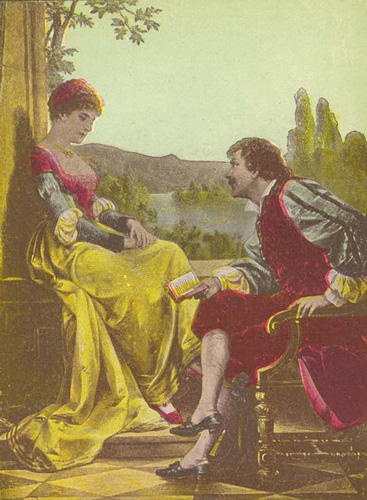
THE LOVER’S TALE.
Woodwork.
Says one writer, "There is a widespread illusion gone out through the world that to have everything in a dwelling 'finished in hard wood throughout,' as the advertisements say, is the only orthodox thing. Paint smells of turpentine and heresy." In this respect it is useless to deny that there is solid comfort in the permanency and genuineness of oak, walnut, or ash, that paint is powerless to give.
But the natural color of woods in many cases may fail to harmonize with the scheme of color to be carried out in the furnishings of the apartment.
In such case, the woodwork should be subjected to delicate, harmonious, painted tints, or polish or gilding, as the case may be.
WINDOW DECORATION.
There is a great variety of woods from which we may choose, but to obtain from them the finer shadings and combinations of color is difficult, not to say impossible.
There is no necessity for making the woodwork that is to be painted unnecessarily substantial or elaborate. Woods such as white maple, holly, poplar, for the light effects; black birch, cherry, mahogany, for darker.
"One fallacy among people," says an architect, "is an immovable faith that the first duty of a human apartment is to look as high as possible. A cathedral, or the rotunda of the Capitol, must have height to produce an overpowering effect. But in an ordinary room of ordinary size, comfort, convenience and prettiness are more to be sought after than height."
Ordinary woodwork must be painted in such shades as will debar it from occupying the prominent position to which positive beauty is alone entitled. Give it a similarity to the ground of the paper, but a little darker, and the rounded surface of any fancy moldings, a shade or two darker. Paint the doors the same, except the panels, which may be decorated, in which case they must be painted the tint of the furniture as a background for the design. This may be very simple, a band of color, a vine in outline or flat color. Trace the outline of wild vines, or ferns, anything graceful. Originality is not demanded. There are good reasons why window casings should start from floor or base, since in this way a visible means of support is given to the entire window, which otherwise has a suspended, insecure look. The panel underneath may be of wood or plaster.
Doors.
Doors are the greatest problem in a room. They monopolize the space on the floor and wall that should be free for pictures and large articles of furniture, and otherwise completely demoralize the apartment. To do away with this inconvenience substitute heavy curtains whenever an impassable barrier is unnecessary; closet doors, for instance, and those between parlors. Again, doors that are much open may be made to slide into the walls. Then, for ornament and as a screen, the doorway may be furnished with hangings, costly or not, as the purse may dictate.
The outer doors are intended as a defense from intrusion from without. It is not really good taste to have these doors of plate glass as that militates against the primal idea of strength and protection.
A Door Divan.
Chairs and sofas we have without end in variety and beauty. Every alcove and nook in every possible sort of room has been thought of and provided for except the one place that exists in almost every house and is the one place where people are always wanting to sit—that is the doorway itself. Folding doors between communicating rooms are seldom closed. An ordinary chair within a few feet of the space never looks well. It shows its back to one room or the other and is in the way.
A divan is an addition to any decorative arrangement of either room. It does not interfere with any graceful drapery that may be arranged at the door. It is decidedly useful, convenient and gives a certain touch of the unusual to the room.
An Improvised Bookcase.
A superfluous doorway or window too often mars the effect of a room, and the present day architecture, as found in cheap apartments and houses, frequently abounds in this sort of generosity.
To surmount the difficulty a very useful inclosure can be constructed by placing two uprights and a few shelves within the door jamb, or against it, as the case may be. Staining or painting them to match the rest of the woodwork is a small matter, while arranging brass rods and pretty curtains is not much more.
Screens.
Screens are a necessary object of household adornment. It is not requisite that they should be expensive, but the uses to which they can be put are legion. A plain frame of hard wood, or pine stained, rectangular, three or four inches wide and one inch thick, furnished with feet, and with or without castors, is all that is necessary. Covering may be done with a great variety of materials, cheap or dear. Ornamentation may be applied, embroidered, sketched, outlined, or painted. If the screen is made in two or three parts to fold like clothes bars, feet will not be necessary.
A rustic fire-screen is a unique affair, handsome and useful where there are open fires, as a shield from heat in cold weather, and as a screen for the emptiness of grate or fireplace during the summer. It is formed from natural branches, two straight and two crotched ones, from which all the smaller branches and twigs have been cut away so as to have but little more than protruding knots. When these are well seasoned, rub, brush and rebrush, both with a soft brush and a stiff one, to remove from every crevice in the bark every loose particle of moss and dust. Then, with liquid gold, gild the bark all over, or, if preferred, gild only the bare wood where it is exposed at the ends and where the limbs are cut off, and give a touch of gold to every crack or protuberance, or, if a smoother finish is desired, remove all of the bark and smoothly gild or enamel the whole surface.
The screen, suspended from the upper crosspiece, is a fringed silk rug woven on a hand loom, as old-fashioned carpets were woven. It falls freely from the top, its own weight keeping it in place, but it might be tied to the standards—half way down and at the upper corners—with bows of braid, soft ribbon or with heavy tassel-tipped cords, or a smaller rug without fringe might be suspended by gilt rings and finished at the bottom with a row of tassels in mingled shades.
In a small apartment, where the radiator is an objection, hang on the wall over it a large picture, placing before the unsightly heater a screen of not too high dimensions. If a space is too large for your picture, hang on either side a bracket, on which place a quaint jug or jar.
For a sewing-room, or, in fact, any apartment where the weekly mending is done, a darning screen is wonderfully commodious. Its conveniences consist of two capacious pockets, to hold stockings or any garment fresh from the laundry and needing attention; a handy shelf whereon to place one's sewing, a tidy little cushion with scissors and loosely swung by ribbons to one side.
ORNAMENTAL SCREEN.
It is a delightful bit of property to serve one, while seated at an open window in summer time or upon an upper veranda with one's work, looking out over the sea with the perfume of flowers in the air.
Trim the skeleton screen to harmonize with the fittings of the room.
A carpenter constructed the framework for the two panels, with the bar across the top, and the little shelf for twenty-five cents. The pine used was an old packing box. The panels must be three and one-half feet high and eighteen inches wide, made of strips three inches broad. The shelf should be eight inches wide and twelve inches long.
Four yards and one-half of chintz in cream-tinted ground, sprinkled with Dresden nosegays gaily dashed with pink and delicate green color, eight cents a yard. Four grades of delicate pink silesia and two and one-half yards of unbleached muslin for interlining, made an item of fifty cents. Hinges and corners and nail-heads of brass, satin ribbon and tacks, by considerable calculation, can be pressed into the amount of seventy-five cents.
A Saturday morning industriously spent in the upholstery of the little screen presented it in completeness.
Screens can be used to protect from drafts of air, by day or night, to keep the sun from an exposed spot on the carpet, to shade the light from weary eyes, to temporarily close archways that have no doors, and to conceal a door that is not often used. They will divide a large room into two small ones when a sudden influx of company arrives, or even close in a corner for the same hospitable emergency. They make delightful nooks in sitting-rooms for the little folks' playhouse, or they may screen off, from the morning caller, a temporary sewing-room in the back parlor, and in sleeping-rooms, occupied by more than one person, a cosy dressing-room may be made by their use.