Visiting Cards. (continued 7)
Reading edition
Say money is "plentiful," not "plenty."
Say "between you and me."
Say "If he should live," "If he should come," instead of "If he comes," "If he live."
Don't say "I have saw" for "I have seen."
Don't say "dress;" if a lady, say "gown." The word dress applies to the entire toilet. Gown, to the one article.
Various Hints on Etiquette.
Enter a room as if you felt yourself entitled to a welcome, but wished to take no undue advantage of it.
Do not press a favor where you see it will be unwelcome.
Treat all the guests you meet at your friend's table, for the time being, as your equals.
A very trifling and yet important thing that every woman should know is that it is exceedingly inelegant in rising from a chair to raise herself by pressure on the arms. Unless she is old or infirm she should rise without assistance.
Do not rush into a friendship with everybody you meet. Friendships so quickly made are quickly broken.
In another man's house do not take upon yourself to play the host—not even at the host's request.
In making gifts let them be in proportion to your means. A rich man does not thank a poor man for making him a present which he knows the giver cannot afford.
Do not claim the acquaintance of a man of rank on the ground that you once met him at a house to which you had been invited.
Let it be said of you as it was said of Macaulay, that he remembered everything, "except an injury."
In making calls, do your best to lighten the infliction to your hostess. Do not stay long; and do not enter upon a subject of conversation which may terrify her with the apprehension that you intend to remain until you have exhausted it.
Do not give another, even if it be a better, version of a story already told by one of your companions.
The touchstone of good manners is the way in which a man behaves to his superiors or inferiors.
It is not proper for a gentleman to call upon a lady unless he has first received permission to do so.
It is not proper for a gentleman to wear his overshoes in the drawing-room.
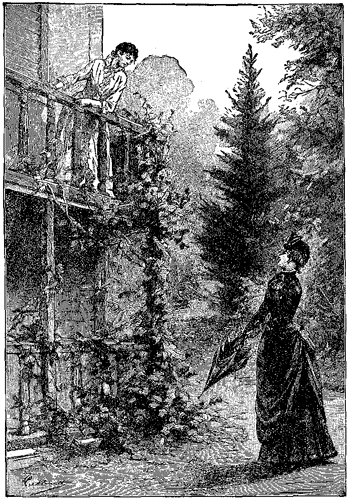
A MORNING WALK.
Children or young people should never monopolize the most desirable positions and most comfortable chairs.
No gentleman will smoke while walking, riding or driving with a lady, or while speaking to her in the street. Sometimes, at informal summer resorts, there is a little latitude allowed here.
If a dinner party is given in honor of a lady, it is the host's place to go in to dinner first, taking in the lady in whose honor the dinner is given. Furthermore, it is proper, under some circumstances, for the hostess to go in to dinner last with the husband of the lady whom the host is escorting.
It is proper to help all the ladies, including those of the household, before any gentleman is helped, no matter how distinguished a person he may be.
First Attentions for Ladies.
When the visitors are gentlemen, and only a mother and daughter are at the table, the maid ought first to serve the mother, then the daughter and last the gentlemen. If the mother serves tea at luncheon she helps the daughter first, and after her the men guests. The rule is always that a lady takes precedence.
On leaving the table at a public place, such as a restaurant or hotel dining-room, the lady precedes the gentleman.
Apples are pared, and eaten in small quarters, at dessert. Grapes are plucked from their stems, and the pulp squeezed out in the mouth, while the fingers hold the skins, which are laid at one side of the plate. Bananas are peeled, cut in thin slices, and eaten with a fork. Peaches are eaten after paring, with a silver knife and fork. Oranges are skinned by cutting in quarters, or left whole, and the sections are then pulled apart, and eaten, rejecting the seeds into the hand.
Celery is usually dipped into the salt-cellar, and eaten from the stalk, or it can be cut on the plate, in small bits, and eaten with a fork. When dining at a hotel you can partake of the side dishes on the same plate that meat and potato have been served, or ask the waiter to change your plate, as you prefer.
When fried eggs are used for a breakfast dish, they are put upon your plate, from the side dish; but in many homes, eggs are baked in small dishes, each person being served with a dish, which should be well buttered before putting in the egg to be cooked.
It does not matter upon which side of her escort a lady sits at table. The gentleman will draw out a chair for the lady, if a waiter is not in attendance to do it, and take the next seat himself.
When passing your plate to be helped a second time, lay the knife and fork at the left-hand side.
Do not, if talking to a friend, drop all conversation so soon as a child requires attention, or has some childish remark to make.
When in parlor, or drawing-room, if a woman, standing, hands a cup, a book, a flower, or any article to a man who is seated, he should rise to receive it. This rule is without exception.
Minor Usages of the Best Society.
When a man offers a lady any civility, a stranger or an acquaintance, opens a door, hands her a parcel she has dropped, or offers her a seat, he should lift his hat at the same moment.
If a young lady accepts the escort of a gentleman to an entertainment, she should never accompany him, at its close, to a restaurant for refreshments unless she is chaperoned by a lady much older than herself.
"Good-evening" is a proper salutation upon entering a room for a call. "Good-night" upon retiring at its close.
A man on horseback, who sees a lady wishes to stop him, will dismount and walk by her side, leading his horse, for there are few occasions on which it is permissible to stand talking on the street.
A lady may permit a man walking with her to carry any small parcel that she has, but never more than one.
A lady wishing to avoid bowing to an undesirable acquaintance, must look aside, or drop the eyes, for if the eyes meet a bow is absolutely necessary.
If a lady asks a man to accompany her to a place of amusement, she must provide the conveyance.
If a lady invites a man to drive with her, he should walk to her house, unless the distance is too great, when she should offer to call for him. If this is the case, he should watch, and, if possible, meet her on the way.
Do not refuse to accept an apology; even if friendship is not restored, an open quarrel will be averted.
Do not be familiar with a new acquaintance. One can be courteous without familiarity.
Breaches of Etiquette.
It is a breach of etiquette to remove the gloves when making a formal call.
It is a breach of etiquette to stare around the room.
It is a breach of etiquette for a caller who is waiting the entrance of the hostess to open the piano or touch it if it is open.
It is a breach of etiquette to go to the room of an invalid unless invited.
It is a breach of etiquette to look at your watch when calling.
It is a breach of etiquette to walk around the room when waiting for the hostess.
It is a breach of etiquette for the caller to open or shut a door, raise or lower a window curtain, or in any other way alter the arrangement of a room.
It is a breach of etiquette to turn your chair so as to bring your back to some one near you.
It is a breach of etiquette when making a call to play with any ornament in the room, or to seem to be aware of anything but the company present.
It is a breach of etiquette to remain when you find the host or hostess dressed to go out.
It is a breach of etiquette during a call to draw near the fire to warm your hands or feet, unless you are invited by the mistress of the house to do so.
It is a breach of etiquette to make remarks upon a caller who has just left the room, whether by the hostess or visitors.
It is a breach of etiquette and a positive unkindness to call upon a friend who is in reduced circumstances with any parade of wealth in equipage or dress.
It is a breach of etiquette for the hostess to leave the room when visitors are present.
It is a breach of etiquette to assume any ungraceful or uncouth position, such as standing with the arms akimbo, sitting astride a chair, smoking in the presence of ladies, wearing your hat, leaning back in the chair, standing with legs crossed or feet on the chairs, leaning forward in the chair with elbows on the knees. All these acts stamp you as ill-bred and unpolished.

IN addition to the ordinary rules of etiquette, official society in Washington City is governed by a code of fixed laws. The social observances of the White House are prescribed with great exactness, and constitute the Court Etiquette of the Republic. At the very commencement of the Government under the Constitution the social question became one of great magnitude, and in order to adjust it upon a proper basis, President Washington caused a definite Code to be drawn up; but the rules were too arbitrary and exacting to give satisfaction, and society was not disposed to acknowledge so genuine an equality as the code required among its members. Frequent and bitter quarrels arose in consequence of the clashing of social claims, and at last a code was agreed upon, which may be stated as follows:
The Recognized Head.
The President and his family are recognized as the head and front of the social structure. The President, as such, must not be invited to dinner by any one, and accepts no such invitations, and pays no calls or visits of ceremony. He may visit in his private capacity at pleasure.
An invitation to dine at the White House takes precedence of all others, and a previous engagement must not be pleaded as an excuse for declining it. Such an invitation must be promptly accepted in writing.
During the winter season, a public reception or levee is held at stated times, at which guests are expected to appear in full dress. They are presented by the usher to the President, and have the honor of shaking hands with him. They then pass on, and are presented by another usher to the wife of the President, to whom they bow, and pass on. These receptions last from eight until ten o'clock p.m.
On the first of January and the Fourth of July the President holds public receptions, commencing at noon, at which the Foreign Ministers present in Washington appear in full court dress, and the officers of the army and navy in full uniform. On such occasions, the President receives first the Heads of Departments, Governors of States, Justices of the Supreme Court and Members of the two Houses of Congress, in the order named; then the Members of the Diplomatic Corps, who are followed by the officers of the army and navy. The doors are then thrown open to the general public, who for the space of two hours pay their respects to the Chief Magistrate of the Nation.
The Vice-President of the United States is expected to pay a formal visit to the President on the meeting of Congress, but he is entitled to the first visit from all other persons, which he may return by card or in person.
Formal Calls.
The Judges of the Supreme Court of the United States call upon the President and Vice-President on the annual meeting of the court in December, and on New Year's Day and the Fourth of July. They are entitled to the first call from all other persons.
Members of the Cabinet call upon the President on the first of January and the Fourth of July. They are required to pay the first calls, either in person or by card, to the Vice-President, the Judges of the Supreme Court, Senators and the Speaker of the House of Representatives on the meeting of Congress. They are entitled to the first call from all other persons.
Senators call in person upon the President and Vice-President on the meeting of Congress, New Year's Day and the Fourth of July, if Congress is in session at the last named time. They also call first upon the Judges of the Supreme Court, and upon the Speaker of the House of Representatives on the meeting of Congress. They are entitled to the first call from all other persons.
The Speaker of the House of Representatives calls upon the President on the meeting of Congress, on New Year's Day, and on the Fourth of July, if Congress is in session. The first call is due from him to the Vice-President and the Judges of the Supreme Court, but to him from all other persons.
Members of the House of Representatives call in person upon the President on the meeting of Congress, and on New Year's Day, and by card or in person on the Fourth of July, if Congress is in session. They call first, by card or in person, upon the Vice-President, the Judges of the Supreme Court, Speaker of the House, Senators, Cabinet Officers and Foreign Ministers, soon after the opening of the session.
Ministers from Foreign Countries.
Foreign Ministers call upon the President on the first of January and the Fourth of July. They call first, in person or by card, upon the Vice-President, Cabinet Officers, Judges of the Supreme Court and the Speaker of the House on the first opportunity after presenting their credentials to the President. They also make an annual call of ceremony, by card or in person, on the above mentioned officials soon after the meeting of Congress. They are entitled to the first calls from all other persons.
The Judges of the Court of Claims call in person upon the President on New Year's Day and the Fourth of July. They pay first calls to Cabinet Officers and Members of the Diplomatic Corps, and call annually, by card or in person, upon the Vice-President, Judges of the Supreme Court, Senators, Speaker and Members of the House soon after the meeting of Congress.
The intercourse of the other officers of the Government is regulated by superiority of rank in the public service.
The intercourse of the families of officials is regulated by the rules which govern the officials themselves.
Besides the public levees of the President, the ladies of the White House hold receptions at stated periods, to which invitations are regularly issued. The President sometimes appears upon these occasions, but is under no obligation to do so.
It has long been the custom for the President to give a series of State Dinners during the session of Congress, to which the various members of that body, the higher Government officials and the Diplomatic Corps are successively invited. In order to show attention to all, and offend none, it is necessary to give quite a number of these dinners during the session.
[The proper titles to be used in addressing the President, Members of the Cabinet, Members of Congress, Judges of the Supreme Court and other Government officials, are found in the Department on "Letter Writing."]
“THE end and aim of all our work should be the harmonious growth of our whole being," says Fröebel. "Know thyself," quoth Epictetus, the Stoic, and, knowing thyself, grow strong of mind, self-centered and self-possessed. "Know thyself," reiterates the modern disciple of Delsarte, since only by knowledge of self can be developed the real personality of the individual.
Grace and self-possession are the aim of Delsarte; it therefore fairly falls within the province of a work on etiquette to look somewhat into the subject. If one would control others he must first control himself, possess himself. Delsarte looked upon the nature of man as a trinity, and believed that the mental, moral and physical should be educated at the same time. Modern education tends to develop man in special directions to the neglect of others. Either the overstrained mental faculties revenge themselves by giving us the nervous, broken-down, mental type so common; or else we have the crude physical type wherein ordinary labor has exercised but a few muscles and joints.
The Three Languages.
Again, says Delsarte, "Man has for the expression of his triune nature three languages, the word, the tone, the gesture. Tones express bodily conditions, pleasure or pain. Words are symbols to interpret thought. Gestures relate to other beings and express our emotions. Of these three, the first receives undue cultivation, since we study all the words that have been said or written, while singers and actors alone cultivate tone or gesture."
Thus it comes that "the soul struggles to speak through an imperfect instrument; sometimes it ceases to struggle and finally has nothing to say."
In labor the man moves, special muscles do special work, but when a man is moved, an undulating "wave of feeling passes over him and his whole body becomes eloquent." A bow may be so careless and jerky as to be almost an insult, or it may be so gracious as to seem a caress. Again, the real self, gracious and beautiful, may strive to express itself through a set of faculties that are hardened and narrowed by decades of self-constraint on the part of himself and his ancestors.
"Physical habits have a way of making themselves felt by a reflex action on the inner nature," and with this axiom in view we feel that cultivation of the Delsartean Art of Expression becomes a vital part of our education to the end that all our emotions and all our tones may become "the outward and visible signs of an inward and spiritual nature." This principle may be called the keynote of Delsarteanism, and Edmond Russell, that modern exponent thereof, claims that as these beautiful, expressive gymnastics are for the purpose of correcting individual deviations from grace, no regular set of rules should be printed for the use of all, but that each special angularity of person or harshness of tone must be corrected by special exercises.
Harmonious Development of the Body.
Nevertheless, there are many set forms of movements by the practice of which none can fail to derive benefit both for the inner and the outer man. Other physical gymnastics seek to give strength to certain sets of muscles to the neglect of others. The rythmical movements of the Delsarte system bring into action each muscle of the body without wearying any, to the harmonious developing of all, since in all, save exceptional cases, it will be found, upon beginning this treatment, that more than half the muscles of the body are unused, while the other, and overworked half, move in stiff and angular fashion.
All students will discover it is first requisite that an "undoing process" shall precede the "upbuilding process." Stiffness of joint, or tension of muscles, whether recognized or not, must first be done away with before "the body can be molded to the expression of high thought." For this purpose the "decomposing," "relaxing" or "devitalizing" motions are given. The old gymnast doubled up the fist and, with great tension, gave a blow which jarred the whole nervous system. The "freeing" motions of Delsarte give harmonious, restful, wave movements to all portions of the anatomy.
Graceful motions are never in the nature of a blow struck straight from the shoulder, but curves and spirals constitute the lines of beauty. Nature shows us this in the free untrammelled motions of a child, or again in man, when his whole nature is so stirred to its best and sweetest depths that he is carried out of his usual tense, conscious self into unconscious rythmic expression of his feeling. What nature does for us in times of great excitement Delsarte will do for us at all times by means of his exercises, practiced until the conscious mechanical motion becomes unconscious, automatic, and the body grows responsive to all high emotions and impulses.
Relaxing the Muscles.
In relaxing movements, the whole arm and hand, shoulder, elbow, wrist, fingers, are shaken until the joints are completely relaxed and a warm, tingling sensation passes through the entire arm. It is then dropped at the side in perfect passivity. The result is twofold—a feeling of repose and controlling power, and an absence of that nervous tendency to "fidget," or handle something, glove buttons, or watch chain, without which a morning call can scarcely be accomplished by either hostess or guest. This alone will give us a sense of perfect rest which we have never before experienced. Similar exercises are given for other portions of the body—legs and feet—a revolving of the head to limber the neck; a revolution of the shoulders and the body to gain that flexibility which is the secret of grace.
Delsartean exercises break up constrained awkward physical habits, establish in their stead restful, graceful, natural ones. Of these there are many classes.
The Delsarte relaxing exercises precede and prepare the way for all others. In their restful removal of nerve-tension they appeal especially to the overworked, nervous class.
The Delsarte sleep exercises are useful in overcoming insomnia. The Delsarte laws of expression give us a key to character, study, and the laws that underlie all art. The Delsarte work develops self-possession. The Delsarte rythmical exercises enable one not only to appear better and feel better, but, by a reflex action, to be better.
In this physical work the first object is an entire, absolute letting go of all unnecessary tension, all tension that has overstrained the muscles through an excess of effort in our daily life, though many times this effort is purely unconscious on the part of the individual. "How many a patient, trusting soul do we see with the muscles of the forehead strained and elevated until the eyebrows never fall to their normal height," or the brows are contracted until the hard lines graven between the eyes ever bespeak either pain or care.
The founders of the Benedictine nuns caught some echo of this truth when, by a rule of their order, no sister among them is permitted to wear a frown upon her brow. And the placid-faced sisterhood evidence in their sweet expressions the close relation between the exoteric and esoteric of our natures; the reflex action between the physical and the spiritual entities of our being.
Art of Breathing.
There are a few general points that may be given here to the improvement of many little habits that unconsciously enslave us and to the "letting go" of the "officious personal endeavor" that we make, as it were, to hold ourselves together—never believing that nature is more capable of the task. After the decomposing exercises comes the practice of one of the first Delsartean axioms: "Control at the center, freedom at the extremities." Without this control the newly acquired flexibility will be weak and affected.
To obtain this control the art of breathing must first be acquired. To do this properly the chest should be inflated and thrown forward by the action of the diaphragm and held as the most prominent part of the body; a position too often usurped by the inferior abdomen. The same motion which throws out the chest should draw in the lower part of the trunk, hanging it from the curve of the spine. In the proper attitude for good breathing the hips turn slightly inward and the chin goes back, but not up. There should be no effort to throw back the shoulders. Take care of the chest, and the shoulders will take care of themselves.
Position of the Shoulders.
Mrs. Edmond Russell says she would "like to make a call that would reach every man and woman in the country. 'Lift up your shoulders.' When one says this nine-tenths of them stiffen at the neck, throw themselves backward and project the body below the waist, the whole figure out of line. No, you should get the poise of a Greek goddess." Lift the chest, with the shoulders down, until it is on a line with the toes. This throws the extension on the center of the body where it should be. The heart and lungs now have full play. Close the lips; draw in the air through the nostrils, using the muscles below the diaphragm as a bellows, until the pressure against the ribs has a bursting sensation. Keep this tension firmly and steadily as long as you can; then slowly and gradually let the breath out through the lips. If you wish to sing, or recite, or even to talk, see what power is at your command.
"Try this breathing, inspiration, retention, expiration—these three movements—at night before you go to bed, when the body is free; in the morning before you dress. When you walk take in great, glorious lungsful of air until full, or deep breathing becomes a habit. Believe me, breathing properly is a certain cure for nervousness, shyness and embarrassment."
It gives command and freedom of motion, a sense of power. Keep the lips closed and breathe only through the nostrils. This is a most important fact to remember, and should always be impressed upon children. The cold air should never be taken directly into the lungs as is the case when it is inhaled through the parted lips. Children, as well as grown people, should learn to keep the mouth closed during sleep; this would prevent many lung diseases, the disagreeable habit of snoring, and the vacant, inane expression produced by an open mouth.
There is no better exercise to acquire a good habit of breathing than reading aloud. Try how much can be read easily, without strain, upon a single inflation of the lungs. Never gasp, catch up, or piece out a breath. "You may add years to your life by the simple act of breathing." Every public speaker knows, or should know, the feeling of repose and self-possession that comes over him as he calmly, silently, faces his audience long enough to draw three of these deep, full breaths. Nervousness has vanished; he and his audience have had time to become acquainted, and, having command over himself, he is able to command the minds of those before him.
Standing and Walking.
When one has learned to breathe properly, then it is that standing and walking may be practiced. Lift up the chest, inflate the lungs naturally, as in paragraph on breathing, then step up to the front of a door, letting the toes touch the woodwork. At the same time the forehead should meet the upper portion of the door, when it may be assumed that a perfect standing posture has been taken. The poise will seem at first to be a little forward of a straight line, but to disprove this it will be found that a plumb line dropped from the ear will fall through shoulder, hip and ankle. The head will be poised as if to carry a burden steadily on the crown and the weight of the body will rest on the ball of the foot, not the heel.
This position may seem insecure at first, as well as stiff and self-conscious. With some this sensation will wear off sooner than with others, according to their adaptability, and the result will be assured power for long, graceful, strengthening walks.
In walking, a common fault is to let the knees bend continuously; this gives a "flabbyness" to the whole personal expression, that always seems an outward exponent of a "weak-kneed" character. The knees, to obviate this, should be stiffened when walking. In the other extreme, most women stiffen the ankle-joint unduly, thus giving a straight up and down cramped walk, which is accompanied by coming down with all force upon the heel, thereby producing a jar throughout the entire nervous system, as well as an awkward locomotion. In this way all benefit of the strong, natural spring of the instep, which tends to lessen this jar and give grace and springiness to the step is lost, and much weariness of the flesh is the result.
Mrs. Russell says: "We have a system of levers to do our walking with, and they act precisely as do all levers. One leg is a lever to pry the body over the other leg, and the latter becomes a pendulum and swings back by force of gravity. When you walk three miles and feel as if you could walk ten, you are walking that way. When you are tired out, you are taking irregular steps and walking on your heels.
"In walking the foot should be used as an elastic arch, the ball striking the ground first, not the heel. Trying to step too far is productive of awkwardness. Hurrying is another cause. It is bad walking to lift up your foot and put it down. If the sole of the foot shows at all, it should be from the rear. What is wanting is elasticity. Swinging the arms in walking, which is universal, is absolutely unnecessary, and purely a waste of strength. Let them hang pendulum fashion."
Stair-Climbing.
"Trained stair-climbers should be the healthiest as well as the most beautiful of women, yet," says Mrs. Russell, "a town of stairs given, and I will prophesy thin, eye-circled, cross-looking women." All of this is to be laid to the fact that most women climb stairs in the hardest and most awkward manner.
"In going upstairs there should be no waddling from side to side, no trudging, no leaning forward, and no apparent weariness. The body should remain erect, the step should be taken with the ball of the foot, and the movement to the next step be made with a springing motion. This produces a graceful, poetic elevation instead of a cumbersome hauling of the body upward, and throws all of the strain upon the strong muscles of the calf of the leg. This slightly accented springing from step to step leads the true system of pacing on level ground; hence, the stairway may be made the walker's gymnasium."
Art of “Letting Go.”
"Relax, relax," says Edmond Russell. "Let go the tense hold of your arms that is wearing out your vitality. You will get rest by doing this. Sleepless people will fall asleep. Stop holding yourself in a knot and relax. Hold up the chest, breathe slowly and deeply through the nose, and relax the extremities."
"Try letting go," says Mrs. Russell; "it is a great rest. You can let yourself go for a few moments in the theater, in a crowd, in church, in the street car, anywhere. It is the universal habit to hold on to one's self with a grip that would almost lift one's weight, muscles tightened, nerves strained to no purpose. The mind is too eager and fast for the body. The result is exhaustion."
"How shall it be avoided? Take the will out of the body when it is not in action. In walking, let the lower limbs do the work; the arms have nothing to do: let them be carried as attachments, pendulums if you will, but at rest." Let the hands fall easily when sitting in carriage, street car, or drawing-room.
On Corset Wearing.
The wearing of corsets meets the strong disapproval of all Delsarteans, as "control of the breath underlies gesture, walk and voice," and a tightened corset-lace necessarily cramps the breathing power. The tight, high collar is also objectionable for the same reason.
An English writer justly observes that "all the greater harmonies and higher courtesies of life must extend over the whole body." Now, in great emotions the chest expands, and especially the lower part where the ribs are freest and intended to expand most, and this part it is that tight corsets most compress to attain the artificial waist. The figure, trying to accommodate itself to the new conditions becomes deteriorated in all directions. The back grows rounded, the ribs fall in, and the stomach obtrudes itself unduly; all this to the injury of health and of harmonious beauty of form.
Mr. Russell also asserts that a forced compression of the waist damages the power of the figure as an instrument for the expression of emotions, the result of all this being an unfavorable reaction upon the mind and character of the unfortunate victims. One of his maxims is: "A beautiful woman is at her lowest plane in a tight-fitting dress; an ugly woman on her highest in drapery!"
General Remarks.
Educated men and women of to-day study social, domestic and political economy, forgetting that vital economy that Delsarte teaches is more essential to our interests and the interests of our descendants.
"Relax, relax, relax!" one is tempted to cry in unison with Edmond Russell. Give us what there is in you. Make yourself "a being whose body is the exponent of the soul responsive to every command of the spirit."
Cease limping through life on high-heeled shoes. Cease lifting the shoulders, fidgeting the hands, painfully raising the eyebrows, and contorting the face into a meaningless smile. Remember that all facial contortions leave indelible traces in their wake. The laugh, or broad smile that half closes, or squints the eyes, engraves those fine ray-like, much-dreaded lines about the eye, known as crow's feet. Remember that "laughter ages the face more than tears." Smile more often with the eyes. Let them light up and laugh for you. Trust me, in most cases a vast improvement will result, since scarcely any adult laughs well, and if there is some trait of affectation, frivolity, cruelty, or even coarseness in the character, uncontrolled laughter will be the sure exponent thereof.
Rest more. Do not try to accomplish too many things at once. Do not let your thoughts be weeks or days ahead of you and the task in hand. This would be imposing double duty upon the already strained physique. If the body is at one store, do not let the mind fly off to shop in half a dozen other stores to snatch "bargains" from the hands of other over-burdened ones.
Straighten out the frowns on your strained brows. Cease carrying numberless loose packages, and loads of heavy skirts in your hands, and struggling with the well-dressed mob to secure coveted bargains. They are dearly bought at the loss of beauty, youth and repose. One such day ages the face. If you do not believe it, ye dwellers in cities, go stand before your mirror next time you reach home, dusty, rasped, fragmentary, weary from a day of counter-shoving, neither mistress of yourself nor those about you, and the face that meets your gaze will tell its own story.
Rightly does Herbert Spencer say, "We have had something too much of the gospel of work, it is time to preach the gospel of relaxation."
And this chapter will have reached its aim if it shall be the means of inducing any to become disciples of Delsarte, restful converts of this gospel of relaxation, which is one with the Gospel of Beauty.
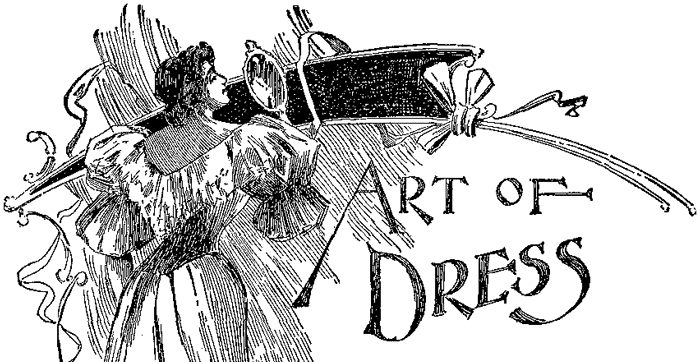
“DRESS may be called the speech of the body," says Mrs. Haweis.
A woman's dress should be so much the expression of herself that, seeing it, we think not of the gown, but of the woman who is its soul. The true art of dress is reached when it serves only to heighten the charms of the wearer, not to draw attention from her to center upon her garments. One writer on beauty in dress claims that "the object is threefold: to cover, to warm, to beautify," and in dealing with this latter point farther says that, "rather than to beautify, it is to emphasize beauty." To this statement should be added that its mission is also to minimize or do away with defects.
Most dressing is done to enhance the beauty of the face, but women should remember that the tint of the complexion, the color of hair and eyes, are but a small part of the personnel. The physique must be taken into account. The "type" is a fact fixed and inevitable, and the woman is wise who sets herself steadfastly to "develop and emphasize its beauties and overshadow and efface its defects."
It is only by real study that a woman grows to understand and analyze her "type" and suit all accessories to her own personality; to adjust, as it were, her "relations." Art, after all, is simply, as Edmund Russell admirably defines it, "relations, the right thing in the right place."
Study your own individuality and assert it in your dress. "No woman need be ugly if she knows her own points," and some points of attractiveness every woman has. Lord Chesterfield, that cynical man of the world, assures us that "no woman is ugly when she is well dressed." That is, dressed with reference to revealing good points and concealing weak ones. Time spent in this study is gain, when one remembers in how many ways actual outward ugliness is an impediment. "The greater portion of ill-tempered, ugly women are ill-tempered simply because they believe themselves hopelessly ugly." A woman, finding her fairer friends constantly preferred despite her vain attempts to please, grows disheartened, then sarcastic, envious, ill-tempered, half unconsciously.
"Knowledge is power; beauty and knowledge combined are well-nigh all-powerful."
Stout and Thin.
Texture, color and form must all be considered in relation to the personal appearance or "type." The beautiful in itself is not always a safe guide, but its beauty in relation to the wearer must be the test. Fair, delicate, slender women make a great mistake when they over-weigh themselves with rich, heavy fabrics, no matter how beautiful these may be in themselves. Instead, they should keep to clinging, draping materials, sheer lawns and shining silks.
On the contrary, the very stout woman may wear all manner of rich gownings that fall in gracious massive folds. Clad thus, her size will have about it a restful element of repose. Let her beware of closely fitted gowns. These tend to enhance the size they are supposed to conceal. Watteau or Princess robes falling from the shoulder in unbroken lines render her imposing. Little ruffles should be avoided, or frills of lace, and whatever drapery there be should fall from shoulder or hip; this gives long curving undulations that follow every movement.
The stout woman should leave black satin severely alone; reflecting the light, it reveals form and size relentlessly. "Revealed form is vulgar, suggested form poetic," says the high art of to-day, and who would not be poetic and gracious if she could? "If stout women," declares Edmund Russell, "would learn to move in grand, slow rhythm, and wear textures so heavy that the lines of their figures were concealed, they would have a grandeur and dignity that no slender woman could hope to attain."
Women must recognize their defects before they can hope to correct them. A tall, angular woman must adopt soft, fleecy materials, so made that they can float and curve about all ungraceful angles, hiding, or softening them. She of a deficient figure must never wear a plain, tightly fitting gown, unless it is relieved, and filled out with soft full vests, or veiled with falling folds of lace.
There is only an occasional perfect form that will bear the merciless revelation of the plain, tight habit, and even then the suggestion of a concealing drapery heightens the beauty of the revealed curves. "All dress should be governed by shawl instead of glove rule," assert the latest canons of costume.
Tall or Short.
There are proportionately more women that are too short, than too tall. Always a little sensitive to this defect, some try to increase their stature by high heels, which renders their gait awkward, besides being injurious to health. Others endeavor to add to their apparent height by cultivating a long waist. This they do at the expense of shortening the lower limbs, thus making themselves seem shorter than they actually are. Others strive to attain the same end by dressing the hair high, in this way too often adding to the apparent bulk of the head and giving a top-heavy appearance to the figure. It is here that a full-length glass becomes almost a necessity in the dressing-room, so that the entire effect of the figure may be observed at once, and defects of this nature detected at a glance. Sometimes a high ornament worn at the top of the head apparently increases height, but beware of any bulky style.
Long lines of drapery from shoulder to foot give the effect of height. Horizontal lines crossing the figure shorten the form.
Short, stout women, by wearing short basques that make a line about the hips, or ruffles and puffs at the shoulders, increase their bulk and shorten their stature.
Women too tall and slender use horizontal lines and puffed and ruffled effects to great advantage, thus increasing the apparent size of an arm by puffs and surrounding bands, or hips by the descriptive line of a basque.
The way of wearing the hair, also, may greatly change the whole appearance. Worn at the nape of the neck it is domestic; lower, romantic; on a level with the head, classic; on top of the head, stylish.
Decorations.
A tenet of Delsartean art asserts that, "A decoration is to make something else beautiful and must not assert, but sacrifice itself. Ornament that has no use whatever is never, in any high sense, beautiful."
A trimming with no reason for being is generally ungraceful. Buttons which fasten nothing should never be scattered over a garment. Bows, which are simply strings tied together, should only be placed where there is some possible use for strings tied together. In short, according to Mrs. Haweis, "Anything that looks useful, and is useless, is in bad taste." For instance, the dress imitating a peasant or a fishwife is never so graceful or piquant as the real costume, since the handkerchief covering the peasant's bare neck is much more picturesque than a bodice trimmed in form of a kerchief.
Slashes are at all times a most beautiful decoration. At shoulder, elbow, breast, edge of a flattened cap, the knees, cut just where a devotee of comfort might cut them to give more freedom of movement. The slash forms an unrivalled opportunity for displays of color. Deep blue, parting to display a glimpse of amber, white through black, the combinations are endless, and the whole gives the idea of a glimpse of an undergarment through an outer one. The contrast of a lining of vest, sleeve or panel is also a harmonious ornament.
Décolleté Costume.
It is not the province of this work to decide the vexed question of the low-cut bodice for full dress. In this respect every woman will be a law unto herself, and every woman knows in her own mind the border line below which the corsage should not fall. All, however, do not know how greatly the hard, horizontal line of the low-cut bodice diminishes the appearance of height. Herein lies the great advantage of the heart or square-shaped opening showing the throat, since a dress high behind, or on the shoulders, gives all the height. Last, but not least, all the lovely curves of the throat are shown in this way, and any suspicion of angularity of the collar bone is hidden.
A dress should never end directly upon the skin. The line of contact should always be softened by an edge of lace, tulle, or ruching. First, for the idea of cleanliness; second, because "nature abhors sharp edges." In flowers there are contrasts of color, but they are always softened, each shade stealing a little from the other as they blend.
A regularly décolleté gown is properly worn only during the same hours that a gentleman's dress suit is donned, that is, "from dusk to dawn."
Sharp edges should be avoided as much as possible in the entire costume. A glove that ends exactly at the wrist bone, or a boot at the ankle joint, with a straight line, is always ugly; so are dresses when they are cut in a circle close to the juncture of the neck with the shoulder, giving the neck a decapitated appearance. The line of contrast should always be softened with an edge of lace, or a necklace, and only round, pretty throats should dare such a display.
The skirt ought to appear, even if it is not, as a portion and a continuance of the bodice. That is, "if the bodice be cut to fit the figure tightly, the skirt ought properly to be plainly gored. If the bodice be full at the waist line, the skirt also should contain fullness, for this form signifies a loose, full garment bound at the waist with a girdle."
Full waists and plain skirts, or vice versa, betray at once that skirt and bodice do not belong to each other. This course, however, is admissible at times, for instance, in case of the lovely, loose tea-jackets worn now, or in donning any cool lawn blouse, or dressing sacque for comfort.
The trained skirt is a most graceful garb, adding to height and diminishing stoutness, but it is never suitable for the street. For house, evening or carriage toilets it is eminently proper and pretty. All the movements of the form are softened and dignified by its sweeping undulations until one comes to feel that short skirts are really a mistake for a house gown, since so much grace and beauty of motion are sacrificed thereby.
Graceful Sleeves.
Few women have beautiful arms above the elbow. Fatness is not correctness of form, so that a short sleeve, no sleeve, or the painful strap which is all so many evening dresses can boast, is by no means always a thing of beauty.
A sleeve that falls in lace and frills just below the elbow hides many defects, besides softening, and rendering delicate, the lower arm and the hand.
A sleeve long enough to turn upward as a cuff, is much more effective than a simulated cuff, just as the thing itself is always better than an imitation. A sleeve that stops short at the wrist joint should be relieved by lace to be artistic.
Full sleeves improve every form. The very stout should never make the mistake of wearing a very tight sleeve, since to do so simply increases the apparent size of the arm. A full sleeve bound to the arm between joints gives an impression of comfort and beauty like the slashed sleeve before mentioned.
Painters have immortalized beautiful sleeves, as well as beautiful costumes. Indeed, to decide on really beautiful gowns one must study the great masters—Gainsborough, Reynolds, Watteau—until the study of costume becomes what it should be—a study of art.
Purchasing.
There should never be trying contrasts in the quality of the various articles that go to make up the sum-total of dress. To expend almost the entire allowance on a gorgeous bonnet that puts every other detail of the costume to blush, or to wear a shabby cloak with an elegant gown are examples of injudicious expenditure.
Instead, let it be remembered how many articles must be purchased and then so expend the sum to be drawn upon that it will not be exhausted on two or three expensive articles to the neglect of the necessary accessories.
An important point to be considered is the surroundings in which the garments are to be worn. Whether one is to drive over country roads or walk city streets; whether they must last one season or more. In this latter case care should be taken to choose quiet colors and inconspicuous patterns.
If the gown must serve many purposes let it be of some plain wool goods, tastefully made, hat and gloves harmonizing in tint, the whole bearing the imprint of the true lady and suitable for almost any occasion. At the same time the entire outfit will have cost no more than the dearly-purchased silk gown that left no margin for hat, gloves, or shoes, and must be worn on every occasion, suitable or unsuitable, to the discomfort of the wearer and the ruin of the gown.
If riding about in the country, choose wool fabrics that will not crease easily, or show dust, and for summer, cotton materials that will come bright and fresh from the hands of the laundress.
The Young Girl.
Sweet simplicity alone should be the guide for the young girl's costume. The dewy bloom of the cheek, the clear young eyes, the soft rosebud lips, the sweet curves of the lithe form that come but once in a lifetime, are what we want most to see.
No heavy velvets or gorgeous trimmings should be worn by any girl under twenty-one. To call attention to her ornaments is to detract from her priceless ornament of sweet and fleeting youth.
Simple muslins and wools, soft, clinging silks and gauzes should be worn. Flowers are preferable to jewels. A necklace of pearls may be worn, should the complexion warrant, but other than this is a waste of money, and a waste of beauty.
Soft colors, where the skin permits, simplicity in cut, little if any trimming, and we have the costume most fitting for a girl to wear, and when we say "fitting" we have found the key to perfect dressing.
Diamonds and Precious Stones.
Women seem to look upon diamonds as a sort of social parole, while, in truth, there are but few women who can wear them without detracting from their own brilliancy; without sacrificing themselves to their jewels.
Dark, brilliant eyes and dazzling teeth may wear them safely, or, very clear, cool skins with bright, blue eyes may dare them at their own risk. Yet, to "tip the ear with diamond fire" is sure to call attention from the best points of the face, and in too many cases simply effaces and outshines the face itself.
Edmond Russell severely criticises diamond solitaires for earrings and esteems the stone a difficult one to wear except when small and used in quantities as settings for other jewels.
The secret of good taste in jewels is for a woman to seek out those gems whose colors harmonize with or heighten her own tints, as she does the shades for her gown, and confine herself to them. It is quite the thing now to have a special stone, as it is to have a special perfume. For instance, the turquoise is very becoming to some (it is Mrs. Langtry's stone), garnets or rubies to others. The pearl, where it can be worn, softens the face more than any other jewel. The moonstone is very nearly as effective, as well as the beautiful opal.
Rings, some authorities say, should be worn in barbaric profusion, or not at all. A slender, beautifully modeled hand can afford to be guiltless of rings. One less perfect in shape, but white, can be enhanced in charm by a blaze of jewels.
Plump Women.
In the days of the painter Rubens stout women were the most fashionable creatures that walked the face of the earth. Rubens would paint none other than those of very firm build, and so artistically did he drape them, so cleverly did he pose them, and so well did he color them, that every woman aspired to sit for his pictures. To be painted by Rubens was a guarantee of beauty, grace and feminine loveliness of every description.
The Rubens woman is a stout woman of good figure. Stout women nearly always have fine forms. Their bust line is good. It is low and the neck curve full, even if not very long. The Rubens artist makes the most of these good points and conceals others.
In modern times, however, the stout woman finds that the fashions are rarely meant for her. In view of this, a number of wealthy New York women have banded themselves together in a Rubens Club, with one of its chief aims the designing of dresses for the members. For this purpose a professional designer is chosen, an artist of no mean merit.
The president of the Rubens Club, who is a woman of beauty and wealth and great loveliness of manner, had the honor of having the first gown designed for herself. This was an evening robe of great beauty, a regular Rubens gown.
The materials were dead white cashmere and dull black satin, with a very little lace and jet. The under gown, or the gown itself, more strictly speaking, fell from the shoulders in a long, loose robe. In the front there was a center trimming of black satin and lace and a heavy ruffle of lace outlined the bust and suggested the waist. A few jets were added. The back fitted closely, and around the foot extended a deep band of the black.
Over the Rubens gown fell a robe of the satin. It was caught at each shoulder and fell into a train three feet long when the wearer walked. In repose it lay around her feet, giving her height and a becoming setting.
The good points of this gown are, first, the way it showed off the very plump neck of the wearer. The fine throat line was visible, but at the shoulders, where too much massiveness takes the place of fine firm flesh, the robe was draped. The arms were likewise covered at the top, their thickest part, and, as the robe fell over them when in repose, much of their apparent size disappeared.
The robe had one very odd feature. The train was a doublet one. The back of the robe was little more than walking length, but the ends were very long indeed. This made a square court train like a monarch's robe, and could be easily brought front by the hand, for trimming or drapery when the wearer was not walking.
Black Satin and Sparkling Jets.
In choosing the color of the gown to be snow-white instead of cream color, the artist knew what he was specifying. White is a diminishing color, while cream color enlarges. The same with black satin. Satin, being full of lights and shades, is uncertain in size, and it is preferable to silk or velvet, which makes the person thicker. The jets are dressy, wicked little ornaments that wink at you unexpectedly and disappear.
Much pains are taken in choosing colors, and then comes the artist's real work. The hardest thing is to fit out his patrons with street gowns that will be conventional, and yet Rubenesque. To do this he takes advantage of the cape idea. A stout woman in a neat fitting gown, not too close under the bust, looks picturesque with a golf cape swinging from one shoulder. It gives her height. The dolmans that open in front and fall low at each side are admirable also, according to his ideas.

“A THING should be beautiful in itself, and it should be beautiful for you." "Good dressing includes a suggestion of poetry;" but to gain this poetic grace careful study must be made of hair, eyes and skin, for a dress that is beautiful in itself, or beautiful on one wearer, may be a failure on another.
Study to "compose" your costume well; then, donning it, cease to think of it or yourself. Lead up gently to all contrasting colors that are introduced into a costume for linings of loose draperies, sleeves, or as vests. Glaring contrasts, or "spotty" effects should be guarded against. All brilliant colors in a costume should be reached gradually like a climax in music, or a high light in a fine painting. Otherwise there is a jar, and the harmony of relation is broken.
Complexion Determines Dress Colors.
Sometimes a color used sparingly in a knot of ribbon, or glimpsed as a lining, is becoming, while the same color, used in quantity, or as a ground color of the costume, might prove inharmonious with the complexion.
It is well for every woman to choose a certain proved range of colors that she can bear, and to venture cautiously or seldom on new experiments. These colors will be found like a musical scale, to harmonize well in almost any combination. Thus beauty, convenience and economy are all consulted by loyalty to these proved shades.
Endless arrangements might be suggested on the economical side of the question. The light evening silk of the season before may be used for lining or form the long loose front of the tea-gown of the present. The rich draperies of last year's carriage gown may fitly furnish forth the natty velvet vest and dainty bonnet to wear with this year's street suit, and nothing be lost.
One more caution as to colors. The very delicate blonde who has reveled in palest, daintiest shades must beware of presuming too long on that evanescent bloom, lest she find herself basing the color of her dress on a flower that faded years ago. Or else, maybe, on one that has unfolded into a richer bloom, and by not adapting her color scale to the changes of time, she loses all the beauty of the present.
Another mistake women make is to forget that lovely childish curves of early youth change with the advancing years and the babyish style of dressing, so becoming then, may be worn too long. The rounded throat of the plump woman becomes muscular all too soon, and the delicate throat of the slender woman is too prone to lose its soft outlines.
The changes of color that occur almost always in cool, pale blondes are often but changes in beauty; still, these changes in complexion must be met with changes in dress.
Combinations of Color.
"A secret of artistic dressing is to match the hair as nearly as possible for day and the eyes for evening."
"The producing of an all-over effect by drapery, veiling, and head-gear of the same shade is most thoroughly artistic."
These two high art axioms may be given as a safe foundation for the choice of colors, in following which no one can greatly err.
The woman of mezzo-tints, of soft half-tones of complexion, hair and eyes, loses all color and force when she clothes herself with deep, intense hues. Low, warm, unaggressive shades are needed as a background to bring out all her own best points.
"Some people," says Miss Oakey, "have many possibilities of form and color which may be brought out under special treatment, but most people have only the one possibility which can be improved upon." Certain women may be dressed in one set of colors that emphasize the whiteness of their skin; and, in still another, that bring out their own color, while others must be content with one certain range of tints.
Red Hair, with Brown Eyes.
This type of woman may wear amber, deep lined with fawn or pale yellowish pink; dark, rich red, like a red hollyhock; creamy-white (creamy-white satin with pearls and old point lace); olives and dark greens, claret, maroon, plum and gold color.
Jewels—topaz, amber, pearls and gold ornaments.
All manner of lovely combinations may be made out of these colors; especially dark amber, approaching brown, contrasted with pale fawn or gold color. Topazes for jewels. Sable furs and the deeper shade of mink are exceedingly becoming, and the same colors of the fur can be had in most dress materials. There is also a certain shade of maroon which makes red hair a positive golden, and throws into bold relief the clear white tint of the complexion even when there are freckles. These same freckles are also improved by the wearing of this maroon color.
Red Hair, with Gray or Green Eyes.
This type may wear all the above colors, adding to them all the browns and purples. Amethysts may be worn with the grays. Grays and any of the above greens contrast beautifully.
The Ineffective Type.
This style of woman has dull, light brown hair, no brilliancy of complexion, usually gray or blue eyes. The type often numbers some of our most spiritual and intellectual women, as well as, very often, our constitutionally delicate women. It is a type very difficult to dress effectively. The black of velvet may be worn, and soft wools relieved by velvet or lace; creamy white, by casting reflected lights, clears the complexion. Be careful of this however. Warm, pale pink may be worn with it. Invisible blues and greens (in other words, very dark shades). The palest possible pink may be combined with these as linings, vests or ribbons. Pale pink, lined with a pink almost white; pale, but not chalky blues. Blue should not be worn in silk, unless of a very dull or lusterless quality.
Stylish and Appropriate Jewels.
If the eyes are blue, sapphires may be permitted (a gray sapphire is best); pearls, the greenish turquoise, moonstones, intaglios, cameos, antique coins.
This ineffective type frequently, because of better health, gains a warmer glow to the skin and a richer tone to the hair. In this case there may be added to the above colors yellow-browns, fawn-browns, and a little lighter green, contrasted with the darker greens.
Brown-black hair, steel-gray eyes, fair skin with color in cheeks, may wear all greens (save the very light), cream-white, fawns, grays, browns, reds, violet, a rich pink, and all blues. If any type can wear black with impunity, this can. For jewels, any desired stone.
Black hair, very dark eyes, golden-brown skin, warm color, brilliantly white teeth, may wear rich browns, clarets, deep amber, cream-white, warm pinks and flame-color. Avoid black and very pale colors. Yellow may be worn sometimes, but with a warning here to the black-haired type in general. A writer on color wisely says that "yellow is a color that should be suspiciously approached with black hair. It is very often but a vulgar contrast." For jewels, diamonds and all rich colored precious stones.
Black Hair, Rather Sallow Skin.
This style can wear black, but it must be relieved by white laces to soften and light up the face, thus giving the "effectness of a drawing in black and white." Dark grays, the dull reds occasionally. There is a peculiar yellow-red, dusty, unluminous, very dark, that can be profitably worn. Flame-color can be worn as linings, or trimmings, though since there is so little color in this style, no colors seem to have a true relation to it.
Dull gold is about the only ornament that can be worn, save a delicate onyx cameo. Flowers: white water-lilies, camellias, or the darkest, duskiest, damask roses, and none of these in such profusion as to appear conspicuous.
Black Hair, Clear Skin, Blue Eyes.
This beautiful combination gives a wide range of color for selection. Blues, especially sapphire shades, dark reds, pale pink, blue grays, white, both cream and blue-white, and black, solid and transparent. For jewels, pearls, sapphires, opals, turquoise, diamonds. White flowers, also violets, pansies, etc.
The woman with blue eyes should always have some blue about her. It is really extremely interesting to notice how blue brought up close to the throat and then a bow of the same in her hair intensifies the blue in the eyes, making even the pale, wishy-washy orbs a deep violet. When the blue beneath the face is too trying there must be some of the same put in the hair or hat, as the case may be. This applies to all colors.
Brown hair, warm brown skin, brown eyes, may wear browns, yellows, ambers, cream-white, rich blues, tans, fawns, all reds, olive-green and maroon; flame-color, and rose pink in small quantities. This type can wear sharp brilliant contrasts of colors if she choose, providing they keep within range. Black, blue, white and all cold, pale colors are to be avoided. The jewels may be diamonds and all rich colored stones. Brown-eyed women should wear brown for the very same reason that the blue-eyed woman should wear blue. Not necessarily entire brown costumes, but brown placed near enough the face to have the desired effect.
Dark brown hair, creamy-white skin and velvety-brown eyes, this combination is beautiful, and may wear the black of silk, or velvet with creamy lace to relieve the face. Dark reds, purples and maroons, peacock-green, olive-green, ambers, violet, rose pink, with pearls, amber, topaz, ruby, garnet, diamonds.
Chestnut Hair, Fair Skin, Blue Eyes.
This type can wear almost any color, except mauve and mysterious, pale colors. To wear yellow, she must contrast it with brown or subdued green.
Chestnut hair, gray or green eyes: this type must be more cautious, especially if the complexion be pale or sallow. Olive-green (not too brown), relieved with palest pink. White contrasted with old gold. Dark and light blues; purple with white; lilac and burnt cream mingled (pongee is burnt cream shade). Black with yellow greens. Red in small quantities. In almost every eye there is a touch of green. In some cases it is the predominant color, and when that is the case green should be worn.
Blonde, fair hair (pale gold or flaxen), blue eyes, with or without a rose flush: this is one of the few types that can wear blue-white. All cool, refreshing colors; cold silvery blues, pale greens, pale grays, black, even the shiny black of satin, are all becoming. Heliotrope, purple, cool violet, pink and lavender may be worn. It may be mentioned here that, while there are many other colors she can wear, the cool blonde will never be better dressed than when adhering to the colors that rightfully belong to her, and to her alone. Her style is never more charming than when arrayed in sheer, floating, gauzy materials. But since winter must come, silks, velvets and all wools are at her disposal in the desired shades. Amethysts, emeralds, sapphires and opals should be her jewels.
Almost Any Color.
The golden blonde gradually deepens in color as time passes on; she has usually gray-green or hazel eyes, and a warm, rosy skin. It is a type that has a wide range of color from which to choose.
Warm reds and even flame-color can be worn, but ambers, yellows and fawns will be the more harmonious. Warm pink, too, black, brown, warm greens, cream-white, turquoise-blue, violet, purple and warm gray.
This same type with pale, clear skin, instead of the roseate blue, must choose very different shades. Olive-greens, all soft yellow-greens, cream and transparent white, pale peacock and turquoise-blues, pale amber, mauve pinks, shades of amethyst and heliotrope are all suited to this type.
Pearls, opals, moonstones, turquoise and topaz, all flowers may be worn, also pansies, sweet peas, and pale tinted roses.
All blondes, save the cool blonde, deepen in color as time goes on. Let them watch for this, drop their palest tints, and adopt a few warmer hues.
Occasionally, we see a blonde in whom this deepening process has turned the hair to a golden brown, brought out the warm golden tints of the skin, and with it the blue eyes. Here the mistake is often made of ignoring the blue eyes. This should never be done. Fawns and old golds are good for this type. Browns, deep, rich pinks, blues, all greens but the palest, bluish grays, cream-white and pansy-purple.
Gray Hair.
Premature gray hair has a picturesque and charming effect, often giving beauty to what might otherwise prove a commonplace countenance. There are several types to be considered. Greenish gray hair, premature or natural, accompanied with brown, or dark gray eyes, and a skin in which the brownish tints prevail, can wear all dark greens and olives, blue, browns, and dark amber, warm yellows and dark, dusky reds, yellowish-pinks, dark blues and purple, especially the brownish-purples, also cream-white. Gray or black is to be avoided. This range of color will, of course, be chosen from, in accordance with the age of the wearer. For jewels, reddish topaz, and amethyst are beautiful for this type, and tea-roses a most effective flower.
Gray hair with a lighter, clear complexion and, perhaps, some color in the cheeks, can wear the loveliest harmonies in grays. Black can also be adopted and any of the first mentioned colors except brown.
A pale complexion with gray or blue and snowy hair, will be elegant in the black of lace or velvet.
Prematurely gray with fine clear complexion, either pale or roseate, together with blue eyes, is a magnificent type. The gray hair gives the brilliancy of powder, and diamonds combined with turquoise can be worn with fine effect; pearls also.
The Black Gown.
Women, as a rule, consider their wardrobe incomplete unless it embraces at least one good black gown. "So very convenient, you know, and suitable for so many occasions." In many respects this is very true. But there are several points to be considered. First, there are some types that should never wear black. Again, there are others that must carefully discriminate between the black of velvet, wool, satin, or lace, and the transparent black of grenadine and gauze. While to all comes the caution that, after thirty years of age, no woman can safely wear all black without thereby ageing her face.
Black certainly whitens the skin by contrast, but it brings out and deepens every line. Only plump, fair, unlined faces can safely bear the contrast.
In wearing black, the material whose tone is most becoming to the skin, must be chosen. For instance, very few skins can bear the glossy black of satin with its reflected lights. Black, however, may be softened by a profusion of cream laces or jetted until it scintillates with every motion, and for evening wear the bodice may be cut low, thus removing it from direct contrast with the face.
Various Hints.
Blondes may, if they choose, wear yellows in harmony with their hair. This possibility was first daringly acted upon by Worth with most charming results.
Blue eyes can always be deepened by wearing the appropriate shade of blue. White can be worn by women of all ages, and in almost all materials is it becoming. For evening wear and for day wear it is most satisfactory. Southern women make a point of dressing in it altogether.
For evening wear, where the complexion renders it possible, a very pretty effect is produced by wearing colors that relate or melt into the skin tints, such as pinky browns, soft drabs, ashes of roses or warm, creamy tints, like the heart of a tea-rose.
The Choice of Colors.
Much more lies in choosing a becoming color than people generally imagine. There is an old story told about some celebrated man, whose lifelong devotion to his wife was considered somewhat remarkable, as she was a very plain woman. One of his friends asked him what had been the first thing about her that had attracted him. He said: "A pink shawl that was lying on the back of the chair in which she was sitting made so pleasing a contrast to the white frock she wore that I thought only of that, and upon asking for an introduction to her solely on account of the pink shawl, I was then introduced to a wonderful fascination of manner and grace of mind which have enthralled me ever since."
A woman's surroundings of necessity play a great part in her appearance, but it does not by any means follow that luxurious furnishings have any more effect than the very simplest and plainest, particularly if they do not throw out well the beauty of the coloring. What shades of ribbon to choose, what colors to wear are far more serious matters than the majority of people realize.
The most stunning gown in the world, if it be unbecoming, will not be half so efficacious as the simplest and plainest of gowns of a becoming color and cut. This is emphatically a picturesque era, and wide latitude is allowed in the choice of what is becoming. But big hats, big sleeves, very stand-out skirts and a general fashion-plate air do not do for every woman, and she who has her gown made on the simplest possible lines will create more sensation in a roomful of very much gotten-up women than if she attempted to vie with them.
Harmony and Contrast of Colors.
The following is a list of colors which contrast and harmonize:
White contrasts with black and harmonizes with gray.
White contrasts with brown and harmonizes with buff.
White contrasts with blue and harmonizes with sky-blue.
White contrasts with purple and harmonizes with rose.
White contrasts with green and harmonizes with pea-green.
Cold greens contrast with crimson and harmonize with olive.
Cold greens contrast with purple and harmonize with citrine.
Cold greens contrast with white and harmonize with blues.
Warm greens contrast with crimson and harmonize with yellows.
Warm greens contrast with maroon and harmonize with orange.
Warm greens contrast with purple and harmonize with citrine.
Warm greens contrast with red and harmonize with sky-blue.
Warm greens contrast with pink and harmonize with gray.
Orange contrasts with purple and harmonizes with yellow.
Orange contrasts with blues and harmonizes with red.
Orange contrasts with black and harmonizes with warm green.
Orange contrasts with olive and harmonizes with warm brown.
Citrine contrasts with brown and harmonizes with green.
Citrine contrasts with crimson and harmonizes with buff.
Russet contrasts with green and harmonizes with red.
Olive contrasts with white and harmonizes with black.
Olive contrasts with maroon and harmonizes with brown.
Gold contrasts with any dark color, but looks richer with purple, green, blue, black and brown than with the other colors. It harmonizes with all light color, but least with yellow. The best harmony is with white.

“THE beautiful is the suitable." "A woman careless of her dress is either unloved, or unhappy." "Dress is to the body what good sense is to the mind." "Dress is really a department of manners," and appeals to the eye with the same force that gracious words and softly keyed voices appeal to the ear. Costliness is not the measure of the beauty of dress. Nay, rather suitability, harmony, becomingness, unobtrusiveness, fitness for the place and person are the qualities that make it perfect.
And because these canons of good taste are so frequently sinned against it has seemed best to give the proper dress and appointments for the proper times. Not as to particular styles for they are fleeting as the breath of fashion, but as to general principles which are well nigh changeless. Once certain of these fundamental principles, embarrassment and self-consciousness are banished.
Dress at Home.
It is, perhaps, the dress at home that tells most of the care and character of the wearer. Much regard is given to the dress for other occasions, but here comes the test of delicacy and refinement, the criterion of the individual.
Neatness is the first requisite, suitability the second. There is nothing more of an offense to good taste than seeing the delicate fabric, the ribbons, the laces of a once elegant toilet, degraded to the uses of the kitchen, spotted and soiled almost beyond recognition.
Have gowns adapted to the tasks for which they are intended. The neat gingham, the plain wool gown, are pretty and appropriate for the morning wear of any lady who must superintend the workings of her own household. Aprons, gloves, dust caps, which can be quickly doffed and will leave her neat and presentable for the stray morning caller without the necessity, on her part, of a change of costume, and on his, of a tedious waiting.
For afternoon the prettiest of toilets may be worn in the shape of house-dresses, or tea-jackets made of otherwise useless remnants of bright silks, and ribbons may be used to wear with otherwise presentable skirts whose original bodices have been long outworn. Trains, medium, are always pretty in the house, hence tea-gowns, from the richest to the most modest in cost, are always in favor. Avoid very short skirts for the house; they are awkward, and belittle you from a mental as well as a physical standpoint.
Observe the utmost neatness in every detail of the toilet for home or street. It is an old rule, but a very good one, that a woman may be judged "by her boots, gloves and pocket-handkerchiefs." To this may be added "finger nails," and last but not least, skirt edges. "No matter how elegant the general get-up may be," asserts one fastidious critic, "if a woman's skirt binding is muddy, frayed, or pendant, she is, to my mind, not a gentlewoman."
The General Fitness.
The style of the person should have much to do with choosing the style of dress for any occasion. Only people lacking the slightest originality of mind would think of blindly following the dictates of fashion without any reference to their own physical style.
Very short women should not wear very large hats. Women with very thin faces should avoid wide hat brims and many plumes. Women with large, full faces should not go to the extreme in wearing small bonnets. To do so is but to exaggerate the defect in each case. No matter what the extremity of style may be, there is always a happy medium from which to choose.
Flying curls and a great superabundance of ribbons and fluttering ends belong only to a young girl. To persist in an extremely youthful style of dress long after the passing of youth, instead of adding to the apparent youth of the wearer, simply defeats its own end by exaggerating the defects it was meant to conceal.
Small, thin women should not wear too much black. Let them wear a profusion of fluffy laces about the throat; soft, puffy vests, or, as one writer observes, "learn something from Sara Bernhardt and her consummate skill in concealing bones."
Short, stout women should see that all adornments, such as folds, plaits, etc., keep as much as possible in perpendicular lines. It is a mistake to think that perfect plainness will disguise the breadth, it rather emphasizes it. On this style of woman a loosely-fitted wrap has a better effect for the street than a tight, plain garment.
Common-Sense Sleeves.
A very stout or a very thin woman should never wear extremely light sleeves, no matter what the style may be. The stout woman should also avoid an elbow sleeve with loosely falling ruffles, and the trimming, if possible, should run in lengthwise folds or bands. This precaution tends to decrease the apparent size of the arm. The slender woman, on the contrary, is much improved by the puffed elbow sleeve ending with a fall of lace.
Let women learn to put on belts so that they will slip downward in front and up in the back. This does everything for the waist in making it look slender and graceful. If yokes are worn, it is well to remember that a deep yoke is more becoming than a narrow one. If it is short in front, it looks awkward, and if it is short behind, it gives a round shouldered effect.
Where a rich toilet is worn for any occasion, be sure that everything is in keeping. If the gown be of velvet do not wear with it a linen collar or cheap lace. If real lace is beyond the means there are always the filmy tulles and crêpe lisse. If jewelry is worn, it should be of the best, be it much or little. The fan, also, for such a costume should carry out the idea of luxury.
Cheap, fanciful, pretty things have their place in connection with soft wool, or pretty cotton costumes, but "lightness or grace is one thing; magnificence or luxury, another."
A very young girl should never wear rich, heavy fabrics; they are unsuited to her youthful face and ways.
The evils of tight lacing are so pronounced that it would seem almost unnecessary to remonstrate against them in this age of enlightenment, were they not so continually forced upon our view. Nothing could be more unbecoming to the women fair, fat and forty, who are usually the ones to adopt this custom; an inch less in waist is hardly gained at the price of an unbecoming flush, a labored breathing, and a serious injury to the health, besides the lack of grace that comes from binding and constricting any portion of the human form divine.
Gloves and Shoes.
To have many dresses is always a mistake even among the very wealthy. They are constantly going out of fashion and unless the owner is continually seen at balls, receptions and other gatherings, they are entirely unnecessary.
The glove of to-day is fitted comfortably. Nothing is more indicative of a lack of taste than to crowd the hand into a glove that is several sizes too small for it. The same might be said of the foot, and with more reason, since a painfully tight shoe not only injures the health, comfort and complexion of the wearer, but is ruinous to all grace of carriage.
There is nothing marks the true lady as much as the perfection of neatness and style in gloves and shoes. To be well gloved and to have one's feet neatly clad, no matter how plain the attire, is to be well dressed.
(Other hints on this subject will be found in the departments of "Art of Dress" and "Colors and Complexions.")
The umbrella, too, must be carefully chosen. If it is possible to have parasols and umbrellas for different occasions, then there is no difficulty of choice, but where one must answer for all occasions of the season, let it be a plain, dark or black silk. This will be suitable at all times, but if the fancy of the moment, as to pale and delicate colorings be consulted, the result is too often painfully incongruous. In buying gloves, shoes or umbrellas, it is worth while to invest in a good article. There is no economy in the poorer grades.
Artifices of the Toilet.
All artificial aids to beauty should be sparingly used, and have no place whatever upon the toilet table of the young girl. Powder and paint are so obvious to the eye, that their use, or rather abuse, by some otherwise sensible women, is a continual wonder. A dust of rice powder is sometimes excusable, but there can be no possible apology for the "made-up" faces one sees upon our streets. They deceive no one and have no excuse for being. The woman who stands in the pitiless glare of the footlights must needs add color to replace that stolen from her face by the strong white light of day, but others have no such excuse for "frescoing" the face. It is a sin alike against good taste and good breeding.
There are various simple preparations that can be used to clear the skin, and various massage treatments to smooth out the cruel little lines that time writes on all faces, and kindly unguents to fill out the hollow cheeks and temples, and thus keep the outlines of youth a little longer. And there is wholesome living and vigorous exercise, and daily and revivifying baths to call the flush of health to the cheek; and loving thoughts and kindly deeds to keep the eyes soft and bright, and thus to set the inroads of time at defiance for many years. And since a woman is no older than she looks, and since the prerogatives of youth are dear to the heart, it is her bounden duty to keep herself sweet and young.
There is one excusable addition to the personal charms and that is where nature has denied the grace of luxuriant locks. This lack can be so cunningly supplied by the hairdresser's art that detection is impossible, and as it ever has been, and ever will be, that a woman's hair is a glory unto her, there can be no reason against her hiding from view any lack of it when it is done in an artistic fashion.
When to Wear Jewels.
Mme. de Maintenon declared that good taste simply indicates good sense, but many women who boast of good sense seem not to have the slightest idea of the times and places for wearing precious stones.
It is conceded by all authorities that articles of adornment consisting of or containing jewels or precious stones should never be worn in the street. Exception is made in favor of rings and watches. The woman who wishes to adopt correct form in dress will never wear any but the simplest little pin to fasten her gown at the throat during the morning hours and on the street.
For ceremonious visits, a pretty and ornamental pin of gold is proper, or of gold and enamel, but even then it should have a useful purpose; it should fasten some part of the toilet. The enameled and gold wreaths of myrtle or of forget-me-nots are extremely pretty for these simple pins. So are the true love-nots or a flower of enamel upon gold, but without the all-prevailing diamond dewdrop or center.
For dinner, a woman may wear the richest gems, it being understood that the function is a ceremonious one, and that she shall wear a low gown. Should she dine in a more democratic way and the men of the family do not wear evening dress, she naturally will wear a high gown or one possibly open a little at the throat. She may wear a pin with a single gem under these circumstances.
For balls, operas or entertainments of corresponding splendor, a woman, when she is not herself the hostess, may wear any number of well-chosen jewels. It is quite correct to be sumptuous in this particular, but well to remember that jewels, like flowers, harmonize or do not harmonize, and that emeralds and turquoises, for example, may not be worn in conjunction, because, as the French say, "they swear at each other."
It is not good form to wear ornaments made in the form of beasts or reptiles. The sacred emblem of the cross set in shining jewels and worn at ball or rout, shows a most pitiable ignorance of the eternal fitness of things.
Well bred young girls are limited as to jewels—a string of pearls for the slender neck, a ring with the natal stone or an armament of turquoises and pearls, a little gold love manacle about the wrist, that is all, and quite enough until after marriage. A bride may wear for the marriage ceremony either diamonds or pearls—not in profusion—but never gold ornaments.
Use of Scents and Flowers.
The use of various scents is more sinned against than any other toilet accessory. Only the faintest suggestion of perfume should be allowed to hang about the garments of a well-bred woman or girl. To wear any redolence on the person in the shape of sachet bags is unpardonable. To many people strong perfumes are extremely unpleasant, and those who have regard for the feelings of others would forbear their use for this reason alone, even were it not a sin against the canons of good breeding as well.
When perfumes are used, it is a dainty custom to choose one favorite scent and to use that, and that only, so that in time the sweet, illusive odor becomes almost a part of the personality.
Flowers, fresh, dewy flowers seem the natural adornment of youth especially, and to forswear the pretty custom would appear an uncalled-for giving up of the sweet thought which dedicates the flowers of the field to their human prototypes. Yet there is reason in the custom that has, in great measure, withdrawn them from the heated ball-room and the artificially illuminated dinner table.
Corsage bouquets, in dancing, become an early ruin. Carried in the hand at a ball, they are speedily tossed aside on the nearest point of refuge and left there to ignominiously fade. When flowers are worn at an evening entertainment, choose those that will best stand the light and heat.
The Face Veil.
In spite of the protestations of oculists, women continue to regard veils as an essential part of their toilets; first, because they are becoming; and, second, because they keep their hair in order. The plain tulles and nets, which come in all colors, single and double widths, are always pleasant to wear and less trying to the eyes than the coarser meshes. The veil of Brussels net wrought in sprigged designs is a failure. It is becoming to nobody, and is essentially inartistic.
Women with dark hair and eyes and a brilliant color look well in veils with the dots larger and nearer together. If the skin is clear, white veils are very becoming, though apt to give an impression of a made-up complexion. The woman with fair hair and blue eyes, and without color, generally looks best in a large meshed black veil, with the dots—if dots are worn—far apart. A navy blue veil makes the skin look clear and fair, and a gray veil should never be worn by the pale or sallow woman.
When to Wear Gloves.
The question of when to wear gloves is a much disputed point in the etiquette of dress. They are worn to dinner parties, but custom prescribes that they shall be removed in sitting down at the table. After using the finger-bowl, the gloves should be resumed before leaving the table, or else immediately after returning to the drawing-room. To wear gloves while assisting to pour tea for an "at home," is out of place, but it is very usual to wear them while receiving in the afternoon, though their omission at such a time is pardonable. The visitors, of course, wear both gloves and bonnets.
At a "stand-up" evening supper it is not usual to remove the gloves since there is really no time or place to do it, where each one is expected to leave as soon as possible to make room for the next. Remove the hand only of the right glove and tuck it back under the wrist.
Dancing parties always call for gloves, preferably light in tint. To wear gloves while playing cards is also an unnecessary affectation of elegance. Walking, driving, shopping and all outdoor events, such as lawn parties, etc., call for gloves. Tint and quality of these are to be regulated by the occasion or the costume.
When to Wear Low-cut Gowns.
This question has but one answer, "Never by daylight." In this respect the rule that governs the wearing of a man's dress suit—"from dusk to dawn," is applicable. Even on those occasions when the jealous daylight is shut out and candlelight reigns, dress suits and full décolleté gowns are not permissible. A concession can be made by cutting the corsage a little low in the throat, and by elbow sleeves or almost no sleeves.
For every social function held from midday to a late dinner hour, young girls, especially, should wear their gowns cut high with long sleeves, except on some gala occasion, when the rule may be somewhat relaxed as above.
Even at balls, evening parties, late dinners, the young girl's evening dress, if décolleté, should be very modest in cut. Where a dinner and dance follow a large afternoon reception and the men who are invited are apt to arrive at dinner in full evening dress, a girl's dress may be somewhat elaborated, but not to the extreme of ball costume.
Ball Dress.
For the ball-room the most elaborate dress is to be worn; décolleté corsage, flowers and jewels are all appropriate. Those who dance should wear pale colors and light, floating fabrics, leaving the heavy silks and velvets for those who do not indulge in this amusement.
A low-cut corsage is not expected of elderly women unless they wish it. Chaperons can wear an elegant dinner dress if they desire; velvets or brocades, cut square in the neck, with a profusion of fine lace and rich ornaments. In short, she should be as different as possible from her charge.
If an elderly woman of full figure wears a low-necked dress, a lace scarf or something of that sort should be thrown over her shoulders.
Gowns cut dancing length or with train, are appropriate for the ball-room, but where much dancing is to be indulged in, trains are very much in the way.
Opera Dress.
For the opera the most elegant dressing is desirable. Ladies may wear evening gowns, and men dress suits. If they occupy boxes this is almost an obligation. Light colors render the house more attractive—are, in fact, a part of the whole spectacle. Jewels and flowers are there, and those who wear visiting or street costume are in the minority.
If a man wear a dress suit it is expected that the woman will show him sufficient respect to wear an evening gown. The man's costume is donned out of respect for the occasion and the woman, and she betrays utter ignorance or remissness of duty when she does not return the compliment in kind.
High hats are an abomination at opera or theater. Where anything is worn upon the head, it should be in the shape of a tiny bonnet, a dainty confection of tulle, flowers and ribbon.
This is especially necessary where a public conveyance must be made use of to reach the place. At an opera matinée the bonnet must be worn in connection with an elegant visiting or reception costume.
Middle-aged women wear the same costume at the opera that they would at a dinner party.
Theater Costume.
To dress for the theater is a much simpler matter than for the opera. Display is not required here. Elegant visiting or promenade costume is appropriate. Dressy little bonnets or small hats, gloves, either matching the gown or light in tint, complete the theater toilet. If a large hat is worn to the theater, common courtesy demands its removal that those in the rear may see the stage.
Dress for concerts admits of a little more display than for the theater. A silk gown with a little lace and jewelry, and white or light kid gloves.
Dinner Dress.
A lady's dinner dress may be elegant as her fancy dictates. But if she is hostess she should never try to eclipse her guests. Trained gowns are eminently suitable, and may be worn by maids or matrons alike. Full length trains are not necessary, and even demi-trains need not be worn by very young women. But the soft sweep of a train lends an added grace to a woman's gown, and this is one of the few places where it can be appropriately worn. The corsage may be cut square, or heart-shaped, or opened at the throat in any pretty way, but never so low as for a ball dress. Sleeves are usually half length, and bracelets are given an opportunity for display. Long gloves must be worn. As to color, all shades, from the safe selection of a black silk or velvet, down to the palest tints, are in order, the only proviso being that color and material suit the style of the wearer. An elderly lady inclined to stoutness, and with a florid cast of countenance, is at her worst in light silks or satin. They heighten her defects, while darker shades subdue her coloring and serve to decrease her apparent size and superfluous breadth.