X. Go Liberal, Go Fascist?
Reading edition
Even before the war ended, there had been signs of economic distress within Japan. While the profits from the war boom were going into the pockets of a small group, a sharp rise in the cost of living had caused suffering among the masses of the people. Speculators were profiteering in rice, which soared from 20 or 25 yen to more than 50 yen on the five-bushel unit. In the summer of 1918 there were serious “rice riots,” and troops were called out to suppress the demonstrations. During the war, moreover, trade union and socialist ideas had taken root in Japan, paving the way for the growth of labor unions and left-wing parties in the post-war years.
UPS AND DOWNS
Then came the world slump in 1920-21, which led to a sudden collapse of Japan’s war boom. Partial recovery had no sooner set in than it received a sharp jolt from the disastrous earthquake of 1923. To meet these setbacks, Japan drew heavily on the financial reserves accumulated during the war. Reconstruction after the earthquake created another short-lived boom—ended by a bank panic in 1927.
Despite post-war difficulties, however, Japan managed to keep her industry on the up grade. The great advances made during the war were maintained and consolidated. In the post-war slump the number of factory workers had declined, but in 1927-28 they reached the wartime level of 2,000,000 again. Throughout the ’twenties, except for a sharp drop in 1921, Japan’s total foreign trade continued to hold the new average level of 4,000 million yen. Population leaped forward, from about 50 million persons in 1914 to 56 million in 1920, and to nearly 65 million in 1930 (see chart, page 69).
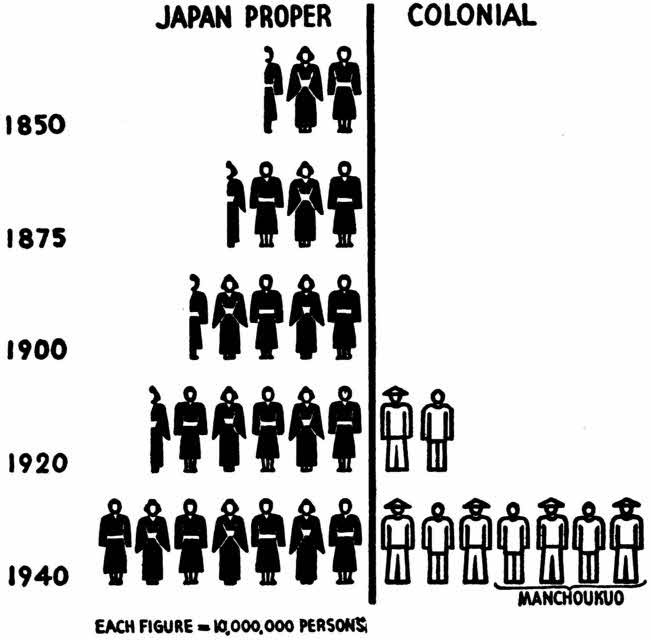
A GROWING POPULATION
BIG BUSINESS TO THE FORE
During and after the war, Japan’s business groups had come of age. They were no longer subordinate to the other ruling forces in the state. Japan’s effort to overtake the West, as we noticed, had led to a close tie-up between government and industry. This relationship had made it easy for Japan’s great business houses to become monopolies. From the beginning they had united banking, trade and industry under one roof. Post-war developments, such as the financial crisis of 1927, had carried the process of financial concentration beyond even what was characteristic of Western countries. By this time half-a-dozen of Japan’s huge family combines, such as Mitsui and Mitsubishi, dominated Japanese economy. They had become one of the most powerful financial ruling groups in the world.
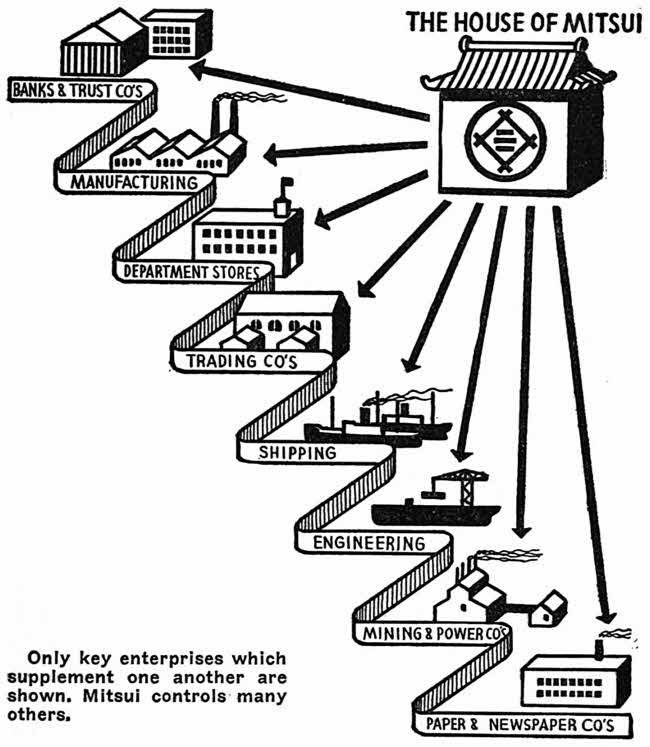
ONE OF JAPAN’S FAMILY EMPIRES
BUT INDUSTRY DEPENDS ON FOREIGN TRADE
And here we have to point out the striking paradox in Japan’s new economic society. It was still largely agricultural. In 1925 more than half the people were dependent on agriculture for their livelihood. But the peasants were too poor to buy the typical consumption goods (automobiles, for example) that were staples in the home markets of Western countries. Thus it was impossible for Japan to develop modern factory industries turning out all lines of consumption goods. Only in cotton textiles, with their special export market, and in shipbuilding and metallurgy, serving the army and navy, were large-scale factories practical. In 1928 the greater part of Japan’s manufactured goods was produced in industrial units employing ten, five or even fewer workers. Firms like Mitsui and Mitsubishi, however, contracted for the output of these small-scale industrial units and then sold it, often in foreign markets.
Thus Japan, although she had made great strides in some lines of industry, had become dangerously dependent on international trade. After 1929, with the onset of the world depression, the difficulties of this situation were plain to see. Quotas and tariffs barred even Japan’s low-priced goods. Old sores rankled, particularly those affecting immigration. The Exclusion Act, passed by the American Congress over the President’s disapproval in 1924, cut the deepest. In fact, it undid most of the good effects of the generous aid America gave Japan after the earthquake in 1923.
THE LIBERALS TAKE A HAND
These post-war years, especially after 1921, witnessed a brief flowering of parliamentary democracy in Japan. None of the architects of the Constitution, least of all Ito, had foreseen this possibility. Yet in the late ’twenties it seemed as if the Cabinet might win unchallenged power, that party government would reign supreme, and that the House of Representatives would become the true seat of authority.
This change came about quite naturally, through the increasing influence of the great business houses. By 1925 the industrialists and the bankers, or their representatives, held many of the leading offices which the clansmen had formerly made their own. They held the presidency of the Privy Council, and the key posts in the Imperial Household Ministry. They were influential in the House of Peers, in the bureaucracy and even in the Army and Navy. Generals and admirals could actually be found to support the policies of party governments. All the Elder Statesmen except Prince Saionji had died. And even he, being related to the Sumitomo banking house, was in sympathy with the capitalist outlook. As Prince Saionji was the Emperor’s chief adviser on the choice of a new Premier, he occupied the most strategic position in the state. In the 1925-31 period, on his nomination, six consecutive governments were formed by party Premiers holding majorities in the Diet’s lower house.
POLITICAL PARTIES
Party influence, increasing with the growth of capitalism in Japan, reached its height during these years. At an earlier period the clan bureaucrats had manipulated the parties to suit themselves—usually with little difficulty. But as time passed, the parties formed closer and closer ties with the great business houses. Mitsubishi interests were linked with the Minseito party, Mitsui with the Seiyukai party. The Election Law was gradually amended, increasing the number of voters, until in 1925 manhood suffrage was adopted. This change forced Diet members to spend large sums in electioneering, and made them more dependent on capitalist support. Consequently, it strengthened the capitalists’ control over the Minseito and the Seiyukai. At the same time it made possible the rise of labor and left-wing parties, which began to win Diet seats.
After 1925 the Cabinets formed by the Minseito and Seiyukai parties began to have to account directly to their majorities in the House of Representatives for what they did. Parliamentary government was by no means fully established, however. An adverse vote in the lower house did not, as a rule, overthrow these Cabinets. More often they fell because of backstage maneuvers in the Privy Council or the House of Peers. Nor were their leaders and policies always liberal. For a time General Baron Tanaka was president of the Seiyukai. He represented the aggressive, militarist wing of the Choshu clan. The Seiyukai Cabinet of 1927-29, formed under his Premiership, carried out a “positive policy” of military intervention in China. Tanaka had to be a party leader in order to become Premier. But his policy showed the strength of old tendencies, even in a generally liberal era.
On the other hand, the succeeding Minseito Cabinet (1929-31) was the strongest and most liberal party government which has ever held office in Japan. It came the nearest to establishing democracy there. It also had to meet the first onslaught of the military-fascist forces that have since become so powerful. In the story of Japan’s political development, it thus represents a critical turning point of unusual significance.
SWAN SONG OF THE JAPANESE LIBERALS
The Minseito Cabinet of 1929-31 was liberal, but by no means radical. It was, in reality, a government of “big business.” Its liberalism stood out mainly in its moderate foreign policy, which contrasted sharply with Tanaka’s earlier aggressive moves. It was headed by distinguished leaders: Hamaguchi (Premier), Shidehara (Foreign Minister) and Inouye (Finance Minister).
This Cabinet labored, however, under a fatal handicap, similar to that which confronted President Hoover in our own country. For it entered office in July 1929, at the height of the post-war boom. The Wall Street crash, and the spreading world depression, immediately followed. The swift change in economic conditions during its period in office had much to do with its final overthrow.
Hamaguchi and his Cabinet aides began with a great victory on the issue of the London Naval Treaty of 1930. This treaty extended limitations to cruisers and destroyers, as well as capital ships. The army and navy die-hards opposed it bitterly. The people and the press supported the Cabinet’s fight for it. On October 1, 1930 the Privy Council ratified the treaty. The Cabinet and the people had won.
For the moment it seemed as if the Cabinet had brought the army and navy under control. Real democracy seemed possible. But the triumph was short-lived. It was the swan song of parliamentary government in Japan. In November 1930 Premier Hamaguchi was shot by an assassin; eight months later he died from his wounds. His loss seriously weakened the Cabinet, and cut down its chance of success on new issues which were developing.
THE DEPRESSION STRIKES JAPAN
By the end of 1930 the depression had struck Japan with full force. It laid the Cabinet open to attack by the rising military-fascist forces.
The most serious consequences of the depression were felt in Japan’s foreign trade. In 1929 Japan’s export-import trade stood at 4,365 million yen. In 1930 it fell to 3,016 million, and in 1931 to 2,383 million. In two years Japan’s trade was cut nearly in half. Even at that period, few Western countries suffered such a rapid and severe contraction of their foreign trade.
The effects of this decline on Japan’s economy were catastrophic. Agriculture and industry were both hard hit. The income from rice and silk declined until there was actual famine in some rural districts. Industrial unemployment mounted to three million, higher than ever before in Japan. The middle-class professionals and wage-earners suffered wage cuts, or were thrown out of work. There was general social unrest, and Marxist doctrines won a wide acceptance. Strikes in industry, and tenant conflicts in rural areas, became commonplace.
In the light of these conditions, the weaknesses of Japan’s economy stood out in bold relief. Fully half the home market consisted of poverty-stricken peasants. To put the rural population back on its feet and enable it to buy the products of industry, drastic social reforms, such as rent reductions and debt moratoria for the farmers, were obviously needed. Neither the landowners nor the great business houses were prepared to embark on such a “new deal.” The army had a different solution—aggressive expansion abroad and military-fascist repression at home.
This army program led to a finish fight with the Minseito Cabinet. And the army leaders fought—and won—their campaign in Manchuria.
THE ARMY STRIKES IN MANCHURIA
The Minseito Cabinet had been trying to pursue a “friendly policy” toward China. Baron Shidehara, the Foreign Minister, wanted friendly relations with all countries. In this way he sought to foster Japan’s foreign trade, and thus solve Japan’s economic problems. But he could not control the army, especially after the depression had cut down trade and brought unrest to Japan.
During the summer of 1931 a series of “incidents” occurred in Manchuria, in which the hand of the military was plainly to be seen. At home in Japan the army used these incidents to arouse popular support for “positive” action in defense of supposedly threatened Japanese interests. General Minami, new War Minister in the Cabinet, openly supported this propaganda campaign. Baron Shidehara attempted to reach a peaceful settlement of the Manchurian issues. But in vain. On September 18, 1931—the historic date we mentioned at the beginning of this book—the army struck in Manchuria. The “Mukden incident”—alleged blowing up of a section of the South Manchuria Railway track—served as an excuse for the Japanese army to occupy the chief Manchurian cities.
This independent coup d’état by the army dealt a fatal blow to the Minseito Cabinet. Baron Shidehara was forced into the position of apologizing for the army’s actions, though he must have heartily detested them. On December 11, 1931 the Cabinet resigned.