VIII. Creating a Modern Empire
Reading edition
By 1890, when the first Diet elections were held, the foundations of a new Empire had been laid. In the few short years since 1868, the old feudal society had undergone a profound change. Agriculture was still the key to Japan’s economy, but factory industry and foreign trade were growing in importance. A strong centralized state had come into being. Modern methods were revolutionizing science, education, medicine, law and many other fields. There was an army recruited through universal service and trained in Western ways, and the beginnings of a modern navy.
JAPAN LOOKS ABROAD
The Meiji statesmen were now ready to turn their attention to foreign policy. Even before the Restoration many of the Japanese leaders had favored territorial expansion. During the years of internal reform, however, they had cautiously refrained from rash adventures abroad. A strong movement in favor of a punitive expedition to Korea had developed in 1871-73, but the dominant clan bureaucrats had skilfully prevented the outbreak of war. They had permitted a Formosan expedition in 1874, but had settled the resulting issues peacefully with China. Some small gains had been made. The Bonin Islands were annexed in 1876, and the Liuchiu Islands in 1879. A naval demonstration in 1876 secured to Japan special treaty rights in Korea, which led to more and more intervention in Korean affairs.
But these were not the foreign problems which chiefly occupied the early Meiji leaders. First and foremost, they were trying to change the unequal treaties concluded with the Western powers at the end of the Tokugawa period. These treaties, you will remember, permitted Western nationals to be tried in their own consular courts (the system of extraterritoriality), and fixed Japan’s tariff at the low rate of 5 per cent. The struggle to throw off these irksome restrictions was the central issue in Japan’s foreign relations down to 1894.
FIGHTING THE UNEQUAL TREATIES
The Japanese made many efforts to regain control of both tariffs and courts before they finally won success. An official mission under Prince Iwakura toured Western capitals in 1871-73 but failed to gain treaty revision. As other attempts also came to nothing, an intense popular resentment developed in Japan. In 1889, just when his negotiations for treaty revision were progressing favorably, a bomb tore off Count Okuma’s leg. Success was not won, however, until a new treaty was concluded with Great Britain on July 16, 1894. The other powers soon followed suit. Japan’s law courts had been modernized, and she now enforced new civil, commercial and criminal codes. In 1899, when the new treaties went into effect, all Westerners became subject to Japanese law. These treaties thus brought the extraterritorial system to an end. But they all contained tariff schedules that lasted for 12 years, so that Japan did not secure full control over her own tariffs until the treaties expired in 1911.
WAR WITH CHINA
On July 25, 1894, nine days after signature of the “equal” treaty with Great Britain, Japanese naval forces suddenly attacked and sank a transport carrying Chinese troops to Korea. War was formally declared on August 1. Thus, by an unusual coincidence, Japan was at war with China two weeks after she had won her twenty-five-year campaign for treaty revision.
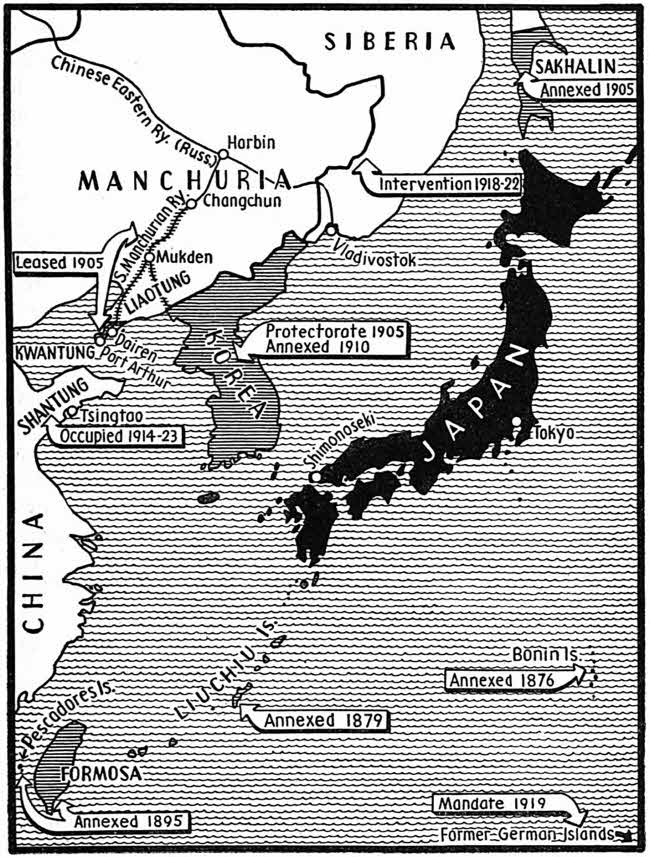
IN QUEST OF EMPIRE (1876-1923)
Japan’s statesmen had correctly estimated the weakness of China, as well as their own degree of preparedness. They did not plunge into war on a hasty impulse. The army and navy were tuned for action. With harsh realism, the Japanese leaders unhesitatingly adopted a program of expansion by force as soon as conditions seemed favorable. Their fight for treaty revision had been a fight for equality with the Western powers. They believed that even fuller recognition of equality would come after a successful war. They were also driven by strong economic considerations. The restrictions of the narrow home market were already irking Japan’s youthful cotton textile export houses, and they were trying to pry their way into the Korean and Chinese markets. Victory in the Sino-Japanese War of 1894-95 opened both these markets to Japanese manufacturers. It was a significant omen of the future that the new Japan should have discovered, so early in its career, that resort to the sword might help to overcome the handicaps of its late appearance on the international scene.
We should also take note of several other results of Japan’s first modern war. The territorial gains—Formosa and the Pescadores Islands—were a welcome prize. More important was China’s formal recognition of Korean independence, which left Japan practically a free hand in the peninsula. By its new commercial treaty with China, Japan also gained the benefits of extraterritoriality and low tariff rates in that country—the system she hated so heartily when it was applied against herself, as it still was at that time. The war indemnity of nearly $180,000,000, moreover, helped Japan to expand its armaments still further in preparation for the war with Russia in 1904.
THUS FAR AND NO FARTHER
An episode which heightened Japan’s sensitiveness in her foreign relations marked the peace settlement. In the Treaty of Shimonoseki, China had agreed to cede Japan the Liaotung Peninsula in South Manchuria. Germany, Russia and France objected to this territorial cession, and backed their objections by an ultimatum to Tokyo threatening war. Japan was forced to submit, and in exchange for a slight increase in the indemnity, the territory was returned to China. More than the pre-Restoration bombardments of Kagoshima and Shimonoseki, more even than the galling yoke of the unequal treaties, this “tripartite intervention” rankled in Japanese hearts. This sense of humiliation was not lessened in 1898, when Russia secured from China a 25-year lease of the southern tip of the disputed Liaotung Peninsula and proceeded to fortify Port Arthur and join Harbin to Dairen by a new railway line.
WAR WITH RUSSIA
On the whole, however, the gains of the war had proved sufficient to justify the calculations of Japan’s leaders, and to strengthen the forces within Japan that were working toward expansion. In 1900 Japan took part as an equal with the Western powers in quelling the famous Boxer Uprising, in China, and shared in the returns from the Boxer Indemnity which they later imposed as a punishment on the Chinese. The fact that the British thought it worth while to sign an alliance with Japan in 1902 was an additional testimony to her growing prestige. Fortified by this alliance, and by strenuous efforts to build up her military and naval forces, Japan emerged successfully from her clash with Tsarist Russia in 1904-05.
The peace terms did not include the indemnity Japan coveted, largely because she was too exhausted to continue the struggle. But still there were substantial gains. Japan won a protectorate over Korea, which she converted to full annexation in 1910. The Russian leasehold at the tip of the Liaotung Peninsula was transferred to Japan, and also the Russian railway lines in South Manchuria. Finally, Russia ceded the southern half of Sakhalin Island to Japan, and granted important fishing rights in northern Pacific waters to Japanese interests.
The Treaty of Portsmouth, which set forth these terms and in which President Theodore Roosevelt mediated, established Japan as the rising power in the Far East. In 1905, three weeks before the treaty was signed, the Anglo-Japanese Alliance was extended for ten years, with provisions sanctioning Japan’s paramount interests in Korea.
END OF THE MEIJI ERA
In the decade spanned by the two wars, Japan had forged rapidly ahead in her economic development. Her foreign trade, which totaled only 265 million yen in 1895, had jumped to 810 million in 1905 (see chart, page 61). Her steam shipping had shown an even more extraordinary spurt—from 15,000 tons in 1893 to 1,552,000 tons in 1905.
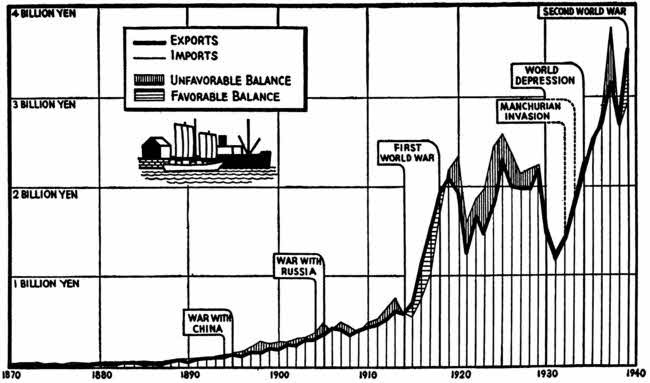
HOW JAPAN’S FOREIGN TRADE HAS GROWN
On the political side, the new constitution worked out pretty much as the clan statesmen had expected. For a short time the bureaucrats had some difficulty with the Diet, where a liberal opposition threatened to develop. But they soon checked this tendency. They intimidated or bought off opposition leaders. They embarked on a policy of war and expansion—which the liberals supported. And, eventually, they organized parties headed by members of the bureaucracy itself—in the first instance, Prince Ito.
The Meiji Emperor died on July 30, 1912. During his long reign of nearly 45 years, all the great changes which we have been considering had taken place. From a weak feudal state, Japan had been transformed into a great power. Two years after Emperor Meiji’s passing, the outbreak of the World War ushered in a period of still more ambitious expansion and growth.