IV. Japan Bars Her Door
Reading edition
We must now leap several centuries to about 1550, when the first Western traders and missionaries reached Japan.
The Japan of 1550 differed greatly from the Japan of the Fujiwara era we left behind us five or six centuries earlier. The Fujiwara power had passed away in the twelfth century. Its civilian government had grown weak. It could not even keep the peace. As disorder grew in the provinces, great independent lords surrounded themselves with military retainers on their private estates. A feudal society gradually emerged. In 1185 one of these feudal lords established his supremacy over the others, and soon obtained Imperial appointment as “Shogun,” or Generalissimo. The Emperor’s court still carried on at Kyoto, but political control passed increasingly to the Shoguns, who became military dictators. A military aristocracy—but a rapidly shifting one—dominated Japan. As new feudal lords grew in strength, they would challenge the Shogun’s authority and bitter civil wars would follow. Strife and disorder amounting to anarchy marked the century which preceded 1550.
Then the trend was reversed. By 1590, through the work of three great leaders—Nobunaga, Hideyoshi and Ieyasu—the country was unified again. In the brief period that followed—say, until 1625—Japan was confronted with a fateful question. Should it embark on a program of military and commercial expansion, similar to that which Western nations were just entering upon? For a time it seemed that the answer might be “yes.” In the end, it was “no.” And that “no” changed the whole course of Far Eastern and perhaps world history. In 1603 Ieyasu established the Tokugawa Shogunate, destined to rule Japan for more than 250 years. After 1616, under his successors, the seclusion policy was gradually adopted, and Japan was practically isolated from the outside world.
Was this choice inevitable? We cannot really tell. We do know that in the period just before she barred her door Japan was reaching outward toward full intercourse with the West.
REACHING OUTWARD
For the last thirty years of the sixteenth century were a dynamic period in Japanese history. An excess of energy in Japan seemed to match the urge for discovery and conquest that stirred the rising nations of Europe.
Japan’s domestic and foreign trade had been increasing at a rapid pace. Native industries had grown, and trade guilds had flourished. After 1550 this commercial development leaped forward. Sakai, a great trading center, became virtually a free city, ruled by its merchant princes. Nagasaki was opened to foreign trade in 1570, and soon developed into a thriving port. At this time, too, Japanese ships, often on piratical expeditions, were venturing into the waters of the Philippines and Siam. In groups and as individuals, Japanese emigrants were found at various ports in southeast Asia. Hideyoshi even conceived the project of conquering China, but after overrunning Korea in 1592-93, his armies (numbering 150,000 men) were defeated.
After 1550 missionaries and traders from Portugal, Spain, Holland and England came to Japan in growing numbers. The Japanese eagerly seized upon Western products and technical advances, notably in firearms and shipbuilding. These commercial contacts with the West modified Japan’s economy and stimulated her industrial development. For several decades Christianity, introduced by St. Francis Xavier in 1549-51, was welcomed. Some of the feudal lords became Christians. By 1617 there were some 300,000 Christian converts, or nearly as many as today.
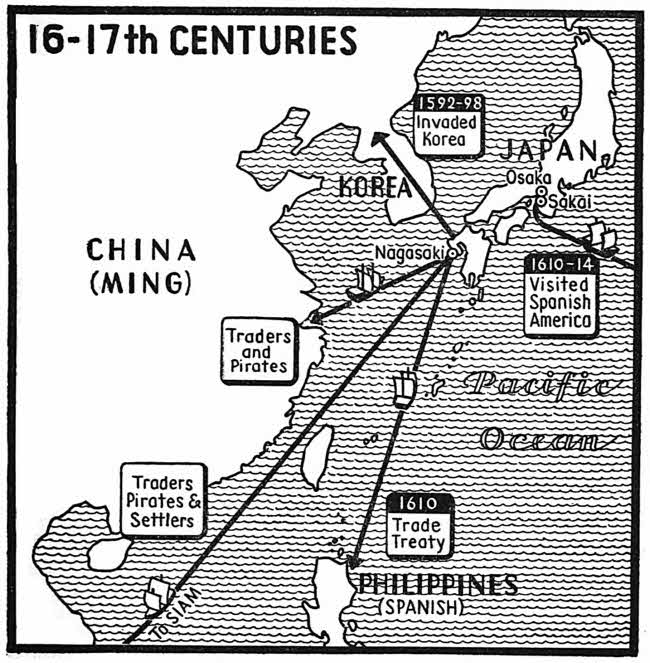
JAPAN’S OVERSEAS ADVENTURES 16-17th CENTURIES
JAPAN SENDS ENVOYS TO SPAIN
For a time, there was the possibility of even more extensive contacts between Tokugawa Japan and the West. Ieyasu, the first Tokugawa Shogun, deliberately sought to make Japan a great center of international trade. China, mindful of Hideyoshi’s Korean invasions, rebuffed him. He then turned to the West—that is, to Spain, then the richest trading nation of Europe. In 1610 Ieyasu concluded a commercial treaty with the Spanish governor of the Philippines. In 1610 and 1614 Japanese envoys crossed the Pacific and visited some of the Spanish possessions in America. Then they went on across the Atlantic. In Madrid the Japanese envoy had an audience with King Philip III on January 30, 1615; later, he saw the Pope at Rome. The Spanish king, however, influenced by the anti-Christian persecutions that had already occurred in Japan, rejected Ieyasu’s request for a treaty establishing trade relations with Spain and the Spanish-American possessions.
BUT FINALLY PULLS IN HER LINES
It was not until more than two centuries later that such an opportunity presented itself again. For soon after Ieyasu’s death in 1616, the policy of national seclusion was adopted.
Many factors led to this decision. The narrow intolerance of the missionaries, as well as conflicts between rival Jesuit and Franciscan orders, had created difficulties almost from the beginning of their stay in Japan. More important was the fear that estates of the Christian lords might become centers of rebellion, and thus lay Japan open to conquest by a foreign power. Persecution began under Hideyoshi, and after 1616 a series of anti-Christian edicts was issued. The Christian persecutions reached their height in 1622-24, although Christianity was not fully stamped out until 1638.
At this time Japanese were forbidden to go abroad, and the building of large sea-going vessels was also prohibited. All foreign traders and priests either left Japan or were expelled. A small Dutch trading center, restricted after 1641 to the islet patch of Deshima, was all that remained of the early period of intercourse with the West. By 1650 the policy of national seclusion, introduced by the Shoguns of the Tokugawa clan, was in full force. It was maintained until after the middle of the nineteenth century, or well into the modern era.
THE DUTCH OASIS ON DESHIMA
We should be on guard, however, against some common errors about this important period in Japan’s history. The term “hermit nation” must not be taken too literally. Seclusion was not complete. Through the Dutch settlement on Deshima, ideas from Europe filtered into Japan. A small group of Japanese scholars studied the Dutch language. In 1745 they prepared a Dutch-Japanese dictionary, and in 1774 a Dutch textbook on anatomy was translated. Of course, Japan did not keep abreast of Western technical progress during the Tokugawa epoch. But valuable beginnings were made, especially in language study, medicine, geography, map-making and military science.
Another common error associated with the idea of a “hermit nation” is that Tokugawa Japan remained static for two hundred years. In reality great internal changes occurred during this period, some of which were fundamental. By 1850 Japan was a very different country from what it had been in 1650.
The seeming lack of development was most evident in the Tokugawa political system. Its broad outlines did not, in fact, change very much. The Emperor and his court were kept secluded at Kyoto. The real center of government lay in Tokyo, where the Shoguns and their ministers ruled. Most of the land was owned by the Tokugawa family and the great feudal lords (daimyo) closely associated with it. About three-eighths, however, was owned by the “outer lords,” such as Choshu and Satsuma. These “outer lords” were viewed as potential rebels, and were denied posts in the central administration. All of the feudal lords had to spend certain months in attendance on the Shogun at Tokyo, and had to leave their families there as hostages when they went back to their own lands.
FOUR CLASSES OF SOCIETY
Efforts were made to draw strict class lines. The feudal lords and their military retainers, or samurai, held the highest rank. The farmers came next, but they were severely taxed and harshly treated. The townspeople were looked upon as the lowest class of all. A samurai had the right to cut down a merchant with his sword, but very early in the Tokugawa period he learned to respect the power of the merchant’s purse.
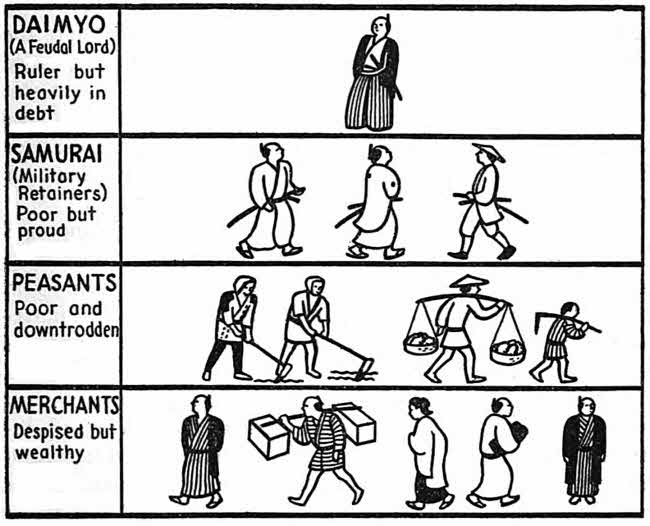
JAPAN’S PRE-RESTORATION SOCIETY
DAIMYO (A Feudal Lord) Ruler but heavily in debt
SAMURAI (Military Retainers) Poor but proud
PEASANTS Poor and downtrodden
MERCHANTS Despised but wealthy
Yet all measures to preserve a rigid centralized feudalism, and to maintain Tokugawa rule, proved futile. Halfway through the period serious economic problems began to appear. By 1850 the whole system was on the verge of collapse.
THE SHOGUNS FAIL TO CONTROL THE MERCHANTS
In their attempts to prevent change, the Shoguns were unable to master one basic element in their society—trade and industry. Even before the Tokugawa regime was established, as we have seen, Japan’s commerce had already grown sizable. Foreign trade was then cut off. But internal trade, stimulated by a long period of peace, continued to develop. New luxury goods of many varieties were produced, and industry prospered. The merchant class in the cities grew wealthy and powerful. Large business houses, including the present Mitsui firm, were founded. Money, instead of rice, became the medium of exchange. The transition to a money economy was gradual, but it worked a revolution in Japanese society.
Incomes of the daimyo and samurai were in rice. The rice had to be changed into money, and great exchange marts—similar to our modern commodity exchanges—grew up in Osaka. The rice brokers “rigged” prices. Dizzy price fluctuations occurred. The feudal lords and their samurai fell into debt to the rice brokers and the money lenders. Government intervention did not help matters. The Shogunate either debased the coinage, or tried vainly to control prices by decree. The farmers suffered most of all—from the change to money, from the price fluctuations, and from still heavier taxes when the feudal lords became indebted to the merchants. After 1725 the number of farmers declined; after 1750 peasant uprisings were frequent.
AND FACE A RISING REVOLT
In other ways, too, loyalty to the Shogunate was undermined. The luxury of the towns stimulated a type of life quite the opposite from that inspired by the Spartan ethical code, called Bushido, of the samurai. Rich townspeople craved amusement—and painting, the drama, and the novel flourished. No laws could prevent the samurai from being drawn to this life, nor could executing a more than usually lavish merchant or usurer turn back the tide of the new age.
Other intellectual currents were more acutely dangerous to the Shogunate. Ancient history, literature and religion were studied, and there was a revival of interest in Shintoism. From these historical and literary schools there grew a political movement, aimed at restoring the Emperor to his former place as ruler of the nation.
Thus, by the middle of the nineteenth century, the country was ripe for revolt. In the background lay the misery and distress of the farmer. But the active promoters of this revolutionary overthrow of the Shogunate were discontented groups within the ruling class. Four of these groups banded together to bring about the Restoration: (1) the “outer lords” of Choshu, Satsuma and the other western fiefs; (2) the lesser samurai, ambitious and energetic; (3) the merchants, who desired removal of feudal restrictions on their business activities; and (4) the court nobles of ancient lineage who still clung to the Emperor at Kyoto. This was a powerful coalition, and sooner or later it would undoubtedly have brought down the Shogunate through its own strength. As it happened, pressure on Japan from Western nations came to its aid and hastened the outbreak of the revolt that was brewing inside the country.