VII. Who Rules Modern Japan?
Reading edition
We are now able to distinguish the main groups which were to rule the modern Japanese Empire. Within the quarter century from 1853 to 1877 a new leadership had emerged.
True to Japan’s history and tradition, control was concentrated in a few hands. The ruling group was composed of the clan leaders, dominating the government bureaucracy (since grown to nearly 500,000 office holders); the old feudal lords with great landed estates; and the business group—bankers, traders and industrialists.
HAND IN GLOVE
At the head of this partnership were the clan leaders, and a few representatives of the old court nobility. The clan bureaucrats, as they came to be called, held the influential posts in the new Imperial government. To a large extent, their dictatorial powers carried on the old feudal tradition. Many of them were civilians, but they also controlled the army (Choshu) and the navy (Satsuma). The business people, on the other hand, especially in the beginning, were definitely in a subordinate position. It was the government which controlled most of the early industrial enterprises, as we have seen. Not until much later, after the World War of 1914-18, did trade and industry reach a size which enabled the capitalists to make themselves felt politically.
It was the existence of the “upper crust” and the inferior status of business that largely determined the character of the new political institutions established during the Meiji era. They were designed, it is true, to serve the purposes of the whole combination of ruling groups. But at the same time the clan bureaucrats took good care to set up the machinery they needed to perpetuate their own supremacy.
CONSERVATIVES VS. LIBERALS
For a decade after the Restoration of 1868, an outright dictatorship functioned in Japan. The powers of the clansmen were almost unlimited. Within the ruling group itself, however, there were wide differences of opinion on some points. One important question was what institutional forms the new government should adopt. Headed by Itagaki (a Tosa samurai), the more liberal reformers wanted to set up a fully representative government modeled on the advanced Western democracies. But most of the clansmen opposed such a radical step. In the end, however, the conservatives accepted the necessity of a written constitution—which they drew up themselves.
Even this concession was made grudgingly, and only after it had become absolutely necessary. But several factors worked in favor of the liberals. The prestige of Western institutions was high at this period. An article in the Emperor’s Charter Oath, moreover, was interpreted as a pledge to inaugurate a “deliberative assembly.” Quoting this pledge, the liberals started a political campaign which won considerable support. Finally, the rising capitalists needed a representative system in order to secure a real voice in the government. Despite all these advantages, in the end the liberals were outmaneuvered in the political arena. They obtained a constitution, it is true, but one which was written and imposed by the conservative clansmen. The result was not a democratic Bill of Rights but a highly autocratic document. With but few exceptions, the liberals’ failure at this time was characteristic of Japan’s later history.
THE LIBERALS LOSE
The political struggle reached its climax in the second decade after the Restoration. In the press and on the public platform, the liberals waged their campaign. In 1878 they succeeded in getting provincial assemblies with limited powers, and in 1880 local (town, city and village) assemblies. In 1881, riots followed the exposure of graft in the central administration. To save their position, the conservatives had the Emperor issue a declaration promising a National Assembly in 1890—nine years ahead.
But the political struggle did not abate. It now turned on what should be the terms of the constitution which was to establish the elective assembly. The conservatives meanwhile took strong measures against the opposition. They strictly enforced laws curbing the press. They suppressed Itagaki’s political party in 1884. In 1887 martial law was proclaimed in Tokyo, and the opposition leaders were driven from the capital. In this way the conservative bureaucrats got a free hand in drafting the new constitution and putting it over.
Hirobumi Ito, its main architect, had gone abroad in 1882 to study Western constitutional practices. He was greatly impressed by Bismarck, and took the Prussian Constitution as his model. First, certain preparatory changes were made. A nobility of five orders was established in 1884, and a Cabinet in 1885. A civil service was started, and in 1887 a Supreme War Council was set up to advise the Emperor on military and naval affairs. In 1888 Ito became president of the Privy Council, which was given authority to revise the draft constitution he had prepared. Ito’s work of framing the document was carried out “in absolute secrecy.” After it had been read in private to a small group of officials, the Emperor promulgated the new constitution on February 11, 1889. The first elections to the Imperial Diet were held in 1890.
A GIFT OF THE EMPEROR
The Constitution was a “gift” of the Emperor. It was not intended to establish popular government. Its preamble emphasized the old theocratic (priest-king) traditions of Japan. The Emperor “inherited” the right to rule “from Our Ancestors,” and ruled “in lineal succession unbroken for ages eternal.” Ito and his colleagues not only incorporated these traditional ideas into the Constitution. They made them the cornerstone of the new system of universal education, and thus instilled them in the mass of the Japanese people. Reverence for the Emperor as a divine ruler helped enormously to keep the new regime solidly in place.
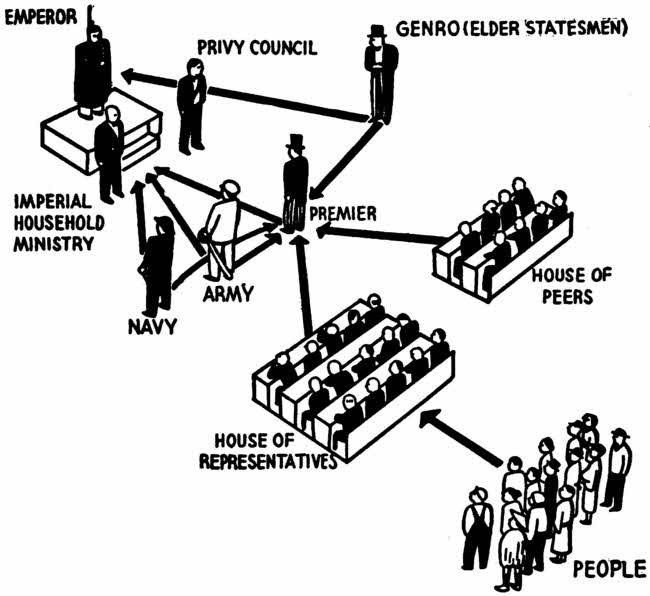
JAPAN’S RULING SYSTEM THE GOVERNMENT UNDER ITO’S CONSTITUTION
Practically all the government’s powers, both civil and military, were vested in the Emperor. Vast economic power bolstered his political authority. No longer, as on occasion in feudal times, could the Emperor become penniless. For court expenses, the Imperial Family receives an annual grant of 4,500,000 yen (more than a million dollars). Its holdings in lands and blocks of shares, estimated at over one billion yen, provide a large additional income. So it is one of the wealthiest families in Japan.
THE EMPEROR MUST BE “CONSTITUTIONAL”
The Emperor’s powers are exercised on the advice of his ministers, in accordance with constitutional practice. He is not supposed to act on his own authority. Real power, therefore, resides not in the Emperor but in his advisers, acting through the agencies set up by the Constitution. On the surface, these agencies seem to establish a system of representative government. There is a Cabinet, and a Diet with two houses—the House of Peers and the House of Representatives. And political parties like those of the Western democracies soon formed to contest elections in Japan.
But there the resemblance ends. There is not only the supposedly divine power of the Emperor. The democratic forms themselves are a shell, empty of the real meat of popular government. In all effective representative systems, as we well know, the legislature—particularly its lower house—has real authority. Not so under Ito’s Constitution. Ito ranged an overwhelming battery of aristocratic, bureaucratic and militarist influence in five powerful agencies of government. You can see from our chart on page 49 what these agencies were. They completely eclipsed the House of Representatives. Moreover, they often dominated the Cabinet, or disputed its authority. And through them, as much as through the Cabinet, the clansmen ruled Japan with a tight rein. Let us see how each worked out in practice.
NON-POPULAR AGENCIES OF GOVERNMENT
First, there were the Elder Statesmen (or Genro). They were a body completely outside the Constitution. Survivors of the early Meiji clansmen, they had prestige and experience. For several decades after 1900 they held the government in the hollow of their hands. They made and unmade Cabinets, shuffled the Premiership among themselves, decided on war and peace. Their last representative, Prince Saionji, died in November 1940 at the age of 92. So from now on there will be no more Genro to be reckoned with.
Next comes the Imperial Household Ministry. Two officials here occupy key positions. The Lord Keeper of the Privy Seal holds the seals which must be affixed to state documents. And the Minister of the Imperial Household has charge of matters connected with the Imperial Family. These men are not only themselves powerful advisers of the Emperor. But appointments to see the Emperor must be made through them. So at times they have been able to bar their political opponents from reaching the Imperial ear. Usually they hold office for life or until they wish to resign.
The Privy Council is likewise a useful piece of machinery for Japan’s ruling group. It is the supreme advisory body to the Emperor. It consists of 26 life members, usually of great age. Cabinet Ministers serve as members of the Council ex-officio, but are outvoted by at least two to one. Among other things, the Privy Council ratifies treaties, approves amendments to the Constitution, and passes on Imperial ordinances.
The House of Peers consists of about 400 members, of whom more than 200 are drawn from the nobility, 125 are life appointees, and nearly 70 are elected from the largest taxpayers. It is an extremely aristocratic and conservative body. Yet its powers equal those of the lower house. And its members can become Premiers or Cabinet Ministers.
Lastly, the Army and Navy, with their General Staffs and their representatives on the Supreme War Council, are largely independent of civilian control. The chiefs of the General Staffs and the War and Navy Ministers have direct access to the Emperor. This means that they can go over the Premier’s head to appeal any decision of his to the Emperor. The War and Navy Ministers cannot be civilians. They must be ranking officers in active service. Since they are nominated by the Supreme War Council, the latter body can overthrow a Cabinet by simply ordering them to resign. Or it can prevent the formation of a new Cabinet which it does not like by refusing to offer nominations for the War and Navy Ministries.
THE PEOPLE’S REPRESENTATIVES
As against these aristocratic, bureaucratic and military organs of government, the popular will can be expressed only through the House of Representatives. The position of the House is very weak, especially in comparison with the normal legislature of a full-fledged democracy.
For Ito saw fit to curb the powers of the Diet’s lower house by a series of drastic restrictions. Large fixed, or non-votable, expenditures limit its control over the public purse. If appropriations are not voted, the Cabinet has the right to enforce the preceding year’s budget. Most bills are introduced not by Diet members but by the Cabinet, which also possesses an absolute veto. Moreover, the Cabinet can issue Imperial ordinances which, with few qualifications, have the force of law. It can dissolve the lower house, and thus force an election—an expensive proceeding for the deputies. And for several decades only part of the people could vote. Not until 1925 was full manhood suffrage (age 25) adopted. During elections the Home Ministry has often intimidated the voters. And popular rights are further curbed by a controlled press, a strong centralized police force, a large degree of central domination of local government, and the possibility that one may be arrested and held indefinitely without trial (because Japan has no habeas corpus law).
The development of a Cabinet with independent power, responsible to the lower house of the Diet, would seem impossible under these circumstances. Entrenched positions were held by the aristocrats, the bureaucrats and the militarists. For if they did not control the Cabinet, always a necessary citadel of power, they could be sure of bringing about its downfall. A responsible Cabinet did emerge in the post-war years. But, as we shall see, this period was short-lived. After 1930, largely through the pressure of the militarists, the pendulum swung back.