V. How the Door Was Opened
Reading edition
By the nineteenth century, a new flood of Western influence was sweeping into the Far East. As in the age of exploration and discovery, the West was knocking at the door.
In those earlier days, we must remember, the West had had little to offer in the way of progress. In fact, in the arts and in the graces of civilized life, the East could have given pointers to the West. But now the West came strong in the might of the industrial revolution. Master of machine technique, it was turning out manufactured products in larger and larger quantities. It was extending international trade by leaps and bounds. It was seeking new markets and sources of raw materials throughout the world. And the most powerful of the Western countries were staking out colonies wherever they could.
A PERIOD OF TRANSITION
1853 to 1868 were the years of transition for Japan. They were crowded with events that laid the cornerstone of the modern Japanese Empire.
Two broad trends were uppermost during these years. First, there was the coming of the Western powers with their demand for diplomatic relations, trade and intercourse—in a word, for the end of the seclusion policy and the opening of Japan’s door. Of course, the Shogun, as the ruling power, had the job of dealing with the Western nations. Too weak to resist, he had to give way. And his enemies at home seized on this opportunity to discredit him. The second main trend, therefore, was the sharpening of Japan’s internal conflict.
The extraordinary thing about this internal conflict in Japan was this. The groups opposing the Shogunate were revolutionaries: they rejected the existing system and fought for a new one. They sought progress for Japan—and progress meant opening the country to Western influence. Yet in their struggle with the Shoguns they were all against the foreigner. The reason is not far to seek. Anti-foreign demonstrations provided a handy weapon for attacking and discrediting the Shogunate. As we shall see later on, when it had served its purpose, this weapon was dropped.
But, meanwhile, let us look a little more closely at the two broad trends we have mentioned. Let us see first how, by a series of steps taken between 1853 and 1867, Japan’s door was gradually opened.
THE “UNEQUAL” TREATIES
What happened to Japan in her relations with the Western powers at this time had previously happened to China. For a long time there had been a closely regulated Western trade at Canton. During the early nineteenth century this trade had steadily expanded. China’s last-minute efforts to keep real control in her own hands were unsuccessful. The Anglo-Chinese war of 1839-42, and further conflicts in 1857-60, ended China’s seclusion and forced the Manchu authorities to treat with the Western powers on terms of diplomatic equality. The treaties signed at this time—later called the “unequal” treaties—actually established China’s inequality. Not only were new ports opened to Western trade. But a fixed schedule of Chinese tariff dues, usually not exceeding 5 per cent, was also enforced. In addition, Western nationals were exempted from trial under Chinese law. Instead, they were to be tried in courts set up by their own consuls in China. This was the system known as “extraterritoriality.”
These events in China did not pass unnoticed in Japan. Many of the Japanese leaders, despite the Shogunate’s policy of isolation, were aware of what was happening in China. They began to be alarmed over Japan’s future, fearing that the Western powers would soon be knocking at Japan’s door. And sure enough, very soon they were.
COMMODORE PERRY BRINGS A LETTER
The visits of Commodore Perry’s squadron to Japan in 1853 and 1854, bearing President Fillmore’s letter asking for the opening of trade relations, were the prelude. Commodore Perry secured the first treaty, on March 31, 1854. More important was the commercial treaty (July 29, 1858) negotiated by Townsend Harris, first American Minister to Japan. This treaty opened five Japanese ports to Americans for trade and residence, and—like the treaties with China—provided for a fixed tariff schedule and extraterritoriality. It was the model for similar agreements, also concluded in 1858, with England, France, Russia and Holland. All of these treaties were signed by the Shogun, but not by the Emperor. Later, as the Emperor’s power grew, the opposition sought to prevent application of the treaties on the ground that the Emperor had not ratified them. In November 1865, however, an Allied naval demonstration off Osaka forced the Emperor to give his signature. Finally, in June 1866, a tariff convention set 5 per cent as the duty on practically all imports and exports.
We shall have to return to these treaties a little later. For soon after the Restoration of the Emperor, they became a galling yoke to the Japanese. The tariff and extraterritorial provisions, in particular, were resented as shackles on the full exercise of Japan’s sovereignty. Three long decades were to pass before Japan gained enough strength, toward the close of the century, to revise these unequal treaties.
THE INTERNAL STRUGGLE IN JAPAN
At the time the treaties were negotiated, however, the issue was not one of equality. The issue was whether there should be any treaties at all. For many Japanese wanted no opening of Japan’s door. After the first treaties, nevertheless, a growing number of Westerners began to live in the ports opened to foreigners. The cry to “expel the foreigner” was then raised. Coupled with this slogan was the challenging demand to “revere the Emperor”—a direct call to revolution against the Shogun. The whole country was aroused. It seethed with internal strife and dissension, with plots and counter-plots, and even with armed conflict.
The anti-foreign movement was merely the spark that set off a bonfire that had been long in the making. By 1850 the Shogunate was nearly bankrupt. The feudal lords, or daimyo, were in the same position. Most of their landed property was mortgaged to the merchant-bankers—the rising capitalist class. Thousands of samurai were poverty-stricken. The condition of the peasantry, taxed more and more heavily to pay for the debts of the feudal lords, was desperate. Even the wealthy merchants, irked by feudal restrictions and the social and political inferiority that was forced upon them, were dissatisfied. The demand for change was growing broader and deeper.
SUPPORTERS OF THE EMPEROR
In Kyoto the Emperor had become the center of an active and determined political movement. Its platform—anti-foreign and anti-Tokugawa—called for the restoration of the Imperial power. The court nobles and a growing number of the samurai and feudal lords supported it. Wealthy merchant-banker families, such as the Mitsui house, provided it with cash. Above all, the movement was eventually backed by a coalition of the western clans, notably those of Choshu and Satsuma. The part these clans played, both in the Restoration movement and in the later Imperial government, was decisive.
THE ROLE OF THE WESTERN CLANS
These clans, you will remember, were ruled by so-called “outer lords,” who were denied a part in the Tokugawa administration. The fact that they were so far from the center of government at Tokyo encouraged them to be independent. Moreover, they were in many respects the strongest and most progressive of the leading Japanese clans. In developing manufacture and trade as a means of boosting clan revenue, Satsuma, Choshu, Tosa and Hizen were far ahead of other clans. They fostered not only handicrafts, porcelain manufacture, sugar-refining and textile mills, but mining, iron foundries, gun-making, shipbuilding and allied military industries. Choshu also made a revolutionary change in its army, by including commoners as well as the samurai in its ranks.
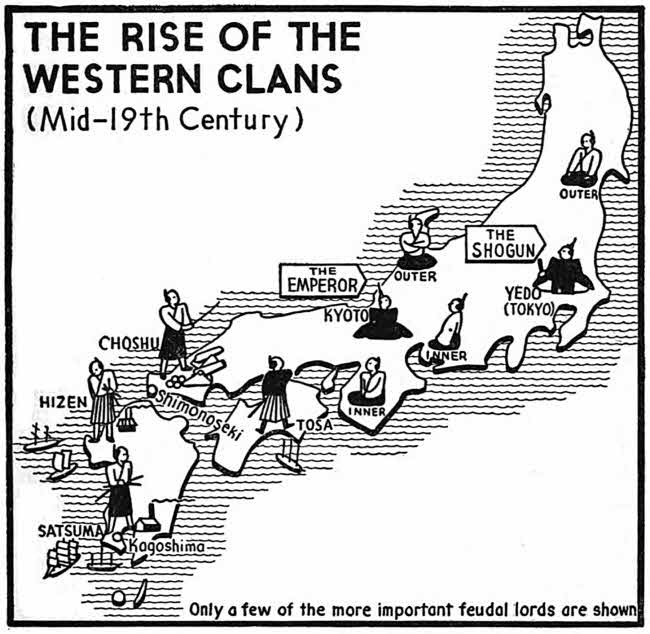
THE RISE OF THE WESTERN CLANS (Mid-19th Century)
In these western clans, the anti-foreign spirit was at first intense. For some years, in defiance of the Shogunate, the clans carried on what was practically an independent war against the Western powers and the new treaty rights of Westerners in Japan. They frequently attacked foreigners and their employees. Things came to a head in 1863-64, when they tried to expel the foreigners. In August 1863, in retaliation for the murder of an Englishman by Satsuma clansmen, a British squadron bombarded the Satsuma port of Kagoshima. And in September 1864 an Allied fleet (British, Dutch, French, American) destroyed Choshu forts at Shimonoseki which had been firing on Western vessels passing through the narrow straits.
These decisive proofs of Western military and naval superiority gave Satsuma and Choshu pause. Both clans stopped their anti-foreign activities. They had long seen the need of acquiring modern armaments. This determination was now made doubly strong. Many other leaders came to see that Japan could not keep her door shut forever, and that her salvation lay in mastering Western techniques. Once having grasped this principle, they acted on it boldly and unhesitatingly.
THE RESTORATION
The Emperor’s prestige—and, indeed, actual authority—had grown steadily throughout this transition period. As early as 1858, recognizing the Emperor’s new importance, the Shogun sought his approval of greater intercourse with the West. In 1863 the Shogun even obeyed an Imperial summons to Kyoto. The advent of a new Shogun and a new Emperor in 1867 made the transfer of authority all the easier. In November 1867 the new Shogun resigned, and on January 3, 1868 the Emperor Meiji, backed by the western clans, formally assumed control of the nation. Six months later the Tokugawa forces, taking the field in opposition to the seizure of power by the western clans, were defeated in pitched battle. A new Empire had been founded.