III. Imitating the Chinese
Reading edition
One of the most dramatic episodes of modern history has been Japan’s adoption of Western institutions and techniques. But the interesting thing is that such wholesale borrowings were not new in the history of Japan. More than a thousand years earlier she had drawn similarly on Chinese civilization. That earlier period, moreover, was akin to the later in one significant respect—the old Japanese ways persisted under the new shell. The changes were only skin-deep. And the more important beliefs and practices that featured the early clan society we have been studying continued to govern Japanese behavior.
Japan’s contacts with China had begun well before the seventh century, the period when they became so marked. At first these contacts had been only secondhand, through Korea. Direct relations with China had been established early in the fifth century, but had remained unofficial. The first official Japanese envoy was sent to the Sui Dynasty in 607 A.D., and a second embassy followed in 608. In the two centuries after 630, no less than twelve Japanese embassies visited the T’ang court at Ch’ang-an, located on the site of the modern city of Sian (see map opposite). These two hundred years were China’s golden age, when dazzling Ch’ang-an was the world’s foremost civilized center. Japanese monks and scholars accompanied the embassies, often remaining in China for long periods of study. They brought back to Japan a thorough knowledge of Chinese culture—much as Japanese students have returned from Western countries with new knowledge and skills during the past eighty years or so.
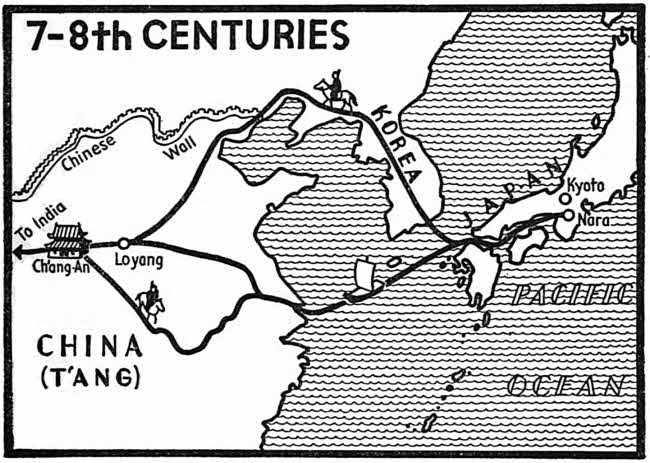
ROUTES TO THE CONTINENT 7-8th CENTURIES
CHINA BECOMES THE “GLASS OF FASHION”
Chinese civilization, during the seventh and eighth centuries, was transplanted to Japan on a vast scale. Nara, the new Japanese capital (see map opposite), was built on the lavish model of Ch’ang-an. Court society became highly sophisticated. The ability to write a good Chinese hand, or turn a Chinese verse, was the indispensable equipment of an educated man. The first national histories of Japan were written—most of them in the Chinese language. Buddhism flourished. Japanese artistic skill expressed itself in masterpieces of sculpture and architecture, modeled on T’ang examples but individual in genius and execution. Native Japanese poetry flowered and, in general, this was the classic age of Japanese culture.
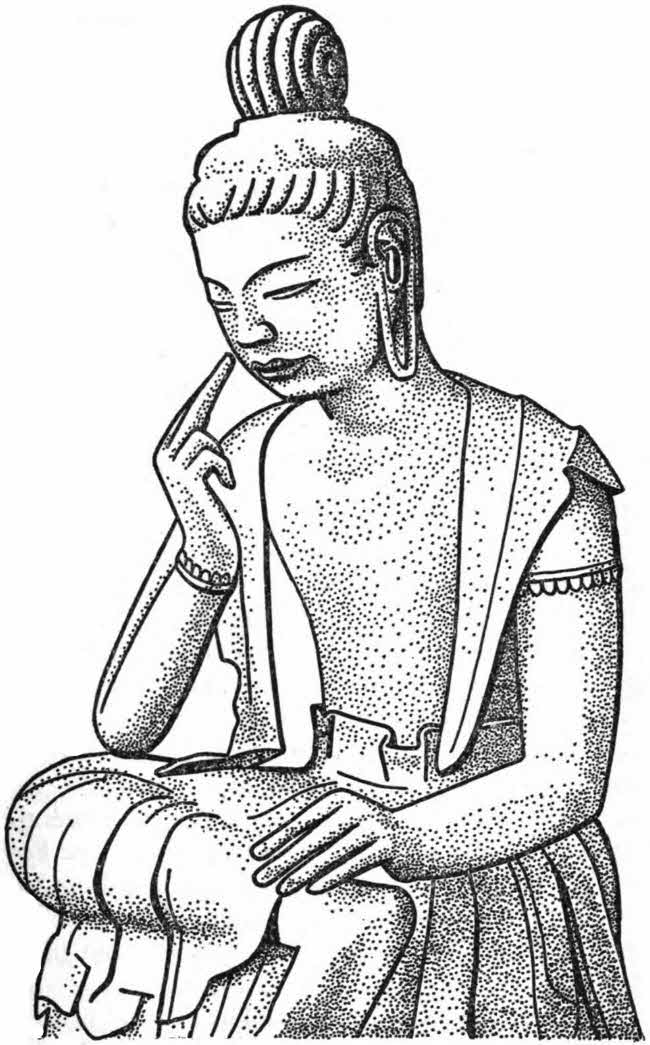
“Japanese artistic skill expressed itself in masterpieces of sculpture ... modeled on T’ang examples.”
In the field of government the Japanese also imitated the T’ang system. They declared the land “nationalized”—or subject only to the Emperor’s control. They reorganized local government, putting Imperial officials in direct control, especially of tax revenues. In China such officials were chosen through an examination system, so examinations were introduced in Japan. The Emperor was now, in theory at least, the all-powerful head of the Japanese state.
BUT IT’S CHINA—“WITH A DIFFERENCE”
These reforms were not amateurish. They were based on a good knowledge of the principles and practices of the Chinese system. Yet in their pure Chinese form they worked against certain ingrained Japanese ideas, most of all the hereditary principle. So, from the beginning, the Japanese changed the Chinese system as they took it over. The changes may not have seemed great at the time, but they were really basic. Within a few centuries, the new institutions had produced an entirely different result in Japan. Only in form did they bear any resemblance to the institutions of China.
The clearest example of such changes is the way Japan’s statesmen treated the Chinese examination system. In China, at its best, this was a real civil service system. For centuries the path to public office lay through success in the examinations. Sons of great families undoubtedly had a better chance of succeeding, and bribery and favoritism were rife in decadent periods. But the “success story” of the Horatio Alger type fills Chinese literature. In not a few cases, the poor but brilliant Chinese youth passes the examinations with honors, and becomes a powerful and wealthy official.
THE ARISTOCRAT’S PLACE IN THE SUN
This system was altogether too democratic for Japan’s clan society, with its emphasis on aristocratic lineage. At the very outset it was drastically modified. Training schools were set up, but only nobles of a certain rank could enter them. These persons alone could take the examinations, and qualify for high office. After a time, even the examinations were discontinued. Important government posts soon became hereditary again. Lower posts in the provinces were usually taken by local leaders, instead of officers sent by the Imperial government. The higher provincial officials meanwhile stayed at court, and delegated their powers to personal followers in the various localities.
A similar development took place in the case of the land reforms. The land was “nationalized,” but it proved impossible to preserve the public domain. The great estates of the clan leaders were returned to them in payment for their official services, and then remained hereditary. Powerful individuals encroached on the public lands, or impoverished peasants escaped tax exactions by joining their lands to privately owned manors, and becoming serfs. In practice, the public domain was gradually taken over by private families, the court nobility or the great monasteries.
THE POWER BEHIND THE THRONE
As these private estates were usually tax-free, the Imperial government was soon deprived of its revenue. And so, as time went on, the Emperor became a mere figurehead. Elaborate state councils and ministries, patterned after those of China, became nothing more than ceremonial forms. Yet centralization was maintained for several centuries, with the great Fujiwara family as the real power behind the throne. This family held vast provincial estates, controlled many of the local officials, and dominated the court. By wedding the Imperial princes to Fujiwara ladies, it reduced the Emperors to puppets. The Fujiwara dictatorship ruled a much more intricate and cultured society than had existed in the early clan period. On the surface, this new society was Chinese; in fact, it was still run in the old Japanese way.
Changes there had been, however. The courtier had replaced the warrior. Instead of fighting clan chieftains, a bureaucracy of civilians now ruled. Buddhism had pervaded Japanese society from top to bottom. The teachings of Confucius had also been introduced from China. For a time the home-grown Shinto religion was overshadowed, and lay dormant. But it was not wholly eclipsed. The Emperor reigned, if he did not rule. Though the Shinto ritual, playing up the Emperor’s descent from the Sun Goddess, might be neglected, it was never lost. Japanese government was still theocratic (centering on a priest-king), even if a Fujiwara pulled the strings and bureaucrats played all the active roles.