II. Introducing Imperial Japan
Reading edition
Japan proper, consisting of four closely connected islands, has often been compared to the British Isles. A map of the Eurasian continent shows the similarity of their geographical position. Japan’s island chain is much longer, but it clings to the Asiatic mainland very much as the British Isles cling to the European mainland. The Straits of Tsushima take the place of the English Channel.
Actually, however, Japan is much farther from the mainland than Britain, even in the narrow waters of Tsushima. The steamer from Shimonoseki takes nearly eight hours in crossing over to Fusan, on the tip of the Korean peninsula. This fact has had important historical results. The stretch of water has been wide enough to make invasion difficult—at least until modern times. Yet it has not been so wide as to bar cultural exchanges with the mainland.
JAPAN AND THE ASIATIC MAINLAND
During historic times, for roughly 2,000 years, Japan was never successfully invaded. In 1066 William the Conqueror successfully invaded England. But two centuries later, in 1274 and 1281, Kublai Khan’s Mongol-Chinese armies twice failed to conquer Japan. For long periods, when Japan’s rulers so wished, they were able to isolate their country more or less completely from the Asiatic mainland.
On the other hand, Japan was close enough to the continent to benefit from the earlier growth of civilization there. From the very beginning of Japanese national life, we can trace significant advances to the coming of peoples and cultures from the Korean peninsula. At times, notably in the seventh and eighth centuries, the flood of cultural influences from China almost swamped Japan and threatened to sweep away her native institutions. During the past century Western influence has caused equally great changes in Japanese life. Each time, however, a solid core of Japanese tradition resisted destruction, and shaped the new elements into a social pattern characteristically Japanese.
JAPAN’S ISLAND HOME
Many local features of Japan’s island home are as important as its geographical position. Its natural beauties have fed the highly developed aesthetic sense of the Japanese people. No one who has traveled the Inland Sea can forget its sparkling waters, or the lovely islands which dot its surface. The majestic beauty of Mt. Fuji is world famous. Hallowed associations enhance its snow-capped splendor for the Japanese.
Not all characteristics of the group of Japanese islands are so favorable. Many of its mountains are volcanic in origin. Several volcanoes are still active. Earthquakes occur frequently. (The disastrous earthquake of 1923, with over 150,000 dead and injured, is still fresh in our memories.) Typhoons, sweeping in from the sea in destructive assault, are also common. So nature contributes an element of insecurity to the life of the Japanese, offsetting the protection their isolation gives them.
Today other natural features give rise to a more serious insecurity. Japan’s territory is small, barely the size of California, the population is large and prolific. Four-fifths of the islands are so mountainous that they are useless for the intensive rice cultivation which is the principal Japanese agricultural pursuit. In recent times, when modern industry became necessary, the Japanese islands were found to lack most minerals. Water power is abundant, and can be harnessed to produce electricity. There are considerable reserves of coal, though not of good coking quality. But there is little iron, and even less of the minor but still important metals. To these factors, which have not prevented the Japanese from becoming an industrial nation, we shall have to return later on.
WHO ARE THE JAPANESE?
Like all modern peoples, the Japanese of today are a mixed race. In prehistoric times one migrant people after another overran the islands. The ocean set a barrier to further migration. So the invaders had to settle down, either exterminating the people already there or else intermarrying with them.
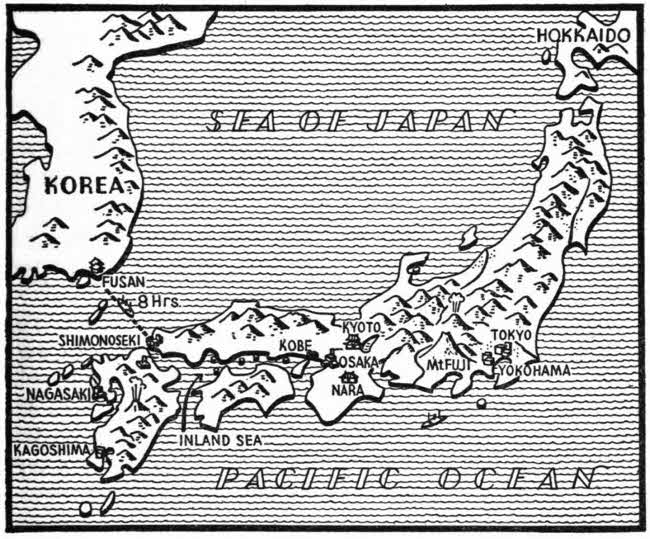
JAPAN’S ISLAND HOME
The last invasions must have occurred early in the Christian era. Scholars are not agreed on the exact racial proportions of the groups which mingled to form the modern Japanese people. The basic stock is probably Mongolian, the result of migrations through Korea from the north Asiatic continent. There is apparently a southern admixture, coming from either southeast China or Malaysia. Many of these groups were late invaders of the islands. They found there an Ainu people, possibly of Caucasian racial origin. Ainu remnants still survive in Japan, but most of them have been absorbed or exterminated in the course of centuries of warfare.
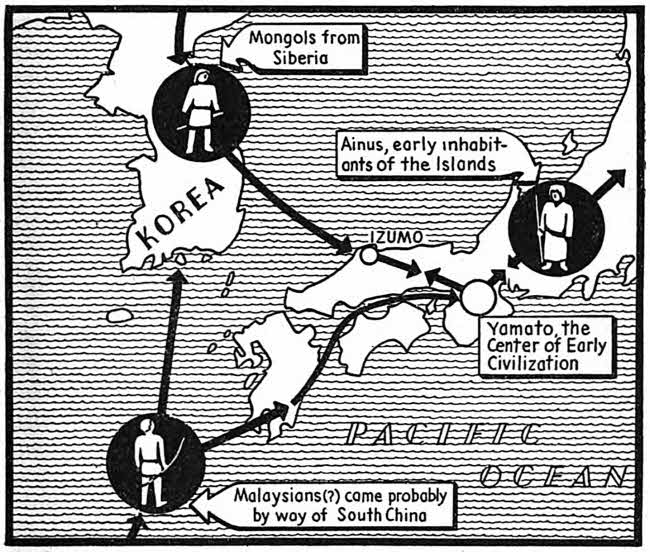
EARLY INVADERS AND SETTLERS
Three main racial elements thus entered into the making of the Japanese people. To the Mongol strain is undoubtedly due the warlike spirit of the Japanese, while from southeast Asia comes a mythology that has been interwoven with Japan’s political institutions. Later, there were also many Chinese and Korean immigrants. By the end of the seventh century, according to one source, more than one-third of Japan’s noble families claimed Chinese or Korean descent.
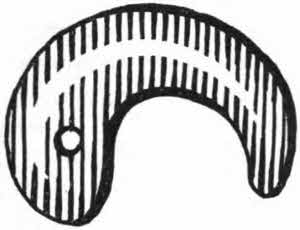
A Magatama, or bead ornament, common in early Japanese tombs. Often made of jade, nephrite or chrysoprase—materials found not in Japan but in the Ural-Baikal regions.
EARLY JAPANESE INSTITUTIONS
To understand modern Japan, we need to study the past even more than in the case of most Western nations. For survivals of ancient traditions play a large part in Japan’s national life today. These beliefs and practices can be traced back for nearly two thousand years. What were these institutions like in their earliest form?
Historians give only a partial answer to this question. The latest island invaders, who became the dominant Japanese, were a group of clans or tribes. Leadership in these clans was hereditary. The clan elder was both chieftain and high priest. He supervised or performed sacrifices to the clan god, who was usually held to be his direct ancestor. All clansmen were supposedly united by blood ties to the clan elder, and thus shared in the divine descent.
“THE WAY OF THE GODS”
Societies ruled by a priest-king, usually called “theocracies,” have existed in many parts of the world. In Japan, however, theocracy grew all the stronger because of a mythological tradition, later called Shinto, or “Way of the Gods,” centering about a Sun Goddess (Amaterasu). There were many aspects to Shinto, including an early nature worship. But its main feature came to be the story of the Sun Goddess, whose descendants were the Japanese people. Early in their history the rulers of Japan raised this myth to the dignity of a state cult. The chieftain of the Yamato clan, the strongest of all, claimed direct descent from the Sun Goddess. This claim was a very real thing in Japan. It was taken much more literally than our vaguer Western idea of “the divine right of kings,” which persisted until the eighteenth century in Europe.
The clansmen were aristocrats who handed on their privileges from father to son, and to whom war was second nature. But agriculture, in the shape of the cultivation of rice, was already a cornerstone in the economy of this early Japanese society. Under the clansmen were “guilds” of farmers and artisans, who did most of the productive work. Membership in these producing units also passed from father to son. These serfs, as well as a smaller number of actual slaves, were made up largely of war captives, conquered natives, or immigrants from Korea.
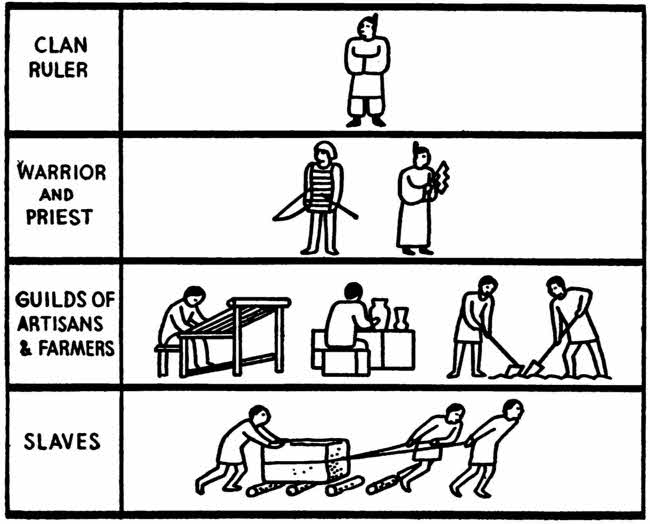
JAPAN’S EARLY SOCIETY (5-6th CENTURIES)
The chief ideas of this primitive Shinto society are quite clear. There was a strong emphasis on the hereditary principle. The idea of an aristocracy of the blood was strengthened by the idea of descent from the gods. Government was by men, not by law. The clan or group, not the individual, was important. The mass of the people lived to serve their rulers. We shall see how these primitive ideas—so like the totalitarian ideas of today—have influenced Japanese history through the centuries.
BEGINNINGS OF A NATION-STATE
At first the invading clans were not unified. There was little centralized government. The Yamato chieftain had only a shadowy authority over the other clans. He was “first among equals,” rather than an overlord. He controlled directly the territory held by his own clan, but not the lands of other clans. Nor did his religious authority extend far beyond his own clan.
During the first four or five centuries of the Christian era this picture was steadily changing. Most of central and western Japan was conquered and occupied as the result of a long series of wars. The power of the Yamato clan was growing. Its chieftain was becoming the ruler of a centralized state. His position was approaching that of a king. Lesser leaders were being attached to this “Emperor,” and were assuming the role of ministers at the “court.”
In other ways, too, the various clans were merging into a centralized state. The Emperor, as the direct descendant of the Sun Goddess, came to be recognized as divine ruler of the whole Japanese people. More and more the Japanese thought of themselves as a single patriarchal family, headed by “the Sovereign that is a manifest God.” Ancestors of the other clan leaders, also divine, were brought into relation with those of the Emperor, but in subordinate rank. The strongest clans were able to claim descent from deities closely associated with the Sun Goddess.
CONQUESTS IN KOREA
These political and religious changes were the outward signs of an underlying movement of growth and expansion. A larger and larger area of the islands was being occupied. The population was growing, and additional economic units, or “guilds,” were being formed. Japanese armies were fighting in Korea, where they dominated the southern region of the peninsula for long periods. Through this contact with the mainland, a stream of Korean immigrants, and even some Chinese, flowed into Japan. Many of them were educated scribes, Buddhist priests or expert artisans. By the fifth century the Japanese had learned the rudiments of Chinese writing, and in the sixth century Buddhism was officially introduced from Korea. The wealth of Chinese civilization was thus opened up to the Japanese people.
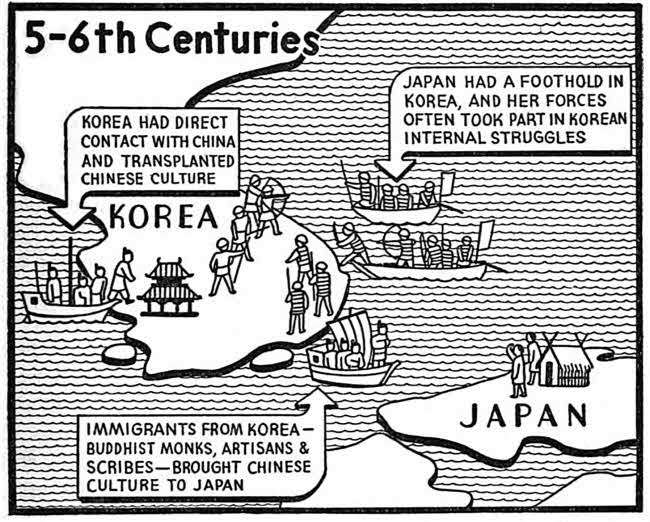
INTERCOURSE WITH KOREA 5-6th Centuries
THE OLD ORDER BREAKS DOWN
By the sixth century, Japan faced new and difficult problems. Old forms of government were breaking down. The simple clan rule, based on blood ties, was being upset by migrations within, and immigration from without. New leaders were faking their family trees, in order to claim divine descent. The clan chieftains found their priestly control over the people slipping, and had to try the use of political and military power instead.
Special difficulties arose when new areas were conquered, or large numbers of immigrants arrived. There were disputes between clans, some of which favored “guilds” and some a freer order of serfs. The Imperial clan proved able to get the richest of the new areas, and to extend the lands and increase the people under its control. But this did not settle the problem. For the leading clans tried to control the Emperor, and fought over rival claimants to the throne.
These bitter quarrels threatened to tear the new state apart. A more effective centralization, both of economic and political power, had obviously become necessary. The groundwork had been laid, and the times called for a drastic change. The model was sought in China, then flourishing under the T’ang Dynasty (618-907 A.D.).