Volume 3 — CHAPTER VIII.
Reading edition
A weary journey.—Meeting with Tungusees.—Grand attack of wolves.—The first sables killed.
After securing the skin of the bear, the travellers proceeded on their journey, the weather still continuing clear, but intensely cold. They were, however, well secured by furs, and they plodded cheerfully on, over the snow-crust. There was little variety, for the country was generally level, and often they marched on for hours without meeting a single object of the least interest. No villages were to be seen over the wide wastes; not a human being met the view; not a bird, not a living thing, enlivened the prospect. And it was as still as it was desolate; for, save when the wind sighed over the snow, not a sound was to be heard. It seemed as if nature was in a repose so profound as to resemble death itself.
It is not remarkable, that, after several days of weary travel over a country like this, our adventurers at last rejoiced to meet with a small settlement of Tungusees. This was situated in a little valley; and so low were the houses, that the travellers had come close upon them before they perceived them. Their approach was announced by the barking of three or four shaggy wolf-dogs, who seemed to exert their lungs to the utmost upon the occasion.
The party was stared at in silence by the inhabitants for a short time, but Linsk soon announced himself and friends as hunters, and as he spoke in the Tungusian language, the little party were at once made welcome. Alexis was amused at the whole scene. The houses were made of stakes set in a circle, covered with mud, over which there was now a mantle of snow. The entrances were so low that it was necessary to creep in upon the hands and knees. There was no light within, except the few rays that struggled in at the door, or were emitted by a smouldering fire, the smoke of which was let out at a hole in the top.
Each hut consisted of one apartment, and here the family all slept, cooked, and ate. The beds consisted of the skins of wolves and bears; the articles of furniture were few, as the people sat on the ground, and most of the cooking was performed by simple boiling or roasting before the fire.
Supper was soon provided, for it was evening when the travellers arrived. This consisted of a piece of bear’s flesh, which was very juicy, and resembled pork. It seemed to be esteemed a great delicacy by the people themselves, and a number of persons came into the hut where our adventurers were entertained, and, somewhat unceremoniously, helped themselves with their fingers to a portion of the coveted viands.
Our travellers had before seen something of Tungusian life and manners; but their admiration was excited anew by the greediness which they all displayed upon the present occasion—men, women, and children. Their hands were daubed in grease up to the wrists, and a very considerable portion of their faces was also anointed in the same way. They tore the flesh from the bones like dogs, and if a piece of meat fell upon the floor, however it might be powdered with dirt, it was carried to the mouth without scruple or inspection. The children lay down upon the floor, and, driving the dogs away, licked up the puddles of fat that were spilled in the greedy scramble. But there was withal much good nature and merriment among the party, and though the speech was often rough and the manner uncouth, good humor seemed to pervade the whole scene.
After the meal was done, brandy was brought in and circulated freely among the men of the company. Some of the women contrived to get a little for themselves through the influence of their admirers. The party soon grew merry, then boisterous, and at last quarrelsome. There was some scuffling and many hard words. Late at night the revel broke up, and the party separated.
It was late the next day, when Alexis and his two young companions were called by Linsk from their repose. They took an ample breakfast, and the party set forward upon their journey. For several days they proceeded without any occurrence worthy of note. At last they came to a little forest of evergreen trees, in which they found two or three small huts, but now deserted by their inhabitants. And here, as it was evening, they concluded to spend the night. Having slightly closed the door with a few pieces of bark to exclude the cold, they built a fire, and had sat down to their frugal supper of dried deer’s flesh, when the ever-watchful ear of Linsk caught certain sounds from without, which arrested his attention. He had listened but a moment, when the fragments at the door were pushed aside, and a wolf thrust his head in at the opening, and gazed intently upon the party. They were all so taken by surprise, that, for a moment, they neither spoke nor moved. It was not long, however, before Linsk arose, seized his gun, and was on the point of discharging it at the wolf, when the latter suddenly withdrew. The whole party followed him out, but what was their astonishment to see around them a pack of at least forty wolves, now ready to make a united attack upon them! It was night, and their glaring eyeballs seemed like sparks of fire, and their teeth were laid bare, as if to rend their victims in pieces. At the same time the barking, yelping, and howling of the savage animals, apparently driven to desperation by hunger, were terrific. The whole scene was indeed so unexpected and so startling, that Alexis and his two young companions immediately slunk back into the hut. Linsk followed, but at least a dozen of the assailants were snapping at his heels, as he drew them in through the door. The old hunter saw in an instant that there was but one mode of warfare which offered the least chance of safety, and this was, to face the enemy at the opening, and prevent them, at all hazards, from effecting an entrance. Getting down upon his knees, therefore, he turned round and looked his furious assailants full in the face. His gun was in his hand, and his knife ready in the belt. Fixing his eye intently upon the wolves, so as to watch every motion, he spoke rapidly to the young men behind him,—“Steady, boys, steady; don’t be afraid. Draw up close and keep your guns ready. What an ill-mannered set they are! I’ll give ’em a dose directly.—Now!”
At this instant, the old hunter fired his gun, and a yell of terror and anguish burst from the pack, who at the moment were jammed into the entrance of the hut. Two or three of them were killed, and several were wounded; but others rushed into their places, and in the space of a few seconds Linsk was again threatened with a mass of heads struggling for entrance at the door. He soon gave them another shot, and finally a third, and the disheartened beasts, leaving eight or ten of their companions dead or mortally wounded on the scene of combat, retired, with many a howl, into the echoing forest.
The next day was occupied by securing the skins of the wolves, and the hunters concluded to spend the next night in the hut, taking care, however, to secure the entrance against the possibility of an attack like that of the preceding evening.
In the morning, the party rose early, and, instead of pursuing their journey, they plunged into the forest, hoping to meet with some sables or ermines. They had not gone far before two little, dark-colored animals, with very long bodies and short legs, were seen running and leaping upon the snow. Linsk uttered a low “hush,” and approached them carefully, under cover of a large tree. He soon approached them, and raising his gun to his eye, seemed about to fire, when, suddenly lowering his piece, he beckoned to Alexis, who came instantly to his side. Obedient to a signal given by Linsk, Alexis drew up his gun and fired; the whole party ran to the spot, and, with great exultation, they picked up the animals, which proved to be two very fine sables. These were the first that Alexis had killed, and they brought to his mind so forcibly the injunctions of Kathinka, and her intense desire that he should be successful in his enterprise, that he burst into a flood of tears. The two sons of Linsk looked at him with amazement, but the old man guessed the cause of his emotion, and by some sportive remark, diverted the thoughts of the party into other channels. The kindness of Linsk in this, and in giving Alexis the first chance to fire, filled the heart of the young hunter with gratitude, which he did not soon forget.
They now pursued their sport, and before the evening came, they had caught seven sables and three ermines. They, therefore, returned to their hut, and now began to think of spending several weeks at this place, for the purpose of pursuing the object of their expedition.
Letter from a Subscriber.
Many thanks to the writer of the following:-
New York, March 15th, 1842.
Dear Mr. Merry—The following lines are from one who has been both instructed and amused by your writings, and although a very youthful subscriber, she begs you will accept them as a small offering from the heart of
Margaret.
The name of Merry long will be Remembered well, and loved by me. Not all the works of ancient lore Transmit to youth so sweet a store Of learning true, in nature’s dress, The garb so simple, yet the best; Religion’s power, so deep, so pure, Through endless ages to endure! Youth bounds at Merry’s joyous name, And e’en old age its love may claim.
Envy.—The envy which grudges the success for which it would want the courage to contend, was well rebuked by the French Marshal Lefevre, who had been in a great many battles, and who had acquired great wealth and fame. One of his friends expressing the most unbounded admiration of his magnificent residence, exclaimed, “How fortunate you are!” “I see you envy me,” said the marshal; “but come, you shall have all that I possess, at a much cheaper rate than I myself paid for it. Step down with me into the yard; you shall let me fire twenty musket shots at you, at the distance of thirty paces, and if I fail to bring you down, all that I have is yours. What! you refuse?” said the marshal, seeing that his friend demurred—“know that before I reached my present eminence, I was obliged to stand more than a thousand musket shots, and those who pulled the triggers were nothing like thirty paces from me.”
Toad-Stools and Mushrooms.
These two kinds of plants, though of similar appearance, are so very different, that while one is poisonous, the other is a wholesome and delicious article of food.
The toad-stool, of which we here give a picture, usually grows in moist places, and where the soil is very rich.
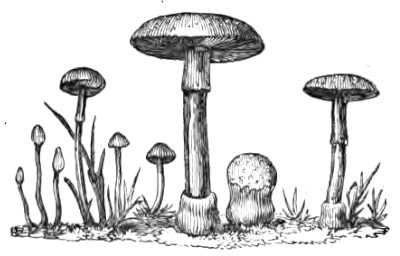
Toad-stools.
The mushroom grows in situations similar to those in which the toad-stool is found. They both belong to the genus which the botanists call agarice; but they may be easily distinguished. The edges of the mushroom are usually thin, ragged, and turned a little upward; while those of the toad-stool are bent down, and carried round in a smooth circle, the top being shaped like an umbrella. The under side of the mushroom is of a pinkish hue, and the skin is easily peeled off from the top.
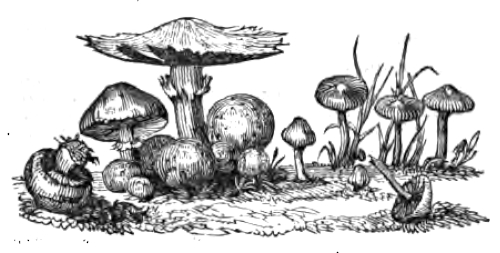
Mushroom.
The mushroom is cooked in various ways; here, it is chiefly used for making ketchup; but in France, the people stew and fry it, and consider it among the most delicate of dishes.
The Return of Spring.
Now spring returns, and all the earth Is clad in cheerful green; The heart of man is filled with mirth, And happiness is seen. The violet rears its modest head, To welcome in the spring, And from its low and humble bed Doth sweetest odors bring. The birds are warbling in the grove, And flutter on the wing, And to their mates in notes of love Responsive echoes sing. Far as the eye can view, the hills Are clad in verdure bright; The rivers and the trickling rills Are pleasant to the sight. Nature another aspect wears, Stern winter’s reign is o’er; While everything the power declares Of Him whom we adore.
Puzzles.
See here, what a string of puzzles have been sent me by my young readers! Who will unravel them?
Puzzle, No. 1.
I am a word of 6 letters.
My 1, 2, 6, 5, is what Oliver Twist asked for.
My 3, 2, 1, is a nickname for a boy.
My 4, 2, 1, 5, every one loves.
My 1, 2, 3, 4, every good house-keeper dreads.
My whole is my dearest friend.
Fanny.
Puzzle, No. 2.
I am a word of 14 letters.
My 5, 9, 13, 6, 13, is an important article best found in Ireland.
My 2, 6, 13, is a very useful fowl.
My 14, 9, 10, 11, is a very unpleasant state to be in.
My 9, 10, 12, is very pleasant in summer.
My 7, 2, 3, 8, 12, is also very pleasant in summer.
My 7, 2, 3, 4, 11, is a very large fish.
My 2, 3, 1, 11, is a useful vehicle.
My whole is the name of a celebrated author, which I shall give you in my next.
A Black-eyed Subscriber.
Puzzle, No. 3.
I am a sentence composed of 26 letters.
My 1, 11, 15, 4, 24, 8, is a flourishing city.
My 3, 15, 18, 17, 17, 16, is a road.
My 7, 8, 6, is a girl’s name.
My 12, 11, 10, is a disturbance.
My 4, 5, 10, 6, is a municipal corporation.
My 19, 21, 26, 14, is what you take on my whole.
My 15, 24, 26, is the grass over a grave.
My 22, 24, 25, 26, is a burden.
My 13, 2, 6, 9, 5, 23, is a bird of prey.
My whole is a link of a great iron chain.
Puzzle, No. 4.
I am a name of 17 letters.
My 9, 10, 3, 12, 17, 2, is a useful mechanic.
My 15, 10, 13, 8, 7, is what we all wish to be.
My 1, 11, 4, is that for want of which great misfortunes have happened.
My 2, 14, 5, 8, is an article of commerce.
My 13, 11, 15, 16, 6, is French for a city.
My 1, 6, 17, 2, is a person of rank.
My whole is a distinguished foreigner.
Puzzle, No. 5.No
I am a word of 9 letters.
My 9, 8, 8, 1, is the name of a number.
My 4, 8, 1, 3, 7, is the name of a kind of house.
My 9, 5, 3, 3, is the name of a large cask.
My 6, 5, 3, 9, is what butchers often do.
My 1, 2, 3, 4, is a nickname.
My 8, 2, 3, 4, is what every animal in creation does.
My 6, 2, 3, 7, is the name of a small pet animal, to be found in almost every house.
My 4, 5, 3, 9, is an exclamation signifying “Let alone!”
My 1, 8, 3, 4, is an implement used by fishermen.
My 1, 5, 3, 9, is found in the woods.
My whole is the name of a great sandheap.
Come out here, and I’ll lick the whole of you; as the boy said ven he seed a bottle full of sugar sticks in a shop window!
To my Correspondents.
Whew! what a lot of letters I have got from my little black-eyed and blue-eyed friends, this month! Some contain answers to old puzzles, and some contain new puzzles, and some put questions which puzzle me not a little. However, I am very glad to hear from anybody who takes an interest in poor Bob Merry; and I think all the better of young people, who can be kind to an old fellow with a wooden leg, and content to hear stories from one who never went to college. I feel cheered by these pleasant, lively letters; and sometimes, when my old pate reels with hard work, and my eyes grow dim as I think over the sad fortunes that pursue me, I go to the package of my correspondents, and there find consolation. “No matter—no matter,” say I to myself, “if all the world deserts or abuses me, at least these little friends will be true to me!” So, thereupon, I wipe my eyes, clean my spectacles, whistle some merry tune, and sit down to write something cheerful and pleasant for my Magazine.
Well, now I say again, that I am much obliged to my kind friends, and I am glad to observe that they always pay their postage. Only one instance to the contrary has occurred: my little friend, Cornelius W——, of Newark, New Jersey, forgot to pay the postage on the specimen of his handwriting that he sent me. I mention this for his benefit, because the habit of forgetting to do things as they ought to be done is a very bad habit. Suppose, for instance, that a person should get into the habit of eating carelessly; why, at last, instead of eating the meat, and rejecting the bones, he might swallow the bones, and reject the meat! Think of that, Master Cornelius.
I have received the answers of A. L., W. H. S., C. F. W. P., F. A. S., and others, to the puzzles in the March number, all of which are right. The first is Bunker Hill Monument; the second is A Black-eyed Friend.
The following request I will reflect upon.
Mr. Merry—I wish very much to have the story of Philip Brusque continued. I wish to know what Mr. Bonfils did. Was he a good king, and did they have any more riots? If you will “lift the curtain,” you will satisfy my wishes, and oblige
A Subscriber.
Boston, March 5, 1842.
The “Meditations of an Old Man” are a little too melancholy for our young readers; they do not like to weep very often, and I expect that Bob Merry’s story will, by and bye, call for all the tears they can spare.
I insert the following with pleasure. It seems that young Bare-Head is a “Wolverene;” and if he will tell his real life and adventures, no doubt they will be worth hearing. What a good title it will be!—“The Adventures of Ben Bare-Head, the Wolverene!”
MASTER BARE-HEAD’S PUZZLE. I am a name of 13 letters.
My 5, 3, 13, is a stupid fellow.
My 4, 8, 1, 5, 6, 7, is a kind of shrub.
My 13, 5, 1, is a nickname.
My 1, 5, 11, 6, 7, often takes place between two individuals.
My 6, 7, 2, 4, 10, is a pleasing diversion.
My 3, 12, 10, 5, 1, is a useful agent.
My 5, 13, 7, 10, 4, is what we every day behold.
My 9, 11, 5, 12, 10, is what I am.
My 6, 7, 10, 3, 13, has ruined many.
My 4, 7, 5, 1, 10, many do not possess.
My 7, 2, 11, is what I have not got.
My 6, 2, 9, 7, is what a Hoosier seldom sees.
My 7, 8, 12, is common in Michigan.
My 1, 5, 9, 12, is often seen in Boston.
My 6, 7, 10, 4, 12, is a convenient article.
My 11, 10, 10, 12, 7, 5, 6, 7, 10, makes cross women.
My 1, 8, 13, 10, 8, 1, will doubtless be a benefit to the rising generation.
My whole may well be considered the pride of America.
When this is solved, you shall have a harder one.
Ben. Bare-Head.
Bertrand, Michigan, Jan. 31, 1842.
The following lines are pretty good for so young a writer:—
THE DESTRUCTION OF SODOM AND GOMORRAH, THE CITIES OF THE PLAIN.
Brightly o’er those proud cities The morning sun arose, And over those princely palaces His robe effulgent throws. But whether on stately palace, Or spire, or idol fane, He shows his gorgeous coloring There it ne’er must rest again. And lovely, O most lovely, Was the scene he shone on, now! From the verdant flower-decked vale, To the mountain’s pine-clad brow, With the crystal stream’s meandering flow, And its waters dancing bright,— All nature teems with beauty, With joy, and life, and light. And from every shrub and flower What a fragrant perfume breathes, While fruit of almost every clime Hangs in rich clusters from the trees; And birds, of plumage rich and rare, Pour forth their notes of love, In strains so wild, so thrilling, sweet, From every sheltering grove! And who would deem that sin Could mar a scene so beauteous, bright, So filled with things that please the eye, And give the mind delight? And yet such guilt stalked proudly here, Such sin without alloy, As to tempt the Almighty’s wrath to curse, His anger to destroy. But soon, ah me! how very soon, And what a change is there! A bellowing earthquake shakes the ground, Loud thunders fill the air; Bright fire from heaven flashes In sheets of liquid flame, And a heap of wretched ruins Those proud cities then became. What keen remorse and anguish Must have through those bosoms thrilled, What shrieks and shouts of agony Must the echoing air have filled! But no remorse, or anguish, Could then avail to save, And those once splendid cities Found one promiscuous grave. H. D. B.
Well done, my gray-eyed friend—P. J. U. Come and see me, and I will give thee a hearty shake of the hand!
Esteemed Friend:—
I have received thy Magazine, and write on purpose to inform thee of my wish to see the last of our friend Brusque on the island of Fredonia; and hope it will be of no inconvenience to unravel the whole. Although I am a gray-eyed little friend, I have taken the liberty to write thee a few lines, and hope thee will receive it from an unknown boy, aged 11 years, who longs to see thee and hear those interesting stories which I hope will soon appear in our pretty little books; but as that cannot be at present, I still hope to get them, with yellow covers, with my father’s name on the back.
From a gray-eyed friend,
P. J. U.
The suggestion of a “Black-Eyed Friend,” as to juvenile plays or dialogues, is received, and shall be duly considered. I notice his remark that I have not given the names of all the kinds of type; and he is correct in his observation. J. H. W., Oak street, Boston, writes a fair, handsome hand, and this is a pleasant thing to a blear-eyed old fellow, like me. His solution is right. G. W. F., of Pittsburgh, also writes very neatly, and his letter is expressed with great propriety. He, too, is correct in his answers to the riddles. The enigma of J. W. P. is ingenious—but the name itself is a puzzle. Here it is: “General Diebitsch Sabalkansky.” Why, this name reminds me of a stick that was so crooked it could never lie still!
Irish Wit.—“Please your honor, is a thing lost when you know where it is?” said an Irish footman to his master.
“To be sure not, you booby.”
“Och! thank your honor for that; the de’il of harm then, for the new copper takettle’s at the bottom of the well!”