Volume 3 — PETER PARLEY’S NEW STORIES.
Reading edition
No. III.
Truth and Falsehood—an Allegory.
In ancient days, there lived in Damascus, a city of Syria, a youth whose name was Myron. His father, who was very rich, died suddenly, leaving him a vast estate. He had a great deal of money, and a beautiful house, to which a fine garden was attached. One day he was walking in this garden, and the air being warm and pleasant, he sat down by a fountain, sheltered from the sun by the overhanging branches of the cedar trees. The scene was tranquil and soothing, and such was its effect upon Myron, that he fell into a dream or reverie, in which the following events seemed actually to come to pass.
He fancied that he was walking in one of the paths of the garden, thinking upon the death of his father, and the situation in which he was now placed. His mother had been dead for some years: he was therefore an orphan, and must depend upon himself to mark out his course of conduct. His wealth, indeed, brought around him a host of friends, real or pretended—but could he confide in them? Some of them spoke smooth words to him, and flattered him, and made themselves very agreeable; while others were less pleasing, but apparently more sincere. But which, of all these persons, could he confide in? This question often occurred to him, and he felt anxious to decide and act according to the dictates of wisdom. While he was thinking on this subject, the scene changed, and he appeared to be on a journey alone, and travelling a road which was new and strange to him.
The path before him seemed plain enough for a time, but soon it became less defined, and several other roads branched off to the right and left. He, however, proceeded—but at length the road entered a forest, which grew deeper as he advanced, while the track became more obscure. At last he came to a point where he was entirely in doubt as to the road he was to take; and this doubt was mingled with anxiety, for night was now at hand, and a thunder-storm was approaching. Already the ruddy lightning was flashing among the dark shadows of the pines, and the thunder was growling over the distant hills.
While the youth was looking anxiously around for some one to be his guide in this dilemma, he was surprised as well as pleased to see a comely youth approaching him. Scarcely had he greeted the young stranger, when an aged and reverend man also joined the party.
Myron looked at them both attentively, for their appearance was remarkable; beside, he was now in a situation to need counsel and direction, and he wished, if possible, to learn from the aspect of these persons, which he might most safely trust. He was, however, unable to decide between them, and at last he spoke to them as follows:
“I am travelling, my friends, to a distant city, and having lost my way, I beg you to tell me which road I am to follow.”
The youth replied, with a bland smile, “Fair friend, I know the way to the city you seek, and as it is my pleasure to aid the unfortunate, I will lead you to the end of your journey, if you will put yourself under my care.”
Myron noticed, that as the youth spoke, his face grew more lovely, and the tones of his voice were sweet and musical, like the notes of a lute. He was captivated with the young stranger, and was about to express both his thanks and his assent to the proposal, when he observed a frown upon the brow of the old man, at their side. At the same time this grave stranger said, “Do you know, young man, the name of this person under whose guidance you are about to place yourself?”
“I do not,” said Myron, “nor do I care to know it. The fair face and soft speech of the young man, assure me of his kindness and fidelity; and I am willing to place my happiness in his hands. Come,” said he, “let us depart on our journey, and leave this haughty old man to his musings.”
With this rude speech, Myron turned on his heel, and taking the arm of the youth, they were about to depart, when the sage spoke to Myron, saying,—“The time may come, young man, when you will need a friend: when such an occasion arrives, and you are ready to abide by safe counsel, call for me, and I will obey your summons. My name is Truth!”
The two youths now departed, laughing heartily at the old codger, as they called him, whom they left behind. After a short space Myron asked the name of his companion—as a mere matter of curiosity. “Oh,” said the young man, “that old fellow, Truth, calls me Falsehood, but I pass under the various titles of Pleasure, Fancy, and Folly—according to the humor I am in. One day, when I sport with the flowers, they name me pleasure; and at another time, when I play with the sunbeams, they call me fancy; and again, when I give myself up to mirth or wine, they call me folly.”
“But do you do all these things?” asked Myron, in some wonder.
“To be sure I do, and many others,” said the youth, “as you shall see before our acquaintance ends. But remember that I am now your guide; and it is my duty to make your journey pleasant. Let us take this path to the left, for it will conduct us through the most charming scenes.”
The two companions took the left hand path as suggested, and for some time it led them among pleasant valleys, and sweet lawns, and the most enchanting landscapes. At last they came to a scene more beautiful than any they had met. Groups of lofty trees were scattered here and there over a grassy slope, the verdure of which was like velvet. In the middle of this spot was a fountain, and the waters being thrown into the air, fell in glittering showers, making at the same time a sound of entrancing music. Amid the forest bowers, were birds of gorgeous plumage, and their song was more lovely than that of the nightingale.
Myron was delighted. He had never before seen anything so beautiful. Again and again he thanked his guide for the pleasure he had bestowed upon him. So absorbed was he in the scene, that he forgot his journey, and it was not till the sun began to set behind the hills that he was called to reflection. He then asked his guide where they were to spend the night. The reply was evasive, and Myron did not fail to remark that a sinister smile came over the face of his friend, as he said—“Let us go forward, we shall find a lodging in due time.”
The two proceeded, but they had not gone far before the clouds began to thicken, and in a short space it was intensely dark. The road grew rough and thorny, and at last Myron fell over a stone of considerable size. He rose with difficulty, and when he called for his companion, he was not to be found. Nothing could exceed the amazement and terror of the young traveller; for now he began to hear the cries of wild animals, and in a short space he could make out the form of a lion, stealing upon him, through the darkness.
The words of the old man whom he had treated so rudely, now flashed upon his memory—and in the agony of the moment he called out, “Truth—Truth—come to my aid, and be my guide!” These words were uttered aloud, and with such energy, that Myron awoke from his dream, his heart beating, and his body covered with a cold perspiration. But the vision seemed to bear a wholesome meaning, and the words, which broke from his lips in the moment of his fancied peril, became the rule of his after life. He rejected falsehood, which promises fair, and for a time tempts us with darling pleasures, but leads us into scenes of terror and distress, and leaves us helpless at the hour of our utmost need. He made Truth his friend and guide, and was both successful and happy in the great journey of life.
The Chimpansé.
This is a species of ape, found on the western coast of Africa. He is more like a man than any other of the four-handed race, and is the only one that can easily walk erect. He is often seen walking with a cane in the woods. The negroes say that he is a kind of man, and only refuses to talk because he is afraid of being made to work.
These creatures live in the woods, and sometimes attack the natives with clubs and stones. The Europeans, who live in the settlements along the coast, have trained some of these creatures so that they perform various kinds of labor, such as bringing water in jugs, rinsing out glasses, turning spits, and handing liquor round to company at table.
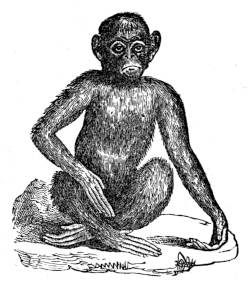
M. Grandpry, a French gentleman describes one that he had on board a vessel. She had learnt to heat the oven; she took great care not to let any of the coals fall out, which might have done mischief in the ship; and she was very accurate in observing when the oven was heated to the proper degree, of which she immediately apprized the baker, who, relying with perfect confidence upon her information, carried his dough to the oven as soon as the chimpansé came to fetch him. This animal performed all the business of a sailor; spliced ropes, handed the sails, and assisted at unfurling them; and she was, in fact, considered by the sailors as one of themselves. The vessel was bound for America, but the poor animal did not live to see that country, having fallen a victim to the brutality of the first mate, who inflicted very cruel chastisement upon her, which she had not deserved. She endured it with the greatest patience, only holding out her hands in a suppliant attitude, in order to break the force of the blows she received. But from that moment she steadily refused to take any food, and died on the fifth day, from grief and hunger. She was lamented by every one on board, not insensible to the feelings of humanity, who knew the circumstances of her fate.
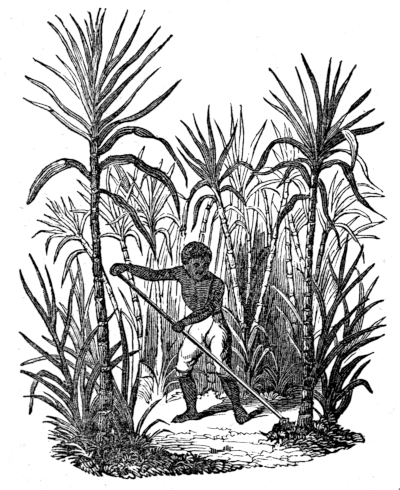
The Sugar-Cane.
Sugar is found in a great many vegetables, particularly in beets, carrots, parsnips, sugar-cane, Indian corn, the sugar-maple tree, &c. Sugar is manufactured from beets, in large quantities, in France, and in this country it is made from beets also, to some extent. It is also made from the juice of the maple tree, particularly in the western states. In March the trees are tapped in the sides, and little reeds are inserted, in which the sap, as it ascends from the earth to the extremities, is caught and conducted into wooden troughs. It is then boiled down, and becomes first molasses and then sugar. Many millions of pounds are made in this way each year.
But this is a very small quantity, compared with what is made from the sugarcane, in the West Indies, Louisiana, and South America. The sugar-cane is a jointed reed, of a fine straw color, growing from eight to fourteen feet high. It terminates at the top in blade-shaped leaves, the edges of which are finely notched. Its flowers form a delicate silver-colored cluster.
When the cane is about a year old, it is cut and crushed between iron rollers, which press out the juice. This is then conducted into large copper boilers, and by various processes, of boiling and cooling, it is at last made into sugar, and molasses, the latter being the liquid part that drips from the sugar. In the process of manufacture, a good deal of lime and bullocks’ blood are mixed with the juice of the cane, and these assist in refining the sugar.
A very interesting discovery has lately been made in this country, which is, that the stalks of Indian corn, if the ears are cropped just after they begin to set, will produce more sugar than the cane. Accordingly a machine for the crushing of the stalks has been contrived, and a model of it may be seen at the patent office at Washington. It is said that a single acre of ground will yearly produce a ton of sugar, and it is believed that sugar will soon be raised in abundance in all the western states, in this way. The stalks make excellent fodder for cattle, after the juice is crushed out.
Sugar is now regarded as one of the necessaries of life, and about 600,000 tons, or 120,000,000 of pounds are annually produced. Yet it seems that sugar was not known to the Greeks or Romans, and it is never mentioned in the Bible. It was, in fact, only known as a medicine, till modern times. In the tenth century it took the place of honey in the druggist’s shop, and was chiefly used in fevers, to relieve them.
The sugar-cane was found growing wild in the West Indies, by Christopher Columbus. The art of refining sugar so as to make it white, was discovered in the sixteenth century, by a Venetian, who made a vast fortune by it.
Dialogue on Politeness.
Louisa. Good morning, mother. I have been in search of you for the last half hour. Julia and I have been talking very earnestly on a certain subject, but we do not agree at all in our opinions; so I have come to you to get yours. I rather think you will be “on my side,” as I suppose I have learnt to judge a little as you do; as is very natural I should, mother.
Mother. I should certainly be very sorry, my dear, if your mind and opinions were not influenced by mine. But what is the question which has excited such animated discussion? Some new style of bonnet, or the manner of singing the last new song?
L. Neither, mother; but something much more important. We have been talking of the manners of two of our schoolmates, Matilda Hervy and Caroline Perkins. Julia prefers Caroline’s manners, and I prefer Matilda’s. Julia thinks Caroline a perfect pattern of politeness.
M. Ah! for what reason, my dear?
L. O, because she smiles so sweetly when she speaks; always shakes hands with people; flatters them, and repeats compliments she has heard of them, and all that sort of thing.
M. Is Caroline the same to all, my dear?
L. O, no, mother; she is polite only to a certain set of people. Matilda is the same to all, both rich and poor. Caroline evidently has an object in her attentions, which is, to get the favor of those who can do her kindnesses in return. Can a person be truly polite, mother, without a kind heart and a well-principled mind?
M. I think not, Louisa. I have myself to-day been the witness of something quite apropos to our subject. In riding in the omnibus from Cambridge, this morning, I observed among the passengers two young men, about the age of your brother Albert, apparently collegians, who, from their intercourse, I judged to be intimate friends—probably classmates; but there was a marked difference in their manners and appearance. One of them, to some personal advantages added elegance of dress, and a voice the tones of which were particularly musical when he addressed a pretty and fashionable lady opposite him. If, by the jolting of the carriage, he accidentally touched the hem of her garment, he apologized most gracefully; and he was evidently regarded by the whole party as a most polite young man. The classmate had nothing remarkable in his appearance, bearing none of the externals of polite life. Suddenly the bell rang, and we stopped to take up a woman, who had with her a large bundle, which, as we were already crowded uncomfortably, she retained in her arms. The last-mentioned young man, seeing that she was heavily burdened, and looked weak and sickly, kindly told her to allow him to hold the bundle for her. There was instantly a smile exchanged between the lady and the well-dressed collegian, with unrepressed glances of contempt at the bundle, accompanied with loud hints about vulgarity, &c. This conduct was observed by the woman, and seemed to hurt her feelings much. However, she did not ride far, and when the coach stopped, her kind young friend assisted her out with as much consideration as if she were a princess. This little incident pleased me much.
L. Really, mother, I should think there was precisely the difference between Matilda and Caroline, as between the two collegians. Caroline’s kind acts and polite words are always for the rich, the high-born, or the fashionable. Matilda delights in doing favors to those who can make her no return. She looks upon all as her fellow-creatures—never seeming to think of their station in life. She treats the poor, wherever she finds them, as her “neighbors,” in the Bible sense of the word. She has made many a widow’s heart to sing for joy, and she is truly a good Samaritan.
M. You are enthusiastic, my dear, in praise of your friend. I shall certainly give my opinion in favor of Matilda, whose politeness is evidently the politeness of the heart; and though a person may sometimes be sneered at for practising it toward the poor and humble, he will generally be respected, and always have more influence than he who is only polite to a few for interest’s sake. I hope, my dear, as you appreciate Matilda’s worth, you will make her your model. I am very glad my daughter loves such a character, as we almost always imitate what we admire. A person who is polite and kind to all, enjoys the highest kind of satisfaction; for he knows that in loving his neighbor, he also obeys God.—[Young Ladies’ Friend.]
Mistress and Servant.—A lady, the other day, meeting a girl, who had lately left her service, enquired, “Well, Mary, where do you live now?” “Please, madam, I don’t live nowhere now,” rejoined the girl; “I am married.”
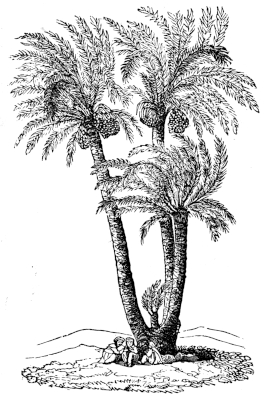
The Date Tree.
This is a species of palm, which produces the sweet fruit which is brought to us from Smyrna, and other ports in the Mediterranean, and which is well known under the name of date.
In the regions between Barbary and the Great Desert, the soil, which is of a sandy nature, is so much parched by the intense heat of the sun’s rays, that none of the corn plants will grow; and in the arid district, called the land of dates, the few vegetables that can be found are of the most dwarfish description. No plants arise to form the variety of food to which we are accustomed; and the natives of these districts live almost exclusively upon the fruit of the date tree. A paste is made of this fruit by pressing it in large baskets. This paste is not used for present supply, but is intended for a provision in case of a failure in the crops of dates, which sometimes occurs, owing to the ravages committed by locusts.
The date in its natural state forms the usual food; and the juice yielded by it when fresh, contains so much nutriment as to render those who live upon it so extremely fat. As, by the Moors, corpulence is esteemed an indispensable requisite of beauty, the ladies belonging to the families of distinction among them, nourish themselves, during the season, solely with the fresh fruit, and by continuing this regimen during two or three months, they become of an enormous size.
The date palm flourishes very generally on sandy soils in the hot countries of Asia and Africa. Not always, however, is the soil that supports it, barren as the one I have described. It is frequently found by streams, and as the tired traveller sees its foliage waving afar, he hastens towards it, hoping to find a stream of water. Sometimes its tall stem is surrounded by beautiful climbing plants, and the most brilliant flowers flourish beneath its shadow.
This palm frequently attains the height of sixty feet, and stands perfectly upright, unlike, in this respect, some other species of palm, whose slight forms yield to the winds. It was to this tree that the Psalmist alluded when he said, “The righteous shall grow as the palm tree,”—firm and unmoved by the shocks of temptation and the storms of adversity. The clusters of dates are sometimes five feet in length, and, when ripe, are of a bright gold color, over which the summit of the tree is crowned with a beautiful foliage.
Dress.
There is nothing in which mankind display more caprice, than in dress; and it is curious to remark, that this caprice is most conspicuous in the more civilized countries. In London and Paris, the fashions of dress change every year, and in some things, every few weeks. There is a new style of bonnet in Paris at least every three months.
But in China and India, and indeed over all Asia, the fashions of dress are unchangeable. The people now wear almost exactly the same garments, of the same colors and the same forms, as a thousand years ago.
The country people of Europe, generally, have a fixed costume, which continues, with little change, from generation to generation; but in the great cities, all is variety and vicissitude. In this country we copy European fashions, and there are some silly people whose greatest desire is to be dressed in the Parisian style.
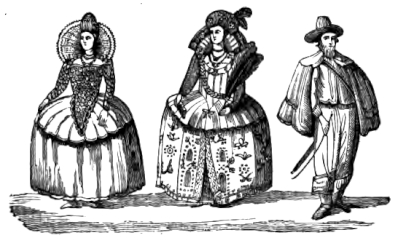
Now when we are told of the Chinese ladies, who have their feet bandaged in order to make them small, until they can hardly walk—thus rendering themselves miserable and useless, and all this to be thought genteel—we think them very absurd. But look at the picture, on the preceding page, and tell me if these ladies are not about as foolish. They are dressed in the fashion of Queen Elizabeth’s time, and it has been much imitated by the ladies of modern days.
But we must not laugh at the ladies only, for the other sex deserve a share of our notice. Foppery is not confined to any country. A young savage of the western woods, has often the ambition to figure as a gay fellow, as well as the New York or Boston dandy. He does not go to the tailor, to be made a man of, but he relies upon his own skill. He paints himself over with clay, of various colors, mixed with bears’ grease. One side of his face is made blue, and another yellow. On his breast a serpent is figured; on his back, a buffalo or a wolf. On his head he wears the feathers of an eagle; around his neck, the claws of the grisly bear; on his back is a bundle of scalps, and on his arms the skin of a skunk. Over his shoulder is a buffalo-robe decorated with a frill of quills, and ornamented with beads. Such is your dandy of savage life.
And now for the dandy of our cities. The great thing is to have abundance of hair; and the more it hangs over the eyes, and obtrudes itself around the nose and mouth and neck, and in every other place that may suggest the idea of discomfort or filthiness, so much the better, thinks the dandy. For my own part, I lay it down as an invariable rule, that if a youth displays an unusual quantity of hair or beard, he is deficient, to the same extent, in brains. I believe this is a safe ground of judgment. But still, it is the fashion, just now, to run to hair, and thus it seems our young men have an ambition to excel in that, in which, after all their efforts, the bear, the buffalo, and indeed most beasts, will always surpass them. When I see one of these whiskered, soap-locked fellows, I always think of the description that an Irish girl gave of a skunk that was rude to her, upon a certain occasion. As she went home, she carried evidence of the fact, and when the people asked what it meant—“Faith!” said she, “and it was a little hairy beast that did it!”
Spanish Names.—The love of long Christian names by the Spaniards has frequently been a subject of ridicule. A Spaniard on his travel, arrived in the night at a little village in France, in which there was but one hotel. As it was almost midnight, he knocked at the door a long time without hearing any one stir. At length the host, putting his head out of the chamber window, asked who was there. The Spaniard replied, “Don Juan Pedro, Hernandez, Rodriguez, Alvarez de Villanova, Count de Malafra, Cavellero de Santiago d’Alcantara.” “Mercy on me,” said the host, as he shut the window, “I have but two spare beds, and you ask me lodging for a score.”
Eagles, and some other Matters.
The eagle is considered the king of birds, as the lion is called the king of beasts. Now both the lion and eagle are strong, and they readily sacrifice all other creatures to their own gluttonous appetites. At the same time, they are both cowardly creatures. The lion is a skulking beast, and steals upon his prey like a thieving cat; and he readily flies from danger, except when hunger impels him to bold deeds. The eagle too, when his crop is well filled, is a lazy creature, and at any time a much smaller bird may drive him away.
Now, the title of king was given to the lion and the eagle, in ancient days, and it shows what the people then thought of kings. It is obvious that they supposed a king to be a powerful, but selfish creature, sacrificing everybody to himself, as do the lion and the eagle. They did not suppose it necessary for the king to be noble, generous, and courageous, for they would not, in that case, have given the title of king, to sly, thieving, cowardly animals.
The opinion of mankind, in early days, being that kings were like lions and eagles, feeding and feasting upon others whom they could master, was no doubt just; and, with few exceptions, this is a true view of the character of kings, in all ages. They have ever cared much for themselves, and very little for the people at large.
But there is one thing more to be remarked in respect to the characters given to animals by the ancients. They called the lion noble, because he was powerful; and for the same reason they called the eagle the bird of Jove—thus making it the associate of one of their gods! At the same time that the ancients thus gave such sounding titles to rapacious and savage animals, they considered a dog as one of the meanest of quadrupeds, and to call a man a dog, was to insult with a very opprobrious epithet. The ancients also called the ass stupid, and a goose was the very emblem of folly.
Now we should reflect a little upon these matters. The dog is a faithful creature, fond of his master, and choosing to live with him, whether in wealth or poverty, rather than to live anywhere else. He prefers remaining in the humble log-cabin, or poor cottage, with only a bone to eat, provided his master and his friend is there, rather than to live in the lordly mansion upon sausages and beef steak, among strangers. The characteristic of the dog, then, is attachment to his friend; and yet, in ancient days, the people called the butchering lion noble, and the faithful dog mean.
And as to the ass, he is in fact one of the most sagacious of all quadrupeds. Old Æsop, who made fables, seems to have done justice to this long-eared, four-legged sage, for, he makes him say a vast many wise things. But not to insist upon the ass’s gift of speech, he is not only an intelligent creature, but he is patient, enduring, hard-working, temperate, and unoffending; at the same time he is more free from vice than almost any other quadruped, even though he is often in the hands of persons who do not set good examples, and abuse him most shamefully. Now as this good beast was called stupid by the ancients, it is fair to infer, that they considered patience, temperance, diligence, and freedom from vice, as mean.
And now a word as to the goose. My young readers may titter as much as they please—for in spite of all their mirth, I am going to stand up for this poor, abused bird. The goose is not silly—but, as compared with other birds, it is in fact wise. There is no creature so watchful as a goose. In a wild state, when in danger of being shot down by the huntsman, they set sentinels to keep guard while the flock is feeding; and on his giving notice of danger, they take wing and fly away. In a domestic state, they give notice by their cackle of every disturbance, and any noise that may happen about the house at night.
Geese are also very courageous in defence of their young; and, beside this, they are capable of attachment, beyond any other bird. The celebrated writer, Buffon, tells a most interesting story of a goose, called Jacquot, that became fond of him because he helped the poor fellow when he was beaten almost to death by a rival gander. Every time Buffon came near, the grateful bird would sing out to him in the most cheerful manner, and would run to him, and put his head up to be patted.
“One day,” says Buffon, “having followed me as far as the ice-house at the top of the park, the spot where I must necessarily part with him in pursuing my path to a wood at half a league distance, I shut him in the park. He no sooner saw himself separated from me, than he vented strange cries. However, I went on my road; and had advanced about a third of the distance, when the noise of a heavy flight made me turn my head; I saw my Jacquot only four paces from me. He followed me all the way, partly on foot, partly on wing; getting before me and stopping at the cross-paths to see which way I should take.
“Our journey lasted from ten o’clock in the morning till eight in the evening; and my companion followed me through all the windings of the wood, without seeming to be tired. After this he attended me everywhere, so as to become troublesome; for I was not able to go to any place without his tracing my steps, so that one day he came to find me in the church! Another time, as he was passing by the rector’s window, he heard me talking in the room; and, as he found the door open, he entered, climbed up stairs, and, marching in, gave a loud exclamation of joy, to the no small affright of the family!
“I am sorry in relating such traits of my interesting and faithful friend Jacquot, when I reflect that it was myself that first dissolved the pleasing connection; but it was necessary for me to separate him from me by force. Poor Jacquot found himself as free in the best apartments as in his own; and after several accidents of this kind, he was shut up and I saw him no more. His inquietude lasted about a year, and he died from vexation. He was become as dry as a bit of wood, I am told; for I would not see him; and his death was concealed from me for more than two months after the event. Were I to recount all the friendly incidents between me and poor Jacquot, I should not for several days have done writing. He died in the third year of our friendship, aged seven years and two months.”
This is a very pleasing story, and sets forth the goose as capable of attachment, and, also, as gifted with much more intelligence than most animals display. But I have another pleasant story for my readers.
At East Barnet, in Hertfordshire, England, some years ago, a gentleman had a Canadian goose, which attached itself in the most affectionate manner to the house dog, but never attempted to enter his kennel, except in rainy weather. Whenever the dog barked, the goose set up a loud cackling, and ran at the person she supposed the dog barked at, and would bite at his heels. She was exceedingly anxious to be on the most familiar terms with her canine friend, and sometimes attempted to eat along with him, which, however, he would not suffer, nor indeed did he manifest the same friendship towards the goose, which it did towards him, treating it rather with indifference. This creature would never go to roost with the others at night, unless driven by main force; and when in the morning they were turned into the field, she refused to go thither, and bent her course towards the yard gate, where she sat all day watching the dog.
The proprietor at length finding it in vain to attempt keeping these animals apart, gave orders that the goose should be no longer interfered with, but left entirely to the freedom of her own will. Being thus left at liberty to pursue her own inclinations, she ran about the yard with him all night, and when the dog went to the village, she never failed to accompany him, and contrived to keep pace with his more rapid movements by the assistance of her wings, and in this way, betwixt running and flying, accompanied him all over the parish. This extraordinary affection is supposed to have originated in the dog having rescued her from a fox in the very moment of distress. It continued for two years, and only terminated with the death of the goose.
Now is not this a good story? and it is all about a goose, that people call a foolish bird. But here is another story, quite as good as any I have told.
“An old goose,” says an English writer, “that had been for a fortnight hatching in a farmer’s kitchen, was perceived on a sudden to be taken violently ill. She soon after left the nest, and repaired to an outhouse where there was a young goose of the first year, which she brought with her into the kitchen. The young one immediately scrambled into the old one’s nest, sat, hatched, and afterwards brought up the brood. The old goose, as soon as the young one had taken her place, sat down by the side of the nest, and shortly after died. As the young goose had never been in the habit of entering the kitchen before, I know of no way of accounting for this fact, but by supposing that the old one had some way of communicating her thoughts and anxieties, which the other was perfectly able to understand. A sister of mine, who witnessed the transaction, gave me the information in the evening of the day it happened.”
Now I begun this chapter by talking about eagles, and I have been rambling on about geese—but I have an object in all this. I wish to show my readers that we have taken certain notions, in regard to animals, from the ancients, which are erroneous; and which have a bad influence upon us. Many a time has a poor ass got a kick, just because of a prejudice that has been handed down from age to age. People scarcely think it wrong to abuse a creature that is called stupid! Now the ass is not stupid; and it is too bad, wrongfully to give him a hard name, and then to kick him for it!
And it is much the same with dogs. How much have these poor creatures suffered, in their day and generation, just because the ancients called them hard names, and thus transmitted, even to our time, a prejudice! And the tranquil, quiet, harmless, goose—how often has a boy hurled a stone at one, and scarcely thought it wrong to wound a creature that is regarded as the emblem of folly!
Now, as I said, we ought to reflect upon these things; we ought not to allow such prejudices to influence us, and to make us really cruel to brute beasts, who are but as God made them, and who fulfil His design in their creation, more perfectly, I suspect, than some other beings I could name, who think pretty well of themselves!
And one observation more is to be made here. The facts we have stated show what erroneous notions the ancients had of virtue. They called the lion and eagle noble, only because they are powerful; they called the dog mean, though he is a pattern of fidelity; they called the ass stupid, though he is patient and frugal; they called the goose silly, because of its great mildness. All these things prove that in the olden time, people thought much of power, and almost worshipped it, even when it was selfish and savage, as is the king of beasts or of birds; while they rather despised the noble virtues of patience, fidelity, friendship, frugality and mildness.
I might go on to tell you of the eagles, with which subject I began this chapter; and especially of the harpy eagle, of which a fine portrait accompanies this number. But in Volume I., page 5, I have said so much on the subject, that I must cut the matter short, only saying that the harpy eagle is a native of South America, and is the most powerful of birds, it being able, by the stroke of its wings, to break a man’s skull.
April.
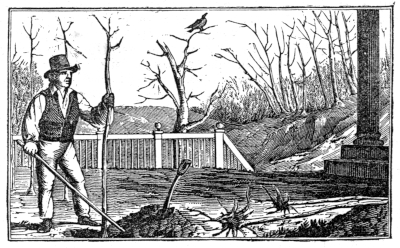
This month derives its name from the Latin word Aperio, to open, because at this period the earth is opened by the sower and the planter, to receive the seed. In the southern parts of the United States, it is a very warm, pleasant season, and so it is in Italy, and Spain. In Carolina, the weather is so warm in April, that the people put on their thin clothes, the forests are in leaf, the apple-trees are in bloom, or perchance already the blossoms are past.
But with us at the north, April is still a windy, chilly, capricious season. Not a green leaf, not an opening flower is to be seen. A few solitary birds are with us, and now and then we have a warm day. The grass begins to look a little green, where the soil is rich and the land slopes to the south.
But still, April is a month in which we all take delight, for, at this time we begin to work in the garden, and there is a promise of spring around us. The snow is gone, the ice has fled, jack-frost comes not, the hens in the barn-yard make a cheerful cackle, the geese at the brook keep up a jolly gobble, the boys play at ball on the green, the lambs frisk on the hill-sides, the plough is in the furrow; winter is gone—summer is coming!
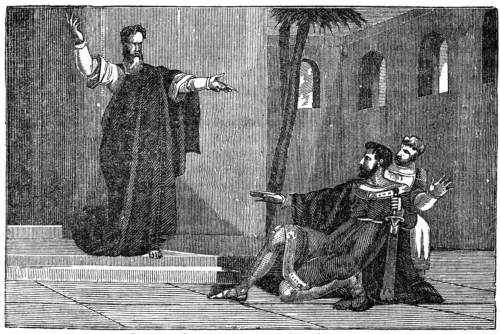
Jeremiah foretelling the downfall of Jerusalem.
The Prophet Jeremiah.
Jeremiah was one of the most celebrated of the Jewish prophets. He lived about six hundred years before Christ, and prophesied about seventy years after Isaiah. He began his career, by divine command, at an early age. He was a man of great piety, and a sincere lover of his country. He foresaw the evils which his sinful countrymen would bring upon themselves by their idolatries, and while he warned them of the wrath to come, he seems to have done it with an almost breaking heart.
It became his duty, in obedience to the instruction of God, to predict the downfall of Jerusalem, and the destruction of the temple. Zedekiah was then king of Judah, and the fearful prophecy no doubt grated harshly on his ear. The people, too, who cared not for the truth, but only desired a prophet who would prophesy smooth things, took Jeremiah, and were near putting him to death, only on account of his fidelity.
In the 21st chapter of the prophecies of Jeremiah, we see his prediction of the fate that awaited Jerusalem, and in the 52d chapter, we see how this sad and fearful warning was fulfilled.
After the destruction of Jerusalem,—he himself witnessing the completion of this prophecy,—he was carried into Egypt with a remnant of the Jews, and, according to tradition, was murdered by his countrymen, for warning them against their idolatrous practices.
The book of Lamentations is a melancholy and pathetic poem, written by Jeremiah, in commemoration of the destruction of Jerusalem by Nebuchadnezzar. It is exceedingly affecting, and it is impossible to read it without deeply sympathizing with the afflicted prophet. Some parts are very beautiful, and the whole being imbued with a religious spirit and feeling, it is calculated, in a peculiar degree, to soften, purify, and sanctify the heart of the Christian.