Volume 3 — PETER PARLEY’S NEW STORIES.
Reading edition
No. 1.
The Two Seekers.
I promised, in my last number, to give my readers some of the genuine stories found among old Parley’s papers. Here is one of them, and I shall follow it with others.
R. Merry.
There were once two boys, Philip and Frederick, who were brothers. Philip was a cheerful, pleasant, good-natured fellow; he had always a bright smile on his face, and it made everybody feel an emotion of happiness just to look at him. It was like a strip of sunshine, peeping into a dark room—it made all light and pleasant around.
Beside this, Philip had a kind heart; indeed, his face was but a sort of picture of his bosom. But the quality for which he was remarkable, was a disposition to see good things, only, in his friends and companions. He appeared to have no eye for bad qualities. If he noticed the faults, errors, or vices of others, he seldom spoke of them. He never came to his parents and teachers, exaggerating the naughty things that his playmates had done. On the contrary, when he spoke of his friends, it was generally to tell some pleasant thing they had said or done. Even when he felt bound to notice another’s fault, he did it only from a sense of duty, and always with reluctance, and in mild and palliating terms.
Now Frederick was quite the reverse of all this. He loved dearly to tell tales. Every day he came home from school, giving an account of something wrong that had been done by his playmates, or brothers and sisters. He never told any good of them, but took delight only in displaying their faults. He did not tell his parents or teacher these things from a sense of duty, but from love of scandal—from a love of telling unpleasant tales. And, what was the worst part of it all, was this: Frederick’s love of tale-bearing grew upon him, by indulgence, till he would stretch the truth, and make that which was innocent in one of his little friends, appear to be wicked. He seemed to have no eye for pleasant and good things—he only noticed bad ones: nay, more, he fancied that he saw wickedness, when nothing of the kind existed. This evil propensity grew upon him by degrees; for you know that if one gets into a bad practice, and keeps on in it, it becomes at last a habit which we cannot easily resist. A bad habit is like an unbroke horse, which will not mind the bit or bridle, and so is very apt to run away with his rider.
It was just so with Frederick: he had got into the habit of looking out for faults, and telling of faults, and now he could see nothing else, and talk of nothing else.
Now the mother of these two boys was a good and wise woman. She noticed the traits of character we have described, in her sons, and while she was pleased with one, she was pained and offended on account of the other. She often talked with Frederick, told him of his fault, and besought him to imitate his amiable brother: but as I have said, Frederick had indulged his love of telling tales, till it had become a habit, and this habit every day ran away with him. At last the mother hit upon a thing that cured Frederick of his vice—and what do you think it was?
I will tell you, if you will just keep out of the way of my great toe. I have got a touch of the gout, boys, and you must be careful. Tom, Jerry, Peter!—don’t be so careless! Keep clear of my great toe, I beg of you!
Now I do not believe that any of you can guess what it was that cured master Frederick. It was not a pill, or a poultice; no, it was a story—and as I think it a good one, I will tell it to you.
“There were once two boys,” said the mother, “who went forth into the fields. One was named Horace, and the other was named Clarence. The former was fond of anything that was beautiful—of flowers, of sweet odors, of pleasant landscapes. The other loved things that were hideous or hateful—as serpents, and lizards—and his favorite haunts were slimy swamps and dingy thickets.
“One day the two boys returned from their rambles; Horace bringing a beautiful and fragrant blossom in his hand, and Clarence bringing a serpent. They rushed up to their mother, each anxious to show the prize he had won. Clarence was so forward, that he placed the serpent near his mother’s hand; whereupon the reptile put forth his forked tongue, and then he fixed his fangs in her flesh.
“In a moment a pain darted through the mother’s frame, and her arm began to swell up. She was in great distress, and sent for the physician. When he came, he manifested great alarm, for he said the serpent was an adder, and its bite was fatal, unless he could find a rare flower, for this alone could heal the wound. While he said this, he noticed the blossom which Horace held in his hand. He seized upon it with joy, saying—‘This, this is the very plant I desired!’ He applied it to the wound, and it was healed in an instant.
“But this was not the whole of the story. While these things were taking place, the adder turned upon the hand of Clarence, and inflicted a wound upon it. He screamed aloud, for the pain was very acute. The physician instantly saw what had happened, and applying the healing flower to the poor boy’s wound, the pain ceased, as if by enchantment, and he, too, was instantly healed.”
Such was the story which the mother told to her two sons. She then asked Frederick if he understood the meaning of the tale. The boy hung his head, and made no answer. The mother then went on as follows:—
“My dear Frederick—the story means that he who goes forth with a love of the beautiful, the pleasant, the agreeable, is sure to find it: and that he who goes forth to find that which is evil, is also sure to find what he seeks. It means that the former will bring peace and happiness to his mother, his home, his friends; and that the latter will bring home evil—evil to sting his mother, and evil that will turn and sting himself. The story means that we can find good, if we seek it, in our friends, and that this good is like a sweet flower, a healing plant, imparting peace and happiness to all around. The story means that we can find or fancy evil, if we seek for it, in our friends; but that, like an adder, this only wounds others, and poisons those who love to seize upon it.”
Now this was the way the mother cured her son. Frederick took the story to heart; he laid it up in his memory. When he was tempted to look out for the faults of his companions, and to carry them home, he thought of the adder, and turning away from evil, he looked out for good; and it was not long before he was as successful in finding it as his brother Philip.
Resistance to Pain.
On one occasion, while some missionaries at South Africa were at dinner in their tent, some of the native chiefs and their wives being present, one of them seeing Mr. Read, a missionary, help himself to cayenne pepper, its red color attracted his attention, and he asked for some of it. On getting the cayenne, he instantly threw a quantity of it upon his tongue, but on feeling its pungency, he shut his eyes, clapped his hand upon his mouth, and holding down his head, endeavored manfully to conceal the pain. When he was able to look up, he slyly touched Mr. Read with his foot to intimate that he should say nothing, but give the same dose to the others present. Another chief next got some, who also instantly felt its powers; but, understanding the joke, as soon as he was able to speak, he asked for some for his wife; and thus it went round, to the great diversion of all present.
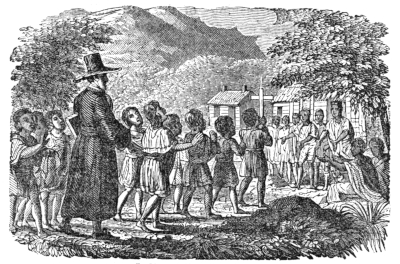
Indian children singing.