Volume 3 — CHAPTER XI.
Reading edition
The meeting.—Discussion.—A government adopted.—Conclusion for the present.
The time for the meeting of the people to take measures for the establishment of a government for the island of Fredonia, was fixed for the day which followed the events narrated in the last chapter. This meeting was looked forward to with intense interest, by all parties. The men, who knew that there could be no peace or safety in society, without government, regarded the event as likely to decide whether the inhabitants of the island were to be happy or miserable.
The women, who were perhaps not apt to reflect upon these things, had also learned from their experience that a government, establishing and enforcing laws, was indispensable to the quiet and security of society: they saw that their own lives, their freedom, their homes, were not secure, without the protection of law. Even the children had found that government was necessary, and these as well as the women, were now rejoicing at the prospect of having this great blessing bestowed upon the little community of Fredonia.
The day for the meeting arrived, and the men of the island assembled, agreeably to the appointment. First came the men of the tent party, and then, those from the Outcast’s cave. The latter were greeted by a shout of welcome, and mingling with the rest, a kind shaking of hands took place between those, who so lately were arrayed against each other in deadly conflict.
After a short time, Mr. Bonfils, being the oldest man of the company, called the assembly to order, and he being chosen chairman, went on to state the objects of the assembly, in the following words:
“My dear friends; it has been the will of Providence to cast us together upon this lonely, but beautiful island. It would seem that so small a community, regulated by mutual respect and mutual good will, might dwell together in peace and amity, without the restraints of law, or the requisitions of government. But history has told us, that in all lands, and in all ages, peace, order, justice, are only to be secured by established laws, and the means of carrying them into effect. There must be government, even in a family; there must be some power to check error, to punish crime, to command obedience to the rule of right. Where there is no government, there the violent, the unjust, the selfish, have sway, and become tyrants over the rest of the community. Our own unhappy experience teaches us this.
“Now we have met together, with a knowledge, a conviction of these truths. We know, we feel, we see that law is necessary, and that there must be a government to enforce it. Without this, there is no peace, no security, no quiet fireside, no happy home, no pleasant society. Without this, all is fear, anxiety, and anarchy.
“Let us then enter upon the duties of this occasion, with a proper sense of the obligation that rests upon us; of the serious duty which is imposed on every man present. We are about to decide questions which are of vital interest, not only to each actor in this scene, but to these wives and sisters and children, whom we see gathered at a little distance, watching our proceedings, as if their very lives were at stake.”
This speech was followed by a burst of applause; but soon a man by the name of Maurice arose—one who had been a leading supporter of Rogere—and addressed the assembly as follows:
“Mr. Chairman; it is well known that I am one of the persons who have followed the opinions of that leader who lost his life in the battle of the tents. I followed him from a conviction that his views were right. The fact is, that I have seen so much selfishness in the officers of the law, that I have learned to despise the law itself. Perhaps, however, I have been wrong. I wish to ask two questions—the first is this: Is not liberty a good thing? You will answer that it is. It is admitted, all the world over, that liberty is one of the greatest enjoyments of life. My second question then is—Why restrain liberty by laws? Every law is a cord put around the limbs of liberty. If you pass a law that I shall not steal, it is restraint of my freedom; it limits my liberty; it takes away a part of that, which all agree is one of the greatest benefits of life. And thus, as you proceed to pass one law after another, do you not at last bind every member of society by such a multiplied web of restraints, as to make him the slave of law? And is not a member of a society where you have a system of laws, like a fly in the hands of the spider, wound round and round by a bondage that he cannot burst, and which only renders him a slave of that power which has thus entangled him?”
When Maurice had done, Brusque arose, and spoke as follows:
“Mr. Chairman; I am happy that Mr. Maurice has thus stated a difficulty which has arisen in my own mind: he has stated it fairly, and it ought to be fairly answered. Liberty is certainly a good thing; without it, man cannot enjoy the highest happiness of which he is capable. All useless restraints of liberty are therefore wrong; all unnecessary restraints of liberty are wrong. But the true state of the case is this: we can enjoy no liberty, but by submitting to certain restraints. It is true that every law is an abridgment of liberty; but it is better to have some abridgment of it, than to lose it all.
“I wish to possess my life in safety; accordingly I submit to a law which forbids murder: I wish to possess my property in security; and therefore I submit to a law which forbids theft and violence: I wish to possess my house without intrusion; I therefore submit to a law which forbids one man to trespass upon the premises of another: I wish to go and come, without hindrance, and without fear; I therefore submit to a law which forbids highway robbery, and all interference with a man’s pursuit of his lawful business.
“Now, if we reflect a little, we shall readily see that by submitting to certain restraints, we do actually increase the amount of practical, available, useful liberty. By submitting to laws, therefore, we get more freedom than we lose. That this is the fact, may be easily tested by observation. Go to any civilized country, where there is a settled government and a complete system of laws, and you will find, in general, that a man enjoys his house, his home, his lands, his time, his thoughts, his property, without fear: whereas, if you go to a savage land, where there is no government and no law, there you will find your life, property, and liberty, exposed every moment to destruction. Who, then, can fail to see that the very laws which abridge liberty in some respects, actually increase the amount of liberty enjoyed by the community.”
Maurice professed himself satisfied with this solution of his difficulties; and the meeting proceeded to appoint a committee, to go out and prepare some plan, to be submitted to the meeting. This committee returned, and after a short space, brought in a resolution, that Mr. Bonfils be for one year placed at the head of the little community, with absolute power; and that, at the end of that period, such plan of government as the people might decree, should be established.
This resolution was adopted unanimously. The men threw up their hats in joy, and the air rang with acclamations. The women and children heard the cheerful sounds, and ran toward the men, who met them half way. It was a scene of unmixed joy. Brusque and Emilie met, and the tears of satisfaction fell down their cheeks. François went to his aged mother, and even her dimmed eye was lighted with pleasure at the joyful issue of the meeting.
We must now take leave of the island of Fredonia—at least for a time—and whether we ever return to it, must depend upon the wishes of our young readers. If they are anxious to see how the people flourished under the reign of their aged old chief, and how they proceeded in after years, perchance we may lift the curtain and show them the scene that lies behind it. But I hope that our readers have learnt, that not only men and women, but children, have an interest in government, and therefore that it is a thing they should try to understand.
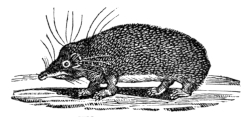
The Tanrec.
This creature resembles the hedgehog, but is larger than that animal, and is destitute of a tail. It does not roll itself into a ball, for defence, like the former animal. It passes three of the warmest months of the year in a state of torpor, differing in this respect from other animals, which become torpid from extreme cold. Its legs are very short, and it moves very slowly. It is fond of the water, and loves to wallow in the mud. It moves about only by night. There are three species, all found in the island of Madagascar.
Letter from a Correspondent.
Little Readers of the Museum:
I sometimes read Mr. Robert Merry’s Museum, and I like it very much, as I presume all his little “blue-eyed and black-eyed readers” do. He talks very much like good old Peter Parley. I should think he had heard him tell many a story while he rested his wooden leg on a chair, with a parcel of little laughing girls and boys around him. Oh, how many times I have longed to see him, and crawl up in his lap and hear his stories! But Mr. Merry says he is dead, and I never can see him. I am very—very sorry, for I hoped I should sometime visit him, for I loved him very much, and I guess he would have loved me some, for I like old people, and always mean to treat them with respect. How cruel it was for others to write books and pretend that Peter Parley wrote them!—for it seems that this shortened his life. I am glad, however, that Mr. Merry has his writings, for I think he loves his little friends so well that he will frequently publish some of them. I said that I loved Peter Parley, and I guess you will not think it strange that I should, when I tell you what a useful little book he once published, and how much pleasure I took in reading it. He wrote a great many interesting pieces which I read and studied, and they did me much good, I think. I hope that the little readers of the Museum will learn a good deal from what they read.
Peter Parley wrote a piece which told us how to make pens. I read it over, and over again, and, finally, I thought I would see if I could not make one. So I went to my little desk and took out a quill, got my aunt’s knife and laid the book before me and tried to do just as Peter Parley told me I must. I succeeded very well, and my friends were quite pleased. This encouraged me very much, and soon I made them so well that my teachers made me no more pens. By-and-by my little associates got me to make and mend theirs, and I loved the business very much.
Well, a few years since, I went to a beautiful village to attend school, where a splendid academy stands, around which, are large green trees, under whose shade my little readers would love to sit. There I staid two or three years. Often did I walk out with the teachers, whom I loved, to botanize, or ramble, with nimble step, over the beautiful hills of that sweet place, and listen to the constant murmur of its waterfalls, or gather the delicate flowers that grew so plentifully there. But to my story. My teachers saw that I made my own pens, and occasionally, when they were busy, would bring me one to make for them. The students soon found it out, and I had plenty of business. One day the principal of the school came to me and offered to compensate me by giving me my tuition one term, which was six dollars, if I would make and mend pens. I did not accept the money of course, though I cheerfully and gladly performed the small service.
So you see, Peter Parley’s instruction has done me a great deal of good, for how many persons there are who cannot make a good pen, because they never learned how.
My little readers, I am now almost twenty years old, but I still remember many other things which I read in Peter Parley’s books when I was a little girl. Mr. Robert Merry talks and writes just like him, almost, and I hope you will love to read and study attentively Merry’s Museum, for it is a good little work, and a pleasant one. Be assured, my young friends, you can learn a great deal from it, if you read it carefully. I should like to say much more to you, but I cannot now. I have been sitting by the fire, in a rocking-chair, writing this on a large book, with a pussy under it for a desk, but she has just jumped from my lap, and refuses to be made a table of any longer. So farewell.
Your young friend, Laura.
Springfield, Jan. 6, 1842
Cookery Book.—“Has that cookery book any pictures?” said Miss C. to a bookseller. “No, miss, none,” was the answer. “Why,” exclaimed the witty young lady, “what is the use of telling us how to make a good dinner, if they give us no plates?”
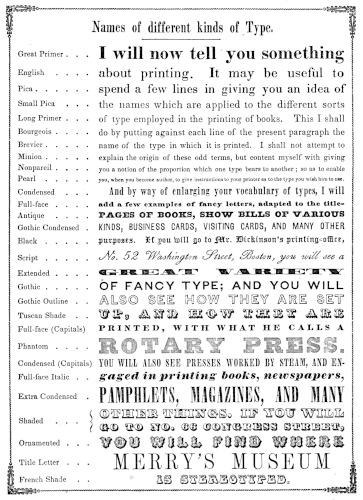
Names of different kinds of Type.
Great PrimerI will now tell you something
Englishabout printing. It may be useful to
Picaspend a few lines in giving you an idea of
Small Picathe names which are applied to the different sorts
Long Primerof type employed in the printing of books. This I shall
Bourgeoisdo by putting against each line of the present paragraph the
Breviername of the type in which it is printed. I shall not attempt to
Minionexplain the origin of these odd terms, but content myself with giving
Nonpareilyou a notion of the proportion which one type bears to another; so as to enable
Pearlyou, when you become author, to give instructions to your printer as to the type you wish him to use.
CondensedAnd by way of enlarging your vocabulary of types, I will
Full-faceadd a few examples of fancy letters, adapted to the title-
AntiquePAGES OF BOOKS, SHOW BILLS OF VARIOUS
Gothic CondensedKINDS, BUSINESS CARDS, VISITING CARDS, AND MANY OTHER
Blackpurposes. If you will go to Mr. Dickinson’s printing-office,
ScriptNo. 52 Washington Street, Boston, you will see a
ExtendedGREAT VARIETY
GothicOF FANCY TYPE; AND YOU WILL
Gothic OutlineALSO SEE HOW THEY ARE SET
Tuscan ShadeUP, AND HOW THEY ARE
Full-face (Capitals)PRINTED, WITH WHAT HE CALLS A
PhantomROTARY PRESS.
Condensed (Capitals)YOU WILL ALSO SEE PRESSES WORKED BY STEAM, AND EN-
Full-face Italicgaged in printing books, newspapers,
Extra CondensedPAMPHLETS, MAGAZINES, AND MANY
ShadedOTHER THINGS. IF YOU WILL GO TO NO. 66 CONGRESS STREET,
OrnamentedYOU WILL FIND WHERE
Title LetterMERRY’S MUSEUM
French ShadeIS STEREOTYPED.