Volume 3 — CHAPTER XVIII.
Reading edition
We are told that the wandering Arabs, after the day’s march over the desert which they love to inhabit, gather in groups at night and amuse each other by telling tales. It always seemed to me that a story under these circumstances would be more interesting than if told in the house, by the quiet fireside; for the feelings and fancy are apt to be excited when there is nothing but the heavens above us and the wide landscape around us. Certain I am that Mat Olmsted’s story of the Chippewa Chief and his bride Meena, seemed far more interesting from the fact that it was related in the woods, by the side of a watch-fire. It must be understood that my friend was no scholar; and, though I have mended his language as to the grammar, I have not added to its point or significance. His Yankee phrases and tone gave additional force to his narrative; and, owing to this and the circumstances under which he told his tale, it made such an impression on my mind, that I remember it better than anything else which has lain so long in memory.
I slept pretty well during the night, though I waked up several times, and saw Mat with one eye open, at my side. Feeling that I had a faithful sentinel to keep guard, I fell back into my repose. The sun rose at last. It was a beautiful frosty morning, and the black and gray squirrels were enlivening the woods with their merry gambols. I should gladly have stayed in the place for a long time, and really began to feel that I should like to turn Indian and make the forest my dwelling-place. But this was momentary: we soon began our march, and entering the high road, proceeded on our way to Albany.
I have not time or space to tell all the little adventures we met with—all the good jokes Mat uttered, or the smart speeches he made. I must hurry on in my story, for I am afraid that, if I do not, my readers will think it like the old woman’s stocking—the more she knit, the further she got from the end of it.
We reached Albany in a few days, and finding a sloop about departing for New York, we concluded to take passage in her and go to that city. This was a little out of our way, but we did not mind that. The captain of the vessel was a Dutchman, and his name was Dyke. He was a short, stout, broad-shouldered man, and his pantaloons were made somewhat like petticoats hitched up between his legs. He had a pipe in his mouth nearly the whole time; and such clouds of smoke as he did send forth! Puff, puff, puff! Mat Olmsted called him Captain Volcano, more than half the time. However, he was a good sailor, and he managed the sloop very well.
Beside Mat and myself, there was a young man on board, who had been collecting furs from the Indians, and was now proceeding to sell them at New York. He was a pleasant fellow, and such lots of stories as he and Mat and the Dutch captain told, I never heard before. I could fill a book with them; but I shall only give a sample from each of the narrators.
One moonlight evening, as we were gliding down the Hudson river, its broad bosom seeming like a sea of silver, we were all seated on the deck of the vessel, the captain, as usual, puffing at his pipe as if he was carrying on a manufactory of clouds, and was paid by the hogshead. For some time there was a dead silence; when at last the captain took his pipe from his mouth, and gravely remarked that his father was the bravest man that ever lived.
“How so?” says Matthew.
“Look there,” said Captain Dyke, pointing to a little island in the river, which we were then passing. “That island,” he continued, “was once the resort of Captain Kid, the famous pirate, who had a fine ship in which he sailed over the world, and, robbing every vessel he met of its money, collected a vast deal of gold and silver. After a long voyage, he used to sail up this river and bury his money on this island. When I was a boy, there was a hut still standing there, which was said to have been built by Kid himself.
“There were a great many wild stories told about this hut; for it was said that the captain and his crew used to hold their revels there. Long after the famous freebooter was hung, and his companions were dead, it was maintained that strange noises were heard in the hut, and several persons who had peeped in at night declared that they had seen Kid there in the midst of his jolly sailors, all of them drinking, singing, and telling wild tales of the sea.
“Now my father, as I said, was a brave man, and he offered to sleep in the hut one night for a bottle of brandy. This banter was accepted, and my father was put over to the island in a boat and left to himself. He had taken care to have the bottle of brandy with him. He repaired to the hut, and sat himself down upon a sailor’s chest which chanced to be there.
“There was no furniture in the room, save a rough table which stood in the centre, and an old-fashioned high-backed chair. My father placed the bottle on the table, and which, by the way, was one of your deep craft, with a long neck, and holding somewhere about half a gallon.
“After sitting nearly an hour upon the chest, all the while looking at the bottle, which glimmered in the moonlight that stole between the rafters of the hut, my father laid himself down on the floor and tried to go to sleep. He had not lain long, however, before the bottle slid gently off the table, and then began to lengthen, till it grew up as tall as a woman. Pretty soon it assumed the shape of one of my father’s sweethearts, and beckoned to him to come and kiss her! With this request he complied, of course, and then they fell to dancing in a very merry style. As they were whirling round and round, the old chair began to bob about, and at the same moment the rickety table rocked to and fro, then whirled round and performed a pirouette upon one of its legs. A moment after, these two joined hand in hand with my father and his sweetheart, and round and round they flew. Everything went on like a regular cotillon. It was back to back, cross over, right and left, chassez, and balance to partners! My father was in great spirits, and he performed the double shuffle to admiration. The old table did the same, the high-backed chair followed, and Miss Bottle beat them all. Such pigeon-wings as she executed never were seen before! The whole party caught the spirit of the moment, and it now seemed to be a strife to see which would surpass the rest in feats of grace and agility.
“My father had seen many a frolic, but never such a one as that; and, what was remarkable, the dance seemed constantly to increase in quickness and merriment. The top of the table looked like the jolly face of a Dutchman, the mouth stretched wide, and the eyes goggling with laughter. The old chair seemed to nod and wink with elvish mirth; and the maiden, who all the time appeared to have a queer resemblance to a bottle, frisked and flirted the gayest of the party. On went the dance, until my father was entirely out of breath; but there was no cessation to the sport. There seemed to be an old fiddler standing in one corner, but nothing save two eyes and his elbow were distinctly visible. The latter flew more rapidly every moment, the music quickened; and the dancers kept time. For seven hours my father performed his part in the dance, until, at last, he reeled, and, falling forward, knocked the table, the chair, and the bottle all into a heap. The vision immediately vanished, and soon after there was a rapping at the door. The people had come over to the island, for it was now morning. They found my father in a swoon, lying across the table, the chair crushed, and the bottle broken in a hundred fragments, which lay scattered on the floor.”
“A strange story that,” says Matthew, as the Dutchman paused; “but I wish to ask one question. Was there any liquor upon the floor where the bottle was broken?”
“Not a drop,” said the Dutchman; “and that’s a good proof that old Nick himself was there to drink the liquor.”
“No, no,” said Matthew, significantly; “it only proves that your father kissed Miss Bottle a little too often; so he got drunk and had the nightmare, and all this scene was a vision of his brain! This proves that your father could drink two quarts of brandy in a single night. I had an uncle who performed a greater feat than that in the revolutionary war, for he captured a British officer with a sausage!”
“Indeed!” said the captain and the fur-trader both at once; “let us hear the story.”
“Well,” said Matthew; “it happened thus. At one time during the war, as you all know, Washington was situated with his little army at Tappan, near the North river, while Sir Harry Clinton, the British commander, with his troops, were at New York. The space between the two armies was called the Neutral Ground, and it was chiefly occupied by a set of people called Cow-boys. These fellows went back and forth, trading with both parties, and cheating everybody, as they could get a chance.
“Now my uncle, whose name was Darby, was a Cow-boy by profession, but he was a patriot in disguise, as you shall hear. One cold winter’s night he was trudging along over the road with a bag of sausages on his back, going to sell them to General Putnam, whose quarters were at the distance of three or four miles. As he was walking along over a lonely part of the road, it being a little after sunset and already growing dark, he heard a horse’s gallop at no great distance. He was at the bottom of a hill, and in the midst of a thick wood. Looking to the top of the hill, he saw a man on horseback, who now began gently to come down the descent. My uncle was not only made for a patriot, but also for a great general. Believing that the man on horseback was a British officer, the idea suddenly entered his head that he would capture him, if it should appear that he was unarmed. Accordingly, he thrust his hand hastily into his wallet, took out one of the frozen sausages, crooked it in the shape of a pistol, and stood still in the middle of the road. The stranger soon approached, and my uncle Darby called out, ‘Who goes there?’ ‘You must first tell me who you are!’ said the person on horseback. ‘That’s as we can agree,’ said my uncle; ‘for it takes two to make a bargain in these parts.’ All this time, he was looking very sharp to see if the man had any weapons about him, and perceiving that he was unarmed, he sprang upon him like a tiger, seized the horse by the bridle, and thrust the muzzle of the seeming pistol in the face of the rider.
“‘Dismount, or I’ll blow your brains out!’ said Darby. My uncle had a voice of thunder, and the astonished traveller expected every moment to be shot through the body. It was no time for parley; so the man dismounted, and my uncle, putting his foot in the stirrup, sprung to the saddle in an instant. ‘Now,’ said he, ‘my pretty fellow, you must go and see old Put. To the right about face, forward, march!’ The man hesitated, but my uncle pretended to cock his pistol, and pointed it at the man’s breast. This settled the question, and the poor fellow began doggedly to ascend the hill. Following him close behind, and keeping his weapon in a threatening attitude, he conducted the man along the road, and in the space of about an hour ushered him into the presence of General Putnam. On examination, he proved to be a British sergeant, who was out upon a frolic, and, wishing to pass as an American, had left his weapons behind. The story made a vast deal of fun in the camp, and my uncle acquired great renown for his exploit. But patriotism is often rewarded with ingratitude. My uncle received the sergeant’s horse, it is true, as a recompense, but he was called ‘Sassage Darby’ during the remainder of his life.”
When Matthew had done, the captain turned to the fur-trader, and said, “We have each of us told our story; it is now your turn to tell one.” “Well,” said the young man in reply; “you have related an adventure of your father; our friend Matthew has told one of his uncle; I will now relate one of myself.”
“When I was a boy, I read Robinson Crusoe, and so I had a great fancy for going to sea. Nothing would do, but I must be a sailor. My father and mother were both opposed to it; and, finding it impossible to obtain their consent, I resolved to run away. Getting together a little money, I packed up my clothes, and one night set off for New London in Connecticut, a distance of about twenty miles from where I lived. I there entered on board a schooner bound for Boston, which sailed the next day. There were but five persons on board,—the captain, his two sons, one sixteen and the other seventeen years old,—an old sailor, and myself.
“It was the beginning of winter, but the weather was uncommonly fine, and in a short time we were out upon the sea. We scudded along with a light wind for a couple of days, when there was a sudden change of weather. It first blew from the southeast, and rained smartly. I was a little sea-sick, but still able to keep upon the deck. The storm increased, and the wind shifting to the northeast, it began to snow. At the same time it grew cold, and in a very short space everything about the vessel was sheeted with ice and snow. She became perfectly unmanageable, and was now drifting before the gale towards the island of Nantucket, which was at our lee. We put out our anchor, but it was not of sufficient length to reach the bottom.
“Believing that she must inevitably go ashore, the captain loosed his boat, and getting into it himself, directed us to follow him. His two sons obeyed; but the old sailor, conceiving that the boat must be swamped in the raging sea, chose to continue in the vessel and persuaded me to remain with him. The captain departed, and proceeded toward the shore. But it was now evening, and we soon lost sight of him.
“We continued to drift along for a couple of hours, when the anchor suddenly took effect, and we rode out the night in safety. In the morning, the storm had abated, but everything was so covered with ice that it was impossible for us to get up a sail. In this condition we remained for four days, when a spell of milder weather set in, and we were able to get the little schooner under way. In about a week we reached Boston, where we learned the fate of the captain and his two sons. He reached the shore in safety, but at the distance of nearly three miles from any house. Both of his sons were chilled with the intense cold, and the younger was in a short time unable to walk. Yielding to his fate, the poor fellow lay down upon the beach and begged his father to leave him to die, as the only means of saving his own life and that of his brother. The father would not listen to this. So he took the young man upon his back, and proceeded on his way. He had not gone more than half a mile, when the elder son sunk to the earth, incapable of proceeding farther.
“The storm still continued to rage, and for a moment the old man gave way to despair; but soon recovering, he set forward, with the younger son upon his back. Having proceeded a quarter of a mile, he laid him down upon the beach, and returned to the elder boy, whom he found almost in a state of insensibility. Taking him upon his shoulders, he carried him to the spot where he had left his younger son. What was his agony to discover that the boy was cold and lifeless! He now proceeded with the one upon his back, but in a short time his foot faltered, and he fell to the earth. There was no way, but to leave his children, and reach the house, if possible, for aid. Faint and exhausted, he proceeded with a staggering step, and when at last he reached the house, his mind was so bewildered, that he could scarcely tell his piteous tale. He said enough, however, to give the people some intimation of the truth, and two men immediately set out to scour the beach. They were not long in discovering the bodies of the two boys, who were covered with the spray of the sea, thickly frozen to their garments. Everything was done for them that kindness could suggest, and all had the happiness of soon discovering signs of life. Gradually, both recovered, and the anguish of the father gave way to joy. In four days they were all able to leave the place, and soon after our arrival with the little schooner they came on board. I had, however, seen enough of the sea, and resolved in my heart never to trust myself upon its treacherous bosom again. I made my way back to my home; and, thoroughly penitent for my disobedience, resolved never again to disobey my parents; for during the storm, and especially that fearful night when the old sailor and myself were alone in the vessel, the thought of my misconduct weighed heavily upon my heart, and took away from me the power of providing against the danger that beset me.”
As the young man finished his story, the captain puffed forth an enormous quantity of smoke, and the rest of our party retired to bed!
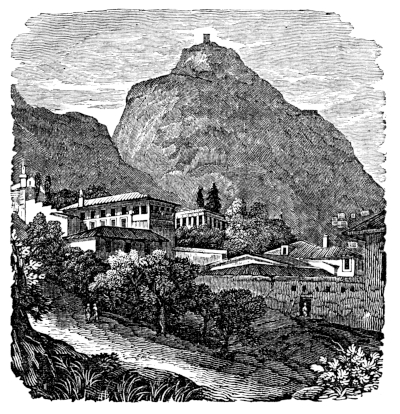
Misitra and the Ancient Sparta.
Misitra is a considerable town in Greece, and situated in the province of Laconia. It occupies the slope of a hill, and, as you approach it, has an imposing aspect. You would think it a very large and splendid capital; but as you enter it, the illusion vanishes, and you find yourself in narrow, winding, and dirty streets, where no fine buildings, ancient or modern, meet the eye.
At the distance of a few miles are the ruins of ancient Sparta, the capital of the Lacedemonians, a brave, stern, warlike people, who adopted the laws of Lycurgus, and formed a great contrast to the gay, polished, fickle Athenians. But, alas! no monuments of the Spartans remain on the site of their ancient capital, and the place is only marked by the remains of Roman edifices, erected after the Spartans were subjected to the Roman yoke!
Absence of Mind.
The following cases of absence of mind are furnished by the newspapers:
A short time since, a person engaged a butcher to come the next morning and kill a hog for him. The butcher told him to have the water boiled early, and he would attend. In the morning he came, asked if the water was boiled, and being answered affirmatively, killed the hog, and brought him to his scalding position. He then ordered the good man of the house to bring out the water, which he did by bringing out cold water. This surprised the butcher.
“Where,” said he, “is your boiling water?”
“Why, here!—Molly and I boiled it last night! Oh, now I know!—you can’t scald hogs without the water is hot!”
Exit the man of the knife, in a rage!—N. O. Pic.
On Sunday morning, between the hours of one and two o’clock, as Inspector Donnigan, of the police, was going his rounds, he observed a man, stripped to his shirt, standing in a short, narrow, and uncovered passage in Denmark street, London. On approaching him, and asking what he was doing there, the man replied that he was getting into bed; and at the time he shook from head to foot with the cold, which was very intense.
Donnigan asked him if he was aware he was in the street. He replied he was not, and that he fancied he was by his bed-side, and said his clothes were somewhere about. The officer, after searching for some time, discovered an excellent suit of clothes and a silk cravat on the sill of a window about thirty yards off, with shoes and stockings underneath, and a hat close by.
The cold had by this time brought the man to his perfect senses, and, by the advice of the inspector, he put on his clothes, and, thanking him for his attention, proceeded homewards!
A few years ago, Inspector Norman, belonging to the same division, while going his rounds, had his attention directed to some wagons which were placed in Black Lion-yard, Whitechapel, by a loud snoring.
He procured a light, and on proceeding to the spot, he found an Irish gentleman fast asleep between the shafts of a wagon, with his clothes off to his shirt, and apparently as comfortable as if reposing on a bed of down. His clothes were carefully placed over one of the shafts, and on the top of them rested his pocket-book, containing nearly £800 in bank notes, and in his trowsers pockets a quantity of gold and silver, beside a valuable gold watch, &c. He was at once aroused and taken care of, and the preservation of his property was considered almost miraculous, as, in the immediate neighborhood in which he was found, were located some of the most expert thieves in Europe.—London paper.
The Star Fish.
Did you ever stand on the rocky shore of the sea and notice the star fishes that come floating along? Many of them appear like pieces of jelly, drifting with the tide, without life, and without the power of motion. But they are all capable of moving from place to place, and shoot out their arms in every direction. Some of them have five rays, as in the picture; this kind are called five-fingered Jack. These star fishes have very ravenous appetites, and are very expert in gratifying them. They grasp prawns, shrimps, worms, and insects that come in their way; and, soft and pulpy as they seem, woe to the poor creature that they get hold of! One thing is very curious, and that is that they devour shells of considerable size, which are crushed to pieces in their stomachs!
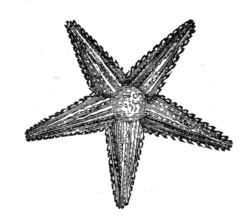
Not only are the star fishes of different forms, but they are of different hues also: some are striped, some are red, and some green. In fine weather, they are seen in the water, spread out, fishing for their meal. Some have long, fibrous arms, which stretch forth to a distance, and with them they pull in their prey. If you take one of those creatures and put him on the shore, he becomes a mass of offensive liquid, like water, in about twenty-four hours.
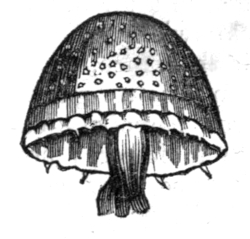
This picture represents one of these curious creatures, called Medusa. The kinds, as I have said, are numerous, and in some seas they are found in myriads. The most curious property of these strange fishes is, that they give out a light at night, which often makes the waves very brilliant. If you ever go to sea, you will notice this light in the track of the vessel, almost seeming as if the water were on fire.
WHERE IS THY HOME?
“Where is thy home, thou lonely man?” I asked a pilgrim gray, Who came, with furrowed brow, and wan, Slow musing on his way. He paused, and with a solemn mien, Upturned his holy eyes,— “The land I seek thou ne’er hast seen,— My home is in the skies!” O! blest—thrice blest! the heart must be To whom such thoughts are given, That walks from worldly fetters free,— Its only home in heaven!
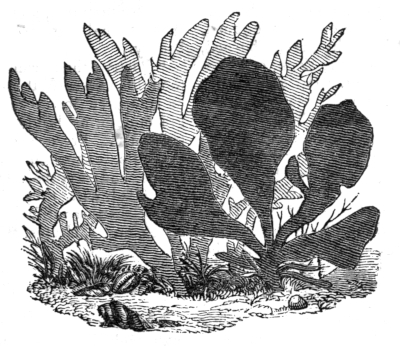
Sea-Weed.
Every portion of the earth seems covered with vegetation, except now and then some sandy desert. Even the rocks are covered with mosses; and we have heard of little red plants, that take root so thickly in snow-flakes, as to make a fall of snow seem like a shower of blood.
The bottom of the sea, too, is sown with myriads of plants. These are of many forms and many hues, but mostly of a green color: it is owing to the plants beneath the surface that the sea has such a verdant tinge. In some tropical portions of the sea, the marine plants are so thick as to obstruct the passage of ships; and some species are said to grow seven hundred feet in length!
Inquisitive Jack and his Aunt Piper.
There was once a little boy who had neither father nor mother, but he had an excellent aunt, and she supplied the place of parents. Her name was Piper, and a very good woman she was. The boy’s name was John; but, as he was always asking questions, he at length got the name of Inquisitive Jack.
He was perpetually teasing his aunt to tell him about the sun, or the moon,—to explain to him why the fire burned, or where the rain came from, or something else of the kind. His aunt, being unmarried, and having little else to do, used to sit down for hours together, and answer little Jack’s inquiries.
One winter’s day, they were sitting by a pleasant fire, and Jack had been reading in a book of poetry. After a while, he laid down the book, and asked his aunt why some things were told in poetry and some in prose. To this the good lady replied as follows.
“I must tell you, in the first place, my boy, that prose is the language of common speech, such as I am now talking to you. But there are certain thoughts and feelings that are too fine and beautiful for prose. If these were expressed in a common way, their beauty would be lost. I will try to make you understand this by a story.
“There were once some flowers growing in a garden, but they were mixed with other plants, such as peas, beans, potatoes, beets, and other things. These had, therefore, a common appearance, and no one noticed their beauty.
“At length, the gardener took up these flowers, and set them out in a nice bed of earth, which he had prepared for them. This situation permitted their bright colors and fair forms to be seen, and they therefore attracted the attention of every person who passed by.
“Everybody admired them; and those who overlooked them as common things when planted in a kitchen garden, were ready to acknowledge their beauty, and praise their fragrance, when they were flourishing in a flower-garden.
“Thus you perceive that I compare fine thoughts to flowers; however beautiful they may be, they would strike us less, and please us less, if they were presented in a common way. They want a situation appropriate to them, and then we shall perceive and feel their full beauty.
“Poetry, then, consists of beautiful thoughts in beautiful language, and may be compared to a bed of flowers, with graceful forms, bright colors, and sweet fragrance. Prose consists of common thoughts, expressed in common language, and may be compared to a garden filled with things that are useful rather than beautiful, such as beets, potatoes, and cabbages.”—Second Reader.
A word to my Correspondents.
I beg my young friends who favor me with their letters to understand that I receive them with great pleasure, even though I do not find an opportunity to put them all in print. I give my thanks to Christopher Columbus; to J. A. H——, of Medford, and others, who have taken into their heads to send me puzzles; but as I have given a great supply of these the last month, I must pass them by, at least for the present.
The following letter contains a suggestion that I shall certainly comply with. The idea is a very good one.
Mr. Robert Merry:
I have just learned to read, and I wish you would put some little stories in your Museum, such as I can understand. My sister Jane reads it, and she likes it very much, but it has too many long words for me. Won’t you put in two or three pages for me, every month? I shall then like you very much.
Lucy A——.
Washington, March 23, 1842.
Dear Mr. Merry:
My mother has just commenced taking your Magazine for me, and I like it very much. The March number was very long in coming, but when it did come it was very interesting. Every number that I get, I always look for Philip Brusque and the Siberian Sable-Hunter. I was glad to find them both in this number. I hope that the story of Philip Brusque will not long be discontinued, it is so interesting. The puzzles, with some help, I found out; and I set my wits to work and made one. Perhaps you will think it worth putting in the Museum; so here it is. I am composed of 14 letters. My 4th, 5th, 1st, 2d, is an article much used in winter. My 11th, 1st, 13th, 14th, 8th, an ancient poet. My 6th, 7th, 10th, 11th, 8th, the worst of passions. My 3d, 6th, 10th, 12th, a celebrated authoress. My 9th, 3d, 1st, 6th, a purifier. My whole, our nation’s scourge.
Another Black-eyed Friend.
Mr. Robert Merry:
The following puzzle is from three subscribers for Merry’s Museum for 1842, and it will oblige them to see it in the May number.
H. T. C. E. J. S. J. W. C.
I am a word of 13 letters.
My 3d, 12th, 13th, 5th, 12th, and 9th, is the
name of one of the ex-presidents of the United States.
My 1st, 8th, 13th, and 9th, is a name common with the female sex.
My 4th, 5th, 12th, and 13th, is the name of a metal.
My 7th, 9th, 6th, and 2d, is the name of another.
My 11th, 10th, 9th, and 2d, is a common thing
with boys in winter.
My 6th, 4th, and 5th, is one of the elements.
My whole is the name of a great warrior.
I am quite pleased with the following, and should be happy to hear from Bertha very often.
CHARADE.
My first’s the end of him whose wife
Was turned one day to salt;
And doubtless, if the truth must out,
My fourth’s the end of malt.
My second, if you will believe it,
Essential is to rest;
My third,—and you can well conceive it,—
Is that which you love best.
My fifth—my last—’tis found in heaven—
’Tis found, alas! in hell;
And though not in an oyster met,
It lives in every shell.
Already hath my humble name
In these brief lines been set;
But modest merit’s overlooked,
And you don’t see me yet!
I am the greatest earthly good,—
The only path to glory,—
Come, gentle reader, guess my name,
And keep me e’er before thee!—Bertha.
The letter from J. A. is very gratifying, so I give it an insertion.
Petersburgh, Va., March 2, 1842.
Mr. Merry:
I have just begun to take your Museum, and I like it very much. I think you tell stories very much as Peter Parley did. I like Parley’s books so much that I called my little dog Peter Parley. He died some time ago, and now I am going to get another, and I intend to call it Robert Merry. I hope you won’t be offended at this, for we always call dogs after famous people. I think the best of your stories is the Sable-Hunter, but I really wish you would go on with it a little faster.
James A——.
The following is inserted, not because it is a very famous specimen of poetry but because it is written by quite a young person, and shows a very tender feeling
ON A DEAD RABBIT.
Once upon a time, When I was in my prime, I had a rabbit white as milk, And its hair was soft as silk. One morn I went to feed it,— There was no rabbit there— And long I hunted after it, Looking everywhere. One day, when I was wandering, Something met my eye, It was my little rabbit, Hung on a tree close by. But oh! I can’t relate it— That pretty one was dead; And sadly did I bury it, In a lonely, narrow bed!
“FAR AWAY”—THE BLUEBIRD’S SONG.
THE WORDS AND MUSIC COMPOSED FOR MERRY’S MUSEUM.
[Audio content is not currently supported on your device.
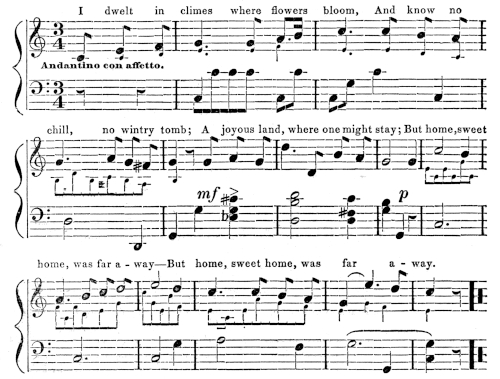
I dwelt in climes where flowers bloom, And know no chill, no wintry tomb; A joyous land, where one might stay; But home, sweet home was far away— But home, sweet home, was far a-way. I sat upon the topmost bough At peep of dawn, as I do now, And tried to sing a cheerful lay— But no—’twas ever “far away!” I loved that land of fruits and flowers, Where spring and summer twine their bowers, And gentle zephyrs round them play— But my birth-tree was far away! Far north, where I was born and bred, My winged thoughts were ever fled; And, spurning joys that round me lay, I sighed for pleasures far away! Gay birds around sang many a song, And cheerful notes rang loud and long— But oh, my heart tuned every lay To plaintive airs of “far away!” The brook came laughing down the dell, Yet sad to me its joyous swell; And though its chime made others gay, I only thought of “far away!” And now, returned, how dear the hours, Though chill the wind and bare the bowers; Yet this is home; and that sad lay I sing no more of—“far away!”