Volume 3 — CHAPTER XX.
Reading edition
Journey towards Rome.—Vineyards.—The olive season.—Beautiful scene at Mola di Gaeta.—A shepherd among the mountains.—The robbers of Fondi.—The Pontine marshes.—Velletri.—The nightingale.—First sight of Rome.
On the first day of April I set out for Rome. For ten or fifteen miles beyond Naples, the country appeared to be nothing but one great vineyard. The vines are not propped by poles, as I found them in Sicily, but are trained to poplar trees. I passed many wells by the roadside, furnished with water-wheels turned by oxen: these are used for irrigating the fields in summer, from which I judged that the country often suffers from drought. All along the road were guard-houses with gens-d’armes at regular intervals, a security against robbers, according to the design; but we generally found these valiant fellows fast asleep! We might have stolen their muskets and made them all prisoners before they were well awake. The roads in this quarter are covered with a fine white dust, which in the unclouded season of midsummer must have a bad effect upon the eyes. The great number of blind people we saw, confirmed the impression. About noon we reached Capua, famous for having once been the most luxurious city in the world, but now a decayed town, where everybody seems to be fast asleep. Beyond this place the road began to run among the hills. At night we stopped at the village of St. Agatha, where we found a tolerably good inn. We set out early next morning, and passed through fields covered with olive trees. The peasants whom we met had sprigs of olive stuck in their hats. This was the olive season, and we saw the women and children picking up the fruit under the trees. When the olives are ripe, they turn black and drop from the trees. The oil is squeezed from them by a common press. The olives used for pickling are taken from the tree before they are ripe.
At noon we arrived at Mola di Gaeta, one of the most delightful spots I ever beheld. It stands on the sea-shore, and is skirted by a range of lofty hills covered with orange groves. The trees were laden with fruit as bright as gold. The fresh green foliage, the clear sky, the blue sea, and the white towers of Gaeta which appear on a promontory stretching out into the ocean, all combine to form a most enchanting prospect. I do not wonder that Cicero chose this spot for his country-seat; here they showed us the spot where, according to Plutarch, he was killed. Further on we continued to find the same abundance of olive trees: this appears to be a great oil district. A range of rocky mountains at a distance seemed to consist of nothing but naked crags; but the plains and low hills are under good cultivation. The soil in most parts is very rich, and the country wants nothing but a good government and an industrious people, to make the kingdom of Naples one of the most flourishing territories on the face of the earth. In the afternoon we traversed a steep, narrow mountain pass, and entered upon a wild, rugged country. I got out of the carriage and trudged along on foot, for the road was so hilly that I could keep ahead of the horses. The country exhibited quite a solitude; there was neither house nor human being to be seen for miles. Suddenly the notes of a wild kind of music fell on my ear, and looking down a rocky glen, I discovered a shepherd tending his flock, and piping on a reed in the true Arcadian style. It was the first genuine spectacle of pastoral life that I had ever seen, and I halted some minutes to take a view of him. Very pretty poems have been written about pastoral manners, in which shepherds and shepherdesses make fine romantic figures. The sight of a real shepherd, however, is enough to dissipate all the romance of this subject. This fellow wore the true pastoral dress, jacket and leggins of sheepskin, with the wool outside!—a more ragged, scarecrow-looking object never met my eyes. I would give a round sum of money to get one of these Neapolitan shepherds to show himself in the streets of Boston. An Indian sachem would be nothing in comparison to him.
The country continued wild and broken till we reached Fondi, a town among the mountains, once notorious for its robberies. These were carried on so openly and to such an extent, that the government were obliged to surround the town with troops, and threaten to batter every house to the ground with cannon, unless the leaders of the banditti were given up. Since these fellows have been hanged, and the roads guarded with soldiers, travelling has been pretty safe. But nothing except force prevents the inhabitants of Fondi from resuming their old habits of robbery. I never saw so villanous-looking a set of ragamuffins anywhere else. Every man and boy in the town has the genuine countenance of a cut-throat; and the women do not look much better. We stopped here just long enough to get our passports examined; but that was long enough. Though the people are not allowed to rob, they almost make up for it in begging; for their impudence and obstinacy in this business nearly amount to violence. The whole population were either crowding around us, begging, or lying in crowds about the church steps, lazily sunning themselves. I longed to stir up the louts, and set them to work. From laziness to begging, and from begging to robbery, is a regular and almost inevitable progress.
The road beyond Fondi ran along the shores, and in the afternoon we reached the territory of the Pope. The first sight we saw here was a herd of buffaloes in a field. These animals are tame, and used the same as oxen. They are not like the buffalo, or, more properly, bison of the western prairies, but a distinct species of quadruped. At night we reached Terracina, the first town in the papal dominions. It stands on the seashore, at the foot of a lofty, precipitous rock. During the night the wind was high, and drove a heavy surf upon the beach. A bright moonlight made a stroll along the shore very pleasant. In the morning the wind had gone down, and we recommenced our journey. Here we entered upon the famous Pontine marshes, over which the road passes nearly thirty miles in a straight line, and a great part of the way bordered by trees. These marshes consist of swampy and boggy tracts, with lagoons of water and patches of dry pasture-land interspersed here and there. Herds of buffaloes and black swine were roaming about in the dry spots, and the lagoons were covered with flocks of wild ducks and other waterfowl; but not a human being or a house was to be seen. These marshes breed so pestilential an air in summer, that the neighborhood is uninhabitable. They are bordered by a range of mountains on one side, and on the other by the Mediterranean.
There were no thick woods anywhere to be seen; a few scattered cork and ilex trees were all that met the eye. The mountains were bare to their very summits. The country, after passing the marshes, became very beautiful, and as we approached the town of Velletri we beheld the most enchanting landscapes. Here, for the first time, I heard the nightingale. He sings in the most lively and voluble strain, and is well worthy of his great reputation among the feathered songsters; but there is no American bird whom he resembles in tone or manner. We stopped for the night at Velletri, which stands on a commanding eminence, with an almost boundless prospect toward the south. On the other side, you look down a deep valley and up the side of a mountain beyond, covered with verdant fields, gardens, vineyards, and every variety of cultivation.
Rome was now but twenty-four Italian or eighteen English miles distant. The morning broke delightfully, and my impatience to see the great capital of the world was at such a height, that I would not wait for the carriage, but set out on foot. Long strings of wagons were coming from Rome, having left that city late the preceding night. It was amusing to notice that the drivers were nearly all fast asleep. The horses were eating all the way, each one having a bundle of hay tied to the head of the shaft in such a manner that he could help himself. The road over which I was passing was the celebrated Appian way, and is paved neatly and durably with square stones laid diamond-wise. As the day drew on, I met the country people going to their work. The women have a curious head-dress, consisting of a square fold of cloth, starched stiff and laid flat on the top of the head, often fastened with a silver pin as big as a kitchen skewer.
Two or three more small towns on the road could not induce me to slacken my pace towards the great object of my curiosity. At length, about the middle of the forenoon, as I ascended a steep hill, I caught sight of a lofty dome at a distance, which I instantly knew for St. Peter’s! Rome indeed was before me!—a sight which no man can behold for the first time without emotions impossible to describe. I stopped involuntarily. A wide plain extended from the foot of the eminence on which I stood to the walls of Rome. Long lines of aqueducts, ruined towers, and broken masses of walls and other architecture, chequered the surface of the plain; and the whole exhibited a striking spectacle of ruin and desolation. This was the Campagna di Roma, which, in the day of its prosperity, was covered with houses and gardens, the suburbs of the great city. Now, everything is still, solitary and lifeless. As I approached the city, I saw nothing around me but fields without fences, overgrown with brambles; not a house nor a garden, nor a human being, except here and there a ragged shepherd watching his sheep, which were browsing among the ruins! Nearer the city, I passed occasionally a field of wheat, and now and then a house; but hardly any people were to be seen, and nothing of the hurry, life and bustle which indicate the neighborhood of a populous city. This spectacle of solitude and desolation continued even after passing the gates of Rome; for half the territory within the walls is an utter waste.
Rattlesnakes.—Two men, Egbert Galusha and Reuben Davis, residing in the town of Dresden, on the east side of Lake George, recently killed, in three days, on the east side of Tongue Mountain, in the town of Bolton, eleven hundred and four rattlesnakes! They were confined to rocks and uninhabited places. Some of the reptiles were of an enormous size, having from six to twenty rattles. They were killed for their oil or grease, which is said to be very valuable. We will turn out Warren county against the world for rattlesnakes!—Glenns’ Falls Clarion.
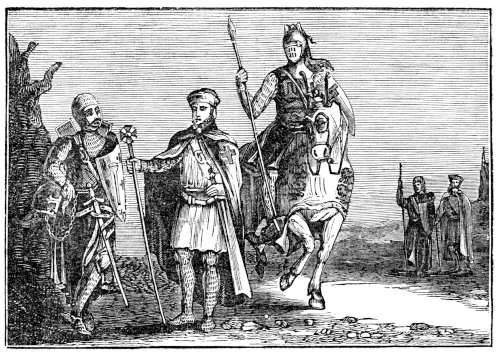
Knights Templars.
About seven or eight hundred years ago, it was the custom of Christians, in various parts of the world, to go to the city of Jerusalem, to say prayers and perform penances, thinking that they benefited their souls thereby. Jerusalem belonged to the Turks then, as it does now; and it frequently happened that these Christians were ill-treated by the inhabitants, who despised and hated them.
This ill-treatment roused the people of Europe to vengeance, and vast armies went to take Jerusalem from the Turks, whom they called infidels. There were several of these wonderful expeditions, called Crusades, during the tenth, twelfth, and thirteenth centuries, in which several millions of people lost their lives. Jerusalem was taken from the Turks, but they got it back again after a short time.
It was about the period of the crusades that Knight-Errantry took its rise. The knights-errant, or wandering knights, rode on fine horses, with spears and swords; and when they met each other they went to battle, often for the fun of it. They pretended to go about to relieve the distressed and to punish injustice: and there was need enough of this—for, in that age of the world, there was a great deal of cruelty and oppression. Sometimes these knights really performed very noble and brave actions. The stories of their adventures, preserved in ancient books, are very interesting.
The order of Knights Templars was formed at Jerusalem, by seven gentlemen, about the year 1120. They professed to devote themselves to the service of God, and actually set about punishing robbers and thieves who troubled the Christians who went on pilgrimages to Jerusalem. They increased in numbers, and had apartments assigned them near Solomon’s Temple, whence they were called Templars. After a time, the Templars were numerous in Europe, where they grew very rich and powerful. At last they were accused of high crimes; and, in the fourteenth century, the order was suppressed.