Volume 3 — CHAPTER XVIII.
Reading edition
Description of the crater.—Prospect from the top.—Accident in the descent of the mountain.—Visit to Torre del Greco.—Singular life led by the inhabitants.—Remarkable situation of a powder-house.
Although we were now on the top of the mountain, yet the crater was still at some distance, and we followed a rude pathway which ran for nearly a quarter of a mile among the lava crags. Everywhere the rents and fissures sent up streams of white smoke from beneath our feet, and the smell of sulphur loaded the air. The masses of lava were heaped confusedly around us. The surface had evidently been once a smooth bed of this hard material, which had cooled on the spot after its ejection from the bowels of the mountain, and subsequently had been split up and blown into fragments by another convulsion. There would be no passing here had not a pathway been made by levelling the crags and filling up the gaps which yawn at every step. The traveller is reminded at each moment that he is walking over terrible fires which are at no great distance beneath his feet. For all this, no one need be afraid to go to the top of Vesuvius. Eruptions never break out so suddenly but that a man may escape from the top of the mountain to the foot, in season for his safety. Generally, some days before the mountain begins to burn, it gives warning by subterranean noises, slight shakings, and increased volumes of smoke. Whenever lives have been lost, it has been owing to the disregard of these symptoms, and the presumptuous curiosity of those who dare to ascend the mountain when on fire.
Heavy columns of smoke now rose before us, pouring off horizontally through the air over an abrupt and long ridge of lava. On climbing this last ascent, the view of the great crater burst upon us, with its yawning depths, puffing out smoke and steam. Here we stopped to contemplate the spectacle. We stood on the edge of the crater, which was wide enough to enable us to walk along with safety. The smoke concealed one side of it from our view. We judged it about half a mile across; but in this lofty region, with no neighboring objects for the eye to light upon and form a comparison, the measurement cannot be depended on. It goes shelving down on all sides, with a fearful steepness, showing great bright crags of brimstone and red fire-stones jutting out from the black lava surface. The great spiracle in the centre appeared to be choked up; the smoke rising through minor clefts and chinks all round the sides and bottom of the crater. The edge on which we stood, and along which we walked for a quarter of a mile, was full of holes and cracks sending out smoke; and on thrusting our sticks into them, they took fire and were drawn out blazing. The windward side of the crater only, is accessible; there is no going quite round, on account of the suffocating smoke. All the inner surface of the crater appeared to be firm and solid, and we judged, by throwing stones down, that a person might descend to the bottom in safety, were it not for the fumes of sulphur with which it is constantly filled. I tried it for some distance, letting myself carefully down upon my hands and feet from crag to crag, until I became half stifled, when, being convinced that no wise man would go any further, I seized a fragment of the rock as a trophy of my exploit, and clambered up again. The performance cost me the best part of a pair of boots, which were pretty well crisped among the hot rocks.
The distant prospect from the top of Vesuvius is most superb. The great, craggy red head of Monte Somma frowns wildly opposite, while far beneath are the blue waters of the bay, the white clustering houses of Naples, the mountainous coast of Torrento, dotted with white houses, and the sweet blue islands of Capri, Ischia, and Procida, resting on the distant ocean. All around, on the land side, the eye wanders over green fields, orchards, and gardens, fresh with flowers and herbage, even at this early season. Away in the east the long mountainous ridge of the Apennines is seen skirting the horizon with their dark sides and snow-capped peaks. The view is sublime, and worth, of itself, a voyage across the Atlantic.
We spent nearly an hour about the crater, admiring the beauty and grandeur of the scenery, and picking up curious bits of lava and other minerals, which arrest the traveller’s curiosity at every step. I found, among other things, a lump of salt, about the size of my fist, most beautifully crystallized into the shape of a tree. As we were preparing to descend, I cast my eyes downward and discovered our donkeys at the foot of the cone, standing huddled together in a cluster. They were almost directly under our feet, but at such a distance that they were diminished to the size of young rabbits. To descend the cone is quite as toilsome as to climb up, and a great deal more dangerous. In the loose soil one is apt to move downward too fast, and between walking and sliding, a great deal of care must be taken lest you go heels over head. I had got about half way down, when I heard a loud cry above; I looked up and saw a great stone coming down upon me. One of the party above had loosened it, while floundering and scrambling his way through the loose earth, and now gathering speed in its progress, it was rolling down directly over my head, bouncing from heap to heap, and ploughing up the soil in a most fearful manner. I scrambled down hill much faster than before, but again casting my eyes upward, found that the stone was overtaking me. I now began to feel seriously alarmed, for I was in imminent danger of being crushed to death. The stone came thundering onward, but fortunately, just before it reached me, it struck a little knoll and bounded off obliquely, dashing the gravel and pebbles to the right and left and ploughing the ground into a furrow, till it reached the bottom. A great avalanche of earth and stones came pouring after it, by which I was nearly carried off my legs and swept away; but by fixing my staff firmly into the ground and resisting with main force, I checked my slide till the danger was over. I reached the foot of the cone with no other mishap than to find myself completely out of breath.
The guides told me that many accidents had happened and much injury been occasioned to travellers by the tricks of frolicsome and imprudent people, who frequently set the stones rolling down hill for their own amusement. These are always the travellers themselves, for the natives are too well acquainted with the dangerous nature of such sport to allow themselves to practise it.
On our way homeward we went to see the little town of Torre del Greco, which stands at some distance up the mountain. In the neighborhood are immense fields of lava and every mark of the fearful ravages of the volcano. Whenever a great eruption takes place, this town is almost sure to suffer. Earthquakes shake it, ashes and cinders overwhelm it, and rivers of burning lava scorch its fields and sweep away its houses. How many times it has been destroyed I do not remember; but the inhabitants always go back and rebuild it when the lava cools. They live a strange life, constantly in the jaws of destruction; yet the vicinity of so much danger gives them no more concern, on common occasions, than the dangers of the sea cause to a sailor. When the mountain shakes and bellows, and the flames begin to issue from the top, they prepare for a start; but it is not till the streams of lava pour down upon the back of the town, that they consider it time to run. Then they snatch up their bundles and scamper for life. It is remarkable that the only powder magazine about Naples used to be here, and, for aught I know, may be so still!
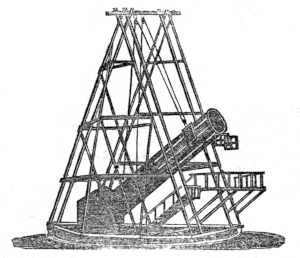
Herschel’s Telescope.
Herschel the Astronomer.
Sir William Herschel was born at Hanover, in Germany, in 1738. At the age of fourteen he entered the Hanoverian Guards, as a musician, and in 1757, proceeded to England in that capacity. Here he became a teacher of music. In 1770, he began to devote himself to the study of astronomy. In 1781, he discovered the planet now called Herschel, but which he called Georgium sidus, or George’s star, in compliment to George III., then king of England. In 1787, he completed his great telescope, the tube of which was forty feet in length, and which was surrounded with machines for turning it in all directions. When observing a heavenly body, he sat at the top of the tube, and looked down to the bottom, where, in a measure, he saw the reflection of the object he wished to notice. In 1789, he discovered the sixth and seventh moons of Saturn. He died in 1822, in the eighty-fourth year of his age. His son is now one of the most famous of living astronomers.