Volume 3 — MERRY’S MUSEUM. VOLUME III.—No. 2.
Reading edition
Anecdote of a Traveller.
The following amusing anecdote is told of Buckhardt, a famous traveller in Africa:—
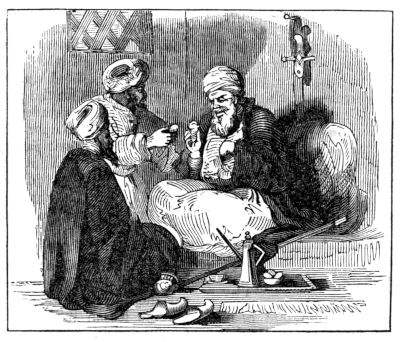
Buckhardt sailed from England early in 1809, and arrived at Malta in safety. Here he equipped himself in the style of an Oriental, assuming the character of an Indian Mahommedan merchant, and sailed for Acre, whence he hoped to be able to reach Tripoli, in Syria, or Latakia. After being twice duped by the captains of the little trading vessels with whom he engaged a passage, by their telling him, when he was fairly embarked, that they were not going to the place which they had represented, he reached the coast of Syria, at Suedieh. Having bargained with the muleteers for the transport of himself and his baggage to Aleppo, he was beginning to load the mules, when he received a message from the aga, or Turkish governor of the place, requesting to see him. Our traveller found this dignitary smoking his pipe in a miserable room, and pulling off his slipper, he sat down before him. After having partaken of a cup of coffee, Buckhardt asked his highness what he wanted. The aga answered by making a sign with his thumb and fore-finger, like a person counting money; at the same time inquiring particularly what was contained in the chest of which our traveller’s baggage was composed. Buckhardt, who had among them several packets for the British consul at Aleppo, told him that he did not know, but that he thought there was a sort of Frank or European drink (beer) and some eatables, which he had brought from Malta for the consul. Not to be thus eluded, the aga sent one of his people to examine the contents. The messenger tasted the beer and found it abominably bitter, and as a sample of the eatables, he carried a potato, which he took out of one of the barrels, to his master. The aga tasted the raw potato, and, instantly spitting it out again, exclaimed loudly against the Franks’ stomach, which could bear such food. After this sample he did not care to investigate farther, and exacting a fine of ten piastres he allowed Buckhardt to proceed.
Dr. Cotton and the Sheep.
There is an anecdote told of Mr. Cotton, the old minister of Boylston, which may perhaps amuse some of our young readers. This gentleman’s house stood upon an eminence, with a garden sloping down in front, filled with fruit-trees. At the foot of the garden was a fence, and, in a straight line with the fence, an old well-curb. Mr. Cotton kept a great number of sheep, as most of our farmers did in olden times; and one day these uneasy creatures took it into their heads to get a taste of their master’s fruit. But the minister had another mind about the matter, and sallied out to give the marauders better instructions. The sheep were somewhat alarmed at being detected, and, according to their usual habit, all followed their leader to escape. The well-curb being the lowest part of the barrier which presented itself to the retreating general, over he leaped, and down he went to the very bottom of the well; and after him came several of his followers, till the well was in danger of being choked up with the silly sheep. There was but one way for the good pastor to save his flock; and, like a gallant chieftain, over the curb he also leaped, and boldly faced the flying insurgents, who were rushing on to destruction. We need not add that the coup-de-main was effectual, and that the remainder of the herd was in this manner preserved. As for the precipitated general and his comrades, they humbly lifted themselves upon their hind feet, and stretching their paws toward their master, bleated a faint petition for release. “Don’t be in haste,” quietly replied the good pastor; “wait patiently till I go to the house for a rope—then I will try to save you.” He was as good as his word. Descending the well, he fastened the rope around their bodies, and drew them safely out; and I dare say the silly creatures did not soon forget the lesson they had learned at so fearful a risk.
The Robin.
A robin came, in the severity of winter, to the window of an honest farmer, and appeared as though he wished to enter. Then the farmer opened the window and kindly took the confiding little animal into his dwelling. He picked up the crumbs that fell from the table. The children loved and valued the bird. But when spring again appeared and the trees were covered with leaves, the farmer opened his window, and the little stranger flew into a neighboring grove, and built his nest and sang his cheerful song.
And behold, when winter returned, the robin came again to the dwelling of the farmer, and brought his mate with him. And the farmer, together with his children, rejoiced greatly, when they saw the two little animals, as they looked with their clear, small eyes, confidently round. And the children said, “The birds regard us as though they had something to say.”
Then the father answered, “If they could speak they would say, Friendly confidence awakens confidence, and love produces reciprocal affection.”
Echo: a Dialogue.
The following dialogue between Echo and a glutton was written in 1609:—
Glut. Who curbs his appetite’s a fool.
Echo. Ah, fool!
Glut. I do not like this abstinence.
Echo. Hence!
Glut. My joy’s a feast, my wish is wine.
Echo. Swine!
Glut. Will it hurt me if I eat too much?
Echo. Much!
Glut. Thou mockest me, nymph, I’ll not believe it.
Echo. Believe it!
Glut. Dost thou condemn, then, what I do?
Echo. I do.
Glut. Is it that which brings infirmities?
Echo. It is!
Glut. Then, sweetest temperance, I’ll love thee!
Echo. I love thee!
Glut. If all be true which thou dost tell, to gluttony I bid farewell.
Echo. Farewell.
The Lion and the Ass.
An ass was one day travelling with a lion, who wanted the assistance of his bray in frightening the animals he was hunting. The ass felt very proud of his company, and did not like to speak to his old acquaintances.
As they were travelling along in this manner, the ass met an old friend, of his own race, who very civilly bade him a good morning. The ass started back with a stare, and said, “really, you are very impudent—I don’t know you!”
“Why not?” replied his friend: “because you are in company with a lion, are you any better than I am—anything more than an ass?”
Those narrow-minded people, who, in prosperity, forget the friends of their humbler days, are about as wise as the ass in the fable.
National Characteristics.
England is said, by a French paper, to be a vast manufactory, a great laboratory, a universal country-house. France is a rich farm, tending to turn itself into a manufactory. Germany is an uncultivated field, because they are philosophers and not peasants who till it. Southern Italy is a villa in ruins. Northern Italy is an artificial prairie. Belgium is a forge. Holland is a canal. Sweden and Denmark are carpenter’s yards. Poland is a sandy heath. Russia is an ice-house. Switzerland is an avalanche. Greece is a field in a state of nature. Turkey is a field, fallow. India is a gold mine. Egypt is a workshop for apprentices. Africa is a furnace. Algiers is a nursery-ground. Asia is a grove. The Antilles are sugar-refineries. South America is a store. North America is a till, full. Spain is a till, empty.