Volume 3 — MERRY’S MUSEUM. VOLUME III.—No. 6.
Reading edition
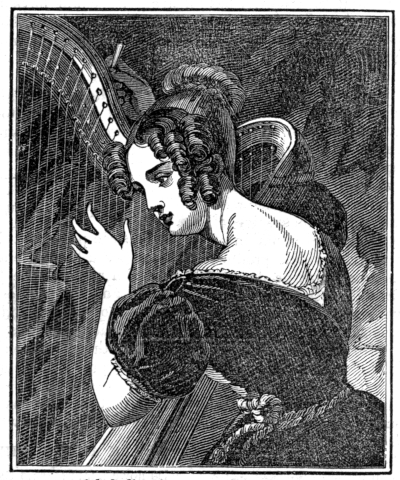
A lady listening to the notes of a harp.
The sense of Hearing.
The sense of hearing lies in the ear, the organs of which are contrived with admirable skill and ingenuity. The air is capable of being moved so as to produce a rapid shaking or vibration. Such a movement of the air is made by the explosion of a gun, by the human voice, &c. Thus vibration of the air with the perception of it, is what we call sound.
Now at the bottom of a winding cavity in the ear is a delicate organ called the drum, which is affected by every motion of the air, however slight; and which, by means of nerves, conveys to the brain the perception of such motion. It is by this means that we hear distant as well as near sounds, and often know what is going on even beyond the reach of sight. Hearing, then, is only perceiving vibrations or quick motions of the air, and sound is only such vibration, with the perception of it.
The delicacy and perfection of the mechanism of the ear are so great, that by its power we not only are able to distinguish the vibrations of the air, caused by the voice of one person, from those produced by that of another, but even to distinguish the vibrations, produced by one string of a musical instrument from those of another. It is owing to the perfection of this mechanism that we are able to distinguish musical notes, to judge of the distance of sounds, to discriminate between the several songs of the orchard and the grove.
Most quadrupeds have long ears, which they can move forward and back with great ease, so as to distinguish with quickness and accuracy the species of sounds, and the nature and situation of the animals or objects which produce them. If you notice a cat or dog, or even a horse, you will observe that the ear is very active, seeking to gather information as to what is going on around. The ears of the hare and rabbit are peculiarly fitted to the use of such timid creatures.
We observe that children seem often inattentive to sounds, and that they are very fond of noise. The reason is this: the bones of their ears are soft, and therefore not sonorous; accordingly, their sense of hearing is dull. When they appear inattentive, they do not hear; yet the exercise of the sense is pleasant, and therefore loud noises delight them. For this reason it is that they usually speak loud, and, when several of them are together, they seem to be much gratified with making an uproar.
The sense of hearing is not only of the greatest use to us in the serious business or life, but it is the source of an infinite number of pleasures. What gratification we sometimes enjoy at hearing the voice of a dear friend! What enjoyment we derive from music! Beside all this, language, which is the great vehicle of thought, is communicated by the ear. It is true that after they are formed we commit words to paper; but these are only signs of sounds previously formed. Without hearing we could have no speech, and all would be dumb; without speech there could be no writing, no books. How vastly, then, is the circle of our knowledge and our pleasures enlarged by this sense, and how does the goodness and the wisdom of the Creator appear in bestowing upon his creatures such a wonderful and beneficent gift!
“Fresh Flowers.”
This is the pleasant title of a pleasant book, which a kind friend has sent me. There is a resemblance between bright thoughts and bright blossoms, between the world of poetry and the world of roses, and honeysuckles, and lilacs, and lilies: and therefore the title of this book is not only pretty, but appropriate. Let any one read the following, and he will see that such a book may well bear the title of “Fresh Flowers.”
A TALK AMONG THE FLOWERS. “Do flowers talk?” said Caroline; “I never hear Voices from mine. Mamma, you said the flowers told Wondrous things, both new and old.” “Sweet voices come from every flower, That blooms in garden, Wood or bower; Sweet, silent voices, Caroline: Come then and listen, daughter mine.” “I will to you a story tell, And you must mind The moral well; ’T will teach you a bright lesson, child, From garden flowers, and blossoms wild.”
Not far from the borders of a dark wood, was a bright and cheerful-looking garden. Flowers were there, of every hue and form, growing and rejoicing beneath the beams of the summer’s sun.
“Ah, how happy we are!” said the marigold to the larkspur.
“Here we bloom and soar upward almost to the very sun,” said a family of sun-flowers.
“Yes, and climb as high as the sky,” cried a convolvolus and jasmine, who had wound themselves round a tall princess-feather.
“How brilliant and stately we are,” said the proud dahlia. “We are admired far more than those pale flowers that grow in yonder wood.”
“I pity the poor faded things,” whispered a bright coreopsis.
“I look down upon them,” said a fierce tiger-lily.
“The sun loves the garden flowers best,” said a pansy of great beauty, to some sweet mignionette; “let us be glad that our home is in this bright place.”
“I will ring a peal for very happiness,” replied a gay Canterbury bell; “for how could we exist in the gloom of that forest?”
“Let us be merry and glad that we are not wood flowers,” shouted they all, with a musical laugh that rung through the wood and made the wild-flowers, wonder.
A bright golden-rod, that grew on the edge of the forest, with his friend the aster, heard this conversation, and felt the injustice of it. Gracefully bowing his yellow plumes, he exclaimed, “Indeed, you do not know us; our life is the happiest in the world. In the deep woods, sheltered from the storm and heat, by the towering trees that soar above us like guardian angels, we live in peace and beauty. The sun does not always bathe us in a flood of light as he does the garden flowers, but he darts his beams through green boughs, and they come to us in tenfold beauty, scattered in a golden shower; and in the still night, the stars look down between the tops of the tall trees, and gaze silently and lovingly upon us.”
The wood flowers heard the silvery tones of the golden-rod with glee, as he recounted their blessed sources of delight.
“We have music too,” said he, “such as never floats through garden airs. We listen to the wind, as it sighs through the pines, and waves the bowery branches of the oak and maple; for each tree is a separate harp, that gives forth its own sweet melodies.”
Then all the flowers that grew by the brook said, “Hear the music of the waters, as they dash along over the rocks, and look on them as they reflect the sunlight upon us, and make us bright and beautiful.”
And the little mosses called out from the shades, “O let us always grow in the greenwood, and live in its shadows, and delight in its sweet voices.”
Then the ferns waved joyfully, and the clematis clung round the elder in a close embrace; and they blessed themselves that they lived amid the lights and shades of the forest.
Then spoke the “lilies of the field” to the little blue-eyed grass, that was looking up into the sky: “How merry are we in the meadows, where grows all that is greenest and freshest. Happiness pervades and fills the universe. It is above us with the birds and the clouds, around us with every flower and green leaf and blade of grass. Let man take a lesson from our kingdom and be wise; for all here are happiest in the place allotted to them by their Creator.”
The following contains a very beautiful thought, and it is expressed with a simplicity that reminds us of Dr. Watts’ songs for children.
GOOD NIGHT, LITTLE STAR. Good night, little star; I will go to my bed, And leave you to burn, While I lay down my head On my pillow to sleep, Till the morning light; Then you will be fading, And I shall be bright.
We make one more quotation, and take leave of this little book, recommending it to all our young readers, who will find it at all the bookstores.
WHAT IS IT MAKES ME HAPPIEST? What is it makes me happiest? Is it my last new play? Is it my bounding ball, or hoop I follow every day? Is it my puzzles or my blocks? My pleasant solitaire? My dolls, my kitten, or my books, My flowers fresh and fair? What is it makes me happiest? It is not one of these; Yet they are treasures dear to me, And never fail to please. O, it is looks and tones of love, From those I love the best, That follow me when I do right; These make me happiest!
June.
June is the first of the summer months, and it is, in our climate, the brightest and pleasantest of the year. The poet Thomson describes it as the season when
Heaven descends In universal bounty, shedding herbs, And fruits, and flowers in Nature’s ample lap.
It is said that Juno, the goddess, who was wife of Jupiter, in the fantastic religion of the ancients, claimed June as her month, and it is said, therefore, to have been named after her. Now, though the story of Jupiter and Juno is mainly a fiction, there is perhaps some truth in it. Very likely some old king had a headstrong wife, who tormented him very much. After many years, the poets began to write verses about them, and called one a god and the other a goddess. Thus, no doubt, it was, that the people learnt to believe in them as divine beings. Still, according to all accounts, Juno was a pretty selfish kind of a person, and it is very likely that, if she took a notion to have a month, or a year, to herself, she would have teased Jupiter till he had given it to her. Thus it may seem very likely that June is named after Juno, as being her month.
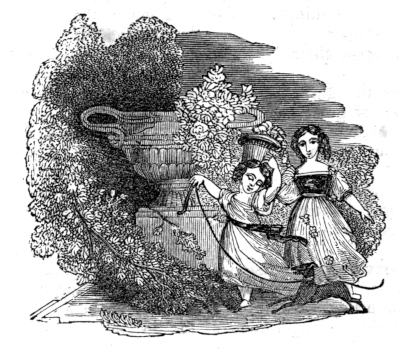
But there is another story about the name of this favorite month. Some writers say that it comes from a Latin word, junioribus, as if it was the month of the young. Whether this was the origin of the name or not, we believe it is the favorite season of children. The two girls, and even the little dog, at the beginning of this article, seem to think that everything is made for them—the sunshine, the green grass, the blushing flowers. How happy is that period of life, when everything gives pleasure! How happy is childhood, the June of life, when the heart is as bright as the season, and the mind as full of flowers as the meadow. Sweet June—blest childhood—farewell!
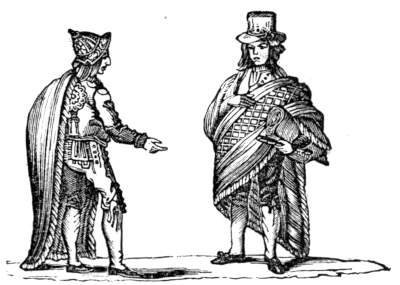
Mexicans of the present day.