PART FOURTH. FATS AND OILS.
Reading edition
277. Nomenclature.—The terms fat and oil are often used interchangeably and it is difficult in all cases to limit definitely their application. The consistence of the substance at usual room temperatures may be regarded as a point of demarcation. The term fat, in this sense, is applied to glycerids which are solid or semi solid, and oil to those which are quite or approximately liquid. A further classification is found in the origin of the glycerids, and this gives rise to the groups known as animal or vegetable fats and oils. In this manual, in harmony with the practices mentioned above, the term fat will be used to designate an animal or vegetable glycerid which is solid, and the term oil one which is liquid at common room temperature, viz., about 20°. There are few animal oils, and few vegetable fats when judged by this standard, and it therefore happens that the term oil is almost synonymous with vegetable glycerid and fat with a glycerid of animal origin. Nearly related to the fats and oils is the group of bodies known as resins and waxes. This group of bodies, however, can be distinguished from the fats and oils by chemical characteristics. The waxes are ethers formed by the union of fatty acids and alcohols of the ethane, and perhaps also of the ethylene series.[229] This chemical difference is not easily expressed and the terms themselves often add confusion to the meaning, as for instance, japan wax is composed mostly of fats, and sperm oil is essentially a wax.
278. Composition.—Fats and oils are composed chiefly of salts produced by the combination of the complex base glycerol with the fat acids. Certain glycerids, as the lecithins, contain also phosphorus in organic combinations, nitrogen, and possibly other inorganic constituents in organic forms. By the action of alkalies the glycerids are easily decomposed, the acid combining with the inorganic base and the glycerol becoming free. The salts thus produced form the soaps of commerce and the freed base, when collected and purified, is the glycerol of the trade.
When waxes are decomposed by alkalies, fatty acids and alcohols of the ethane series are produced.
The natural glycerids formed from glycerol, which is a trihydric (triatomic) alcohol, are found in the neutral state composed of three molecules of the acid, united with one of the base. If R represent the radicle of the fat acid the general formula for the chemical process by which the salt is produced is:
Glycerol. Acid. Salt. Water.
O.H O.R
C₃H₅ O.H + 3R.OH = C₃H₅ O.R + 3H₂O.
O.H O.R
The resulting salts are called triglycerids or neutral glycyl ethers.[230] In natural animal and vegetable products, only the neutral salts are found, the mono- and diglycerids resulting from artificial synthesis. For this reason the prefix tri is not necessarily used in designating the natural glycerids, stearin, for instance, meaning the same as tristearin.
279. Principal Glycerids.—The most important glycerids which the analyst will find are the following:
Olein, C₃H₅O(O.C₁₈H₃₃O)₃.
Stearin, C₃H₅O(O.C₁₈H₃₅)₃.
Palmitin, C₃H₅O(O.C₁₆H₃₁O)₃.
Linolein, C₃H₅O(O.C₁₈H₃₁O)₃.
Butyrin, C₃H₅O(O.C₄H₇O)₃.
Olein is the chief constituent of most oils; palmitin is found in palm oil and many other natural glycerids; stearin is a leading constituent of the fats of beeves and sheep, and butyrin is a characteristic constituent of butter, which owes its flavor largely to this glycerid and its nearly related concomitants.
280. Extraction of Oils and Fats.—Preparatory to a physical and chemical study of the fats and oils is their separation from the other organic matters with which they may be associated. In the case of animal tissues this is usually accomplished by the application of heat. The operation known as rendering may be conducted in many different ways. For laboratory purposes, the animal tissues holding the fat are placed in a convenient dish and a degree of heat applied which will liquify all the fat particles and free them from their investing membranes. The temperature employed should be as low as possible to secure the desired effect, but fats can be subjected for some time to a heat of a little more than 100°, without danger of decomposition. The direct heat of a lamp, however, should not be applied, since it is difficult to avoid too high a temperature at the point of contact of the flame and dish. The dry heat of an air-bath or rendering in an autoclave or by steam is preferable. The residual animal matter is subjected to pressure and the combined liquid fat freed from foreign matters by filtering through a jacket filter, which is kept at a temperature above the solidifying point of the contents.
On a large scale, as in rendering lard, the fat is separated by steam in closed vats which are strong enough to withstand the steam pressure employed. For analytical purposes it is best to extract the fat from animal tissues in the manner described, since the action of solvents is slow on fat particles enveloped in their containing membranes, and the fats, when extracted, are liable to be contaminated with extraneous matters. In dried and ground flesh meal, however, the fat may be extracted with the usual solvents. For the quantitive determination of fat in bones or flesh, the sample, as finely divided as possible, is thoroughly dried, and the fat separated from an aliquot finely powdered portion by extraction with chloroform, ether, or petroleum. The action of anhydrous ether on dried and powdered animal matters is apparently a continuous one. Dormeyer has shown that even after an extraction of several months additional matter goes into solution.[231] The fat in such cases can be determined by saponification with alcoholic potash and the estimation of the free fatty acids produced.
From vegetable substances, such as seeds, the fat is extracted either by pressure or by the use of solvents. For quantitive purposes, only solvents are employed. The dry, finely ground material is exhausted with anhydrous ether or petroleum spirit, in one of the convenient forms of apparatus already described (33->43). In very oily seeds great difficulty is experienced in securing a fine state of subdivision suited to complete extraction. In such cases it is advisable to conduct the process in two stages. In the first stage the material, in coarse powder, is exhausted as far as possible and the percentage of oil determined. The residue is then easily reduced to a fine powder, in an aliquot part of which the remaining oil is determined in the usual way.
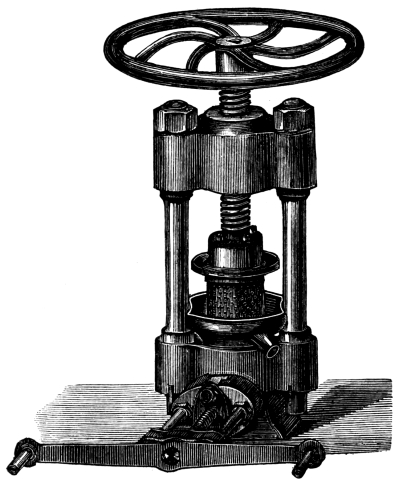
Fig. 79.—Oil Press.
In securing oils for physical and chemical examination both pressure and solution may be employed. The purest oils are secured by pressure at a low temperature. To obtain anything like a good extraction some sort of hydraulic pressure must be used. In this laboratory a press is employed in which the first pressure is secured by a screw and this is supplemented by hydraulic pressure in which glycerol is the transmitting liquid. The construction of the press is shown in the accompanying figure.
The whole press is warmed to nearly 100°. The hot finely ground oily material, enclosed in a cloth bag, is placed in the perforated cylinder and compressed as firmly as possible by turning with the hands the wheel shown at the top of the figure. The final pressure is secured by the screw shown at the bottom of the figure whereby a piston is driven into a cylinder containing glycerol. The degree of pressure obtained is equal to 300 atmospheres.
Even with the best laboratory hydraulic pressure not more than two-thirds of the total oil contents of oleaginous seeds can be secured and the process is totally inapplicable to securing the oil from tissues when it exists in quantities of less than ten per cent. To get practically all of the oil the best method is to extract with carefully distilled petroleum of low boiling point.
In the preparation of this reagent the petroleum ether of commerce, containing bodies boiling at temperatures of from 35° to 80°, is repeatedly fractioned by distillation until a product is obtained which boils at from 45° to 60°. The distillation of this material is conducted in a large flask heated with steam, furnished with a column containing a number of separatory funnels and connected with an appropriate condenser. The distillate is secured in a bottle packed with broken ice, as shown in Fig. 80. A thermometer suspended in the vapor of the petroleum serves to regulate the process. Too much care to avoid accidents cannot be exercised in this operation. Not only must steam be used in heating, but all flame and fire must be rigidly excluded from the room in which the distillation takes place, and the doors leading to other rooms where gas jets may be burning must be kept closed. In the beginning of the process, as much as possible of the petroleum boiling under 45° must be removed and rejected. The distillation is then continued until the temperature rises above 60°. The parts of the distillate saved between these temperatures are redistilled under similar conditions. Other portions of the petroleum, boiling at other temperatures, may be secured in the same way. The products may be in a measure freed of unpleasant odors by redistilling them from a mixture with lard. When used for quantitive purposes the petroleum ether must leave no residue when evaporated at 100°.
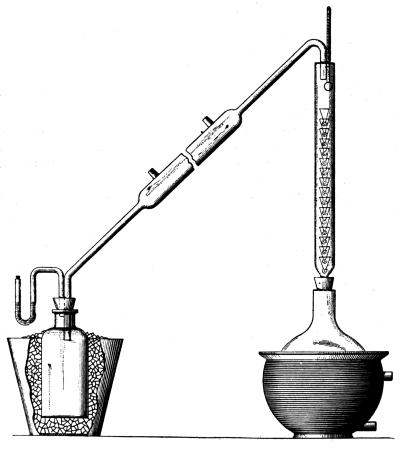
Fig. 80.—Apparatus for Fractional Distillation of Petroleum Ether.
281. Freeing Extracted Oils from Petroleum.—The petroleum ether which is used for extracting oils tends to give them an unpleasant odor and flavor and its entire separation is a matter of some difficulty. The greater part of the solvent may be recovered as described in paragraph 43. Heating the extracted oil for several hours in thin layers, will remove the last traces of the solvent, but affords opportunity for oxidation, especially in the case of drying oils. An effective means of driving off the last traces of petroleum is to cause a current of dry carbon dioxid to pass through the sample contained in a cylinder and heated to a temperature of from 85° to 90°. The atmosphere of the inert gas will preserve the oil from oxidation and the sample will, as a rule, be found free of the petroleum odor after about ten hours treatment. Ethyl ether or chloroform may be used instead of petroleum, but these solvents act on other matters than the glycerids, and the extract is therefore liable to be contaminated with more impurities than when the petroleum ether is employed. Other solvents for fats are carbon tetrachlorid, carbon disulfid, and benzene. In general, petroleum ether should be employed in preference to other solvents, except in the case of castor oil, which is difficultly soluble in both petroleum and petroleum ethers.
282. Freeing Fats Of Moisture.—Any excess of water in glycerids will accumulate at the bottom of the liquid sample and can be removed by decanting the fat or separating it from the oil by any other convenient method. The warm oil may be almost entirely freed of any residual moisture by passing it through a dry filter paper in a jacket funnel kept at a high temperature. A section showing the construction of such a funnel with a folded filter paper in place, is shown in Fig. 81. The final drying, when great exactness is required, is accomplished in a vacuum, or in an atmosphere of inert gas, or in the cold in an exsiccator over sulfuric acid. In drying, it is well to expose the hot oil as little as possible to the action of the air. Wherever convenient, it should be protected from oxidation by some inert gas or a vacuum.
283. Sampling for Analysis.—It is a matter of some difficulty to secure a representative sample of a fat or oil for analytical purposes. The moisture in a fat is apt to be unevenly distributed, and the sampling is to be accomplished in a manner to secure the greatest possible uniformity. When the quantity of material is of considerable quantity a trier may be used which will remove a cylindrical or partly cylindrical mass from the whole length or depth. By securing several subsamples of this kind, and well mixing them, an average sample of the whole mass may be secured. Where the fat is found in different casks or packages samples should be drawn from each as described above. The subsamples are mixed together in weights corresponding to the different casks from which they are taken and the mass obtained by this mixture divided into three equal portions. Two of these parts are melted in a dish at a temperature not exceeding 60°, with constant stirring, and when fully liquid the third part is added. As a rule, the liquid fat retains enough heat to melt the added quantity. As soon as the mixed fats begin to grow pasty the mass is vigorously stirred to secure an intimate mixture of the water and other foreign bodies.[232]
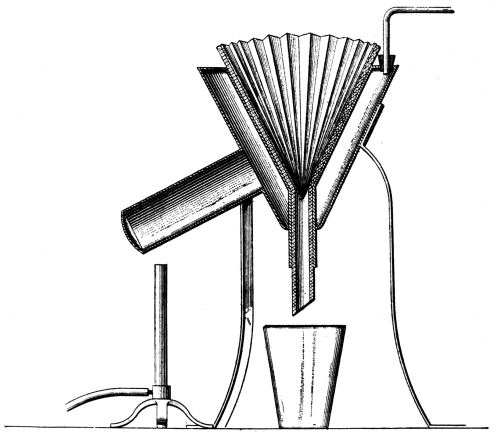
Fig. 81.—Section Showing Construction of a Funnel for Hot Filtration.
In the case of butter fat the official chemists recommend that subsamples be drawn from all parts of the package until about 500 grams are secured. The portions thus drawn are to be perfectly melted in a closed vessel at as low a temperature as possible, and when melted the whole is to be shaken violently for some minutes till the mass is homogeneous, and sufficiently solidified to prevent the separation of the water and fat. A portion is then poured into the vessel from which it is to be weighed for analysis, and this should nearly or quite fill it. This sample should be kept in a cold place till analyzed.[233]
284. Estimation of Water.—In the official method for butter fat, which may be applied to all kinds, about two grams are dried to constant weight, at the temperature of boiling water, in a dish with flat bottom, having a surface of at least twenty square centimeters.
The use of clean dry sand or asbestos is admissible, and is necessary if a dish with round bottom be employed.
In the method recommended by Benedikt, about five grams of the sampled fat are placed in a small flask or beaker and dried at 100° with occasional stirring to bring the water to the surface.
According to the method of Sonnenschein, the sample is placed in a flask carrying a cork, with an arrangement of glass tubes, whereby a current of dry air may be aspirated over the fat during the process of drying. When the flask is properly fitted its weight is taken, the fat put in and reweighed to get the exact amount. The fat is better preserved by aspirating carbon dioxid instead of air.[234] The moisture may also be readily determined by drying on pumice stone, as described in paragraph 26. In this case it is well to conduct the desiccation in vacuum or in an inert atmosphere to prevent oxidation.
PHYSICAL PROPERTIES OF FATS.
285. Specific Gravity.—The specific gravity of an oil is readily determined by a westphal balance (53), by a spindle, by a sprengel tube, or more accurately by a pyknometer. The general principles governing the conduct of the work have already been given (48-59). The methods described for determining the density of sugar solutions are essentially the same as those used for oils, but it is to be remembered that oils and fats are lighter than water and the graduation of the sinkers for the hydrostatic balance, and the spindles for direct determination must be for such lighter liquids. The necessity of determining the density of a fat at a temperature above its melting point is manifest, and for this reason the use of the pyknometer at a high temperature (40° to 100°) is to be preferred to all the other processes, in the case of fats which are solid at temperatures below 25°.
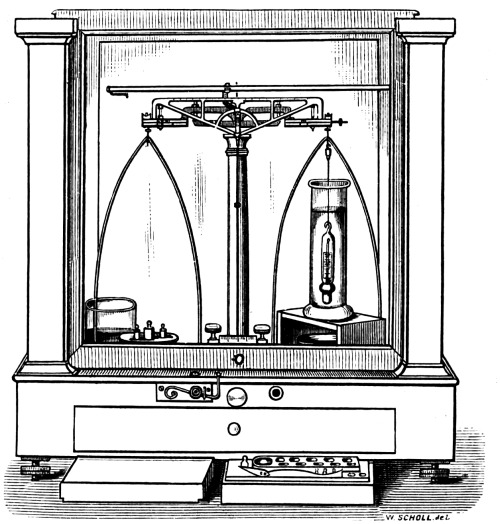
Fig. 82.—Balance and Westphal Sinker.
When great delicacy of manipulation is desired, combined with rapid work, an analytical balance and westphal sinker may be used conjointly.[235] In this case it is well to have two or three sinkers graduated for 20°, 25°, and 40°, respectively. Nearly all fats, when melted and cooled to 40°, remain in a liquid state long enough to determine their density. The sinkers are provided with delicate thermometers, and the temperature, which at the beginning is a little above the degree at which the sinker is graduated, is allowed to fall to just that degree, when the equilibrium is secured in the usual manner. The sinker is conveniently made to displace just five grams of distilled water at the temperature of graduation, but it is evident that a round number is not necessary, but only convenient for calculation.
286. Expression of Specific Gravity.—Much confusion arises in the study of data of densities because the temperatures at which the determinations are made are not expressed. The absolute specific gravity would be a comparison of the weight of the object at 4°, with water at the same temperature. It is evident that such determinations are not always convenient, and for this reason the determinations of density are usually made at other temperatures.
In the case of a sinker, which at 35° displaces exactly five grams of water, the following statements may be made: One cubic centimeter of water at 35° weighs 0.994098 gram. The volume of a sinker displacing five grams of water at that temperature is therefore 5.0297 cubic centimeters. This volume of water at 4° weighs 5.0297 grams. In a given case the sinker placed in an oil at 35° is found to displace a weight equal to 4.5725 grams corresponding to a specific gravity of 35°/35° = 0.9145. From the foregoing data the following tabular summary is constructed:
Weight of 5.0287 cubic centimeters of oil at 35°, 4.5725 grams.
” ” 5.0297 ” ” ” water at 35°, 5.0000 ”
” ” 5.0297 ” ” ” ” ” 4°, 5.0297 ”
Relative weight of oil at 35°, to water at 35°, 0.9145 grams.
” ” ” ” ” 35°, ” ” ” 4°, 0.9092 ”
287. Coefficient of Expansion of Oils.—Oils and fats of every kind have almost the same coefficient of expansion with increasing temperature. The coefficient of expansion is usually calculated by the formula
δ = D₀ - D₀ʹ
(tʹ - t)D₀
in which δ represents the coefficient of expansion, D₀ the density at the lowest temperature, D₀ʹ the density at the highest temperature, t the lowest, and tʹ the highest temperatures.
In the investigations made by Crampton it was shown that the formula would be more accurate, written as follows:[236]
δ = D₀ - D₀ʹ
(tʹ - t) × D₀ + D₀ʹ
2
The absolute densities can be calculated from the formula Δ = δ + K, in which Δ represents the coefficient of absolute expansion, δ the apparent coefficient of expansions observed in glass vessels, and K the cubical coefficient of expansion of the glass vessel. The mean absolute coefficient of expansion for fats and oils, for 1° as determined by experiment, is almost exactly 0.0008, and the apparent coefficient of expansion nearly 0.00077.[237]
288. Standard of Comparison.—In expressing specific gravities it is advisable to refer them always to water at 4°. The temperature at which the observation is made should also be given. Thus the expression of the specific gravity of lard, determined at different temperatures, is made as follows:
15°.5
d —— = 0.89679;
4°
40°
d —— = 0.91181;
4°
100°
and d —— = 0.85997,
4°
indicating the relative weights of the sample under examination at 15°.5, 40°, and 100°, respectively, to water at 4°.
289. Densities of Common Fats and Oils.—It is convenient to have at hand some of the data representing the densities of common fats and oils, and the following numbers are from results of determinations made in this laboratory:[238]
15°.5 40° 100°
Temperature. d = —. d = —. d = —.
4° 4° 4°
Leaf lard 0.91181 0.89679 0.85997
Lard stearin 0.90965 0.89443 0.85750
Oleostearin 0.90714 0.89223 0.85572
Crude cottonseed oil 0.92016 0.90486 0.86739
Summer ” ” 0.92055 0.90496 0.86681
Winter ” ” 0.92179 0.90612 0.86774
Refined ” ” 0.92150 0.90573 0.86714
Compound lard ” 0.91515 0.90000 0.86289
Olive oil 0.91505 0.89965 0.86168
290. Melting Point.—The temperature at which fats become sensibly liquid is a physical characteristic of some importance. Unfortunately, the line of demarcation between the solid and liquid states of this class of bodies is not very clear. Few of them pass per saltum from one state to the other. In most cases there is a gradual transition, which, between its initial and final points, may show a difference of several degrees in temperature. It has been noted, further, that fats recently melted behave differently from those which have been solid for several hours. For this reason it is advisable, in preparing glycerids for the determination of their melting point, to fuse them the day before the examination is to be made. The temperature at which a glycerid passes from a liquid to a solid state is usually higher than that at which it resumes its solid form. If, however, the change of temperature could be made with extreme slowness, exposing the sample for many hours at near its critical temperature, these differences would be much less marked.
Many methods have been devised for determining the melting point of fats, and none has been found that is satisfactory in every respect. In some cases the moment at which fluidity occurs is assumed to be that one when the small sample loses its opalescence and becomes clear. In other cases the moment of fluidity is determined by the change of shape of the sample or by observing the common phenomena presented by a liquid body. In still other cases, the point at which the sample becomes fluid is determined by the automatic completion of an electric circuit, which is indicated by the ringing of a bell. This latter process has been found very misleading in our experience. Only a few of the proposed methods seem to demand attention here, and some of those, depending on the visible liquefaction of a small quantity of the fat or based on the physical property, possessed by all liquids when removed from external stress, of assuming a spheroidal state will be described. Other methods which may demand attention in any particular case may be found in the works cited.[239]
291. Determination in a Capillary Tube.—A capillary tube is dipped into the melted fat and when filled one end of the tube is sealed in the lamp and it is then put aside in a cool place for twenty-four hours. At the end of this time the tube is tied to the bulb of a delicate thermometer the length used or filled with fat being of the same length as the thermometer bulb. The thermometer and attached fat are placed in water, oil, or other transparent media, and gently warmed until the capillary column of fat becomes transparent. At this moment the thermometric reading is made and entered as the melting point of the fat. In comparative determinations the same length of time should be observed in heating, otherwise discordant results will be obtained. As in all other methods, the resulting members are comparative and not absolute points of fusion, and the data secured by two observers on the same sample may not agree, if different methods of preparing the fat and different rates of fusion have been employed.
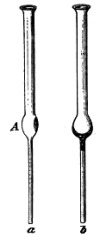
Fig. 83.— Melting Point Tubes.
Several modifications of the method just described are practiced, and perhaps with advantage in some cases. In one of these a small particle of the fat is solidified in a bulb blown on a small tube, as indicated in Fig. 83, tube a. The tube, in an upright position, is heated in a convenient bath until the particle of fat just begins to run assuming soon the position shown in tube b. This temperature is determined by a thermometer, whose bulb is kept in contact with the part of the observation tube containing the fat particle. The rise of temperature is continued until the fat collected at the bottom of the bulb is entirely transparent. This is called the point of complete fusion.[240]
Pohl covers the bulb of a thermometer with a thin film of fat, and the instrument is then fixed in a test tube, in such a way as not to touch the bottom, and the film of fat warmed by the air-bath until it fuses and collects in a droplet at the end of the thermometer bulb.[241]
Carr has modified this process by inserting the thermometer in a round flask in such a way that the bulb of the thermometer is as nearly as possible in the center. By this device the heating through the intervening air is more regular and more readily controlled.[242]
A particle of fat placed on the surface of clean mercury will melt when the mercury is raised to the proper temperature. Where larger quantities of the fat are employed, a small shot or pellet of mercury may be placed upon the surface and the whole warmed until the metal sinks. Of the above noted methods, the analyst will find some form of capillary tube or the use of a film of the fat on the bulb of a thermometer the most satisfactory.[243]
Hehner and Angell have modified the sinking point method by increasing the size of the sinker without a corresponding increase in weight. This is accomplished by blowing a small pear-shaped float, nearly one centimeter in diameter and about two long. The stem of the pear is drawn out and broken off, and while the bulb is still warm, the open end of the stem is held in mercury, and a small quantity of this substance, sufficient in amount to cause the float to sink slowly through a melted fat, is introduced into the bulb of the apparatus and the stem sealed. The whole bulb should displace about one cubic centimeter of liquid and weigh, after filling with mercury, about three and four-tenths grams. In conducting the experiment about thirty grams of the dry melted fat are placed in a large test tube and cooled by immersing the tube in water at a temperature of 15°. The tube containing the solidified fat is placed in a bath of cold water and the sinker is placed in the center of the surface of the fat. The bath is slowly heated until the float disappears. The temperature of the bath is read just as the bulb part of the float disappears. The method is recommended especially by the authors for butter fat investigations.[244]
298. Melting Point Determined by the Spheroidal State.—The method described by the author, depending on the assumption of the spheroidal state of a particle of liquid removed from all external stress, has been found quite satisfactory in this laboratory, and has been adopted by the official chemists.[245] In the preparation of the apparatus there are required:
(a) a piece of ice floating in distilled water that has been recently boiled, and (b) a mixture of alcohol and water of the same specific gravity as the fat to be examined. This is prepared by boiling distilled water and ninety-five per cent alcohol for a few minutes to remove the gases which they may hold in solution. While still hot, the water is poured into the test tube described below until it is nearly half full. The test tube is then nearly filled with the hot alcohol, which is carefully poured down the side of the inclined tube to avoid too much mixing. If the alcohol is not added until the water has cooled, the mixture will contain so many air bubbles as to be unfit for use. These bubbles will gather on the disk of fat as the temperature rises and finally force it to the top.
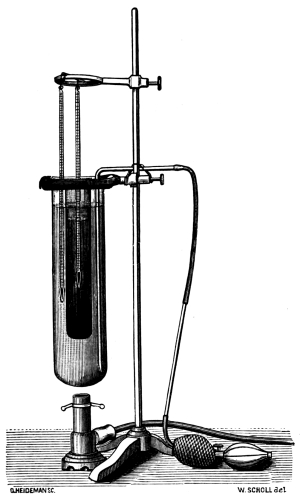
Fig. 84.—Apparatus for the Determination of Melting point.
The apparatus for determining the melting point is shown in Fig. 84, and consists of (a) an accurate thermometer reading easily tenths of a degree; (b) a cathetometer for reading the thermometer (but this may be done with an eye-glass if held steadily and properly adjusted); (c) a thermometer; (d) a tall beaker, thirty-five centimeters high and ten in diameter; (e) a test tube thirty centimeters long and three and a half in diameter; (f) a stand for supporting the apparatus; (g) some method of stirring the water in the beaker (for example, a blowing bulb of rubber, and a bent glass tube extending to near the bottom of the beaker).
The disks of fat are prepared as follows: The melted and filtered fat is allowed to fall from a dropping tube from a height of about twenty cubic centimeters on a smooth piece of ice floating in recently boiled distilled water. The disks thus formed are from one to one and a half centimeters in diameter and weigh about 200 milligrams. By pressing the ice under the water the disks are made to float on the surface, whence they are easily removed with a steel spatula, which should be cooled in the ice water before using. They should be prepared a day or at least a few hours before using.
The test tube containing the alcohol and water is placed in a tall beaker, containing water and ice, until cold. The disk of fat is then dropped into the tube from the spatula, and at once sinks until it reaches a part of the tube where the density of the alcohol-water is exactly equivalent to its own. Here it remains at rest and free from the action of any force save that inherent in its own molecules.
The delicate thermometer is placed in the test tube and lowered until the bulb is just above the disk. In order to secure an even temperature in all parts of the alcohol mixture in the vicinity of the disk, the thermometer is gently moved from time to time in a circularly pendulous manner.
The disk having been placed in position, the water in the beaker is slowly heated, and kept constantly stirred by means of the blowing apparatus already described.
When the temperature of the alcohol-water mixture rises to about 6° below the melting point, the disk of fat begins to shrivel, and gradually rolls up into an irregular mass.
The thermometer is now lowered until the fat particle is even with the center of the bulb. The bulb of the thermometer should be small, so as to indicate only the temperature of the mixture near the fat. A gentle rotatory movement from time to time should be given to the thermometer bulb. The rise of temperature should be so regulated that the last 2° of increment require about ten minutes. The mass of fat gradually approaches the form of a sphere, and when it is sensibly so the reading of the thermometer is to be made. As soon as the temperature is taken the test tube is removed from the bath and placed again in the cooler. A second tube, containing alcohol and water, is at once placed in the bath. The test tube (ice water having been used as a cooler) is of low enough temperature to cool the bath sufficiently. After the first determination, which should be only a trial, the temperature of the bath should be so regulated as to reach a maximum of about 1°.5 above the melting point of the fat under examination.
The edge of the disk should not be allowed to touch the sides of the tube. This accident rarely happens, but in case it should take place, and the disk adhere to the sides of the tube, a new trial should be made.
Triplicate determinations should be made, and the second and third results should show a near agreement.
Example.—Melting point of sample of butter:
Degrees.
First trial 33.15
Second trial 33.05
Third trial 33.00
The fatty acids, being soluble in alcohol, cannot be treated as the ordinary glycerids. But even those glycerids which are slightly soluble in alcohol may be subjected to the above treatment without fear of experiencing any grave disturbance of the fusing points.
293. Solidifying Point.—The temperature at which a fat shows incipient solidification is usually lower than the point of fusion. The same difficulties are encountered in determining the temperature of solidification as are presented in observing the true melting point. The passage from a transparent liquid to an opaque solid is gradual, showing all the phases of turbidity from beginning opalescence to complete opacity. The best the analyst can do is to determine, as accurately as possible, the temperature at which the more solid glycerids of the mixture begin to form definite crystals. This point is affected to a marked degree by the element of time. A fat cooled just below its melting point will become solid after hours, or days, whereas it could be quickly cooled far below that temperature and still be limpid.
The methods of observation are the same for the glycerids and fatty acids, and the general process of determination is sufficiently set forth in the following description of the method as used in this laboratory.[246]
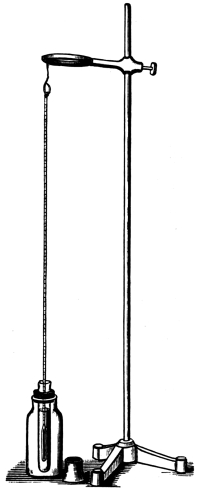
Fig. 85.—Apparatus for Determining Crystallizing Point.
The melted fat or fat acid is placed in a test tube contained in a large bottle, which serves as a jacket to protect the tube from sudden or violent changes of temperature. The efficiency of the jacket may be increased by exhausting the air therefrom, as in the apparatus for determining the heat of bromination, hereafter described. A very delicate thermometer, graduated in tenths of a degree, and having a long bulb, is employed. By means of the reading glass, the reading can be made in twentieths of a degree. The arrangement of the apparatus is shown in Fig. 85. The test tube is nearly filled with the melted matter. The bottom of the jacket should be gently warmed to prevent a too rapid congelation in the bottom of the test tube containing the melted fat, and the tube is to be so placed as to leave an air space between it and the bottom of the bottle. The thermometer is suspended in such a manner as to have the bulb as nearly as possible in the center of the melted fat. The thermometer should be protected from air currents and should be kept perfectly still. In case the congealing point is lower than room temperature the jacket may be immersed in a cooling mixture, the temperature of which is only slightly below the freezing point of the fatty mass.
When crystals of fat begin to form, the descent of the mercury in the stem of the thermometer will become very slow and finally reach a minimum, which should be noted. As the crystallization extends inwards and approaches the bulb of the thermometer a point will be reached when the mercury begins to rise. At this time the partially crystallized mass should be vigorously stirred with the thermometer and again left at rest in as nearly, the original position as possible. By this operation the mercury will be made to rise and its maximum position should be noted as the true crystallizing point of the whole mass. In comparing different samples, it is important that the elements of time in which the first crystallization takes place should be kept, as nearly as possible, the same. A unit of one hour in cooling the mixture from a temperature just above its point of fusion until the incipient crystallization is noticed, is a convenient one for glycerids and for fat acids.
294. Determination of Refractive Power.—The property of refracting light is possessed by fats in different degrees and these differences are of great help in analytical work. The examination may be made by the simple refractometer of Abbe or Bertrand, or by the more elaborate apparatus of Pulfrich.
The comparative refractive power of fats can also be observed by means of the oleorefractometer of Amagat-Jean or the differential refractometer of Zune.[247]
For details of the construction of these apparatus, with a description of the optical principles on which they are based, the papers above cited may be consulted. In this laboratory the instruments which have been employed are three in number, viz., Abbe’s small refractometer, Pulfrich’s refractometer using yellow light, and the oleorefractometer of Amagat-Jean. A brief description of the methods of manipulating these instruments is all that can be attempted in this manual.
295. Refractive Index.—Refractive index is an expression employed to characterize the measurement of the degree of deflection caused in a ray of light in passing from one transparent medium into another. It is the quotient of the sine of the angle of the incident, divided by the sine of the angle of the refracted ray.
In the case of oils which remain liquid at room temperatures, the determinations can be made without the aid of any device to maintain liquidity. In the case of fat which becomes solid at ordinary room temperatures, the determination must either be made in a room artificially warmed or the apparatus must have some device, as in the later instruments of Abbe and Pulfrich, and in the apparatus of Amagat-Jean, whereby the sample under examination can be maintained in a transparent condition. In each case the accuracy of the apparatus should be tested by pure water, the refractive index of which at 18° is 1.333. The refractive index is either read directly on the scale as in Abbe’s instrument, or calculated from the angles measured as in Pulfrich’s apparatus.
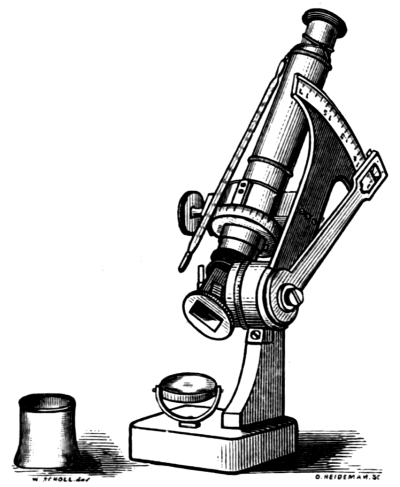
Fig. 86.—Abbe’s Refractometer.
296. Abbe’s Refractometer.—For practical use the small instrument invented by Abbe will be found sufficient. The one which has been in use for many years in this laboratory is shown in Fig. 86. The illustration represents the apparatus in the position preliminary to reading the index. In preparing the sample of oil for observation the instrument is turned on its axis until the prisms between which the oil is placed assume a horizontal position, as is seen in Fig. 87. The movable prism is unfastened and laid aside, the fixed prism covered with a rectangular shaped piece of tissue paper on which one or two drops of the oil are placed. The movable prism is replaced in such a manner as to secure a complete separation of the two prisms by the film of oiled tissue paper. A little practice will enable the analyst to secure this result.
After the paper disk holding the fat is secured by replacing the upper prism, the apparatus is placed in its normal position and the index moved until the light directed through the apparatus by the mirror shows the field of vision divided into dark and light portions. The dispersion apparatus is now turned until the rainbow colors on the part between the dark and light fields have disappeared. Before doing this, however, the telescope, the eyepiece of the apparatus, is so adjusted as to bring the cross lines of the field of vision distinctly into focus. The index of the apparatus is now moved back and forth until the line of the two fields of vision falls exactly at the intersection of the cross lines. The refractive index of the fat under examination is then read directly upon the scale by means of a small magnifying glass. To check the accuracy of the first reading, the dispersion apparatus should be turned through an angle of 180° until the colors have again disappeared, and, after adjustment, the scale of the instrument again read. These two readings should nearly coincide, and their mean is the true reading of the fat under examination.
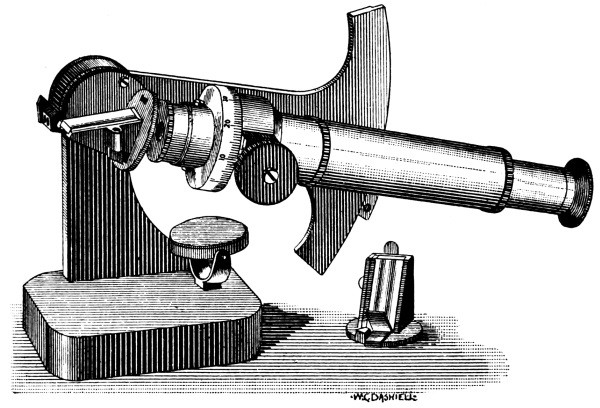
Fig. 87.—Charging Position of Refractometer.
For butter fats the apparatus should be kept in a warm place, the temperature of which does not fall below 30°. For reducing the results obtained to a standard temperature, say 25°, the factor 0.000176 may be used. As the temperature rises the refractive index falls.
Example.—Refractive index of a butter fat determined at 32°.4 = 1.4540, reduced to 25° as follows: 32.4 -25 = 7.4; 0.000176 × 7.4 = 0.0013; then 1.4540 + 0.0013 = 1.4553.
The instrument used should be set with distilled water at 18°, the theoretical refractive index of water at that temperature being 1.333. In the determination above given, the refractive index of pure water measured 1.3300; hence the above numbers should be corrected for theory by the addition of 0.0030, making the corrected index of the butter fat mentioned at the temperature given, 1.4583.
297. Pulfrich’s Refractometer.—For exact scientific measurements, Pulfrich’s apparatus has given here entire satisfaction. In this instrument a larger quantity of the oil is required than for the abbe, and this quantity is held in a cylindrical glass vessel luted to the top of the prism. The method of accomplishing this and also an illustration of the refraction of the rays of light are shown in Fig. 88.
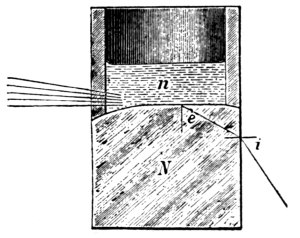
Fig. 88.—Prism of Pulfrich’s Refractometer.
The angle i is measured by a divided circle read with the aid of a small telescope. The index of the prism of highly refractive glass N is known. The oil is seen at n. The light used is the yellow sodium ray (D). From the observed angle the refractive index of n is calculated from the formula
n = √ N² - sin²i.
For convenience the values of n for all usual values of i are computed once for all and arranged for use in tabular form. The latest model of Pulfrich’s apparatus, arranged both for liquid and solid bodies, and also for spectrometric observation is shown in Fig. 89.
When the sodium light is used it is placed behind the apparatus and the light is collected and reflected on the refractive prism by the lens N. Through H and G is secured the micrometric reading of the angle on the scale D by means of the telescopic arrangement F E. For regulating the temperature of the oil and adjacent parts, a stream of water at any desired temperature is made to circulate through L and S in the direction indicated by the arrows. The manner in which this is accomplished is shown in the cross section of that part of the apparatus as indicated in Fig. 90.
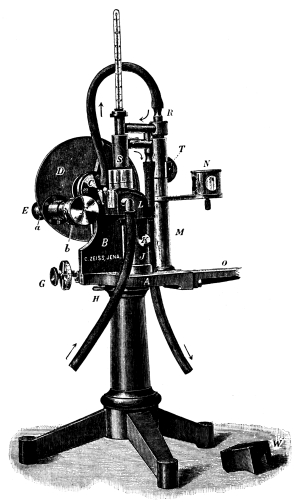
Fig. 89.—Pulfrich’s New Refractometer.
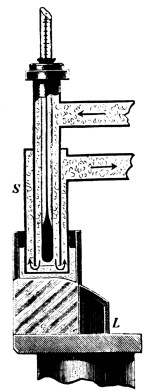
Fig. 90.— Heating Apparatus for Pulfrich’s Refractometer.
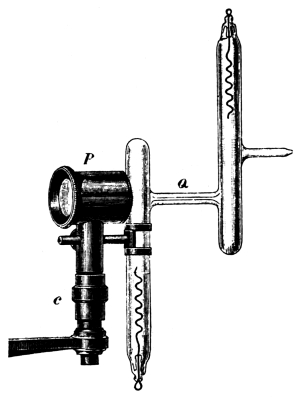
Fig. 91.—Spectrometer Attachment.
For further details of the construction and operation of the apparatus the original description may be consulted.[248]
In case a spectrometric observation is desired the H ray, for instance, is produced by the geissler tube Q, Fig. 91. The light is concentrated and thrown upon the refractive prism by the lens P, the lens N, Fig. 89, being removed for this purpose.
Tables, for correcting the dispersion and for calculating the indices for each angle and fraction thereof, and for corrections peculiar to the apparatus, accompany each instrument.
298. Refractive Indices of some Common Oils.—The following numbers show the refractive indices obtained by Long for some of the more common oils. The light used was the yellow ray of the sodium flame.[249]
Name. Temperature. Refractive index. Calculated for 25°.
Olive oil (France) 26°.6 1.4673 1.4677
” ” (California) 25°.4 1.4677 1.4678
Cottonseed oil 24°.8 1.4722 1.4721
” ” 26°.3 1.4703 1.4709
” ” 25°.3 1.4718 1.4719
Sesamé oil 24°.8 1.4728 1.4728
” ” 26°.8 1.4710 1.4716
Castor ” 25°.4 1.4771 1.4773
Lard ” 27°.3 1.4657 1.4666
Peanut ” 25°.3 1.4696 1.4696
In case of the use of Abbe’s apparatus, in which diffused sunlight is the source of the illumination, the numbers obtained cannot be compared directly with those just given unless the apparatus be first so adjusted as to read with distilled water at 18°, 1.333. In this case the reading of the scale gives the index as determined by the yellow ray. The numbers obtained with Abbe’s instrument for some common oils are given below.[250]
In the determinations the instrument was set with water at 18°, reading 1.3300, and they were corrected by adding 0.0030 in order to compensate for the error of the apparatus.
Material. Calculated for 25°. Corrected index.
Lard 1.4620 1.4650
Cotton oil 1.4674 1.4704
Olive oil stearin 1.4582 1.4610
Lard stearin 1.4594 1.4624
299. Oleorefractometer.—Instead of measuring the angular value of the refractive power of an oil it may be compared with some standard on a purely arbitrary scale. Such an apparatus is illustrated by the oleorefractometer of Amagat-Jean, or by Zeiss’s butyrorefractometer.
In the first named instrument, Fig. 92, the oil to be examined is compared directly with another typical oil and the shadow produced by the difference in refraction is located on a scale read by a telescope and graduated for two different temperatures.[251] The internal structure of the apparatus is shown in Fig. 93.
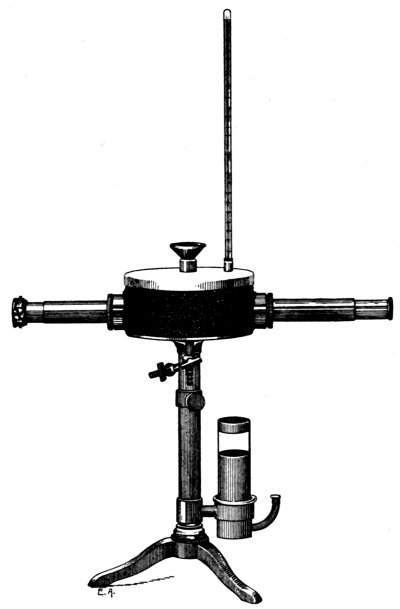
Fig. 92.—Oleorefractometer.
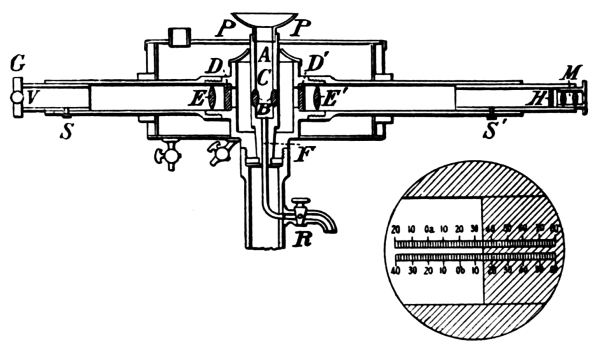
Fig. 93.—Section Showing Construction of Oleorefractometer.
In the center of the apparatus a metal cylinder, A, is found carrying two plate glass pieces, C B, so placed as to form an angle of 107°. This cylinder is placed in a larger one, provided with two circular glass windows. To these two openings are fixed to the right and left, the telescopic attachments, G, V, S, E, and the apparatus M, H, Sʹ, Eʹ, for rendering the rays of light parallel. The field of vision is divided into two portions, light and dark, by a semicircular stop inserted in the collimator, and contains the double scale shown in the figure placed at H. The field of vision is illuminated by a gas or oil lamp placed at a convenient distance from the collimator. The inner metallic cylinder A is surrounded with an outer one, to which the optical parts are attached at D Dʹ by means of plane glass plates. This cylinder is in turn contained in the large water cylinder P P, carrying a thermometer in the opening shown at the top on the left. The manipulation of the apparatus is very simple. The outer cylinder is filled with water, at a temperature below 22°, the middle one with the typical oil furnished with the instrument, the cover of the apparatus carrying the thermometer placed in position and the cup-shaped funnel inserted in the cylinder A, which is at first also filled with the typical oil. The whole system is next brought slowly to the temperature of 22° by means of the lamp shown in Fig. 92. The telescope is adjusted to bring the scale of the field of vision into focus and the line dividing the light and shadow of the field should fall exactly on 0°a. If this be not the case the 0° is adjusted by screws provided for that purpose until it is in proper position. The typical oil is withdrawn from A by the cock R, the cylinder washed with a little of the oil to be examined and then filled therewith. On again observing the field of vision the line separating the shadow from the light will be found moved to the right or left, if the oil have an index different from that of the typical oil. The position of the dividing line is read on the scale.
For fats the temperature of the apparatus is brought exactly to 45° and the scale 0°b is used. In other respects the manipulation for the fats is exactly that described for oils. In the use of 0°a, in case the room be warmer than 22°, all the liquids employed should be cooled below 22° before being placed in the apparatus. It is then only necessary to wait until the room temperature warms the system to 22°. In the case of fats it is advisable to heat all the liquids to about 50° and allow them to cool to 45° instead of heating them to that temperature by means of the lamp.
One grave objection to this instrument is found in the absence of the proper scientific spirit controlling its manufacture and sale, as evidenced by the attempt to preserve the secret of the composition of the typical oil and the negligence in testing the scale of the instruments which will be pointed out further along.
According to Jean[252] the common oils, when purified, give the following readings at 22°:
Peanut oil +3.5 to +6.5
Colza ” +17.5 ” +21.0
Cotton ” +18.0 ” +18.0
Linseed ” +47.0 ” +54.5
Lard ” +5.5 ” +5.5
Olive ” +1.5 ” 0.0
Sesamé ” +17.5 ” +19.0
Oleomargarin -15.0 ” -15.0
Butter fat -30.0 ” -30.0
Mutton oil 0.0 ” 0.0
Fish ” +38.0 ” +38.0
In this instrument, therefore, vegetable and fish oils, as a rule, show a right hand, and animal fats a left hand deviation.
The oleorefractometer has been extensively used in this laboratory and the data obtained thereby have been found useful. We have not found, however, the values fixed by Jean to be constant. The numbers for lard have varied from -3.0 to -10.0, and other fats have shown almost as wide a variation from the values assigned by him.
Jean states that the number for lard, determined by the oleorefractometer, is -12, and he gives a definite number for each of the common oils and fats. On trying the pure lards of known origin in this instrument, I have never yet found one that showed a deviation of -12 divisions of the scale; but I have no doubt that there are many such lards in existence. The pure normal lards derived from the fat of a single animal would naturally show greater variations in their chemical and physical properties, than a typical lard derived from the mixed fats of a great many animals. In leaf lard, rendered in the laboratory, the reading of the oleorefractometer was found to be -10°, while with the intestinal lard it was -9°. On the other hand, a lard rendered from the fat from the back of the animal showed a reading of only -3°, and a typical cottonseed oil a reading of +12°. According to the statement of Jean, a lard which gives even as low a refractive number as -9, by his instrument, would be adjudged at least one-quarter cottonseed oil.
After a thorough trial of the instrument of Jean, I am convinced that it is of great diagnostic value, but if used in the arbitrary manner indicated by the author it would lead to endless error and confusion. In other words, this instrument is of greater value in analyses than Abbe’s ordinary refractometer, because it gives a wider expansion in the limits of the field of vision, and therefore can be more accurately read, but it is far from affording a certain means of discovering traces of adulteration with other fats.
300. Variations in the Instruments.—In the use of the oleorefractometer, attention should be called to the fact that, through some negligence in manufacture, the instruments do not give, in all instances, the same reading with the same substance. Allen obtained the following data with a sample of lard examined in three instruments, viz., 4°.5, 6°, and 11°. Such wide differences in the scales of the instruments cannot fail to disparage the value of comparative determinations.
The variations in samples of known origin, when read on the same instrument, however, will show the range of error to which the determinations made with the oleorefractometer are subject. Pearmain has tabulated a large number of observations of this kind, covering 240 samples of oils.[253]
Following are the data relating to the most important oils.
At 22°.
Name of oil. Highest reading. Degrees. Lowest reading. Degrees. Mean reading. Degrees.
Almond 10.5 8.0 9.5
Peanut 7.0 5.0 6.0
Castor 42.0 39.0 40.0
Codliver 46.0 40.0 44.0
Cottonseed (crude) 17.0 16.0 16.5
”(refined) 23.0 17.0 21.5
Lard oil -1.0 0.0 0.0
Linseed (crude) 52.0 48.0 50.0
” (refined) 54.0 50.0 52.5
Olive 3.5 1.0 2.0
Rape 20.0 16.0 17.5
Sesamé 17.0 13.0 15.5
Sunflower 35.0 35.0 35.0
Tallow oil -5.0 -1.0 -3.0
Oleic acid -33.0 -29.0 -32.0
At 45°.
Butter -34.0 -25.0 -30.0
Oleomargarin -18.0 -13.0 -15.0
Lard -14.0 -8.0 -10.5
Tallow -18.0 -15.0 -16.0
Paraffin 58.5 54.0 56.0
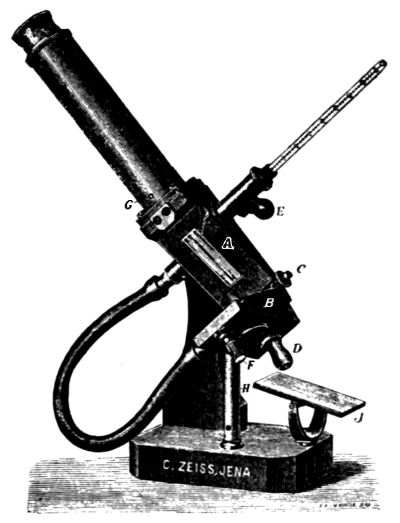
Fig. 94.—Butyrorefractometer.
301. Butyrorefractometer.—Another instrument graduated on an arbitrary scale is the butyrorefractometer of Zeiss. This apparatus, which resembles in some respects the instrument of Abbe, differs therefrom essentially in dispensing with the revolving prisms of Amici, whereby the chromatic fringing due to dispersion is corrected, and on having the scale fixed for one substance, in this instance, pure butter fat. The form of the instrument is shown in Fig. 94. The achromatization for the butter fat is secured in the prisms between which a film of the fat is placed, as in the Abbe instrument. When a fat, differing from that for which the instrument is graduated is introduced, the fringes of the dark and light portions of the field will not only be colored (difference in dispersion), but the line of separation will also be displaced (difference in refractive power). The apparatus is therefore used in the differential determination of these two properties. It must not be forgotten, however, that butter fats differ so much in these properties among themselves as to make possible the condemnation of a pure as an adulterated sample.
302. Method of Charging the Apparatus.—The prism casing of the instrument is opened by turning the pin F to the right and pushing the half B of the prism casing aside. The prism and its appendages must be cleaned with the greatest care, the best means for this purpose being soft clean linen moistened with a little alcohol or ether.
Melt the sample of butter in a spoon and pour it upon a small paper filter held between the fingers and apply the first two or three drops of clear butter fat so obtained to the surface of the prism contained in prism casing B. For this purpose the apparatus should be raised with the left hand so as to place the prism surface in a horizontal position.
Press B against A and replace F by turning it in the opposite direction into its original position; thereby B is prevented from falling back and both prism surfaces are kept in close contact.
303. Method of Observation.—While looking into the telescope, give the mirror J such a position as to render the critical line which separates the bright left part of the field from the dark right part distinctly visible. It may also be necessary to move or turn the instrument about a little. First it will be necessary to ascertain whether the space between the prism surfaces be uniformly filled with butter, for, if not, the critical line will not be distinct.
By allowing a current of water of constant temperature to flow through the apparatus, some time previous to the taking of the reading, the at first somewhat hazy critical line approaches in a short time, generally after a minute, a fixed position and quickly attains its greatest distinctness. When this point has been reached note the appearance of the critical line (i. e., whether colorless or colored and in the latter case of what color); also note the position of the critical line on the centesimal scale, which admits of the tenth divisions being conveniently estimated, and at the same time read the thermometer. By making an extended series of successive readings and by employing an assistant for melting and preparing the small samples of butter, from twenty-five to thirty refractometric butter tests may, after a little practice, be made in an hour.
The readings of the refractive indices of a large number of butter samples made at 25° are, by means of a table which will be found below, directly reduced to scale divisions and yield the following equivalents:[254]
Natural butter (1.4590-1.4620) : 49.5-54.0 scale divisions.
Margarin (1.4650-1.4700) : 58.6-66.4 ” ”
Mixtures (1.4620-1.4690) : 54.0-64.8 ” ”
Whenever, in the refractometric examination of butter at a temperature of 25°, higher values than 54.0 are found for the critical lines these samples will, according to Wollny, by chemical analysis, always be found to be adulterated; but in all samples in which the value for the position of the critical line does not fall below 52.5, chemical analysis maybe dispensed with and the samples may be pronounced to be pure butter.
In calculating the position of the critical line for other temperatures than 25° allow for 1° variation of temperature a mean value of 0.55 scale division. The following table, which has been compiled in this manner, shows the values corresponding to various temperatures, each value being the upper limit of scale divisions admissible in pure butter:
Temp. Sc. div. Temp. Sc. div. Temp. Sc. div. Temp. Sc. div.
45° 41.5 40° 44.2 35° 47.0 30° 49.8
44° 42.0 39° 44.8 34° 47.5 29° 50.3
43° 42.6 38° 45.3 33° 48.1 28° 50.8
42° 43.1 37° 45.9 32° 48.6 27° 51.4
41° 43.7 36° 46.4 31° 49.2 26° 51.9
40° 44.2 35° 47.0 30° 49.8 25° 52.5
If, therefore, at any temperature between 45° and 25° values be found for the critical line, which are less than the values corresponding to the same temperature according to the table, the sample of butter may safely be pronounced to be natural, i. e., unadulterated butter. If the reading show higher numbers for the critical line the sample should be reserved for chemical analysis. A special thermometer for use in the examination of butter will be described in the section devoted to dairy products.
304. Range of Application of the Butyrorefractometer.—The extended range of the ocular scale of the refractometer, n = 1.42 to 1.49, which embraces the refractive indices of the majority of oils and fats, renders the instrument applicable for testing oils and fats and also for examining glycerol.
By reference to the subjoined table the scale divisions may be transformed into terms of refractive indices. It gives the refractive indices for yellow light for every ten divisions of the scale. The differential column Δ gives the change of the refractive indices in terms of the fourth decimal per scale division. Owing to the accuracy with which the readings can be taken (0.1 scale division) the error of the value of n rarely exceeds one unit of the fourth decimal of n.
Table of Refractive Indices.
Scale div. nD. Δ. Scale div. nD. Δ.
0 1.4220 8.0 50 1.4593 6.6
10 1.4300 7.7 60 1.4650 6.4
20 1.4377 7.5 70 1.4723 6.0
30 1.4452 7.2 80 1.4783 5.7
40 1.4524 6.9 90 1.4840 5.5
50 1.4593 100 1.4895
The process of observation is precisely the same as that already described. In cases, however, where the critical line presents very broad fringes (turpentine, linseed oil, etc.) it is advisable to repeat the reading with the aid of a sodium flame.
305. Viscosity.—An important property of an oil, especially when its lubricating qualities are considered, is the measure of the friction which the particles exert on other bodies and among themselves, in other words, its viscosity. In the measure of this property no definite element can be considered, but the analyst must be content with comparing the given sample with the properties of some other liquid regarded as a standard. The usual method of procedure consists in determining the time required for equal volumes of the two liquids to pass through an orifice of given dimensions, under identical conditions of temperature and pressure. In many instances the viscosity of oils is determined by comparing them with water or rape oil, while, in other cases, a solution of sugar is employed as the standard of measurement.
In case rape oil be taken as a standard and its viscosity represented by 100 the number representing the viscosity of any other oil may be found by multiplying the number of seconds required for the outflow of fifty cubic centimeters by 100 and dividing by 535. If the specific gravity vary from that of rape oil, viz., 0.915, at 15°, a correction must be made by multiplying the result obtained above by the specific gravity of the sample and dividing the product by 0.915. If n be the observed time of outflow in seconds and s the specific gravity the viscosity is expressed as follows:[255]
V = n × 100 × s = n × 100 × s
535 × 0.195 489.525
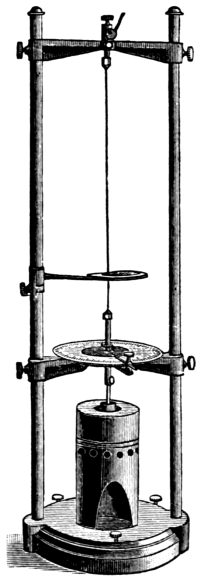
Fig. 95.— Doolittle’s Viscosimeter.
It is important that the height of the oil in the cylinders from which it is delivered be kept constant, and this is secured by supplying additional quantities, on the principle of the mariotte bottle.
306. The Torsion Viscosimeter.—In this laboratory the torsion viscosimeter, based on the principle described by Babcock is used. The instrument employed is the one described by Doolittle.[256] The construction of the apparatus is illustrated in Fig. 95.
A steel wire is suspended from a firm support and fastened to a stem which passes through a graduated horizontal disk, thus permitting the accurate measurement of the torsion of the wire. The disk is adjusted so that the index point reads exactly 0, thus showing that there is no torsion in the wire. A brass cylinder seven centimeters long by five in diameter, having a slender stem by which to suspend it, is immersed in the oil and fastened by a thumbscrew to the lower part of the stem of the disk. The oil cup is surrounded by a bath of water or high fire-test oil, according to the temperature at which it is desired to determine the viscosity. This temperature obtained, while the disk is resting on its supports, the wire is twisted 360° by rotating the milled head at the top. The disk being released, the cylinder rotates in the oil by virtue of the torsion of the wire.
The action now observed is identical with that of the simple pendulum.
If there were no resistance to be overcome, the disk would return to 0, and the momentum thus acquired would carry it 360° in the opposite direction. But the resistance of the oil to the rotation of the cylinder causes the revolution to fall short of 360°, and the greater the viscosity of the oil the greater will be the resistance, and also the retardation. This retardation is found to be a very delicate measure of the viscosity of the oil.
This retardation may be read in a number of ways, but the simplest is to read directly the number of degrees of retardation between the first and second complete arcs covered by the rotating pendulum. For example, suppose the wire be twisted 360° and the disk released so that rotation begins. In order to obtain an absolute reading to start from, which shall be independent of any slight error in adjustment, ignore the starting point and make the first reading of the index at the end of the first swing. The disk is allowed to complete a vibration and the needle is read again at its nearest approach to the first point read. The difference in the two readings will measure the retardation due to the viscosity of the liquid. In order to eliminate errors duplicate determinations are made, the milled head being rotated in an opposite direction in the second one. The mean of the two readings will represent the true retardation. Each instrument is standardized in a solution of pure cane sugar, as proposed by Babcock, and the viscosity, in each case, is a number representing the number of grams of sugar in 100 cubic centimeters, which, at 22°, would produce the retardation noted.
Each instrument is accompanied by a table which contains the necessary corrections for it and the number expressing the viscosity, corresponding to the different degrees of retardation, as read on the index. The following numbers, representing the viscosity of some oils as determined by the method of Doolittle, were obtained by Krug.[257]
Peanut oil 48.50
Olive ” 53.00
Cottonseed ” 46.25
Linseed ” 33.50
307. Microscopic Appearance.—When fats are allowed to slowly crystallize from an ethereal solution they may afford crystalline forms, which, when examined with a magnifying glass, yield valuable indications of the nature and origin of the substance under examination.[258]
The method of securing fat crystals for microscopic examination, which has been used in this laboratory, is as follows: From two to five grams of the fat are placed in a test tube and dissolved in from ten to twenty cubic centimeters of ether. The tube is loosely stoppered with cotton and allowed to stand, for fifteen hours or longer, in a moderately warm room where no sudden changes of temperature are likely to take place. It is advisable to prepare several solutions of the same substance with varying properties of solvent, for it is not possible to secure in a given instance those conditions which produce the most characteristic crystals. The rate and time of the crystallization should be such that the microscopic examination can take place when only a small portion of the fat has separated in a crystalline condition. A drop of the mass containing the crystals is removed by means of a pipette, placed on a slide, a drop of cotton or olive oil added, a cover glass gently pressed down on the mixture and the preparation subjected to microscopic examination. Several slides should be prepared from the same or different crystallizations. Sometimes the results of an examination made in this way are very definite, but the analyst must be warned not to expect definite data in all cases. Often the microscopic investigations result in the production of negative or misleading observations, and, at best, this method of procedure must be regarded only as helpful and confirmatory.
A modification of the method of preparation described above has been suggested by Gladding.[259] About five grams of the melted fat are placed in a small erlenmeyer, dissolved in a mixture of ten cubic centimeters of absolute alcohol mixed with half that quantity of ether. The flask is stoppered with a plug of cotton and allowed to stand in a cool place for about half an hour. By this treatment the more easily crystallizable portions of the fat separate in a crystalline form, while the triolein and its nearly related glycerids remain in solution. The crystalline product is separated by filtration through paper wet with alcohol and washed once with the solvent mentioned above. After drying in the air for some time the crystals are removed from the paper and dissolved in twenty-five cubic centimeters of ether, the cotton plug inserted, and the erlenmeyer placed, in a standing position, in a large beaker containing water. The water jacket prevents any sudden changes of temperature and affords an opportunity for the uniform evaporation of the ether which should continue for fifteen hours or longer in a cool place.
Other solvents, viz., alcohol, chloroform, carbon disulfid, carbon tetrachlorid, petroleum and petroleum ether have been extensively used in the preparation of fat crystals for microscopic examination, but in our experience none of these is equal to ether when used as already described.
308. Microscopic Appearance of Crystals of Fats.—For an extended study and illustration of the characteristics of fat crystals the bulletin of the Division of Chemistry, already cited, may be consulted. In the case of lard, there is a tendency, more or less pronounced, to form prismatic crystals with rhombic ends. Beef fat on the other hand shows a tendency to form fan-shaped crystals in which the radii are often curved.
Typical crystals of swine and beef fat are shown in the accompanying figures, 96 and 97.[260] In mixtures of swine and beef fats the typical crystals are not always developed, but in most cases the fan-shaped crystals of the beef fat will appear more or less modified when that fat forms twenty per cent or more of the mixture. When only five or ten per cent of the beef fat on the one hand or a like amount of swine fat on the other are present the expectation of developing any characteristic crystals of the minimum constituent is not likely to be realized.
The typical crystals of lard are thought by some experts to be palmitin and those of beef fat stearin, but no direct evidence has been adduced in support of these a priori theories.
In the experience of this laboratory, as described by Crampton,[261] the differences between the typical crystallization of beef and swine fats are plainly shown. In mixed fats, on the contrary, confusing observations are often made. In a mixture of ten per cent of beef and ninety per cent of swine fats a uniform kind of crystallization is observed, not distinctly typical, but the characteristics of the lard crystals predominate. In many cases a positive identification of the crystals is only made possible by repeated crystallizations. In the examination of so-called refined lards, which are mixtures of lard and beef fat, the form of aggregation of the crystals is found to resemble the fan-shaped typical forms of beef fat. When the single crystals, however, are examined with a higher magnifying power, they are not found to be pointed but blunt, and some present the appearance of plates with oblique terminations, but not so characteristic as those obtained from pure lard. In other cases in compound lards no beef fat crystals are observed and these lards may have been made partly of cotton oil stearin. When a lard crystal presents its edge to observation it may readily escape identification, or may even be mistaken for a crystal of beef fat. In order to insure a side view the cover glass should be pressed down with a slight rotatory movement, whereby some of the lard crystals at least may be made to present a side view.
309. Observation of Fat Crystals with Polarized Light.—The appearance of fat crystals, when observed by means of polarized light alone or with the adjunct of a selenite plate, is often of value in distinguishing the nature and origin of the sample.[262]
Every fat and oil which is amorphous will present the same set of phenomena when observed with polarized light through a selenite plate, but when a fat has been melted and allowed to cool slowly the field of vision will appear mottled and particolored when thus examined. This method has been largely used in the technical examination of butter for adulterants, and the microscope is extensively employed by the chemists of the Bureau of Internal Revenue for this purpose. In the examination of the crystals of butter fat by polarized light a cross is usually observed when the nicols are turned at the proper angle, but the cross, while almost uniformly seen with butter, is not distinctive, since other fats often show it. These forms of crystals are best obtained by heating the butter fat to the boiling-point of water for about a minute and then allowing it to slowly solidify, and stand for twenty-four hours.
Pure butter, properly made, is never subjected to fusion, and hence, when examined through a selenite plate, presents a uniform field of vision similarly illuminated and tinted throughout. In oleomargarin, the fats are sometimes, during their preparation, in a fused condition. The field of vision is therefore filled to a greater or less extent with crystals more or less perfect in form. Some of these crystals, being doubly refracting, will impart to a selenite field a mottled appearance. Such a phenomenon is therefore indicative of a fraudulent butter or of one which has been at some time subjected to a temperature at or above its fusing point.
310. Spectroscopic Examination of Oils.—The presence of chlorophyll or of its alteration products is a characteristic of crude oils of vegetable origin. In refined oils, even when of a vegetable origin, all traces of the chlorophyll products may disappear. The absorption bands given by oils are not all alike and in doubtful cases a suspected sample should be compared with one of known origin.
In conducting the examination, the oil in a glass vessel with parallel sides, is placed in front of the slit of the spectroscope and any absorption band is located by means of the common divided scale and by the color of the spectrum on which it falls. Olive and linseed oils give three sharply defined absorption bands, a very dark one in the red, a faint one on the orange and a well marked one in the green.
Sesame, arachis, poppyseed and cottonseed oils also show absorption bands. Castor and almond oils do not affect the spectrum.
Fig. 96.
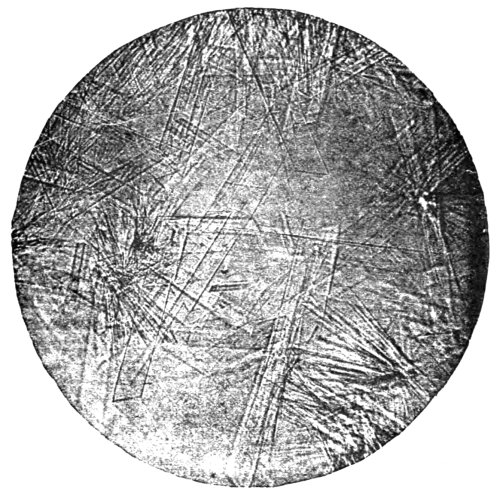
Lard Crystals × 65.
Fig. 97.
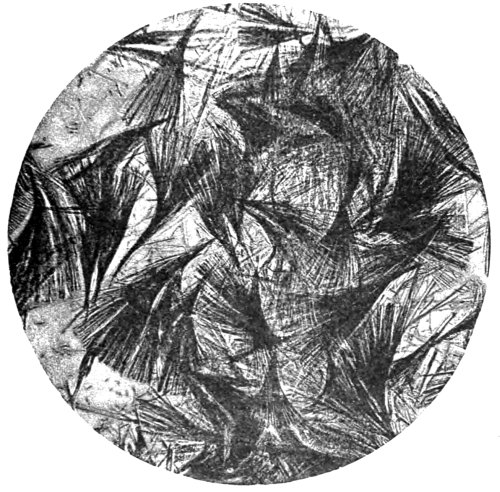
Refined Lard (beef fat) Crystals × 65.
A. Hoen & Co., Lithocaustic.
Rape and flaxseed oils absorb a part of the spectrum but do not affect the rest of it. The spectroscope is of little practical utility in oil analysis.[263]
311. Critical Temperature of Solution.—The study of the critical temperature of solution of oils has been made by Crismer, who finds it of value in analytical work.[264] If a fatty substance be heated under pressure, with a solvent, e. g., alcohol, it will be noticed that as the temperature rises the meniscus of separation of the two liquids tends to become a horizontal plane. If at this point the contents of the tube be thoroughly mixed by shaking and then be left at rest, a point will soon be reached at which the two liquids again separate, and this point is distinctly a function of temperature. Following is a description of a convenient method of determining the critical temperature of the solution of fats and oils for experimental purposes. Tubes are prepared for holding the reagents in such a way that, after the introduction of the fat and alcohol, they can be easily sealed. The capacity of these tubes should be about five cubic centimeters. They should be charged with about one cubic centimeter of the dry filtered fat and about twice that quantity of ninety-five per cent alcohol. Care should be exercised to avoid touching the upper sides of the tube with the reagents. When charged the tubes are sealed in the flame of a lamp and attached to the bulb of a delicate thermometer in such a manner as to have the surface of its liquid contents even with the top of the bulb. The tube is conveniently fastened to the thermometer by a platinum wire. For duplicate determinations two tubes may be fastened to the same thermometric bulb. The apparatus thus prepared is placed in a large vessel filled with strong sulfuric acid. The operator should be careful to protect himself from the danger which might arise from an explosion of the sealed tubes during heating. It is advisable in all cases to observe the reaction through a large pane of clear glass. The bath of sulfuric acid is heated by any convenient means and an even temperature throughout the mass is secured by stirring with the thermometer and its attachments. When the meniscus which separates the two liquids becomes a horizontal plane the thermometer is removed and the liquid in the tubes well mixed until it appear homogeneous. The thermometer is replaced in the bath, which is allowed to cool slowly, and the phenomena which take place in the sealed tubes are carefully noted. The critical temperature of solution is that at which the two liquids begin to separate. This moment is easily noted. It is, moreover, preceded by a similar phenomenon taking place in the capillary part of the tube which retains a drop of the mixture on shaking. In this droplet an opalescence is first noted. In the mass of the liquid this opalescence, a few seconds afterwards, is observed to permeate the whole, followed by the formation of zones and finally of the reappearance of the meniscus of separation between the two liquids. The temperature at this moment of opalescence preceding the separation of the liquid is the critical temperature of solution. With alcohol of 0.8195 specific gravity, at 15°.5 (ninety-five per cent), the observed critical temperatures for some of the more common fats and oils are as given below:
Butter fat 100°.0
Oleomargarin 125°.0
Peanut oil 123°.0
Cotton ” 116°.0
Olive ” 123°.0
Sesamé ” 121°.0
Colza ” 132°.5
Mutton tallow 116°.0
Beef marrow 125°.0
Nut oil 100°.5
When the alcohol is not pure or if it be of a different density from that named, the numbers expressing the critical temperature of solution will vary from those given above.
312. Polarization.—The pure glycerids are generally neutral to polarized light. In oils the degree of polarization obtained is often variable, sometimes to the right and sometimes to the left. Olive oil, as a rule, shows a slight right hand polarization. Peanut, sesamé, and cottonseed oils vary in polarizing power, but in no case is it very marked. Castor oil polarizes slightly to the right.
In determining the polarizing power of an oil it should be obtained in a perfectly limpid state by filtration and observed through a tube of convenient length, as a rule, 200 millimeters. The deviation obtained may be expressed in divisions of the sugar scale of the instrument or in degrees of angular rotation.
313. Turbidity Temperature.—The turbidity temperature of a fat, when dissolved in glacial acetic acid, as suggested by Valenta, may prove of some diagnostic value.[265] The fats are dissolved, with the aid of heat, in glacial acetic acid and, on slowly cooling, the temperature at which they become turbid is observed. The following data observed by Jones are given for comparison.[266]
The numbers represent the turbidity temperature of the fat when treated with the glacial acetic acid, and allowed to cool slowly. Butter fat, from 40° to 70°, mostly from 52° to 65°; oleomargarin, 95° to 106°; rape oil, 101°; sesamé oil, 77°; linseed oil, 53° to 57°; lard oil, 96°; olive oil, 89°; peanut oil, 61° to 88°.
It is important in this test that the acetic acid be absolutely glacial. About three cubic centimeters of the glacial acetic acid, and three of the fat, should be used.
CHEMICAL PROPERTIES.
314. Solubility in Alcohol.—As has already been noted, the glycerids are freely soluble in ether, chloroform, carbon bisulfid, acetone, carbon tetrachlorid, and some other less commonly used solvents. Their solubility in absolute alcohol is variable and the determination of its degree may often be useful in analytical work.
The method used by Milliau for determining the degree of solubility is as follows:[267] The fatty matter is deprived of its free acids by shaking for half an hour with twice its volume of ninety-five per cent alcohol. After standing until the liquids are separated, the oil or fat is drawn off and washed three times with distilled water. The sample is deprived of water by filtering through a hot jacket filter and a given weight of the dry sample is well shaken with twice its weight of absolute alcohol. A weighed portion of the alcoholic solution obtained is evaporated to remove the alcohol and the weight of the residual fat determined. From the data obtained the percentage of solubility is calculated. Olive oils, when treated as described above, show a solubility of about forty-three parts per thousand of absolute alcohol, cotton oil sixty-two parts, sesamé forty-one parts, peanut sixty-six parts, colza twenty parts, and flaxseed seventy parts per thousand.
315. Coloration Produced by Oxidants.—When oils and fats are mixed with oxidizing reagents, such as sulfuric and nitric acids, the glycerids are partly decomposed with the production of colors which have some analytical significance. The most simple method of applying these tests is by the use of a thick porcelain plate provided with small cup-shaped depressions for holding the few drops of material required. Two or three drops of the oil under examination are placed in each of the cups, a like quantity of the oxidizing reagent added, and the mixture stirred with a small glass rod. The colors produced are carefully noted and the mixture is allowed to remain at room temperature for at least twelve hours in order that the final tint may be observed. The sulfuric acid used for this reaction should have a specific gravity of one and seven-tenths and the nitric acid should have the usual commercial strength of the strongest acid. Pure lard, when treated with sulfuric acid, as above described, shows but little change of color while the vegetable oils mostly turn brown or black. In addition to the reagents mentioned many others, including sulfuric and nitric acids, sulfuric acid and potassium bichromate, chlorin, ammonia, hydrogen peroxid, sodium hydroxid and aqua regia are used. Only a few of these tests seem to have sufficient analytical importance to merit any detailed description.[268]
316. Coloration in Large Masses.—Instead of applying the color test in the small way just described, larger quantities of the fat may be used, either in the natural state or after solution in petroleum or other solvent. For this purpose about ten cubic centimeters of the oil are shaken with a few drops of sulfuric acid or sulfuric and nitric acids. Lard, when thus treated (five drops of sulfuric acid to ten cubic centimeters of lard) shows practically no coloration. When treated with an equal volume of sulfuric acid and shaken, the lard on separating has a brown-red tint.[269]
Olive oil, with a few drops of sulfuric acid, gives a green color, while cottonseed, peanut and other vegetable oils, when thus treated with sulfuric and nitric acids, show brown to black coloration. The delicacy of the reaction may be increased by first dissolving the fat or oil in petroleum ether.
In the use of the coloration test with solvents, a convenient method is to dissolve about one cubic centimeter of the fat in a test tube in petroleum ether, add one drop of strong sulfuric acid and shake.
In the case of lard, the color does not change or becomes yellow or red. Cottonseed oil, similarly treated, shows a brown or black color.[270]
317. Special Nitric Acid Test.—A special nitric acid test for cottonseed oil is made with nitric acid of exactly 1.375 specific gravity at 15°. This test is especially valuable in detecting cottonseed in olive oil. The operation is conveniently conducted by shaking together equal volumes of the oil and acid in a test tube until an intimate mixture or emulsion is secured. When any considerable quantity of cottonseed oil is present an immediate brown coloration is produced, from the intensity of which the relative proportion of cottonseed oil in the case of a mixture may be roughly approximated. When only a little cottonseed oil is present in the mixture, the test tube containing the reagents should be set aside for several hours before the final observation is made.
318. Coloration with Phosphomolybdic Acid.—Among the color tests, one which we have found of use is the coloration produced in certain oils, mostly of a vegetable origin, by phosphomolybdic acid.[271]
The method of applying the test is extremely simple. A few cubic centimeters of the oil or melted lard are dissolved in an equal volume of chloroform, and a third volume of ten per cent phosphomolybdic acid added. The mouth of the test tube is closed with the thumb, and the whole is violently shaken. On being left in repose, the phosphomolybdic acid gathers at the top, and the coloration produced therein is easily observed. Cottonseed oil and peanut oil both give a beautiful green when treated in this way, which is turned to a blue on the addition of ammonia. Linseed oil gives a green color, but forms a kind of emulsion which obscures the color to some extent. The pure lards rendered in the laboratory give no coloration whatever to the reagent, but it retains its beautiful amber color in every case. Mixtures containing as little as ten per cent cottonseed oil and ninety per cent lard, show a distinct greenish tint, while twenty per cent cottonseed oil gives a distinct green. This reaction, therefore, may be considered of great value, and on account of its easy application it should come into wide use. But it is probable that different samples of cottonseed oil, refined to different degrees or in different ways, vary in their deportment with phosphomolybdic acid as they do with silver nitrate. In other words, there may be some samples of cottonseed oil which will not give the green color when treated as above, or so faintly as to have no diagnostic value in mixtures.
This reaction shows itself with nearly all vegetable oils but those which have been chemically treated either for the purpose of bleaching, or for the removal of the acidity, do not respond to the test at all, or else in a feeble manner, and that only after standing some time. Lard, goose fat, tallow, deer fat, butter fat, etc., show no change in color on being treated with this reagent, either with or without the addition of alkali. The presence of a small quantity of vegetable oil betrays itself by the appearance of the above mentioned coloration, the intensity of which forms an approximate measure of the amount of vegetable oil present in the sample. In experiments with suspected lards, which deviated in their iodin absorption numbers from those of genuine lard, the results were concordant, the color deepening as the iodin figure rose. The mineral fats (paraffin, vaselin) are without action on this reagent, and the only animal fat which reduces it is codliver oil.
In like manner some samples of lard may be found which exhibit a deportment with this reagent similar to that shown with vegetable oils, and tallow and lard oil have been shown to give more distinct reactions than some of the vegetable oils.[272]
The phosphomolybdic acid may be prepared by precipitating a solution of ammonium molybdate with sodium phosphate and dissolving the washed precipitate in a warm solution of sodium carbonate. The solution is evaporated to dryness and the dry residue subjected to heat. If a blue coloration be produced it may be discharged by adding a little nitric acid and reheating. The residue is dissolved in water, acidified with nitric and made of such a strength as to contain about ten per cent of the substance.
319. Coloration with Picric Acid.—If to ten cubic centimeters of oil a cold saturated solution of picric acid in ether be added and the latter be allowed to evaporate slowly, the acid remains dissolved in the oil, to which it communicates a brown color.
Pure lard, after the evaporation of the ether, appears of a citron-yellow color; if cottonseed oil be present, however, the mixture assumes a brown-red color.[273]
320. Coloration with Silver Nitrate.—A modification of Bechi’s method of reducing silver nitrate, given further on, has been proposed by Brullé.[274] The reagent employed consists of twenty-five parts of silver nitrate in 1,000 parts of alcohol of ninety-five per cent strength. Twelve cubic centimeters of the oil to be examined and five of the reagent are placed in a test tube, held in a vessel containing boiling water, and the ebullition continued for about twenty minutes. At the end of this time an olive oil, even if it be an impure one, will show a beautiful green tint. With seed oils the results are quite different. Cotton oil submitted to this treatment becomes completely black. Peanut oil shows at first a brown-red coloration and finally a somewhat green tint, losing its transparency. Sesamé oil is distinguished by a red-brown tint very pronounced and remaining red. Colza oil takes on a yellowish green coloration, becomes turbid and is easily distinguished in its reaction from olive oil. In mixtures of olive oil with the other oils, any notable proportion of the seed oils can be easily determined by the above reactions. Natural butter treated with this reagent retains its primitive color. That containing margarin becomes a brick-red and as little as five per cent of margarin in butter can be detected by this test. With ten per cent the tint is very pronounced.
321. Coloration with Stannic Bromid.—This reagent is prepared by adding dry bromin, drop by drop, to powdered or granulated tin held in a flask immersed in ice water, until a persistent red color indicates that the bromin is in excess. In the application of this reagent three or four drops of it are added successively to a little less than that quantity of the oil, the mixture well stirred and set aside for a few minutes. The unsaponifiable matters of castor oil give a green color when thus treated, sandal wood oil a blood-red color and cedar oil a purplish color.[275]
322. Coloration with Auric Chlorid.—The use of auric chlorid for producing colorations in oils and fats was first proposed by Hirschsohn.[276] One gram of auric chlorid is dissolved in 200 cubic centimeters of chloroform and about six drops of this reagent added to five cubic centimeters of the oil to be tested. In the case of cottonseed oil a beautiful red color is produced.
I have found that even pure lards give a trace of color sometimes with this reagent, and therefore the production of a slight red tint cannot in all cases be regarded as conclusive of the presence of cottonseed oil.[277]
In general, it may be said that the color reactions with fats and oils have a certain qualitive and sorting value, and in any doubtful case they should not be omitted. Their value can only be established by comparison under identical conditions with a large number of fats and oils of known purity. The analyst must not depend too confidingly on the data found in books, but must patiently work out these reactions for himself.
323. Thermal Reactions.—The measurement of the heat produced by mixing glycerids with reagents which decompose them or excite other speedy chemical reactions, gives valuable analytical data. These measurements may be made in any convenient form of calorimeter. The containing vessel for the reagents should be made of platinum or some other good conducting metal not affected by them.
The heat produced is measured in the usual way by the increment in temperature noted in the mass of water surrounding the containing vessel. The determination of the heat produced in chemical reactions is a tedious and delicate operation requiring special forms of apparatus for different substances. The time element in these operations is a matter of importance, since it is necessary to work in rooms subject to slight changes of temperature and to leave the apparatus for some time at rest, in order to bring it and its contents to a uniform temperature. For these reasons the more elaborate methods of calorimetric examination are not well suited to ordinary analytical work, and the reader is referred to standard works on thermal chemistry for the details of such operations.[278] For our purpose here a description of two simple thermal processes, easily and quickly conducted, will be sufficient, while a description of the method of determining the heat of combustion of foods will be given in another place.
324. Heat of Sulfuric Saponification.—Maumené was the first to utilize the production of heat caused by mixing sulfuric acid with a fat as an analytical process.[279] In conducting the process a sulfuric acid of constant strength should be employed inasmuch as the rise of temperature produced by a strong acid is much greater than when a weaker acid is employed. The process is at best only comparative and it is evident that the total rise of temperature in any given case depends on the strength of the acid, the character, and purity of the fat or oil, the nature of the apparatus and its degree of insulation, the method of mixing and the initial temperature. For this reason the data given by different analysts vary greatly.[280] For some of the methods of conducting the operation the reader may consult the work of Allen, cited above, or other authorities.[281]
In this laboratory the process is conducted as follows:[282] The initial temperature of the reagents should be a constant one. For oils 20° is a convenient starting point and for fats about 35°, at which temperature most of them are soft enough to be easily mixed with the reagent. The acid employed should be the pure monohydrated form, specific gravity at 20°, 1.845.
The apparatus used is shown in Fig. 98.
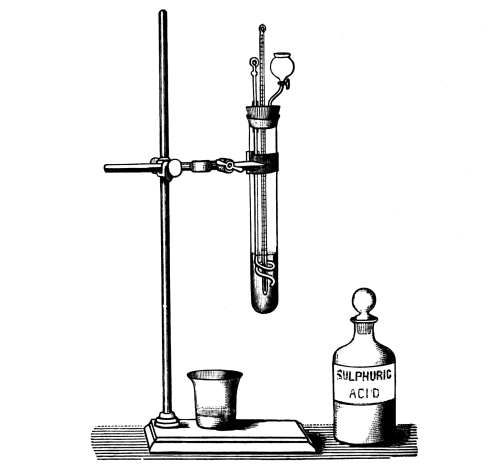
Fig. 98.—Apparatus for Determining Rise of Temperature with Sulfuric Acid.
The test tube which holds the reagents is twenty-four centimeters in length and five in diameter. It is provided with a stopper having three perforations, one for a delicate thermometer, one for a bulb funnel for delivering the sulfuric acid, and one to guide a stirring rod bent into a spiral as shown. The thermometer is read with a magnifying glass. Fifty cubic centimeters of the fat are placed in the test tube and ten of sulfuric acid in the funnel and the apparatus is exposed at the temperature desired until all parts of it, together with the reagents, have reached the same degree. The test tube holding the oil should be placed in a vacuum-jacket tube, such as will be described in paragraph 316. The oil is allowed to run in as rapidly as possible from the funnel and the stirring rod is moved up and down two or three times until the oil and acid are well mixed. Care must be exercised to stir no more than is necessary for good mixing. The mercury is observed as it ascends in the tube of the thermometer and its maximum height is noted. With the glass it is easy to read to tenths, when the thermometer is graduated in fifths of a degree. When oils are tested which produce a rise of temperature approaching 100°, in the above circumstances, (cottonseed, linseed and some others) either smaller quantities should be used or the oil diluted with some inert substance or dissolved in some inert solvent of high boiling point. For a study of the variations produced in the rise of temperature when varying proportions of oil and acid are used, the work of Munroe may be consulted.[283]
The thermélaeometer described by Jean is a somewhat complicated piece of apparatus and does not possess any advantage over the simple form described above.[284]
Instead of expressing the data obtained in thermal degrees showing the rise of temperature, Thompson and Ballentyne refer them to the heat produced in mixing sulfuric acid and water.[285]
The observed thermal degree of the oil and acid divided by that of the water and acid is termed the specific temperature reaction. For convenience in writing, this quotient is multiplied by 100. The respective quantities of acid and water are ten and fifty cubic centimeters. This method of calculation has the advantage of eliminating to a certain degree the variations which arise in the use of sulfuric acid of differing specific gravities. In the following table are given the comparative data obtained for some common oils.[286]
Acid of 95.4 per cent. Acid of 96.8 per cent. Acid of 99 per cent.
Kind of oil. Rise of temp. with the oil. Specific temp. reaction. Rise of temp. with the oil. Specific temp. reaction. Rise of temp. with the oil. Specific temp. reaction.
0° 0° 0° 0° 0° 0°
Olive oil 36.5 95 39.4 85 44.8 96
Rapeseed oil 49.0 127 37.0 89 58.0 124
Castor oil 34.0 88
Linseed oil 104.5 270 125.2 269
325. Method of Richmond.—The rise of temperature produced by mixing an oil and sulfuric acid is determined by Richmond in a simple calorimeter, which is constructed by fitting a small deep beaker inside a larger one with a packing of cotton. The heat capacity of the system is determined by adding to ten grams of water, in the inner beaker, at room temperature, twenty-five grams of water of a noted higher temperature and observing the temperature of the mixture. The cooling of the system, during the time required for one determination of heat of sulfuric saponification, does not exceed one per cent of the whole number of calories produced.[287] Between the limits of ninety-two per cent and one hundred per cent the rise of temperature observed is directly proportional to the strength of the acid.