PART SEVENTH. MISCELLANEOUS AGRICULTURAL PRODUCTS. (continued 2)
Reading edition
590. Precipitation with Metallic Salts.—The methods depending on precipitation of the tannins with metallic salts are but little used and only one of them will be mentioned here. A full description of the others is contained in Trimble’s book.[608] A method for the determination of caffetannic acid in coffee has been worked out by Krug and used with some satisfaction.[609]
In this method two grams of the coffee meal are digested for thirty-six hours with ten cubic centimeters of water, a little more than twice that volume of ninety-five per cent alcohol added and the digestion continued for a day. The contents of the flask are poured on a filter and the residue washed with alcohol. The filtrate contains tannin, caffetannic acid and traces of coloring matter and fat. It is heated to the boiling point and clarified with a solution of lead acetate. A caffetannate of lead containing forty-nine per cent of the metal is precipitated. As soon as the precipitate has become flocculent it is collected on a filter, washed with ninety per cent alcohol until the soluble lead salts are all removed, then with ether and dried. The composition of the precipitate is represented by the formula Pb₃(C₁₅H₁₅O₈)₂. The caffetannic acid is calculated by the equation: Weight of precipitate: weight of caffetannic acid = 1267: 652.
591. The Gelatin Method.—The precipitation of tannin with gelatin is the basis of a process for its quantitive estimation which, according to Trimble, is conducted as follows:[610] Two and a half grams of gelatin and ten grams of alum are dissolved in water and the volume of the solution made up to one liter. The solution of gelatin and also that of the tannin are heated to 70° and the tannin is precipitated by adding the gelatin reagent slowly, with constant stirring, until the precipitate coagulates, and, on settling, leaves a clear liquor in which no further precipitate is produced on adding a few drops more of the reagent. In case the clearing of the mixture do not take place readily, the process should be repeated with a more dilute tannin solution. The precipitate is collected on two counterpoised filter papers one placed inside the other, dried at 110° and weighed, the empty filter paper being placed on the pan with the weights. For pure tannin (gallotannic acid) fifty-four per cent of the weight of the precipitate are tannin. Ammonium chlorid and common salt have been used in place of the alum in preparing the reagent, but if the proportion of alum mentioned above be used, satisfactory results will be obtained in most cases.
592. The Hide Powder Method.—The principle of this method is based on the change in specific gravity, i. e., total solids, which a tannin solution will undergo when brought into contact with raw hides in a state of fine subdivision. The hide powder absorbs the tannin, and the total solid content of the solution is correspondingly diminished. The method is conducted according to the official directions as follows:[611]
Preparation of the Sample.—The bark, wood, leaves or other materials holding the tannins, are dried and ground to a fine powder and thoroughly extracted with water as mentioned below. In each case the solution or extraction is made as thorough as possible and the volume of the extract is made up to a definite amount.
Quantity of Tanning Material.—Use such an amount of the tanning material as shall give in 100 cubic centimeters of the filtered solution about one gram of dry solids. In the case of barks, woods, leaves and similar materials, transfer to a half liter flask, fill the flask with water at approximately 80° and let stand over night in a bath which is kept at 80°, cool, fill to the mark, shake well and filter. In the case of extracts and sweet liquors, wash the proper quantity into a half liter flask with water at approximately 80°, almost filling the flask, cool and fill to the mark.
Determination of Moisture.—Dry five grams of the sample in a flat bottom dish at the temperature of boiling water until the weight becomes constant.
Determination of Total Solids.—Shake the solution, which should be at a temperature of about 20°, and immediately remove 100 cubic centimeters with a pipette, evaporate in a weighed dish and dry to constant weight at the temperature of boiling water.
Determination of Soluble Solids.—Filter a portion of the solution through a folded filter, returning the filtrate to the filter twice and adding a teaspoonful of kaolin, if necessary. Evaporate 100 cubic centimeters of the filtrate and dry as above.
Determination of Tanning Substances.—Extract twenty grams of hide powder by shaking for five minutes with 250 cubic centimeters of water, filter through well washed muslin or linen, repeat the operation three times and dry as much as possible in a suitable press. Weigh the wet powder and determine the residual moisture in about one-fourth of the whole by drying to constant weight at 100°. Shake 200 cubic centimeters of the unfiltered solution of the tannin with the rest of the moist hide powder for about five minutes, add five grams of barium sulfate, shake for one minute and filter through a schleicher and schüll folded filter, No. 590, fifteen centimeters in diameter, returning the first twenty-five cubic centimeters of the filtrate. Evaporate 100 cubic centimeters of the clear filtrate and dry the residue to constant weight at a temperature of boiling water. The difference between the soluble solids obtained in the filtered tannin solution and the residue as obtained above is the amount of tanning material absorbed by the hide powder. This weight must be corrected for the water retained by the hide powder. The shaking must be conducted by means of a mechanical shaker, in order to remove all the tannin substance from the solution. The simple machine used by druggists, and known as the milkshake, is recommended.
Testing the Hide Powder.—Shake ten grams of the hide powder with 200 cubic centimeters of water for five minutes, filter through muslin or linen, squeeze out thoroughly by hand, replace the residue in the flask and repeat the operation twice with the same quantity of water. Pass the last filtrate through paper until a perfectly clear liquid is obtained. Evaporate 100 cubic centimeters of the final filtrate in a weighed dish, dry at 100° until the weight is constant. If the residue amount to more than ten milligrams the sample should be rejected. The hide powder must be kept in a dry place and tested once a month.
Prepare a solution of pure gallotannic acid by dissolving five grams in one liter of water. Determine the total solids by evaporating 100 cubic centimeters of this solution and drying to constant weight. Treat 200 cubic centimeters of the solution with hide powder exactly as described above. The hide powder must absorb at least ninety-five per cent of the total solids present. The gallotannic acid used must be completely soluble in water, alcohol, acetone and acetic ether and should contain not more than one per cent of substances not removed by digesting with excess of yellow mercuric oxid on the steam bath for two hours.
Testing the Non-Tannin Filtrate. For Tannin:—Test a small portion of the clear non-tannin filtrate with a few drops of a ten per cent solution of gelatin. A cloudiness indicates the presence of tannin, in which case the determination must be repeated, using twenty-five grams of hide powder instead of twenty grams.
For Soluble Hide:—To a small portion of the clear non-tannin filtrate, add a few drops of the original solution, previously filtered to remove reds. A cloudiness indicates the presence of soluble hide due to incomplete washing of the hide powder. In this case, repeat the determination with perfectly washed hide powder.
593. The Permanganate Gelatin Method.—This process, which is essentially the method of Löwenthal, as improved by Councler, Schroeder and Proctor and as used by Spencer for the determination of tannin in teas, is conducted as described below.[612] The principle of the process is based on the oxidation of all bodies in solution oxidizable by potassium permanganate, the subsequent precipitation of the tannin by a gelatin solution, and the final oxidation, by means of permanganate, of the remaining organic bodies. The difference between the total oxidizable matter and that left after the precipitation of the tannin represents the tannin originally in solution.
Reagents Required.—The following reagents are necessary to the proper conduct of the potassium permanganate process:
(1). Potassium permanganate solution containing about one and a third grams of the salt in a liter:
The potassium permanganate solution is set by titration against the decinormal oxalic acid solution mentioned below. The end reaction with the indicator must be of the same tint in all the titrations, i. e., either golden yellow or pink.
(2). Tenth-normal oxalic acid solution for determining the exact titer of the permanganate solution:
(3). Indigo-carmin solution to be used as an indicator and containing six grams of indigo-carmin and fifty cubic centimeters of sulfuric acid in a liter. The indigo-carmin must be very pure and quite free of indigo-blue.
(4). Gelatin solution, prepared by digesting twenty-five grams of gelatin at room temperature for one hour in a saturated solution of sodium chlorid, then heating until solution is complete, cooling and making the volume up to one liter:
(5). A salt acid solution, made by adding to 975 cubic centimeters of a saturated solution of sodium chlorid, enough strong sulfuric acid to bring the volume of the mixture to one liter:
(6). Powdered kaolin for promoting filtration.
The Process.—Five grams of the finely powdered tea (or other vegetable substance containing tannin) are boiled with distilled water in a flask of half a liter capacity for half an hour. The distilled water should be at room temperature when poured over the powdered tea. After cooling, the volume of the decoction is completed to half a liter, and the contents of the flask poured on a filter. To ten cubic centimeters of the filtered tea infusion are added two and a half times as much of the indigo-carmin solution and about three-quarters of a liter of distilled water.
The permanganate solution is run in from a burette, a little at a time, with vigorous stirring, until the color changes to a light green, and then drop by drop until the final color selected for the end of the reaction, golden yellow or faint pink, is obtained. The number of cubic centimeters of permanganate required is noted and represented by a in the formula below. The titration should be made in triplicate and the mean of the two more nearly agreeing readings taken as the correct one.
One hundred cubic centimeters of the filtered tea infusion, obtained as directed above, are mixed with half that quantity of the gelatin reagent, the first named quantity of the acid salt solution added, together with ten grams of the powdered kaolin, the mixture well shaken for several minutes and poured on a filter. Twenty-five cubic centimeters of the filtrate, corresponding to ten of the original tea solution are titrated with the permanganate reagent, under the conditions given above, and the reading of the burette made and represented by b. The quantity of permanganate solution, viz., c, required to oxidize the tannin is calculated from the formula a - b = c. The relation between the permanganate, oxalic acid and tannin is such that 0.04157 gram of gallotannic acid is equivalent to 0.063 gram of oxalic acid. The relation between the oxalic acid solution and the permanganate having been previously determined the data for calculating the quantity of tannin, estimated as gallotannic acid, are at hand.
594. The Permanganate Hide Powder Method.—Instead of throwing out the tannin with gelatin it may be absorbed by hide powder. The principle of the process, save this modification, is the same as in the method just described. As described by Trimble, the analysis is conducted according to the following directions:[613]
Reagents Required.—The reagents required for conducting the permanganate hide powder process are as follows:
1. Permanganate Solution.—Ten grams of pure potassium permanganate are dissolved in six liters of water. The solution is standardized with pure tannin. The moisture in the pure tannin is determined by drying at 100° to constant weight and then a quantity of the undried substance, representing two grams of the dried material, is dissolved in one liter of water. Ten cubic centimeters of this solution and double that quantity of the indigo solution to be described below, are mixed with three-quarters of a liter of water and the permanganate solution added from a burette with constant stirring until the liquid assumes a greenish color and then, drop by drop, until a pure yellow color with a pinkish rim is obtained. Fifty cubic centimeters of the pure tannin solution are digested, with frequent shaking, with three grams of hide powder which has been previously well moistened and dried in a press for eighteen or twenty hours, the contents of the flask thrown on a filter and ten cubic centimeters of the filtrate titrated with the permanganate solution as directed above. The difference between the amount of permanganate solution required for the first and second titrations represents the amount of pure tannin or oxidizable matter removed by the hide powder.
2. Indigo Solution.—The indicator which is used in the titrations is prepared by dissolving thirty grams of sodium sulfindigotate in three liters of dilute sulfuric acid made by adding one volume of the strong acid to three volumes of water. The solution is shaken for a few minutes, thrown upon a filter and the insoluble residue washed with sufficient water to make the volume of the filtrate six liters.
3. Hide Powder.—The hide powder used should be white, wooly in character and sufficiently well extracted with water to afford no other extract capable of oxidizing the permanganate solution.
The Process.—The reagents having been prepared and tested as above, the solution of the substance containing the tannin, prepared as described further on, is titrated first with the permanganate solution in the manner already given. Fifty cubic centimeters of the tannin solution are then shaken, from, time to time for eighteen hours, with three grams of hide powder, thrown upon a filter and ten cubic centimeters of the filtrate titrated with the potassium permanganate as above described. From the data obtained, the quantity of permanganate solution corresponding to the tannin removed by the hide powder is easily calculated. The value of the permanganate solution having been previously set with a pure tannin, renders easy of calculation the corresponding amount of pure tannin in the solution under examination.
595. Preparation of the Tannin Infusion.—A sample weighing about a kilogram should be secured, representing as nearly as possible the whole of the materials containing tannin in a given lot. The sample is reduced to a fine powder and passed through a sieve containing apertures about a millimeter in diameter. The quantity of the sample used for the extraction depends largely upon its content of tannin. Five grams of nutgalls, ten grams of sumach or twenty grams of oak bark represent about the quantities necessary for these classes of tannin-holding materials. The sample is boiled for half an hour with half a liter of water, filtered through a linen bag into a liter flask and washed and pressed with enough water to make the volume of the filtrate equal to one liter. The proper quantities of this solution are used for the analytical processes described above.
TOBACCO.
596. Fermented and Unfermented Tobacco.—Samples of tobacco may reach the analyst either in the fermented or unfermented state. As a basis for comparison, it is advisable in all cases to determine the constituents of the sample before fermentation sets in. The analysis, after fermentation is complete, will then show the changes of a chemical nature which it has undergone during the process of curing and sweating. Only tobacco which has undergone fermentation is found to be in a suitable condition for consumption. In addition to the natural constituents of tobacco, it may contain, in the manufactured state, flavoring ingredients such as licorice and sugar, coloring matters and in some instances, it is said, opium or other stimulating drugs. It is believed, however, that opium is not often found in manufactured tobacco, and it has never been found in this laboratory in cigarettes, although all the standard brands have been examined for it.[614]
In researches made at the Connecticut Station it is shown that fermentation produces but little change in the relative quantities of nitric acid, ammonia, fiber and starch in the leaves, while those of nicotin, albuminoids and amids are diminished. This is not in harmony with the generally accepted theory that starch is inverted and fermented during the process.[615]
The nature of the ferments which are active in producing the changes which tobacco undergoes in curing, is not definitely understood. Some of the organic constituents of the tobacco undergo a considerable change during the process. Any sugar which is found in the freshly cured leaves disappears wholly or in part. As products of fermentation may also be found succinic, fumaric, formic, acetic, propionic and butyric acids.
597. Acid and Basic Constituents of Tobacco.—In unfermented and fermented tobacco are found certain organic acids, among the most important of which are citric, malic, oxalic, pectic and tannic. Of the inorganic acids the chief which are found are nitric, sulfuric and hydrochloric. Among the bases ammonia and nicotin are the most important. Ammonia is found in the unfermented tobacco in only small quantities, but in the fermented product it may sometimes reach as high as half a per cent. The presence of these two nitrogenous bases in tobacco renders the estimation of the proteid matter contained therein somewhat tedious and difficult.
598. Composition of Tobacco Ash.—The mineral constituents of tobacco are highly important from a commercial point of view. The burning properties of tobacco depend largely upon the nature of its mineral constituents. A sample containing a large quantity of chlorids burns much less freely than one in which the sulfates and nitrates predominate. For this reason, the use of potash fertilizers containing large amounts of chlorin is injudicious in tobacco culture, the carbonates and sulfates of potash being preferred. The leaves of the tobacco plant contain a much larger percentage of mineral constituents than the stems, their respective contents of pure ash, that is ash free from carbon dioxid, carbon and sand, being about seventeen and seven. The pure ash of the leaves has the following mean composition: Potash 29.1 per cent, soda 3.2 per cent, lime 36.0 per cent, magnesia 7.4 per cent, iron oxid 2.0 per cent, phosphoric acid 4.7 per cent, sulfuric acid 6.0 per cent, silica 5.8 per cent, and chlorin 6.7 per cent.[616]
599. Composition of Tobacco.—The mean composition of some of the more important varieties of water-free tobacco is shown in the following table:[617]
Havana, per cent. Sumatra, per cent. Kentucky, per cent. Java, per cent.
Nicotin 3.98 2.38 4.59 3.30
Malic acid 12.11 11.11 11.57 6.04
Citric acid 2.05 2.53 3.40 3.30
Oxalic acid 1.53 2.97 2.03 3.38
Acetic acid 0.42 0.29 0.43 0.22
Tannic acid 1.13 0.98 1.48 0.51
Nitric acid 1.32 0.60 1.88 0.23
Pectic acid 11.36 11.88 8.22 10.13
Cellulose 15.76 10.59 12.48 11.82
Ammonia 0.49 0.06 0.19 0.23
Soluble nitrogenous matter 7.74 8.84 13.90 10.39
Insoluble”” 9.75 7.97 8.10 9.53
Residue and chlorophyll 5.15 8.63 1.99 6.45
Oil 1.03 1.26 2.28 0.81
Ash 17.50 17.03 14.36 18.46
Undetermined 8.68 12.88 13.10 15.20
Among the undetermined matters are included those of a gummy or resinous composition not extracted by ether, the exact nature of which is not well understood, and the starches, sugars, pentosans and galactan.
Tobacco grown in more northern latitudes has less nicotin than the samples given in the foregoing table.
The following table shows the composition of tobacco grown in Connecticut:[618]
(A) = Unfermented,
(B) = Fermented,
Upper leaves. Short seconds. First wrappers.
(A) % (B) % (A) % (B) % (A) % (B) %
Water 23.50 23.40 27.40 21.10 27.50 24.90
Pure ash 14.89 15.27 22.85 25.25 15.84 16.22
Nicotin 2.50 1.79 0.77 0.50 1.26 1.44
Nitric acid 1.89 1.97 2.39 2.82 2.59 2.35
Ammonia 0.67 0.71 0.16 0.16 0.33 0.47
Proteids 12.19 13.31 6.69 6.81 11.31 11.62
Fiber 7.90 8.78 7.89 8.95 9.92 10.42
Starch 3.20 3.36 2.62 3.01 2.89 3.08
Oil and fat 3.87 3.42 2.95 3.04 2.84 2.92
Undeterm’d 29.39 27.99 26.28 28.36 25.52 26.88
600. Estimation of Water.—In the estimation of water in vegetable substances, as has already been noted, it is usual to dry them in the air or partial vacuum, or in an inert gas, at a temperature of 100° until a constant weight is reached. By this process, not only the water, but all substances volatile at the temperature and in the conditions mentioned are expelled. The quantity of these volatile substances in vegetable matter, as a rule, is insignificant and hence the total loss may be estimated as water. In the case of tobacco a far different condition is presented, inasmuch as the nicotin, which sometimes amounts to five per cent of the weight of the sample, is also volatile under the conditions mentioned. It is advisable, therefore, to dry the sample of tobacco at a temperature not above fifty degrees and in a vacuum as complete as possible. Tobacco is also extremely rich in its content of crystallized mineral salts, containing often water of crystallization, and there is danger of this crystal water being lost when the sample is dried at 100°. The desiccation is conveniently made in the apparatus described on page 22. If a high vacuum be employed, viz., about twenty-five inches of mercury, it is better not to allow the temperature to go above 40° or 45°. A rather rapid current of dry air should be allowed to pass through the apparatus for the more speedy removal of the moisture and a dish containing sulfuric acid may also be placed inside of the drying apparatus. It is possible by proceeding in this way to secure constant weight in the sample after a few hours.
601. Estimation of Nitric Acid.—The nitric acid in a sample of tobacco is most easily estimated by the ferrous chlorid process.[619]
The sample is best prepared by making an alcoholic extract which is accomplished by exhausting about twenty-five grams of the fine tobacco powder with 200 cubic centimeters for forty per cent alcohol made slightly alkaline by soda lye. The mixture is boiled in a flask with a reflux condenser for about an hour. After cooling, the volume is completed to a definite quantity, and, after filtering, an aliquot part is used for the analytical process. It is evident that the nitric acid cannot be estimated in this case after previous reduction to ammonia by zinc or iron on account of the presence of ammonia in the sample itself. If, however, the amount of ammonia be determined in a separate portion of the sample, the nitric acid may be reduced in the usual way, by zinc or iron, the total quantity of ammonia determined by distillation, the quantity originally present in the sample deducted and the residual ammonia calculated to nitric acid.
602. Sulfuric and Hydrochloric Acids.—These two acids are determined in the ash of the sample by the usual methods. The sulfuric acid thus found represents the original sulfuric acid in combination with the bases in the mineral parts of the plant, together with that produced by the oxidation of the organic sulfur during combustion. In order to avoid all loss of sulfur during the combustion, the precautions already given should be observed. The separation of the sulfur pre-existing as sulfates from that converted into sulfates during the combustion is accomplished as previously directed.[620] For ordinary purposes, this separation is not necessary.
To avoid loss of chlorin from volatilization during incineration the temperature should be kept at the lowest possible point until the mass is charred, the soluble salts extracted from the charred mass and the incineration completed as usual.
603. Oxalic, Citric and Malic Acids.—The separation and estimation of organic acids from vegetable tissues is a matter of great difficulty, especially when they exist as is usually the case, in very minute proportions. During incineration, the salts of the inorganic acids are converted into carbonates and the subsequent examination of the ash gives no indication of the character of the original acids. In the case of tobacco, the organic acids of chief importance, from an analytical point of view, are oxalic, citric and malic. These acids may be extracted and separated by the following process:[621]
Ten grams of the dry tobacco powder are rubbed up in a mortar with twelve cubic centimeters of dilute sulfuric acid (one to five) and then absorbed with coarse pumice stone powder in sufficient quantity to cause all the liquid to disappear. The mass is placed in an extraction apparatus of proper size and thoroughly extracted with ether until a drop of the extract leaves no acid residue on evaporation. Usually about ten hours are required. The organic acids are thus separated from the mineral acids. The ether is removed from the extract and the residue dissolved in hot water, cooled, filtered, if necessary several times, until the solution is separated from the fat and resin which have been extracted by the ether. The filtrate is neutralized with ammonia, slightly acidified with acetic and the oxalic acid contained therein thrown out by means of a dilute solution of calcium acetate, which must not be added in excess. The calcium oxalate is separated by filtration, and determined as lime oxid. To the filtrate is added drop by drop, with constant stirring, a dilute solution of lead acetate, prepared by mixing one part of a saturated solution of lead acetate with four parts of water. When the precipitate formed has settled, the clear supernatant liquid is tested by adding a drop of acetic acid and a few drops of the dilute lead acetate. In case a precipitate be formed, the addition of the lead acetate is continued until a precipitate is secured which will immediately dissolve in acetic acid. At this moment the citric acid is almost completely precipitated. In order to avoid the accumulation of the acetic acid by reason of the repetition of the process as above described, the mixture is neutralized each time with dilute ammonia. The precipitated neutral lead citrate obtained by the above process, is separated by filtration and, in order to avoid its decomposition when washed with pure water, it is washed with a very dilute acetic acid solution of lead acetate. The washing and filtration are accomplished as quickly as possible, and the final washing is made with alcohol of thirty-six per cent strength. In the filtrate the residual lead citrate, together with a little lead malate, are precipitated by the alcohol used as the wash and this precipitate is also separated by filtration. The filtrate containing the greater part of the malic acid is evaporated to remove the alcohol and treated with lead acetate in excess. Afterwards it is mixed with five times its volume of thirty-six per cent alcohol containing a half per cent of acetic acid. In these conditions the lead malate is completely precipitated as neutral salt, and after standing a few hours, is separated by filtration. The three precipitates, obtained as above, are dried at 100° and weighed. If the precipitates have been collected on filter paper they should be removed as completely as possible, the papers incinerated in the usual way and any reduced lead converted into nitrate and oxid by treatment with nitric acid and subsequent ignition. From the quantities of lead oxid obtained, the weights of the citric and malic acids are computed. The precipitate which is obtained by the action of alcohol, above noted, is also dried and ignited and the lead oxid found divided equally between the citric and malic acids, the respective quantities of which found, are included in computing their total weights. The weight of the citric acid is calculated from the formula (C₆H₅O₇)₂Pb₃ + H₂O, and that of the malic acid from the formula C₄H₄O₅Pb + H₂O.
604. Acetic Acid.—For the determination of the volatile acids of the fatty series existing in tobacco, the following process, also due to Schlösing, may be followed:[622]
The apparatus employed is shown in Fig. 121. Ten grams of the pulverized tobacco, moistened with water and mixed with a little powdered tartaric acid, are placed in the tube A. The two ends of the tube, A, are stoppered with asbestos or glass wool. Steam, generated in the flask, D, is passed into B. After fifteen minutes, or as soon as it is certain that the contents of A have reached a temperature of 100°, the dish, F, containing mercury, is placed in the position shown in the figure. The steam, by this arrangement, is forced into the lower end of A, passes into the condenser E, and the condensed water collected in C. The operation should be so conducted as to avoid any condensation of water in B. It is advisable during the progress of the distillation, which should continue for at least twenty minutes, to neutralize from time to time the acetic acid collected in C by a set solution of dilute alkali, or, an excess of the alkaline solution may be placed in C and the part not neutralized by the acetic acid determined at the end of the distillation by titration.
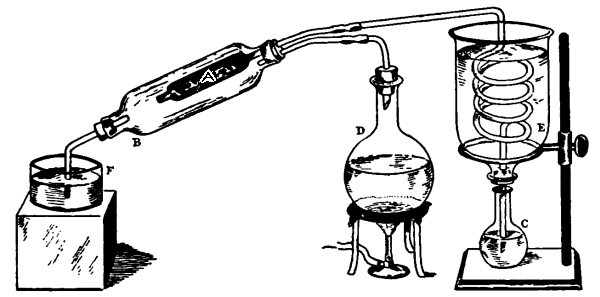
Fig. 121.—Apparatus for Acetic Acid.
605. Pectic Acid.—Under this term are included not only the pectic acid but all the other bodies of a pectose nature contained in tobacco. These bodies are of considerable interest, although they do not belong to the most important constituents. In fresh tobacco leaves are found three pectin bodies. One pectin is soluble in water, another is an insoluble pectose and the third is the pectose body forming salts with the alkalies, i. e., true pectic acid. In fermented tobacco pectic acid is found chiefly in combination with lime in the ribs of the leaves, serving to give them the necessary stiffness. For the estimation of the pectin bodies (mucilage) the powdered tobacco is thoroughly extracted with cold water. An aliquot part of the aqueous extract is mixed with two volumes of strong alcohol and allowed to stand in a well closed vessel in a cool place for twenty-four hours. The precipitate is collected on a filter, washed with sixty-six per cent alcohol, dried and weighed. The dried residue is incinerated and the amount of ash determined. In general, vegetable mucilages contain about five per cent of ash. If more than this be found, it is due to the solution of the salts of the organic acids contained in the sample. A dried vegetable mucilage, obtained as above, dissolves in water to a mucilaginous liquid which does not reduce alkaline copper solution until it has been hydrolyzed by boiling with a dilute mineral acid.[623]
606. Tannic Acid.—This acid is separated and estimated by the processes given in paragraphs 589-595.
607. Starch and Sugar.—The unfermented leaves of tobacco contain considerable quantities of carbohydrates in addition to woody fiber, pentosans, galactan and cellulose. Among these, starch is the most important. Sugar exists in small quantities in the fresh leaf, usually not over one per cent. During fermentation, according to some authorities, the starch is partially converted into sugar and the latter substance disappears under the action of the alcoholic ferments. It has been found at the Connecticut Station, however, that the starch content of the leaf does not decrease during fermentation. The starch and sugar may be determined in the fresh leaves by the methods already given.
In the manufacture of certain grades of tobacco it is customary to add a quantity of sugar. The analyst may thus be called upon to determine in some cases whether the sugar found in a sample is natural or added. The occurrence of natural sugars in tobacco has been investigated at the instance of the British Treasury.[624]
The natural sugars which may be found in sun dried tobaccos usually disappear entirely during the process of fermentation. It was found by the Somerset House chemists that the content of sugar in commercial tobaccos varies from none at all to over fifteen per cent. A remarkable example of this variation is reported in two samples from this country, one of which, grown in Kentucky, contained no sugar, and the other grown in Virginia, 15.2 per cent.
It was noticed that the saccharin matters in the tobaccos examined were neutral to polarized light. They are determined by their copper reducing power. The tobacco sugars are therefore to be classed with the reducing bodies, not optically active, found in the juices of sorghum and sugar canes.
608. Ammonia.—As has already been intimated, ammonia exists only in minute quantities in fresh tobacco leaves, but in considerable quantities after fermentation. In the estimation of ammonia, twenty grams of the tobacco powder are digested with 250 cubic centimeters of water, acidulated with sulfuric and after an hour enough water added to make the total quantity 400 cubic centimeters. After filtration, an aliquot part of the filtrate, about 200 cubic centimeters, is treated with magnesium oxid in excess and the ammonia and nicotin removed by distillation in a current of steam. The distillate is collected in dilute sulfuric acid of known strength. The total amount of the two bases is determined by titration and the quantity of base representing the nicotin, which has been determined in a separate sample, subtracted in order to obtain the weight of the ammonia.[625]
The ammonia in tobacco is determined by Nessler in the following manner:[626]
The powdered tobacco is mixed with water and magnesium oxid and after standing for several hours it is distilled in a current of steam, the distillate received in dilute sulfuric acid and the process continued until a drop of the distillate gives no reaction for ammonia with the nessler reagent. The excess of sulfuric acid in the distillate is neutralized with pure sodium carbonate and the nicotin precipitated by a neutral solution of mercuric iodid and potassium iodid. The precipitate is separated by filtration, the filtrate treated with sodium sulfid, and the ammonia again obtained by distillation with an alkali, collected in dilute solution of set sulfuric acid and determined by titration. The difference of the two determinations represents the ammonia.
609. Nicotin.—In this laboratory McElroy has made a study of some of the best approved methods for determining nicotin, and finds the most simple and reliable to be that proposed by Kissling.[627] The finely powdered tobacco should be dried at a temperature not exceeding 60°, or it may be partially dried at that temperature before grinding and the final drying completed afterwards. Twenty grams of the powdered sample are intimately mixed by means of a pestle with ten cubic centimeters of dilute alcoholic solution of soda lye, made by dissolving six grams of sodium hydroxid in forty cubic centimeters of water and completing the volume to 100 cubic centimeters with ninety-five per cent alcohol. The mass is transferred to an extraction paper cylinder, placed in an extraction apparatus and extracted for three hours with ether. The ether is nearly all removed by careful distillation, the residue mixed with fifty cubic centimeters of a very dilute soda lye solution (4 to 100) and subjected to distillation in a current of steam. The flask containing the nicotin extract should be connected with the condensing apparatus by a safety bulb as is usual in the distillation of substances containing fixed alkali. The distillation should be conducted rapidly and in such a manner that when 200 cubic centimeters of the distillate have been collected, not more than fifteen cubic centimeters of the liquid remain in the distillation flask. In the distillate, the nicotin is determined by titration with a set solution of dilute sulfuric acid, using rosolic acid or phenacetolin as indicator. It is advisable to titrate each fifty cubic centimeters of the distillate as it is received and the distillation is continued until the last fifty cubic centimeters give no appreciable quantity of the alkaloid. In the calculations one molecule of sulfuric acid is equivalent to two molecules of nicotin according to the equation
H₂SO₄ = (C₁₀H₁₄N₂)₂.
98324
Polarization Method.—Popovici has based a method of detecting the quantity of nicotin in tobacco on its property of rotating the plane of polarized light.[628] The gyrodynat of pure nicotin is expressed by the formula [a]D = -161°.6. When ten parts of nicotin are mixed with ninety parts of water, this value becomes -74°.1. By reason of this great depression in gyrodynatic value Popovici determined the relation which exists between the dilute solutions of nicotin and the number of minutes of angular rotation produced on polarization in a 200 millimeter tube. In a solution in which two grams of nicotin are contained in fifty cubic centimeters, each minute of angular rotation is found to correspond to 6.5 milligrams of nicotin. For one gram in solution in the same volume one minute of angular rotation corresponds to 5.9 milligrams and for a half gram in solution to 5.7 milligrams.
The nicotin is prepared for polarization by extracting with ether, as indicated in the previous paragraph, and the ethereal solution from twenty grams of tobacco is shaken with a concentrated solution of sodium phosphotungstate in nitric acid by means of which nicotin and ammonia are precipitated and rapidly settle. The supernatant liquid is carefully poured off and the residue made up to a volume of fifty cubic centimeters with distilled water and the nicotin freed from any of its compounds by the addition of eight grams of finely powdered barium hydroxid. In order to promote the decomposition of the nicotin compounds the mixture should be shaken at intervals for several hours. The at first blue precipitate changes into blue green and finally into yellow. It is separated by filtration and the somewhat yellow colored filtrate placed in an observation tube, polarized, the polarization calculated to minutes of angular rotation and the number of minutes thus found multiplied by the nearest factor given above.
The analyst will find a description of other methods of estimating nicotin in tobacco in the periodical literature of analytical chemistry.[629]
610. Estimation of Amid Nitrogen.—For the estimation of amid nitrogen ten grams of the powdered tobacco are digested with 100 cubic centimeters of forty per cent alcohol, the extract separated by filtration, acidified with sulfuric and the albumin, peptone, nicotin and ammonia precipitated with as little phosphotungstic acid as possible. The precipitate is separated by filtration and seventy-five cubic centimeters of the filtrate evaporated in a thin glass or tin foil capsule after the addition of a little barium chlorid and the nitrogen determined in the residue. The nitrogen thus obtained is that which was present in an amid state. The nitrogen present as amids, ammonia and nicotin subtracted from the total nitrogen leaves that present as protein.
611. Fractional Extraction of Tobacco.—To determine the character of the soluble constituents of tobacco it is advisable to subject it to a fractional extraction with different reagents. The reagents usually employed in the order mentioned are petroleum ether, ether, absolute alcohol, water, dilute soda lye and dilute hydrochloric acid. The extract obtained by petroleum ether contains vegetable wax, chlorophyll and its alteration products, fat, ethereal oils, and resin bodies. The extract with ether may be divided into water soluble and alcohol soluble bodies. Among the first are small quantities of glucosids and nicotin while in the alcoholic solution resin predominates.
The alcoholic extract is also divided into water soluble and alcohol soluble parts. The first contains the nicotin, which is insoluble in ether, in combination with acids, together with tannic acid and allied bodies and also the sugar. The part insoluble in water consists chiefly of resin.
The aqueous solution contains the vegetable mucilages (pectin) soluble carbohydrates, soluble proteids and organic acids.
The dilute soda lye solution contains chiefly proteids.
The dilute hydrochloric acid solution contains the starch and the oxalic acid originally combined with lime. The extractions with dilute soda lye and dilute hydrochloric acid should be made at a boiling temperature. The residual matter consists of a mixture of carbohydrate bodies to which the term crude fiber is usually applied.
612. Burning Qualities.—When tobacco is to be used for the manufacture of cigars, or cigarettes, or for smoking in pipes, its ability to keep burning is a matter of great importance. The tobacco, when once ignited, should burn for some time and form, a fluffy ash, free of fused mineral particles. A tobacco with good burning properties is one containing nitrates in considerable quantity, not too much sugar and starch, a porous cellular structure and comparatively free of chlorin. In determining comparative burning properties the tests may be applied to the single leaf or the tobacco may be first rolled into a cigar form and burned in an artificial smoker.
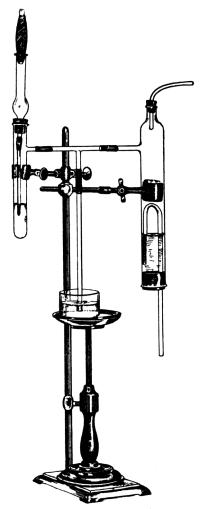
Fig. 122. Apparatus for Smoking.
In applying the test to the leaf it is important that the ignition be made with a fuse without flame, which maintains a uniform burning power. Any good slow burning fuse may be used and it is applied to the leaf in such a way that a hole may be burned in it, leaving its edges uniformly ignited. The number of seconds elapsing before the last spark is extinguished is noted. At the Connecticut Experiment Station a lighter, proposed by Nessler, is employed. It is prepared by digesting eighty grams of gum arabic in 120 cubic centimeters, and forty grams of gum tragacanth in a quarter of a liter of water for two days, mixing the mucilaginous masses and adding ten grams of potassium nitrate and about 350 grams of pulverized charcoal. The mixture is rolled, on a plate sprinkled with charcoal, into sticks a few inches in length and of the diameter of a cigar and dried at a gentle heat. These fuses burn slowly and without smoke and are well suited for lighting tobacco leaves. Several tests, at least six, should be made with each leaf. Leaves having a uniform burning power should be used as comparators and the number of seconds they burn be designated by 100. It is important that all the samples to be tested be exposed for a day or two to the same atmosphere in order that they may have, as nearly as possible, the same content of moisture. The burning tests, when possible, should be made both before and after fermentation. As a rule fermentation improves the burning quality of second rate leaves, but has little effect on leaves of the first quality.
613. Artificial Smoker.—For the purpose of comparing the burning properties of cigars, or of leaves rolled into cigar form, the artificial smoking apparatus devised by Penfield and modified in this laboratory is employed.[630] The construction of the apparatus is shown in the accompanying figure.
The lighted cigar is set in the tube at the left, so that air entering the test-tube must pass through the cigar. The test-tube contains enough water to seal the end of the tube carrying the cigar, and is connected with the aspirator on the right by the T tube, as shown. An arm of the T dips just beneath the surface of the liquid in the cup in the center. Water flows in a slow stream into the aspirator through the tube at the extreme right, forcing the air out through the arm of the T until the siphon begins to act. While the water is voided through the long arm of the siphon, air enters through the cigar, the liquid rising in the T. The action of the apparatus is automatic and intermittent. When the cigar is about one-third burned, it is removed without disturbing the ash cone, and the latter examined and compared with other samples as a standard. The sealing liquid of the long arm of the T may be mercury or water. In case mercury be used, care must be taken not to immerse the open end of the T more than one millimeter therein.
FERMENTED BEVERAGES.
614. Description.—Among fermented beverages are included those drinks, containing alcohol, prepared by fermenting the sugars or starches of fruits, cereals or other agricultural products. Wine and beer, in their various forms, and cider are the chief members of this class of bodies. Koumiss, although a fermented beverage, is not included in this classification, having been noticed under dairy products. The large number of artificial drinks, made by mixing alcohol with fruit and synthesized essences, is also excluded, although the methods of analysis which are used may be applied also to them.
Fermented beverages containing less than two per cent of alcohol are usually regarded as non-intoxicating drinks. Beers are of several varieties, and the term includes lager beer, ale, porter and stout. Distilled liquors are obtained by separating the alcohols and other volatile matters from the products of fermentation by distillation. It is not practicable here to attempt a description of the methods of preparing fermented drinks. Special works on this branch of the subject are easy of access.[631]
615. Important Constituents.—Alcohol is the most important constituent of fermented beverages. The solid matters, commonly called extract, which are obtained on evaporation are composed of dextrins, sugars, organic acids, nitrogenous bodies and mineral matters affording ash on combustion. Of these the dextrins and sugars form the chief part and the proteid bodies nearly ten per cent in the case of beers made of malt and hops. In beers the bitter principles derived from hops, while not important by reason of quantity, are of the utmost consequence from a gustatory and hygienic point of view. The ash of fermented beverages varies with their nature, or with the character of the water used in making the mash. In the manufacture of beer, water containing a considerable proportion of gypsum is often used, and this substance is sometimes added in the course of manufacture, especially of wine. The presence of common salt in the ash in any notable quantity is evidence of the addition of this condiment, either to improve the taste of the beverage or to increase the thirst of the drinker. In cider the organic acids, especially malic, are of importance.
Glycerol is a product of fermentation and of the hydrolysis of the fats and oils in the substances fermented.
616. Specific Gravity.—In order to secure uniformity of expression, the specific gravity of fermented beverages is determined at about 15°.6, although that is a temperature much below the average found in American laboratories. The specific gravity may be determined by an alcoholometer, pyknometer or hydrostatic balance in harmony with the directions given in paragraphs 48-54 and 285. By reason of the extractive matters held in solution, fermented beverages are usually heavier than water, even if the content of alcohol be twenty per cent or more. On the other hand distilled liquors are lighter than water.
617. Determination of Alcohol.—The determination of the percentage of alcohol present in a solution is based on two general principles. On the one hand, and this is the base of the methods in common use, the alcohol is secured mixed only with water and its amount determined by ascertaining the specific gravity of the mixture. On the other hand the quantity of alcohol in a mixture may be determined by ascertaining the temperature of the vapors produced on boiling. This is the principle involved in the use of the ebullioscope. The latter method is not employed to any extent in this country.
Use of the Alcoholometer.—The alcoholometer usually employed is known by the name of Gay-Lussac, who first made practical use of it in the determination of alcohol. It is constructed in such a way as to read directly the volume of absolute alcohol contained in one hundred volumes of the liquid at a temperature of 15°.6. The instruments employed should be carefully calibrated and thoroughly cleaned by washing with absolute alcohol before use. The stem of the instrument must be kept free from any greasy substance, and this is secured by washing it with ether. After this last washing the analyst should be careful not to touch the stem of the instrument with his fingers. It is most convenient to make the determination exactly at 15°.6, but when made at other temperatures the reading of the instrument is corrected by tables which may be found in works especially devoted to the analysis of wines.[632]
In this country the alcoholometer is used to some extent, but the official method is based upon the determination of the specific gravity by an instrument constructed in every respect like the alcoholometer, but giving the specific gravity of the liquor at 15°.6 instead of its percentage by volume in alcohol. The reading of the instrument having been determined at a temperature of 15°.6, the corresponding percentage of alcohol by volume or by weight is taken directly from the table given further on.
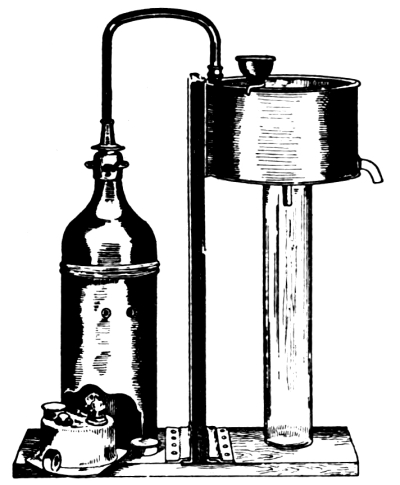
Fig. 123. Metal Distilling Apparatus.
Methods of Distillation.—The metal apparatus employed in the laboratory of the Department of Agriculture, for the distillation of fermented beverages in order to determine the percentage of alcohol by the method given above, is shown in the accompanying figure. The apparatus consists of a retort of copper carried on supports in such a way as to permit an alcohol or bunsen lamp to be placed under it. It is connected with a block tin condenser and the distillate is received in a tall graduated cylinder placed under the condenser in such a way as to prevent the loss of any alcohol in the form of vapor. Exactly 300 cubic centimeters of the wine or fermented beverage are used for the distillation. Any acid which the wine contains is first saturated with calcium carbonate before placing in the retort. Exactly 100 cubic centimeters of distillate are collected and the volume of the distillate is completed to 300 cubic centimeters by the addition of recently distilled water.[633] The cylinder containing the distillate is brought to a temperature of 15°.6, the alcoholometer inserted and its reading taken with the usual precautions.
Official Method.—The alcoholometers employed in the official methods are calibrated to agree with those used by the officers of the Bureau of Internal Revenue. They are most conveniently constructed, carrying the thermometer scale in the same stem with that showing the specific gravity. It is highly important that the analyst assure himself of the exact calibration of the instrument before using it. Inasmuch as the volume of the distillate may not be suited in all cases to the use of a large alcoholometer, it is customary in this laboratory to determine the specific gravity by means of the hydrostatic balance, as described further on. Attention is also called to the fact that, in the official method, directions are not given to neutralize the free acid of the fermented beverage before the distillation. Since the Internal Revenue Bureau is concerned chiefly with the determination of alcohol in distilled liquors, this omission is of little consequence. Even in ordinary fermented beverages the percentage of volatile acids, (acetic etc.,) is so small as to make the error due to the failure to neutralize it of but little consequence. In order, however, to avoid every possibility of error, it is recommended that in all instances the free acids of the sample be neutralized before distillation. In this laboratory, the distillations are conducted in a glass apparatus shown in the accompanying figure. The manipulation is as follow:[634]
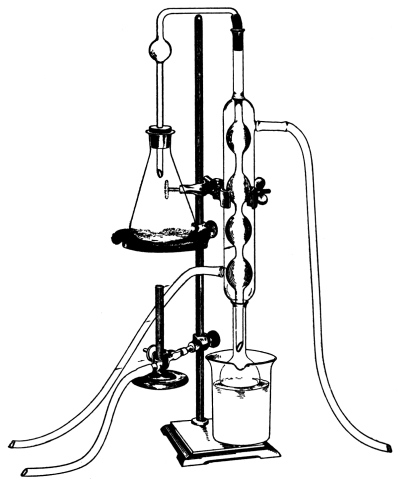
Fig. 124. Distilling Apparatus.
One hundred cubic centimeters of the liquor are placed in a flask of from 250 to 300 cubic centimeters capacity, fifty cubic centimeters of water added, the flask attached to a vertical condenser by means of a bent bulb tube, 100 cubic centimeters distilled and the specific gravity of the distillate determined. The distillate is also weighed, or its weight calculated from the specific gravity. The corresponding percentage of alcohol by weight is obtained from the appended table, and this figure multiplied by the weight of the distillate, and the result divided by the weight of the sample, gives the per cent of alcohol by weight contained therein.
The percentage of alcohol by volume of the liquor is the same as that of the distillate, and is obtained directly from the appended table.
In distilled liquors about thirty grams are diluted to 150 cubic centimeters, 100 cubic centimeters distilled and the per cent of alcohol by weight determined as above.
The percentage of alcohol by volume in the distillate is obtained from the appended table. This figure divided by the number expressing the volume in cubic centimeters of the liquor taken for the determination (calculated from the specific gravity), and the result multiplied by 100 gives the per cent of alcohol by volume in the original liquor.
618. Determining the Specific Gravity of the Distillate.—The specific gravity of the distillate may be determined by the pyknometer, alcoholometer, hydrostatic balance or in any accurate way. The volume of the distillate is not always large enough to be conveniently used with an alcoholometer, especially the large ones employed by the Bureau of Internal Revenue. In the laboratory of the Agricultural Department, it is customary to determine the density of the distillate by the hydrostatic balance shown in paragraph 285. The specific gravity is in each case determined at 15°.6, referred to water of the same temperature, or if at a different temperature calculated thereto.
619. Table for Use with Hydrostatic Plummet.—It is more convenient to determine the density of the alcoholic distillate at room temperature than to reduce it to the standard for which the plummet is graduated. In the case of a plummet which displaces exactly five grams, or multiple thereof, of distilled water at 15°.6, the corrections for temperatures between 12°.2 and 30° are found in the following table, prepared by Bigelow.[635]
If the weight of the alcoholic solution displaced be 4.96075 grams the apparent specific gravity 0.99215 and the temperature of observation 25°.4, the correction, which is additive, as given in the table is 0.00191 and the true specific gravity is 0.99406 and the percentage of alcohol by volume 4.08.
When the plummet does not exactly displace five grams of water at 15°.6, but nearly so, the table may still be used.
For example, suppose the weight of water displaced be 4.9868 instead of five grams. The apparent specific gravity of the water by this plummet is 0.99736 and the difference between this and the true specific gravity is 0.00264, which is a constant correction to be added to the specific gravity as determined in each case.
Correction Table for Specific Gravity.
Below 15°.6 Subtract; Above 15°.6 Add.
Temp. Correction. Temp. Correction. Temp. Correction.
12.2 0.00047 18.2 0.00043 24.2 0.00163
12.4 0.00044 18.4 0.00046 24.4 0.00167
12.6 0.00042 18.6 0.00050 24.6 0.00172
12.8 0.00039 18.8 0.00053 24.8 0.00176
13.0 0.00037 19.0 0.00057 25.0 0.00181
13.2 0.00634 19.2 0.00061 25.2 0.00186
13.4 0.00032 19.4 0.00065 25.4 0.00191
13.6 0.00029 19.6 0.00068 25.6 0.00195
13.8 0.00027 19.8 0.00072 25.8 0.00200
14.0 0.00024 20.0 0.00076 26.0 0.00205
14.2 0.00021 20.2 0.00080 26.2 0.00210
14.4 0.00018 20.4 0.00084 26.4 0.00215
14.6 0.00015 20.6 0.00087 26.6 0.00220
14.8 0.00012 20.8 0.00091 26.8 0.00225
15.0 0.00009 21.0 0.00095 27.0 0.00230
15.2 0.00006 21.2 0.00099 27.2 0.00235
15.4 0.00003 21.4 0.00103 27.4 0.00240
15.6 0.00000 21.6 0.00107 27.6 0.00246
15.8 0.00003 21.8 0.00111 27.8 0.00251
16.0 0.00006 22.0 0.00115 28.0 0.00256
16.2 0.00009 22.2 0.00119 28.2 0.00261
16.4 0.00012 22.4 0.00123 28.4 0.00267
16.6 0.00016 22.6 0.00128 28.6 0.00272
16.8 0.00019 22.8 0.00132 28.8 0.00278
17.0 0.00022 23.0 0.00136 29.0 0.00283
17.2 0.00025 23.2 0.00140 29.2 0.00288
17.4 0.00029 23.4 0.00145 29.4 0.00294
17.6 0.00032 23.6 0.00149 29.6 0.00299
17.8 0.00036 23.8 0.00154 29.8 0.00306
18.0 0.00039 24.0 0.00158 30.0 0.00311
The table is only accurate when the distillate does not contain over seven nor less than three per cent of alcohol. If the distillate contain more than seven per cent of alcohol it is diluted and the compensating correction made.
620. Calculating Results.—The specific gravity of the alcoholic distillate having been determined by any approved method and corrected to a temperature of 15°.6, the corresponding per cents of alcohol by volume and by weight are found by consulting the following table.[636] If, for example, the corrected specific gravity be exactly that given in any figure of the table the corresponding per cents are directly read. If the specific gravity found fall between two numbers in the table the corresponding per cents are determined by interpolation.
Table Showing Percentage of Alcohol by Weight and by Volume.
Specific gravity at 15°.6./15°.6. Per cent alcohol by volume. Per cent alcohol by weight.
1.00000 0.00 0.00
0.99992 .05 .04
984 .10 .08
976 .15 .12
968 .20 .16
961 .25 .20
953 .30 .24
945 .35 .28
937 .40 .32
930 .45 .36
.99923 0.50 0.40
915 .55 .44
907 .60 .48
900 .65 .52
892 .70 .56
884 .75 .60
877 .80 .64
869 .85 .67
861 .90 .71
854 .95 .75
.99849 1.00 0.79
842 .05 .83
834 .10 .87
827 .15 .91
819 .20 .95
812 .25 .99
805 .30 1.03
797 .35 .07
790 .40 .11
782 .45 .15
.99775 1.50 1.19
768 .55 .23
760 .60 .27
753 .65 .31
745 .70 .35
738 .75 .39
731 .80 .43
723 .85 .47
716 .90 .51
708 .95 .55
.99701 2.00 1.59
694 .05 .63
687 .10 .67
679 .15 .71
672 .20 .75
665 .25 .79
658 .30 .83
651 .35 .87
643 .40 .91
636 .45 .95
0.99629 2.50 1.99
622 .55 2.03
615 .60 .07
607 .65 .11
600 .70 .15
593 .75 .19
586 .80 .23
579 .85 .27
571 .90 .31
564 .95 .35
.99557 3.00 2.39
550 .05 .43
543 .10 .47
536 .15 .51
529 .20 .55
522 .25 .59
515 .30 .64
508 .35 .68
501 .40 .72
494 .45 .76
.99487 3.50 2.80
480 .55 .84
473 .60 .88
466 .65 .92
459 .70 .96
452 .75 3.00
445 .80 .04
438 .85 .08
431 .90 .12
424 .95 .16
.99417 4.00 3.20
410 .05 .24
403 .10 .28
397 .15 .32
390 .20 .36
383 .25 .40
376 .30 .44
369 .35 .48
363 .40 .52
356 .45 .56
.99349 4.50 3.60
342 .55 .64
335 .60 .68
329 .65 .72
322 .70 .76
315 .75 .80
308 .80 .84
301 .85 .88
295 .90 .92
288 .95 .96
0.99281 5.00 4.00
274 .05 .04
268 .10 .08
261 .15 .12
255 .20 .16
248 .25 .20
241 .30 .24
235 .35 .28
228 .40 .32
222 .45 .36
.99215 5.50 4.40
208 .55 .44
202 .60 .48
195 .65 .52
189 .70 .56
182 .75 .60
175 .80 .64
169 .85 .68
162 .90 .72
156 .95 .76
.99149 6.00 4.80
143 .05 .84
136 .10 .87
130 .15 .92
123 .20 .96
117 .25 5.00
111 .30 .05
104 .35 .09
098 .40 .13
091 .45 .17
.99085 6.50 5.21
079 .55 .25
072 .60 .29
066 .65 .33
059 .70 .37
053 .75 .41
047 .80 .45
040 .85 .49
034 .90 .53
027 .95 .57
.99021 7.00 5.61
015 .05 .65
009 .10 .69
002 .15 .73
.98996 .20 .77
990 .25 .81
984 .30 .86
978 .35 .90
971 .40 .94
965 .45 .98
0.98959 7.50 6.02
953 .55 .06
947 .60 .10
940 .65 .14
934 .70 .18
928 .75 .22
922 .80 .26
916 .85 .30
909 .90 .34
903 .95 .38
.98897 8.00 6.42
891 .05 .46
885 .10 .50
879 .15 .54
873 .20 .58
867 .25 .62
861 .30 .67
855 .35 .71
849 .40 .75
843 .45 .79
.98837 8.50 6.83
831 .55 .87
825 .60 .91
819 .65 .95
813 .70 .99
807 .75 7.03
801 .80 .07
795 .85 .11
789 .90 .15
783 .95 .19
.98777 9.00 7.23
771 .05 .27
765 .10 .31
754 .20 .39
748 .25 .43
742 .30 .48
736 .35 .52
724 .45 .60
.98719 9.50 7.64
713 .55 .68
707 .60 .72
701 .65 .76
695 .70 .80
689 .75 .84
683 .80 .88
678 .85 .92
672 .90 .96
666 .95 8.00
0.98660 10.00 8.04
654 .05 .08
649 .10 .12
643 .15 .16
637 .20 .20
632 .25 .24
626 .30 .28
620 .35 .33
614 .40 .37
609 .45 .41
.98603 10.50 8.45
597 .55 .49
592 .60 .53
586 .65 .57
580 .70 .61
575 .75 .65
569 .80 .70
563 .85 .74
557 .90 .78
552 .95 .82
.98546 11.00 8.86
540 .05 .90
535 .10 .94
529 .15 .98
524 .20 9.02
518 .25 .07
513 .30 .11
507 .35 .15
502 .40 .19
496 .45 .23
.98491 11.50 9.27
485 .55 .31
479 .60 .35
474 .65 .39
468 .70 .43
463 .75 .47
457 .80 .51
452 .85 .55
446 .90 .59
441 .95 .63
.98435 12.00 9.67
430 .05 .71
424 .10 .75
419 .15 .79
413 .20 .83
408 .25 .87
402 .30 .92
397 .35 .96
391 .40 10.00
386 .45 .04
0.98381 12.50 10.08
375 .55 .12
370 .60 .16
364 .65 .20
359 .70 .24
353 .75 .28
348 .80 .33
342 .85 .37
337 .90 .41
331 .95 .45
.98326 13.00 10.49
321 .05 .53
315 .10 .57
310 .15 .61
305 .20 .65
299 .25 .69
294 .30 .74
289 .35 .78
283 .40 .82
278 .45 .86
.98273 13.50 10.90
267 .55 .94
262 .60 .98
256 .65 11.02
251 .70 .06
246 .75 .14
240 .80 .15
235 .85 .19
230 .90 .23
224 .95 .27
.98219 14.00 11.31
214 .05 .35
209 .10 .39
203 .15 .43
198 .20 .47
193 .25 .52
188 .30 .56
182 .35 .60
177 .40 .64
172 .45 .68
.98167 14.50 11.72
161 .55 .76
156 .60 .80
151 .65 .84
146 .70 .88
140 .75 .93
135 .80 .97
130 .85 12.01
125 .90 .05
119 .95 .09
0.98114 15.00 12.13
108 .05 .17
104 .10 .21
099 .15 .25
093 .20 .29
088 .25 .33
083 .30 .38
078 .35 .42
073 .40 .46
068 .45 .50
.98063 15.50 12.54
057 .55 .58
052 .60 .62
047 .65 .66
042 .70 .70
037 .75 .75
032 .80 .79
026 .85 .83
021 .90 .87
016 .95 .91
.98011 16.00 12.95
005 .05 .99
001 .10 13.03
.97996 .15 .08
991 .20 .12
986 .25 .16
980 .30 .20
975 .35 .24
970 .40 .29
965 .45 .33
.97960 16.50 13.37
955 .55 .41
950 .60 .45
945 .65 .49
940 .70 .53
935 .75 .57
929 .80 .62
924 .85 .66
919 .90 .70
914 .95 .74
.97909 17.00 13.78
904 .05 .82
899 .10 .86
894 .15 .90
889 .20 .94
884 .25 .98
879 .30 14.03
874 .35 .07
869 .40 .11
864 .45 .15
0.97859 17.50 14.19
853 .55 .23
848 .60 .27
843 .65 .31
838 .70 .35
833 .75 .40
828 .80 .44
823 .85 .48
818 .90 .52
813 .95 .56
.97808 18.00 14.60
803 .05 .64
798 .10 .68
793 .15 .73
788 .20 .77
783 .25 .81
778 .30 .85
773 .35 .89
768 .40 .94
763 .45 .98
.97758 18.50 15.02
753 .55 .06
748 .60 .10
743 .65 .14
738 .70 .18
733 .75 .22
728 .80 .27
723 .85 .31
718 .90 .35
713 .95 .39
.97708 19.00 15.43
703 .05 .47
698 .10 .51
693 .15 .55
688 .20 .59
683 .25 .63
678 .30 .68
673 .35 .72
668 .40 .76
663 .45 .80
.97658 19.50 15.84
653 .55 .88
648 .60 .93
643 .65 .97
638 .70 16.01
633 .75 .05
628 .80 .09
623 .85 .14
618 .90 .18
613 .95 .22
0.97608 20.00 16.26
603 .05 .30
598 .10 .34
593 .15 .38
588 .20 .42
583 .25 .46
578 .30 .51
573 .35 .58
568 .40 .59
563 .45 .63
.97558 20.50 16.67
552 .55 .71
547 .60 .75
542 .65 .80
537 .70 .84
532 .75 .88
527 .80 .92
522 .85 .96
517 .90 17.01
512 .95 .05
.97507 21.00 17.09
502 .05 .13
497 .10 .17
492 .15 .22
487 .20 .26
482 .25 .30
477 .30 .34
472 .35 .38
467 .40 .43
462 .45 .47
.97457 21.50 17.51
451 .55 .55
446 .60 .59
441 .65 .63
436 .70 .67
431 .75 .71
426 .80 .76
421 .85 .80
416 .90 .84
411 .95 .88
.97406 22.00 17.92
401 .05 .96
396 .10 18.00
391 .15 .05
386 .20 .09
381 .25 .13
375 .30 .17
370 .35 .21
365 .40 .26
360 .45 .30
0.97355 22.50 18.34
350 .55 .38
345 .60 .42
340 .65 .47
335 .70 .51
330 .75 .55
324 .80 .59
319 .85 .63
314 .90 .68
309 .95 .72
.97304 23.00 18.76
299 .05 .80
294 .10 .84
289 .15 .88
283 .20 .92
278 .25 .96
273 .30 19.01
268 .35 .05
263 .40 .09
258 .45 .13
.97253 23.50 19.17
247 .55 .21
242 .60 .25
237 .65 .30
232 .70 .34
227 .75 .38
222 .80 .42
216 .85 .46
211 .90 .51
206 .95 .55
.97201 24.00 19.59
196 .05 .63
191 .10 .67
185 .15 .72
180 .20 .76
175 .25 .80
170 .30 .84
165 .35 .88
159 .40 .93
154 .45 .97
.97149 24.50 20.01
144 .55 .05
139 .60 .09
133 .65 .14
128 .70 .18
123 .75 .22
118 .80 .26
113 .85 .30
107 .90 .35
102 .95 .39
0.97097 25.00 20.43
092 .05 .47
086 .10 .51
081 .15 .56
076 .20 .60
071 .25 .64
065 .30 .68
060 .35 .72
055 .40 .77
049 .45 .81
.97014 25.50 20.85
039 .55 .89
033 .60 .93
028 .65 .98
023 .70 21.02
018 .75 .06
012 .80 .10
007 .85 .14
001 .90 .19
.96996 .95 .23
.96991 26.00 21.27
986 .05 .31
980 .10 .35
975 .15 .40
969 .20 .44
964 .25 .48
959 .30 .52
953 .35 .56
949 .40 .61
942 .45 .65
.96937 26.50 21.69
932 .55 .73
926 .60 .77
921 .65 .82
915 .70 .86
910 .75 .90
905 .80 .94
899 .85 .98
894 .90 22.03
888 .95 .07
.96883 27.00 22.11
877 .05 .15
872 .10 .20
866 .15 .24
861 .20 .28
855 .25 .33
850 .30 .37
844 .35 .41
839 .40 .45
833 .45 .50
0.96828 27.50 22.54
822 .55 .58
816 .60 .62
811 .65 .67
805 .70 .71
800 .75 .75
794 .80 .79
789 .85 .83
783 .90 .88
778 .95 .92
.96772 28.00 22.96
766 .05 23.00
761 .10 .04
755 .15 .09
749 .20 .13
744 .25 .17
738 .30 .21
732 .35 .25
726 .40 .30
721 .45 .34
.96715 28.50 23.38
709 .55 .42
704 .60 .47
698 .65 .51
692 .70 .55
687 .75 .60
681 .80 .64
675 .85 .68
669 .90 .72
664 .95 .77
.96658 29.00 23.81
652 .05 .85
646 .10 .89
640 .15 .94
635 .20 .98
629 .25 24.02
623 .30 .06
617 .35 .10
611 .40 .15
605 .45 .19
.96600 29.50 24.23
594 .55 .27
587 .60 .32
582 .65 .36
576 .70 .40
570 .75 .45
564 .80 .49
559 .85 .53
553 .90 .57
547 .95 .62
0.96541 30.00 24.66
535 .05 .70
529 .10 .74
523 .15 .79
517 .20 .83
511 .25 .87
505 .30 .91
499 .35 .95
493 .40 25.00
487 .45 .04
.96481 30.50 25.08
475 .55 .12
469 .60 .17
463 .65 .21
457 .70 .25
451 .75 .30
445 .80 .34
439 .85 .38
433 .90 .42
427 .95 .47
.96421 31.00 25.51
415 .05 .55
409 .10 .60
403 .15 .64
396 .20 .68
390 .25 .73
384 .30 .77
378 .35 .81
372 .40 .85
366 .45 .90
.96360 31.50 25.94
353 .55 .98
347 .60 26.03
341 .65 .07
335 .70 .11
329 .75 .16
323 .80 .20
316 .85 .24
310 .90 .28
304 .95 .33
.96298 32.00 26.37
292 .05 .41
285 .10 .46
279 .15 .50
273 .20 .54
267 .25 .59
260 .30 .63
254 .35 .67
248 .40 .71
241 .45 .76
0.96235 32.50 26.80
229 .55 .84
222 .60 .89
216 .65 .93
210 .70 .97
204 .75 27.02
197 .80 .06
191 .85 .10
185 .90 .14
178 .95 .19
.96172 33.00 27.23
166 .05 .27
159 .10 .32
153 .15 .36
146 .20 .40
140 .25 .45
133 .30 .49
127 .35 .53
120 .40 .57
114 .45 .62
.96108 33.50 27.66
101 .55 .70
095 .60 .75
088 .65 .79
082 .70 .83
075 .75 .88
069 .80 .92
062 .85 .97
056 .90 28.00
049 .95 .05
.96043 34.00 28.09
036 .05 .13
030 .10 .18
023 .15 .22
016 .20 .26
010 .25 .31
003 .30 .35
.95996 .35 .39
990 .40 .43
983 .45 .48
.95977 34.50 28.52
970 .55 .56
963 .60 .61
957 .65 .65
950 .70 .70
943 .75 .74
937 .80 .78
930 .85 .83
923 .90 .87
917 .95 .92
0.95910 35.00 28.96
903 .05 29.00
896 .10 .05
889 .15 .09
883 .20 .13
876 .25 .18
869 .30 .22
862 .35 .26
855 .40 .30
848 .45 .35
.95842 35.50 29.39
835 .55 .43
828 .60 .48
821 .65 .52
814 .70 .57
807 .75 .61
800 .80 .65
794 .85 .70
787 .90 .74
780 .95 .79
.95773 36.00 29.83
766 .05 .87
759 .10 .92
752 .15 .96
745 .20 30.00
738 .25 .05
731 .30 .09
724 .35 .13
717 .40 .17
710 .45 .22
.95703 36.50 30.26
695 .55 .30
688 .60 .35
681 .65 .39
674 .70 .44
667 .75 .48
660 .80 .52
653 .85 .57
646 .90 .61
639 .95 .66
.95632 37.00 30.70
625 .05 .74
618 .10 .79
610 .15 .83
603 .20 .88
596 .25 .92
589 .30 .96
581 .35 31.01
574 .40 .05
567 .45 .10
0.95560 37.50 31.14
552 .55 .18
545 .60 .23
538 .65 .27
531 .70 .32
523 .75 .36
516 .80 .40
509 .85 .45
502 .90 .49
494 .95 .54
.95487 38.00 31.58
480 .05 .63
472 .10 .67
465 .15 .72
457 .20 .76
450 .25 .81
442 .30 .85
435 .35 .90
427 .40 .94
420 .45 .99
.95413 38.50 32.03
405 .55 .07
398 .60 .12
390 .65 .16
383 .70 .20
375 .75 .25
368 .80 .29
360 .85 .33
353 .90 .37
345 .95 .42
.95338 39.00 32.46
330 .05 .50
323 .10 .55
315 .15 .59
307 .20 .64
300 .25 .68
292 .30 .72
284 .35 .77
277 .40 .81
269 .45 .86
.95262 39.50 32.90
254 .55 .95
246 .60 .99
239 .65 33.04
231 .70 .08
223 .75 .13
216 .80 .17
208 .85 .22
200 .90 .27
193 .95 .31
0.95185 40.00 33.35
177 .05 .39
169 .10 .44
161 .15 .48
154 .20 .53
146 .25 .57
138 .30 .61
130 .35 .66
122 .40 .70
114 .45 .75
.95107 40.50 33.79
099 .55 .84
091 .60 .88
083 .65 .93
075 .70 .97
067 .75 34.02
059 .80 .06
052 .85 .11
044 .90 .15
036 .95 .20
.95028 41.00 34.24
020 .05 .28
012 .10 .33
004 .15 .37
.94996 .20 .42
988 .25 .46
980 .30 .50
972 .35 .55
964 .40 .59
956 .45 .64
.94948 41.50 34.68
940 .55 .73
932 .60 .77
924 .65 .82
916 .70 .86
908 .75 .91
900 .80 .95
892 .85 35.00
884 .90 .04
876 .95 .09
.94868 42.00 35.13
860 .05 .18
852 .10 .22
843 .15 .27
835 .20 .31
827 .25 .36
820 .30 .40
811 .35 .45
802 .40 .49
794 .45 .54
0.94786 42.50 35.58
778 .55 .63
770 .60 .67
761 .65 .72
753 .70 .76
745 .75 .81
737 .80 .85
729 .85 .90
720 .90 .94
712 .95 .99
.94704 43.00 36.03
696 .05 .08
687 .10 .12
679 .15 .17
670 .20 .21
662 .25 .23
654 .30 .30
645 .35 .35
637 .40 .39
628 .45 .44
.94620 43.50 36.48
612 .55 .53
603 .60 .57
595 .65 .62
586 .70 .66
578 .75 .71
570 .80 .75
561 .85 .80
553 .90 .84
544 .95 .89
.94536 44.00 36.93
527 .05 .98
519 .10 37.02
510 .15 .07
502 .20 .11
493 .25 .16
484 .30 .21
476 .35 .25
467 .40 .30
459 .45 .34
.94450 44.50 37.39
441 .55 .44
433 .60 .48
424 .65 .53
416 .70 .57
407 .75 .62
398 .80 .66
390 .85 .71
381 .90 .76
373 .95 .80
0.94364 45.00 37.84
355 .05 .89
346 .10 .93
338 .15 .98
329 .20 38.02
320 .25 .07
311 .30 .12
302 .35 .16
294 .40 .21
285 .45 .25
.94276 45.50 38.30
267 .55 .35
258 .60 .39
250 .65 .44
241 .70 .48
232 .75 .53
223 .80 .57
214 .85 .62
206 .90 .66
197 .95 .71
.94188 46.00 38.75
179 .05 .80
170 .10 .84
161 .15 .89
152 .20 .93
143 .25 .98
134 .30 39.03
125 .35 .07
116 .40 .12
107 .45 .16
.94098 46.50 39.21
089 .55 .26
080 .60 .30
071 .65 .35
062 .70 .39
053 .75 .44
044 .80 .49
035 .85 .53
026 .90 .58
017 .95 .62
.94008 47.00 39.67
.93999 .05 .72
990 .10 .76
980 .15 .81
971 .20 .85
962 .25 .90
953 .30 .95
944 .35 .99
934 .40 40.04
925 .45 .08
0.93916 47.50 40.13
906 .55 .18
898 .60 .22
888 .65 .27
879 .70 .32
870 .75 .37
861 .80 .41
852 .85 .46
842 .90 .51
833 .95 .55
.93824 48.00 40.60
815 .05 .65
808 .10 .69
796 .15 .74
786 .20 .78
777 .25 .83
768 .30 .88
758 .35 .92
740 .40 .97
739 .45 41.01
.93730 48.50 41.06
721 .55 .11
711 .60 .15
702 .65 .20
692 .70 .24
683 .75 .29
673 .80 .34
664 .85 .38
655 .90 .43
645 .95 .47
.93636 49.00 41.52
626 .05 .57
617 .10 .61
607 .15 .66
598 .20 .71
588 .25 .76
578 .30 .80
569 .35 .85
559 .40 .90
550 .45 .94
.93540 49.50 41.99
530 .55 42.04
521 .60 .08
511 .65 .13
502 .70 .18
492 .75 .23
482 .80 .27
473 .85 .32
463 .90 .37
454 .95 .41
621. Determination of Percentage of Alcohol by Means Of Vapor Temperature.—The temperature of a mixture of alcohol and water vapors is less than that of water alone and the depression is inversely proportional to the quantity of alcohol present. This principle is utilized in the construction of the ebullioscope or ebulliometer. In this apparatus the temperature of pure boiling water vapor is determined by a preliminary experiment. This point must be frequently revised in order to correct it for variations in barometric pressure. The water is withdrawn from the boiler of the apparatus, the same volume of a wine or beer placed therein, and the vapor temperature again determined. By comparing the boiling point of the wine, with a scale calibrated for different percentages of alcohol, the quantity of spirit present is determined. When water vapor is at 100° a vin ordinaire having eight per cent of alcohol gives a vapor at 93°.8. The presence of extractive matters in the sample, which tend to raise its boiling point, is neglected in the calculation of results.
622. Improved Ebullioscope.—The principle mentioned in the above paragraph may be applied with a considerable degree of accuracy, by using the improved ebullioscope described below.[637]
The apparatus consists of a glass flask F, shaped somewhat like an erlenmeyer, closed at the top with a rubber stopper carrying a central aperture for the insertion of the delicate thermometer A B, and a lateral smaller aperture for connecting the interior of the flask with the condenser D. The return of the condensed vapors from D is effected through the tube entering the flask F in such a manner as to deliver the condensed liquid beneath the surface of the liquid in F as shown in the figure. The flask F contains pieces of scrap platinum or pumice stone to prevent bumping and secure an even ebullition. The flask F rests upon a disk of asbestos, perforated in such a way as to have the opening fully covered by the bottom of the flask. To protect F against the influence of air currents it is enclosed in the glass cylinder E resting on the asbestos disk below and closed with a detachable soft rubber cover at the top. The temperature between the cylinder E and the flask F is measured by the thermometer C and the flame of the lamp G should be so adjusted as to bring the temperature between the flask F and the cylinder E to about 90° at the time of reading the thermometer B. The bulb of the thermometer B may be protected by a thin glass tube carrying distilled water, so adjusted as to prevent the escape of the watery vapor into F. The thermometer B is such as is used for determining molecular weights by the cryoscopic method. It has a cistern at A which holds any excess of mercury not needed in adjusting the thermometer for any required temperature.
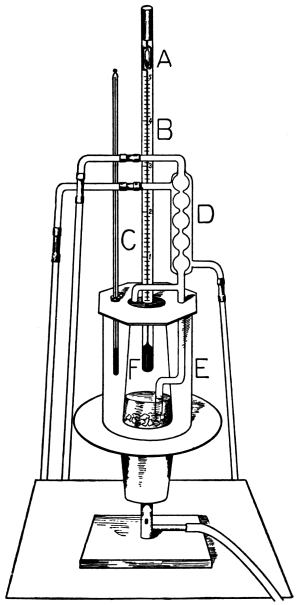
Fig. 125. Improved Ebullioscope.
A second apparatus, exactly similar to the one described, is conveniently used for measuring the changes in barometric pressure during the process of the analysis. The temperature of the vapor of boiling water having been first determined, the beer or wine is placed in F, and the temperature of the vapor of the boiling liquid determined after the temperature of the air layer between E and F reaches about 90°, measured on the thermometer C. By using alcoholic mixtures of known strength the depression for each changing per cent of alcohol is determined for each system of apparatus employed, and this having once been done, the percentage of alcohol in any unknown liquid is at once determined by inspecting the thermometer, the bulb of which is immersed in the vapor from the boiling liquid. In the apparatus figured, a depression of 0°.8 is equivalent to one per cent of alcohol by volume. Full directions for the manipulation of the apparatus may be found in the paper cited above.
623. Total Fixed Matters.—The residue left on evaporating a fermented beverage to dryness is commonly known as extractive matter, or simply extract. It is composed chiefly of unfermented carbohydrates, organic acids, nitrogenous bodies, glycerol and mineral substances. Hydrochloric and sulfuric acids may also be found therein. If any non-volatile preservatives have been used in the sample, such as borax, salicylates and the like, these will also be found in the solid residue. The bodies which escape are water, alcohols, ethers and essential oils. The character of the residue left by wines and beers is evidently different. In each case it should contain typical components which aid in judging of the purity of the sample. For instance, in beers the substitution for malt of carbohydrate bodies comparatively free of proteids, produces a beer containing a deficiency of nitrogenous bodies. Pure malt beer will rarely have less than one-half of a per cent of proteids, while beer made largely of glucose, rice or hominy grits, will have a much smaller quantity. First will be described below the methods of determining the fixed residue left on evaporation, and thereafter the processes for ascertaining its leading components.
624. Methods of the Official Chemists.—Two methods are in use by the official chemists for determining the fixed solids in fermented beverages.[638] They are as follows:
Direct Method.—Fifty cubic centimeters of the sample are weighed, placed in a platinum dish about eighty millimeters in diameter and capable of holding about seventy-five cubic centimeters and evaporated on the steam bath to a sirupy consistence. The residue is heated for two and a half hours in a drying oven at the temperature of boiling water and weighed.
In Sweet Wines.—Ten cubic centimeters of the liquor are weighed and diluted to 100 with water. Fifty cubic centimeters of this solution are evaporated as described above.
Optional Method.—Fifty cubic centimeters of the sample are placed in a platinum or porcelain dish and evaporated on the steam bath until the volume is reduced to one-third. The dealcoholized liquid is washed into a fifty cubic centimeter flask, cooled and made up to the original volume. It is mixed thoroughly and the specific gravity ascertained with a pyknometer, hydrostatic balance or an accurately standardized hydrometer. The percentage of total solids is obtained from the appended table. The column on the left of the specific gravity gives the percentage of extract in a wine, as calculated by Hager, and that on the right the percentage of extract in a beer or wort, as calculated by Schultze. According to Baumert, however, Schultze’s table gives results which approximate more closely the data obtained by direct estimation than does Hager’s.
Tables of Hager and Schultze for the Determination of Extract by the Indirect Method.
Hager. Specific gravity. Schultze.
0.84 1.0038 1.00
0.86 1.0039 1.02
0.88 1.0040 1.05
0.90 1.0041 1.08
0.92 1.0042 1.10
0.94 1.0043 1.13
0.96 1.0044 1.15
0.98 1.0045 1.18
1.00 1.0046 1.21
1.02 1.0047 1.23
1.04 1.0048 1.26
1.06 1.0049 1.29
1.08 1.0050 1.31
1.10 1.0051 1.34
1.12 1.0052 1.36
1.15 1.0053 1.39
1.17 1.0054 1.41
1.19 1.0055 1.44
1.22 1.0056 1.46
1.25 1.0057 1.49
1.27 1.0058 1.51
1.30 1.0059 1.54
1.32 1.0060 1.56
1.34 1.0061 1.59
1.37 1.0062 1.62
1.39 1.0063 1.64
1.42 1.0064 1.67
1.44 1.0065 1.69
1.46 1.0066 1.72
1.48 1.0067 1.74
1.50 1.0068 1.77
1.52 1.0069 1.79
1.55 1.0070 1.82
1.57 1.0071 1.84
1.59 1.0072 1.87
1.61 1.0073 1.90
1.64 1.0074 1.92
1.66 1.0075 1.95
1.68 1.0076 1.97
1.70 1.0077 2.00
1.72 1.0078 2.02
1.75 1.0079 2.05
1.77 1.0080 2.07
1.79 1.0081 2.10
1.82 1.0082 2.12
1.84 1.0083 2.15
1.86 1.0084 2.17
1.88 1.0085 2.20
1.90 1.0086 2.23
1.92 1.0087 2.25
1.94 1.0088 2.28
1.96 1.0089 2.30
1.98 1.0090 2.33
2.00 1.0091 2.35
2.03 1.0092 2.38
2.05 1.0093 2.41
2.07 1.0094 2.43
2.09 1.0095 2.46
2.11 1.0096 2.48
2.14 1.0097 2.51
2.16 1.0098 2.53
2.18 1.0099 2.56
2.21 1.0100 2.58
2.23 1.0101 2.61
2.25 1.0102 2.64
2.27 1.0103 2.66
2.30 1.0104 2.69
2.32 1.0105 2.71
2.34 1.0106 2.74
2.36 1.0107 2.76
2.38 1.0108 2.79
2.40 1.0109 2.82
2.42 1.0110 2.84
2.44 1.0111 2.87
2.46 1.0112 2.89
2.48 1.0113 2.92
2.50 1.0114 2.94
2.52 1.0115 2.97
2.54 1.0116 2.99
2.57 1.0117 3.02
2.59 1.0118 3.05
2.61 1.0119 3.07
2.64 1.0120 3.10
2.66 1.0121 3.12
2.68 1.0122 3.15
2.70 1.0123 3.17
2.72 1.0124 3.20
2.75 1.0125 3.23
2.77 1.0126 3.25
2.79 1.0127 3.28
2.82 1.0128 3.30
2.84 1.0129 3.33
2.86 1.0130 3.35
2.88 1.0131 3.38
2.90 1.0132 3.41
2.92 1.0133 3.43
2.94 1.0134 3.46
2.96 1.0135 3.48
2.98 1.0136 3.51
3.00 1.0137 3.54
If it be desired to use this table for the examination of liquors containing a higher percentage of extract, Schultze’s table (intended originally for wort) may be consulted.
Gautier regards the fixed solids as the residue obtained on evaporating, in a flat platinum dish, ten cubic centimeters of wine at 100° for four hours and a half.[639]
The official French method is as follows: Twenty cubic centimeters of wine are placed in a flat bottom, platinum dish of such a diameter that the depth of the liquid therein does not exceed one millimeter. The dish should be immersed as totally as possible in the steam. The heating is continued for six hours.
The following method is used at the municipal laboratory of Paris:
Twenty-five cubic centimeters of wine are placed in a flat bottom, platinum dish seventy millimeters in diameter and twenty-five deep. The dish is placed on a water bath in such a manner that it just touches the surface of the water which is kept at a constant level. The heating is continued for seven hours.[640]
625. Determination in a Vacuum.—To avoid the changes and decomposition produced by heating, the fixed solids may also be determined by drying the sample in a vacuum over sulfuric acid. In this laboratory, it has been found that the process may be greatly facilitated by connecting the desiccating apparatus with the vacuum service of the working desks in which a vacuum corresponding to a mercurial column of 600 millimeters is obtained. The desiccator is provided with a valve whereby a minute current of dry air is allowed to flow through it. This current is not large enough to lessen the vacuum but is sufficient to greatly accelerate the rapidity of the evaporation. The evaporation is hastened also, in a marked degree, by absorbing the liquid with a piece of filter paper previously dried in a vacuum. When it is desired to examine the residue, however, it must be obtained in a flat dish exposing a large surface to evaporation.
626. Estimation of Water.—It is evident that the percentage of water in a fermented beverage is easily calculated when the percentage of alcohol by weight and that of the dry residue are known. In a given case, if the number of grams of alcohol in 100 of the sample be five and that of fixed solids four and a half, the quantity of water therein is 100 - (5.0 + 4.5) = 90.5 grams. In this case the volatile essences are counted as water, but these, at most, are so small in quantity as to be practically unweighable. Nevertheless, it must be admitted that direct drying, in many cases, may give erroneous results, especially when the sample contains an abundance of ethers and of glycerol. The loss which takes place on evaporation may be diminished by adding to the sample, before evaporation, a known weight of potassium sulfate in crystals, which serves to increase the surface of evaporation, to hasten the process and to obtain a quantity of residue in excess of that secured by direct evaporation in an open dish.
627. Total Acidity.—The acidity found in fermented beverages is due both to the natural acids of the materials from which they are made, and to those caused by fermentation. The typical acids also indicate the nature of the original materials, as malic in cider and tartaric in wine. The acids of beers are due almost exclusively to fermentation, and acetic is probably the dominant one. In determining total acidity, it is not always convenient to ascertain beforehand what acid predominates, nor to accurately distribute the acid among its various components. In the analytical work it is advisable, therefore, to estimate the total acid of cider as malic, of wines as tartaric and of beers as acetic. The process of titration is conducted as follows:
Expel any carbon dioxid that is present by continued shaking. Transfer ten cubic centimeters to a beaker and, in the case of white wines, add about ten drops of a neutral litmus solution. Add decinormal sodium hydroxid solution until the red color changes to violet. Then add the reagent, a few drops at a time, until a drop of the liquid, placed on delicate red litmus paper, shows an alkaline reaction.
One cubic centimeter of decinormal sodium hydroxid solution = 0.0075 gram tartaric, 0.0067 of malic and 0.006 gram of acetic acid.
628. Determination of Volatile Acids.—Fifty cubic centimeters of the sample, to which a little tannin has been added to prevent foaming, are distilled in a current of steam. The flask is heated until the liquid boils, when the lamp under it is turned down and the steam passed through until 200 cubic centimeters have been collected in the receiver. The distillate is titrated with decinormal sodium hydroxid solution and the result expressed as acetic acid.
One cubic centimeter of decinormal sodium hydroxid solution = 0.0060 gram acetic acid.
The acidity due to volatile acids may be determined by ascertaining the total acidity as above described, evaporating 100 cubic centimeters to one-third of their volume, restoring the original volume with water and again titrating. The difference between the first and second titrations represents the volatile acidity.
A method of determining volatile acidity in wines, without the application of heat, has been proposed by de la Source.[641] The sample, five cubic centimeters, freed of carbon dioxid by shaking, is placed in a flat dish about eight centimeters in diameter. In a separate portion of the sample, the total acidity is determined in the presence of phenolphthalien by a set solution of barium hydroxid, one cubic centimeter of which is equal to four milligrams of sulfuric acid. The sample in the flat dish is placed in a desiccator, which contains both sulfuric acid and solid potassium hydroxid, and left for two days, by which time it is practically dry. The residue is dissolved in two cubic centimeters of warm water and the dish is kept in the desiccator for an additional two days. By this time the volatile acids, even acetic, will have disappeared and the residual acidity is determined after solution in water.
The method is also applicable when wines have been treated with an alkali. In this case two samples of five cubic centimeters each are acidified with two cubic centimeters of a solution of tartaric acid containing twenty-five grams per liter. This treatment sets free the volatile acids, and their quantity is determined as before.
629. Titration with Phenolphthalien.—The total acidity is also easily determined by titration with a set alkali, using phenolphthalien as indicator. Colored liquors must be treated with animal black before the analysis. The sample is shaken to expel carbon dioxid and five cubic centimeters added to 100 of water containing phenolphthalien. The set alkali (tenth normal soda) is added until the red color is discharged. Even wines having a considerable degree of color may be titrated in this way.[642] The acidity, expressed as tartaric, may be stated as due to sulfuric by dividing by 1.53.
630. Determination of Tartaric Acid.—The determination of potassium bitartrate is necessary when an estimation of the free tartaric acid is desired.[643]
Fifty cubic centimeters of wine are placed in a porcelain dish and evaporated to a sirupy consistence, a little quartz sand being added to render subsequent extraction easier. After cooling, seventy cubic centimeters of ninety-six per cent alcohol are added with constant stirring. After standing for twelve hours, at as low a temperature as practicable, the solution is filtered and the precipitate washed with alcohol until the filtrate is no longer acid. The alcoholic filtrate is preserved for the estimation of the tartaric acid. The filter and precipitate are returned to the porcelain dish and repeatedly treated with hot water, each extraction being filtered into a flask or beaker until the washings are neutral. The combined aqueous filtrates and washings are titrated with decinormal sodium hydroxid solution.
One cubic centimeter of decinormal sodium hydroxid solution = 0.0188 gram potassium bitartrate.
The alcoholic filtrate is made up to a definite volume with water and divided into two equal portions. One portion is exactly neutralized with decinormal sodium hydroxid solution, the other portion added, the alcohol evaporated, the residue washed into a porcelain dish and treated as above.
One cubic centimeter decinormal sodium hydroxid solution = 0.0075 gram tartaric acid.
As, however, only half of the free tartaric acid is determined by this method:
One cubic centimeter decinormal sodium hydroxid = 0.0150 gram of tartaric acid.
631. Modified Berthelot-Fleury Method.—Ten cubic centimeters of wine are neutralized with potassium hydroxid solution and mixed in a graduated cylinder with forty cubic centimeters of the same sample. To one-fifth of the volume, corresponding to ten cubic centimeters of wine, fifty cubic centimeters of a mixture of equal parts of alcohol and ether are added and allowed to stand twenty-four hours. The precipitated potassium bitartrate is separated by filtration, dissolved in water and titrated. The excess of potassium bitartrate over the amount of that constituent present in the wine corresponds to the free tartaric acid.[644]
632. Determination of Tartaric, Malic and Succinic Acids.—Two hundred cubic centimeters of wine are evaporated to one-half, cooled and lead subacetate solution added until the reaction is alkaline.[645] The precipitate is separated by filtration and washed with cold water until the filtrate shows only a slight reaction for lead. The precipitate is washed from the filter into a beaker, by means of hot water, and treated hot with hydrogen sulfid until all the lead is converted into sulfid. It is then filtered hot and the lead sulfid washed with hot water until the washings are no longer acid. The filtrate and washings are evaporated to fifty cubic centimeters and accurately neutralized with potassium hydroxid. An excess of a saturated solution of calcium acetate is added and the liquid allowed to stand from four to six hours with frequent stirring. It is then filtered and the precipitate washed until the filtrate amounts to exactly 100 cubic centimeters. The precipitate of calcium tartrate is converted into calcium oxid by igniting in a platinum crucible. After cooling, from ten to fifteen cubic centimeters of normal hydrochloric acid are added, the solution washed into a beaker and accurately titrated with normal potassium hydroxid solution. Every cubic centimeter of normal acid saturated by the calcium oxid is equivalent to 0.0750 gram tartaric acid. To the amount so obtained, 0.0286 gram must be added, representing the tartaric acid held in solution in the filtrate as calcium tartrate. The sum represents the total tartaric acid in the wine.
The filtrate from the calcium tartrate is evaporated to about twenty-five cubic centimeters, cooled and mixed with three times its volume of ninety-six per cent alcohol. After standing several hours, the precipitate is collected on a weighed filter, dried at 100° and weighed. It represents the calcium salts of malic, succinic and sulfuric acids and of the tartaric acid which remained in solution. This precipitate is dissolved in a minimum quantity of hydrochloric acid, filtered and the filter washed with hot water. Potassium carbonate solution is added to the hot filtrate, and the precipitated calcium carbonate separated by filtration and washed. The filtrate contains the potassium salts of the above named acids. It is neutralized with acetic acid, evaporated to a small volume and precipitated hot with barium chlorid. The precipitate of barium succinate and sulfate is separated by filtration, washed with hot water and treated on the filter with dilute hydrochloric acid. The barium sulfate remaining is washed, dried, ignited and weighed. In the filtrate, which contains the barium succinate, the barium is precipitated hot with sulfuric acid, washed, dried, ignited and weighed. Two hundred and twenty-three parts of barium sulfate equal 118 parts of succinic acid. The succinic and sulfuric acids, as well as the tartaric acid remaining in solution, which is equal to 0.0286 gram, are to be calculated as calcium salts and the result deducted from the total weight of the calcium precipitate. The remainder is the calcium malate, of which 172 parts equal 134 parts malic acid.
According to Macagno, succinic acid may be estimated in wines by the following process:[646] One liter of the wine is digested with lead hydroxid, evaporated on the water bath and the residue extracted with strong alcohol. The residual salts of lead are boiled with a ten per cent solution of ammonium nitrate, which dissolves the salts of succinic acid. The solution is filtered, the lead removed by hydrogen sulfid, boiled, neutralized with ammonia and treated with ferric chlorid as long as a precipitate is formed. The ferric succinate is separated by filtration, washed and ignited. The succinic acid is calculated from the weight of ferric oxid obtained.