PART SIXTH. DAIRY PRODUCTS.
Reading edition
426. Introductory.—The importance of dairy products has led to the publication of a vast amount of literature relating thereto, and it seems almost a hopeless task to present even a typical abstract of the various analytical processes which have been proposed and used in their study. The general principles which have been developed in the preceding parts of this volume are applicable to the study of dairy products, and the analyst who is guided by them can intelligently examine the bodies specially considered in the present part. There have been developed, however, many valuable processes for the special examination of dairy products, which are of such a nature that they could not be properly discussed in the preceding pages. In the present part an effort will be made to present in a typical form the most important of these processes and to state the general principles on which they are based. This subject is naturally subdivided into three parts, viz., milk, butter and cheese. The milk sugar industry is not of sufficient importance to receive a special classification.
MILK.
427. Composition of Milk.—The composition of milk not only varies with the genus and species of the mammal from which it is derived, but also depends in a marked degree on idiosyncrasy.[400]
Milk is a mixture containing water, proteids, fat, carbohydrates, organic and inorganic acids and mineral salts. There have also been observed in milk in minute quantities ammonia, urea, hypoxanthin, chyme, chyle, biliverdin, cholesterin, mucin, lecithin, kreatin, leucin and tyrosin. In the fermentation which milk undergoes in incipient decomposition there is sometimes developed from the proteid matter, as pointed out by Vaughn, a ptomaine, tyrotoxicon, which is a virulent poison.[401] The presence of these last named bodies is of interest chiefly to the physiologist and pathologist and can receive no further attention here.
From a nutritive point of view, the important components of milk are the fats, proteids and sugar, but especially in the nourishment of the young the value of lime and phosphoric acid must be remembered. The mean composition of the most important milks, as determined by recent analyses, is given below:
Water. Per cent. Sugar. Per cent. Proteids. Per cent. Fat. Per cent. Ash. Per cent.
Cow 86.90 4.80 3.60 4.00 0.70
Human 88.75 6.00 1.50 3.45 0.30
Goat 85.70 4.45 4.30 4.75 0.80
Ass 89.50 6.25 2.00 1.75 0.50
Mare 90.75 5.70 2.00 1.20 0.35
Sheep 80.80 4.90 6.55 6.85 0.90
The mean composition of milk, as given by Watts and König, is given in the following tables:
Watts.
Water. Solids. Proteids. Fats. Sugar. Mineral Salts.
Woman 87.65 12.35 3.07 3.91 5.01 0.17
Ass 90.70 9.30 1.70 1.55 5.80 0.50
Cow 86.56 13.44 4.08 4.03 4.60 0.73
Goat 86.76 13.24 4.23 4.48 3.91 0.62
Sheep 83.31 16.69 5.73 6.05 3.96 0.68
Mare 82.84 17.16 1.64 6.87 8.65
König.
Water. Fat. Casein and albumin. Milk Sugar. Ash.
Woman 87.41 3.78 2.29 6.21 0.31
Mare 90.78 1.21 1.99 5.67 0.35
Ass 89.64 1.63 2.22 5.99 0.51
Cow 87.17 3.69 3.55 4.88 0.71
The average composition of 120,540 samples of cow milk, as determined by analysis, extending over a period of eleven years, was found by Vieth to be as follows:[402]
Per cent.
Total solids 12.9
Solids not fat 8.8
Fat 4.1
The quantity of solids and fat in milk is less after longer than after shorter periods between milkings.
The quantity of solids and fat in cow milk is less in the spring than in the autumn.
The chief organic acid naturally present in milk is citric, which exists probably in combination with lime.
The mean content of citric acid in milk is about one-tenth of one per cent.[403]
Citric acid is not found in human milk, and probably exists only in the mammary secretions of herbivores.
Among the mineral acids of milk, phosphoric is the most important, but a part of the phosphorus found as phosphoric acid in the ash of milk may come from pre-existing organic phosphorus (lecithin, nuclein).
The sulfuric acid, which is found in the ash of milk, is derived from the sulfur of the proteid matter during ignition.
Lactic acid is developed from lactose during the souring of milk as the result of bacterial activity.
Gases are also found in solutions of milk, notably carbon dioxid, which gives to freshly drawn milk its brothy appearance.
The ash of milk has the following composition expressed as grams per liter of the original milk:[404]
Component. Grams per liter. Probable form of combination. Grams per liter.
Chlorin 0.90 sodium chlorid 0.962
potassium chlorid 0.830
Phosphoric acid 2.42 KH₂PO₄ 1.156
K₂HPO₄ 0.853
MgHPO₄ 0.336
CaHPO₄ 0.671
Ca₃(PO₄)₂ 0.806
Potassium 1.80 (as shown above)
and as potassium citrate 0.495
Sodium 0.49 sodium chlorid 0.962
Lime 1.90 (as shown above)
and as calcium citrate 2.133
Magnesia 0.20 MgHPO₄ 0.336
The percentage composition of the ash of milk, according to Fleischmann and Schrott, is expressed as follows:[405]
Per cent.
Potassium oxid, K₂O 25.42
Sodium oxid, Na₂O 10.94
Calcium oxid, CaO 21.45
Magnesium oxid, MgO 2.54
Iron oxid, Fe₂O₃ 0.11
Sulfuric acid, SO₃ 4.11
Phosphoric acid, P₂O₅ 24.11
Chlorin, Cl 14.60
103.28
Less Cl as O 3.28
100.00
428. Alterability of Milk.—The natural souring and coagulation of milk is attributed by most authorities to bacterial action produced by infection from the air or containing vessels.[406] Pasteur, however, shows that fresh milk sterilized at a temperature of 110° may be exposed to the air without danger of souring.[407] After about three days, however, a fermentation is set up which is totally different from that produced by the microzymes naturally present in the milk. This point has been further investigated by Béchamp, who finds that the natural souring of milk is accomplished without the evolution of any gas, while the fermentation produced in sterilized milk by the microbes of the air, is uniformly attended by a gaseous development.[408] As a result of his investigations, he concludes that the souring of milk takes place spontaneously by reason of milk being an organic matter, in the physiological sense of the term, and that this alteration is produced solely by the natural microzymes of the milk.
According to Béchamp, the milk derived from healthy animals is capable of spontaneous alteration, which consists in the development of lactic acid and alcohol, and of curd in those milks which contain caseinates produced by the precipitating action of the acids formed. Oxygen and the germs which are present in the air, according to him, have nothing to do with this alteration in the properties of milk. Milk belongs to that class of organic bodies like blood, which are called organic from a physiological point of view, on account of containing automatic forces which produce rapid changes therein when they are withdrawn from the living organisms.
After milk has become sour by the spontaneous action of the microzymes which it contains, there are developed micro-organisms, such as vibriones and bacteria from a natural evolution from the microzymes.
Milk which is sterilized at a high temperature, viz., that of boiling water or above, is no longer milk in the true physiological sense of that term. The globules of the milk undergo changes and the microzymes a modification of their functions, so that in milk thus altered by heat, they are able to produce a coagulation without development of acidity. The microzymes thus modified, however, retain to a large extent their ability to become active. Human milk differs from cow milk in containing neither caseinates nor casein, but special proteid bodies, and also a galactozyme or galactozymase functionally very different from that which exists in cow milk. The extractive matter is also a special kind, consisting of milk globules and microzymes belonging particularly to it and containing three times less phosphate and mineral salts than cow milk. Boiling the milk of the cow or other animals does not render it similar to that of woman. There is no treatment, therefore, of any milk which renders it entirely suited to the nourishment of infants. The composition of the milk of the cow may be represented by three groups:
1. Organic elements in suspension; consisting chiefly of the globules of the milk, which are mostly composed of the fat, of an epidermoid membrane containing mineral matter of special soluble albumins and of microzymes containing also mineral matter.
2. Dissolved constituents; consisting of caseinates, lactalbuminates, galactozymase, holding phosphates in combination, lactose, extractive matter, organic phosphates of lime, acetates, urea and alcohol.
3. Mineral matters in solution; consisting of sodium and calcium chlorids, carbon dioxid and oxygen.[409]
It will be noticed from the above classification that Béchamp fails to mention citrate of lime. It is scarcely necessary to add to this brief résumé of the theories of Béchamp that they are entirely at variance with the opinions held by nearly all his contemporaries.
429. Effects of Boiling on Milk.—On boiling, the albumin in milk is coagulated and on separating the proteid bodies by saturation with magnesium sulfate no albumin is found in the filtrate. The total casein precipitated from boiled is therefore greater than from unboiled milk. Jager has shown that the casein can be precipitated from boiled milk by rennet, but with greater difficulty than from unboiled.[410] According to this author in 3.75 per cent of proteid in milk there are found 3.15 per cent of casein, 0.35 of albumin and 0.25 of globulin.
430. Appearance of the Milk.—The color, taste, odor and other sensible characters of the milk are to be observed and noted at the time the sample is secured. Any variation from the faint yellow color of the milk is due to some abnormal state. A reddish tint indicates the admixture of blood, while a blue color is characteristic of the presence of unusual micro-organisms. Odor and taste will reveal often the character of the food which the animals have eaten. Any marked departure of the sample from the properties of normal milk should at once lead to its condemnation for culinary or dietetic purposes.
431. Micro-Organisms of the Milk.—Milk is a natural culture solution for the growth of micro-organisms, and they multiply therein with almost incredible rapidity. Some of these are useful, as, for instance, those which are active in the ripening of cream, and others are of an injurious nature, producing fermentations which destroy the sugars or proteids of the milk and develop acid, alcohol, mucous or ptomaine products. It is not possible here to even enumerate the kinds of micro-organisms which abound in milk and the reader is referred to the standard works on that subject.[411]
For analytical purposes it is important that the sample be kept as free as possible of all micro-organisms, good or bad, which may be accomplished by some of the methods given below.
432. Sampling Milk.—It is not difficult to secure for examination representative samples of milk, if the proper precautions be taken. On the other hand, the ease and rapidity with which a milk undergoes profound changes render necessary a careful control of the methods of taking samples. The most rapid changes to which a mass of milk is obnoxious are due to the separation of the fat particles and to the action of bacteria. Even after standing for a few minutes, it will be found that the fat globules are not evenly distributed. Before securing the sample for analysis, it is necessary to well stir or mix the milk. A mean sample may also be secured from a can of milk by the sampling tube devised by Scovell, which will be described below.
In securing samples, a full detailed description of the cow or herd furnishing them is desirable, together with all other data which seem to illustrate in any way the general and particular conditions of the dairy. Samples are to be preserved in clean, well stoppered vessels, properly numbered and securely sealed.
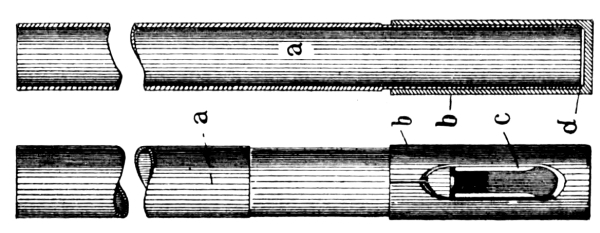
Fig. 106.—Scovell’s Milk Sampling Tube.
433. Scovell’s Milk Sampler.—In sampling large quantities of milk in pails or shipping cans, it is exceedingly inconvenient to mix the milk by pouring from one vessel to another or by any easy process of stirring. In order to get representative samples in such conditions, Scovell has put in use a sampler, by means of which a typical portion of the milk may be withdrawn from a can without either pouring or stirring. The construction of the sampler is shown in Fig. 106, representing it in outline and longitudinal section. The tube a, made of brass, is open at both ends and of any convenient dimensions. Its lower end slides in a large tube b, closed at the bottom and having three elliptical, lateral openings c, which admit the milk as the tube is slowly depressed in the contents of the can. In getting the sample, a is raised as shown in profile. When the bottom of b reaches the bottom of the can a is pushed down as shown in the section. The milk contained in the sampler is then readily withdrawn.
434. Preserving Milk for Analysis.—Pasteurizing or boiling the sample is not advisable by reason of the changes produced in the milk by heat. The milk sample may be preserved by adding to it a little chloroform, one part in 100 being sufficient. Boric and salicylic acids may also be used, but not so advantageously as formaldehyd or mercuric chlorid. Rideal has observed that one part of formaldehyd will preserve 10,000 parts of milk in a fresh state for seven days. The formaldehyd sold in the trade contains about one part of formaldehyd in 320 of the mixture. One-half pint of this commercial article is sufficient for about twenty gallons of milk, corresponding to about one part of pure formaldehyd to 45,000 parts of milk. Rideal much prefers formalin (formaldehyd) to borax or boric acid as a milk preservative. No ill effects due to its toxic action have been observed, even when it is consumed in a one per cent solution.[412]
Samples of milk can be kept in this way from four to six weeks by adding about one drop of the commercial formaldehyd to each ounce of sample. The analyst should remember in such cases that the formaldehyd may not all escape on evaporation, on account of forming some kind of a compound with the constituents of the milk, as is pointed out by Bevan.[413]
Bevan suggests that the formaldehyd may not actually be retained in the sample, but that the increase in the apparent amount of total solids is due to the conversion of the lactose into galactose. This point, however, has not been determined.
Richmond and Boseley propose to detect formalin by means of diphenylamin. A solution of diphenylamin is made with water, with the help of just enough sulfuric acid to secure a proper solvent effect. The liquid to be tested, which is supposed to contain formaldehyd, or the distillate therefrom, is added to this solution and boiled. If formaldehyd be present, a white flocculent precipitate is deposited, which is colored green if the acid used contain nitrates. For other methods of detecting formalin and for a partial literature of the subject the paper mentioned above may be consulted.
One gram of fine-ground mercuric chlorid dissolved in 2,000 grams of milk will preserve it, practically unchanged, for several days. One gram of potassium bichromate dissolved in one liter of milk will also preserve it for some time. Thymol, hydrochloric acid, carbon disulfid, ether and other antiseptics may also be employed. No more of the preserving agent should be used than is required to keep the milk until the analysis is completed.
All methods of preservation are rendered more efficient by the maintenance of a low temperature, whereby the vitality of the bacteria is greatly reduced.
435. Freezing Point of Milk.—By reason of its content of sugar and other dissolved solids, the freezing point of milk is depressed below 0°. A good idea of the purity of whole milk is secured by subjecting it to a kryoscopic test. The apparatus employed for this purpose is that used in general analytical work in the determination of freezing points. Pure full milk freezes at about 0°.55 below zero, and any marked variation from this number shows adulteration or abnormal composition.[414] A simple apparatus, especially adapted to milk, is described by Beckmann.[415] The kryoscopic investigation may also be extended to butter fat dissolved in benzol.
436. Electric Conductivity of Milk.—The electric conductivity of milk may also be used as an index of its composition. The addition of water to milk diminishes its conductivity.[416] This method of investigation has at present but little practical value.
437. Viscosity Of Milk.—The viscosity of milk may be determined by the methods already described. Any variation from the usual degree of fluidity is indicated either by the abstraction of some of the contents of the milk, the addition of some adulterant or the result of fermentation.
438. Acidity and Alkalinity of Milk.—Fresh milk of normal constitution has an amphoteric reaction. It will redden blue and blue red litmus paper. This arises from the presence in the milk of both neutral and acid phosphates of the alkalies. A saturated alkaline phosphate, i. e., one in which all the acid hydrogen of the acid has been replaced by the base has an alkaline reaction while the acid phosphates react acid. When fresh milk is boiled its reaction becomes strongly alkaline and this arises chiefly from the escape of the dissolved carbon dioxid. By the action of micro-organisms on the lactose of milk, the alkaline reaction soon becomes acid, and delicate test paper will show this decomposition long before it becomes perceptible to the taste. It is advisable to test the reactions of the milk as soon as possible after it is drawn from the udder, both before and after boiling.
439. Determination of the Acidity of Milk.—In the determination of the acidity of milk it is important that it first be freed of the carbon dioxid it contains.[417] Van Slyke has found that too high results are obtained by the direct titration of milk for acidity, and when the milk is previously diluted the results are also somewhat too high.[418] Good results are got by diluting the milk with hot water and boiling for a short time to expel the carbon dioxid. Twenty-five cubic centimeters of milk are diluted with water to about a quarter of a liter, as above, two cubic centimeters of a one per cent alcoholic phenolphthalien added and the titration accomplished by decinormal alkali. This variation of the methods of procedure, suggested by Hopkins and Powers, appears to be the best process at present known for the determination of acidity. The reader is referred to the paper cited above for references to other methods which have been proposed.
440. Opacity Of Milk.—The white color and opacity of milk are doubtless due to the presence of the suspended fat particles and to the colloid casein. On the latter it is probably principally dependent since the color of milk is not very sensibly changed after it has passed the extractor, which leaves not to exceed one-tenth of one per cent of fat in it. Some idea of the quality of the milk, however, may be obtained by determining its opacity. This is accomplished by the use of a lactoscope. The one generally employed was devised by Feser and is shown in Fig. 107.
The instrument consists of a cylindrical glass vessel of a little more than 100 cubic centimeters content, in the lower part of which is set a cone of white glass marked with black lines. Into this part are placed four cubic centimeters of milk. A small quantity of water is added and the contents of the vessel shaken. This operation is repeated until the black lines on the white glass just become visible. The graduations on the left side show the volume of water which is necessary to bring the dark lines into view, while those on the right indicate approximately the percentage of fat present.
Among the other lactoscopes which have been used may be mentioned those of Donné, Vogel, Hoppe-Seyler, Trommer, Seidlitz, Reischauer, Mittelstrass, Hénocque, and Heusner.[419] Since the invention of so many quick and accurate methods of fat estimation these instruments have little more than a historical interest.
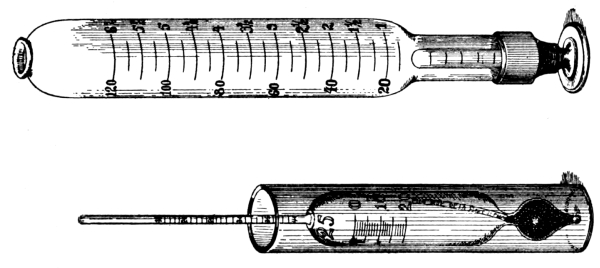
Fig. 107.—Lactoscope, Lactometer and Creamometer.
441. Creamometry.—The volume of cream which a sample of milk affords under arbitrary conditions of time and temperature is sometimes of value in judging the quality of milk. A convenient creamometer is a small cylinder graduated in such a way that the volume of cream separated in a given time can be easily noted. There are many kinds of apparatus used for this purpose, a typical one being shown in Fig. 107.
The usual time of setting is twenty-four hours. A quicker determination is secured by placing the milk in strong glass graduated tubes and subjecting these to centrifugal action. The process is not exact and is now rarely practiced as an analytical method, even for valuing the butter making properties of milk.
442. Specific Gravity.—The specific gravity of milk is uniformly referred to a temperature of 15°. Generally no attempt is made to free the milk of dissolved gases beforehand. This should not be done by boiling but by placing the sample in a vacuum for some time. Any of the methods described for determining specific gravity in sugar solutions may be used for milk (48-59). The specific gravity of milk varies in general from 1.028 to 1.034. Nearly all good cow milk from herds will show a specific gravity varying from 1.030 to 1.032. In extreme cases from single cows the limits may exceed those first given above, but such milk cannot be regarded as normal.
Increasing quantities of solids not fat in solution, tend to increase the specific gravity, while an excess of fat tends to diminish it. There is a general ratio existing between the solids not fat and the fat in cow milk, which may be expressed as 9: 4. The removal of cream and the addition of water in such a manner as not to affect the specific gravity of the sample disturbs this ratio.
The determination of the specific gravity alone, therefore, cannot be relied upon as an index of the purity of a milk.
443. Lactometry.—A hydrometer especially constructed for use in determining the density of milk is called a lactometer. In this country the one most commonly used is known as the lactometer of the New York Board of Health. It is a hydrometer, delicately constructed, with a large cylindrical air space and a small stem carrying the thermometric and lactometric scales. It is shown held in the creamometer in Fig. 107. The milk is brought to a temperature of 60° F. and the reading of the lactometer scale observed. This is converted into a number expressing the specific gravity by means of a table of corresponding values given below. Each mark on the scale of the instrument corresponds to two degrees and these marks extend from 0° to 120°. The numbers of this scale can be converted into those corresponding to the direct reading instrument, described in the next paragraph, by multiplying them by 0.29.
The minimum density for whole milk at 60° F. is fixed by this instrument at 100°, corresponding to a specific gravity of 1.029. The instrument is also constructed without the thermometric scale. The mean density of many thousand samples of pure milk, as observed by the New York authorities, is 1.0319.
The specific gravity is easily secured, and while not of itself decisive, should always be determined. The specific gravity of milk increases for some time after it is drawn and should be made both when fresh and after the lapse of several hours.[420]
Table Showing Specific Gravities Corresponding to Degrees of the New York Board Of Health Lactometer. Temperature 60° F.
Degree. Sp. gr. Degree. Sp. gr.
90 1.02619 106 1.03074
91 1.02639 107 1.03103
92 1.02668 108 1.03132
93 1.02697 109 1.03161
94 1.02726 110 1.03190
95 1.02755 111 1.03219
96 1.02784 112 1.03248
97 1.02813 113 1.03277
98 1.02842 114 1.03306
99 1.02871 115 1.03335
100 1.02900 116 1.03364
101 1.02929 117 1.03393
102 1.02958 118 1.03422
103 1.02987 119 1.03451
104 1.03016 120 1.03480
105 1.03045
444. Direct Reading Lactometer.—A more convenient form of lactometer is one which gives the specific gravity directly on the scale. The figures given represent those found in the second and third decimal places of the number expressing the specific gravity. Thus 31 on the scale indicates a specific gravity of 1.031. This instrument is also known as the lactometer of Quévenne. For use with milk, the scale of the instrument does not need to embrace a wider limit than from 25 to 35, and such an instrument is capable of giving more delicate readings than when the scale extends from 14 to 42, as is usually the case with the quévenne instrument.
Langlet has invented a lactoscope with a scale, showing the corrections to be applied for temperatures other than 15°. A detailed description of this instrument, as well as the one proposed by Pinchon, is unnecessary.[421]
445. Density of Sour Milk.—Coagulated milk cannot be used directly for the determination of the specific gravity, both because of its consistence and by reason of the fact that the fat is more or less completely separated. In such a case, the casein may be dissolved by the addition of a measured quantity of a solvent of a known specific gravity, the density of the resulting solution determined and that of the original milk calculated from the observed data. Ammonia is a suitable solvent for this purpose.[422]
446. Density of the Milk Serum.—The specific gravity of the milk serum, after the removal of the fat and casein by precipitation and filtration, may also be determined. For normal cow milk the number is about 1.027.
447. Total Solids.—The direct gravimetric determination of the total solids in milk is attended with many difficulties, and has been the theme of a very extended periodical literature. A mere examination of the many processes which have been proposed would require several pages.
The most direct method of procedure is to dry a small quantity of milk in a flat-bottom dish to constant weight on a steam-bath. The surface of the dish should be very large, even for one or two grams of milk; in fact the relation between the quantity of milk and the surface of the dish should be such that the fluid is just sufficient in amount to moisten the bottom of the dish with the thinnest possible film. The dish, during drying, is kept in a horizontal position at least until its contents will not flow. The water of the sample will be practically all evaporated in about two hours. The operation may be accelerated by drying in vacuo.
The drying may also be accomplished by using a flat-bottom dish containing some absorbent, such as sand, pumice stone, asbestos or crysolite. The milk may also be absorbed by a dried paper coil and dried thereon (26).
It is convenient to determine the water in the sample subsequently to be used for the gravimetric determination of the fat, and this is secured by the adoption of the paper coil method, as suggested by the author, or by the use of a perforated metal tube containing porous asbestos, as proposed by Babcock.[423]
The process is conveniently carried out as follows:
Provide a hollow cylinder of perforated sheet metal sixty millimeters long and twenty millimeters in diameter, closed five millimeters from one end by a disk of the same material. The perforations should be about 0.7 millimeter in diameter and as close together as possible. Fill loosely with from one and a half to two and a half grams of dry woolly asbestos and weigh. Introduce a weighed quantity of milk (about five grams). Dry at 100° for four hours. During the first part of the drying the door of the oven should be left partly open to allow escape of moisture. Cool in a desiccator and weigh. Repeat the drying until the weight remains constant. Place in an extractor and treat with anhydrous ether for two hours. Evaporate the ether and dry the fat at 100°. The extracted fat is weighed and the number thus obtained may be checked by drying and weighing the cylinder containing the residue.
The asbestos best suited for use in this process should be of a woolly nature, quite absorbent, and, previous to use, be ignited to free it of moisture and organic matter. A variety of serpentine, crysolite is sometimes used instead of asbestos. When the content of water alone is desired, it is accurately determined by drying in vacuo over pumice stone (page 33).
The methods above mentioned are typical and will prove a sufficient guide for conducting the desiccation, either as described or by any modification of the methods which may be preferred.
448. Calculation of Total Solids.—By reason of the ease and celerity with which the density of a milk and its content of fat can be obtained, analysts have found it convenient to calculate the percentage of total solids instead of determining it directly. This is accomplished by arbitrary formulas based on the data of numerous analyses. These formulas give satisfactory results when the samples do not vary widely from the normal and may be used with advantage in most cases.
Among the earliest formulas for the calculation may be mentioned those of Fleischmann and Morgen,[424] Behrend and Morgen,[425] Claus, Stutzer and Meyer,[426] Hehner,[427] and Hehner and Richmond.[428] Without doing more than citing these papers it will be sufficient here to give the formulas as corrected by the most recent experience.
In the formula worked out by Babcock the specific gravity of the sample is represented by S, the fat by F, and the solids not fat by t. The formula is written as follows:[429]
t = ( 100S - FS ) (250 - 2.5 F).
100 - 1.0753FS
In this formula it is assumed that the difference between the specific gravity of the milk serum and that of water is directly proportional to the per cent of solids in the serum, but this assumption is not strictly correct. Even in extreme cases, however, the error does not amount to more than 0.05 per cent.
Since a given amount of milk sugar increases the density of a milk more than the same quantity of casein, it is evident that the formula would not apply to those instances in which the ratio between these two ingredients is greatly disturbed, as for instance, the whey.
The formula of Hehner and Richmond, in its latest form, is expressed as follows:
T = 0.2625 G + 1.2F,
D
in which T represents the total solids, G the reading of the quévenne lactometer, D the specific gravity, and F the fat.
Example.—Let the reading of the lactometer be 31, corresponding to D 1.031, and the percentage of fat be three and five-tenths, what is the percentage of the total solids?
Substituting these values in the formulas we have
T = 0.2625 31 + 1.2 × 3.5 = 12.09.
1.031
To simplify the calculations, Richmond’s formula may be written
T = G + 6F + 0.14.
4 5
Calculated by this shortened formula from the above data T = 12.09, the same as given in the larger formula.
Calculating the solids not fat in the hypothetical case given above by Babcock’s formula, we get t = 8.46, and this plus 3.5 gives 11.96, which is slightly lower than the number obtained by the richmond process.
The babcock formula may be simplified by substituting the number expressing the reading of the quévenne lactometer for that donating the specific gravity, in other words, the specific gravity multiplied by 100 and the quotient diminished by 1000.
The formulas for solids not fat and total solids then become
t = L + 0.2F, and T = L + 1.2F,
4 4
in which L represents the reading of the lactometer. By the addition of the constant factor 0.14 the results calculated by the formula of Babcock are the same as those obtained by the method of Richmond.
In the following table are given the solids not fat in milks as calculated by Babcock’s formula. To obtain the total solids add the per cent of fat to solids not fat. To obtain total solids according to Richmond’s formula increase that number by 0.14.
Table Showing Per Cent of Solids not Fat in Milk Corresponding to Quévenne’s Lactometer Readings and Per Cent of Fat.
Per cent Lactometer reading at 60° F.
of fat. 26. 27. 28. 29. 30. 31. 32. 33. 34. 35. 36 .
0.0 6.50 6.75 7.00 7.25 7.50 7.75 8.00 8.25 8.50 8.75 9.00
0.1 6.52 6.77 7.02 7.27 7.52 7.77 8.02 8.27 8.52 8.77 9.02
0.2 6.54 6.79 7.04 7.29 7.54 7.79 8.04 8.29 8.54 8.79 9.04
0.3 6.56 6.81 7.06 7.31 7.56 7.81 8.06 8.31 8.56 8.81 9.06
0.4 6.58 6.83 7.08 7.33 7.58 7.83 8.08 8.33 8.58 8.83 9.08
0.5 6.60 6.85 7.10 7.35 7.60 7.85 8.10 8.35 8.60 8.85 9.10
0.6 6.62 6.87 7.12 7.37 7.62 7.87 8.12 8.37 8.62 8.87 9.12
0.7 6.64 6.89 7.14 7.39 7.64 7.89 8.14 8.39 8.64 8.89 9.14
0.8 6.66 6.91 7.16 7.41 7.66 7.91 8.16 8.41 8.66 8.91 9.16
0.9 6.68 6.93 7.18 7.43 7.68 7.93 8.18 8.43 8.68 8.93 9.18
1.0 6.70 6.95 7.20 7.45 7.70 7.95 8.20 8.45 8.70 8.95 9.20
1.1 6.72 6.97 7.22 7.47 7.72 7.97 8.22 8.47 8.72 8.97 9.22
1.2 6.74 6.99 7.24 7.49 7.74 7.99 8.24 8.49 8.74 8.99 9.24
1.3 6.76 7.01 7.26 7.51 7.76 8.01 8.26 8.51 8.76 9.01 9.26
1.4 6.78 7.03 7.28 7.53 7.78 8.03 8.28 8.53 8.78 9.03 9.28
1.5 6.80 7.05 7.30 7.55 7.80 8.05 8.30 8.55 8.80 9.05 9.30
1.6 6.82 7.07 7.32 7.57 7.82 8.07 8.32 8.57 8.82 9.07 9.32
1.7 6.84 7.09 7.34 7.59 7.84 8.09 8.34 8.59 8.84 9.09 9.34
1.8 6.86 7.11 7.36 7.61 7.86 8.11 8.36 8.61 8.86 9.11 9.37
1.9 6.88 7.13 7.38 7.63 7.88 8.13 8.38 8.63 8.88 9.14 9.39
2.0 6.90 7.15 7.40 7.65 7.90 8.15 8.40 8.66 8.91 9.16 9.41
2.1 6.92 7.17 7.42 7.67 7.92 8.17 8.42 8.68 8.93 9.18 9.43
2.2 6.94 7.19 7.44 7.69 7.94 8.19 8.44 8.70 8.95 9.20 9.45
2.3 6.96 7.21 7.46 7.71 7.96 8.21 8.46 8.72 8.97 9.22 9.47
2.4 6.98 7.23 7.48 7.73 7.98 8.23 8.48 8.74 8.99 9.24 9.49
2.5 7.00 7.25 7.50 7.75 8.00 8.25 8.50 8.76 9.01 9.26 9.51
2.6 7.02 7.27 7.52 7.77 8.02 8.27 8.52 8.78 9.03 9.28 9.53
2.7 7.04 7.29 7.54 7.79 8.04 8.29 8.54 8.80 9.05 9.30 9.55
2.8 7.06 7.31 7.56 7.81 8.06 8.31 8.57 8.82 9.07 9.32 9.57
2.9 7.08 7.33 7.58 7.83 8.08 8.33 8.59 8.84 9.09 9.34 9.59
3.0 7.10 7.35 7.60 7.85 8.10 8.36 8.61 8.86 9.11 9.36 9.61
3.1 7.12 7.37 7.62 7.87 8.13 8.38 8.63 8.88 9.13 9.38 9.64
3.2 7.14 7.39 7.64 7.89 8.15 8.40 8.65 8.90 9.15 9.41 9.66
3.3 7.16 7.41 7.66 7.92 8.17 8.42 8.67 8.92 9.18 9.43 9.68
3.4 7.18 7.43 7.69 7.94 8.19 8.44 8.69 8.94 9.20 9.45 9.70
3.5 7.20 7.45 7.71 7.96 8.21 8.46 8.71 8.96 9.22 9.47 9.72
3.6 7.22 7.48 7.73 7.98 8.23 8.48 8.73 8.98 9.24 9.49 9.74
3.7 7.24 7.50 7.75 8.00 8.25 8.50 8.75 9.00 9.26 9.51 9.76
3.8 7.26 7.52 7.77 8.02 8.27 8.52 8.77 9.02 9.28 9.53 9.78
3.9 7.28 7.54 7.79 8.04 8.29 8.54 8.79 9.04 9.30 9.55 9.80
4.0 7.30 7.56 7.81 8.06 8.31 8.56 8.81 9.06 9.32 9.57 9.83
4.1 7.32 7.58 7.83 8.08 8.33 8.58 8.83 9.08 9.34 9.59 9.85
4.2 7.34 7.60 7.85 8.10 8.35 8.60 8.85 9.11 9.36 9.62 9.87
4.3 7.36 7.62 7.87 8.12 8.37 8.62 8.88 9.13 9.38 9.64 9.89
4.4 7.38 7.64 7.89 8.14 8.39 8.64 8.90 9.15 9.40 9.66 9.91
4.5 7.40 7.66 7.91 8.16 8.41 8.66 8.92 9.17 9.42 9.68 9.93
4.6 7.43 7.68 7.93 8.18 8.43 8.68 8.94 9.19 9.44 9.70 9.95
4.7 7.45 7.70 7.95 8.20 8.45 8.70 8.96 9.21 9.46 9.72 9.97
4.8 7.47 7.72 7.97 8.22 8.47 8.72 8.98 9.23 9.48 9.74 9.99
4.9 7.49 7.74 7.99 8.24 8.49 8.74 9.00 9.25 9.50 9.76 10.01
5.0 7.51 7.76 8.01 8.26 8.51 8.76 9.02 9.27 9.52 9.78 10.03
5.1 7.53 7.78 8.03 8.28 8.53 8.79 9.04 9.29 9.54 9.80 10.05
5.2 7.55 7.80 8.05 8.30 8.55 8.81 9.06 9.31 9.56 9.82 10.07
5.3 7.57 7.82 8.07 8.32 8.57 8.83 9.08 9.33 9.58 9.84 10.09
5.4 7.59 7.84 8.09 8.34 8.60 8.85 9.10 9.36 9.61 9.86 10.11
5.5 7.61 7.86 8.11 8.36 8.62 8.87 9.12 9.38 9.63 9.88 10.13
5.6 7.63 7.88 8.13 8.39 8.64 8.89 9.15 9.40 9.65 9.90 10.15
5.7 7.65 7.90 8.15 8.41 8.66 8.91 9.17 9.42 9.67 9.92 10.17
5.8 7.67 7.92 8.17 8.43 8.68 8.94 9.19 9.44 9.69 9.94 10.19
5.9 7.69 7.94 8.20 8.45 8.70 8.96 9.21 9.46 9.71 9.96 10.22
6.0 7.71 7.96 8.22 8.47 8.72 8.98 9.23 9.48 9.73 9.98 10.24
449. Determination of Ash.—In the determination of the solid residue obtained by drying milk, it is important to observe the directions already given (28-32).
In the direct ignition of the sample, a portion of the sulfur and phosphorus may escape oxidation and be lost as volatile compounds. This loss may be avoided by the use of proper oxidizing agents or by conducting the combustion as heretofore described.[430] In the official method, it is directed to add six cubic centimeters of nitric acid to twenty of milk, evaporate to dryness and ignite the residue at a low red heat until free of carbon.[431] It is doubtful if this precaution be entirely sufficient to save all the sulfur and phosphorus, but the method is evidently more reliable than the common one of direct ignition without any oxidizing reagent whatever.
ESTIMATION OF FAT.
450. Form of Fat in Milk.—The fat in milk occurs in the form of globules suspended in the liquid, in other words in the form of an emulsion. Many authorities have asserted that each globule of fat is contained in a haptogenic membrane composed presumably of nitrogenous matter, but there is no convincing evidence of the truth of this opinion. The weight of experimental evidence is in the opposite direction. The supposed action of the membrane and the phenomena produced thereby are more easily explained by the surface tension existing between the fat globules and the menstruum in which they are suspended.
Babcock affirms that the spontaneous coagulation of the fibrin present in milk tends to draw the fat globules into clusters, and this tendency can be arrested by adding a little soda or potash lye to the milk as soon as it is drawn.[432]
The diameter of the fat globules is extremely variable, extending in some cases from two to twenty micromillimeters. In cow milk, the usual diameters are from three to five micromillimeters.
451. Number of Fat Globules in Milk.—The number of fat globules in milk depends on their size and the percentage of fat. It is evident that no definite statement of the number can be made. There is a tendency, on the part of the globules, to diminish in size and increase in number as the period of lactation is prolonged. To avoid large numbers, it is convenient to give the number of globules in 0.0001 cubic millimeter. This number may be found within wide limits depending on the individual, race, food and other local conditions to which the animal or herd is subjected. In general, in whole milk this number will be found between 140 and 250.
452. Method of Counting Globules.—The number of globules in milk is computed with the aid of the microscope. The most convenient method is the one devised by Babcock.[433] In carrying out this computation, capillary tubes, from two to three centimeters long and about one-tenth millimeter in internal diameter, are provided. The exact diameter of each tube, in at least three points, is determined by the micrometer attachment of the microscope, and from these measurements the mean diameter of the tube is calculated. This known, its cubic content for any given length is easily computed. Ten cubic centimeters of the milk are diluted with distilled water to half a liter and one end of a capillary tube dipped therein. The tube is quickly filled with diluted milk and each end is closed with a little wax to prevent evaporation. Several of these tubes being thus prepared, they are placed in a horizontal position on the stage of the microscope and covered with glycerol and a cover glass. The tubes are left at rest for some time until all the fat globules have attached themselves to the upper surfaces, in which position they are easily counted. The micrometer is so placed as to lie parallel with the tubes, and the number of globules, corresponding to each division of its scale, counted. The mean number of globules corresponding to each division of the micrometer scale is thus determined.
To compare the data obtained with each tube they are reduced to a common basis of the number of globules found in a length of fifty divisions of the micrometer scale in a tube having a diameter of 100 divisions, using the formula
N = 10000n
d²
in which n = the number of globules found in the standard length of tube measured and d = the diameter of the tube. It is not difficult to actually count all the globules in a length of fifty divisions of the scale, but the computation may also be made from the mean numbers found in a few divisions. The usual number of globules found in a length of 0.1 millimeter in a tube 0.1 millimeter in diameter, varies from fifty to one hundred.
Example.—The length of one division of the micrometer scale is 0.002 millimeter, and the internal diameter of the tube 0.1 millimeter. The content of a tube, of a length of 0.002 × 50 = 0.1 millimeter, is therefore 0.0007854 cubic millimeter.
The cubic content of a tube 100 scale divisions in diameter and fifty in length is 0.0031416 cubic millimeter. The number of globules found in fifty divisions of the tubes used is 40. Then the number which would be contained in a tube of a diameter of 100 divisions of the micrometer scale and a length of fifty divisions thereof is
N = 10000n = 400000 = 160.
d² 2500
Since the milk is diluted fifty times, the actual number of globules corresponding to the volume given is 8000. It is convenient to reduce the observations to some definite volume, exempla gratia, 0.0001 cubic centimeter. The equation for this in the above instance is 0.0031416: 0.0001 = 8000: x, whence x = 223, = number of fat globules in 0.0001 cubic millimeter.
In one cubic millimeter of milk there are therefore 2,230,000 fat globules, and in one cubic centimeter 2,230,000,000 globules. In a single drop of milk there are from one to two hundred million fat globules.[434]
453. Classification of Methods of Determining Fat in Milk.—The fat, being the most valuable of the constituents of milk, is the subject of a number of analytical processes. An effort will be made here to classify these various methods and to illustrate each class with one or more typical processes. In general the methods may be divided into analytical and commercial, those of the first class being used for scientific and of the other for trade purposes. For normal milk, some of the trade methods have proved to be quite as accurate as the more chronokleptic analytical processes to which, in disputed cases, a final appeal must be taken. When the analyst is called upon to determine the fat in a large number of samples of milk some one of the trade methods may often be adopted with great advantage.
454. Dry Extraction Methods.—Among the oldest and most reliable methods of determining fat in milk, are included those processes based on the principle of drying the milk and extracting the fat from the residue by an appropriate solvent. The solvents generally employed are ether and petroleum spirit of low boiling point. The methods of drying are legion.
In extracting with ether, it must not be forgotten that other bodies than fat may pass into solution on the one hand and on the other any substituted glycerid, such as lecithin or nuclein, which may be present may escape solution, at least in part. Perhaps petroleum spirit, boiling at from 45° to 60°, is the best solvent for fat, but it is almost the universal custom in this and other countries to use ether.
455. The Official Methods.—In the methods adopted by the Association of Official Agricultural Chemists two processes are recommended.
(1) The Asbestos Process: In this process it is directed to extract the residue from the determination of water by the asbestos method (447) with anhydrous pure ether until the fat is removed, evaporate the ether, dry the fat at 100° and weigh. The fat may also be determined by difference, after drying the extracted cylinders at 100°.
(2) Paper Coil Method: This is essentially the method proposed by Adams as modified by the author.[435] Coils made of thick filter paper are cut into strips 6.25 by 62.5 centimeters, thoroughly extracted with ether and alcohol, or the weight of the extract corrected by a constant obtained for the paper. If this latter method be used, a small amount of anhydrous sodium carbonate should be added. Paper free of matters soluble in ether is also to be had for this purpose. From a weighing bottle about five grams of milk are transferred to the coil by a pipette, taking care to keep dry the lower end of the coil. The coil, dry end down, is placed on a piece of glass, and dried at a temperature of boiling water for one hour, or better, dried in hydrogen at a temperature of boiling water, transferred to an extraction apparatus and extracted with absolute ether or petroleum spirit boiling at about 45°. The extracted fat is dried in hydrogen and weighed. Experience has shown that drying in hydrogen is not necessary. The fat may be conveniently dried in partial vacuo.
456. Variations of Extraction Method.—The method of preparing the milk for fat extraction is capable of many variations. Some of the most important follow:
(1) Evaporation on Sand: The sand should be pure, dry and of uniform size of grain. It may be held in a dish or tube. The dish may be made of tin foil, so that it can be introduced with its contents into the extraction apparatus after the desiccation is complete. For this purpose, it is cut into fragments of convenient size after its contents have been poured into the extractor. The scissors used are washed with the solvent.
(2) Evaporation on Kieselguhr: Dry kieselguhr (infusorial earth, tripoli) may take the place of the sand as above noted. The manipulation is the same as with sand.
(3) Evaporation on Plaster of Paris,[436] (Soxhlet Method),[437] (4) On Pumice Stone, (5) On Powdered Glass, (6) On Chrysolite:[438] The manipulation in these cases is conducted as with sand and no detailed description is required.
(7) Evaporation on Organic Substances: These variations would fall under the general heading of drying on paper. The following materials have been used; viz., sponge,[439] lint,[440] and wood pulp.[441] In these variations the principal precautions to be observed are to secure the organic material in a dry state and free of any matter soluble in the solvent used.
(8) Dehydration with Anhydrous Copper Sulfate: In this process the water of the sample is absorbed by powdered anhydrous copper sulfate, the residual mass extracted and the butter fat obtained determined by saponification and titration.[442] In the manipulation about twenty grams of the anhydrous copper sulfate are placed in a mortar, a depression made therein in such a manner that ten cubic centimeters of milk can be poured into it without wetting it through to the mortar. The water is soon absorbed when the mass is ground with a little dry sand and transferred to the extractor.
Petroleum spirit of low boiling point is used as a solvent, successive portions of about fifteen cubic centimeters each being forced through the powdered mass under pressure. Two or three treatments with the petroleum are required. The residual butter fat, after the evaporation of the petroleum, is saponified with a measured portion, about twenty-five cubic centimeters, of seminormal alcoholic potash lye. The residual alkali is determined by titration with seminormal hydrochloric acid in the usual manner. From the data obtained is calculated the quantity of alkali employed in the saponification. The weight of butter fat extracted is then calculated on the assumption that 230 milligrams of potash are required to saponify one gram of the fat.
457. Gypsum Method for Sour Milk.—In sour milk, extraction of the dry residue with ether is attended with danger of securing a part of the free lactic acid in the extract. This may be avoided, at least in part, by making the milk neutral or slightly alkaline before desiccation. This method is illustrated by a variation of Soxhlet’s method of drying on gypsum proposed by Kühn.[443] The curdled milk is treated with potash lye of forty per cent strength until the reaction is slightly alkaline. For absorbing the sample before drying, a mixture is employed consisting of twenty-five grams of plaster of paris, four of precipitated carbonate of lime and two of acid potassium sulfate. To this mixture ten grams of the milk, rendered alkaline as above noted, are added in a desiccating dish, the excess of moisture evaporated at 100°, the residual mass finely ground and extracted with ether for four hours. A little gypsum may be found in the solution, but in such small quantities as not to interfere seriously with the accuracy of the results obtained.
458. Estimation of Fat in Altered Milk.—In altered milk the lactose has usually undergone a fermentation affording considerable quantities of lactic acid. If such milks be treated by the extraction method for fat, the results will always be too high, because of the solubility of lactic acid in ether.
Vizern[444] has proposed to avoid this error by first warming the soured milk for a few minutes to 40°, at which temperature the clabber is easily divided by vigorous shaking. Of the milk thus prepared, thirty grams are diluted with two or three volumes of water and poured onto a smooth and moistened filter. The vessel and filter are washed several times until the filtrate presents no further acid reaction. The filter and its contents are next placed in a vessel containing some fine washed sand. A small quantity of water is added, sufficient to form a paste. With a stirring rod, the filter is entirely broken up and the whole mass thoroughly mixed. Dried on the water bath the material is subjected to extraction in the ordinary way. Several analyses made on fresh milk and on milk kept for several months show that almost identical results are obtained.
In respect of this process there would be danger, on long standing, of the formation of free acids from butter glycerids, and these acids would be removed by the process of washing prescribed. In this case the quantity of fat obtained would be less than in the original sample.
459. Comparison of Methods.—An immense amount of work has been done by analysts in comparing the various types of extraction methods outlined above.[445]
The consensus of opinion is that good results are obtained by all the methods when properly conducted, and preference is given to the two methods finally adopted by the Association of Official Chemists. As solvents, pure ether and petroleum spirit of low boiling point are preferred. The direct extraction gravimetric processes are important, since it is to these that all the other quicker and easier methods must appeal for the proof of their accuracy.
460. Wet Extraction Methods.—It has been found quite impracticable to extract the fat from milk by shaking it directly with the solvent. An emulsion is produced whereby the solvent itself becomes incorporated with the other constituents of the milk, and from which it is not separated easily even with the aid of whirling. The disturbing element which prevents the separation of the solvent is doubtless the colloid casein, since, when this is previously rendered soluble, the separation of the solvent holding the fat is easily accomplished.
The principle on which the methods of wet extraction are based is a simple one; viz., to secure a complete or partial solution of the casein and subsequently to extract the fat with a solvent immiscible with water. The methods may be divided into three great classes; viz., (1) those in which the solvent is evaporated from the whole of the extracted fat and the residual matters weighed; (2) processes in which an aliquot part of the fat solution is employed and the total fat calculated from the data secured; (3) the density of the fat solution is determined at a definite temperature and the percentage of fat corresponding thereto determined from tables or otherwise. Methods (1) and (2) are practically identical in principle and one or the other may be applied according to convenience or to local considerations. The methods may be further subdivided in respect of the reagents used to secure complete or partial solution of the casein, as, for instance, alkali or acid.[446]
461. Solution in an Acid.—A good type of these processes is the method of Schmid.[447] In this process ten cubic centimeters of milk are placed in a test tube of about five times that content, graduated to measure small volumes. An equal quantity of hydrochloric acid is added, the mixture shaken, boiled until it turns dark brown, and cooled quickly. The fat is extracted by shaking with thirty cubic centimeters of ether. After standing some time the ethereal solution separates and its volume is noted. An aliquot part of the solution is removed, the solvent evaporated, and the weight of fat in the whole determined by calculation.
The schmid process has been improved by Stokes,[448] Hill,[449] and Richmond.[450] The most important of these variations consists in weighing instead of measuring the milk employed, thus insuring greater accuracy. Dyer and Roberts affirm that the ether dissolves some of the caramel products formed on boiling condensed milk with hydrochloric acid, and that the data obtained in such cases by the process of Schmid are too high.[451]
Since lactic acid is also slightly soluble in ether, sour milk should not be extracted with that solvent. In these cases petroleum spirit, or a mixture of petroleum and ether, as suggested by Pinette, may be used.[452] Another variation consists in extracting the fat with several portions of the solvent and evaporating all the extracts thus obtained to get the total fat. This method is perhaps the best of those in which the fat is extracted from the residual liquid after the decomposition of the casein by an acid, and may be recommended as both reliable and typical within the limitations mentioned above.
462. Solution in an Alkali.—The casein of milk is not so readily dissolved in an alkali as in an acid, but the solution is sufficient to permit the extraction of the fat. Soda and potash lyes and ammonia are the alkaline bodies usually employed. To promote the separation of the emulsions, alcohol is added with advantage. The principle of the process rests on the observed power of an alkali to free the fat globules sufficiently to allow them to dissolve in ether or some other solvent. When the solvent has separated from the emulsion at first formed, the whole or a part of it is used for the determination of fat in a manner entirely analogous to that employed in the process with the acid solutions described above. There are many methods based on this principle, and some of the typical ones will be given below. Experience has shown that extraction from an alkaline solution is more troublesome and less perfect than from an acid and these alkaline methods are, therefore, not so much practiced now as they were formerly.
463. Method of Short.—Instead of measuring the volume of the separated fat, Short has proposed a method in which the casein is dissolved in an alkali and the fat at the same time saponified. The soap thus produced is decomposed by sulfuric acid and the volume of the separated fat acids noted. This volume represents eighty-seven per cent of the corresponding volume of fat.[453]
The solvent employed is a mixture of sodium and potassium hydroxids, containing in one liter 125 and 150 grams, respectively, of these alkalies. The sample of milk is mixed with half its volume of the reagent and placed in boiling water for two hours. By this treatment the casein is dissolved and the fat saponified. After cooling to about 60°, the soap is decomposed by the addition of equal parts of sulfuric and acetic acids. The tubes containing the mixture are again placed in boiling water for an hour and they are then filled with boiling water to within one inch of the top. The tubes may either be furnished with a graduation or the column of fat be measured by a scale.
464. Method of Thörner.—The process of Short is conducted by Thörner as follows:[454]
Ten cubic centimeters of milk measured at 15° are saponified, in tubes fitting a centrifugal, by the addition of one and a half cubic centimeters of an alcoholic potash lye, containing 160 grams of potassium hydroxid per liter, or one cubic centimeter of an aqueous fifty per cent soda lye. The saponification is hastened by setting the tubes in boiling water, where they remain for two minutes. The soap formed is decomposed with a strong acid, sulfuric preferred, the tubes placed in the centrifugal and whirled for four minutes, when the fat acids will be formed in the narrow graduated part of the tube and the volume occupied thereby is noted after immersion in boiling water. Thörner’s process is not followed in this country, but is used to a considerable extent in Germany.[455]
465. Liebermann’s Method.—In this method, fifty cubic centimeters of milk, at ordinary temperatures, are placed in a glass cylinder twenty-five centimeters high and about four and a half internal diameter; five cubic centimeters of potash lye of 1.27 specific gravity are added, the cylinder closed with a well fitting cork stopper and thoroughly shaken.[456] After shaking, fifty cubic centimeters of petroleum spirit, boiling point about 60°, are added. The cylinder is again stoppered and vigorously shaken until an emulsion is formed. To this emulsion fifty cubic centimeters of alcohol of ninety-five per cent strength are added, and the whole again thoroughly shaken. After four or five minutes the petroleum spirit, containing the fat, separates. In order to insure an absolute separation of the fat, however, the shaking may be repeated three or four times for about one-quarter minute, waiting each time between the shakings until the spirit separates.
Of the separated petroleum spirit twenty cubic centimeters are placed in a small weighed flask. The use of the flask is recommended on account of the ease with which the petroleum spirit can be evaporated without danger of loss of fat. Instead of the flask a weighed beaker or other weighed dish may be employed.
The petroleum spirit is carefully evaporated on a water-bath and the residue dried at 110° to 120° for one hour. The weight found multiplied by five gives the content of fat in 100 cubic centimeters of the milk. The percentage by weight can then be calculated by taking into consideration the specific gravity of the milk employed.
The results obtained by this method agree well with those obtained by the paper coil method, when petroleum spirit instead of sulfuric ether is used as the solvent for the fat. Sulfuric ether, however, gives an apparently higher content of fat because of the solution of other bodies not fat present in the milk.
466. Densimetric Methods.—Instead of evaporating the separated fat solution and weighing the residue, its density may be determined and the percentage of fat dissolved therein obtained by calculation, or more conveniently from tables. The typical method of this kind is due to Soxhlet, and until the introduction of modern rapid volumetric processes, it was used perhaps more extensively than any other proceeding for the determination of fat in milk.[457] The reagents employed in the process are ether saturated with water and a potash lye containing 400 grams of potash in a liter. The principle of the process is based on the assumption that a milk made alkaline with potash will give up all its fat when shaken with ether and the quantity of fat in solution can be determined by ascertaining the specific gravity of the ethereal solution.
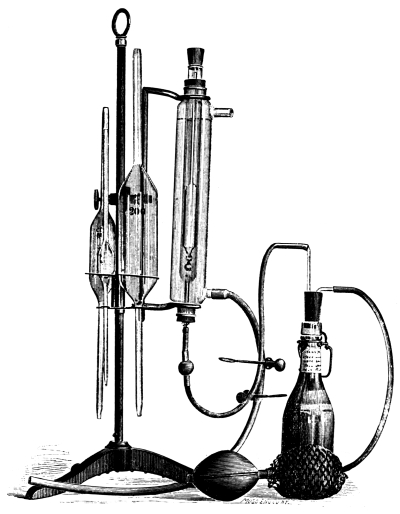
Fig. 108. Areometric Fat Apparatus.
The apparatus is arranged as shown in Fig. 108, whereby it is easy to drive the ethereal fat solution into the measuring vessel by means of the bellows shown. In the bottle, seen at the right of the engraving are placed 200 cubic centimeters of milk, ten of the potash lye and sixty of the aqueous ether. The milk and potash are first added and well shaken, the ether then added, and the contents of the bottle are shaken until a homogeneous emulsion is formed. The bottle is then set aside for the separation of the ethereal solution, which is promoted by gently jarring it from time to time. When the chief part of the solution has separated, a sufficient quantity of it is driven over into the measuring apparatus, by means of the air bulbs, to float the hydrometer contained in the inner cylinder. After a few moments the scale of the oleometer is read and the percentage of fat calculated from the table. All the measurements are made at a temperature of 17°.5. The temperature is preserved constant by filling the outer cylinder of the apparatus with water. If the room be warmer than 17°.5, the water added should be at a temperature slightly below that and vice versa. The oleometer carries a thermometer which indicates the moment when the reading is to be made.
The scale of the oleometer is graduated arbitrarily from 43 to 66, corresponding to the specific gravities 0.743 and 0.766, respectively, or to corresponding fat contents of 2.07 and 5.12 per cent, in the milk, a range which covers most normal milks.
In the use of the table the per cents corresponding to parts of an oleometer division can be easily calculated.
Table for Calculating Per Cent of Fat in Milk by Areometric Method of Soxhlet.
Reading of oleometer. Per cent fat in milk. Reading of oleometer. Per cent fat in milk.
43 2.07 55 3.49
44 2.18 56 3.63
45 2.30 57 3.75
46 2.40 58 3.90
47 2.52 59 4.03
48 2.64 60 4.18
49 2.76 61 4.32
50 2.88 62 4.47
51 3.00 63 4.63
52 3.12 64 4.79
53 3.25 65 4.95
54 3.37 66 5.12
467. Application of the Areometric Method.—Soxhlet’s method, as outlined above, with many modifications, has been extensively used in Europe and to a limited degree in this country, and the results obtained are in general satisfactory, when the sample is a mixed one from a large number of cows and of average composition.
The author has shown that the process is not applicable to abnormal milk and often not to milk derived from one animal alone.[458]
The chief difficulty is found in securing a separation of the emulsion. This trouble can usually be readily overcome by whirling. Any centrifugal machine, which can receive the bottle in which the emulsion is made, may be employed for that purpose.
Since the introduction of more modern and convenient methods of fat determination, the areometric method has fallen into disuse and perhaps is no longer practiced in this country. It is valuable now chiefly from the fact that many of the recorded analyses of milk fat were made by it, and also for its typical character in representing all methods of analysis of fat in milk based on the density of ethereal solutions.
468. The Lactobutyrometer.—A typical instrument for measuring the volume of fat in a milk is known as Marchand’s lactobutyrometer. It is based on the observation that ether will dissolve the fat from milk when the casein is wholly or partly dissolved by an alkali, and further, that the fat in an impure form can be separated from its ethereal solution by the action of alcohol. Experience has shown that all the fat is not separated from the ethereal solution by this process, and also that the part separated is a saturated solution in ether. The method cannot be rigorously placed in the two classes given above, but being volumetric demands consideration here chiefly because of its historical interest.[459]
The instrument employed by Marchand is a tube about thirty centimeters long and twelve in diameter, closed at one end and marked in three portions of ten cubic centimeters each. The upper part is divided in tenths of a cubic centimeter. The superior divisions are subdivided so that the readings can be made to hundredths of a cubic centimeter.
The tube is filled with milk to the first mark and two or three drops of a twenty-five per cent solution of soda lye added thereto. Ether is poured in to the second mark, the tube closed and vigorously shaken. Alcohol of about ninety per cent strength is added to the upper mark, the tube closed, shaken and allowed to stand in a vertical position, with occasional jolting, until the separation of the liquids is complete. In order to promote the separation the tube is placed in a cylinder containing water at 40°.
When the separation is complete the milk serum is found at the bottom, the mixture of alcohol and ether in the middle and the fat at the top. The mixture of ether and alcohol contains 0.126 gram of fat, and each cubic centimeter of the separated ether fat 0.233 gram of fat. The total volume of the separated fat, multiplied by 0.233, and the product increased by 0.126, will give the weight of fat in the ten cubic centimeters of milk employed.
Example.—Milk used, ten cubic centimeters of 1.032 specific gravity = 10.32 grams. The observed volume of the saturated ether fat solution is two cubic centimeters. Then the weight of fat is 2 × 0.233 + 0.126 = 0.592 gram. The percentage of fat in the sample is 0.592 × 100 ÷ 10.32 = 5.74.
In the apparatus used in this laboratory the upper division of the graduation is marked 12.6, because this represents the quantity of fat which remains in the ether-alcohol mixture for one liter of milk. From this point the graduation is extended downward to ninety-five, which, for ten cubic centimeters of milk, represents 0.95 gram. After the fat has separated, enough ninety-five per cent alcohol is added to bring the upper surface exactly to the graduation 12.6. The number of grams per liter of milk is then read directly from the scale.
In respect of applicability, the observation made regarding Soxhlet’s areometric method may be repeated.
In practical work in this country the lactobutyrometer is no longer used, but many of the recorded determinations of fat in milk have been made by this method.
469. Volumetric Methods.—For practical purposes, the volumetric methods of estimating fat in milk have entirely superseded all the other processes. It has been found that the fat readily separates in a pure state from the other constituents of milk whenever the casein is rendered completely soluble; whereas no process has yet been devised whereby the fat can be easily separated in a pure state from milk which has not been treated with some reagent capable of effecting a solution of the casein. The volumetric methods may be divided into two classes; viz., (1) Those in which the fat is separated by the simple action of gravity, and (2) those in which the natural action of gravity is supplanted by centrifugal motion. Each of these classes embraces a large number of variations and some of the typical ones will be described in the following paragraphs. As solvents for the casein a large number of reagents has been used, including alkalies and single and mixed acids. In practice, preference is given to the least complex and most easily prepared solvents.
470. Method Of Patrick.—A typical illustration of the method of collecting the fat after solution of the casein, without the aid of whirling, is found in the process devised by Patrick.[460]
The solvent employed is a mixture of acetic, sulfuric and hydrochloric acids, saturated with sodium sulfate, in the respective volumetric proportions of nine, five and two. The separation is accomplished in a large test tube drawn out near the top into a constricted neck which is graduated to measure the volume of the separated fat or to give direct percentage results.
The tube should have a content of about twenty-five cubic centimeters below the upper mark on the neck. In use 10.4 cubic centimeters of milk and a sufficient quantity of the mixed acids to fill it nearly to the upper mark are placed in the tube, together with a piece of pumice stone, and the mixture boiled. On cooling below 100°, the fat will separate and the volume thereof may be measured in the constricted portion of the tube. The volume of the fat may be converted into weight on multiplying by 0.88 at 60°, or more conveniently the percentage of fat be taken from a table. In practice, the tube is filled with the milk and acid mixture nearly up to the neck, its contents well mixed and additional acid mixture added until the liquid is raised in the tube above the neck. After mixing a second time, the contents are boiled for five minutes and the fat allowed to collect in the expanded part of the tube above the neck. When the fat has collected, the mixture is boiled gently a second time for a few minutes. By this treatment the fat is mixed with the upper portions of the acid liquid and clarified. The clearing of the fat may be hastened by sprinkling over it a little effloresced sodium sulfate. The fat is brought into the graduated neck by opening a small orifice in the belly of the tube, which is closed by means of a rubber band. When the temperature has reached 60°, the space occupied by the fat is noted and the numbers obtained express the percentage of fat in the sample.
This process is illustrative of the principle of analysis, but is no longer used in analytical determinations.
471. The Lactocrite.—One of the earliest methods for fat estimation in milk, depending on the solution of the casein and the collection of the fat by means of whirling, is based on the use of a centrifugal machine known as the lactocrite. This apparatus is modeled very like the machine usually employed for creamery work,[461] and at one time was extensively used, but it has now given place to less troublesome and expensive machines. The acid mixture for freeing the fat of casein is composed of glacial acetic acid carrying five per cent of sulfuric. The samples of milk are heated with the acid mixture in test tubes provided with stoppers and short glass tubes to return the condensation products. The hot mixture is poured into a small metallic cylindrical cup holding about three cubic centimeters. This cup fits by means of an accurately ground shoulder on a metal casing, carrying inside a heavy glass graduated tube of small internal diameter. The excess of the milk mixture escapes through a small aperture in the metallic screw cap of the metal holder. The metal holder is cut away on both sides in order to expose the graduations on the glass tube. The glass tube is held water-tight by means of perforated elastic washers. Thus prepared the tubes are inserted in the radial holes of a revolving steel disk previously heated to a temperature of 60°. The whirling is accomplished in a few minutes by imparting to the steel disk a speed of about 6,000 revolutions per minute. At the end of this operation the fat is found in a clear column in the small glass tube and the number of the divisions it occupies in this tube is noted. Each division of the scale represents one-tenth per cent of fat.
This apparatus is capable of giving accurate results when all its parts are in good working order. In this laboratory the chief difficulty which its use has presented is in keeping the joints in the glass metal tube tight.
This description of the apparatus is given to secure an illustration of the principle involved, a principle which has been worked out in later times into some of the most rapid and practical processes of estimating fat in milk.
472. Modification of Lindström.—Many modifications have been proposed for conducting the determination of fat by means of the lactocrite, but they do not involve any new principle and are of doubtful merit. In the modification suggested by Lindström, which has attained quite an extended practical application, the solvent mixture is composed of lactic and sulfuric acids and the butyrometer tubes are so changed as to permit the collection of the fat in the graduated neck after whirling, by means of adding water. The apparatus is also adjusted to secure the congelation of the fat column before its volume is noted.[462] The analyst can read the fat volume at his leisure when it is in the solid state and is not confused by changes of volume during the observation. The best acid mixture has been found to be composed of 100 volumes of lactic, an equal amount of acetic and fifteen volumes of sulfuric acids.[463]
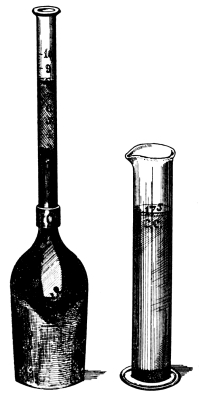
Fig. 109. Babcock’s Butyrometer and Acid Measure.
473. The Babcock Method.—Among the many quick volumetric methods which have been proposed for the determination of fat in milk, none has secured so wide an application as that suggested by Babcock.[464]
The chief point of advantage in the use of this method is found in effecting the solution of the casein by means of sulfuric acid of about 1.83 specific gravity. By this reagent the casein is dissolved in a few moments without the aid of any other heat than that generated by mixing the milk with the reagent. The bottle in which the separation is made is shown in Fig. 109. The graduations on the neck are based on the use of eighteen grams of milk. To avoid the trouble of weighing, the milk is measured from a pipette graduated to deliver eighteen grams of milk of the usual specific gravity. While it is true that normal milk may vary somewhat in its density, it has been found that a pipette marked at 17.6 cubic centimeters delivers a weight which can be safely assumed to vary but slightly from the one desired. The graduated bottle holds easily thirty-five cubic centimeters of liquid in its expanded portion and the volume of milk just noted is mixed with an equal volume of sulfuric acid, conveniently measured from the lip cylinder shown in the figure. The complete mixture of the milk and acid is effected by gently rotating the bottle until its contents are homogeneous. The final color of the mixture varies from dark brown to black.
While still hot, the bottles are placed in a centrifugal machine and whirled for at least five minutes. The most convenient machine, where it is available, is the one driven by a jet of steam. The revolutions of the centrifugal should be at least 700 per minute for a twenty inch and 1,200 for a twelve inch wheel. After five minutes the bottles are removed and filled to the upper mark or nearly so with hot water, replaced in the machine and whirled for at least one minute. The fat will then be found in a clearly defined column in the graduated neck of the bottle. In reading the scale, the extreme limits between the lowest point marked by the lower meniscus and the highest point marked by the edge of the upper meniscus are to be regarded as the termini of the fat column.
In testing cream by the babcock process, it may either be diluted until the column of fat secured is contained in the graduated part of the neck or specially graduated bottles may be used.
Condensed Milk: In applying the babcock test to condensed milk, it is necessary to weigh the sample and to use only about eight grams.[465] This quantity is placed in the bottle and dissolved in ten cubic centimeters of water and the analysis completed as above. The reading noted is multiplied by eighteen and divided by the weight of the sample taken.
Skim Milk: In determining the fat in skim milk and whey, it is desirable to use a bottle of double the usual capacity, but with the same graduation on the neck. The percentage of fat noted is divided by two.
Cheese: Five grams are a convenient quantity of cheese to employ. To this quantity in the bottle are added fifteen cubic centimeters of hot water and the flask gently shaken and warmed until the cheese is softened. The treatment with acid and whirling are the same as described above. The noted reading is multiplied by eighteen and divided by five.
474. Solution in Amyl Alcohol and Hydrochloric and Sulfuric Acids.—Leffmann and Beam have proposed to aid the solution of the casein in sulfuric acid by the previous addition to the milk of a mixture of equal volumes of amyl alcohol and hydrochloric acid.[466] In this process the same graduated flasks may be used as in the babcock process, or a special flask may be employed. In this case the graduation of the neck is for fifteen cubic centimeters of milk, and each one and a half cubic centimeters is divided into eighty-six parts. The quantity of milk noted is placed in the flask, together with three cubic centimeters of the mixture of amyl alcohol and hydrochloric acid, and well shaken. To the mixture, sulfuric acid of 1.83 specific gravity is added until the belly of the flask is nearly full and the contents well mixed by shaking. When the casein is dissolved, the addition of the sulfuric acid is continued until the flask is filled to the upper mark and again the contents mixed. It is well to close the mouth of the flask with a stopper while shaking. The bottle is placed in a centrifugal and whirled for a few moments, when the fat is collected in the graduated neck and its volume noted.
The process is also known in this country as the beimling method.[467] The fat separated in the above process is probably mixed with a little fusel oil, and therefore it is advisable to use the specially graduated bottle instead of one marked in absolute volumes.[468]
The method, when conducted according to the details found in the papers cited, gives accurate results, but is somewhat more complicated than the babcock process and is not now used to any great extent in analytical work.
475. Method of Gerber.—The method proposed by Gerber for estimating fat in milk is based on the processes of Babcock, Beimling and Beam already described. The tubes in which the decomposition of the milk and the measurement of the fat are accomplished are of two kinds, one open at only one end for milk and the other open at both ends for cheese. They are closed during the separation by rubber stoppers.[469]
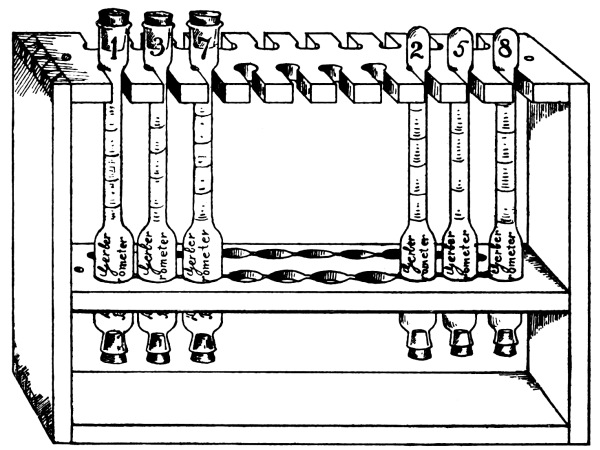
Fig. 110. Gerber’s Butyrometers.
The apparatus have been greatly improved and simplified since the first description of them was published and have come into extensive use in Europe and to a limited extent in this country.[470]
The butyrometer tubes are made of various sizes and shapes, but the most convenient are those noted above as shown in Fig. 110.
Before adding the strong sulfuric acid, one cubic centimeter of amyl alcohol is mixed with the milk in the butyrometer. This admixture serves to clarify the fat and render the reading more easy.
The centrifugal is run by hand, and the required speed of rotation is given it by means of a cord wrapped spirally about its axis, as shown in Fig. 111. The cord in the new machines is replaced by a leather strap working on a ratchet.
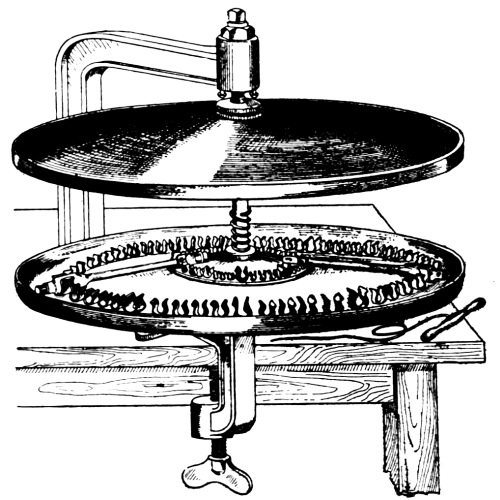
Fig. 111. Gerber’s Centrifugal.
The process is more speedy than that of Babcock, and the results have been shown by a large experience to be reliable and accurate.
The sulfuric acid employed is of 1.825 to 1.830 specific gravity. There is no danger of loss by the formation of volatile ethers where the quantity of amyl alcohol used does not exceed one cubic centimeter. In a comparison of the respective merits of the methods of Babcock, Thörner and Gerber, made by Hausamann, the first place is awarded to the Gerber process.[471] In the figure 110, the butyrometers marked 2, 5 and 8 are for milk, and those numbered 1, 3 and 7 are for cream and cheese. In conducting the analysis, ten cubic centimeters of the sulfuric acid are placed in the butyrometer with one cubic centimeter of the amyl alcohol. When mixed, eleven cubic centimeters of the milk are added and the contents of the tube well mixed, the tube stoppered and placed in the centrifugal. The larger tubes, open at both ends, require double the quantities of the reagents mentioned. The measurements are made at about 15°.
Minute directions for conducting the analyses with milk, skim milk, buttermilk, cream, condensed milk, cheese and butter accompany each apparatus.
PROTEID BODIES IN MILK.
476. Kinds of Proteid Bodies in Milk.—The proteid bodies in milk are all found in at least partial solution. Some authorities state that a portion of the casein is present in the form of fine particles suspended after the manner of the fat globules.[472] The number and kind of proteid bodies are not known with definiteness. Among those which are known with certainty are casein, albumin, peptone and fibrin. The latter body was discovered in milk by Babcock.[473] Lactoglobulin and lactoprotein are also names given to imperfectly known proteid bodies in milk. Lactoprotein is not precipitated either by acids or by heat and is therefore probably a peptone. By far the greater part of the proteid matters in milk is casein. Casein has been called caseinogen by Halliburton,[474] and paracasein by Schulze and Röse.[475] Casein has intimate relations to the mineral matters in milk, and is probably itself made up of several proteid bodies of slightly differing properties. In general all that class of proteid matter contained in milk which is precipitated by rennet or a weak acid, or spontaneously on the development of lactic acid, is designated by the term casein, while the albumins and peptones in similar conditions remain in solution. Casein contains phosphorus, presumably as nuclein. Fibrin is recognized in milk by the reactions it gives with hydrogen peroxid or gum guiacum. The decomposition of hydrogen peroxid is not a certain test for fibrin, inasmuch as pus and many other bodies will produce the same effect. If the milk decompose hydrogen peroxid, however, before and not after boiling, an additional proof of the presence of fibrin is obtained, since boiled fibrin does not act on the reagent.[476] The gum guiacum test is applied by dipping a strip of filter paper into the milk and drying. The solution of gum guiacum is applied to the dried paper and the presence of fibrin is recognized by the blue color which is produced. The fibrin is probably changed into some other proteid during the ripening of cream in which the fibrin is chiefly found. The albumin in milk is coagulated by boiling, while the casein remains practically unaffected when subjected to that temperature.
477. Estimation of Total Proteid Matter.—The total proteid matter in milk is determined by any of the general methods applicable to the estimation of total nitrogen, but the moist combustion method is by far the most convenient. From the total nitrogen, that which represents ammonia or other nonproteid nitrogenous bodies, is to be deducted and the remainder multiplied by an appropriate factor. Practically all the nitrogen obtained is derived from the proteid matters and, as a rule, no correction is necessary. The factors employed for calculating the weight of proteid matter from the nitrogen obtained vary from 6.25 to 7.04. It is desirable that additional investigations be made to determine the magnitude of this factor. It is suggested that provisionally the factor 6.40 be used. In the method adopted by the Association of Official Agricultural Chemists it is directed that about five grams of milk be placed in the oxidizing flask and treated without previous evaporation exactly as described for the estimation of total nitrogen in the absence of nitrates. The nitrogen obtained is multiplied by 6.25 to get the total proteid matter.[477] In order to prevent the too great dilution of the sulfuric acid, the milk may be evaporated to dryness or nearly so before oxidation. In this laboratory it is conveniently done by placing the milk first in the oxidizing flask, connecting this with the vacuum service and placing the flask in hot water. The aqueous contents of the milk are quickly given off at a temperature not exceeding 85°, and the time required is only a few minutes.
The milk may also be dried in dishes made of thin glass or tin foil and, after desiccation, introduced with the fragments of the dishes into the oxidizing flask.
The preliminary drying in the oxidizing flask is recommended as the best.
Söldner oxidizes the nitrogen in human milk by boiling ten cubic centimeters thereof for three hours with twenty-five of sulfuric acid, fifty milligrams of copper oxid and three drops of a four per cent platinic chlorid solution, and, after distilling the ammonia, uses the factor 6.39 for calculating the proteid matter. According to this author human milk is much less rich in nitrogenous constituents than is generally supposed, containing not more than one and a half per cent thereof in average samples collected at least a month after parturition.[478]
478. Precipitation of Total Proteids with Copper Sulfate.—This method of throwing out the total proteids of milk is due to Ritthausen.[479] The proteids and fat are precipitated together by the addition of a measured volume of copper sulfate solution, containing 63.92 grams of the crystallized salt in one liter. The process, as modified by Pfeiffer, is conducted as follows:[480]
Ten grams of milk are diluted with ten times that much water, five cubic centimeters of the copper sulfate solution added and then soda lye solution drop by drop until the copper is just precipitated. This is determined by testing a few drops of the filtrate with soda lye, which, when the copper is precipitated, will give neither a turbidity nor a blue color.
The mixture is poured into a dry tared filter, the precipitate washed with hot water, dried to constant weight and weighed. The fat is removed from the dry pulverized mass by extraction with ether and the residue dried and weighed.
The quantity of copper oxyhydrate contained in the precipitate is calculated from the quantity of the copper solution used and amounts to 0.2026 gram. The casein thus prepared contains not only the copper compound named, but also some of the sodium sulfate formed on the addition of the soda lye and other mineral salts present in the milk and from which it is quite impossible to completely free it. There are also many other objections to the process, and the product is of such a nature as to render the data obtained by the method very doubtful.
This method is chiefly valuable on account of its historical interest. Not only are the drying and weighing of the precipitate rendered unnecessary by the modern methods of determining nitrogen, but there are numerous sources of error which seem to throw doubt on the accuracy of the results. The copper hydroxid does not lose all its water even on drying at 125°.[481] The method therefore can only be recommended for practical purposes when all the tedious processes of drying, extracting and calculating the quantity of copper oxid are abandoned and the moist washed precipitate used directly for the determination of nitrogen.
479. Proteid Bodies by Ammonium Sulfate.—All the proteid bodies except peptones are precipitated from milk on saturation with ammonium sulfate. This method has little analytical value because of the presence of nitrogenous salt in the precipitate. Zinc sulfate may be substituted for the ammonium salt and thus a determination of proteid matter other than peptone be obtained. This result subtracted from the total proteid nitrogen gives that due to peptone.
480. Total Proteid Matter by Tannic Acid.—For the determination of the total proteid matter in milk Sebelien uses the following process.[482] From three to five grams are diluted with three or four volumes of water, a few drops of a saline solution added (sodium phosphate, sodium chlorid, magnesium sulfate, et similia), and the proteid bodies thrown out with an excess of tannic acid solution. The precipitate is washed with an excess of the precipitant and the nitrogen therein determined and multiplied by 6.37.
481. Separation of Casein from Albumin.—Sebelien prefers magnesium sulfate or sodium chlorid to acetic acid as the best reagent for separating casein from lactalbumin. Of the two saline reagents mentioned, the former is the better. The milk is first diluted with a double volume of the saturated saline solution and then the fine powdered salt added until saturation is secured. The casein is completely thrown out by this treatment, collected on a filter, washed with the saturated saline solution, and the nitrogen therein determined. The difference between the total and casein nitrogen gives the quantity due to the albumin plus the almost negligible quantity due to globulin.[483]
482. Van Slyke’s Method of Estimating Casein.—The casein may be separated from the other albuminoids in milk by the procedure proposed by Van Slyke.[484] Ten grams of the fresh milk are diluted with ninety cubic centimeters of water and the temperature raised to 40°. The casein is thrown down with a ten per cent solution of acetic acid, of which about one and a half cubic centimeters are required. The mixture is well stirred and the precipitate allowed to subside. The whey is decanted onto a filter, and the precipitate washed two or three times with cold water, brought finally onto the filter and washed once or twice with cold water. The filter paper and its contents are used for the determination of nitrogen in the usual way. The casein is calculated from the nitrogen found by multiplication by the factor 6.25. Milk may be preserved for this method of determination by adding to it one part of finely powdered mercuric chlorid for each two thousand parts of the sample. The method is not applicable to curdled milk.
483. Theory of Precipitation.—Most authorities now agree in supposing that the state of semisolution in which the casein is held in milk is secured by the presence of mineral matters in the milk, in some intimate combination with the casein. Among these bodies lime is of the most importance. The action of the dilute acid is chiefly on these mineral bodies, releasing them from combination with the casein, which, being insoluble in the milk serum, is precipitated.
484. Factors for Calculation.—Most analysts still use the common proteid factor, 6.25, in calculating the quantity of proteids from the nitrogen determined by analysis. For casein many different factors have been proposed. According to Makeris the factor varies from 6.83 to 7.04.[485] Munk gives 6.34 for human and 6.37 for cow milk.[486] Sebelien adopts the latter factor, and Hammersten nearly the same; viz., 6.39. The weight of authority, at the present time, favors a factor considerably above 6.25 for calculating the casein and, in fact, the total proteids of milk from the weight of nitrogen obtained.
485. Béchamp’s Method of Preparing Pure Casein.—The casein in about one liter of milk is precipitated by adding gradually about three grams of glacial acetic acid diluted with water. The addition of the acid is arrested at the moment when litmus paper shows a slightly acid reaction. The precipitate thus produced, containing all the casein, the milk globules and the microzymes, is separated by filtration, being washed by decantation before collecting it on the filter. On the filter it is washed with distilled water and the fat removed by shaking with ether. The residue is suspended in water, dissolved in the least possible quantity of ammonium carbonate, any insoluble residue (microzymes, globules) separated by filtration and the pure casein thrown out of the filtrate by the addition of acetic acid. The washing with distilled water, solution in ammonium carbonate, filtration and reprecipitation are repeated three or four times in order to obtain the casein entirely free of other substances. Casein thus prepared is burned to a carbon free ash with difficulty and contains but little over one-tenth per cent of mineral matter.[487]
486. Separation of Casein with Carbon Dioxid.—The supersaturation of the lime compounds of casein with carbon dioxid diminishes the solvent action of the lime and thus helps to throw out the proteid matter. For this reason Hoppe-Seyler recommends the use of carbon dioxid to promote the precipitation of the casein.[488] The milk is diluted with about twenty volumes of water and treated, drop by drop, with very dilute acetic acid as long as a precipitate is formed. A stream of pure carbon dioxid is conducted through the mixture for half an hour, and it is allowed to remain at rest for twelve hours, when the casein will have all gone down and the supernatant liquid will be clear. Albumins and peptones are not thrown out by this treatment.
The method of precipitation is advantageously modified by saturating the diluted milk with carbon dioxid before adding the acetic acid, less of the latter being required when used in the order just noted.[489]
487. Separation of Albumin.—In the filtrate from the casein precipitate the albumin may be separated by heating to 80°. It may also be precipitated by tannic acid, in which case it may contain a little globulin. It may also be thrown out by saturation with ammonium or zinc sulfates. The latter reagent is to be preferred when the nitrogen is to be determined in the precipitate. The quantities of albumin and globulin, especially the latter, present in milk are small compared with its content of casein.
488. Separation of Globulin.—The presence of globulin in milk is demonstrated by Sebelien in the following manner:[490] The milk is saturated with finely powdered common salt and the precipitate produced is separated by filtration. This filtrate in turn is saturated with magnesium sulfate. The precipitate produced by this reagent is collected on a filter, dissolved in water and precipitated by saturation with sodium chlorid. This process is repeated several times. The final precipitate is proved to be globulin by the following reactions: When a solution of it is dialyzed the proteid body separates as a flocculent precipitate, which is easily dissolved in a weak solution of common salt. The clear solution thus obtained becomes turbid on adding water, and more so after the addition of a little acetic acid. A neutral solution of the body is also completely precipitated by saturation with sodium chlorid. These reactions serve to identify the body as a globulin and not an albumin. All the globulin in milk is not obtained by the process, since a part of it is separated with the casein in the first precipitation.