PART FIRST. SAMPLING, DRYING, INCINERATION AND EXTRACTIONS.
Reading edition
1. Introduction.—The analyst may approach the examination of agricultural products from various directions. In the first place he may desire to know their proximate and ultimate constitution irrespective of their relations to the soil or to the food of man and beast. Secondly, his study of these products may have reference solely to the determination of the more valuable plant foods which they have extracted from the soil and air. Lastly, he may approach his task from a hygienic or economic standpoint for the purposes of determining the wholesomeness or the nutritive and economic values of the products of the field, orchard, or garden. In each case the object of the investigation will have a considerable influence on the method of the examination.
It will be the purpose of the present volume to discuss fully the principles of all the standard processes of analysis and the best practice thereof, to the end that the investigator or analyst, whatever may be the design of his work, may find satisfactory directions for prosecuting it. As in the previous volumes, it should be understood that these pages are written largely for the teacher and the analyst already skilled in the principles of analytical chemistry. Much is therefore left to the individual judgment and experience of the worker, to whom it is hoped a judicious choice of approved processes may be made possible.
2. Scope Of the Work.—Under the term agricultural products is included a large number of classes of bodies of most different constitution. In general they are the products of vegetable and animal metabolism. First of all come the vegetable products, fruits, grains and grasses. These may be presented in their natural state, as cereals, green fruits and fodders, or after a certain preparation, as starches, sugars and flours. They may also be met with in even more advanced stages of change, as cooked foods, alcohols and secondary organic acids, such as vinegar. In general, by the term agricultural products is meant not only the direct products of the farm, orchard and forest, but also the modified products thereof and the results of manufacture applied to the raw materials. Thus, not only the grain and straw of wheat are proper materials for agricultural analysis, but also flour and bran, bread and cakes made therefrom. In the case of maize and barley, the manufactured products may extend much further, for not only do we find starch and malt, but also alcohol and beer falling within the scope of our work. In respect of animal products, the agricultural analyst may be called on to investigate the subject of leather and tanning; to determine the composition of meat, milk and butter; to pass upon the character of lard, oleomargarine, and, in general, to determine as fully as possible the course of animal food in all its changes between the field, the packing house and the kitchen.
3. Limitations of Work.—It is evident from the preceding paragraph, that in order to keep the magnitude of this volume within the limits fixed for a single volume the text must be rigidly confined to the fundamental principles and practice of agricultural analysis. The interesting region of pharmacy and allied branches, in respect of plant analysis, can find no description here, and in those branches of technical chemistry, where the materials of elaboration are the products of the field only a superficial view can be given. The main purpose and motive of this volume must relate closely to the more purely agricultural processes.
4. General Manipulations.—There are certain analytical operations which are more or less of a general nature, that is, they are of general application without reference to the character of the material at hand. Among these may be mentioned the determination of moisture and of ash, and the estimation of matters soluble in ether, alcohol and other solvents. These processes will be first described. Preliminary to these analytical steps it is of the utmost importance that the material be properly prepared for examination. In general, this is accomplished by drying the samples until they can be ground or crushed to a fine powder, the attrition being continued until all the particles are made to pass a sieve of a given fineness. The best sieve for this purpose is one having circular apertures half a millimeter in diameter. Some products, both vegetable and animal, require to be reduced to as fine a state as possible without drying. In such instances, passing the product through a sieve is obviously impracticable. Special grinding and disintegrating machines are made for these purposes and they will be described further on.
There are some agricultural products which have to be prepared for examination in special ways and these methods will be given in connection with the processes for analyzing the bodies referred to. Nearly all the bodies, however, with which the analyst will be concerned, can be prepared for examination by the general methods about to be described.
5. Preparation of the Sample. (a) Vegetable Substances.—For all processes of analysis not executed on the fresh sample, substances of a vegetable nature should, if in a fresh state, be dried as rapidly as possible to prevent fermentative changes. It is often of interest to determine the percentage of moisture in the fresh sample. For this purpose a representative portion of the sample should be rapidly reduced to as fine a condition as possible. To accomplish this it should be passed through a shredding machine, or cut by scissors or a knife into fine pieces. A few grams of the shredded material are dried in a flat-bottomed dish at progressively increasing temperatures, beginning at about 60° and ending at from 100° to 110°. The latter temperature should be continued for only a short time. The principle of this process is based upon the fact that if the temperature be raised too high at first, some of the moisture in the interior cells of the vegetable substance can be occluded by the too rapid desiccation of the exterior layers which would take place at a high temperature. The special processes for determining moisture will be given in another place.
The rest of the sample should be partly dried at a lower temperature or air-dried. In the case of fodders and most cattle foods the samples come to the analyst in a naturally air-dried state. When grasses are harvested at a time near their maturity they are sun-dried in the meadows before placing in the stack or barn. Such sun-dried samples are already in a state fit for grinding. Green grasses and fodders should be dried in the sun, or in a bath at a low temperature from 50° to 60° until all danger of fermentative action is over, and then air- or sun-dried in the usual way.
Seeds and cereals usually reach the analyst in a condition suited to grinding without further preliminary preparation. Fruits and vegetables present greater difficulties. Containing larger quantities of water, and often considerable amounts of sugar, they are dried with greater difficulty. The principles which should guide all processes of drying are those already mentioned, viz., to secure a sufficient degree of desiccation to permit of fine grinding and at a temperature high enough to prevent fermentative action, and yet not sufficiently high to cause any marked changes in the constituents of the vegetable organism.
(b) Animal Substances.—The difficulties connected with the preliminary treatment of animal substances are far greater than those just mentioned. Such samples are composed of widely differing tissues, blood, bone, tendon, muscle and adipose matters, and all the complex components of the animal organism are to be considered. The whole animal may be presented for analysis, in which case the different parts composing it should be separated and weighed as exactly as possible. Where only definite parts are to be examined it is best to separate the muscle, bone, and fat as well as may be, before attempting to reduce the whole to a fine powder. The soft portions of the sample are to be ground as finely as possible in a meat or sausage cutter. The bones are crushed in some appropriate manner, and thus prepared for further examination. Where the flesh and softer portions are to be dried and finely ground, the presence of fat often renders the process almost impossible. In such cases the fat must be at least partially removed by petroleum or other solvent. In practically fat-free samples the material, after grinding in a meat cutter, can be partially dried at low temperatures from 60° to 75°, and afterwards ground in much the same manner as is practiced with vegetable substances.
As is the case with the preliminary treatment of vegetable matters, it is impossible to give any general directions of universal applicability. The tact and experience of the analyst in all these cases are better than any dicta of the books. In some instances, as will appear further on, definite directions for given substances can be given, but in all cases the general principles of procedure are on the lines already indicated.
6. Preserving Samples.—In most cases, as is indicated in the foregoing paragraphs, the sample may be dried before grinding to such a degree as to prevent danger from fermentation or decay. The fine-ground samples are usually preserved in glass-stoppered bottles, carefully marked or numbered. In some cases it is advisable to sterilize the bottles after stoppering, by subjecting them to a temperature of 100° for some time. In the case of cereals assurance should be had that the samples do not contain the eggs of any of the pests that often destroy these products. As a rule, samples should be kept for a time after the completion of the analytical work, and this is especially true in all cases where there is any prospect of dispute or litigation. In general it may be said, that samples should be destroyed only when they are spoiled, or when storage room is exhausted.
7. Collecting Samples.—When possible, the analyst should be his own collector. There is often as much danger from data obtained on non-representative samples as from imperfect manipulation. When personal supervision is not possible, the sample when received, should be accompanied by an intelligible description of the method of taking it, and of what it represents. In all cases the object of the examination must be kept steadily in view. Where comparisons are to be made the methods of collecting must be rigidly the same.
The processes of analysis, as conducted with agricultural products, are tedious and difficult. The absolutely definite conditions that attend the analysis of mineral substances, are mostly lacking. The simple determinations of carbon, hydrogen, nitrogen and sulfur, which are required in the usual processes of organic analysis, are simplicity itself when compared with the operations which have to be performed on agricultural products to determine their character and their value as food and raiment. We have to do here with matters on which the sustenance, health and prosperity of the human race are more intimately concerned than with any other of the sciences. This fact also emphasizes the necessity for care in collecting the materials on which the work is to be performed.
8. Grinding Samples.—In order to properly conduct the processes of agricultural analysis it is important to have the sample finely ground. This arises both from the fact that such a sample is apt to contain an average content of the various complex substances of which the material under examination is composed, and because the analytical processes can be conducted with greater success upon the finely divided matter. In mineral analysis it is customary to grind the sample to an impalpable powder in an agate mortar. With agricultural products, however, such a degree of fineness is difficult to attain, and moreover, is not necessary. There is a great difference of opinion among analysts respecting the degree of fineness desirable. In some cases we must be content with a sample which will pass a sieve with a millimeter mesh; in fact it may be found impossible, on account of the stickiness of the material, to sift it at all. In such cases a thorough trituration, so as to form a homogeneous mass will have to be accepted as sufficient. Where bodies can be reduced to a powder however, it is best to pass them through a sieve with circular perforations half a millimeter in diameter. A finer degree of subdivision than this is rarely necessary.
9. The Grinding Apparatus.—The simplest form of apparatus for reducing samples for analysis to a condition suited to passing a fine sieve is a mortar. Where only a few samples are to be prepared and in small quantities, it will not be necessary to provide anything further. After the sample is well disintegrated it is poured on the sieve and all that can pass is shaken or brushed through. The sieve is provided with a receptacle, into which it fits closely, to avoid loss of any particles which may be reduced to a dust. The top of the sieve, when shaken, may also be covered if there be any tendency to loss from dust. Any residue failing to pass the sieve is returned to the mortar and the process thus repeated until all the material has been secured in the receiver. The particles more difficult of pulverization are often different in structure from the more easily pulverized portions, and the sifted matter must always be carefully mixed before the subsample is taken for examination. Often the materials, or portions thereof, will contain particles tough and resistant to the pestle, but the operator must have patience and persistence, for it is highly necessary to accurate work that the whole sample be reduced to proper size.
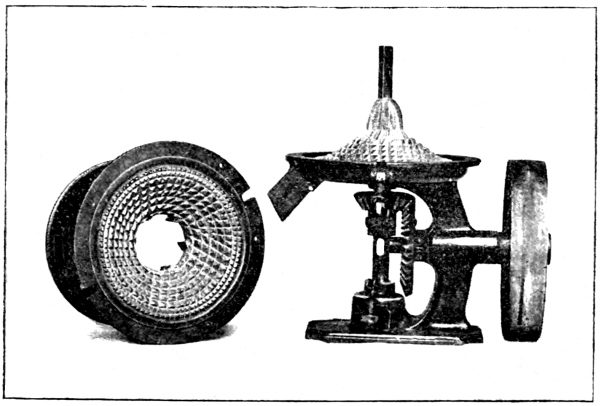
Figure 1. Mill for Grinding Dry Samples.
Where many samples are to be prepared, or in large quantities, mills should take the place of mortars. For properly air-dried vegetable substances, some form of mill used in grinding drugs may be employed. Grinding surfaces of chilled corrugated steel are to be preferred. The essential features of such a mill are that it be made of the best material, properly tempered, and that the parts be easily separated for convenience in cleaning. The grinding surfaces must also be so constructed and adjusted as to secure the proper degree of fineness. In fig. 1 is shown a mill of rather simple construction, which has long been in satisfactory use in this laboratory. Small mills may be operated by hand power, but when they are to be used constantly steam power should be provided. In addition to the removal of nearly all the moisture by air-drying there are many oleaginous seeds which cannot be finely ground until their oil has been removed. For this purpose the grinding surfaces of the mill are opened so that the seeds are only coarsely broken in passing through. The fragments are then digested with light petroleum in a large flask, furnished with a reflux condenser. After digestion the fragments are again passed through the mill adjusted to break them into finer particles.
The alternate grinding and digestion are thus continued until the pulverization is complete. On a small specially prepared sample the total content of oil is separately determined.
Fresh animal tissues are best prepared for preliminary treatment by passing through a sausage mill. The partially homogeneous mass thus secured should be dried at a low temperature and reground as finely as possible. Where much fat is present it may be necessary to extract it as mentioned above, in the case of oleaginous seeds. In such cases both the moisture and fat in the original material should be determined on small specially prepared samples with as great accuracy as possible. Bones, hoofs, horns, hair and hides present special difficulties in preparation, which the analyst will have to overcome with such skill and ingenuity as he may possess.
The analyst will find many specially prepared animal foods already in a fairly homogeneous form, such as potted and canned meats, infant and invalid foods, and the like. Even with these substances, however, a preliminary grinding and mixing will be found of advantage before undertaking the analytical work. Many cases will arise which are apparently entirely without the classification given above. But even in such instances the analyst should not be without resources. Frequently some dry inert substance may be mixed with the material in definite quantities, whereby it is rendered more easily prepared. Perhaps no case will be presented where persistent and judicious efforts to secure a fairly homogeneous sample for analysis will be wholly unavailing.
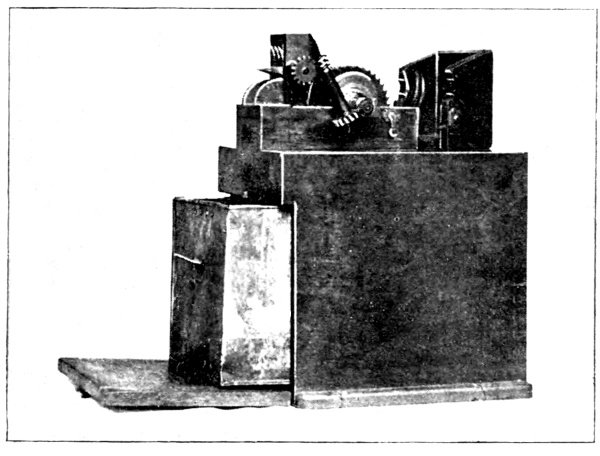
Figure 2. Comminutor for Green Samples.
In the case of green vegetable matters which require to be reduced rapidly to a fine state of subdivision in order to secure even a fairly good sample some special provision must be made. This is the case with stalks of maize and sugar cane, root crops, such as potatoes and beets, and green fodders, such as clover and grasses. The chopping of these bodies into fine fodders by hand is slow and often impracticable. The particles rapidly lose moisture and it is important to secure them promptly as in the preparation of beet pulp for polarization. For general use we have found the apparatus shown in fig. 2 quite satisfactory in this laboratory. It consists of a series of staggered circular saws carried on an axis and geared to be driven at a high velocity, in the case mentioned, 1,400 revolutions per minute. The green material is fed against the revolving saws by the toothed gear-work shown, and is thus reduced to a very fine pulp, which is received in the box below. Stalks of maize, green fodders, sugar canes, beets and other fresh vegetable matters are by this process reduced to a fine homogeneous pulp, suited for sampling and for analytical operations. Such pulped material can also be spread in a fine layer and dried rapidly at a low temperature, thus avoiding danger of fermentative changes when it is desired to secure the materials in a dry condition or to preserve them for future examination. Samples of sorghum cane, thus pulped and dried, have been preserved for many years with their sugar content unchanged.
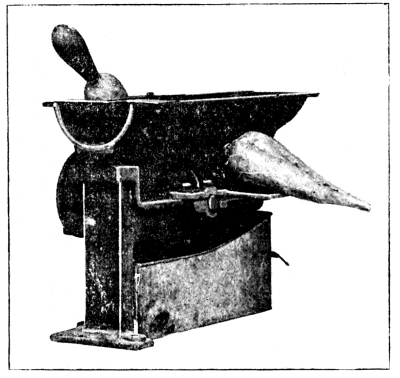
Figure 3. Rasp for Sugar Beets.
Such a machine is also useful in preparing vegetable matter for the separation of its juices in presses. Samples of sugar cane, sugar beets, apples and other bodies of like nature can thus be prepared to secure their juices for chemical examination. Such an apparatus we have found is fully as useful and indispensable in an agricultural laboratory as a drug mill for air-dried materials.
It is often desirable in the preparation of roots for sugar analysis to secure them in a completely disintegrated state, that is with the cellular tissues practically all broken. Such a pulped material can be treated with water and the sugar juices it contains thus at once distributed to all parts of the liquid mass. The operation is known as instantaneous diffusion. The pulp of the vegetable matter is thus introduced into the measuring flask along with the juices and the content of sugar can be easily determined. Several forms of apparatus have been devised for this purpose, one of which is shown in fig. 3. This process, originally devised by Pellet, has come into quite general use in the determination of the sugar content of beets.[1] It is observed that it can be applied to other tubers, such as the turnip, potato, artichoke, etc. It is desirable, therefore, that an agricultural laboratory be equipped with at least three kinds of grinding machines; viz., first, the common drug mill used for grinding seeds, air-dried fodders, and the like; second, a pulping machine like the system of staggered saws above described for the purpose of reducing green vegetable matter to a fine state of subdivision, or one like the pellet rasp for tubers; third, a mill for general use such as is employed for making sausages from soft animal tissues.
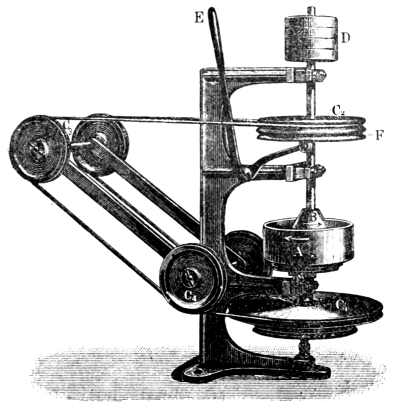
Figure 4. Dreef Grinding Apparatus.
10. Grinding Apparatus at Halle Station.—The machine used at the Halle station for grinding samples for analysis is shown in Fig. 4.[2] It is so adjusted as to have both the upper and lower grinding surfaces in motion. The power is transmitted through the pulley D, which is fixed to an axis carrying also the inner grinding attachment B. Through C₂, C₃, C₄, and C₁, the reverse motion is transmitted to the outer grinder A. By means of the lever E the two grinding surfaces can be separated when the mill is to be cleaned. The dree mill above described is especially useful for grinding malt, dry brewers’ grains, cereals for starch determinations and similar dry bodies. It is not suited to grinding oily seeds and moist samples. These, according to the Halle methods, are rubbed up in a mortar until of a size suited to analysis, and samples such as moist residues, wet cereals, mashes, beet cuttings, silage, etc., are dried before grinding. If it be desired to avoid the loss of acids which may have been formed during fermentation, about ten grams of magnesia should be thoroughly incorporated with each kilogram of the material before drying.
11. Preliminary Treatment of Fish.—The method used by Atwater in preparing fish for analysis is given below.[3] The same process may also be found applicable in the preparation of other animal tissues. The specimens, when received at the laboratory, are at once weighed. The flesh is then separated from the refuse and both are weighed. There is always a slight loss in the separation, due to evaporation and to slimy and fatty matters and small fragments of the tissues which adhere to the hands and the utensils employed in preparing the sample. Perfect separation of the flesh from the other parts of the fish is difficult, but the loss resulting from imperfect separation is small. The skin of the fish, although it has considerable nutritive value, should be separated with the other refuse.
The partial drying of the flesh for securing samples for analytical work is accomplished by chopping it as finely as possible and subjecting from fifty to one hundred grams of it for a day to a temperature of 96° in an atmosphere of hydrogen. After cooling and allowing to stand in the open air for twelve hours, the sample is again weighed, and then ground to a fine powder and made to pass a sieve with a half millimeter mesh. If the samples be very fat they cannot be ground to pass so fine a sieve. In such a case a coarser sieve may be used or the sample reduced to as fine and homogeneous a state as possible, and bottled without sifting.
The reason for drying in hydrogen is to prevent oxidation of the fats. As will be seen further on, however, such bodies can be quickly and accurately dried at low temperatures in a vacuum, and thus all danger of oxidation be avoided. In fact, the preliminary drying of all animal and vegetable tissues, where oxidation is to be feared, can be safely accomplished in a partial vacuum by methods to be described in another place. In order to be able to calculate the data of the analysis to the original fresh state of the substance, a portion of the fresh material should have its water quantitively determined as accurately as possible.
DRYING ORGANIC BODIES.
12. Volatile Bodies.—In agricultural analysis it becomes necessary to determine the percentage of bodies present in any given sample which is volatile at any fixed temperature. The temperature reached by boiling water is the one which is usually selected. It is true that this temperature varies with the altitude and within somewhat narrow limits at the same altitude, due to variations in barometric pressure. As the air pressure to which any given body is subjected, however, is a factor in the determination of its volatile contents, it will be seen that within the altitudes at which chemical laboratories are found, the variations in volatile content will not be important. This arises from the fact that while water boils at a lower temperature, as the height above the sea level increases, the corresponding diminished air pressure permits a more ready escape of volatile matter. As a consequence, a body dried to constant weight at sea level, where the temperature of boiling water is 100°, will show the same percentage of volatile matter as if dried at an altitude where water boils at 99°. When, therefore, it is desirable to determine the volatile matter in a sample approximately at 100°, it is better to direct that it be done in a space surrounded by steam at the natural pressure rather than at exactly 100°, a temperature somewhat difficult to constantly maintain. However, where it is directed or desired to dry to constant weight exactly at 100°, it can be accomplished by means of an air-bath or by a water-jacketed-bath under pressure, or to which enough solid matter is added to raise the boiling-point to 100°. It is not often, however, that it is worth while to make any special efforts to secure a temperature of 100°. When bodies are to be dried at temperatures above 100°, such as 105°, 110°, and so on, an air-bath is the most convenient means of securing the desired end. The different kinds of apparatus to be employed will be described in succeeding paragraphs.
13. Drying at the Temperature of Boiling Water.—The best apparatus for this process is so constructed as to have an interior space entirely surrounded with boiling water or steam, with the exception of the door by which entrance is gained thereto. The metal parts of the apparatus are constructed of copper, and to keep a constant level of water and avoid the danger of evaporating all the liquid, it is advisable to have a reflux condenser attached to the apparatus. It is also well to secure entrance to the interior drying oven, not only by the door, but also by small circular openings, which serve both to hold a thermometer and to permit of the aspiration of a slow stream of dry air through the apparatus during the progress of desiccation. The gaseous bodies formed by the volatilization of the water and other matters are thus carried out of the drying box and the process thereby accelerated. The bath should be heated by a burner so arranged as to distribute the flame as evenly as possible over the base. A single lamp, while it will boil the water in the center, will not keep it at the boiling-point on the sides. The temperature of the interior of the bath will not therefore reach 100°. The interior of the oven should be coated with a non-detachable carbon paint to promote the radiation of the heat from its walls, as well as to protect the parts from oxidation where acid fumes are produced during desiccation. Instead of a reflux condenser a constant water level may be maintained in the bath by means of a mariotte bottle or other similar device.
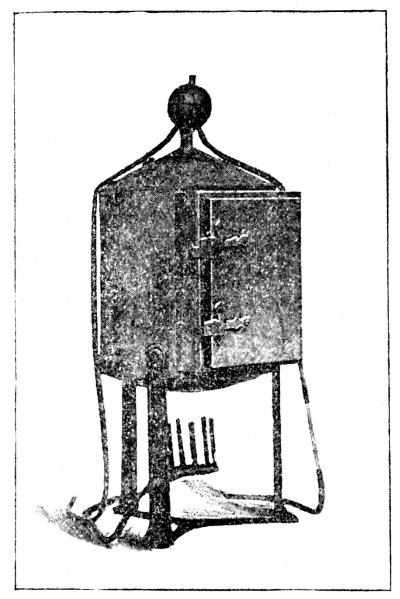
Figure 5. Water-jacketed Drying Oven.
When a bath of this kind is arranged for use with a partial vacuum, it should be made cylindrical in shape, with conical ends, as shown in fig. 5, in order to bear well the pressure to which it is subjected. Among the many forms of steam-baths offered, the analyst will have but little difficulty in selecting one suited to his work. To avoid radiation the exterior of the apparatus should be covered with a non-conducting material.
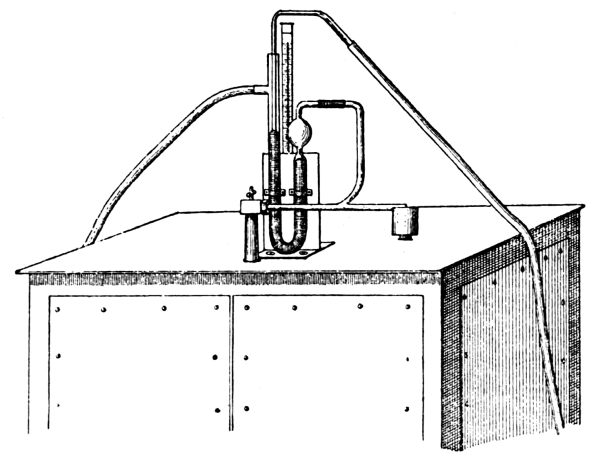
Figure 6. Thermostat for Steam-Bath.
14. Drying In a Closed Water Oven.—When it is desired to keep the temperature of a drying oven exactly at 100° instead of at the heat of boiling water, a closed water oven with a thermostat is to be employed. The oven should be so constructed as to secure a free circulation of the water about the inner space. Since as a rule the water between the walls of the apparatus will be subjected to a slight pressure, these walls should be made strong, or the cylindrical form of apparatus should be used. The thermostat used by the Halle Station is shown in Fig. 6.[4] A ⋃ shaped tube, with a bulb on one arm and a lateral smaller tube sealed on the other, is partly filled with mercury and connected by rubber tubes on the right with the gas supply, and on the left with the burner. The end carrying the bulb is connected directly by a rubber and metal tube with the water space of the oven. This device is provided with a valve which is left open until the temperature of the drying space reaches about 95°. The tube conducting the gas is held in the long arm of the ⋃ by means of a cork through which it passes air-tight and yet is loose enough to permit of its being moved. Its lower end is provided with a long ▲ shaped slit. When the valve leading to the water space is closed and the water reaches the boiling point, the pressure of the vapor depresses the mercury in the bulb arm of the ⋃ and raises it in the other. As the mercury rises it closes the wider opening of the ▲ shaped slit, thus diminishing the flow of gas to the burner. By moving the gas entry tube up or down a position is easily found in which the temperature of the drying space, as shown by the thermometer, is kept accurately and constantly at 100°.
In a bath arranged in this way a steam condenser is not necessary. Since, however, in laboratories which are not at a higher altitude than 1,000 feet the boiling-point of water is nearly 100°, it does not seem necessary to go to so much trouble to secure the exact temperature named. There could be no practical difference in the percentage of moisture determined at 100°, and at the boiling-point of water at a temperature not more than 1° lower.
15. Drying in an Air-Bath.—In drying a substance in a medium of hot air surrounded by steam, as has been described, the process is, in reality, one of drying in air. The apparatus usually meant by the term air-bath, however, has its drying space heated directly by a lamp, or indirectly by a stratum of hot air occupying the place of steam in the oven already described. The simplest form of the apparatus is a metal box, usually copper, heated from below by a lamp. In the jacketed forms the currents of hot air produced directly or indirectly by the lamp are conducted around the inner drying oven, thus securing a more even temperature. The bodies to be dried are held on perforated metal or asbestos shelves in appropriate dishes, and the temperature to which they are subjected is determined by a thermometer, the bulb of which is brought as near as possible to the contents of the dish. One advantage of the air-bath is in being able to secure almost any desired temperature from that of the room to one of 150° or even higher. Its chief disadvantage lies in the difficulty of securing and maintaining an even temperature throughout all parts of the apparatus. Radiation from the sides of the drying oven should be prevented by a covering of asbestos or other non-combustible and non-conducting substance. The burner employed should be a broad one and give as even a distribution of the heat as possible over the bottom of the apparatus.
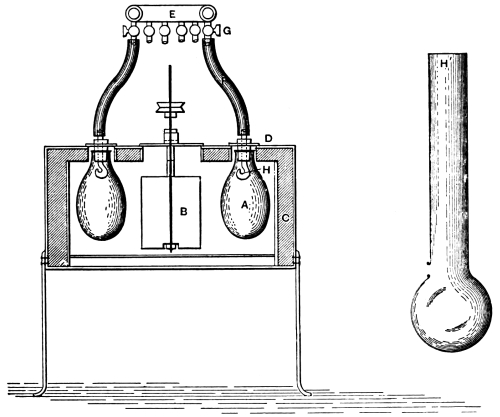
Figure 7. Spencer’s Drying Oven.
16. Spencer’s Air-Drying Oven.—In order to secure an even distribution of the heat in the desiccating space of the oven, Spencer has devised an apparatus, shown in the figure, in which the temperature is maintained evenly throughout the apparatus by means of a fan.[5] The oven has a double bottom, the space between the two bottoms being filled with air. The sides are also double, the space between being filled with plaster. The fan is driven by a toy engine connected with the compressed air service or other convenient method. Thermometers placed in different parts of the apparatus, while in use, show a rigidly even heat at all points so long as the fan is kept in motion. The actual temperature desired can be controlled by a gas regulator. This form of apparatus is well suited to drying a large number of samples at once. Portions of liquids and viscous masses may also be dried by enclosing them in bulbs and connecting with a vacuum.
Spencer’s oven can also be used to advantage in drying viscous liquids in a partial vacuum. For this purpose the flask A, Fig. 7, containing the substance is made with a round bottom to resist the atmospheric pressure. Its capacity is conveniently from 150 to 200 cubic centimeters. It is closed with a rubber stopper carrying a trap, H Hʹ, to keep the evaporated water from falling back. The details of the construction of the trap H are shown at the right of the figure. The vapors enter at the lateral orifice, just above the bulb, while the condensed water falls back into the bulb instead of into the flask A. A series of flasks can be used at once connected through the stopcocks G with the circular tube E leading to the vacuum. A water pump easily exhausts the apparatus, maintaining a vacuum of about twenty-seven inches. The hot air in the oven is kept in motion by the fan B, thus ensuring an even temperature in every part. The flask A may be partly filled with sand or pumice stone before the addition of the samples to be dried, and the weight of water lost is determined by weighing A before and after desiccation. If it be desired to introduce a slow current of dry air or some inert gas into A, it is easily accomplished by passing a small tube, connected with the dry air or gas supply, through the rubber stopper and extending it into the flask as far as possible without coming into contact with the contents.
17. Drying Under Diminished Air Pressure.—The temperature at which any given body loses its volatile products is conditioned largely by the pressure to which it is subjected. At an air pressure of 760 millimeters of mercury, water boils at 100° but it is volatilized at all temperatures. As the pressure diminishes the temperature at which a body loses water at a given rate falls. This is a fact of importance to be considered in drying many agricultural products. This is especially true of those containing oils and sugars, nearly the whole number. Invert sugar especially is apt to suffer profound changes at a temperature of 100°, the levulose it contains undergoing partial decomposition. Oils are prone to oxidation and partial decomposition at high temperatures in the presence of oxygen.
In drying in a partial vacuum therefore a double advantage is secured, that of a lower temperature of desiccation and in presence of less oxygen. It is not necessary to have a complete vacuum. There are few organic products which cannot be completely deprived of their volatile matters at a temperature of from 70° to 80° in a partial vacuum in which the air pressure has been diminished to about one-quarter of its normal force.
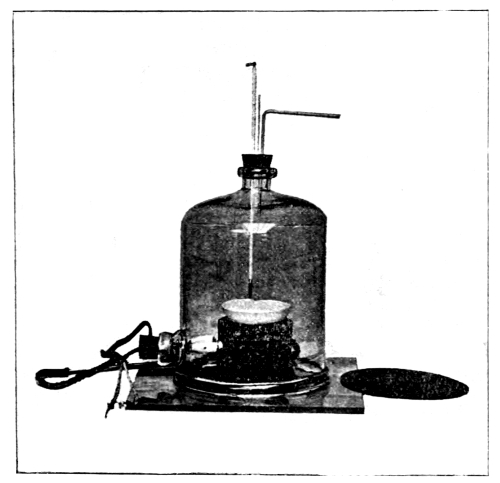
Figure 8. Electric Vacuum Drying Oven.
18. Electric Drying-Bath.—The heat of an electric current can be conveniently used for drying in a partial vacuum by means of the simple device illustrated in Fig. 8. In ordering a heater of this kind the voltage of the current should be stated. The current in use in this laboratory has a voltage of about 120, and is installed on the three wire principle. It is well to use a rheostat with the heater in order to control the temperature within the bell jar. The ground rim of the bell jar rests on a rubber disk placed on a thick ground glass or a metal plate, making an air-tight connection. A disk of asbestos serves to separate the heater from the dish containing the sample, in order to avoid too high a temperature.
19. Steam Coil Apparatus.—For drying at the temperature of superheated steam, it is convenient to use an apparatus furnished with layers or coils of steam pipes. The drying may be accomplished either in the air or in a vacuum. In this laboratory a large drying oven, having three shelves of brass steam-tubes and sides of non-conducting material, is employed with great advantage. The series of heating pipes is so arranged as to be used one at a time or collectively. Each series is furnished with a separate steam valve, and is provided with a trap to control the escape of the condensed vapors. In the bottom of the apparatus are apertures through which air can enter, which after passing through the interior of the oven escapes through a ventilator at the top. With a pressure of forty pounds of steam to the square inch and a free circulation of air, the temperature on the first shelf of the apparatus is about 98°; on the second from 103° to 104°, and on the third about 100°. The vessels containing the bodies to be dried are not placed directly on the brass steam pipes, but the latter are first covered with thick perforated paper or asbestos. For drying large numbers of samples, or large quantities of one sample, such an apparatus is almost indispensable to an agricultural laboratory.
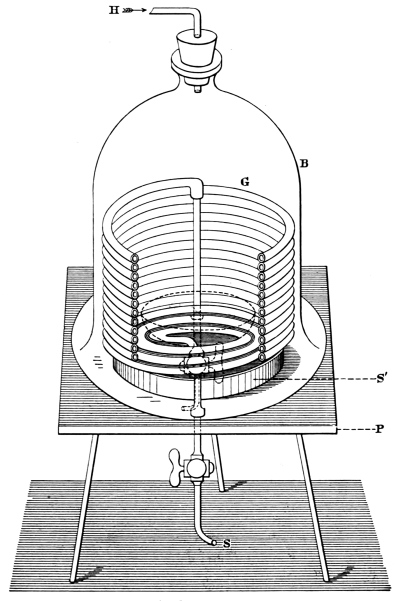
Figure 9. Steam Coil Drying Oven.
A smaller apparatus is shown in Fig. 9. The heating part G is made of a small brass tube arranged near the bottom in a horizontal coil and continued about the sides in a perpendicular coil. Bodies placed on the horizontal shelf are thus entirely surrounded by the heating surfaces except at the top.[6] The steam pipe S is connected with the supply by the usual method, and the escape of the condensation is controlled either by a valve or trap in the usual way. The whole apparatus is covered by a bell jar B, resting on a heavy cast-iron plate P, through which also the ends of the brass coil pass. The upper surface of the iron plate may be planed, or a planed groove may be cut into it, to secure the edge of the bell jar. When the air is to be exhausted from the apparatus, a rubber washer should be placed under the rim of the bell jar. The latter piece of apparatus may either be closed, as shown in the figure, by a rubber stopper, or it is better, though not shown, to have a stopper with three holes. One tube passes just through the stopper and is connected with the vacuum; the second passes to the bottom of the apparatus and serves to introduce a slow stream of dry air or of an inert gas during the desiccation. The third hole is for a thermometer. When no movement of the residual gas in the apparatus is secured, a dish containing strong sulfuric acid S’ is placed on the iron plate and under the horizontal coil, as is shown in the figure. The sulfuric acid so placed does not reach the boiling-point of water, and serves to absorb the aqueous vapors from the residual air in the bell jar. By controlling the steam supply the desiccation of a sample can be secured in the apparatus at any desired temperature within the limit of the temperature of steam at the pressure used. Where no steam service is at hand a strong glass flask may be used as a boiler, in which case the trap end of the coil must be left open. The vacuum may be supplied by an air or bunsen pump. When a vacuum is not used an atmosphere of dry hydrogen may be supplied through H.
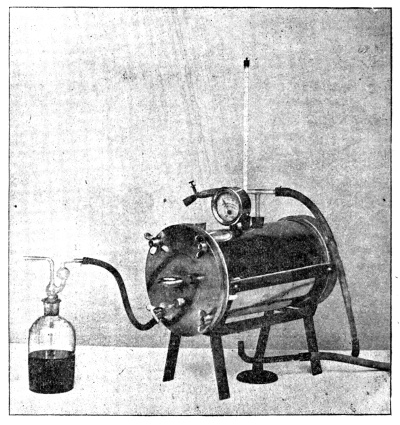
Figure 10. Carr’s Vacuum Drying Oven.
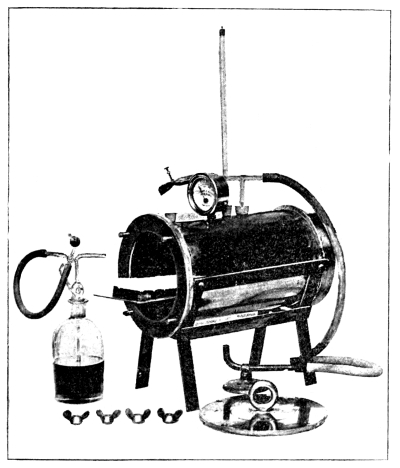
Figure 10. (Bis) Vacuum Oven Open.
20. Carr’s Vacuum Oven.—A convenient drying oven has been devised in this laboratory by Carr.[7] It is made of a large tube, preferably of brass. The tube may be from six to nine inches in diameter and from twelve to fifteen inches long. One end is closed air-tight by a brass end-piece attached by a screw, or brazed. The other end is detachable and is made air-tight by ground surfaces and a soft washer. In the figure this movable end-piece is shown attached by screw-nuts, but experience has shown that these are not necessary. On the upper longitudinal surfaces are apertures for the insertion of a vacuum gauge and for attachment to a vacuum apparatus.
In the figure the thermometer and aperture for introducing dry air or an inert gas are shown in the movable end disk, but they would be more conveniently placed in the fixed end. The oven is heated below by a gas burner, which conveniently should be as long as the oven. The heat is not allowed to strike the brass cylinder directly, but the latter is protected by a piece of asbestos paper.
The temperature inside of the oven can be easily kept practically constant by means of a gas regulator, not shown in the figure, or by a little attention to the lamp. For a vacuum of twenty inches a temperature of about 80° should be maintained. When the vacuum is more complete a lower temperature can be employed. This apparatus is simple in construction, strong, cheap, and highly satisfactory in use.
21. Drying in Hydrogen.—In some of the processes of agricultural analysis it becomes important to dry the sample in hydrogen or other inert gas. This may be accomplished by introducing the dry gas desired into some form of the apparatus already described. The drying may either be accomplished in an atmosphere of hydrogen practically at rest or in a more limited quantity of the gas in motion. The latter method is to be preferred by reason of its greater rapidity. The analyst has at his command many forms of apparatus designed for the purpose mentioned above. It will be sufficient here to describe only two, devised particularly for agricultural purposes.
The first one of these, designed by the author, was intended especially for drying the samples of fodders for analysis according to the methods of the Association of Agricultural Chemists.[8]
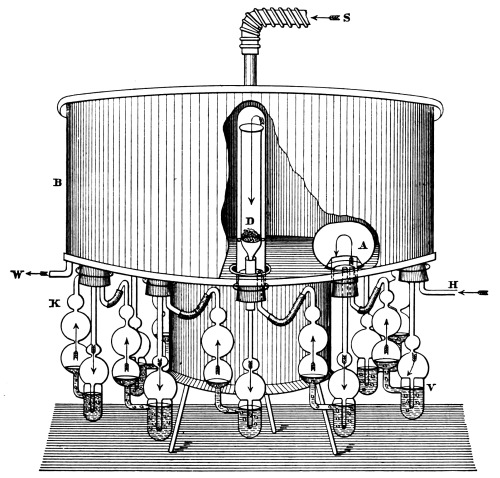
Figure 11. Apparatus for Drying in a Current of Hydrogen.
For the purpose of drying materials contained in flasks and tubes in a current of hydrogen the apparatus shown in Fig. 11 is used. This apparatus consists of a circular box, B, conveniently made of galvanized iron, having a movable cover, S, fitted for the introduction of steam into the interior of the apparatus. Condensed steam escapes at W. A stream of perfectly pure and dry hydrogen enters at H, passes up through the material to be dried, down through the bulb V, containing sulfuric acid, and follows the direction of the arrows through the rest of the apparatus. The stream of hydrogen is thus completely dried by passing through bulbs containing sulfuric acid, on the way from one piece of the apparatus to the other. A, represents a flask such as is used, with the extraction apparatus described. The apparatus which we have used will hold eight tubes or flasks at a time, and thus a single stream of hydrogen is made to do duty eight times in drying eight separate samples. The great advantage of the apparatus is in the fact that the stream of hydrogen must pass over and through the substance to be dried. In order to prevent any sulfuric acid from being carried forward into the next tube the bulb K, above the sulfuric acid, may be filled with solid pieces of soda or potash.
This apparatus has been in use for a long time and no accidents from sulfuric acid being carried forward have occurred, and there is no danger, provided the stream of hydrogen is kept running at a slow rate. If, however, by any accident the stream of hydrogen should be admitted with great rapidity, particles of the sulfuric acid might be carried forward and spoil the next sample. To avoid any such accident as this the proposal to introduce the potash bulb has been made. The apparatus works with perfect satisfaction, and it is believed that when properly adjusted check weighings can be made by weighing the bulbs, showing their increase in weight, which will give the volatile matter, and weighing the flasks or tubes, which will show the loss of weight. The only chance for error in weighing the bulbs is that some of the volatile matter may be material which is not dissolved in sulfuric acid, and is thus carried on and out of the apparatus. The blackening of the sulfuric acid in the bulbs, in the drying of all forms of organic matter, shows that the loss in weight of such bodies is not due to water alone, but also to organic volatile substances, which are capable of being decomposed by the sulfuric acid, thus blackening it.
22. Caldwell’s Hydrogen Drying-Bath.—An excellent device for drying in hydrogen has been described by Caldwell.[9] A vessel of copper or other suitable material serves to hold the tubes containing the samples to be dried. It should be about twenty-four centimeters long, fifteen high, and eight wide. This vessel is contained in another made of the same material and of the dimensions shown in the figure. On one side the edge of this containing vessel may not be more than one centimeter high and the bath should rest against it. The other side is made higher to form a support for the drying tubes as indicated.
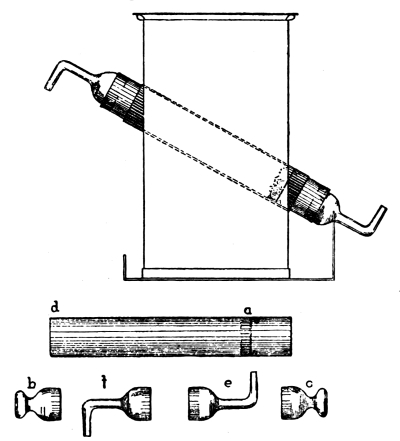
Figure 12. Caldwell’s Hydrogen Drying Apparatus.
The tube containing the substance a d is made of glass and may be closed by the ground stoppers c b or the tube stoppers e f. At a it carries a perforated platinum disk for holding the filtering felt. The tube should be about thirteen centimeters long and have an internal diameter of about twenty millimeters. With its stoppers it should weigh only a little over thirty grams. The asbestos felt should not be thick enough to prevent the free passage of gas. Passing diagonally through the bath are metal tubes, preferably made of copper, and of such a size as just to receive the glass drying tubes. If these be a little loose they should be made tight by wrapping them with a narrow coil of paper at either end of the tubular receptacle. The entrance of cold air between the glass tube and its metal holder is thus prevented, and the glass tube is held firmly in position. The glass tube should be weighed with its two solid stoppers. Afterwards the sample, about two grams, is placed on the asbestos felt and the stoppers replaced and the whole reweighed. The exact weight of the sample is thus obtained. The solid stoppers are then removed and the tube stoppers inserted. The lower end of the tube is then connected with the supply of dry hydrogen. The upper tube stopper is connected by a rubber tube with a small bottle containing sulfuric acid through which the escaping hydrogen is made to bubble. A double purpose is thus secured; moisture is kept from entering the drying tube and the rate at which the hydrogen is passing is easily noted. After the drying is completed the solid stoppers are again inserted, the tube cooled in a desiccator and weighed. The loss of weight is entered as water. The tube containing the sample can afterwards be put into an extractor and treated with ether or petroleum in the manner hereafter described. This apparatus requires more hydrogen than the one previously described, but it is rather simple in construction, is easily controlled, and has given satisfactory results.
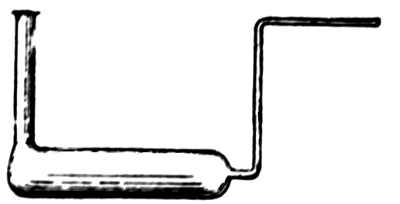
Figure 13. Liebig’s Ente.
23. Drying in Liebig’s Tubes.—In drying samples, especially of fodders, the method practiced at the Halle Station is to place them in drying tubes, the form of which is shown in Fig. 13. A stream of illuminating gas, previously dried by passing over sulfuric acid and calcium chlorid, is directed through the tubes.[10] Many of these tubes can be used at once, arranged as shown in Fig. 14. When the air is all driven out the stream of gas can be ignited so as to regulate the flow properly by the size of the flame. The tubes are held in drying ovens, as shown in the figure, the temperature of which should be kept at 105°-107°. The drying should be continued for eight or ten hours. At the end of this time the gas in the tube is to be expelled by a stream of dry air and the tubes cooled in a desiccator and weighed. There are few advantages in this method not possessed by the processes already described. The samples, moreover, are not left in a condition for further examination, either by incineration or extraction.
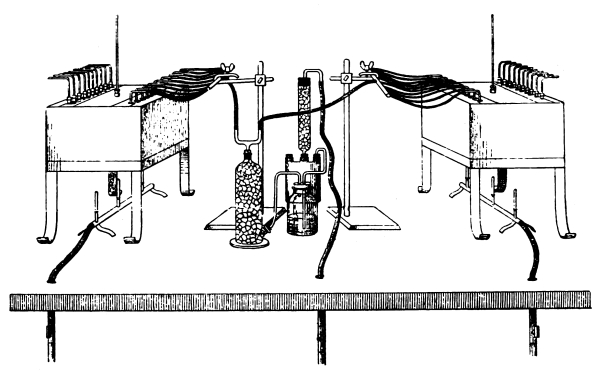
Figure 14. Drying Apparatus used at the Halle Station.
24. Wrampelmayer’s Drying Oven.—The apparatus used at the Wageningen Station, in Holland, for drying agricultural samples, was devised by Wrampelmayer and is shown in Fig. 15. The oven is so constructed as to permit of drying in a stream of inert gas. Illuminating gas is let into the drying space of the oven through the tube A B. At B the entering gas is heated by the same lamp which boils the liquid in the water space of the apparatus. The hot gas is dried in the calcium chlorid tube c and then passes into the oven at D. At E it leaves the apparatus and is thence conducted to the lamp F, used for heating the bath. The lamp should be closed by a wire gauze diaphragm to prevent any possible explosion by reason of any admixture with the air in the oven. The condensation of the aqueous vapors is effected by means of the condenser G. In the drying space is a small shelf holder, which, by means of the hook H, can be removed from the apparatus. The drying space is closed from the upper part of the apparatus, which contains no water by the cover J, resting on a support K. This rim is covered with a rubber gasket L, by means of which the cover J can be fastened with a bayonet latch air-tight. This fastening is shown at N. Being closed in this way the part of the cylindrical oven above the cover may be left entirely open. Instead of the rather elaborate method of closing the bath, some simple and equally effective device might be used. The cover J is best made with double metallic walls enclosing an asbestos packing.
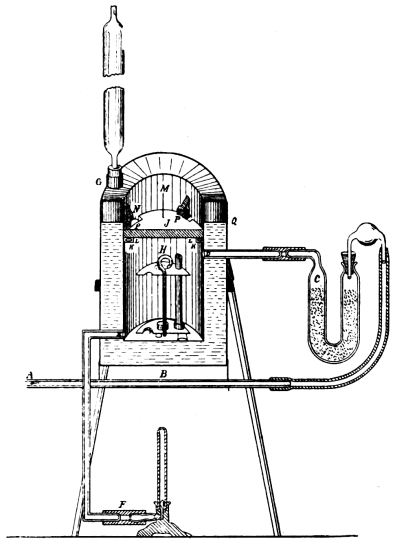
Figure 15. Wrampelmayer’s Oven.
It is evident that this oven could be used with an atmosphere of carbon dioxid or of air, provided the gas for heating were derived from a separate source and the tube between E and F broken. In a drying oven designed by the author, the movable top is made with double walls and the space between is joined to the steam chamber by means of a flexible metallic tube, thus entirely surrounding the drying space with steam.
25. The Ulsch Drying Oven.—A convenient drying oven is described by Ulsch which varies from the ordinary form of a water-jacketed drying apparatus in having a series of drying tubes inserted in the water-steam space.
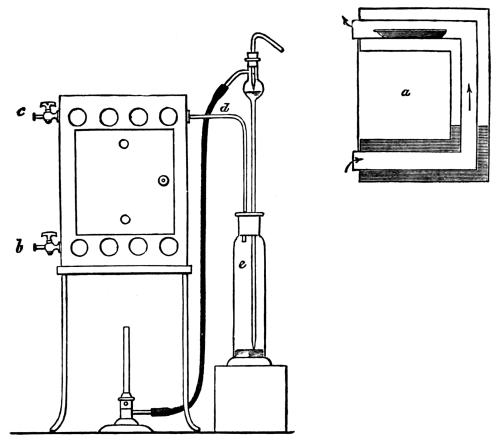
Figure 16. Ulsch Drying Oven.
The arrangement of the oven is shown in the accompanying figure. The water space is filled only to about one-third of its height. When the heat is applied the cock c is left open until the steam has driven out all the air. It is then closed and the temperature of the bath is then regulated by the manometer e, connected with the bath by d. The bottom of the manometer cylinder contains enough mercury to always keep sealed the end of the manometer tube. The rest of the space is filled with water. At the top the manometer tube is expanded into a small bulb which serves as a gas regulator, as shown in the figure. The gas is admitted also by a small hole above the mercury in the bulb, so that when the end of the gas inlet tube is sealed enough gas still passes through to keep the lamp burning. With a mercury pressure of thirty centimeters the temperature of the bath will be about 105°. The walls of the bath should be made strong enough to bear the pressure corresponding to this degree. The drying can be accomplished either in the cubical drying box a or in the drying tubes made of thin copper and disposed as shown in the figure. The natural draft is shown by the arrows. The substance is held in boats placed in the tube as indicated. The air in traversing the tube is brought almost to the temperature of the water-steam space in which the tube lies. The natural current of hot air can easily be replaced by a stream of dry illuminating or other inert gas.
26. Drying Viscous Liquids.—In the case of cane juices, milk, and similar substances, the paper coil method may be used.[11] The manipulation is conducted as follows: A strip of filtering paper from five to eight centimeters wide and forty centimeters in length, is rolled into a loose coil and dried at the temperature of boiling water for two hours, placed in a dry glass-stoppered weighing tube, cooled in a desiccator and weighed. The stoppered weighing tube prevents the absorption of hygroscopic moisture. About three cubic centimeters of the viscous or semi-viscous liquid are placed in a flat dish covered by a plate of thin glass and weighed. The coil is then placed on end in the dish, and the greater part of the liquid is at once absorbed. The proportions between the coil and the amount of liquid should be such that the coil will not be saturated more than two-thirds of its length. It is then removed and placed dry end down in a steam-bath and dried two hours. The dish, covered by the same plate of glass, is again weighed, the loss in weight representing the quantity of liquid absorbed by the coil. After drying for the time specified the coil is again placed in the hot weighing tube, cooled and its weight ascertained. The increase represents the solid matter in the sample taken. This method has been somewhat modified by Josse, who directs that it be conducted as follows:[12] Filter-paper is cut into strips from one to two centimeters wide and three meters long. The strips are crimped so they will not lie too closely together and then wrapped into coils. These coils can absorb about ten cubic centimeters of liquid. One of them is placed in a flat dish about two centimeters high and seven in diameter, and dried as described, covered, cooled and weighed. There are next placed in the dish and weighed one or two grams of the massecuite, molasses, etc., which are to be dried and the dish again weighed and the total weight of the matter added, determined by deducting the weight of the dish and cover. About eight cubic centimeters of water are added, the material dissolved with gentle warming, the coil placed in the dish, and the whole dried for two hours. The cover is then replaced and the whole cooled in a desiccator and weighed. The increase in weight represents the dry matter in the sample taken.
The above method of solution of a viscous sample in order to divide it evenly for desiccation is based on the principle of the method first proposed by the author and Broadbent for drying honeys and other viscous liquids.[13] In this process the sample of honey, molasses, or other viscous liquid is weighed in a flat dish, dissolved in eighty per cent alcohol, and then a weighed quantity of pure dry sand added, sufficient to fill the dish three-quarters full. The alcoholic solution of the viscous liquid is evenly distributed throughout the mass of sand by capillary attraction, and thus easily and rapidly dried when placed on the bath.
Pumice stone, on account of its great porosity, is also an excellent medium for the distribution of a viscous liquid in aiding the process of desiccation. The method has been worked out in great detail in this laboratory by Carr and Sanborn,[14] and most excellent results obtained. Round aluminum dishes two centimeters high and from eight to ten centimeters in diameter are conveniently used for this process. The pumice stone is dried and broken into fragments the size of a pea before use.
27. General Principles of Drying Samples.—It would be a needless waste of space to go into further details of devices for desiccation. A sufficient number has been given to fully illustrate all the principles involved. In general, it may be said that drying in the open air at a temperature not exceeding that of boiling water can be safely practiced with the majority of samples. For instance, we have found practically no change in this laboratory in the composition of cereals dried in the air and in an inert gas. The desiccation should in all cases be accomplished as speedily as possible. To this end the atmosphere in contact with the sample should be dry and kept in motion. An oven surrounded by boiling water and steam is to be preferred to one heated by air. Constancy of temperature is quite as important as its degree and this steadiness is most easily secured by steam at atmospheric pressure. Where higher temperatures than 100° are desired the steam must be under pressure, or the boiling-point of the water may be raised by adding salt or other soluble matters. A bath of paraffin or calcium chlorid may also be used or a sand or air-bath may be employed. The analyst must not forget, however, that inorganic matters are prone to change at temperatures above 100°, even in an inert atmosphere, and higher temperatures must be used with extreme caution.
Drying in partial vacuum and in a slowly changing atmosphere may be practiced with all bodies and must be employed with some. The simple form of apparatus already described will be found useful for this purpose. At a vacuum of twenty inches or more, even unstable organic agricultural products are in little danger of oxidation. In the introduction of a dry gas, therefore, air will be found as a rule entirely satisfactory. In the smaller form of vacuum apparatus described, however, there is no objection to the employment of hydrogen or of carbon dioxid. The gas entering the apparatus should be dried by passing over calcium chlorid or by bubbling through sulfuric acid. In this laboratory the vacuum is provided by an air-pump connected with a large exhaust cylinder. This cylinder is connected by a system of pipes to all the working desks. The chief objection to this system is the unsteadiness of the pressure. When only a few are using the vacuum apparatus for filtering or other purposes the vacuum will stand at about twenty inches. When no one is using it the vacuum will rise to twenty-eight or twenty-nine inches. At other times, when in general use, it may fall to fifteen inches. Where a constant vacuum is desired for drying, therefore, it is advisable to connect the apparatus with a special aspirator which will give a pressure practically constant.
The dishes containing the sample should be low and flat, exposing as large a surface as possible. For viscous liquids it will be found advisable to previously fill the dishes with pumice stone or other inert absorbent material to increase the surface exposed.
The special methods of drying milk, sirup, honeys, and like bodies, will be described in the paragraphs devoted to these substances.
In drying agricultural products, not only water but all other matters volatile at the temperature employed are expelled. It is only necessary to conduct the products of volatilization through sulfuric acid to demonstrate the fact that organic bodies are given off. In the case mentioned the sulfuric acid will be speedily changed to a brown and even black color by these bodies. It is incontestable, however, that in most cases the essential oils and other volatile matters thus escaping are not large in quantity and could not appreciably affect the percentage composition of the sample. In such cases the whole of the loss on drying is entered in the note book as water. There are evidently many products, however, where a considerable percentage of the volatile products is not water. The percentage of essential oils, which have a lower boiling-point than water, can be determined in a separate sample and this deducted from the total loss on drying will give the water.
Simple as it seems, the determination of water in agricultural products often presents peculiar difficulties and taxes to the utmost the patience and skill of the analyst. Having set forth the substantial principles of the process and indicated its more important methods, there is left for the worker in the laboratory the choice of processes already described, or, in special cases, the device of new ones and adaption of old ones to meet the requirements of necessity.
INCINERATION.
28. Determination of Ash.—The principle to be kept in view in the preparation of the ash of agricultural products is to conduct the incineration at as low a temperature as possible to secure a complete combustion. The danger of too high a temperature is two-fold. In the first place some of the mineral constituents constantly present in the ash, notably, some of the salts of potassium and sodium are volatile at high temperatures and thus escape detection. In the second place, some parts of the ash are rather easily fusible and in the melted state occlude particles of unburned organic matter, and thus protect them from complete oxidation. Both of these dangers are avoided, and an ash practically free of carbon obtained, by conducting the combustion at the lowest possible temperature capable of securing the oxidation of the carbonaceous matter.
29. Products Of Combustion.—The most important product of combustion, from the present point of view, is the mineral residue obtained. The organic matter of the sample undergoes decomposition in various ways, depending chiefly on its nature. Complex volatile compounds are formed first largely of an acid nature. The residual carbon is oxidized to carbon dioxid and the hydrogen to water. The relative proportions of these bodies formed, in any given case, depend on the conditions of combustion. With a low temperature and a slow supply of oxygen, the proportion of volatile organic compounds is increased. At a high temperature, and in a surplus of oxygen, the proportions of water and carbon dioxid are greater. At the present time, however, our attention is to be directed exclusively to the mineral residue; the organic products of combustion belonging to the domain of organic chemistry. As has already been intimated, the ash of agricultural samples consists of the mineral matters derived from the tissues, together with any accidental mineral impurities which may be present, some unburned carbon, and the sulfur, phosphorus, chlorin, nitrogen, etc., existing previously in combination with the mineral bases. The organic sulfur and phosphorus may also undergo complete or partial oxidation during incineration and be found in the ash. Unless special precautions be taken, however, a portion of the organic sulfur and phosphorus may escape as volatile compounds during the combustion.[15] The organic nitrogen is probably completely lost, at most, only traces of it being oxidized during the combustion in such a way as to combine with a mineral base. The rare mineral elements that are taken up by plants will also be found in the ash. Here the analyst would look for copper, boron, zinc, manganese, and the other elements which, when existing in the soil, are apt to be found in the tissues of the plants, not, perhaps, as organic or essential compounds, but as concomitants of the other mineral foods absorbed by growing vegetation. This fact is often of importance in toxicological and hygienic examinations of foods. For instance, traces of copper or of boron in the ash of a prescribed food would not be evidence of the use of copper or borax salts as preservatives unless it could be shown that the soil on which the food in question was grown was free of these bodies.
This fact manifestly applies only to those cases where mere traces of these rare bodies are in question. The presence of considerable quantities of them, enough to be inimical to health, could only be attributed to artificial means.
30. Purpose and Conduct of Incineration.—In burning a sample of an agricultural product the analyst may desire to secure either a large sample of ash for analytical purposes as already described or to determine the actual percentage of ash. The first purpose is secured in many ways. In the preparation of ash for manurial purposes, for instance, little care is exercised either to prevent volatilization of mineral matters or to avoid the occurrence of a considerable quantity of carbon in the sample. With this operation we have, at present, nothing whatever to do. In preparing a sample of ash for chemical analysis it is important, where a sufficient quantity of the sample can be obtained, to use as large a quantity of it as convenient. While it is true that very good results may be secured on very small samples, it is always advisable to have a good supply of the material at hand. Since the materials burned have only from one to three per cent of ash, a kilogram of them will supply only from ten to thirty grams. To supply all needful quantities of material and replace the losses due to accident, whenever possible at least twenty grams of the ash should be prepared. The combustion can be carried on in platinum dishes with all bodies free of metallic oxids capable of injuring the platinum. Otherwise porcelain or clay dishes may be employed. As a rule the combustion is best conducted in a muffle at a low red heat. With substances very rich in fusible ash, as for instance the cereals, it is advisable to first char them, extract the greater part of the ash with water, and afterwards burn the residual carbon. The aqueous extract can then be added to the residue of combustion and evaporated to dryness at the temperature of boiling water. During the combustion the contents of the dish should not be disturbed until the carbon is as completely burned out as possible. The naturally porous condition in which the mass is left during the burning is best suited to the entire oxidation of the carbon. At the end however, it may become necessary to bring the superficial particles of unburned carbon into direct contact with the bottom of the dish by stirring its contents. In most instances very good results may be obtained by burning the ash in an open dish without the aid of a muffle. In this case a lamp should be used with diffuse flame covering as evenly as possible the bottom of the dish and thus securing a uniform temperature. The carbon, when once in active combustion, will as a rule be consumed, and an ash reasonably pure be obtained.
The second purpose held in view by the analyst is to determine the actual content of ash in a sample. For this purpose only a small quantity of the material should be used, generally from two to ten grams. The combustion should be conducted in flat-bottomed, shallow dishes, and at a low temperature. In many cases the residue, after determining the moisture, can be at once subjected to incineration, and thus an important saving of time be secured. A muffle, with gentle draft, will be found most useful for securing a white ash. The term, white ash, is sometimes a deceptive one. In samples containing iron or manganese, the ash may be practically free of carbon and yet be highly colored. The point at which the combustion is to be considered as finished therefore should be at the time the carbon has disappeared rather than when no coloration exists. In general the methods of incineration are the same for all substances, but some cases may arise in which special processes must be employed. Some analysts prefer to saturate the substance before incineration with sulfuric acid, securing thus a sulfated ash. This is practiced especially with molasses. In such cases the ash obtained is free of carbon dioxid and roughly the difference in weight is compensated for by deducting one-tenth of the weight of the ash when comparison is to be made with ordinary carbonated ash. Naturally this process could not be used when sulfuric acid is to be determined in the product.
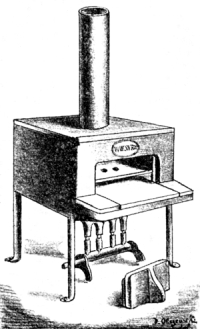
Figure 17. Courtoune Muffle.
31. German Ash Method.—The method pursued at the Halle Station for securing the percentage of ash in a sample is as follows:[16] Five grams of the air-dried sample are incinerated in a platinum dish and the ash ignited until it has assumed a white, or at least a bright gray tint. As soon as combustible gases are emitted at the beginning of the incineration they are ignited and allowed to burn as long as possible. It is advisable to hasten the oxidation by stirring the mass with a piece of platinum wire. If the ash should become agglomerated, as sometimes happens with rich food materials, it must be separated by attrition. The ash, when cooled on a desiccator, is to be weighed. When great exactness is required, it is advised, as set forth in a former paragraph, to first carbonize the mass and then extract the soluble ash with hot water before completing the oxidation. When the latter is complete and the dish cooled the aqueous extract is added, evaporated to dryness and the incineration completed.
32. Courtonne’s Muffle.—The ordinary arrangement of a muffle, as in assaying, may be conveniently used in incineration. A special muffle arrangement has been prepared by Courtonne which not only permits of the burning of a large number of samples at once, but also effects a considerable saving in gas. The muffle as shown in Fig. 17, is made in two stages, and the floor projects in front of the furnace, forming a convenient hearth. The incineration is commenced on the upper stage, where the temperature is low, and finished on the lower one at a higher heat. The furnace is so arranged as to permit the flame of the burning gas to entirely surround the muffle. The draft and temperature within the muffle are controlled by the fire-clay door shown resting on the table.
TREATMENT WITH SOLVENTS.
33. Object Of Treatment.—The next step, in the analytical work, after sampling, drying, and incinerating, is the treatment of the sample with solvents. The object of this work is to separate the material under examination into distinct classes of bodies distinguished from each other by their solubilities. It is not the purpose of this section to describe the various bodies which may be separated in this way, especially from vegetable products. For this description the reader may consult the standard works on plant analysis.[17]
The chief object of a strictly agricultural examination of a field or garden product is to determine its food value. This purpose can be accomplished without entering into a minute separation of nearly allied bodies. For example, in the case of carbohydrates it will be sufficient as a rule, to separate them into four classes. In the first class will be found those soluble in water as the ordinary sugars. In the second group will be found those which, while not easily soluble in water, are readily rendered so by treatment with certain ferments or by hydrolysis with an acid. The starches are types of this class. In the third place are found those bodies which resist the usual processes of hydrolysis either with an acid or alkali, and therefore remain in the residue as fiber. Cellulose is a type of these bodies. In the fourth class are included those bodies which on hydrolysis with an acid yield furfurol on distillation, and therefore belong to the type containing five atoms of carbon or some multiple thereof in their molecule. For ordinary agricultural purpose the separation is not even as complete as is represented above.
What is true of the carbohydrates applies equally well to the fats and to other groups. Especially in the analysis of cereals and of cattle foods, the treatment with solvents is confined to the use in successive order of ether or petroleum, alcohol, dilute acids, and alkalies, the latter at a boiling temperature. The general method of treatment with these solvents will be the subject of the following paragraphs.
34. Extraction of the Fats and Oils.—Two solvents are in general use for the extraction of fats and oils; viz., ethylic ether and a light petroleum. The former is the more common reagent. Before use it should be made as pure as possible by washing first with water, afterwards removing the water by lime or calcium chlorid, and then completing the drying by treatment with metallic sodium. The petroleum spirit used should be purified by several fractional distillations until it has nearly a constant boiling-point of from 45° to 50°. The detailed methods of preparing these reagents will be given in another place. For rigid scientific determinations the petroleum is to be preferred to the ether. It is equally as good a solvent for fats and oils and is almost inert in respect to other vegetable constituents. Ether, on the other hand, dissolves chlorophyll and its partial oxidation products, resins, alkaloids and the like. The extract obtained by ether is therefore less likely to be a pure fat than that secured by petroleum. For purposes of comparison, however, the ether should be employed, inasmuch as it has been used almost exclusively in analytical operations in the past.
35. Methods Of Extraction.—The simplest method for accomplishing the extraction of fat from a sample consists in treating it with successive portions of the solvent in an open dish or a closed flask. This process is actually employed in some analytical operations, as, for instance, in the determination of fat in milk. Experience has shown, however, that a portion of the substance soluble, for instance, in ether, passes very slowly into solution, so that a treatment such as that just described would have to be long continued to secure maximum results. The quantity of solvent required would thus become very large and in the case of ether would entail a great expense. For the greater number of analytical operations, therefore, some device is employed for using the same solvent continually. The methods of extraction therefore fall into two general classes; viz., extraction by digestion and extraction by percolation. This classification holds good also for other solvents besides ether and petroleum. In general, the principles and practice of extraction described for ether may serve equally well for alcohol, acetone and other common solvents.
36. Extraction by Digestion.—In the use of ether or petroleum the sample is covered with an excess of the solvent and allowed to remain for some time in contact therewith. The soluble portions of the sample diffuse into the reagent. The speed of diffusion is promoted by stirring the mixtures. The operation may be conducted in an open dish or a flask. Inasmuch as the residue is, as a rule, to be dried and weighed, an open dish is to be preferred. To avoid loss of reagent and to prevent filling a working room with very dangerous gases, the temperature of digestion should be kept below the boiling-point of the solvent. The greater part of the soluble matter will be extracted with three or four successive applications of the reagent, but, as intimated above, the last portions of the soluble material are extracted with difficulty by this process. In pouring off the solvent care must be exercised to avoid loss of particles of the sample suspended therein. To this end it is best to pour the solvent through a filter. For the extraction of large quantities of material for the purpose of securing the extract for future examination, or simply to remove it, the digestion process is usually employed. This excess of solvent required is easily recovered by subsequent distillation and used again. The method is rarely used for the quantitive estimation of the extract, the process of continuous percolation being more convenient and more exact.
37. Extraction by Percolation.—In this method the solvent employed is poured on the top of the material to be extracted and allowed to pass through it usually by gravitation alone, sometimes with the help of a filter-pump. The principle of the process is essentially that of washing precipitates.
Two distinct forms of apparatus are in use for this process. In the first kind the solvent is poured over the material and after percolation is secured by distillation in another apparatus. In the second kind the solvent is secured after percolation in a flask where it is at once subjected to distillation. The vapors of the solvent are conducted by appropriate means to a condenser placed above the sample. After condensation the solvent is returned to the upper part of the sample. The percolation thus becomes continuous and a very small quantity of the solvent may thus be made to extract a comparatively large amount of material. This process is particularly applicable to the quantitive determination of the extract. After distillation and drying the latter may be weighed in the flask in which it was received or the sample may be dried and weighed in the vessel in which it is held both before and after extraction. One great advantage of the continuous extraction method lies in the fact that when it is once properly started it goes on without further attention from the analyst save an occasional examination of the flow of water through the condenser and of the rate of the distillation. For this reason the process may be continued for many hours without any notable loss of time. The vapor of the solvent in passing to the condenser may pass through a tube out of contact with the material to be extracted or it may pass directly around the tube holding the sample. In the former case the advantage is secured of conducting the extraction at a higher temperature, but there is danger of boiling the solvent in contact with the material and thus permitting the loss of a portion of the sample.
38. Apparatus Used for Extractions.—For extraction by digestion, as has already been said, an open dish may be used. When large quantities of material are under treatment, heavy flasks, holding from five to ten liters, will be found convenient. In these cases a condenser can be attached to the flask and the extraction conducted at the boiling temperature of the solvent. During the process of extraction it is advisable to shake the flask frequently. By proceeding in this way the greater part of the solvent matter will be removed after three or four successive treatments.
In extraction by percolation various forms of apparatus are employed. The ordinary percolators of the manufacturing pharmacist may be used for the larger operations, while the more elaborate forms of continuous extractors will be found most convenient for quantitive work. In each case the analyst must choose that process and form of apparatus best suited to the purpose in view. In the next paragraphs will be described some of the more common forms of apparatus in use.
39. Knorr’s Extraction Apparatus.—The apparatus which has been chiefly used in this laboratory for the past few years is shown in the accompanying figure.[18] The principle of the construction of the apparatus lies in the complete suppression of stoppers and in sealing the only joint of the device with mercury.
The construction and operation of the apparatus will be understood by a brief description of its parts.
A is the flask containing the solvent, W a steam bath made by cutting off the top of a bottle, inverting it and conducting the steam into one of the tubes shown in the stopper while the condensed water runs out of the other. The top of the bath is covered with a number of concentric copper rings, so that the opening may be made of any desirable size. B represents the condenser, which is a long glass tube on which a number of bulbs has been blown, and which is attached to the hood for holding the material to be extracted, as represented at Bʹ, making a solid glass union. Before joining the tube at Bʹ the rubber stopper which is to hold it into the outside condenser of B is slipped on, or the rubber stopper may be cut into its center and slipped over the tube after the union is made. In case alcohol is to be used for the solvent, requiring a higher temperature, the flask holding the solvent is placed entirely within the steam-bath, as represented at Aʹ.
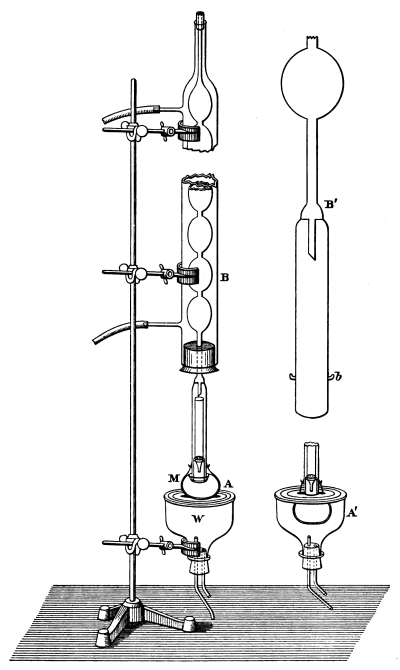
Figure 18. Knorr’s Extraction Apparatus.
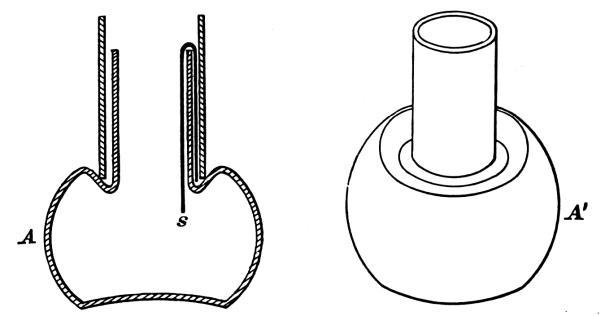
Figure 19. Extraction Flask.
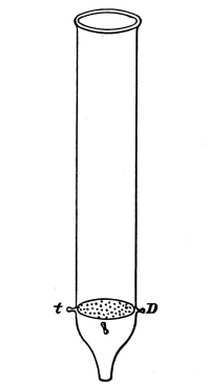
Figure 20. Extraction Tube.
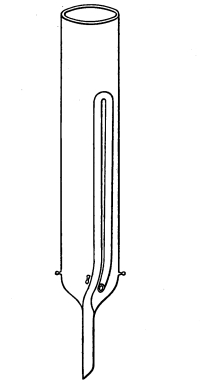
Figure 21. Extraction Siphon Tube.
A more detailed description of the different parts of the apparatus can be seen by consulting Figs. 19, 20, and 21. In A, Fig. 19, is represented a section of the flask which holds the solvent, showing how the sides of the hood containing the matters to be extracted pass over the neck of the flask, and showing at S a small siphon inserted in the space between the neck of the flask and the walls of the hood for the purpose of removing any solvent that may accumulate in this space. A view of the flask itself is shown at Aʹ. It is made by taking an ordinary flask, softening it about the neck and pressing the neck in so as to form a cup, as indicated at Aʹ, to hold the mercury which seals the union of the flask with the condenser. The flask is held in position by passing a rubber band below it, which is attached to two glass nipples, b, blown onto the containing vessel, as shown in Fig. 18. The material to be extracted may be contained in an ordinary tube, as shown in Fig. 20, which may be made from a test tube drawn out, as indicated in the figure, having a perforated platinum disk sealed in at D. The containing tube rests upon the edges of the flask containing the solvent by means of nipples shown at t. If a siphon tube is to be used, one of the most convenient forms is shown in Fig. 21, in which the siphon lies entirely within the extracting tube, thus being protected from breakage. By means of this apparatus the extractions can be carried on with a very small quantity of solvent, there being scarcely any leakage, even with the most volatile solvents, such as ether and petroleum. The apparatus is always ready for use, no corks are to be extracted, and no ground glass joints to be fitted.
40. Soxhlet’s Extraction Apparatus.—A form of continuous extraction apparatus has been proposed by Soxhlet which permits the passage of the vapors of the solvent into the condenser by a separate tube and the return of the condensed solvent after having stood in contact with the sample, to the evaporating flask by a siphon. The advantage of this process lies in freeing the sample entirely from the rise of temperature due to contact with the vapors of the solvent, and in the second place in the complete saturation of the sample with the solvent before siphoning. The sample is conveniently held in a cylinder of extracted filter-paper open above and closed below. This is placed in the large tube between the evaporating flask and the condenser. The sample should not fill the paper holder, and if disposed to float in the solvent, should be held down with a plug of asbestos fiber or of glass wool. The extract may be transferred, by dissolving in the solvent, from the flask to a drying dish, or it may be dried and weighed in the flask where first received.
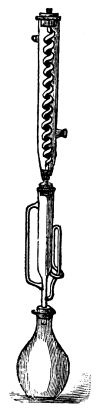
Figure 22. Soxhlet Extraction Apparatus.
There are many forms of apparatus of this kind, one of which is shown in Fig. 22, but a more extended description of them is not necessary. The disadvantages of this process as compared with Knorr’s, are quite apparent. The connections with the evaporating flask and condenser are made with cork stoppers, which must be previously thoroughly extracted with ether and alcohol. These corks soon become dry and hard and difficult to use. The joints are likely to leak, and grave dangers of explosion arise from the vapors of the solvents escaping into the working room. Moreover, it is an advantage to have the sample warmed by the vapors of the solvent during the progress of the extraction, provided the liquid in direct contact with the sample does not boil with sufficient vigor to cause loss.
The use of extraction apparatus with ground glass joints is also unsatisfactory. By reason of unequal expansion and contraction these joints often are not tight. They are also liable to break and thus bring danger and loss of time.
41. Compact Extraction Apparatus.—In order to bring the extraction apparatus into a more compact form, the following described device has been successfully used in this laboratory.[19] The condenser employed is made of metal and is found entirely within the tube holding the solvent.
This form of condenser is shown in Fig. 23, in which the tube E serves to introduce the cold water to the bottom of the condensing device. The tube D serves to carry away the waste water. The tube F serves for the introduction of the solvent by means of a small funnel. When the solvent is introduced and has boiled for a short time, the tube F should be closed. In each of the double conical sections of the condenser a circular disk B is found, which causes the water flowing from A upward to pass against the metallic surfaces of the condenser.
A section of the double conical condenser is shown in the upper right hand corner. It is provided with two small hooks hh, soldered on the lower surface, by means of which the crucible G can be hung with a platinum wire. The condenser is best made smooth and circular in form.
The crucible G, which holds the material to be extracted, can be made of platinum, but for sake of economy also of porcelain. The bottom of the porcelain crucible is left open excepting a small shelf, as indicated, which supports a perforated disk of platinum on which an asbestos film is placed.
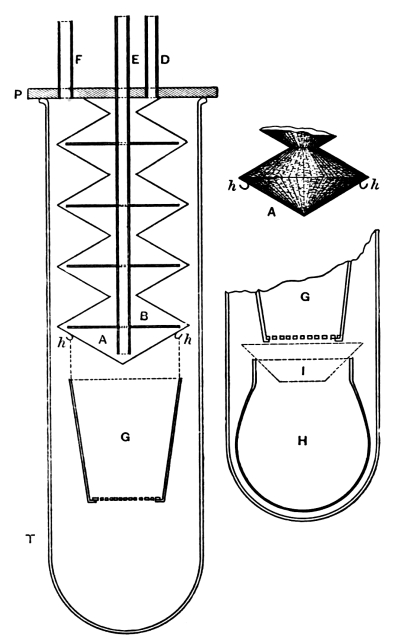
Figure 23. Compact Condensing Apparatus.
The whole apparatus is of such size as to be easily contained in the large test-tube T.
The mouth of the test-tube is ground so as to fit as smoothly as possible to the ground-brass plate of the metallic condenser P.
In case it is desired to weigh the extract it may be done directly by weighing it in the test-tube T after drying in the usual way at the end of the extraction; or a glass flask H, made to fit freely into the test-tube, may be used, in which case a little mercury is poured into the bottom of the tube to seal the space between H and T. To prevent spirting of the substance in H, or projecting any of the extracted material without or against the bottom of the crucible G, the funnel represented by the dotted lines in the right hand section may be used.
Heat may be applied to the test-tube either by hot water, or steam, or by a bunsen, which permits of the flame being turned down to minimum proportions without danger of burning back. When the test-tube alone is used it is advisable to first put into it some fragments of pumice stone, particles of platinum foil, or a spoonful of shot, to prevent bumping of the liquid when the lamp is used as the source of heat.
Any air which the apparatus contains is pushed out through F when the boiling begins, the tube F not being closed until the vapor of the liquid has reached its maximum height. With cold water in the condenser the vapor of ether very rarely reaches above the lower compartment and the vapor of alcohol rarely above the second.
When the plate P is accurately turned so as to fit the ground surface of the mouth of T, it is found that ten cubic centimeters of anhydrous ether or alcohol are sufficient to make a complete extraction, and there is not much loss of solvent in six hours. The thickness of the asbestos film in G, or its fineness, is so adjusted as to prevent too rapid filtration so that the solvent may just cover the material to be extracted, or, after the material is placed in a crucible, a plug of extracted glass wool may be placed above it for the purpose of distributing the solvent evenly over the surface of the material to be extracted and of preventing the escape of fine particles.
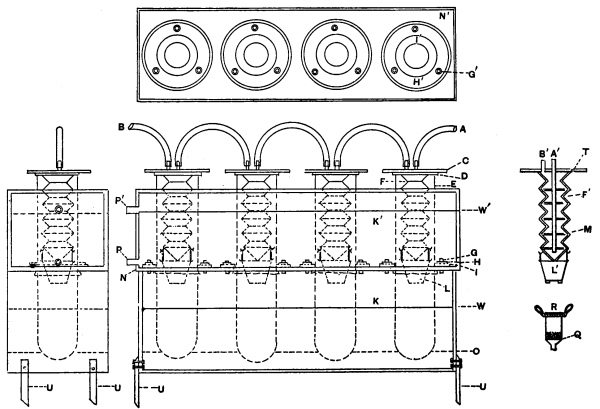
Figure 24. Improved Compact Extraction Apparatus.
In very warm weather the apparatus may be arranged as shown in figure 24. The bath for holding the extraction tubes is made in two parts, K and Kʹ. The bath K has a false bottom shown in the dotted line O, perforated to receive the ends of the extraction tubes and which holds them in place and prevents them from touching the true bottom, where they might be unequally heated by the lamp. The upper bath Kʹ has a perforated bottom, partly closed with rubber-cloth diaphragms Gʹ Nʹ Hʹ. The extraction tubes passing through this bath, water-tight, permit broken ice or ice-water to be held about their tops, and thus secure a complete condensation of the vapors of the solvent which in warm weather might escape the metal condenser. In practice care must be taken to avoid enveloping too much of the upper part of the extraction tube with the ice-water, otherwise the vapors of the solvent will be chiefly condensed on the sides of the extraction tube and will not be returned through the sample. It is not often that the upper bath is needed, and then only with ether, never with alcohol. This apparatus has proved especially useful with alcohol, using, as suggested, glycerol in the bath. The details of its further construction and arrangement are shown in the figure. The extraction tubes are most conveniently arranged in a battery of four, one current of cold water passing in at A and out at B, serving for all. The bath is supported on legs long enough to allow the lamp plenty of room. The details of the condenser M are shown in Bʹ, Aʹ, T, Fʹ, and Lʹ. Instead of a gooch Lʹ for holding the sample a glass tube R, with a perforated platinum disk Q, may be used. The water line in the bath is shown by W. This apparatus may be made very cheaply and without greatly impairing its efficiency by using a plain concentric condenser and leaving off the upper bath Kʹ.
42. Solvents Employed.—It has already been intimated that the chief solvents employed in the extraction of agricultural samples are ether or petroleum and aqueous alcohol. The ether used should be free of alcohol and water, the petroleum should be subjected to fractional distillation to free it of the parts of very high and very low boiling points, and the alcohol as a rule should contain about twenty per cent of water.
There are many instances, however, where other solvents should be used. The use of aqueous alcohol is sometimes preceded by that of alcohol of greater strength or practically free of water. For the extraction of soluble carbohydrates (sugars) cold or tepid water is employed, the temperature of which is not allowed to rise high enough to act upon starch granules. For the solution of the starch itself an acid solvent is used at a boiling temperature, whereby the starch molecules undergo hydrolysis and form dextrin or soluble sugars (maltose, dextrose). By this process also the carbohydrates, whose molecules contain five, or some multiple thereof, atoms of carbon form soluble sugars of which xylose and arabinose are types. The solvent action of acids followed by treatment with dilute alkalies at a boiling temperature, completes practically the solution of all the carbohydrate bodies, save cellulose and nearly related compounds. The starch carbohydrates are further dissolved by the action of certain ferments such as diastase.
Dilute solutions of mineral salts exert a specific solvent action on certain nitrogenous compounds and serve to help separate the albuminoid bodies into definite groups.
Under the proper headings the uses of these principal solvents will be described, but a complete discussion of their action, especially on samples of a vegetable origin, should be looked for in works on plant analysis.[20]
The application of acids and alkalies for the extraction of carbohydrates, insoluble in water and alcohol, will be described, in the paragraphs devoted to the analysis of fodders and cereals. The extraction of these matters, made soluble by ferments, will be discussed in the pages devoted to starch and artificial digestion. It is thus seen that the general preliminary treatment of a sample preparatory to specific methods of examination is confined to drying, extraction with ether and alcohol, and incineration.
43. Recovery of the Solvent.—In using such solvents as ether, chloroform, and others of high value, it is desirable often to recover the solvent. Various forms of apparatus are employed for this purpose, arranged in such a way as both to secure the solvent and to leave the residue in an accessible condition, or in a form suited to weighing in quantitive work. When the extractions are made according to the improved method of Knorr, the flask containing the extract may be at once connected with the apparatus shown in figure 25.[21] A represents the flask containing the solvent to be recovered, W the steam-bath, B the condenser sealed by mercury, M and R the flask receiving the products of condensation. It will be found economical to save ether, alcohol, and chloroform even when only a few cubic centimeters remain after the extraction is complete. In the figure the neck of the flask A is represented as narrower than it really is. The open end of the connecting tube, which is sealed on A by mercury, should be the same size as the tube connecting with the condenser in the extraction apparatus.
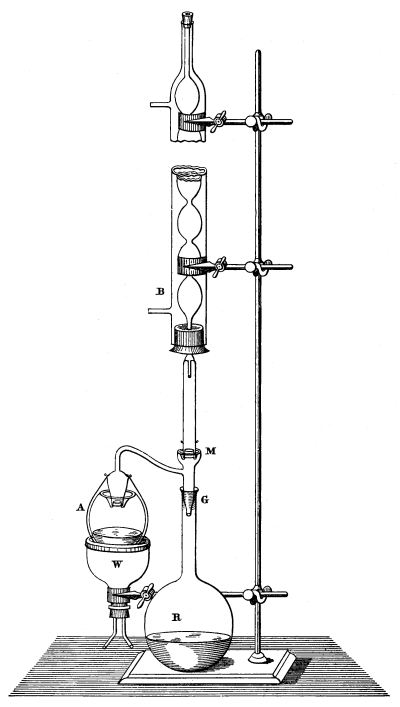
Figure 25.—Knorr’s Apparatus for Receiving Solvents.
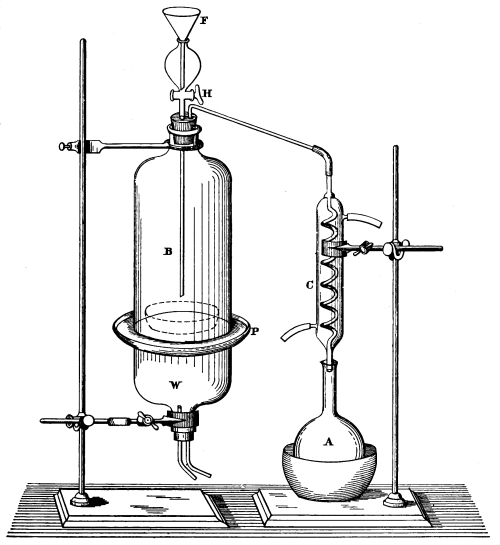
Figure 26. Apparatus for Recovering Solvents from Open Dishes.
It often happens that materials which are dissolved by the ordinary solvents in use are to be collected in open dishes in order that their properties may be studied. At the same time large quantities of solvents must be used, and it is desirable to have some method of recovering them. The device shown in Fig. 26 has been found to work excellently well for this purpose.[22] It consists of a steam-bath, W, and a bottle, B, with the bottom cut off, resting on an iron dish, P, containing a small quantity of mercury, enough to seal the bottom of the bottle. The dish containing the solvent is placed on the mercury, and the bottle placed down over it, forming a tight joint. On the application of steam the solvent escapes into the condenser, C, and is collected as a liquid in the flask A. In very volatile solvents the flask A may be surrounded with ice, or ice-cold water passed through the condenser. When an additional quantity of the solvent is to be added to the dish for the purpose of evaporating it is poured into the funnel F, and the stopcock H opened, which allows the material to run into the dish in B without removing the bottle. In this way many liters of the solvent may be evaporated in any one dish, and the total amount of extract obtained together. At the last the bottle B is removed, and the extract which is found in the dish is ready for further operations.