SURVEY OF THE STATE (continued 3)
Reading edition
Sodium sulphate and bentonite are two of the more recent mineral discoveries in North Dakota. In the southwestern part of the State are large beds of bentonite which, because close to the surface, are easily accessible for commercial purposes. Bentonite is used in the manufacture of paint, rubber, soap, cosmetics, dynamite, and a variety of other products; it has also been found to give rich gold and brown tones to decorative designs on pottery. The chalky-white crystals of sodium sulphate, sometimes known as Glauber's salts, are found in few places in the United States outside of the old lake beds of northwestern North Dakota. Sodium sulphate is principally used in the manufacture of paper. Millions of tons of it are easily accessible in the open lake beds where it has been deposited by springs.
Development of mineral resources should help to solve the unemployment problem of the State—a problem which is constantly growing. Except in recent years, residents have had no difficulty in finding work, because agricultural pursuits usually require the same amount of labor year after year regardless of agricultural prices. Despite this, new factors are increasing unemployment. In the period between 1930 and 1935, North Dakota was the only State in the spring wheat belt to show an increase in population. Another primary cause of increasing unemployment is the steadily growing percentage of persons over 40 years of age: in 1900, 18.4 percent of the population was over 40, in 1920 this had increased to 20.8 percent, and in 1930 to 25.6 percent.
In keeping with the comparative unimportance of the State labor movement at present is the small number of labor unions in North Dakota. The State's first labor organization was the Bismarck Typographical Union, chartered in 1883. In 1906 the American Federation of Labor granted a charter to the Fargo Trades and Labor Assembly, and in 1911 the State Federation was officially organized. Branches of the latter have since been formed in almost all of the larger towns in the State.
State regulation of labor conditions had its beginning in 1907 with the passage of a Workmen's Compensation Act. Many revisions have since been made in this law. A State welfare commission was formed in 1917 to regulate labor conditions; and two years later, partly through the efforts of this commission, a minimum wage law was passed and placed under the administration of the Workmen's Compensation Bureau. At the same time provision was made for regulating the wages and hours of women laborers. In 1936 North Dakota was the only State having an eight-and-one-half hour day provision for women in factories, stores, hotels, laundries, cafes, and telephone and telegraph offices.
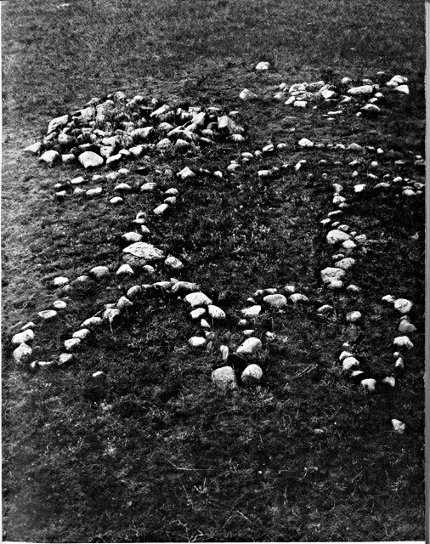
ANCIENT INDIAN TURTLE EFFIGY
Photo by Russell Reid
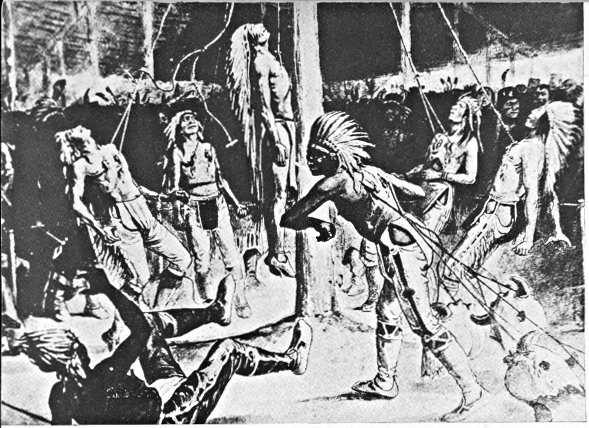
SIOUX SUN DANCE AS ORIGINALLY PERFORMED
Copy of an old drawing courtesy of Frank Fiske
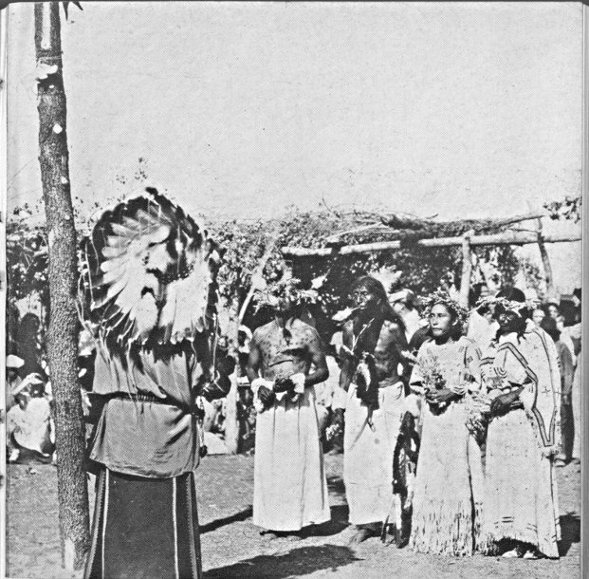
A MODERN SIOUX SUN DANCE CEREMONIAL
Photo by Paul S. Bliss
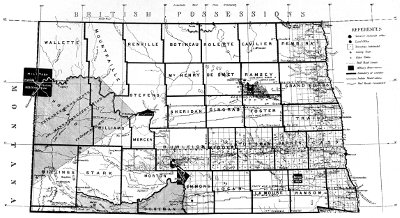
NORTH DAKOTA IN 1879, FROM AN OLD MAP OF DAKOTA TERRITORY
The first State child-labor act was passed in 1909. Under the present law, employment of children under the age of 14 is prohibited. The proposed child-labor amendment to the Constitution of the United States was ratified by the North Dakota Legislature at the 1931 session.
RACIAL GROUPS AND FOLKWAYS
International repute as a farming State brought North Dakota a steady stream of immigration up to the time of the World War. Tales of the rich wheatlands of Dakota drew a continuous procession of settlers with their household goods from the eastern States and from across the sea, to claim a share of the fertile western acres.
Little more than two decades has passed since this influx ceased. The State presents a patchwork of foreign groups, each still retaining many Old World customs of speech, dress, and social life. Cultural assimilation, however, has slowly veneered the life of the State with an American character which is gradually seeping into and supplanting the ways of the Old World.
The prevalence of foreign speech and customs seems quite justified by the 1930 census, which showed 105,148 persons, or 15.5 percent of the total population of 680,845, to be of foreign birth. In addition to this number, a still larger portion of the population, 45.4 percent, is first-generation American, born of foreign parents and therefore in close contact with the speech and customs of its fathers during its formative years.
Forty-two countries, most of them European, have contributed to the foreign-born population of North Dakota. Norway has the largest representation, followed in order of numbers by Russia, Germany, Canada, Sweden, and other countries, including the Netherlands, Denmark, Hungary, Finland, Rumania, and Iceland.
Unfavorable social and economic conditions among the rural population of Norway, coupled with harsh military regulations, prompted most of the Norwegian emigration to the United States. North Dakota was the natural choice of many whose families had, for generations, lived upon the land. Norwegian stock today constitutes 30 percent of the population of the State, and persons born in Norway make up 29.8 percent of its foreign-born population. Their settlements have been made throughout the northern and eastern sections of the State. In contrast with many other national groups, the Norwegians show little tendency to localize, and while predominant in many communities they manifest no aversion to settling where other groups are already represented.
The hospitality of the Norwegians is their greatest distinction. The coffeepot is always in use, and, coffee and pastries made from Old Country recipes are served whenever anyone chances into a Norwegian home, as well as at meals and between meals. The Norwegians have a charming way of bidding each other "Tak for sidst," meaning "Thanks for the last time I met you."
They retain to a marked degree their native tongue in its various dialects or bygdespraag, widely mixed with the English language. They are fond of music, and mountain waltz melodies, polkas, and spring dances, played on the accordion or violin, are enjoyed by young and old alike. The Hardanger violin, which has eight strings, is still made and played by the older musicians. The adult Norwegian, being very independent by nature, does not readily fit into an orchestra or large chorus; such organizations are more common among the younger people.
The most fantastic of the Norwegian dances is the Halling Dance, still seen on special occasions. It is reputedly the survival of a "dance of death" from the days when the knife was the means of avenging jealousies among the young men of Halling Valley in Norway. When a man began the intricate acrobatic steps of the Halling Dance, the other dancers knew he had seen an enemy or rival in the crowd, and unobtrusively withdrew to the edge of the dance floor, leaving the enemy, often unsuspecting, in the clear. Then, in a great whirl, the Halling dancer would send his knife spinning through the air with its message of death. The dance today is an acrobatic performance which requires great skill. It includes handsprings, the Halling-kast—a whirling and kicking step—and the krukeng, a jiglike step done in a half-sitting posture with the dancer moving about the floor.
In many Norwegian towns, Jule Bokke or Christmas Fools still make the rounds of the homes between Christmas and New Year. They are young people dressed in costume and masked, who call on the neighbors and are given food and drink at each home visited.
Among the factors which keep alive the Old Country speech and manners are the lager or societies, each of which represents a district in Norway. Members are former residents, or descendants of residents, of the district. At their meetings, native music, dances, and costumes are revived.
A holiday in all Norwegian communities is the Seventeenth of May, Norway's Independence Day. The festivities usually include speeches, picnicking, and dancing.
Norwegian influence has been felt in every phase of North Dakota life. Among prominent figures in the State have been Paul Fjelde, sculptor; Konrad Elias Birkbough, who discovered a cure for erysipelas; Carl Ben Eielson, pioneer Alaskan aviator; R. A. Nestos, A. G. Sorlie, and Ole Olson, who became Governors of the State. In the business world, the Norwegians have influenced the rapid growth of the cooperative movement. Skiing, a Scandinavian sport, is a popular winter recreation. The accordion, favorite of both the Norwegian and the German, is widely used in concert groups and dance bands. Foods which are commonly known, although not widely prepared outside the Norwegian home, include lutefisk, which is cod cured in lye; lefse, an unleavened potato bread baked in great flat, rough, gray sheets on top of an iron range; and fattigmand, a pastry fried in deep fat.
In the first two decades of the nineteenth century there occurred a German migration into Russia which was to be felt later in North Dakota. Free lands offered by the Russian Government (desirous of having its people learn German farming methods) drew many Prussians eager to escape the heavy taxation of their homeland. Throughout the Black Sea area German colonies grew up; in later years these contributed heavily to the stream of emigration to America. Today Russo-Germans dominate the Russian element, which forms 12.8 percent of the total population of this State.
Because of this Russo-German constituency, the Russian and German racial groups in the State often overlap. Native Germans form 1.5 percent, and persons of German stock 8 percent, of the population. The Russo-Germans first came to this State about 1889, settling in the south-central section, in McIntosh and Emmons Counties. Other Russian and Russo-German settlements are in the Missouri Slope and in the central area of the State. German groups are found in the southeastern part of the State, in Ward County in the northwestern area, and in Morton in the Slope region. Among outstanding Germans who have taken part in the development of the State are two Governors, George F. Shafer and William Langer.
In its residence in Russia, the Russo-German group acquired many customs which now distinguish them from their German cousins, but the two groups have much in common. They cling tenaciously to their native tongue in their homes and churches; the Russo-Germans, however, speak a dialect which is a result of their Russian residence. Both groups retain Old Country customs of dress, most noticeable of which is the use of the tuch or shawl worn by the women in place of a hat. On Sundays and holidays some of the older women appear in beautiful handworked tuecher and full-skirted dresses typical of peasant Europe. White stockings are often worn by the older women on holidays. The occasional appearance of a fez-like astrakhan cap during the winter bespeaks the Russian influence.
Although the dress of the older Russo-Germans is rather somber, their homes are quite the opposite. Floors throughout the house are invariably painted bright orange, this color scheme often extending to the back and front porch and steps. The exteriors of the house and other buildings are likewise sometimes painted in bright colors, with contrasting trimming. A not uncommon decorative scheme consists of two or three brilliant hues alternating in diagonal stripes across the sliding doors of garages, granaries, and barns. The interior of the summer kitchen (which is to be found back of most farmhouses and many town homes) is often painted in contrasting bright colors, one shade being used for a wainscoting effect, another for the top half of the walls and the ceiling, and a third forming a dividing border. Because of American influences, the penchant for these bright colors has become more subdued in recent years.
A popular note in home decoration is the use of bright-colored artificial flowers, which often adorn curtains, picture frames, and the organ or piano in the Russo-German home.
A typically Russian note is the common use of glass tumblers instead of cups for serving hot drinks. Another practice is the use of chicory as a substitute for coffee. A favorite delicacy of the Russo-Germans, also typically Russian, is the sunflower seed, known as the "Russian peanut." They eat these much as Americans eat peanuts. The sunflower seed is becoming popular as a confection throughout the State, and is now roasted and packaged for sale, in contrast with the old method of drying the ripe sunflower in the sun until the seeds could be brushed from the plant.
One of the most beautiful customs retained by the modern generation of Catholic Germans and Russo-Germans is the visit of the "Christmas Angels." Three young girls, trained as a rule by nuns, go dressed as angels from home to home in the community on Christmas Eve. They knock for admission, and when this is granted they enter the home, bless it, and sing one or two Christmas carols. For this service they are given a small amount of money. Another custom is the observance of "Name Day," when, on the day of the saint for whom he is named, each person must hold open house for his friends. Callers greet the host or hostess with "Happy Name Day." Birthdays, on the other hand, if they occur on a day other than the Name Day, are disregarded almost altogether.
Many German families observe December 31 as "Sylvester's Day." On this day the last person arising is "Sylvester" or the lazy member of the family for the coming year. Of course everyone in an industrious German family tries to avoid this stigma. Another New Year's custom is for all members of the family to leave through a rear door of the home at midnight and reenter through a front door. The first person to enter the home after midnight is a herald of the coming year: if he is fair, the new year will bring good luck; but if he is dark, he augurs misfortune.
The German people are fond of community music, and numerous bands and choruses have organized almost spontaneously under leaders. They are especially fond of song, and when a group of older people gathers for a social evening their chief pastime is often hymn singing. Much of the social life centers about the church, although in some communities the verein, or society, has many members and serves to keep alive the speech and customs of the Old Country, much as does the Norwegian lag.
Two interesting German religious sects are the Moravians, represented in the area near Fargo, and the Dunkards or, as they are now known, Dunkers, who have a settlement near Cando. One of the beautiful customs of the Moravians is the "love feast," a survival of an early Christian custom of breaking bread as an indication of brotherly love. The feast today generally consists of coffee and doughnuts, but the spirit is unchanged.
The Dunkers, or German Baptist Brethren, follow their early sectarian precepts of plain dress and plain living. While few of the women still wear the "dropped bonnet"—a small grey or black sunbonnet—the prayer covering or small lace cap is still worn during attendance at church services. Older members of the colony hold to the early rulings of the church in carrying no form of insurance. In early October of each year a harvest festival is held in the form of a religious observance.
From both the Germanic and the Norwegian groups is derived the most prominent foreign contribution to the language of the State: the universal use of ja ("yah") for yes.
Few group characteristics attach to the Canadians, who constitute 1.5 percent of North Dakota's foreign-born population, and are found in the northeast counties and the Red River Valley. Many of them are descendants of the Selkirk colonists who settled from Fort Garry to Fort Pembina early in the nineteenth century. It is from these colonists that most of the Scottish people in this State trace their descent.
For the French-Canadians the most important festival of the year is St. Ann's Day, July 26. A shrine to St. Ann has been built by French and Indians at Belcourt on the Turtle Mountain Reservation, and here on the saint's day come the lame, the halt, and the blind, to walk or be carried in the processional. Many miracles have been claimed.
In French-Canadian communities in the Red River Valley, the colorful Old Country wedding customs are still observed. As the wedding march is played the bridal pair and their attendants enter, followed by young men dressed in highly padded French costumes, and wearing grotesque masks. They are in both male and female attire, and dance and cavort to the delight of the guests.
Like their Norwegian neighbors, the Swedes who have come to America are predominantly a rural people. In North Dakota they constitute 1.2 percent of the total population, and are found in the eastern part of the State, mainly in Cass County, and in the central section east of the Missouri in Burleigh and McLean Counties.
Smaller racial groups in the State include Hollanders, in Emmons County near the south-central border; Danes, in the east-central counties of Cass, Barnes, and Stutsman; Poles and Icelanders, in the northeast section; Hungarians, in the Slope area; Czechs, in Richland and Walsh Counties in the Red River Valley and in Stark County in the Slope area; and many others, all showing a distinct tendency to localize.
Through their national societies, the Ukrainians in Burleigh, McLean, and Billings Counties in the western half of the State have retained much of the music, dances, and costumes of their native land. These are in evidence at their club meetings and also on holidays. The costumes are colorful and elaborate, and testify to the embroidering skill of the girls.
The Bohemians in Richland and Walsh Counties likewise are noted for their musical organizations, but they do not retain their native costumes or dances. The sokol or physical culture group is found in many of the Bohemian communities.
The sauna or steam bathhouse is a characteristic feature of the Finnish settlements in the southern and western sections of the State. Water sprinkled on a large brick stove or on heated rocks provides the steam for these baths, which are stifling on first trial but soon become a pleasing habit. The Finns, like the Norwegians, serve coffee to all guests who come to their homes, no matter what the hour. Coffee is drunk from the saucer, through a lump of sugar held in the cheek. Two holidays which are still celebrated in Old Country style are Midsummer's Day and New Year's. Midsummer's Day, June 24, is an occasion of picnicking, church services, confirmation of scholars, settling arguments or quarrels, and pitching horseshoes. On New Year's Eve, fortunes are told by dropping bits of melted soldering metal into cold water. One piece, melted and hardened before midnight, is a symbol of the old year; and the process is repeated with another piece after the stroke of midnight, to foretell the fortunes of the new year.
Both the Irish and the Icelanders continue to hand down their legends which have been brought from Europe. Icelandic children usually are well posted on the national sagas, including the alfa sorgur, which tell of the huldu folk or elves; and no Irish child is so poor as to be deprived of the ghosts, the banshees, the leprechauns, and other weird creatures of the Emerald Isle.
At Ross, in northwestern North Dakota, is a small colony of Syrians, most of whom are Ahmadiyya Moslems. They have their own place of worship, and conduct services each Friday as well as on other holy days. They retain many food customs of the Near East, one of the most interesting being the use of a meal made by crushing durum wheat which has been boiled and dried in the sun. The meal is then stewed with meats or vegetables or sweet oils.
The sugar beet industry of the Red River Valley has resulted in the importation of Mexican workers, who provide cheap and skilled labor for cultivation of the beet fields. The Mexican population is not large, however, having decreased greatly from the 1930 figure of 600, and has left no permanent imprint of its folklore or customs. The Negro population, never large, is also rapidly decreasing. The 1930 census showed 377 Negroes in the State.
Although not foreign-born, the Indian population constitutes a distinct racial group. Sioux and Rolette Counties, containing the Standing Rock and Turtle Mountain groups, have the greater part of the Indian population and consequently register the highest illiteracy in the State, from 7 to 8 percent. Other counties usually have an illiteracy rate of less than 1 percent, and sometimes less than half of 1 percent.
The Indians retain many racial customs and legends despite the encroachment of the white man's civilization. The metis, of French and Chippewa blood, were famous as hunters and trappers. Many of them were found in the upper Red River Valley and adjoining territory about 1850. Their descendants now live in small clay-plastered log houses, with much of their household equipment and bedding kept in the yard.
Many of North Dakota's characteristic folkways represent foreign cultures rather than anything intrinsically American. There is no lack, however, of native customs which are gradually absorbing and supplanting the Old World ways.
Because North Dakota is a farm State, many of its customs hinge on certain matters of rural importance such as the weather and the crops. Whether or not the farm people are able or inclined to attend is the greatest factor in the success of most social and civic events. Saturday night is the farmer's night in town, a welcome holiday after his week of isolation and work. Shops and garages become social as well as commercial centers, as friends stop to exchange news, gossip, and recipes. In many communities, Saturday night dances are held, and during the summer months a vacant lot will often be the scene of open-air motion pictures, with the spectators seated in their parked cars and blowing the horns in lieu of applause when the pictures meet with approval.
In addition to such general holiday celebrations as Christmas, New Year, and Memorial Day, in the Norwegian sections of the State, Norwegian Independence Day, May 17, is also marked by festivity. Among the Russo-Germans, Ascension Day is an unusually solemn holiday. At Christmas time, holiday decoration of homes is common, and groups of young people stroll about the streets or ride in sleighs singing carols. New Year's Eve brings about the usual noisy gayety, and in many towns it is customary to fire guns in a salute as the new year comes in. Watch parties are held in the churches for the more serious-minded.
The Fourth of July is an important holiday, not so much for its historic meaning as for its local interpretation. For days previously, the skies are anxiously scanned for signs of inclement weather. As the Glorious Fourth dawns a salute is fired, usually by ex-servicemen, and soon in the early morning air the sound of hammers is heard, as booths and "concessions" rapidly go up to be draped with bunting. Flags appear on the buildings and homes. Cars begin to pour into town, parking near Main Street, which has been roped off for the races. The square is soon filled with a milling crowd, all in their best clothes, the children clutching their long-hoarded pennies and nickels which they will exchange for soda pop, ice cream, and firecrackers. The program of the day includes patriotic speeches, airplane and parachute exhibits, races, and bowery dances, and in the evening the climax of the exciting day—a fireworks display.
The Russo-Germans know the holiday simply as "the July," and in a good year it is an occasion for new clothes for the entire family, commonly designated "July dresses" and "July suits."
Conviviality often joins with practical necessity to provide social occasions for North Dakotans. Butchering, sausage making, soap making, quilting, threshing, burials, illness, all furnish opportunity for friends to meet and visit while performing some deed of necessity or kindness. The farmer who is ill during sowing time will often have his crop put in by his neighbors, and he may be called on in the fall to help harvest for the recently bereaved widow of one of his friends. The neighbor who has lost his home by fire or has had some other misfortune will probably be given a "make-glad" party, at which he will receive gifts in kind and perhaps in money. After harvest, when there is straw to be burned, the young people of the locality will hold strawstack parties, roasting wieners and marshmallows as the burning stacks light the autumn night with their red gleam.
Sometimes, with the coming of dusk on winter evenings, bobsleighs slide away from darkened country homes, filled with all the members of the family, from grandparents down to babies. Often the sleigh will pick up additional passengers at a nearby homestead, and sometimes it becomes so crowded that there is scarcely room for the boxes of sandwiches, carefully wrapped cakes, and jars of pickles among the shuffling feet and heated rocks and bricks in the bottom of the sleigh. The singing creak of the sleigh runners accompanies songs that boom out on the night air. Presently a number of sleighs reach an appointed home, but they do not pause long. Across the fields the light of a farmhouse window offers a prelude to their welcome. They become studiously quiet until they reach the door, then burst in with shouts of "Surprise!" There follows a confusion of greetings and commands:
"Get a lantern."
"Put your horses in the east stall. John, show Henry where to put his horses, and—hey, John, turn Jip and Molly out to make room for Millers' team."
"Bring in them sandwiches I brought, Helen."
"Oh, heavens, you knew all about it—you're all dressed up and ready for us. With the country line it ain't possible to surprise anyone."
(Even where there is no country telephone line, it is considered something of a feat to catch the unsuspecting host or hostess napping. Yet all North Dakotans like surprise parties, and have them on birthdays, wedding anniversaries, and every other plausible occasion.)
The farmhouse is converted into a dual-purpose hall. The accordion is placed near the stove to "thaw out," wraps are deposited in corners, on chairs, and on beds, except the one reserved for the babies. Tables, the drophead sewing machine, and everything else that will serve the purpose are arranged for card playing. One room is cleared for dancing. After the first spurt of conversation lags, the musician takes his instrument on his knee, the floor is sprinkled with corn meal or grated paraffin, and soon the house is shaking from studding to rafter. Someone suggests a quadrille, or square dance, and the room resounds with the calls:
"First two gents cross over And leave your lady stand, Side two gents cross over, And take her by the hand. Salute your corner lady, Salute your partners all, Swing the corner lady, And promenade round the hall." "First couple to the right, Birdie in the center and three hands round, Birdie fly out and hunter step in. Three hands round."
At midnight, after three or four hours of dancing and card playing, "the ladies" serve lunch. The hat is passed for contributions to the musician, but he does not take the money until he is through playing, which is usually about 3 o'clock in the morning. Then, after a general bedlam of looking for mislaid coats, the babies are carefully wrapped, the younger children are wakened and rub their eyes sleepily as they climb into the sleighs, the empty cake plates and pickle jars are collected, farewells are called, and horses, anxious to return to their own stalls, speed the drowsy parties home through the cold night.
The young people of the State usually have ample opportunity for courting at such parties, or at meetings of junior church organizations, church camps, and junior choirs. Matchmaking still exists in isolated Russo-German, German, and Norwegian communities, however. Except in the larger towns—and sometimes even there—the newly married pair is usually honored by a charivari, or "chivaree," with the bridal couple seated conspicuously on some slowly moving vehicle and taken through the streets to an accompaniment of blaring automobile horns and clanging tin pans. The bridegroom is expected to climax this procedure by buying drinks or cigars for the crowd.
Cigars are much in evidence at the birth of a first child, and also thereafter at the birth of a son. A child born with a caul is believed by many to have the gift of second sight, and it is also sometimes thought that the caul is a powerful fire-fighting weapon.
Superstitions attach to many other phases of life, as well as to births. Most of these beliefs are not peculiar to North Dakota, but are rather a part of the folklore of the Nation. A dropped spoon means company is coming, and so does the cat's washing its face. Snakes do not die before sundown. A horse-hair put in water will turn into a snake. The number of stars in the ring around the moon show the number of days before a coming storm. Plants which bear underground should be planted in the dark of the moon, and those which bear above ground in the light of the moon. A window shade rolling up when no one is near it portends a death in the family.
Many of the myriad superstitions are not believed, but nevertheless continue to be passed on. There is some belief in ghosts and occult powers, and scarcely any community is without the story of a strange death and a haunted house—such as the tale of the doctor who was mysteriously killed on a farm near Wilton and whose ghostly galloping team disturbed the farmer so much that he was forced to move. These stories, however, are often not credited but merely passed on for effect. As for fortune tellers, the most popular prophets are those who deal, not with tall dark men and long trips, but with isobars and isotherms, for the interests of agricultural North Dakotans are inseparable from the weather, which governs their destinies far more surely than any other factor in their lives.
SCHOOLS, CHURCHES, AND SOCIAL CURRENTS
For many years education and religion in North Dakota were closely associated, for the earliest schools were organized by priests. The Scottish Highlanders of North Dakota's first white settlement—the Selkirk colony at Pembina—were a highly religious peasant people who keenly felt the absence of churches and schools in the land to which they had migrated. Their sponsor, Lord Selkirk, also felt that a church would add to the harmony and stability of the community, and offered to contribute 25 acres for a church and 20 square miles for a school and mission if the Bishop of Quebec would approve a church at Pembina. The bishop acceded, and in 1818 Father Joseph Dumoulin, Father Joseph Provencher, and William Edge, a catechist, arrived to establish churches and schools, and study the "savage languages" in order to "reduce those languages to regular principles so as to be able to publish a grammar after some years of residence."
EDUCATION
The first school in North Dakota, at Pembina, had an enrollment of 60 children, white and half-breed, and courses in English were supplemented by lessons in planting small grains, both intended for the enlightenment of the "savage" Chippewa. The school was conducted until 1823, when, after the determination of the international boundary, many of the Selkirkers moved north to Canada, thus breaking up the colony. The missionaries were withdrawn, and the school and chapel remained closed for a quarter century. When Father George Belcourt came to the region in 1848, he reopened the Pembina Mission and founded another at St. Joseph in the Pembina Mountains. A school conducted at St. Joseph by the Sisters of the Propagation of the Faith received financial aid from the Federal Government, the first Federal support given to education in this State.
In the early settlements of the State, a mother would often gather the children of the neighborhood in her home for instruction, and itinerant teachers occasionally held classes in the tent cities which sprang up in the wake of the railroad. As the communities grew, residents cooperated in hiring teachers and building schools. The railroad companies assisted by shipping lumber free for schools. Between 1853 and the attainment of statehood in 1889, 1,362 schools were opened, many of them in country communities, taught by men or women who had come West to homestead. A teacher's report on one such school, sent to the superintendent of the Griggs County schools in 1886, recorded that he had taught a 62-day term, with 15 pupils enrolled and daily average attendance of 7 7/31; that his salary was $35 a month; and that the school building and grounds were in good condition, the former containing a "Webster's Unabridged Dictionary, New 8-Inch Terrestrial Globe, New Forms and Solids for object Teaching and Two Slate black boards."
By 1883 two institutions of higher education had been founded in the northern half of Dakota Territory. Jamestown College, the first school in the State to offer a normal course, had been established by the Presbyterian Church, and three months later the Territorial assembly voted to found a University of North Dakota at Grand Forks. Originally a liberal arts college, this institution extended its curriculum until, in 1889, it included a law school, a college of mechanical engineering, and a school of mines. In its first year the university had an enrollment of 79; during 1936, 2,555 attended classes or took correspondence work in its six colleges.
Several private colleges were opened prior to 1889, and the Enabling Act of that year provided for the establishment of an agricultural college and normal schools. Like the other private institutions, Jamestown College was forced to close its doors during the financial panic of 1893. Reopened in 1909, it is now the only endowed liberal arts college in the State. The effects of the 1893 depression on the university and normal schools were accentuated by the vetoing of the appropriations for a two-year period. Weathering this crisis, the State colleges and university reached an enrollment of 2,000 in 1904, and by 1936 their total registration exceeded 10,000.
Notable in educational history was the affiliation in 1905 of the university and Wesley College, a Methodist school originally located at Wahpeton. Similar affiliations were later made among other colleges, including the North Dakota Agricultural College, where the Wesley College buildings are now used for an interdenominational school of religion.
To comply with the provision of the Enabling Act requiring establishment and maintenance of a public school system open to all children and free from sectarian control, the first legislature set up an education department administered by three branches—a State superintendent, county superintendents, and district boards. It also created a tuition fund from the proceeds of school lands, supplemented by poll taxes, school taxes levied by general law, and all fines for violation of State statutes. The money from these sources was made available to all schools in which the English language was taught.
The school lands to which the law referred were received by the State in accordance with the plan of the Federal act of 1785 granting each new State carved from the Ohio Territory section 16 of each township for public school support. For North and South Dakota, under the Enabling Act, this grant was doubled, giving the schools one-eighteenth of all land surveyed. Town site boomers and speculators in other States commonly took advantage of school land grants to buy property at prices far below the actual value; but in the Dakotas they were forestalled by the alert Territorial superintendent of schools, W. H. H. Beadle, who incorporated into the constitutions of both States the provision that school lands might not be sold at less than $10 an acre, and might be leased as hay or grazing lands but not for cultivation, and that the title of western coal lands included in the grant must always be retained by the State. Similarly guarded were 750,000 acres of land granted to other educational institutions. So successful was Beadle's plan that it has been adopted by almost every other State admitted to the Union since 1889.
At the State School of Science at Wahpeton, opened in 1903 as a trade school and junior college, two methods of industrial education have been originated, the Babcock plan and the North Dakota plan, both of which have attracted the attention of educators throughout the United States. The former provides for the establishment of three departments within the school—a trade school, a junior college, and a business school, each of which, by a plan of interaction, is made to serve the others. The North Dakota plan, evolved to solve the problem of providing industrial education in an agricultural State, concentrates all trades education in one school, with the exception of night courses offered at other points in the State under the supervision of the school of science.
A second junior college was established in 1925 at the school of forestry in Bottineau. North Dakota is now one of the 27 States which have junior colleges.
Twenty parochial schools, most of them maintained by the Roman Catholic or the Lutheran Church, offer grade and high school work, and are governed by the State department of public instruction.
Under the supervision of the board of administration, the State supports a school for the deaf at Devils Lake, a school for the blind at Bathgate, and an institution for feeble-minded at Grafton. The board also has jurisdiction over the hospital for the insane at Jamestown, the training school for delinquents at Mandan, the penitentiary at Bismarck, and a sanatorium at San Haven. Several semi-public homes and orphanages are operated by churches and other organizations.
It is compulsory for all children between the ages of 7 and 15 to attend school, and a student who has not completed the eighth grade must continue in school until he is 17 years of age. Agriculture is a compulsory course in public schools. Free textbooks are provided for rural schools, and uniform texts are prescribed for all public schools.
A school census taken in June 1930 showed North Dakota to have a school-age population of 222,798, of whom 169,277 were enrolled in public schools—139,580 in elementary, and 29,697 in high schools.
Indian children are given grade and high school education and vocational training in special schools at Fort Totten, Fort Yates, Elbowoods, Belcourt, and Wahpeton. Preservation of tribal arts, including beadwork and pottery, is encouraged.
The North Dakota educational system is greatly influenced by the agrarian character of the State. Because children are needed for farm work, most of the country schools are not opened until October, and operate for a term of only seven or eight months. A survey made in the winter of 1923-24 showed a sharp decline in attendance records in rural schools, and consequently legislation was enacted providing free transportation for pupils living more than two and one-half miles from school. The legislation affected two-fifths of the rural school population, and resulted in improved attendance in elementary schools. The one-room school is still the most common type of educational institution in the State, although the number of consolidated schools is being increased annually. Sixty high schools, including the Benson and Walsh County Agricultural Schools, receive Federal aid through the Smith-Hughes Act, which provides funds for vocational training and courses in agriculture. This act also enables the North Dakota Agricultural College in Fargo to operate extension service and experimental stations, and to provide a State-wide educational program for farmers.
Reading facilities in public schools were improved by the 1911 legislative appropriation of $25 to each school district for a permanent school library. In many communities these school libraries, supplemented by the loan services offered by the State educational institutions and the traveling libraries of the State library commission, are the only sources of reading material. The first public library in the State was opened in 1897 in Grafton by a group of clubwomen, and many other towns have received similar benefit from the efforts of women's clubs to build up library collections.
RELIGION
Through the influence of three prominent men in the Red River settlement—Joseph Rolette, Norman Kittson, and Anton Gringas—Father Belcourt was able to maintain his Pembina Mission, establish another at St. Joseph, and extend his work west to the Turtle Mountains. He held services for Indians and hunters alike.
Meanwhile, Protestantism was introduced into the State by James Tanner, a half-breed interpreter from the Cass Lake (Minnesota) Reservation who had become a Baptist minister. At his request, Rev. Alonzo Barnard came from the Presbyterian mission at Cass Lake to Pembina and St. Joseph late in 1848. Barnard remained only a short time, being succeeded in 1850 by a young Baptist missionary, Elijah Terry, who was killed by hostile Sioux as he was cutting logs for a chapel. The following summer Barnard returned, accompanied by his wife, David Spencer and his family, and John Smith. Despite severe misfortune, including Mrs. Barnard's death from pneumonia, and the death of Mrs. Spencer, who was pierced by an Indian arrow as she stood in the window of her cabin with her baby in her arms, the mission was kept open until 1858.
Except for occasional visits by priests and ministers from Canada to the Pembina settlement, there was little further religious activity in North Dakota until 1871, when the Presbyterians again sent a minister into the Red River Valley. Oscar H. Elmer, who received the appointment, drove up and down the valley in a homemade cutter, and was the first to conduct church services in many of the pioneer towns, including Fargo and Grand Forks.
When the Episcopal Church decided to send a missionary into the newly settled territory, the board, guided by the stories it had heard of Dakota winters, recalled Rev. Robert Wainright from his mission in Labrador, feeling that his experience there should have qualified him to serve in Dakota. Mr. Wainright took over the northern half of Dakota Territory, and raised funds to carry on his work by appearing in Labrador costume and giving exhibitions of his skill with a 40-foot whip, with which it is said he could flick water out of a glass.
As settlement increased, other church groups sent missionaries and ministers. At first, services were held in homes, schools, or tents, and often a building used during the week as a saloon or gambling hall would become a place of worship on Sunday. The ministerial duties frequently included janitor work, and since the remuneration usually consisted of donations from the parishioners, many of the ministers supplemented this income by operating small farms. The hardships of pioneer days led to much resourcefulness on the part of early churchgoers. Gopher tails were saved and placed on the collection plate by those who had no cash to give, for the church could then claim the three-cent bounty on gophers offered by the State. As communities grew, new church buildings were erected, until now some of the most notable structures in the State are churches. Religious colonies came to North Dakota to settle, and Mennonite, Dunkard, Moravian, and Mohammedan are among the approximately 25 creeds represented in the State. Most influential are the Lutheran (due to the large number of Scandinavian settlers) and the Roman Catholic.
The actual number of churches is decreasing as parishes are enlarged, and in smaller towns and rural sections the consolidation of churches has been found practical.
SOCIAL CONDITIONS
A movement in 1915 for increased social legislation resulted in the passage of mothers' pension, juvenile court, and old age pension acts, and in the abolition of capital punishment except in the case of a convict already serving a life sentence for murder.
In contrast to the general trend of prison populations throughout the United States, that of the North Dakota penitentiary has steadily decreased until in 1935-36 it reached the lowest figure in 10 years—274. Most of the decline has occurred in the number of non-residents of the State committed, probably due to the fact that, with poorer crops, employment of transient farm labor has been unnecessary, and the annual influx of transients has therefore decreased.
Impetus was added to the program against juvenile delinquency in 1921 by the publication of the results of a five-year survey which showed that more than 500 children were brought into court annually. Laws regarding juvenile delinquency were made more stringent. The reform school at Mandan was renamed the State Training School, and a corresponding change was effected in the methods of handling delinquents sent there. From a juvenile prison the institution became virtually a boarding school in which boys and girls between the ages of 12 and 21 supplement regular grade and high school work and vocational training with such extracurricular activities as music, dramatics, athletics, and club work.
Since the survey revealed that, while only 5 percent of the child population of the State lived in three cities having a population of more than 10,000, these cities reported 45 percent of the delinquency, social service groups in all cities were enlisted to deal with the problem. New emphasis was placed on character-building organizations such as Boy and Girl Scouts, Campfire Girls, Y. M. C. A., and Y. W. C. A.; playgrounds were opened, and recreational programs promoted. The American Legion formed a Junior Baseball League for boys under 17 years of age, which was so successful that in many communities boys who graduated from the junior teams are now receiving civic support in the organization of intermediate and senior clubs.
North Dakota's moderate temperature and dry air came in for early prominence in the advertisements of promoters, who assured prospective settlers that this was one of the most healthful States in the Union. It was a fortunate circumstance that they were correct, for lack of transportation facilities and the limited number of doctors often made it impossible for settlers to obtain medical aid. Today the number of doctors is adequate for the population, but their tendency to concentrate in the larger towns leaves many western rural communities, and a few in the east, with no medical aid within many miles. Despite this uneven distribution of doctors, North Dakota has always had a good health record. Since there are no large cities, contagious diseases do not spread rapidly and epidemics are comparatively rare. In 1935 the State had a record of 8.0 deaths per thousand of population, while the figure for the United States as a whole was 10.7. The highest death rate is among the Indians, tuberculosis being the most prevalent cause. Largely through the efforts of Dean H. E. French of the university school of medicine, a State health department was established in 1923, and has set up a health program and secured passage of laws providing for medical inspection in public schools, creation of a board of examiners for nurses, registration of nurses, and employment of county nurses.
The work of State agencies for the care of children and aged or physically handicapped persons is coordinated through the State welfare board. Under the provisions of revised legislation enacted in 1935, the board distributed 7,431 old age pensions, and in 1936 inaugurated a program for the aid of the blind which, within a single year, provided vocational education and other assistance for 150 people not enrolled in the State school at Bathgate.
In conjunction with the Children's Bureau, created in 1923, and local lodge groups throughout the State, the welfare board holds clinics for physically handicapped children, provides them with medical care whenever possible, and helps them learn trades. Similar work with adults is carried on by the State department of vocational education and rehabilitation organized in 1921. Of the 124 handicapped individuals who received training through the facilities of the department in 1935-36, 45 were placed in employment.
Stringent pure food and drug acts were drafted for the State by the late Dr. Edwin F. Ladd, an outstanding figure in the field of public health, who as United States Senator from North Dakota drew up some of the Federal pure food laws. A regulatory department maintains a laboratory where foodstuffs and other products are tested for compliance with State laws. The department of public health also has laboratories throughout the State, and several cities have their own facilities for testing water supplies.
TRANSPORTATION
When in 1738 the intrepid French-Canadian, Pierre Verendrye, his three sons, and his nephew set out on foot to trudge weary miles across the prairies to the Mantannes on the Missouri River, they did not dream that some day man-made birds would flash their silver wings against the sky and glide smoothly to rest on the level plains. Less than 200 years were to pass before this miracle of transportation progress would become so commonplace that a native North Dakotan would think nothing of a trip from Montreal to Bismarck by plane, but would be astonished at the thought of anyone's walking that distance.
Verendrye, the first white man known to have touched North Dakota soil, and other explorers who followed in those early years, came on foot to visit the Indians. They found the Mandans, who lived beside the Missouri, in possession of unusual means of water transportation. The dugout canoe, made of a log, was found on all the rivers of North Dakota, but only in the Missouri Valley did the Indians use the bullboat, a circular craft of the coracle type which the Indians made by stretching a buffalo hide over a willow frame. Before the introduction of the horse, Indians used the dog train for hauling heavy loads overland, but when the Sioux migrated into this territory from the south and east they brought the horse with them. Of all tribes the Sioux were the most graceful and daring riders. The horse travois, a rather crude means of hauling baggage devised by the Indians, soon gave way to the white man's wagon as settlers began to pour in.
The covered wagon served to move the immigrant family to its new home, and furnished immediate living quarters. In the Red River country before 1820, the oxcart, made entirely of wood with cross sections of a round log for wheels, was introduced at Pembina. Long creaking trains of these carts drawn by oxen made their way slowly across the country carrying settlers and supplies.
Before the coming of modern means of transportation, the Missouri River formed the most important avenue of entry into what is now North Dakota. The ascent of the river by the steamboat Yellowstone to Fort Union in 1832 was an event of importance, because the Big Muddy had never before been navigated through this territory.
The Indians who witnessed the coming of this first boat found great significance in it also. According to George Catlin, the artist, who was aboard the steamer, some of them shot their dogs and horses in a sacrifice to appease the Great Spirit, whom they thought to be offended; some ran frightened to their homes; and some among the Mandans cautiously approached the ship, "the big medicine canoe with eyes", which in some mysterious way could see its own way to take the deep water in the middle of the channel.
The frequently changing channel and swift current of the river proved a severe test for the hardy and resourceful pilots who followed in the wake of the Yellowstone. As the Sioux City (Iowa) Register stated in 1868, "Of all the variable things in creation the most uncertain are the action of a jury, the state of a woman's mind, and the condition of the Missouri River."
The humorist George Fitch, as quoted in Edna LaMoore Waldo's Dakota, describes the stream in these words:
"There is only one river with a personality, a sense of humor, and a woman's caprice; a river that goes traveling sidewise, that interferes in politics, rearranges geography and dabbles in real estate; a river that plays hide-and-seek with you today, and tomorrow follows you around like a pet dog with a dynamite cracker tied to his tail. That river is the Missouri."
A pilot familiar with the river, and able to foresee its vagaries, often received—and was easily worth—$1,000 a month, fabulous as that salary may now seem.
The Red River was also a highway of traffic in the heyday of the steamboat. Supplies were carried down it to Grand Forks, Pembina, and Winnipeg (then Fort Garry). The steamboat could be employed only during the summer months, however, when the river was open. During the winters in the 1870's, messages, supplies, and mail were carried by pack horse and dog sled. Regular mail routes were established between Fort Abercrombie and Fort Totten, and from St. Paul to Winnipeg, by way of Pembina.
As news of the vast untouched, wealth of the new Territory drifted back to eastern capitalists, they turned their eyes westward. Soon survey parties mapped the projected courses of railroads. By 1871 the Northern Pacific Railway had been completed as far as Moorhead, Minn. The next year it crossed the river, and in 1873 reached Bismarck, halting at the Missouri. It was no easy task to span this treacherous river; and, with the interruption of the panic of 1873, not until 1879 was there any further westward extension. Construction work to the Montana border was finished in 1881, two years before the Northern Pacific became a transcontinental line. So great was the influence of the railroad in bringing new settlers to Dakota that in the period from 1870 to 1875 the population of the western half of the Red River Valley doubled.
General Custer's expedition returned from the Black Hills in 1874 with glowing tales of gold. There was a rush for the Hills, and Bismarck, the nearest railroad terminus, became temporary headquarters for parties leaving by stage for the gold fields. The route that Custer had taken to the Hills from Bismarck was long known as the Territorial Highway.
Although James J. Hill was one of the first to sponsor steamboat traffic on the Red River, it was not until 1880 that he began building the Great Northern Railway down the Red River Valley to Grand Forks, and thence westward to Minot in 1887. Other lines of the Northern Pacific and Great Northern, main and branch lines of the Minneapolis, St. Paul & Sault Ste. Marie, and branches of other roads soon entered the State. In order to build permanent business for their lines, they brought in new settlers, gave special rates on household and farm equipment, and in every way encouraged settlement. It was because of the railroads that bonanza farming, an important phase of North Dakota history, was introduced. The State is now served by seven railroads, with more than 5,000 miles of trackage. The Dakota Division of the Great Northern, with its 1,800 miles of main-line track, is the largest railroad division in the world.
With the railroads came the telegraph lines, the first of which was established between Winnipeg and Abercrombie, with offices at Fargo and Grand Forks, in 1871. Soon all of the young Territory was in communication with the outside world.
The colorful era of the steamboat had ended with the coming of the cheaper and speedier transportation by rail, but methods of local transportation remained unaltered. The horse still furnished the power, although fashions in wagons and buggies might change.
It was left for the twentieth century to usher in the age of speed. In the first decade, the wheezing steam automobile chugged with difficulty over sticky gumbo roads in the Red River Valley, and over scoria trails in the west. Automobiles were rare, and possession of one marked the owner as an aristocrat or a public nuisance, according to the point of view of the observer.
When the internal combustion motor vehicle was improved, road building began in earnest. Bus companies, established to fill a need for north and south transportation facilities not provided by the railroads, opened a campaign for better roads. They were joined by an ever increasing number of car owners, and as a result road conditions have been steadily improved since the early 1920's.
The first bus line in the State was begun in 1922, between Bismarck and Minot. Although the next two years saw the introduction of many bus and truck lines, these were not regulated by State law until placed under jurisdiction of the board of railway commissioners by legislative act in 1925. Immediately, operating permits were required from all companies, one of the first being granted to the Northland Transportation Company, forerunner of the Northland Greyhound Line. Today a network of bus and truck lines covers the State.
The airplane proved admirably suited to this part of the country. The clear dry atmosphere afforded ideal flying conditions, and almost every part of the State was suitable for landing fields, even without improvement. Municipalities became interested in the new mode of transportation, hangars were built, and runways laid out. Now all of the larger cities and towns have airports, and almost every small town has its landing field. Private planes are found at the airports, and here and there ships are seen on farms, where mechanically minded lads pilot them in leisure hours for their own pleasure. All planes and pilots must be licensed under a State law of 1929, as well as conform to the regulations of the Department of Commerce.
Cheering crowds at Fargo, Grand Forks, and Pembina greeted the pilots of the first air mail between the Twin Cities and Winnipeg in 1928. Hundreds of letters and cards were carried on this flight for collectors who desired copies of the special commemorative cancellation stamp. North Dakotans' air mail letters now reach Washington, D. C. or Los Angeles 12 hours after mailing. Daily service on the original line is still maintained, and two other regular lines have been extended into the State, one between Chicago and Seattle which stops at Fargo and Bismarck, the other from Bismarck to Tulsa, Okla.
Transportation has advanced with amazing rapidity since the Territory of Dakota was organized in 1861. Nevertheless, a severe winter such as that of 1935-36 is capable of halting communication almost completely. But even then, with automobile traffic at a standstill because of blocked roads, trains delayed because of mountainous snowdrifts, and planes grounded because snow and ice made landing too hazardous, the radio still kept the State in constant touch with the outside world.
THE PRESS AND RADIO
Whether or not the first printing press in North Dakota, brought to St. Joseph (Walhalla) by Rev. Alonzo Barnard in 1848, was ever used in the State is a matter of conjecture. When Mr. Barnard, a Presbyterian minister, was transferred to Dakota, he took his press—a gift from students at Oberlin College—overland from the Cass Lake (Minnesota) Reservation to Red Lake, by canoe across the lake and down the Red Lake and Red Rivers to Pembina, then by oxcart to St. Joe. Here he may have used it, as he did in Minnesota, to publish news letters and pamphlets for his parishioners, but nothing printed on it in North Dakota has been preserved.
The first North Dakota publication was probably the Frontier Scout, a short-lived four-page, three-column sheet which made its appearance at Fort Union in July 1864. In the following year its successor, the Pioneer Scout, was issued at Fort Rice and, according to its editors, "published weekly by the First U. S. V. Infantry for the edification of the people of Dacotah, both civilized and savage; and as 'green' spots and 'green' backs are so few, we will not mention terms, but bid it, like the grace of God, go free." The editors further declared that "every article in this paper is original and sees the light of day for the first time."
Journalistic activity lapsed subsequent to these military literary efforts, and was not revived until the railroad and the resultant influx of settlers in 1872 brought the new Territory to the attention of Minnesota editors. Col. Clement A. Lounsberry, sent by the Minneapolis Tribune to cover colonization in the Fargo area, went on to Bismarck where, on July 11, 1873, the first number of his own paper, the Bismarck Tribune, appeared. First a weekly and later a daily, it has been published continuously since that time, missing only one edition, and on that occasion newsboys distributed hastily printed handbills containing formal notice that the Tribune plant had been destroyed by fire (see Bismarck).
Early journalism in the Fargo area was stimulated by the offer of the Wells-Fargo Express Company to give a cash bonus for a paper appearing under the name of the Fargo Express. First and unsuccessful bidder for the bonus was a sheet bearing the correct name, but printed at Glyndon, Minn. The prize was awarded in 1874 to a Fargo-printed publication. Between 1874 and 1891 several other papers were issued, to be merged finally in the Fargo Forum in 1891.
In 1874 the Grand Forks Plaindealer was founded; five years later the Herald was also in the field, and eventually absorbed the Plaindealer (see Grand Forks).
With the beginning of settlement newspapers sprang up quickly in the other new towns of Dakota, so that when North Dakota was admitted to the Union in 1889, it had 125 periodicals. Many so-called newspapers were nothing more than a final proof-sheet, printed in order that settlers might comply with the homesteading law which required publication of notice of final claim. The cost of establishing such a paper was slight. Official notices, an occasional advertisement, and a few local news items were all it contained. If the editor could win the favor of the United States Land Office registrar, who usually designated the official paper, he might obtain one hundred or more notices an issue; these at $5 each made his income quite substantial. Often the paper was short-lived, but the editor usually remained in the State, setting up his type cases and presses in some promising small town and starting an actual weekly paper. Many villages had two or more rival papers for a time, and the number of publications increased rapidly; in 1904 there were 265 in the State, and in 1919 a high of 336 was reached. The weekly papers were widely read and often had great political influence.
Improved transportation facilities, however, led to the retreat of the weeklies before the increasing circulation of the daily papers. North Dakota now has 196 publications including 11 dailies and 4 trade journals.
Always active in the political life of the State, the newspapers have been an especially important factor in the Nonpartisan League fight. With the daily press usually unanimously opposed to its program, the league has purchased weeklies through which it has exercised a great influence on the rural population. Although it does not control as many weeklies now as it formerly did, it still has a strong hand in the editorial policies of many papers in the State.
In May 1922, less than two years after the first radio broadcast in the United States had been put on the air by KDKA in Pittsburgh, WDAY of Fargo presented the first commercial broadcast in North Dakota. The State now has seven other stations, situated in Bismarck, Grand Forks, Minot, Devils Lake, Mandan, Valley City, and Jamestown.
KFJM in Grand Forks is one of the few stations in the United States owned by a State university. It is leased to private operators with the provision that its facilities be at the disposal of the school for special broadcasts and experimental work (see Grand Forks).
The radio has made an important contribution to the State service by broadcasting information on weather conditions whenever necessary. Lives and thousands of dollars in property have been saved by warnings of spring floods. During the winter months frequent weather and highway reports are given, and warnings sent out regarding advisability of sending children to school during storms or extremely cold weather. In November 1930 an unusual service was performed by the Fargo and Bismarck stations. Heavy coatings of sleet had broken down telephone and telegraph wires throughout the State, and severed all communication between Fargo and Jamestown, division points on the Northern Pacific. During the first afternoon of the storm short-wave communication was established between the Fargo transmitter and an amateur set at Jamestown, but after sunset interference forced abandonment of this broadcast. Receiving sets were quickly installed at the studios of the Fargo and Bismarck stations, making possible a two-way conversation. On the one available telephone connection between Jamestown and Bismarck the dispatchers' office in Jamestown was hooked up with the Bismarck studio, in Fargo the dispatcher was linked with WDAY, and for two days all trains on the line were dispatched by radio. Between train orders the facilities of both stations were turned over to the telegraph offices, and Fargo alone sent out more than 200 messages.
Several amateur stations were in operation before any commercial broadcasting had been done in North Dakota. When the convention of the Dakota Division of the American Radio Relay League was held in Fargo in 1936, there were 300 licensed operators in attendance, and each year finds an increased number of people selecting short-wave broadcasting as a hobby.
ARCHITECTURE
The buildings of North Dakota cling closely to the low, tranquil landscape of the State, avoiding exposure to the cold northwest winds that sweep across the snowy prairie in winter. Farms and towns huddle in valleys or hug the open plain, and only grain elevators dare to break the comfortable horizontality of the prevailing contours. In the few cities a tendency can be noted toward height in buildings, but the number of skyscrapers in North Dakota can be counted on the fingers of one hand.
Despite this relatively small number one skyscraper, the State Capitol (designed by Joseph B. DeRemer and William F. Kurke, and Holabird and Root, associates), has aroused more interest and comment than any other building in the history of the State. This interest has not been confined to the borders of North Dakota, for the "slender shaft of modernity" which dominates the Bismarck skyline represents a trend in the architecture of State capitols that is gaining the attention of the entire Nation. Because the basic reasons for the skyscraper—exaggerated land values and proximity to transportation centers—are utterly lacking in this capacious prairie State, much criticism has been directed at the type of statehouse chosen. Nevertheless the point is made that the character and purpose of the building as the seat of State government are well expressed in the impressive height and dignity of its lines, while at the same time the structure is decidedly utilitarian. (See Bismarck.)
Utilitarianism characterized the architecture of this region before even the earliest white explorations took place. When Verendrye visited the Mandan Indians along the Missouri in 1738 he found them living in well-built lodges made of earth packed over a framework of logs, comfortably cool in summer and warm in winter. The lodge was constructed of native materials and suited the settled agricultural life of the Mandans. In the same way the easily moved skin tipi of the nomadic Sioux whom the early explorers found to the east of the Missouri was well suited to their wandering mode of life.
The fur traders were the first white people to build in this region, and, like the Indians, they made use of native materials. Their posts, usually on the rivers where timber was available, were rough affairs of untrimmed logs, roofed with dirt laid over a timber framework, with the earth for a floor. Like the Indians of the Missouri Valley, the traders put up log stockades around their posts to ward off attacks of hostile natives.
The settlers who followed the traders into this country also made use of the trees which grew along the streams, but as settlement began to penetrate the unforested interior of the State the earth itself provided building material for frontier homes. A furrow some three inches deep was plowed into a tough sod containing many grass roots, and the broken sod was cut into lengths the width of the wall, up to two and a half feet. One row of blocks was laid lengthwise of the wall and the next crosswise, with the joints staggered as in laying bricks. The finished wall provided a strong, thick barrier against summer heat and winter cold. The roof, like that of many log houses, was of poles covered with brush, often finished with overlapping strips of sod. Sometimes these sod roofs actually bloomed in the spring as their many roots came to life, and one pioneer told of the small poles which formed the framework of his roof leafing out inside the house in midwinter.
Improved transportation brought lumber into North Dakota, and frame shanties and houses were built. The red barn took a prominent place on the farm, and the silo, for storing fodder, reared its vertical mass, sometimes dwarfing even the windmill its revolving silvery fins. Except for the more affluent farms, where the homes sometimes boasted as many as 12 rooms and a porch, the farmhouses followed an uninspired cycle of rectangular or L-shaped frame structures, often with a lean-to shed at the back for storing wood or coal. On Russo-German farms in the southern and western parts of the State a European love of color asserted itself as houses were painted sky blue or nile green or pink, and color combinations such as red, white, and blue formed a pattern of diagonal stripes on the barn or granary door.
In each township appeared the one-room country school, usually white or light green in color, with its three windows on each side, coal shed and door in one end, chimney and black board in the other, and possibly a bell tower over the door. The early school was not only a seat of learning, it was also the community center, where a Saturday night basket social might be followed by church services the next morning.
As the stories of rich land and the lure of the frontier brought more people to this region, small towns grew up on the prairie, most of them consisting of one business street and a few residential streets. Along the wooden sidewalks of Main Street the false-front building predominated, its frame facade rising a half story or more above its roof. The motive for constructing the false-front building may have been to provide space for a sign, or it may have been merely to "put on front" literally as well as figuratively. Often the sole brick building in the young North Dakota town housed the bank, and the hotel could be easily identified by its porches. Near the railroad track was the long gable roof depot of dark red, dark green, or yellow trimmed in red. The school was a boxlike white frame structure topped with a bell tower, and every town had at least one rectangular, white, gable roof church with windows in either side and a steeple and bell on the entrance facade. Residences varied from tar-paper shanties to the ornate, gabled, towered mansion of the eighties.
Dominating the silhouette of these little villages were the grain elevators, those bright sentinels which symbolized the reason for the towns' founding, and still remain the most typical buildings in the North Dakota picture today. Like tall men standing head and shoulders above a crowd, they rise 60 to 70 feet above the low prairie. First glimpsed as any town comes into sight is the row of wedge-shaped cupolas, like arrowheads in profile, topping the almost square red, green, or maroon shafts. On the side opposite the railroad track, along which the elevators are lined, each building has its one-story scalehouse, where the trucks and wagons dump their loads of grain. A few feet from the scalehouse is the small rectangular power house and office building.
As towns have prospered, brick buildings have come into use in the business sections, and new homes of bungalow, Colonial, old English, Spanish, and other modified styles have been built. Leaving behind the era of metal fronts, towers, and domes, public buildings are emerging in neoclassic, Gothic, Colonial, and modern architecture. The little white churches have given way in many instances to stone and brick structures varying in design from Gothic to modern, the United Lutheran Church in Grand Forks being an example of the latter. The schools have shown perhaps the greatest development of any type of building, and most towns now have well-designed modern schools which often serve as community centers.
Native building materials are becoming more popular in North Dakota, and each year an increasing amount of construction utilizes native-made brick and locally quarried sandstone. An interesting development in the use of native materials is the rammed-earth building, the walls of which consist of earth tamped until it is hard as rock. A house and garage of this construction erected on the Scoria Lily ranch near Hettinger (see Tour 9), because of their unusually low building cost, have attracted wide attention. The use of native boulders as a building material is well illustrated in the Cairn, home of Mr. and Mrs. Clell G. Gannon in Bismarck.
Even with these attempts there is no native North Dakota architecture. The schools, farms, grain elevators, and false-front business buildings are common to the entire Midwest. Many of these, although old, do not mellow, but have an air of impermanence, as though intended to serve only until something better came along. A few houses, on the other hand, follow the good, substantial precedent of the older Eastern homes of the country. New buildings which go up represent a variety of forms, a constant flux in ideas.
As evinced by buildings ranging from statehouse to filling stations, North Dakota is architecturally in an irresolute frame of mind, striving, willing to try anything suggested, yet unable, to date, to evolve from these many trials a distinctive architectural contribution of its own.
RECREATION
North Dakota offers many diverse forms of recreation among scenes varying from the spectacle of the fantastically carved Badlands to the severe beauty of the far reaching prairies. The Badlands are probably the best known recreation area of the State. Here the two Roosevelt Regional State Parks have been set aside, and many miles of bridle paths and automobile roads are being built. The strangely colored buttes form one of the most unusual scenic and geologic areas in the United States, and contain endless treasures of petrified wood and fossils of prehistoric plant and animal life.
More conventional is the beauty of the wooded Turtle Mountains, where many attractive lakes provide swimming, fishing, and boating. In the woods are countless varieties of wild flowers, and many species of song birds. Of the many lakes in the Turtle Mountains, the largest and best known are Metigoshe in the northwest part of the hills and Upsilon in the east. Here well-equipped resorts have been established for the accommodation of summer visitors.
Lakes are scattered through the region south of the Turtle Mountains, and provide the main source of summer recreation in that area. Devils Lake, formerly the principal resort in the State, still attracts many visitors each year; and other lakes, especially Spiritwood near Jamestown, are becoming popular. Some North Dakota lakes offer good fishing, being stocked with pike, crappies, sunfish, black bass, and rock bass. The rivers also yield pike, perch, and sunfish, as well as catfish and pickerel.
For the Indians who once inhabited this region, hunting the buffalo was an activity in which the entire community participated. The buffalo had almost disappeared when a young man named Theodore Roosevelt came to Dakota from the East to regain his health; but big game was still plentiful, for his books tell of hunting not only bison, but also deer, mountain sheep, elk, antelope, wolf, coyote, and grizzly bear. Despite the vanishing of the big game, North Dakota still has excellent hunting. In the wooded areas of the Missouri and Mouse River valleys and among the Turtle and Pembina Mountains, deer may be hunted during open seasons. Coyotes are present, as the long dreary wail heard on the western prairies on a still night testifies; an interesting sport is shooting them from airplanes. Many such small animals as the prairie dog, gopher, squirrel, and rabbit provide popular sport; and the alert hunter may even bag a red fox, for these crafty animals can still be found in the broken country where there is cover.
Because migratory flocks pass over the State flying south in the fall, and because the many sloughs, swamps, and shallow lakes form ideal breeding and feeding places, North Dakota has an abundance of game birds. Duck hunting is particularly good in the north and central regions; the southeast section of the State is best for pheasant hunting; and prairie chicken and grouse are also plentiful throughout the State. Sportsmen's clubs have taken an active part in the protection of game birds, providing food for them in winter and sponsoring projects to give them more adequate shelter. Through the efforts of these clubs, several artificial lakes have been created: a typical project is Lake Ardoch, where melted winter snows are impounded to form a home for migratory waterfowl.
The climate of North Dakota is conducive to winter sports. Skating, sleighing, and tobogganing have always been popular, and in recent years many fine ski slides have been built and tournaments held annually. Hockey and curling have many followers. Figure skating, formerly regarded as a professional achievement, has also become popular, and many clubs have been formed. The frozen rivers and snow-covered fields are excellent for ski and snowshoe hikes. In the larger cities gala winter-sports carnivals of competitive and exhibition events are held each year, with entries from this State, Minnesota, and Canada; they are particularly interesting because of their international character. Snow modeling is one of the recent items added to the list of contests, and the varicolored snow statues add a festive appearance to the parks in which the carnivals are held.
Hiking is a favorite sport the year round, and is the only way many interesting but otherwise inaccessible spots in the Badlands, the Turtle and Killdeer Mountains, and in the many State parks can be reached.
On the Indian reservations, glimpses are afforded of a people who, despite a certain degree of assimilation, remain apart from the white civilization that has surrounded them. Special dances are performed on ceremonial occasions and at fairs. The tribal costumes are retained to some extent, particularly among the older people; many of the ancient methods of cooking, weaving, beadwork, and basketry can be seen, and articles of handicraft purchased.
North Dakota is rich in remains of early Indian life. Mounds and village and camp sites yield arrowheads, stone implements, enigmatic petroglyphs, beads, and pottery. Old trails of early white explorers, soldiers, and home seekers can still be traced in many places, despite the fact that large areas have been plowed up.
Of the numerous fairs and agricultural exhibits held throughout the State, probably the most interesting to the tourist are those in the western counties, where rodeos are usually a part of the program. The rodeo (pronounced ro´-deo in North Dakota) customarily is held in a large arena surrounded by a stout fence. The most dangerous sports are riding the "bucking broncs" and "bulldogging"; in the latter, the rider throws himself from his horse to the neck of a running steer, grasps its horns and twists its head in an effort to stop the animal and throw it to the ground, all in the shortest possible length of time. Other events often included are roping running calves; Roman races, in which the contestant stands on the saddles of two horses running double with their bits tied together; and wild-cow milking contests, in which one contestant must draw a half cup of milk from a wild cow while his partner holds the animal. Typical rodeos are held each year in connection with the fairs at Elbowoods and Fort Yates, where interest is increased by the large number of Indians who participate in the contests.
Spectator sports are to be found in almost every town, and include baseball, diamond or soft ball, basketball, football, golf, tennis, track events, boxing tournaments, and horseshoe pitching.
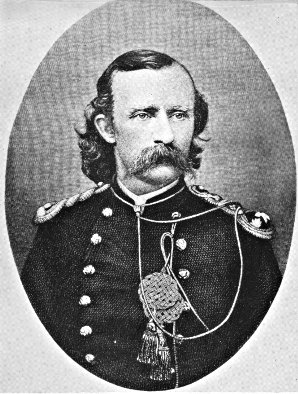
GEN. GEORGE A. CUSTER
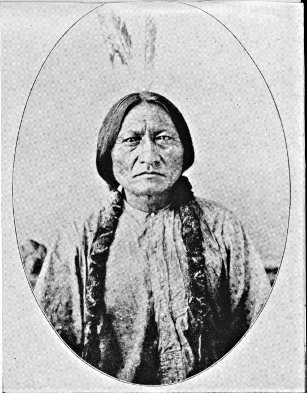
SITTING BULL
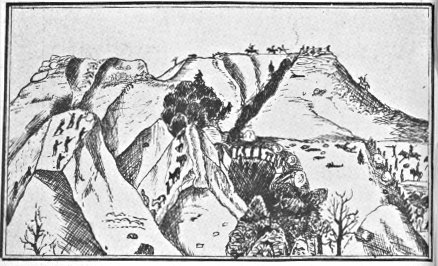
BATTLE OF THE BADLANDS, 1864
Drawing by a soldier who participated in the engagement
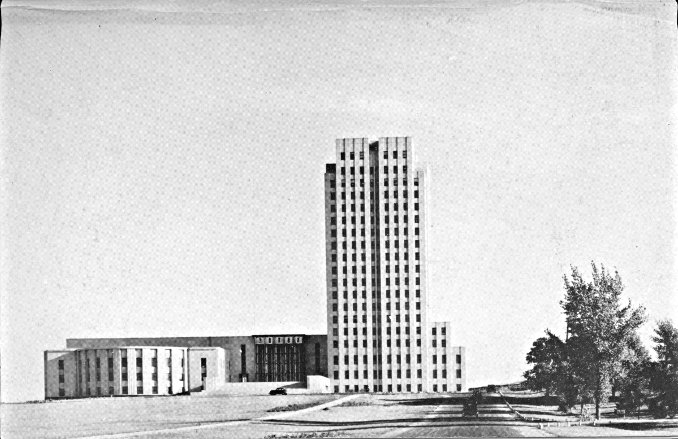
Opposite STATE CAPITOL, BISMARCK Photo by Risem
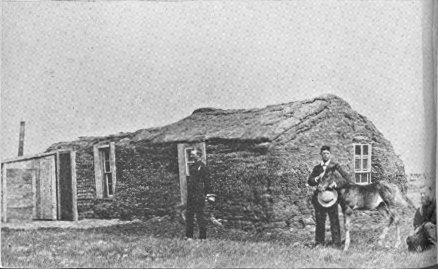
A "LITTLE OLD SOD SHANTY" OF EARLY DAYS
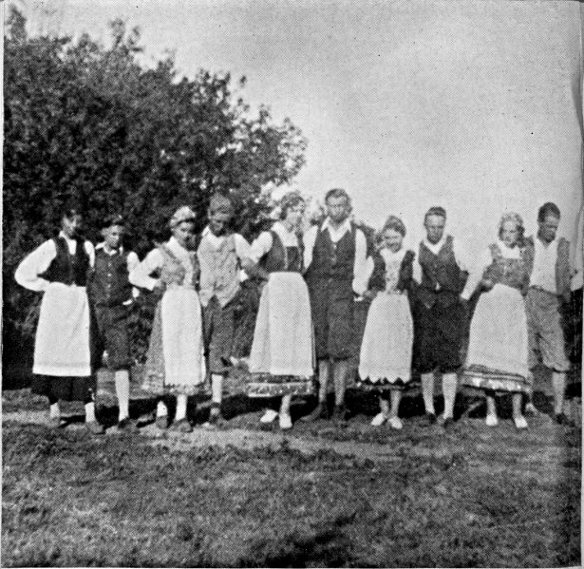
REVIVING A NORWEGIAN FOLKDANCE, ESMOND, N. DAK.
Photo by P. B. Rognlie