SURVEY OF THE STATE (continued 2)
Reading edition
After spending the winter with the friendly Indians, the expedition in April 1805 set out along the river again, following its course into Montana. Their journey through the mountains to the Pacific, led by Sakakawea, is one of the most thrilling adventures in American history.
The party returned in September 1806 to the Hidatsa village on the Missouri where Lewis and Clark, taking leave of their faithful guide, set out for St. Louis and home. The careful observations recorded in the journals of their party are a valuable contribution to the history of this region.
Lewis and Clark were not the only explorers to visit the Missouri region in the early nineteenth century. A decade before they came traders were already ascending the river, and in the succeeding year naturalists and military men added their presence to the growing, if transient, white population. Among the many who left interesting records of their explorations and travels were Charles le Raye, who spent three years as a captive of the Brulé Sioux; Manuel Lisa, one of the most important fur traders on the upper Missouri; Gen. William Ashley, Col. Henry Leavenworth, and Gen. Henry Atkinson, who subdued the Arikara; and Wilson P. Hunt of the Astorian Overland Expedition. Two royal adventurers visited here: Paul Wilhelm, Prince of Wurttemberg, who is said to have taken Sakakawea's son back to Germany with him; and Maximilian, Prince of Wied, who brought with him the Swiss artist Carl Bodmer, whose paintings preserve much of the life and customs of the Mandans. George Catlin, a native artist, was aboard the first steamboat to reach the Yellowstone. He painted and wrote about the Missouri Indians, and left hundreds of pictures of their life. John James Audubon, noted naturalist, spent several months in present North Dakota studying the larger types of North American mammals.
ON THE FRONTIER
The earliest attempt at colonization in this State was the Selkirk settlement in 1812 at Pembina in the Red River Valley. The Earl of Selkirk had arranged for the transportation of a group of evicted Scotch and Irish peasants to the Hudson Bay region in Canada, and some of the emigrants had followed the Red River south and settled at Pembina. The fur traders in that vicinity, however, were not eager to have the wild country inhabited. They made life miserable for the Selkirk settlers, and finally succeeded in driving most of the newcomers out.
Among the fur companies of that time were two famous competitors, the Hudson's Bay and the North West Companies. Others were the Missouri Fur Company, Chouteau and Berthold, Northwestern, Columbia, and Sublette & Campbell, the latter company establishing a post, Fort William, on the site later occupied by Fort Buford military post. John Jacob Astor established the American Fur Company, and for years Fort Union, on North Dakota's western border, was that company's principal post. (See Side Tour 6B.)
Some of northeastern North Dakota's most noted pioneers came into this region as fur traders. Joseph Rolette was sent to Pembina by the American Fur Company in 1842. A member of the Minnesota Territorial Legislature, he was responsible for keeping the capital at St. Paul. Norman Kittson, who established a fur trading post at Pembina in 1843, became the first postmaster, in 1851, in what is now North Dakota. He, too, was a member of the Minnesota Territorial Legislature. Charles Cavileer, while not a fur trader, was a contemporary of these men, and acted as collector of customs at Pembina.
The coming of settlers marked the decline of the fur trade, but at its height it had been colorful. Lewis Crawford, a North Dakota historian, has written:
"In this early race for empire none except fur seekers entered. Their rhythmic paddle blades swished up every stream of the West to its rivulet head; every mountain height and forbidding gorge knew their intrepid feet.... Every nationality had a part.... These were the true pathfinders, the true explorers, the heralds of empire. Their fur-laden vessels floating down the familiar waters of the Missouri and its tributaries represented the wealth, the adventure, the romance of the Northwest."
In the time of the fur trader the Missouri River, the "Smoky Water" of the Indians, was navigable, though as turbulent and capricious as it is today. It was the highway of the trader and later of the gold seeker. The first steamboat to navigate the Missouri through North Dakota was the Yellowstone, which in 1832 ascended the river to Fort Union. To operate a boat on this river required great skill.
Famous pilots in the heyday of the steamboat who wrestled with the wiles of the Missouri included Joseph LaBarge, Grant Marsh, and C. J. Atkins. In 63 years as a pilot Grant Marsh wrecked but one boat on the Mississippi and never had a wreck on the Missouri or Yellowstone.
The yellow gleam of gold, discovered in Montana in 1863 and 1864, drew a rush of prospectors. The railroads had not yet penetrated this territory, and the Missouri was the pathway to the gold fields. Precious cargoes of yellow dust floated down through Dakota, bound for St. Louis. It is said that one boat, the Luella, carried gold dust to the value of $1,250,000 down the river in 1866.
It was not the coming of the railroads to Bismarck in 1873 that marked the decline of the steamboat on the Missouri, but rather the extension of the railroad westward to Montana in 1883.
The Red River of the North was the important channel of traffic for northeastern North Dakota. Steamboats were not as numerous as they were on the Missouri, nor were they operated at such an early date. Fleets of barges and scows were used to transport provisions. The steamer Selkirk commanded by Capt. Alexander Griggs, best known of Red River pilots, brought passengers down the river to settle at Grand Forks the year after he and his crew had unexpectedly spent the winter there (see Grand Forks).
In Territorial days United States military posts were numerous but short-lived. Fort Abercrombie on the west bank of the Red River, about 12 miles north of the site of Wahpeton, was established in 1857. Supplies for this post were brought from St. Paul. When the Sioux went on the warpath in 1862, Minnesota settlers sought refuge here during a seven weeks' siege. The fort was abandoned in 1877 (see Tour 1).
Fort Rice, on the west bank of the Missouri, came next. Gen. Alfred H. Sully's men cut cottonwood trees to build it in 1864. The fort housed four infantry companies. It was to Fort Rice in 1870 that Linda Slaughter, young, talented, followed her husband, Dr. Frank Slaughter. Her writings, depicting the frontier life, found their way into many eastern papers, and today constitute some of the best material on that era of State history. At Fort Rice she buried her first-born child, her only son, in the bitter cold of January. She heard the arrows of hostile Indians whizzing dangerously near. Her luxuriant hair, which she always wore long over her shoulders, was coveted as a scalp lock, and she came near leaving it with the red men on one of her horseback jaunts from the fort. A woman who could paint, write, or lecture at will, she could also cook or nurse as the occasion demanded. In later days she wrote the first telegram that was sent to the world from Edwinton, the village which became Bismarck.
Fort Rice was dismantled in 1878 when Fort Yates, to the south, took its place. Fort Ransom on the Sheyenne was established in 1867. In 1872 Fort Seward, first called Fort Cross, was built at Jamestown. The military reservations of Fort Abercrombie and Fort Seward were opened to homestead entry in 1880.
Fort Totten, near Devils Lake, was constructed in 1867 and served until 1890, when the buildings were turned over to the Indian school. Fort Stevenson on the Missouri at the mouth of Douglas Creek was maintained from 1867-83. Fort Buford was built in 1866 opposite the mouth of the Yellowstone on the north bank of the Missouri. After his surrender in 1877 Chief Joseph was taken through Fort Buford en route to Fort Leavenworth, Kans., and Chiefs Gall and Sitting Bull went there to surrender after their escape into Canada (see Side Tour 6B). The fort existed officially until 1895, but sometime before its abandonment the garrison had been transferred to Fort Assiniboine in Montana.
Established on the Red River near the site of Pembina, Fort Pembina was maintained from 1870 to 1895. Fort McKeen, established in 1872, became, the same year, part of Fort Abraham Lincoln, garrisoned until 1891. It was from Fort Abraham Lincoln that Custer and his Seventh Cavalry marched to death and disaster on the banks of the Little Big Horn in 1876 (see Fort Abraham Lincoln State Park). After 25 years of occupation, Fort Yates was abandoned in 1903, when the new Fort Lincoln was built near Bismarck with facilities for four companies of infantry and supporting detachments. (See Tour 8.)
These early forts were established to protect the settlers along the frontier and to keep the Indians in order. It was after the Sioux outbreak in Minnesota in 1862 that Gen. Henry H. Sibley was sent to punish the Sioux. In June of 1863 he headed his army west from Minnesota toward the Devil's Lake region, where he arrived to find the Indians had gone south. He pursued them and on July 24 engaged them in battle at Big Mound about seven miles north of the present town of Tappen. They retreated, and he followed them to Dead Buffalo Lake, northwest of Dawson, where July 26 another engagement was fought. Two days later he met them again at Stony Lake northeast of Driscoll, but the Sioux retreated rapidly and there was no fighting. Moving on toward the Missouri, Sibley encamped on Apple Creek, seven miles east of the present site of Bismarck, and again near its mouth. The Sioux fled across the river.
Sibley, all along the route, had thrown up defensive earthworks at each of his camps. All of these camp sites which were not plowed under have been definitely located under direction of the State historical society.
Gen. Alfred H. Sully was to have met Sibley on the Missouri, but no contact could be made and Sibley set out for Minnesota on August 1, 1863. Sully came up the river from Sioux City, and was near Long Lake when he learned that Sibley had gone home and the Sioux had recrossed the Missouri and departed for the James River. Sully gave chase—he had been sent out to fight Indians, and fight them he would. The Battle of Whitestone Hill, near Ellendale, followed. Whether the Indians Sully fought had taken part in the Minnesota uprising is today regarded as dubious, but the battle is said to have been the fiercest ever fought on North Dakota soil. The field is now marked by a monument of a cavalry trooper (see Tour 2).
Sully returned to Sioux City but was sent back the following year to deal out still more punishment to the Sioux. After Fort Rice had been established a scouting detachment was sent after the evasive red men, and soon reported Sioux near Killdeer Mountain. Here an engagement was fought July 28, 1864, in which the Indians were severely punished, although afterwards it developed that few of them were Minnesota Sioux.
The troops proceeded up the Little Missouri, where Indians were discovered near Medora. With difficulty Sully traversed 12 miles of Badlands buttes and gullies, continually harassed by the sniping fire of Indians along the route. The fighting of this day is known as the Battle of the Badlands. Following this encounter Sully reached the Yellowstone and returned down the Missouri.
Before he arrived at Fort Rice, he was informed that Capt. James L. Fisk, with a party of immigrants, was in danger. Fisk, who had made expeditions through North Dakota in 1862 and 1863, on this trip followed Sully's trail, and in the Badlands was attacked September 1 by Indians, with the loss of several men. During the next few days several other attacks were made, although no one was killed. Messengers were sent to Sully for aid, and meanwhile the party threw up what fortifications they could in the form of sod walls, and, awaited help. After several days the soldiers arrived and brought the immigrants back to Fort Rice, whence most of them returned to their homes. The remains of their impromptu fortification, known as Fort Dilts, can still be seen (see Tour 9).
One of the most valuable expeditions made through this State was the Stevens Survey of 1853, sent out to discover the most advantageous routes to the Pacific for future railroads. The party was financed by a Federal appropriation, and the northern route, through present North Dakota, was under the direction of Gen. I. I. Stevens.
The guide on this expedition was Pierre Bottineau, one of the outstanding personalities in the history of North Dakota and Minnesota during this period. Of him it has been written that
"It was the guide Bottineau who walked from Winnipeg to St. Paul with James J. Hill, it was the scout Bottineau who headed Jay Cooke's first Northern Pacific survey across the continent, it was the chief Bottineau who gave his name to Bottineau County, and it was the gambler Bottineau who had three queens in his hand, staked Nicollet Island, and lost."
In 1871 the Whistler expedition went up the Little Missouri and into Montana in search of the most practical route for a railroad to the Pacific. Two years later the Stanley expedition, accompanied by a large military escort, conducted another western survey. Engagements with Indians cost this expedition a number of men. One Sioux, Rain-in-the-Face, claimed to have had a part in killing two civilians on the Stanley Survey, and as a result was imprisoned at Fort Lincoln until he escaped. He gained his revenge at the Little Big Horn (see Side Tour 8C).
The Northern Pacific Railway received its charter from the Government in 1864. Magnificent Federal land grants were made: still the road found it difficult to raise the necessary capital to finance the venture, and Jay Cooke & Company undertook the sale of Northern Pacific securities.
On the last day of the year 1871 the line was completed to the Red River at Moorhead, and early in March of the next year it was extended to Fargo. Cooke went into bankruptcy after the financial panic of 1873, but was able to obtain private funds to complete the road to the Missouri that year. Bismarck remained the western terminus of the line until 1879. During the next two years rails were laid to the Montana border, completing the line across the entire State.
In 1870, just before the advent of the railways, the estimated white population of present North Dakota was not more than five hundred. Pembina County, extending the length of the Red River Valley and to the western population limit, was the only organized county in the State.
The Northern Pacific was completed to the Pacific Coast in 1883. Squatters preceded the railroad, settlers followed it, trying to guess future town sites so they could force the company to buy them out at the most profitable price.
The Great Northern was the second important railroad to come into the State. By 1882 James J. Hill, the "Empire Builder," had extended a line up the Dakota side of the Red River to Canada. Hill had a vision of a great railroad connecting the Pacific Coast with the Great Lakes, whence produce could be cheaply transported to New York. Construction began in 1880 and the Great Northern was extended westward across northern North Dakota and in 1893 reached the Coast.
The railroads linked Dakota with the East and civilization, but to the west was the frontier. Here Sioux warriors were beginning to resent the encroaching whites and the appropriation of their hunting grounds. It was imperative, therefore, that soldiers be kept at Fort Abraham Lincoln.
To understand the campaign of 1876 against the Sioux, in which Gen. George A. Custer met his tragic end, it is necessary to go back to the Indian treaty of 1868. The Government by this pact promised to abandon and destroy Forts Reno and Phil Kearney in Wyoming and Fort Smith in Montana. This having been done, the Sioux were guaranteed their freedom in the territory between the North Platte and the Missouri and Yellowstone Rivers. But, when gold was discovered in the Black Hills by a Government reconnaissance expedition under Custer in the summer of 1874, white settlers and prospectors begged for admission to the coveted territory. Military guards at first attempted to keep them out, but when the Indians refused in a treaty council in 1875 to sell or lease land to miners, the Government withdrew the guard and settlers poured in by thousands.
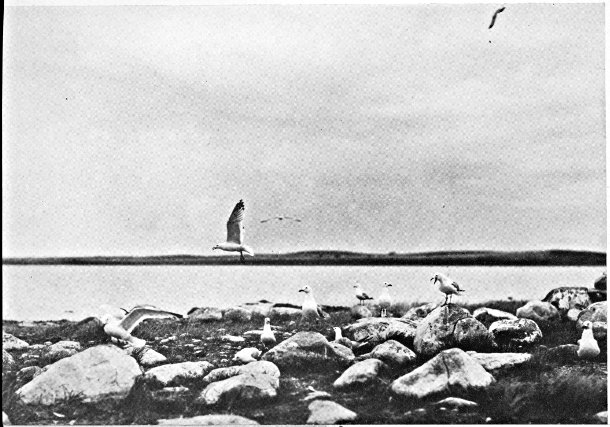
RING-BILLED GULLS
Photo by Russell Reid
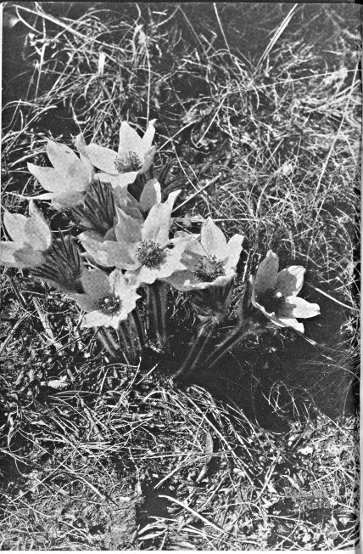
PASQUES
Photo by Russell Reid
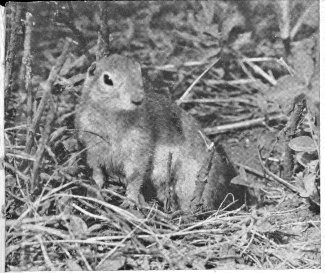
FLICKERTAIL
Photo by Russell Reid
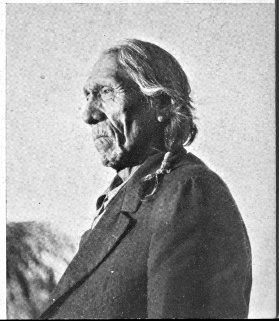
A MODERN INDIAN
Photo by Russell Reid
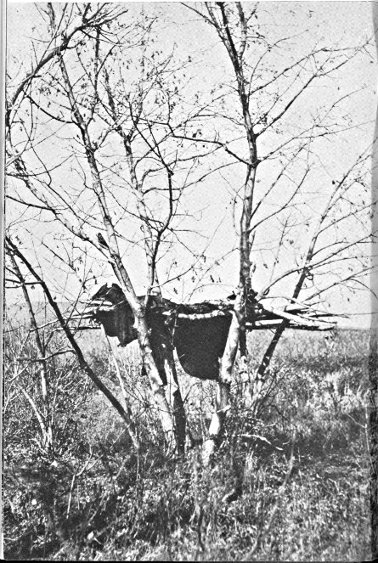
SCAFFOLD BURIAL, FORMERLY USED BY SOME INDIAN TRIBES
Government officials were well aware, when the treaty of 1868 was violated, that an Indian war was inevitable; but although the Government had clearly brought the war down on its own head, it sought the appearance of righteousness.
It was the practice of many Indians to leave their reservations because they wanted to hunt or visit, or because the practices of dishonest agents made life on the reservation unbearable. The Department of the Interior sent out orders for all Indians to be back on their reservations at a certain date, but for many it was impossible to return within the time limit set. The Department designated these people as "hostiles" and turned them over to the War Department, which now had a pretext for taking punitive action.
The campaign of 1876 was planned to force the Indians onto reservations, in order to obtain the relinquishment of the Black Hills. Generals Crook and Gibbon, with their forces, were to meet Generals Terry and Custer with their troops near the Rosebud River in Montana. All were then to move southward against the Indians who were in the hills along the Rosebud and the Little Big Horn.
On the morning of May 17, 1876, the eastern division of the expedition started out from Fort Abraham Lincoln. The cavalry marched about the parade grounds to the tune of Garry Owen, then set out to the strains of The Girl I Left Behind Me. Mrs. Custer accompanied her husband on the first day's ride, returning to the fort as the troopers continued west.
The tragic outcome of the Battle of the Little Big Horn is well known. Not a man of Custer's immediate command survived. The reasons for the annihilation have been debated far and wide. Gen. E. S. Godfrey, who participated in the battle as a lieutenant, in Custer's Last Battle summarizes the affair as follows: "The causes of Custer's defeat were first, the overpowering number of the enemy and their unexpected cohesion; second, Reno's panic rout from the valley; third, the defective extraction of empty cartridge shells from the carbines.... A battle was unavoidable."
Grant Marsh had pushed his supply steamer, the Far West, up the Big Horn to within 15 miles of the battlefield. Reno's wounded were placed aboard and Marsh made the trip of 710 miles down to Bismarck in record time. At midnight July 5 the Far West docked. Colonel Lounsberry, editor of the Bismarck Tribune and correspondent of the New York Herald, gave the story to the world. Mark Kellogg, special correspondent of the Herald and the Tribune, who had accompanied the expedition, had been killed with Custer. Twenty-six widows wept at Fort Lincoln. With Custer's death the frontier era in Dakota history had ended. Although Sitting Bull's forces were undefeated, they took refuge in Canada and remained there until 1881, when they voluntarily surrendered.
They were returned to the reservations. Wishing to keep them there, the authorities took horses, saddles, and arms from both hostile and peaceable Sioux. This move, while it did not pacify the Indians, put an end to the Indian wars.
TERRITORIAL SOLONS AND STRATEGY
At the time of the Little Big Horn campaign Dakota's Territorial Government had functioned for 15 years and was destined to continue 13 years longer. The Territory had been organized in 1861 and President Lincoln had appointed his family physician, Dr. William Jayne, first Governor. As first laid out the new Territory included the present States of North Dakota, South Dakota, Montana, and Wyoming, but after a series of changes it was reduced in 1882 to the area of the present Dakotas.
Yankton, in the southern part of the Territory, was the capital city, and there the first legislature met in 1862. It was an assembly representative of every type in the Territory—all with great and varying ideas of how the ship of state was to be kept afloat.
Thirteen members composed the house, while the senate or council had but nine. In attendance at the session for various reasons were Jim Somers, frontiersman, "armed like an arsenal"; Father Turner of New York; George Kingsbury, newspaperman; Dr. Walter Burleigh, later connected with the Indian Service and the Northern Pacific Railway; and Gen. T. C. Campbell.
Territorial Dakota displayed no small interest in politics. Campaigns were periods of great excitement, with long parades of ardent supporters following the candidates, with cheering and shouting and bragging and fighting by office seekers and votaries alike. It took a brave man to campaign in those days. When Moses Armstrong ran for Congress on the Democratic ticket his friend, Gen. T. C. Campbell, invited him into his part of the Territory to speak. During the general's speech his hat was shot off, but his oratory did not falter. When it came Armstrong's turn to speak he hesitated about addressing such a boisterous crowd, but the general informed him that the time to do his praying was before he crossed the county line, not after.
County seat removals were a prime source of political interest, and the cities in the Territory fought tooth and nail for the privileges of the county capital. Stuffing ballot boxes was not uncommon, and in many instances where removal was voted the defeated city would refuse to give up the county records, and guards would be posted against nocturnal raids of the courthouse vaults by citizens of the victorious town. When the Emmons County Record defeated a plan to move the county seat from Williamsport in 1888, it took full advantage of its success. Beneath the decoration of a crowing cock heading the column, these headlines, typical of the county seat controversies, appeared in the Record November 9 of that year:
ELI
And Billsport Hath The Appellation Earned, For Lo! She Doth Get There With Both Feet. And She Moppeth the Earth With the Cohorts of the Wicked. Yea, Verily, of the Wadites, of the Bumstedites, and the Vanbekites, And They Shall Gnaw a File and Flee Into the Mountains of Hepsidam. FE! FI! FO! FUM!
The entire edition, in celebration of the occasion, was printed in red ink.
Territorial Governors and other high officials were not popular with the people. They were usually from the East and had no interest in the country, their salaries or political advancement being their chief concern. Just after the first legislature had adjourned an Indian uprising disturbed the settlers. It did not take the Governor and other officials long to quit the Territory. Moses Armstrong, later a Congressman, wrote, "With such rapidity do they fly, pale and breathless, that a boy could play marbles on their horizontal coat tails."
Dakota Territory covered about 150,000 square miles and had 36 representatives in the legislature during the 1880's for its population of 300,000. Four judges and three prosecuting attorneys administered matters of Territorial justice.
The second legislative session was no quieter than the first. Because of disputed delegations there were two houses—one met on the levee by the Missouri and the other on the hill above the river. After much time had been lost the differences were compromised and business proceeded.
In 1863 Newton Edmunds of Yankton was appointed Governor of Dakota, the only resident of the Territory ever to hold that office. The next Governor was Faulk of Pennsylvania, then followed Burbank of Indiana, Pennington of Alabama, Howard of Michigan, Ordway of Vermont, Pierce of New York and Illinois, Church of New York and Indiana, and Mellette of Indiana.
The northern and southern parts of the Territory had little in common, and they kept growing farther apart as time went on. In the session of 1883 removal of the capital from Yankton was the big question. Yankton wanted to keep it, Bismarck, Huron, Mitchell, Pierre, and Chamberlain wanted to acquire it, and Fargo or Jamestown would have taken it if offered. A bill was finally passed providing that the Governor appoint nine commissioners to choose a capital city; they were to accept an offer of not less than $100,000 and 160 acres of land on which the capitol was to be built. The land remaining after the capitol grounds were provided for was to be sold for the benefit of the building fund.
The commissioners named were Milo Scott of Grand Forks County, Burleigh Spalding of Cass, Alexander McKenzie of Burleigh, Charles Myers of Spink, George Mathews of Brookings, Alexander Hughes of Yankton, Henry de Long of Lincoln, John P. Belding of Lawrence, and M. B. Thompson of Clay.
The commissioners must, according to law, meet and organize at Yankton. Feeling ran high; the city did not intend to part with the capital without a struggle. Yanktonians awaited the commissioners.
But unknown to the citizens of Yankton, the commissioners had chartered a special train, leaving Sioux City April 3, at 3 a. m. The commissioners' coach was dimly lighted as the train pulled into the city limits of Yankton. The meeting was quickly called to order, officers were chosen, and the meeting adjourned until that afternoon in Canton. The train had still a half mile to go to the city limits when the meeting was over. The commissioners had satisfied the law, having met, organized, and adjourned in Yankton.
The commission thereafter made the rounds of several towns, and was royally entertained by prospective capital cities. Bismarck's offer of $100,000 and 320 acres of land was the best bid received. Thus Bismarck became the Territorial capital.
The cornerstone ceremonies took place September 5, 1883. Many high officials and prominent citizens from the East were guests of the Northern Pacific on the Villard "gold spike" excursion, and were present as guests of honor at the laying of the cornerstone. Among them were Henry Villard, president of the Northern Pacific Railway; General Grant; General Haupt; Henry M. Teller, Secretary of the Interior; the Hon. Sackville West, British Minister; members of the Austro-Hungarian, the Danish, and the Norwegian-Swedish Legations; the Imperial German Minister; Territorial Governor Ordway; and numerous United States Senators, Governors, and mayors.
The next great task was to convince Congress that the Territory was ready for statehood. As early as 1871 the legislature had requested Congress to divide the Territory, and in 1874 Moses Armstrong, while in Congress, had petitioned that the northern part be made into a new Territory named Pembina. Nearly every year a petition was sent to Congress praying for admission as two States. In 1860 it was suggested that the northern part be called North Dakota. The Territorial legislative assembly in 1889 provided that a constitutional convention be held for North Dakota, and February 22, 1889, Congress passed an enabling act for North Dakota, South Dakota, Washington, and Montana.
Delegates to the State convention were elected May 14, 1889, and the convention met in Bismarck July 4 of that year. A parade in which Sitting Bull and other famous Indians participated was part of the entertainment afforded the delegates. Election to approve or disapprove the proposed constitution was held October 1, 1889, and as it was a certainty that the constitution would be accepted, legislators, State officials, and Congressmen were elected at the same time. President Harrison on November 2, 1889, declared North Dakota a State, and John Miller at the same moment became first Governor of North Dakota.
Hand in hand with the political development of the Territory had gone social and economic progress. By the time statehood was attained farmhouses and towns had broken up the barren loneliness of the prairies. Sod shanties, the pioneers' first homes, were being replaced by solid frame structures. Huge bonanza farms were employing hundreds of men and using advanced farming methods that had not yet been introduced on farms in the East (see Agriculture & Farm Life). Schools were being built in every community. Six years before statehood one private college had been established, and the University of North Dakota had opened its doors and was offering courses in the arts and sciences to ambitious pioneer youth.
POLICIES AND POLITICS SINCE STATEHOOD
When the constitutional convention for North Dakota completed its work on August 17, 1889, the product of its labors was a document six times as long as the Federal Constitution. Based upon a model constitution drawn up by Prof. James Bradley Thayer of the Harvard Law School, it contained extremely advanced and enlightened provisions, 217 sections included in 20 articles. To these have since been added 49 amendments.
The civic pattern adopted was very similar to that in force in the older States. The legislative branch in North Dakota consists of a bicameral legislature which meets in January each odd-numbered year. The executive branch is headed by the Governor, who is elected for a term of two years. He has the general veto power and authority to reject any item in an appropriation bill. The judicial department consists of a supreme court of five members, elected for 10-year terms; district courts, county courts, and justices of the peace. The State is divided into six judicial districts, each one under an elective district judge. County courts are courts of record concerned with such matters as probate and guardianship, but in counties having county courts of increased jurisdiction such courts have concurrent jurisdiction with district courts in certain cases.
The State is divided into counties whose administrative functions are carried out by boards of commissioners elected every two years. Any city or village of 500 population or more may choose either the commission form of government or the mayor and council type.
The framework of government is perhaps not very different from that in many other States. It is the legislation in North Dakota that has been anything but a copy of that in any sister State, and the outcome of some of her political experiments has often been of Nation-wide interest. The economy of the State is preponderantly rural, and the tendency has therefore been to try anything that seemed likely to help in the solution of the farmer's problems.
The legislature of the State of North Dakota met for the first time November 19, 1889. This session lasted 120 days, but the length of all subsequent sessions was fixed by the constitution at 60 days. The first men this State sent to the United States Senate were Gilbert Pierce of Fargo and Lyman Casey of Jamestown. H. C. Hansbrough of Devils Lake was the first Congressman. The supreme court had for its chief justice Guy C. H. Corliss, and Joseph M. Bartholomew and Alfred Wallin were associate justices.
In this first session the legislature instituted a department of agriculture for "the promotion of stock-breeding, agriculture, horticulture, manufactures and domestic arts." A school law enacted at this session was an enlightened and detailed piece of legislation. North Dakota had at the beginning of statehood a well-organized school system of 1,362 public schools with 1,741 teachers; a State university at Grand Forks; Catholic schools at Fargo, Grand Forks, and Bismarck; a Congregational college at Fargo; a Presbyterian college at Jamestown; and at Tower City a Baptist college, which, however, failed to survive.
One of the most exciting battles of the first legislative session was the bill to license the Louisiana Lottery. Rumors circulated to the effect that bribery was being practiced, that the lobbyists for the lottery were making liberal offers for votes. The Governor and his friends had hired detectives from the Pinkerton Agency to mingle with the legislators and lobbyists. When the detectives had all the information they needed, they revealed their identity to the lottery supporters. Fearing exposure, the lottery enthusiasts gave up the fight and the bill was killed.
North Dakota was faced with the drought problem during the administration of Gov. Andrew Burke (1891-92), and the people looked to the legislature for some solution to their problems. Their petitions were not at all times considered seriously. One member offered a resolution praying Congress to pass a law establishing a scientific rain bureau and a law offering a reward to anyone discovering a practical system of producing rainfall. The house referred his resolution to the temperance committee.
At the beginning of statehood North Dakota had been subject to a rather autocratic form of government in spite of decidedly democratic constitutional provisions. The State had been economically dependent on the East. The directing powers in the early State government were centered in St. Paul and Minneapolis. Eastern wealth had furnished capital for the railroads, and the railroads had been responsible for the settlement of the State. Likewise, the farmer's crops had also to be sold in the East, and his machinery and supplies must necessarily be purchased there.
At the time North Dakota was admitted to the Union the Republican Party was in control. Democrats at that time in State history and for long afterward were few and far between. These two old-line parties were the only two worthy of note in this early period, although the Populists polled a large vote in the first Presidential election and North Dakota divided its first electoral vote, one vote going to the Democratic, one to the Republican, and one to the Populist candidate.
The railroads and financial interests of St. Paul and Minneapolis had very early begun interfering in North Dakota politics. Judson LaMoure and Alexander McKenzie were the lords of this era, both representing railroad interests in State politics, and the favors they were able to bestow were a safeguard against legislation hostile to the companies. In time they came to be the protectors of other interests, including banks, insurance companies, line elevators, and lumber companies.
The first revolt against this system came in 1892. Gov. Andrew Burke had vetoed a bill favored by the Farmers' Alliance which would force railroads to lease sites or rights-of-way for grain elevators and warehouses. The Farmers' Alliance, Democrats, and Populists fused, and Eli C. D. Shortridge was elected Governor.
In Governor Shortridge's administration the legislature passed a bill for highway improvement. Money was appropriated to enlarge the State capitol building.
The tendency of legislation during the session of 1893 was definitely toward the principles of the Populist platform. During Shortridge's administration North Dakota attempted its first State ownership venture. One hundred thousand dollars was appropriated to build a State elevator at Duluth, Superior, or West Superior. The panic of 1893 came on and the plan was not carried out. In 1894 Roger Allin, regular Republican, was elected Governor, and with that election the first brief rebellion against Eastern capitalism was ended.
Governor Allin felt it necessary to veto several appropriations in order to keep within the probable revenue, and State institutions had practically no funds for operation. In the case of the university, salary was provided for the janitor but not for the faculty. President Merrifield and the faculty preferred to serve without any pay rather than close the institution, and necessary expenditures were met by private subscription. Other institutions were kept open in the same way.
During the administration of Gov. Frank Briggs (1897-98) the Spanish-American War broke out. The entire National Guard volunteered its services, but many members could not be accepted because of the quota set for North Dakota. North Dakota volunteers took part in 30 engagements and skirmishes during the Philippine insurrection.
Governor Briggs died in July 1898 and his term was completed by the Lieutenant Governor, Joseph M. Devine, who later served several years as commissioner of immigration. Both Briggs and Devine were Republicans, and they were succeeded in 1898 by another member of their party, Frederick B. Fancher, a leader in the Farmers' Alliance. Fancher declined a second term, and was succeeded by Maj. Frank White, who had served in the Philippines. White found the State debt the chief problem of his administration. He served two terms and yielded his office to E. Y. Sarles.
Legislation during Sarles' term tended toward control and regulation of corporations. A board was created to supervise State banks, and the manner of organizing insurance companies in the State was prescribed.
Sarles was defeated for reelection by "Honest John" Burke, a Democrat, and the only Governor of this State to serve three terms. From the governorship he left North Dakota to become United States Treasurer under President Wilson, later served as chief justice of the North Dakota Supreme Court, remaining a member of the court until his death in 1937. Crawford, in his history of North Dakota, has said, "The legislative history of the Burke administrations is an instructive illustration of the ideals and motives which were so characteristic of the [Theodore] Roosevelt era." State institutions were liberally provided for, a primary election law was enacted, prohibition laws were enforced, schools were improved, and various regulatory offices and boards were created.
A second revolution in North Dakota political history was ushered in with the election of Burke. The Progressive Republicans, enthusiastic supporters of the so-called "LaFollette reforms," had formed a coalition with the Democrats to elect this first Democrat Governor of North Dakota. "It was," according to Judge Andrew Bruce in his book The Non-Partisan League, "the revolution which laid the foundations for the present Non-Partisan League, for in it the farmers found a new war cry and new objects of anathema. The war cry was 'North Dakota for North Dakotans' and the objects of their anathema were 'Big Business, McKenzie, and McKenzieism.'"
Gov. Louis B. Hanna succeeded Burke in 1913. In 1912, a Presidential election year, North Dakota's electoral votes went to Woodrow Wilson. New apportionment gave this State three representatives in Congress instead of two. Governor Hanna asserted his belief in businesslike administration of government offices, and revised the accounting methods in State departments. Throughout this period tendencies in the State were progressive: social legislation was favored; the State grew rapidly in population; new towns were springing up; the automobile age had arrived.
Through all this ran the thread of the second political revolution which Burke's election had begun, and which was continued through the Hanna administration. It was directed principally against injustices in the grain trade. Farmers were incapable of developing their own marketing facilities. Millions had been invested in the mills and elevators of St. Paul, Minneapolis, and Duluth, and in the "line" (corporation) elevator companies throughout North Dakota. The farmers complained of unfair methods of grading and docking their grain; they claimed that the Minneapolis Chamber of Commerce was a closed corporation, and that its members were identified with the big milling and elevator interests. Even conservative Senator McCumber of North Dakota protested in 1916 before the United States Senate against abuses in the grain trade.
The Equity Exchange had been organized in 1909 to act as a farmers' general selling agency in St. Paul, but had been denied membership in the Minneapolis Chamber of Commerce. The Society of Equity and the Equity Exchange tried to get a bill through the 1915 legislature for the establishment of a State-owned elevator, but the attempt failed. Indignation at the defeat of the bill resulted in the birth, in February 1915, of a new political party, the Nonpartisan[1] League.
A. C. Townley, a genius in the art of organization, spread the league gospel through the State. Townley had begun life in poverty, had failed in a large-scale flax-growing enterprise, and had for a time been identified with the Socialist Party. A. C. Bowen suggested the formation of the league. Charles Edward Russell was the first editor of the newspaper, the Non-Partisan Leader, and Walter Thomas Mills drafted many of its laws. All three of these men were Socialists.
After winning the support of a prominent farmer, Fred Wood, and his two sons, the movement spread rapidly. Before the end of the first year the league had 30,000 members. Its platform embodied five planks:
State ownership of terminal elevators, flour mills, packing houses, and cold storage plants.
State inspection of grain and grain dockage.
Exemption of farm improvements from taxation.
State hail insurance on the acreage tax basis.
Rural credit banks operated at cost.
"Practical salesmanship, a program of immediate and forceful action and the use of the Ford automobile are the factors principally explaining the rise of the Non-Partisan League," declares Herbert Gaston in his book The Non-Partisan League.
Most of the league membership was Republican; it was therefore an easy step to the use of the machinery of that party. In the primary election of June 1916 and again in the fall the league was successful. Lynn J. Frazier became the first league-elected Governor, and three league-endorsed candidates, R. H. Grace, James E. Robinson, and L. E. Birdzell, were placed on the supreme court bench.
Three hundred thousand dollars was appropriated by the legislature to carry out the provisions of a Terminal Elevator Commission bill, but Frazier vetoed the act, declaring the appropriation insufficient. Among the progressive legislation enacted at this session were bills providing for the creation of a State highway department, land title registration (never enforced, however), increased funds for rural schools, reduction of rate of assessments on farm improvements to 5 percent of the true value, and guarantee of deposits in State banks.
Entry of the United States into the World War brought new activities to North Dakota in the spring of 1917. National Guard units were sent, a Council of National Defense was created to aid in the work of mobilization, Liberty Bonds were sold, and the State went $200,000 over its quota in the United War Work campaign.
The World War interrupted, but did not deter, the progress of the league program. Governor Frazier was reelected in 1918, and seven initiated amendments were added to the State constitution, forming the basis for the league program. The law for initiated petitions was changed to require only 20,000 signers; the $200,000 debt limit of the State was abolished and the State was allowed to issue or guarantee bonds not to exceed $10,000,000.
The league's industrial program was established at the 1919 legislative session. The industrial commission, composed of the Governor, the attorney general, and the commissioner of agriculture and labor, was to manage the industries and enterprises undertaken by the State. Under authority of the new legislation, the North Dakota Mill and Elevator Association was established. A small mill was purchased at Drake and later a mill and elevator were built at Grand Forks with a capacity of 3,000 barrels per day and a storage capacity of 1,659,500 bushels (see Tour 1).
In the March primary of 1920 an unusual initiated measure was the center of interest. It was the "recall", which provided for the removal of any elective officers, even judges. The measure became Article 33 of the constitution.
The elections of 1920 again saw the league victorious. In the Republican primaries Dr. E. F. Ladd, president of the State agricultural college, defeated Senator Gronna for the nomination as United States Senator. William Langer, who had been elected attorney general in 1916 with the endorsement of the league, opposed Governor Frazier in the primary and was defeated by a small margin. Frazier and Ladd were elected in November.
Two important initiated measures were passed, one providing for a board of auditors to audit the accounts of the State treasurer, the Bank of North Dakota, and all State industries, the other amending a previous measure so that although State funds and State institution funds must be deposited in the Bank of North Dakota, county, township, municipal, and school district funds need not be deposited there.
In 1920 deflation of the league's boom set in. The United States Supreme Court declared the grain grading law unconstitutional. The Independent Voters Association, anti-Nonpartisan, argued that the cost of government had greatly increased under the Nonpartisans. In the 1921 session of the legislature committees were appointed to investigate. The minority of the Senate committee reported that the industrial commission had practiced a policy of favoritism in affairs of the Bank of North Dakota in distributing public funds to private banks, so that the bank could not at that time meet its obligations; that the commission had failed to exercise proper control of the North Dakota Home Builders' Association, so that its affairs were hopelessly muddled; that it had approved contracts between the Drake mill and private merchants, especially the Consumers United Stores Company, a subsidiary corporation of the Nonpartisan League, resulting in losses to the State; that it had approved a policy of the Bank of North Dakota by which $2,000,000 of a total $5,200,000 in live claims against solvent banks were against 37 institutions mostly classed as "league banks" or "friendly" politically; that it had allowed officers of the bank to deposit public funds in private banks with the result that $1,400,000 of these funds were tied up in insolvent banks.
The recall was exercised for the first time in the United States against the governor of a State. In a special election of 1921, Frazier was defeated by R. A. Nestos, Republican, a member of the Independent Voters Association, or I. V. A.'s, as they were popularly called. The other two members of the industrial commission, Attorney General William Lemke and Commissioner of Agriculture and Labor John Hagan, were also recalled. But measures initiated to curtail the industrial program failed; Governor Nestos had to administer a program to which his party was opposed. Nestos was reelected in 1922. In the same election former Governor Frazier, running for United States Senator, defeated J. F. T. O'Connor, Democrat, who later became comptroller of currency under President Franklin D. Roosevelt.
Governor Nestos was defeated by the Nonpartisan candidate, Arthur G. Sorlie, in the primary of 1924 while I. V. A. Republicans won several of the State offices. Senator Ladd died in office and a Nonpartisan newspaperman, Gerald P. Nye, was appointed to fill the vacancy. He holds that office at the present time (1938). When Governor Sorlie died, Walter Maddock, Lieutenant Governor, filled out the term.
In 1928 George Shafer, an I. V. A., who had been attorney general under Nestos, was elected Governor, and in 1930 he was reelected.
The debt limit having been increased at various times, North Dakota's bonded debt in 1930 was estimated to be $36,357,200; $1,000,000 represented in capital stock of the Bank of North Dakota; $4,000,000 in mill and elevator construction and milling bonds; the remainder in various real estate bond series.
By 1930 North Dakota's population was 680,845, more than double the figure at the opening of the century. Large foreign immigrations accounted for the approximately 88 percent rise in the 1910 census over that of 1900, and by 1920 the figure had risen to 646,872. Statistics of the U. S. Bureau of Census show North Dakota to have been the only spring wheat State having an increase of population during the period from 1930-35. The growth has been almost entirely rural; from 1920 to 1930 no new urban centers (above 2,500) have appeared in the State.
The State capitol building was destroyed by fire December 28, 1930, and plans were immediately laid for building a new statehouse. A $2,000,000 building, unique in that it is North Dakota's only skyscraper, today stands on Bismarck's Capitol Hill.
An initiative measure in the election of 1932 repealed the prohibition clause in the State constitution, making North Dakota, dry since it became a Territory, a wet State.
William Langer, who had been elected attorney general on the Nonpartisan ticket with Frazier and later was defeated as I. V. A. candidate for governor by Frazier, was elected Governor in 1932, once more running as a Nonpartisan.
The period following proved a trying one for the rural population of North Dakota. The farmers suffered because of low market prices for farm products, low land values, bank failures, and crop failures. The situation was acute at the beginning of Langer's administration because many farm mortgages had been based on pre-depression valuations. Farmers feared foreclosure and the wastage of their life efforts.
To prevent foreclosure Governor Langer declared various farm mortgage moratoriums by executive order. For a time an embargo was in effect on agricultural products, forbidding shipment of them from the State in the hope that prices would be forced up. A law enacted to extend the period of redemption on real estate mortgages was held unconstitutional by the North Dakota Supreme Court as applied to existing mortgages. In 1933 laws were passed outlawing crop mortgages and deficiency judgments.
A stormy period in State history ensued when Governor Langer was removed from office July 18, 1934, having been held disqualified under the State constitution by the supreme court because of his conviction on a Federal charge of conspiracy, arising from solicitation of contributions from State and Federal employes for support of his political newspaper, the Leader. (The Federal Courts later reversed the conviction.) Ole Olson, Lieutenant Governor, served the remainder of the term.
Thomas H. Moodie, first Democratic Governor to be elected in 24 years, took office in January 1935, only to be declared ineligible by the supreme court February 2, because of insufficient residence in the State. Walter Welford, Nonpartisan Lieutenant Governor, became acting Governor, the fourth to occupy the gubernatorial chair in little more than six months.
The legislature of 1935 created a State Planning Board to make investigations and surveys relative to the conservation and utilization of the State's natural resources, and a State Welfare Board to act as official agency of the State in any social welfare activity initiated by the Federal Government and to allocate State and Federal funds available for such purpose. The planning board has since cooperated with the Federal Government in work which has involved development of natural resources and building of dams to overcome effects of drought.
Other legislation of the 1935 session provided for a retail sales tax which resulted in greatly increased revenues for education and public welfare purposes, a drivers license law, and a two-year mortgage foreclosure moratorium. Two radical changes in public policy effected through initiated measures in 1935 were provision for manufacture, sale, and distribution of beer, and for Sunday motion pictures.
Former Governor Langer, defeated by Acting Governor Welford for the Nonpartisan nomination for the governorship in 1936, surprised opponents in both the league and other parties by polling a majority in the election, the first governor of any State elected in the individual column on the ballot. In the same election North Dakota put liquor control in the hands of counties, municipalities, and villages.
Indicative of the increasing responsibilities of State Governments, the social-minded legislature of 1937 made the largest appropriation for public welfare in the history of the State—more than $6,100,000 for the 1937-39 biennium.
AGRICULTURE AND FARM LIFE
Land of supersized farms, of spring wheat and winter rye rippling in the wind, of gigantic flower gardens of paradise-blue flax—this is North Dakota, one of the greatest agricultural States of the Nation.
Those who have seen the vast fields in the summer know the meaning of this land to the farmer and the stock-raiser; for while the romantically inclined can meditate on the beauties of a bronze wheatfield under the July sun, or the picturesque qualities of fine cattle grazing on a hillside, the agricultural statistician can point out that 87 percent of the land in the State is devoted to agriculture, and, given sufficient moisture, the richly productive soil will more than repay the efforts of the farmer or stockman who depends upon it for his livelihood.
Here in North Dakota were the original bonanza farms—so-called because of their almost fabulous yields of wheat—some of them two or three townships in extent. They are gone now, but the size of the farms today still startles those familiar with agriculture in other States, for many holdings run as high as 10,000 acres, and the average for the whole State is 463 acres, as against the United States average of 154.8 acres.
Ordinarily the rainfall is sufficient to bring crops of high value, despite the fact that in the western two-thirds of the State it is not abundant. In occasional years the moisture is poorly distributed, resulting in lessened cash values. About twice in a century the dry-land farming area of the United States, of which the western two-thirds of this State is a part, is subject to major drought conditions. At such times farming is difficult and in places impossible—without irrigation. In the drought of the 1880's there were few people in North Dakota to suffer. It took the recent major drought which began in 1929 to impress not only upon North Dakotans, but upon the Federal Government as well, the necessity for reliance in part upon irrigation, utilizing the waters that flow so abundantly through the State—and out of it.
More than a thousand dams are contemplated in the Works Progress Administration program for the State. Many have already been completed, and steps are being taken to divert the waters of the Missouri River into the James and Sheyenne Rivers, and to utilize waters in western tributaries of the Missouri.
Fortunately, North Dakota has never had a land boom. The result is that prices of agricultural land are low, and with the returning rains it is likely that the State will experience a new wave of confidence and prosperity.
Naturally, in a State where 87 percent of the land is devoted to agricultural pursuits, farm conditions are of paramount importance to almost every person. Directly dependent upon the soil are the farm residents who compose 53.6 percent of North Dakota's population. Directly dependent upon the wealth of the farmer are the 28.6 percent who live in small rural towns, and, almost as directly, the 17.9 percent who compose the urban population. Of the urban group, approximately one-third are employed in the processing of agricultural products.
The same general boundaries that divide the State topographically also designate the three agricultural belts. The Red River Valley and Drift Prairie are combined in what is known as the black-earth belt, the Coteau du Missouri constitutes the farming-grazing belt, and the Missouri Slope is the grazing-forage belt.
In the black-earth belt the farms are usually small, averaging less than 400 acres in extent. Here the average annual rainfall varies from 18 to 24 inches, 6 to 8 inches of which falls during the months of May and June, when it is most valuable to small grains.
The black-earth region was the first part of North Dakota to be settled. Furs were the object of the earliest white settlers there, but the value of agricultural pursuits was by no means overlooked even during that early period. Alexander Henry, Jr., the fur trader who foresaw that the Red River Valley would be good agricultural land if the transportation problem could be solved, tells in his diary of planting a garden as early as 1800 at his trading post at the mouth of the Pembina River, where he raised carrots, cabbages, beets, potatoes, and other vegetables. Nor was he free from the evils which beset the modern farmer: his crop was highly satisfactory for several years, but in 1808 everything was eaten by the grasshoppers which swarmed across the land. Henry's agrarian ventures were secondary to his fur trading, however, and it was not until the friends of Charles Cavileer settled at Pembina in 1851 that a permanent agricultural colony was established in the State. An earlier settlement by the Selkirkers of Canada in 1812 had been short-lived. When the Cavileer colony arrived, however, the Selkirk colonists, now established at Fort Douglas, Winnipeg, not only provided Cavileer himself with a bride but also supplied his people with seed wheat, oats, barley, and field peas—an invaluable contribution.
For almost 20 years the little settlement at Pembina was the only farming community in the State. Dakota Territory had been opened to settlement January 1, 1863, and free lands were offered to anyone over 21 years of age who would cultivate and improve his 160-acre homestead, and live on it 5 years. If he wished, he could also obtain a tree claim of 160 acres.
Ten acres of this quarter-section had to be planted in trees, and proof, substantiated by two reliable witnesses, that the trees had been growing for eight years was necessary before the settler could obtain clear title to the claim. The acquisition of tree claims was sometimes hindered by the perpetration of a cruel hoax on newcomers. One of a group of unprincipled men, interested in money rather than in settlement of the land, and unable or unwilling to file claims, would approach a new settler and offer him a "deal" on a piece of land, ostensibly planted as a tree claim, with the little green tree shoots already appearing above the ground. The settler would pay a substantial sum for the advantage of having trees already planted, and in good faith would file on the claim, only to find later in the year that instead of a 10-acre grove he had an excellent but over-abundant crop of turnips. Notwithstanding such discouragements, many fine groves were planted which have not only added greatly to the beauty of the Red River Valley and central North Dakota, but have been invaluable as a protection against soil erosion.
A third tract of 160 acres could be secured under the preemption laws which permitted the settler to locate on land before or after it was surveyed, file declaration of intent to purchase, and pay for the land within 18 months after filing, at the rate of $2.50 an acre for railroad property or $1.25 for any other land. Additional land could be obtained by buying up grants to soldiers in the United States Army. Military land warrants could be purchased for a nominal price, often as low as 50 cents an acre.
At first, despite the ease of obtaining land, there was no great influx of settlers into the new land. The Nation was in the grip of the Civil War, and Indian troubles in the West not only discouraged new settlement but frightened out many who had already made their homes there. Writers who had visited the Territory depicted it as "a land of blizzards and Indians, drought and grasshoppers."
Moreover, homesteading in the northern part of the Territory was complicated by the fact that the nearest land office was at Vermilion, 400 miles away, a long and perilous trip in the day of the oxcart and dogsled. The only surveyed land was in the vicinity of Pembina. Here in 1868 Joseph Rolette, pioneer fur trader and settler, filed the first homestead in North Dakota, the only one before 1870. In 1871 a few more claims were filed, but it was not until 1885 that settlement increased to any great extent. During that year so many "took up" land that Dakota Territory became known as "the land of the free and the home of the boomer ... free homesteaders and town site boomers."
The extension of the Northern Pacific across the Red River into North Dakota was partly responsible for this sudden increase in population. Immigrants found it easier to reach the lands which the Government offered them. The Northern Pacific had been given by Government grant alternate sections of land for a distance of 20 miles on each side of its right-of-way. The land between these sections was opened to homesteading; and since the free lands were just as desirable as its own, the railroad could find no market for its property. It was decided, therefore, that the only way to profit on its investment was to encourage settlement, so that there would be an increased need of transportation in and out of the new country. In lieu of its stocks, which had slumped in the panic of 1873, the road sold some of its enterprising stockholders large portions of its land grants for 40 and 50 cents an acre. Among those persuaded to invest were G. W. Cass, B. P. Cheney, and Oliver Dalrymple. The three formed a company and placed their 12,000 acres, in the vicinity of Fargo, under Dalrymple's management. Thus was formed the first bonanza farm, initiating an important era in the agricultural history of North Dakota.
The chief purpose of the early bonanza farms was to demonstrate on a spectacular scale the potential wealth of the Red River Valley. The farms ranged in size from 3,000 acres to the 65,000-acre Grandin farm which covered more than 100 sections of land. Wheat was the sole crop. All operations were conducted on a large scale, with dozens of the most up-to-date farm machines working on the various divisions of the farms simultaneously, and huge crews of a hundred or more employed during the harvest season. Tales of the bumper crops were soon spread by the transient harvest "hands," and visitors and home seekers came from far and wide to see whether the stories of the fabulous crops were actually true.
Two new inventions added to the success of the wheat-raising bonanza farms. The first of these was the purifier, which made it possible to produce a superior grade of white flour from spring wheat. The second was a roller simplifying the milling of hard wheat, with the result that this grain was placed at a premium. In a single year, the value of the farms was raised from the original 40 and 50 cents to $5 an acre, and by 1906 the lands were worth from $30 to $40.
Because they raised a single crop, the managers of the bonanza farms found it easy to systematize and mechanize their work. The newest farm machines were common in this newly settled area long before they were introduced in the older States.
Eastern syndicates usually owned the bonanza farms, and resident managers were engaged to supervise the work. As long as only wheat was raised, the system was ideal. With the introduction of other crops, however, difficulties arose, principally because stockholders could not agree on a plan of operation. Almost all of the large farms were eventually broken into smaller plots and sold to the immigrants and easterners whom they had attracted to the West. Today, 51,149 of the 84,606 farms in the State are operated by their owners, 33,122 by tenants, and only 335 by managers.
Thousands who were attracted by the success of the bonanza farms and the low railroad rates came west to take up land, and were aided in their preparation by the Emigrant's Guide, published by the Commissioner of Immigration for Dakota Territory in 1870. This contained not only such valuable information as data on the land laws, farming methods, and transportation facilities, but also freight rates and a list of prices of staple commodities to indicate supplies which should be brought from the East and those which could be as cheaply purchased in the new land. Tea was one of the most expensive of pioneer commodities, ranging in price from $1.25 and $2 a pound. Sugar was also high—from 12 to 16 cents a pound. For light, the homesteader had a choice of candles at 25 cents a pound or coal oil at 80 cents a gallon. Furniture, too, could be purchased by those who did not wish to carry it across the prairies from their eastern homes. Extension tables sold for $2 a foot, washstands cost from $4.50 to $10. Ox yokes were $3, a double harness $45. So many homesteading necessities could be purchased at the pioneer settlements that after reading Dakota newspapers of this period a North Carolina editor announced that "the people are fully up to the highest notch of civilization."
As the lands of the Red River Valley and the Drift Plain were occupied, settlers were forced to go farther west into the farming-grazing belt of the Missouri Coteau. Influenced by the fortunes being made in wheat in the eastern part of the State, they too became wheat farmers. But although the soil of the Missouri Coteau is almost as rich as that farther east, it does not have the same advantageous rainfall during the growing season; and while it produced successfully, it did not have the spectacular production of the bonanza farms in the black-earth area.
Today, the farms in this region are somewhat larger than those of the more easterly belt, being from 450 to 600 acres in size, but the relative production is lower. Although grain farming still predominates, ideally the farming-grazing region is, especially in dry years, a livestock section.
To the west of this central region lies the Missouri Slope, which constitutes the grazing-forage belt. Originally the farms here were much smaller than those in other parts of the State—with the repeal in 1891 of tree claim and preemption laws, homesteaders were limited to 160 acres of free land. For a few years the settlers on the Missouri Slope were able to file on desert claims, receiving one section at $1.25 an acre with the understanding that they would improve the land by irrigation; but so many people throughout the arid regions of the United States filed on such claims fraudulently that the act was finally amended to include the requirement that at least $3 an acre must be spent for irrigation.
Despite this land limitation, many new settlers came to western North Dakota during the "back to the land" movement from 1900 to 1910. Besides the farmers who took up free land, there were many school teachers, laborers, and business and professional persons who followed that method, or took a commuted homestead by filing on land, staying there 14 months, and paying the Government $1.25 an acre. In this region, where it is estimated that 30 percent of the land is not suitable for cultivation, it was inevitable that many of these inexperienced persons should settle on worthless property. Experienced ranchers and farmers realized that only large farms could be operated profitably, and purchased homesteads from dissatisfied settlers. In this manner the size of farms increased, until now they run to 800 acres or more.
The most fertile soil of the western region is in the valley of the Missouri. It was here that Verendrye, Lewis and Clark, Catlin, and other early explorers found the Mandan, Hidatsa, and Arikara women carefully cultivating their neat fields of corn, beans, squash, pumpkin, melons, and sunflowers.
Lack of rainfall is the chief drawback to successful agriculture in the grazing-forage belt; but with irrigation, field crops can be raised dependably. The value of irrigation has been demonstrated by the success of the 20,319 acres immediately west of the Yellowstone River in western North Dakota, an area irrigated by the Bureau of Reclamation project of 1906. Similar projects are proposed in the basins of the Knife, Heart, and Grand Rivers.
The grazing-forage belt as a whole, however, is not well suited to agriculture. Texas cattlemen, driving their herds through western Dakota to furnish beef for frontier military posts, saw its true value as a cattle country. The nutritive grasses and natural shelters make this an ideal cattle-raising section.
Among the earliest ranchers were the Deffenbach brothers, who opened a ranch in the extreme southwestern corner of the present State in 1878. Others soon followed, including soldiers who had finished their period of enlistment in the western Army posts and were eager to settle in the new land. Ranching of cattle and sheep became the industry of the western part of the State. As the natural range showed inroads of the new industry, dry-farming was introduced, the chief crops being forage for winter feed.
The land in the three North Dakota farm belts is still used primarily for the purpose for which it was settled. The leading spring wheat State, North Dakota is second only to Kansas in the total wheat production of an average year. Hard spring wheat, particularly marquis and ceres, is an important crop, commanding a premium on the market because of high gluten content. Three-fourths of the Nation's durum, a hardy wheat used in the making of macaroni, is raised here. During the period of 1924-33, North Dakota wheat production averaged 78,737,682 bushels a year. The State leads in rye and flax, and is outranked only by Minnesota in barley production. In production of grain seeds and cereal crops, respectively, the United States Department of Agriculture ranks North Dakota third and seventh.
Like the gold of the wheat, the blue of the flax flower has been part of the North Dakota picture since pioneer days. First planted for an immediate cash income, flax has proved an ideal secondary crop because it extends the seeding and harvesting periods, and since 1900 it has been an established part of the cropping system of the North Central States. One-half of the flax acreage in the United States is planted in North Dakota. As early as 1890, the State produced 458,117 bushels. By 1900, the figure was raised to 13,478,283 bushels, and the 10-year annual average for 1924-33 was 5,081,157 bushels.
Winter rye is extensively planted because of the protection it affords against erosion after a wet autumn. During the five years from 1927 to 1931, an average of 1,196,000 bushels was harvested in North Dakota.
A need for more feed crops for the cattle raised in the State has led to increased production of barley, oats, and emmer, grains which are used locally for feed. About 85 percent of the yield of barley is consumed by hogs and lambs. Barley is also useful as a clean-up crop in the control of annual weeds. The average annual production for 1924-33 was 27,227,284 bushels.
The same desire for an immediate cash crop which was the incentive to raise flax on the pioneer farms was largely responsible for the introduction of potatoes and sugar beets. Potatoes had almost always been raised for local consumption, but no effort was made to produce them in commercial quantities. Then a few enterprising farmers in the Red River Valley planted large acreages, and were successful in marketing the crops outside the State. Because of their high flavor, mealiness, and large uniform size, these northern potatoes command a premium on the market. One warehouse specializes in the shipping of hand-picked, wrapped potatoes, packed like apples or oranges, for sale to railways and other markets demanding fancy-grade potatoes. It is, however, for their seed value that North Dakota potatoes are noted. Their low fiber content makes them ideal seed stock, and under Federal and State supervision they are certified for this purpose. In 1934 North Dakota produced 6,140,254 bushels of seed potatoes. Exports that year totaled 8,390 carloads.
Experimentation showed that the soil which was good for northern potatoes was also excellent for sugar beets. The first crop of beets large enough to be listed in statistics for the State was 24,474 tons, harvested in 1924. By 1929 the tonnage had increased to 59,104. This is one crop which showed an increased production even in the dry year of 1934, when production totaled 82,304 tons, and beets were raised on 13,466 acres on 485 farms. When the industry was first introduced, most of the labor was performed by Mexicans. Under contract to beet farmers, trainloads of these people came north each spring. Not only did they work for very low wages, but they also developed a quality of work rarely equaled by white beet workers. The cultivation and weeding of sugar beets is done almost entirely by hand, a long tedious process in the blazing sun, which the Mexican worker seemed to mind not at all. In the fall, most of them would pack their families into second-hand cars purchased with their summer earnings, and return south. Difficulties of these workers in adjusting themselves to northern modes of living discouraged the use of Mexican labor, however, and today only a few of the larger farms still employ it. Most of the work is now carried on by local labor, often by school children. In driving through the Red River Valley, one can tell the farms on which sugar beets are a crop of many years' standing, for scarcely one of these is without an old tar-paper shack, a cook car remodeled into a house, or some other crude dwelling which was once the home of a family of Mexicans. In otherwise well-kept farmyards, where the buildings are comparatively modern, these laborers' dwellings are very decrepit and out-of-place.
Although not a cash crop like potatoes and beets, corn has become increasingly valuable in North Dakota. This is especially true in the southeastern part of the State, which is the hog-raising area of North Dakota. During the five-year period of 1927-31, the average annual corn production was 20,200,000 bushels. Only in rare instances does North Dakota corn reach the cash markets. It is not husked as in many of the Corn Belt States; instead, the hogs and sometimes the cattle are permitted to feed directly on the stocks in the field. This is known as the "hogging down" method of harvesting corn. About one-half the crop is cut annually for winter fodder.
Other feed crops are also important on the North Dakota farm. Many hay and pasture crops, especially red clover and alfalfa, can be successfully grown in the Red River Valley. In the western sections, alfalfa is raised for seed. Timothy and brome grass are also valuable grass crops in the eastern area.
In 1914 sweet clover was cultivated only on demonstration farms; but by 1929 an average of more than half a million acres was being seeded annually. Each year production of seed increased, reaching a high of 171,600 bushels in 1933. Sweet clover replaces nitrogen and other essential elements in soil which has been badly depleted by overproduction of wheat. One remarkable feature of this crop is its immunity to disease and insect pests.
Sheep are found generally throughout the State, although the northern part of the Red River Valley and the southwestern corner of the Missouri Slope have proved the best sheep-raising land. The animals were brought into the State when ranching first began here, and in 1933 there were 706,000 head of sheep and lambs shipped out of the State and 15,000 slaughtered locally. In 1935 North Dakota ranked twenty-second in the number of sheep on farms and ranges.
A true picture of cattle-raising in North Dakota can scarcely be gained from present conditions. The native grasses of the western part of the State were unable to withstand the heat and insects of recent dry years. As an emergency measure, thousands of cattle were shipped from western ranches to farms in the eastern and central part of the State, and even to other sections of the country where sufficient feed was available to carry them through the winter. The number of cattle and calves was reduced from 1,835,000 in 1934 to 1,157,000 in 1935. The decrease in milk cows, since they are raised in the less arid sections of the State, has been much less than that in beef cattle. In 1934 there were 620,000 milk cows, while in 1935 the number was 596,000—a drop of only 24,000. Thus, despite reverses, North Dakota was able to maintain a position as twenty-first in the Nation in the cattle census of 1935.
Although rarely conducted as an independent enterprise, poultry-raising has had perhaps the greatest increase of any farm industry. Some type of fowl is raised on approximately 89 percent of the farms of the State. In 1929 North Dakota was listed second in the production of turkeys, twenty-fifth in poultry and eggs, thirteenth in ducks, and fourteenth in geese.
Poultry organizations are active in the State. The North Dakota State Poultry Association has held annual shows since 1895, the All-American Turkey Show is held annually in Grand Forks, and there are numerous regional and county organizations. The North Dakota Farmers Union maintains a poultry cooperative at Williston. North Dakota is second only to Texas in supplying turkeys for the Thanksgiving and Christmas tables of the Nation.
The multitudes of wild flowers on the North Dakota prairies are an abundant source of honey; and with this natural incentive to its development, beekeeping has increased rapidly throughout the State. Although it can be successfully conducted in almost every part of the State, the most extensive areas are along the Missouri and in the Red River Valley. The sweet clover bloom is the chief source of honey, and yields abundantly in July and August. The number of bee colonies in the State increased from 32,000 in 1929 to 35,000 in 1932.
All of North Dakota was affected by the prolonged drought in the Great Plains States which began in 1929 and, except for one year, continued through 1936. High winds, intensive cultivation, and low rainfall combined to create the most destructive period of soil erosion known to the State since its earliest settlement. This combination of conditions brought production in all farm products far below normal levels. Even the Red River Valley, though it fared much better than the western part of the State, had subnormal rainfall and was subjected to frequent dust storms. To counteract the menace of drought to the prosperity of a primarily agricultural region, both State and Federal agencies began promotion of conservation in three forms: water, soil, and vegetation. Through the combined efforts of private groups and governmental agencies, ponds, marshes, lakes, and streams are being restored. Some irrigation projects, both private and public, have proved fairly successful in the western counties. The contemplated Missouri River diversion projects, with the Grand, Knife, and Heart sub-projects, would lead to reclamation of a large area of North Dakota. Planting hedges and forests to hold moisture in the soil and to prevent increased erosion constitutes the soil conservation program. To conserve vegetation, a program of dry-farming is recommended, including summer fallowing and the planting of drought-resistant crops.
Various agencies are cooperating in a program to educate farmers in these conservation plans. Extension workers, including county agents and their assistants, are employed by the United States Department of Agriculture to assist farmers. The agricultural college at Fargo, the Northern Great Plains Field Station at Mandan, the State School of Forestry at Bottineau, and experimental stations and farms are constantly conducting soil conservation and moisture control experiments designed to raise North Dakota agriculture to an even higher rank.
FARM LIFE
The fact that eastern and central North Dakota has been settled 25 or 30 years longer than the western part of the State is evident in the appearance of the farms. The average eastern farm home has well-painted and modernized buildings, surrounded by a neat lawn and grove. Electricity is in use on many farms, being supplied from either an individually owned plant or a nearby power line. Telephones, radios, and cars are generally considered necessities. Since the farms are small and close together, and small towns are within a few miles of one another, social contacts are easily maintained. Activities center in the towns, where farm women are members of clubs, lodges, and church societies, and the men of fraternal and civic organizations. Consolidated schools have supplanted many of the one-room buildings, and parent-teacher groups have a prominent social position. Libraries are found in many towns, and are patronized by rural as well as city dwellers.
The farms in central North Dakota are as a rule not as modern as those in the east, but on the whole are well kept. A somewhat different picture, however, is presented by the western farms and ranches. The semiarid climate makes it difficult for even the most ambitious farmer to improve his place with trees, shrubs, grass, and flowers. Moreover, since there were no tree claims in this part of the State, early settlers did not have the incentive to plant groves. Periods of drought have been felt more severely here, and have prevented many farmers from making modern improvements on their buildings. On some farms, the shacks erected to establish residence under the homestead act are still in use. There is, however, one modern convenience found more frequently in western rural homes than in those of the east—the furnace. The chief reason for this is the vast and accessible supply of lignite, a fuel which does not burn readily in stoves.
Since farms in western North Dakota are large, homesteads are necessarily far apart and social contacts cannot be made easily. The majority of homes do not have telephones, because the market is limited to a few patrons and the cost is therefore prohibitive. The longer distances to towns result in lack of interest in urban recreational, social, and church functions.
The one-room school predominates in western North Dakota. Libraries are few, and most of the people fail to take advantage of loaning facilities offered by State libraries.
Farm families in all parts of the State participate in various seasonal activities. During the spring and summer months, school, church, club, and old settlers picnics are scheduled frequently. When harvest season arrives the farmer is exceptionally busy, but always has time to welcome the visitors from town, who come out to watch the threshers and often stay for a cook-car dinner. Later in the fall, especially in the eastern counties, young people participate in strawstack parties. Dances and card parties are held in community halls and barn lofts during the winter.
Winter activities are limited by heavy snowfalls, which often keep communities and farms snow-bound for days. Main-traveled highways are kept open except in unusually bad weather, but side roads are often drifted over for weeks at a time. Then the radio becomes the chief source of entertainment in the farm home; radio reception on the open prairie is exceptionally good. In winter the western farmers have an advantage over those of the east, for they get less snowfall, and chinooks (warm dry winds which descend from the Rocky Mountains) often temper the weather and melt the snow, permitting social life to continue almost uninterrupted.
In every rural community "fair week" is an important date. Farmers take their best cattle, hogs, sheep, and poultry to compete with their neighbors' entries for the prized blue ribbons. Farm women select their finest handiwork, their choicest jars of jellies, jams, and pickles, to enter in competition. Cookies, cakes, and pies are baked both to exhibit and to fill the picnic baskets, for when the family goes to the fair everyone is prepared to spend the day; one or two hurry home in the evening to do the chores, and return in time for the grandstand events at night. Almost every county has its annual fair in June or July, the oldest being the Pembina County Fair, which has been held at Hamilton each year since 1894. Even before this Pembina County Fair, a State fair under State subsidy was being held annually in Grand Forks, where the citizens had donated 80 acres of land for that purpose. When the first State legislature met, it created a department of agriculture, one of the duties of which was to hold an annual agricultural exhibit. Now State help is also received by the fair associations at Fargo and Minot.
Increasingly popular in recent years are the harvest festivals in various towns. These are held in September and October, when the garden products have reached maturity, and therefore often surpass the earlier fairs in the quality of exhibits. The junior chambers of commerce of the State sponsor a Golden Grain Festival which is held the latter part of August, each year in a different city of the State. In September comes the Grand Forks Harvest Festival, and the extension division of the agricultural college sponsors a similar event in Fargo early in October. Bismarck is the scene of the annual Corn Show in October.
Alfalfa Day at Fessenden in March features displays of alfalfa hay and seed, and also includes small grains, corn, and potatoes. The midwinter fair at Park River is sponsored by the Walsh County Agricultural College, and consists of exhibits from farmers throughout the Red River Valley. Other outstanding exhibits include the Barnes County Corn and Lamb Show held in Valley City the fourth week in September, and the Emmons County Breeders Association Stock Show which takes place in Hazelton each June.
INDUSTRY AND LABOR
On any cold winter night in the early 1800's it was not uncommon to see a fur trader set out from Pembina, with his dogsled loaded with valuable pelts, to make the long trek to St. Paul or Fort Garry. With no roads, few landmarks, and the constant danger of Indian attack, such a night trip was extremely hazardous. Daylight, however, presented even more dangers, for the reflection of the winter sun upon the snowy ground often caused snow-blindness; daytime temperatures softened the drifts so that the dogs sank deep into them, while at night they could skim easily over the frozen surface. Despite the dangers of the fur trade, many men engaged in it, taking their cargoes to the frontier cities and bringing back sled-loads of supplies to be exchanged for the furs that Indians brought to the trading posts.
The first stores were at these posts, where the Indians came to barter for blankets, trinkets, food, and alcohol, using the valuable beaver skin as the standard of reckoning. To avoid long discussions over the price of goods, the traders devised a system of marking which could be readily understood by the natives: a single horizontal line drawn on an article indicated a value of one beaver skin, two parallel lines placed the price at two skins, and so on. The quality of some English-made blankets is still designated by a survival of this early system, with lines known as "points" woven into the border.
From this frontier commerce, North Dakota industry grew. In 1909, a century after the fur trade began, the State produced goods valued at $19,150,000; and in 1935 manufactures were valued at $40,076,326, with 325 establishments each doing an annual business of $5,000 or more, and collectively employing 3,306 workers. Although these figures are small in comparison with those of essentially industrial States, they are large in view of the youthfulness of North Dakota and its distinctly agricultural economy.
The fur trade prospered until the Indian insurrections of 1863-64. Then trapping became a perilous occupation, and traders and trappers returned East. Eastward, too, went most of the settlers who had come to farm. The only ones to remain were Charles Cavileer and his little colony at Pembina, who staunchly continued to cultivate their level farms in the face of Indian dangers. With the exception of a few brave adventurers, they had the entire area virtually to themselves, until the extension of the Northern Pacific lines into the Red River Valley in 1871 promoted a period of homesteading. Then, for the first time, agriculture took its place as the leading occupation of this area.
Many of the industries which were important during the development of the State are no longer in existence. Because lumber was an expensive commodity to import, sawmills were established at Grand Forks and Fargo in the 1870's; and because the North Dakota side of the Red River could not furnish a large enough supply for the mills, logs were floated down from the Minnesota woods. Lumberjacking meant cash and wages, and many homesteaders left their families in possession of their claims while they went to Minnesota to earn money for seed and machinery and for building permanent homes on their farms. As traffic on the Red River increased, construction of steamers became an important industry for which North Dakota mills supplied much of the lumber.
On the prairies west of the Red River Valley, the homesteaders could not engage in logging and lumbering to earn money for improving their farms; but, resourcefully, they found another way to get funds. Buffalo bones were scattered abundantly upon the land from Devils Lake westward, and cash prices of eight to ten dollars a carload were paid by sugar manufacturers who used the bones in a refining process. Many homes were built and much machinery purchased with the income derived from gathering and selling this material. Gradually, however, these pioneer occupations died out. The more efficient railway supplanted the river steamers. The supply of buffalo bones was soon exhausted. New occupations, allied with the expanding agriculture of the region, grew into importance.
The first farmers here found the lack of transportation and marketing facilities a great problem. Fort Garry and St. Paul were the nearest markets for grain until 1851. In that year Father Belcourt, who had established a mission where the town of Walhalla now stands, found that sufficient power could be obtained from the Pembina River there to operate a small flour mill. The mill was built, and farmers came from as far east as Pembina to patronize it. Generally, however, there was a lack of mills throughout the region. Elevators and shipping points were far apart, and many farmers had to drive their wagonloads of grain from 25 to 100 miles to market. When the railroads were extended westward, elevators were built in the towns and at sidings, greatly simplifying the marketing problem. The new freight lines made it possible for mills to import fuel from the East, but unfortunately the cost of shipment was prohibitive. The development of North Dakota lignite mines, beginning in the 1880's, removed an important handicap to mill operation, however, and later the lowering of freight rates allowed importation of other fuel. Although a large proportion of North Dakota grain is still shipped out, there are now in the State 27 flour mills which in 1931 had an output valued at $12,000,000. The largest of these is the State-owned mill and elevator opened at Grand Forks in 1922 as part of the Nonpartisan League program of State industries.
One of the important industries which has grown out of the agriculture of North Dakota is seed production. Potatoes, clover, alfalfa, brome-grass, and corn are shipped out in large quantities. A number of nurseries ship trees, plants, and shrubs.
A French nobleman, the Marquis de Mores, was the first person to realize the possibilities of a packing plant in North Dakota. Drawing upon his own and his father-in-law's resources, he established a plant at Medora in 1883. The venture failed, partly because his grass-fed beef, produced at a high cost because of his artless business methods, could not compete with grain-fed meat; but today modern packing plants at Grand Forks and West Fargo prove that the marquis was not the impractical dreamer his contemporaries thought him.
Since most of North Dakota's industry is concerned with the processing of agricultural products, no large manufacturing centers have been developed; but mills, warehouses, poultry markets, and creameries have been established near the areas which they serve—many of the finest creameries are in sparsely settled rural areas. Fargo is the only city in the State that manufactures other than agricultural products.
Difficulties in shipping grain to outside markets provided one of the chief factors in the development of the many cooperatives which are important in the present economic life of the State. Grain farmers early realized that by acting independently they could not trade advantageously with eastern buyers. By 1891 there were ten farmers' elevators in the State, and the cooperative movement grew until the Equity Association, the National Producers Alliance, and the Better Farming Association developed the North Dakota division of the Farmers Educational and Cooperative Union of America, which at present includes some 540 buying and consumers' cooperatives in the State. At first exclusively grain-selling organizations, the cooperatives have expanded to include the handling of twine, machinery, petroleum products, tires, electricity, dairy products, and groceries.
The period since the World War has seen the revival of the occupation of the first white settlers—the fur industry. Some trapping is done each winter, but the fur sellers today do not rely upon this nineteenth-century method of getting pelts. Instead they have farms on which they raise the furbearing animals, usually silver-black foxes. The climate is well suited to this industry, for the cold winters produce heavy and valuable furs.
Although agriculture and its allied industries will probably always predominate, recent years have seen the beginning of the development of North Dakota's great mineral resources, which lay neglected or unrecognized for years while farmers attempted to emulate the phenomenal success of the bonanza wheat growers.
Ranchers in the western counties early discovered large deposits of lignite, a black or brownish substance in a stage between peat and bituminous coal, lying at or near the surface of the earth. Lignite has a conspicuously woody appearance, often showing clearly the grain of the wood or the shape of the trunks and branches from which it was formed. It is known to underlie the entire western part of the State. For many years its use was entirely local, chiefly because it contains a large amount of moisture which evaporates upon exposure to the air, causing the coal to crumble. To overcome this difficulty, shipment is now made in closed boxcars; briquetting of lignite has also proved successful, and the mineral is now common fuel. Lignite is used exclusively by State institutions and by many of the manufacturing concerns in the State. In the eight-month period from November 1, 1935, to June 30, 1936, the production of 355 mines, amounted to 1,704,983 tons, valued at $2,077,800.15. New mines are continually being opened. The rapidity with which the industry has been developed is demonstrated by the fact that there were 67 more mines in operation in 1935 than in 1931, with production in 1935 twice that of 1924 and eight times that of 1908.
The interest of the university school of mines in lignite experimentation did not end with the perfecting of the briquet process. The most recent achievement of the school is the production from lignite of activated carbon, a substance (hitherto produced largely from animal bones) used in water purification, sugar refining, rubber tire manufacture, and other commercial processes. The development of this product should furnish a new and profitable industry for western North Dakota.
Western North Dakota has, in addition to its lignite beds, large deposits of clay. These, like lignite, engaged the interest of the late Dean E. J. Babcock of the university school of mines, and largely as a result of his efforts are being developed. Upon his urging, a ceramics department was created at the university in 1910 to determine the commercial value of native clays. From experiments conducted, it was found that certain varieties made excellent brick, tile, and other building materials, while others were especially suitable for pottery. Reproductions of fine European pottery and original pieces of local design turned out at the university have attracted attention at exhibitions throughout the United States. Large-scale commercial development of the State's clay deposits is centered at Dickinson, where both building materials and pottery are produced.