CHRONOLOGY
Reading edition
1682 La Salle, French explorer, by his Procès Verbal claims part of North Dakota drained by Missouri River for France.
1738 Pierre de la Verendrye, first white man to enter North Dakota, visits Mandan Indians on Missouri.
1742 Verendrye's sons return to North Dakota while searching for a western sea near high mountains.
1762 France transfers land claimed by La Salle to Spain.
1763 By Treaty of Paris England obtains title to part of State drained by Mouse and Red Rivers.
1768 Jonathan Carver explores Northwest through the Red River Valley for Provincial Government.
1797 David Thompson, English geographer, explores and maps Mouse and Missouri River basins.
Charles Chaboillez of the North West Company establishes first trading post in State at Pembina.
1800 Spain cedes American possessions back to France after adjustment of territorial holdings.
Alexander Henry, Jr., opens fur-trading post at Park River.
1801 Alexander Henry, Jr., moves post to Pembina.
1802 March 12, first non-Indian child in State, a girl, born to Pierre Bonza and wife, Negroes, at Henry's post at Pembina.
Charles le Raye explores western North Dakota while captive of Brulé Sioux.
1803 Louisiana Purchase makes southwestern North Dakota part of United States.
1804-5 Lewis and Clark, accompanied by Sakakawea, cross North Dakota on journey to Pacific.
1807 In May, Manuel Lisa sets out from St. Louis in search of suitable sites for trading posts along the Missouri River.
December 29, first white child in State born at Pembina.
1811 John Bradbury and Thomas Nuttall, English botanists, join Astoria Overland Expedition up Missouri and Yellowstone Rivers to Oregon.
1812 Selkirk colonists come to Pembina to make first attempt at permanent white settlement in State.
1818 Father Dumoulin and Father Provencher open first church in State, a Roman Catholic mission at Pembina.
First school, taught by William Edge, begun in connection with this mission.
United States acquires eastern North Dakota by treaty with England.
1820 Grasshopper plague destroys Red River Valley crops.
1822 Gen. W. H. Ashley and other explorers establish fur-trading posts in Missouri Valley.
1823 Gen. Stephen H. Long survey expedition designates official boundary between United States and Canada at point north of Pembina.
Selkirk colonists evacuate Pembina and move to Canadian soil.
1825 Gen. Henry Atkinson and Gen. Henry Leavenworth come up Missouri to make treaties with Arikara and other Indians.
1828 American Fur Company builds Fort Union at mouth of Yellowstone.
1831 Fort Clark built on Missouri by American Fur Company.
1832 Yellowstone, first steamboat to navigate Missouri in North Dakota, makes voyage to Fort Union.
George Catlin, artist and explorer, visits Mandan Indians.
1833 Maximilian, Prince of Wied, conducts scientific expedition up Missouri River.
1837 Smallpox epidemic nearly annihilates Mandan Indian tribe.
1839 John C. Fremont and Jean N. Nicollet lead first exploration through central North Dakota.
Father Pierre Jean De Smet begins missionary work among North Dakota Indians, and persuades Sioux, particularly Hunkpapas, to participate in peace councils.
1842 Joseph Rolette opens American Fur Company post at Pembina.
1843 Rival post built at Pembina by Norman Kittson.
John James Audubon, naturalist, studies animal life in present North Dakota.
1845 Bartholomew Berthold, representing American Fur Company, founds post named for himself on Missouri River.
1848 Father George Belcourt opens mission fields in Pembina, Walhalla, and Turtle Mountains.
Rev. Alonzo Barnard and James Tanner conduct first Protestant church service in State at Pembina.
First printing press brought into North Dakota by Barnard.
1851 First North Dakota post office established at Pembina with Norman Kittson postmaster.
Charles Cavileer brings settlers to Pembina from Minnesota to form first permanent white agricultural colony in State.
First flour mill in State constructed at Walhalla by Father Belcourt.
1853 Stevens survey sponsored by Federal Government to find most advantageous route for railway to Pacific.
1857 Fort Abercrombie, first military post in North Dakota, established on Red River.
1859 January 5, Anson Northrup, first steamboat on Red River, starts trip from Fort Abercrombie to Winnipeg.
1860 Regular steamboat transportation on upper Missouri begins.
1861 Dakota Territory is officially organized.
President Lincoln appoints William Jayne first Governor of Dakota Territory.
1862 First Territorial legislature meets in Yankton.
Refugees from Minnesota Massacre flee to Fort Abercrombie. Little Crow and followers seek refuge with Sioux near Devils Lake.
Capt. James L. Fisk guides parties across North Dakota to Montana gold fields.
1863 January 1, Dakota Territory opened for homesteading.
Gen. Henry H. Sibley and Gen. Alfred H. Sully, sent out to punish Sioux who participated in Minnesota Massacre, conduct extensive campaign through North Dakota.
1864 In July, first North Dakota newspaper, the Frontier Scout, issued at Fort Union.
General Sully supervises building of Fort Rice.
Immigrant party under Capt. James L. Fisk, besieged by Sioux, builds Fort Dilts.
1866 Fort Buford established opposite mouth of Yellowstone.
1867 Fort Ransom, second of chain of forts for protection of immigrants crossing the prairies, established on Sheyenne River by Gen. A. H. Terry.
Forts Stevenson and Totten, and Fort Totten Reservation established.
Treaty with Sisseton and Wahpeton Sioux cedes United States rights to build roads and railroads across Indian lands.
1868 Sioux, influenced by Father De Smet, join peace council at Fort Rice.
Laramie treaty defines reservation boundaries for Sioux, including Standing Rock Reservation.
Joseph Rolette makes first North Dakota homestead entry, filing on land in northwest part of Red River Valley.
1870 Fort Berthold Indian Reservation boundaries defined.
Treaty between Chippewa, Sioux, and whites at Fort Abercrombie brings about permanent peace in eastern area.
1871 Northern Pacific Railway reaches Fargo.
First North Dakota telegraph line put in operation between Fort Abercrombie and Winnipeg.
Whistler expedition begins survey of railway lines westward through North Dakota.
1872 Fort Seward replaces Fort Ransom.
Fort McKeen, later named Fort Abraham Lincoln, built on Missouri.
1873 Fort Abraham Lincoln built.
Bismarck becomes western terminus of Northern Pacific.
July 11, Col. C. A. Lounsberry publishes first issue of Bismarck Tribune, State's oldest newspaper.
1874 United States Weather Bureau established as part of Camp Hancock at Bismarck.
First newspaper in Red River Valley, the Express, printed at Fargo.
Custer brings back report of gold in Black Hills.
1875 Era of bonanza farming is begun.
War Department permits white settlement on reservations in violation of Laramie treaty, precipitating uprisings among Sioux.
1876 May 17, Custer leaves Fort Abraham Lincoln for campaign of the Little Big Horn.
June 25, Custer's immediate command annihilated by Sioux at Battle of Little Big Horn.
1878 Fort Yates completed to succeed Fort Rice.
Ranching introduced in western North Dakota.
1880 James J. Hill begins building Great Northern Railway through State.
Lignite mining opened in western North Dakota.
Military reserves in eastern and central parts of State thrown open to homestead entry.
1881 Northern Pacific reaches Montana border.
1882 Great Northern completed through Red River Valley to Canada.
Turtle Mountain Reservation established for Chippewa.
1883 Territorial capital moved from Yankton to Bismarck.
Jamestown Presbyterian College established.
University of North Dakota opens at Grand Forks.
Marquis de Mores opens packing plant at Medora.
Theodore Roosevelt comes to North Dakota for his health and begins ranching near Medora.
First labor union in State formed at Bismarck.
1885 State hospital for insane opens at Jamestown.
Territorial prison, later State penitentiary, opens at Bismarck.
1886 Bank of Hamilton founded: later becomes first State bank.
1887 Treaty with Sioux allows white settlement on Standing Rock Indian Agency.
1889 February 22, Congress passes enabling act.
July 4, State constitutional convention, held at Bismarck.
October 1, State constitution adopted.
November 2, President Harrison admits North Dakota to statehood. John Miller takes office as first Governor.
November 19, first legislature meets at Bismarck.
1890 State Normal School opens at Valley City.
State Agricultural College opens at Fargo.
State Normal School opens at Mayville.
Andrew Burke elected Governor.
School for the Deaf opens at Devils Lake.
1891 Severe drought throughout State.
1892 Eli Shortridge, Democrat, elected Governor on fusion ticket in reaction against railway interference in State politics.
1893 Industrial School at Ellendale (later State Normal and Industrial School) established.
1894 Roger Allin, Republican, elected Governor.
1896 Frank Briggs, Republican, elected Governor.
1897 First free public library in State opens at Grafton.
Red River Valley flood causes severe damage.
1898 Governor Briggs dies. Lt. Gov. Joseph M. Devine completes term.
Fred B. Fancher, Republican, elected to succeed Devine.
1900 Frank White, Republican, elected Governor.
1902 Governor White reelected.
1903 New Fort Lincoln built and garrisoned.
1904 State School of Science opens at Wahpeton.
School for the Feeble-minded (later Grafton State School) opens at Grafton.
E. Y. Sarles, Republican, elected Governor.
1906 John Burke, only Governor of State to serve three terms, elected on Democratic ticket.
1907 State School of Forestry opens at Bottineau.
1909 First State child labor law enacted.
State Library Commission created.
1912 L. B. Hanna, Republican, elected Governor.
1913 State Normal School opens at Minot.
1915 In February, Nonpartisan League organized.
1916 Lynn J. Frazier, first Nonpartisan Governor, elected.
1918 State Normal School opens at Dickinson.
Seven initiated amendments, basis of league platform, approved by electorate.
1919 Bank of North Dakota organized.
Industrial Commission created.
1920 Recall measure passed.
April 29, contract awarded for building State mill and elevator at Grand Forks.
1921 Governor Frazier recalled; succeeded by R. A. Nestos, I. V. A. Republican.
1922 Former Governor Frazier elected United States Senator.
WDAY, first North Dakota radio station, opens at Fargo.
1924 Arthur G. Sorlie, Nonpartisan, elected Governor.
Gerald P. Nye appointed to fill United States Senate vacancy caused by death of Sen. E. F. Ladd.
1927 Governor Sorlie dies in office; succeeded by Lt. Gov. Walter Maddock.
1928 George F. Shafer, I. V. A. Republican, elected Governor.
Air mail service between Twin Cities and Winnipeg through North Dakota inaugurated.
1929 Prolonged drought throughout Northwest begins.
1930 December 28, Capitol destroyed by fire.
1932 October 8, Vice President Charles M. Curtis dedicates cornerstone of new $2,000,000 capitol building.
William Langer, Nonpartisan, elected Governor.
Prohibition clause of State constitution repealed.
1934 July 18, North Dakota Supreme Court holds Governor Langer disqualified for office; Lt. Gov. Ole Olson becomes Acting Governor.
1935 January 7, Thomas H. Moodie, Democrat, inaugurated Governor.
February 2, State Supreme Court declares Governor Moodie ineligible; Walter Welford, Nonpartisan Lieutenant Governor, becomes Acting Governor.
State Welfare and Planning Boards created.
1936 Langer defeats Welford for governorship, first Governor of any State elected in the individual column of ballot.
Referendum legalizes sale of liquor in State.
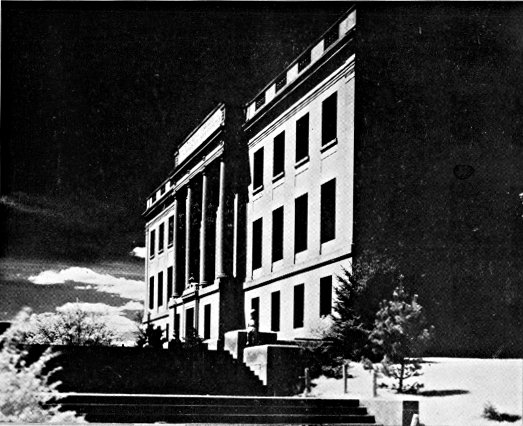
BARNES COUNTY COURTHOUSE, VALLEY CITY
Photo by R. Kenneth McFarland
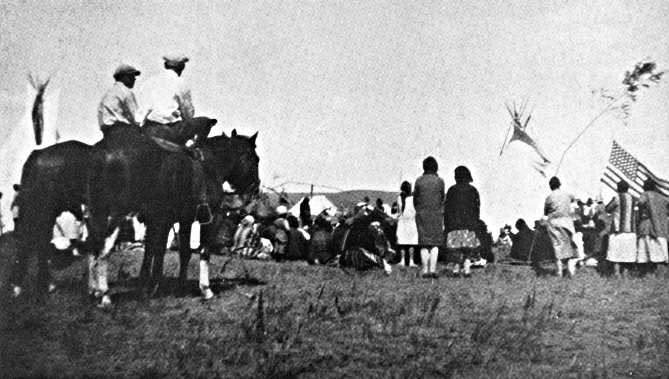
CAMP GATHERING, FORT YATES AGENCY
Photo by Frank Fiske
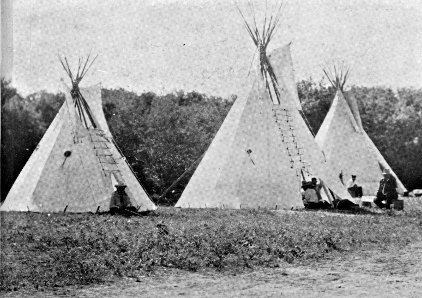
SIOUX TIPIS
Photo by Frank Fiske
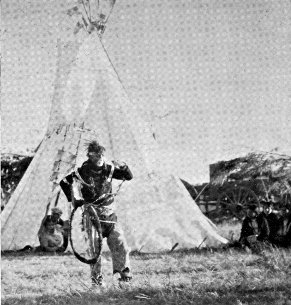
SIOUX HOOP DANCE
Photo by Russell Reid
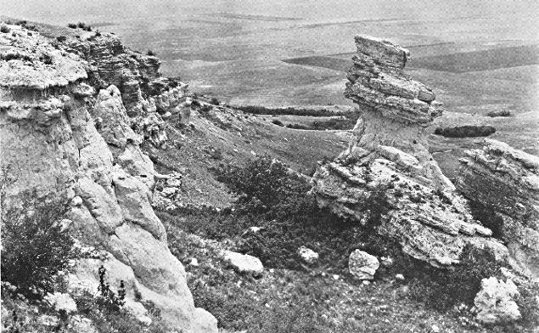
MAGPIE ROCK, KILLDEER MOUNTAINS
Photo by Russell Reid