CITY NEIGHBORS
Reading edition
BISMARCK
Railroad Stations: Northern Pacific, Main Ave. bet. 4th and 5th Sts., for N. P. Ry.; Minneapolis, St. Paul & Sault Ste. Marie, 117 7th St., for Soo Line.
Bus Stations: Union Bus & Truck Terminal, 618 Bdwy., for Northland Greyhound Lines and Interstate Transportation Co.; Grand Pacific Hotel, Bdwy. and 4th St., Mandan-Bismarck, for local intercity line, fare 25c.
Airport: Municipal airport, 2 m. SE. of city on unmarked county road, taxi fare 50c, time 10 min., for Northwest and Hanford Airlines. Day and night service, no public hangars.
Taxis: Fare 25c in first zone and to Capitol; 35c to outlying districts.
City Bus Line: Busses leave Patterson Hotel, Main Ave. at 5th St. and cor. of 4th St. and Bdwy., through residential district to Capitol, fare 10c.
Traffic Regulations: No U-turn on through streets, Main Ave. (US 10) and 6th St. (US 83). Turns in either direction at intersections and vehicle to the right has right-of-way. One-way streets border Custer Park in W. end of city. Street signs show hour parking limits in business district.
Accommodations: 6 hotels; tourist camp adjoining Riverside Park at SW. edge of city, reached by turning L. on US 10 just before reaching Liberty Memorial Bridge.
Information Service: Association of Commerce, 215 6th St. City Hostess maintains office here also.
Theaters and Motion Picture Houses: Bismarck Auditorium, Bdwy. at 6th St., occasional road shows and local productions; 3 motion picture theaters.
Golf: 18-hole course at Country Club on NW. outskirts of city (greens fee 40c, Sat. and Sun. 75c).
Tennis: Country Club and Hughes Field, 316 Ave. D, W.
Swimming: Outdoor municipal pool, 323 W. Bdwy.
Skating: Floodlighted rinks at 7th St. and Ave. D, 4th St. and Ave. F, Hannafin St. and Ave. A.
Hunting and Fishing: Information can be obtained from State Game and Fish Department in the Capitol.
Annual Events: Slope Poultry Show, World War Memorial Bldg., early January; State high school basketball tournament, World War Memorial Bldg., 215 6th St., March, no fixed date; State Art Exhibit, Capitol, mid-May; City Flower show, World War Memorial Bldg., late summer, usually August; State Corn Show, World War Memorial Bldg., last week in October.
BISMARCK (1,670 alt., 11,090 pop.), Burleigh County seat, watched over by its lonely skyscraper statehouse, is the storm center of the State's widely known progressive politics. Ever since it won that honor in Territorial days, its chief claim to fame and most prized possession has been the capitol, which is an integral part of Bismarck, influencing its development and character more than any other single feature. From the very first the capital city showed signs of enterprise that has characterized its growth. Its name was selected with a view to flattering Germany's Iron Chancellor in the hope of bringing German capital to the rescue of the financially stricken Northern Pacific Railway.
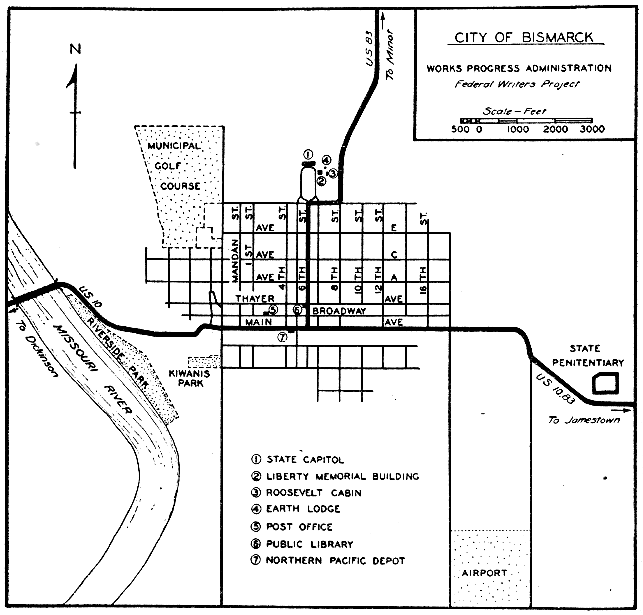
CITY OF BISMARCK
Bismarck is in the south-central portion of the State where the Northern Pacific Railway and US 10 cross the Missouri River. The natural ford here was long known to Indians and buffalo as one of the narrowest and least dangerous crossings on the Missouri. A "pay roll" town because of the State and Federal offices, it is a growing city despite post-boom years; 87 new homes were built during 1936. Modern business buildings constitute the downtown area, and comfortable, new, bungalow-type homes, clean streets, and well-kept lawns can be seen on the hills which not long ago were the home of Indian tribes.
The generous western spirit of the residents seems reflected in the structure of the city. Nothing is crowded. On the east bank of the restless Missouri River the site of the city is hilly, rising to the north. Gullies and small hills in the residential district have been filled in and smoothed off as the city has grown. Along the Missouri near the city cretaceous rocks are exposed. Strata of shale reaching up almost to the summit of the bank are topped with a thin layer of drift. Butte-like hills can be seen in the distance north and east of the city, their flat tops capped with Fox Hills sandstone.
In Bismarck are the headquarters of both of the old-line political parties and the various progressive groups. Hotels are the unofficial headquarters of different parties, especially when the legislature is in session. At such times, although the city is businesslike on the surface, there is an air of expectancy as it awaits new developments in the State's changing political creeds.
Pioneers of the city can still remember the first legislative session in 1889, when the lobbyists for the Louisiana Lottery poured their money into legislators' pockets, and were shadowed and exposed by private detectives hired by a Governor and his friends. Nor forgotten are the machinations of Alexander McKenzie, who represented the railroad interests in all things political, and who in later years exercised his peculiar talents in Alaska to such an extent that Rex Beach accorded him the role of villain in his novel The Spoilers (see below). And even the young citizens recall how four governors succeeded one another in the teakwood gubernatorial office in the course of a little more than six months.
Long before the arrival of the white man, the Mandan Indians found the Bismarck-Mandan area a favorable spot for their homes. Their culture gives this vicinity an interesting archeological background (see Indians and Their Predecessors). Several village sites of the Mandans and Hidatsa are in this vicinity, and a full-sized model of an earth lodge is constructed on the Capitol grounds. Artifacts, including implements of warfare and agriculture, pottery, and beads, were recovered in these sites and are preserved in the museum of the State historical society.
French fur traders, Lewis and Clark, Prince Paul of Wurttemberg, Maximilian, Prince of Wied, and many another early adventurer and explorer passed the site of Bismarck in voyages up the Missouri, but squatters, anticipating the westward path of the Northern Pacific Railway, were the first to settle this vicinity, in the winter of 1871-72. During construction of the railroad a settlement called Burleightown, named for Dr. Walter Burleigh of the Northern Pacific Company, grew up near where Fort Lincoln stands. At the end of the railroad grade on the bank of the Missouri, just opposite Fort McKeen, was a tent-town called Carleton City, later called Point Pleasant, and known to the soldiers of the fort as Whiskey Point.
The site of the city was originally occupied by Camp Greeley, later known as Camp Hancock, a military post established in 1872 for the protection of railroad crews. One of the log buildings of the post is incorporated into the United States Weather Bureau at 101 Main Avenue, the original post site, and is the oldest building in Bismarck.
In 1860 river transportation had begun on the upper Missouri, opening a vast new region to settlement. During this period at least fifty cargoes were being discharged yearly at Fort Benton in Montana, while it required a fleet of some thirty or more vessels to transport troops and carry supplies to the various posts, forts, and Indian agencies in the Missouri basin. The "Crossing on the Missouri" became a stirring steamboat port, attracting many rivermen and wood choppers. The latter served an industry of extensive proportions, since wood supplied all fuel needs for boats on the river and for the military posts and agencies.
The flooding of the flats near Burleightown each spring threatened danger for the railroad grade, however, and this is thought to have been the ostensible reason for changing the route in 1873; actually, the change was probably made to keep land grabbers from obtaining control of the point at which the road would cross the river. A new grade was built about one mile north, running past Camp Greeley. The Lake Superior and Puget Sound Company, a town site location company auxiliary to the Northern Pacific, was then able to locate another city site which was named Edwinton for Edwin F. Johnson, Northern Pacific chief engineer, but was generally known as "The Crossing." When the Burleightown grade was left unused the town was abandoned and the inhabitants moved to Edwinton. In 1873 the name Bismarck was chosen, but the first title of the town persisted. When Mrs. Linda Slaughter became postmistress in 1874 she found it necessary to point out to the Post Office Department in Washington that mail should be addressed to "Bismarck, D. T." rather than to "The Crossing, Northern Pacific Railroad on the Missouri River, D. T."
Rails were laid into Bismarck on June 4, 1873, and it remained the terminus of the Northern Pacific until 1879. With the coming of the railroad the town became the head of navigation on the Missouri. When river traffic closed in the fall because of low water, no attempt was made to operate the Northern Pacific west of Fargo until the following spring, as the company did not have snow-fighting equipment with which to keep the road open during the winter months. Merchants had to stock up in the fall with enough goods to last until spring. Mail came once a week via a Government carrier from Fargo to Fort Abraham Lincoln. Enterprising persons sometimes came from Minnesota with loads of dressed poultry and hogs for Thanksgiving and Christmas. The trip from Fargo to Bismarck took about six days by wagon.
In early days the young town combined the advantages of a river steamboat port and a western railway terminus. A frontier town, the life of its residents was necessarily rugged. A story is told of the young son of a newspaper editor, who questioned a stranger about his family and learned that the father of the visiting gentleman had died. The youngster, familiar with the columns of his own father's paper, said, "Got shot, did he?" The stranger replied that he had not. "Drank too much whiskey?" Again the visitor replied in the negative. "Well, he can't be dead then," the boy triumphantly exclaimed, "'cause that's the only way men die in Bismarck!" There were always the few, however, who made an effort to preserve the social graces. At the first party given in Bismarck, honoring Dr. and Mrs. Slaughter on their fourth wedding anniversary, dancing was part of the entertainment, and the evening ended with refreshments of champagne and buffalo tongue sandwiches.
The first train arrived in Bismarck June 5, 1873. Part of its cargo consisted of printing presses for the Bismarck Tribune, which was first issued July 11, 1873, and continues publication as North Dakota's oldest newspaper. The Tribune's greatest scoop was scored in 1876 when it gave the world the story of the Custer massacre at the Little Big Horn in Montana. Mark Kellogg, reporter for the Tribune and New York Herald, was killed in the battle, but more than a column of notes on the battle was found in a buckskin pouch on his body. When Grant Marsh's steamer Far West brought Reno's wounded and the first news of the disaster, Col. C. A. Lounsberry, founder-editor of the Tribune, obtained the story, wiring it to the Herald at a reputed cost of $3,000 for 24 hours use of the telegraph wires.
Bismarck felt the loss of Custer's command keenly, for he and his Seventh Cavalry officers from Fort Abraham Lincoln had figured prominently in the social life of the city.
The Bismarck Sun, another early newspaper, had a prominent part in the exposure of Indian and military post corruption which led to the impeachment of Secretary of War William W. Belknap in 1876. James A. Emmons, publisher of the paper, issued a handbill entitled Pirates of the Missouri which alleged that appointments as traders at military and Indian posts were being bought from the Secretary of War. The New York Herald sent out a reporter, who obtained a position at Fort Berthold Indian Agency, incognito, and succeeded in exposing the dishonesty prevalent at almost all of the Missouri River posts. The reporter barely escaped with his life when his identity was discovered; but he returned the next year and succeeded in completing his investigation. Belknap was impeached on a charge of bribery, and resigned, but was later acquitted. The episode caused a great furore throughout the country, but particularly in Bismarck.
Gold was discovered in the Black Hills in 1874, and Bismarck experienced its first boom. A regular stagecoach and freight line was maintained to Deadwood, S. Dak. It was more than 200 air line miles cross country, with no towns between. Stations were established every 20 miles and all freight was hauled into the Black Hills by wagon, 10 or 12 yoke of "wild Montana cattle" being used to pull trains of two or three wagonloads of freight. Gold seekers flocked to Bismarck, where they outfitted their supply trains before departing for the gold fields. The Bismarck Tribune of October 25, 1879, reported:
"There are no rooms available at the hotels in Bismarck tonight as there are many transients in town bound for the Hills. Our freight and passenger business to the gold fields has been very heavy during the past ten days, amounting to 300,000 pounds of freight and seventy passengers. There were also two carloads of horses shipped in for the stage coaches. There are at present two and sometimes three stages a day."
Gold dust and nuggets brought $20 an ounce in trade in Bismarck. Many who came to join in the gold rush stayed to take advantage of the business opportunities.
The year 1881 saw a serious flood of the Missouri River. Most Bismarck residents, with their homes up on the hills out of the river's reach, made light of the occasion, some even to the extent of an excursion. Capt. William Braithwaite ran his steamer Eclipse to the foot of Third Street where passengers boarded for a trip to nearby Mandan, the greater part of which, like the five miles of river bottom land between the two towns, was under water. It is reported that everyone on the boat "danced and had a good time." Not so pleasant, however, were the experiences of those who lived in the lowlands. The flood came upon them suddenly, drowning their horses and cattle, inundating their homes, and forcing many to climb trees. Perched above the muddy, swirling waters and floating cakes of ice, several of these unfortunates froze their hands and feet or otherwise suffered from exposure. Wildlife also suffered because of the flood, and deer and other game could be seen floating down the river on cakes of ice.
The Northern Pacific railroad bridge across the Missouri was completed in 1882. Previous to this time the trains had crossed the river on barges in the summer and on tracks laid on the ice in winter.
When the Territorial capital was removed from Yankton, S. Dak., to Bismarck in 1883 the city experienced a second boom. Land prices skyrocketed, and blocks of lots often changed hands several times in an incredibly short period, since it was fondly, if erroneously, anticipated that Bismarck would have a phenomenal growth and would soon outrank many well-established and populous cities. The cornerstone of the capitol building was laid that year at an elaborate ceremony attended by members of the Golden Spike Excursion who were on their way west to celebrate the completion of the Northern Pacific Railway. Headed by ex-President Grant and Henry Villard, president of the Northern Pacific, there was present a galaxy of prominent Americans including Sitting Bull and numerous foreign dignitaries and noblemen. These notable guests spent some time in Bismarck and every effort was exerted to make their stay eventful. One young woman went so far as to painstakingly decorate her apple tree with three bushels of apples purchased at a local grocery store. Showing it to her admiring guests the next day she asked, "What do you think of this for a fruit-growing country?" "Magnificent, magnificent!" Grant replied, "I am surprised, wonderfully surprised!" So were townsmen standing nearby, but they held their tongues.
Since these early booms the growth of the city has not been remarkable, but it has been steady. A large factor in the prosperity of Bismarck has been the numerous Federal and State institutions and offices.
Bismarck's first church service was held on June 15, 1873, although Mrs. Linda W. Slaughter organized a Sunday school in a Camp Hancock tent as early as August of the previous year. The first church in the city was the Presbyterian, at 303 Second Street. When the Catholic church was built in 1898 the Marquise de Mores gave a large stained glass window in honor of her late husband. The window, portraying the Immaculate Conception, bears his name and is in the front of the church in the choir loft. Fourteen religious denominations are represented in Bismarck.
Two hospitals and several clinics serve both the urban population and a large rural area. Radio station KFYR, with studios at 200 Fourth Street, is an associate member of the National Broadcasting Company and operates on 5,000-watt power during the day and 1,000 at night. Four newspapers in addition to the Tribune are published in Bismarck: Two semi-weeklies, the Bismarck Capital and Der Staats Anzeiger (German); and two weeklies, the Leader, organ of the Nonpartisan League, and the Dakota Freie Presse (German). Bismarck and its surrounding territory have a large German and Russo-German population.
The city was the home of James W. Foley, North Dakota poet, during his school days, and later he was a member of the Bismarck Tribune staff. His numerous books include Prairie Breezes and Voices of Song.
Although Bismarck is in the heart of the spring wheat region, where four times more acres are planted in wheat than any other crop, the city's industrial life is subordinate to its political. Commercially it is a wholesale distributing point for many State or district offices of various lines of merchandise. In addition there are flour mills, creameries, grain elevators, and seed-houses. A pioneer seed-house and nursery, the Oscar H. Will Company, founded in Bismarck in 1881, is the largest concern of its kind in the State. Specializing in seed corn, in which it followed the example of the agricultural Mandan Indians, the company has propagated many new, and acclimated several established, varieties of plants, grain, and nursery stock that are exceptionally hardy, drought resisting, and quick maturing. North of Bismarck are extensive lignite coal deposits, with one of the largest strip mines in the State in north Burleigh County, near Wilton.
In 1903 several thousand farmers of German extraction migrated from Wisconsin to settle the farm lands in the Bismarck territory. They have made the city a shipping point for a constantly increasing dairy, wool, honey, and corn output. The drought conditions of the 1930's have cut into agricultural production, but have intensified recognition of the need for diversified farming, which is more widely practiced each year.
One of the most notable events of recent years was the burning of the old capitol in December 1930. The year following there was talk of capital removal, the most serious contender being the city of Jamestown, 100 miles to the east. In the election of 1932, however, popular vote decided in favor of retaining the site at Bismarck, and on October 8 that year Vice President Charles M. Curtis laid the cornerstone of the new statehouse.
POINTS OF INTEREST
1. The 19 stories of the STATE CAPITOL (open weekdays 9-5; guide), N. end of 6th St., high on Capitol Hill, overlook the city and the broad Missouri valley. The white shaft is an impressive sight even to those who quarrel with the idea of a skyscraper capitol for a prairie State. Designed in 1932 by two North Dakota architects, Joseph Bell de Remer of Grand Forks and William F. Kurke of Fargo, with Holabird and Root of Chicago as associates, its clean hard modern lines are exponent of the fact that, as the architect F. A. Gutheim has said, "Domed pseudo-Renaissance state capitols are sinking low on the Western horizon." North Dakota has followed the example of Nebraska and Louisiana in building what may be a forerunner of a new and distinctive style of State capitols.
The possibility of architectural developments from this building does not, however, deter critics who find it difficult to reconcile the skyscraper with the prairies. The customary objection is that those conditions which are the raison d'etre of the skyscraper—high land values and congestion at transportation centers—are decidedly absent in Bismarck. The justification of the building, therefore, must lie in its expression of the dignity and power of the State government.
Despite criticism, the Capitol has its defenders, who feel the strength and height of the structure to be expressive of its intent. And no matter what the decision may be on the architectural problem, the building at any rate fulfills its utilitarian function: it is one of the most efficiently built government buildings in the country. It provides space for approximately one thousand State and Federal employees. The asymmetrical tower arrangement allows complete separation of the executive and legislative branches of the State, and despite differences of opinion as to the exterior of the building, opinion is general that the interior is both remarkable and beautiful.
The building houses State administrative offices in the tower and the State legislature in the circular three-story wing. The two sections of the structure are joined by Memorial Hall. The outer walls of the entire building are faced with Bedford limestone, and the base is trimmed with a broad ribbon of Rosetta black granite (gabbro), a relatively rare stone of volcanic origin.
A sweeping flight of steps leads to the plaza, above which rise the huge bronze-framed windows of Memorial Hall, topped with symbolic bronze figures representing the Indian, Hunter, Trapper, Farmer, Miner, and the Mothers of the State. These figures, as well as others in the interior of the building, are the work of Edgar Miller of Chicago.
The building can be entered from the plaza or on the ground floor through the porte-cochère. The ground floor corridor is wainscoted in rosy-tan Montana travertine. In the lobby is the custodian's desk where visitors register. From this point tours of the building leave hourly. To the right is the elevator lobby, where the sliding bronze elevator doors depict the Indian, the Hunter, the Cowhand, and other figures symbolic of the development of the State. At the end of the elevator lobby is the capitol café.
Steps ascending from the ground floor in a stairwell of highly polished black Belgian marble lead directly into Memorial Hall, which, although 342 ft. long, 25 ft. wide, and 42 ft. high, appears even more spacious with its 10 tall fluted bronze columns lining either side and catching the sunlight which floods through the tall windows of the facade. The walls are of polished Montana travertine and the floors of gray-white Tennessee marble. From the windows in the facade there is a beautiful view of the city, the winding Missouri, and the hazy blue bluffs beyond.
The legislative foyer, a continuation of Memorial Hall into the three-story wing, is paneled in rosewood and curly maple. Inlaid canopies project over upholstered wall seats. Both the House of Representatives (L) and the Senate Chamber (R) are semicircular in design. Paneling of matched chestnut adorns the walls of the House, and the floor and ceiling are blue. An indirect lighting and ventilation system is concealed in the coves of the ceiling. The Senate Chamber, somewhat smaller than the House, has been judged one of the most beautiful rooms in the United States. It is paneled in a rich brown English oak with bronze cross stripes covering the joinings. The ceiling and floor are brown and the chairs are upholstered in cream-colored leather.
At the end of Memorial Hall opposite the legislative foyer are the offices of the governor, attorney general, and secretary of state. In the governor's suite the reception room is paneled in laurelwood, the private office of the governor in teakwood, the corridor in prima vera, and the conference room in mahogany.
The second floor of the tower is occupied by the supreme court. The dignified courtroom is paneled in rosewood, the judges' conference room is finished in walnut, and Honduras mahogany is used in the office of the chief justice. The supreme court law library of 50,000 volumes occupies two large rooms. A fine view of Memorial Hall can be obtained from the supreme court elevator lobby, which faces directly on the hall.
Above the second floor of the tower are other State offices. The eighteenth floor is designed as an observation tower, which affords a panoramic view of the entire Bismarck-Mandan vicinity, taking in Fort Abraham Lincoln State Park, Fort Lincoln, the State Penitentiary, the curving river with its wooded lowlands, the gray-blue bluffs beyond, and, all around, the rolling prairie.
2. LIBERTY MEMORIAL BUILDING (open weekdays 9-5), SE. of the Capitol, a memorial to World War dead, designed in 1921 by Keith and Kurke of Fargo, houses the North Dakota State Library Commission, State Historical Society of North Dakota, and its museum and library. A four-story structure of Classic design, with a base of Minnesota granite and walls of Bedford limestone, its Ionic columns rise gracefully above the grass-covered terrace.
The massive bronze doors of the west facade lead into a corridor paneled in Italian travertine with a trim of Kasota stone. The graceful double stairway which rises across the corridor has marble balustrades and travertine newel posts.
Left of the stairway is the historical society library exhibit room, and right is the State library commission which has general supervision of all public libraries in the State.
On the ground floor are the main offices of the State historical society library. The offices of the historical society are on the second floor. This society was founded in 1887, became a State department in 1905, and in addition to its work in collecting and preserving historical material has been especially active in building up the 46 State parks and historical sites.
The Historical Society Museum, on the second and third floors of the Memorial Building, contains excellent collections of North Dakota material. The Indian collection gives a complete picture of the life of the North Dakota Indian, showing examples of clothing, cooking utensils, pottery, knives, drums, saddles, war clubs, bows and arrows, canoe, and bullboat. It also includes many archeological finds made in the State.
In the pioneer rooms are relics of early days of white settlement of the State. A military collection shows many types of guns and cannon in use since settlement. The natural history rooms contain fine displays of flora and fauna, fossils and minerals.
An equestrian statue of Theodore Roosevelt, the plaster model by A. Phimister Proctor for the statue in Roosevelt Park in Minot (see Minot), is on the third floor, and nearby is the desk which Roosevelt used for most of his writing at his Badlands ranch. Many models of early forts, Indian villages, and river steamboats are on display.
A bronze Statue of Sakakawea stands on the lawn between the statehouse and the Liberty Memorial Building. Sakakawea was the Shoshone Bird Woman who led the Lewis and Clark expedition through the unexplored mountainous Northwest to the Pacific Ocean. The statue, by Leonard Crunelle (1910), depicts the Indian woman with her baby strapped to her back, looking westward toward the country she helped to open.
Unsung during her lifetime, Sakakawea in recent years has been recognized as the outstanding woman in the development of the Northwest. Carrying her new-born son, Baptiste, she joined the expedition at the Mandan village near the present site of Stanton, N. Dak. She accompanied the party with her husband, Touissant Charbonneau, who had been engaged as an interpreter. Soon she proved to be the most valuable member of the party. Her services were those of guide, cook, and general emissary to the Indian tribes encountered on the journey. Lewis and Clark credited her with the success of their expedition.
On the return of the exploring party Sakakawea, Baptiste, and Charbonneau were left at the Mandan village where they had joined the expedition more than a year earlier. Mystery and controversy obscure the lives of the Indian woman and her son from this point. Sakakawea is believed by some to have died on the Shoshone Reservation at Wind River, Wyo., when almost 100 years of age. Others hold that she died at Fort Manuel on the Grand River in South Dakota only a few years after the return of the Lewis and Clark expedition. Painstaking investigation has definitely proved neither theory.
Of Baptiste it is known that he was educated by Capt. William Clark at St. Louis. Returning to the Northwest, he became an interpreter like his father, and met Paul Wilhelm, Prince of Wurttemberg, who was exploring North America. With the German nobleman he went to Europe, but on his return his path is lost to the historian. He may have been with his mother on the Wind River Reservation—if, indeed, she died there.
The Prow of the Battleship North Dakota, mounted on a boulder of native granite, stands N. of the Memorial Building, near the statue of Sakakawea. To the south of the building stands a large Krupp gun, assigned to the State by the Federal Government as a trophy of the World War. Near these guns lie specimens of Cannonball River sandstone formations.
3. ROOSEVELT CABIN (open June 15-Sept. 15, weekdays 10-5, Sun. 2-5), E. of Memorial Building, was the home of Theodore Roosevelt from 1883 to 1885, when he was a rancher in the North Dakota Badlands. Known as the Maltese Cross because of its cattle brand, the ranch was renamed by Roosevelt for nearby Chimney Butte.
The cabin originally had a much steeper, shingle roof, but a later owner replaced this with a sod one, hoping to make the building warmer. The interior furnishings are copies of those used by "Teddy," although the cook stove is thought to be the original. Much Rooseveltiana, including books and guns, is preserved in the cabin.
In 1904 the Chimney Butte cabin was purchased by the North Dakota Commission, and sent to the St. Louis World's Fair of that year, to Portland, Ore., for the Lewis and Clark Centennial Exposition in 1905, and then to Bismarck where it was placed on the grounds in front of the Capitol, and after a few years was moved to its present site. An iron gate, handwrought by Haile Chisholm of the North Dakota Agricultural College faculty, depicts the initial letters of the various fields of enterprise in which Roosevelt engaged.
4. EARTH LODGE (open weekdays 9-5 June 15-Oct. 1), N. of the Roosevelt Cabin, is a reproduction of the dwellings of the Mandan, Arikara, and Hidatsa, the agricultural tribes who inhabited the valley of the Missouri previous to white settlement of this region. (For description of the earth lodge see Indians and Their Predecessors.) The lodge was built by the State historical society under the direction of Scattered Corn, a Mandan woman, the daughter of Moves Slowly, last of the Mandan Corn priests.
The women of the Indian tribes built the lodges in the river villages, although the men gave them assistance in placing the heavy timbers which supported the thick earth walls. A Mandan legend relates that when the first Mandan village was built under the leadership of the tribal hero, Good Furred Robe, the First Man told them how to build the earth lodges.
5. GOVERNOR'S MANSION (private), 320 Ave. B, has been the residence of North Dakota Governors since 1893, when the house was purchased by the State from Asa Fisher, wealthy brewer. Governor Eli C. D. Shortridge was the first chief executive to occupy the mansion. Typical of the architecture of the Territorial day in which it was built, the two-story white frame building, with its spacious, high-ceilinged rooms and four fireplaces, has remained unchanged except for the addition of a front porch. The large elm and box elder trees were planted in 1900. During early statehood many important social functions were held in the mansion.
6. CAIRN (private), 912 Mandan St., home of Mr. and Mrs. Clell G. Gannon, is a small house built largely of native boulders, and designed by its owners.
7. HOME OF ALEXANDER McKENZIE (private), 722 5th St., a large white frame house built in the indeterminate, unpedigreed style typical of North Dakota's architecture of the nineties, remains unchanged from the days when it was the home of Alexander McKenzie (1856-1922), spectacular figure of early Bismarck and State history, master politician, ally of the railroads.
Arriving in Bismarck as a young man in the early 1870's, he soon rose to a position of civic and Territorial importance, becoming an unofficial representative of the Northern Pacific Railway. How much McKenzie had to do with moving the Territorial capital from Yankton to Bismarck will perhaps never be known. However, the fact that a Capital Commission was named and given power to move the capital, and the fact that McKenzie secured for himself a place on the commission, are credited to him as among his most able political maneuvers.
Although he held only one public office—sheriff of Burleigh County for 12 years—his influence and the so-called "McKenzie ring" survived all attacks by political reformers. He was active in State politics until his death in 1922.
8. BURLEIGH COUNTY COURTHOUSE, Thayer Ave. between 5th and 6th Sts., is a three-story modern-type building designed by Ira Rush of Minot and constructed of North Dakota concrete-brick faced with Bedford limestone, with a base of pearl pink granite. In the main floor vestibule, wainscoted in marble, is a series of murals by Clell. G. Gannon, Bismarck artist, depicting early county history. A further native note appears in the balustrading of the stairways, where grilled nickel silver forms a graceful design using the stalk, ear, and slender leaf of the corn as motif.
This is the third Burleigh County courthouse to stand on this block. A marker on the west lawn designates the site of the first, a log building built in 1873. It was replaced in 1880 by a brick structure. The present building was erected in 1930.
9. BISMARCK PUBLIC LIBRARY (open weekdays 10:30-9; Oct.-May Sun. 2-5), 519 Thayer Ave., a Carnegie institution, is a vine-covered, red brick Georgian Colonial style building. In addition to having a large and varied selection of magazines, newspapers, and fiction and non-fiction books, it maintains a separate children's division with loan service, reading room, and story hour.
10. FEDERAL BUILDING, NE. corner Bdwy. and 3rd St., a tile-roofed Indiana limestone building of Italian design, houses the post office, United States courtroom, and various Federal offices.
11. MARQUIS DE MORES' STORAGE PLANT, 300 Main St., is a plain, somewhat shabby building used as a restaurant, built by the marquis when he envisaged a huge meat packing industry in the Badlands (see Tour 8). The building was formerly situated south of the railroad. The walls consist of two-inch planks laid flat on each other. These, together with the brick veneer, form a wall about 14 inches thick.
12. UNITED STATES WEATHER BUREAU (open), 101 Main St., was begun as part of the work of Camp Hancock in 1874, and a portion of the structure, the old log building which was Camp Hancock headquarters, remains. It is the oldest building in Bismarck, but has been sheathed in lumber, and additions have been built. The bureau, moved 11 times, is now permanently established at its first home.
13. WORLD WAR MEMORIAL BUILDING, 215 6th St., which serves as a community center, is a three-story structure of modern design, built of white Hebron (N. Dak.) brick and concrete with limestone trim. It was designed by Liebenberg and Kaplan of Minneapolis in 1930.
14. BANK OF NORTH DAKOTA (open weekdays 8:30-4:30), 700 Main St., was created by a special referendum election of June 26, 1919, passing a law providing that "For the purpose of encouraging and promoting agriculture, commerce and industry, the State of North Dakota shall engage in the business of banking, and for that purpose shall and does establish a system of banking, owned, controlled and operated by it, under the name of the Bank of North Dakota." It is managed and controlled by the State Industrial Commission. State funds, and funds of State institutions are deposited here. The bank was one of the important features in the program of the Nonpartisan League at the time of its organization, being designed to carry out the fourth plank of the league platform, the establishment of rural credit banks operated at cost. The red brick bank building was originally an automobile warehouse.
State Regulatory Department Laboratory (open), is on the fourth floor of the Bank of North Dakota Building. North Dakota was a pioneer State in pure food legislation. A law passed in 1895 paved the way for the pure food and fertilizer laws of 1903. State inspectors, active at all times throughout the State, send samples for analysis to this laboratory, where trained chemists make the tests. Constant inspection of food and dairy products, feeds, fertilizers, water, oils, and paints is maintained.
15. ST. MARY'S CEMETERY, NE. edge of the city, contains the graves of many of the pioneers who played an important part in the development of the city and State. Among those buried here are Alexander McKenzie and his son, Alexander, Jr.; and Gen. E. A. Williams, first representative from Burleigh County to the Territorial Assembly, and his wife.
POINTS OF INTEREST IN ENVIRONS
State Penitentiary, 2 m., Fort Lincoln, 4.5 m., Sibley Island, 7 m., Liberty Memorial Bridge, 1.5 m. (see Tour 8). Fort Abraham Lincoln State Park, 9.5 m. (see Fort Abraham Lincoln State Park). Pioneer Park, 2 m. (see Side Tour 3B).
FARGO
Railroad Stations: Northern Pacific, Bdwy. at Front St.; Great Northern, Bdwy. at 5th Ave. N.; Chicago, Milwaukee and St. Paul (Milwaukee), 1101 2nd Ave. N.
Bus Stations: Union Station, 502 N. P. Ave., for Northland Greyhound, Checker, Jack Rabbit, and Triangle Lines; Cole Hotel, 407½ N. P. Ave., for Liederbach Line.
Airport: Hector Field, NW. outskirts of city, ½ m. W. of US 81, Northwest Airlines, taxi fare 50c, time 10 min.; day and night service, public hangars.
Taxis: 25c anywhere in city, 10c for each additional passenger.
City Bus Line: Intra-city, fare 10c.
Traffic Regulations: Front St. and 1st Ave. N. (US 10), 13th St. (US 81), 10th, and 4th Sts. are through streets. Watch for stop signs and street signals; no U-turn on through streets; turns in either direction at intersections. Street signs designate hour parking limits in business district.
Accommodations: 30 hotels; Fargo municipal tourist camp, Lindenwood Park, marked road ¾ m. S. of city limits, from S. end of 5th St.
Tourist Information Service: Greater North Dakota Association, 13 Bdwy.; Chamber of Commerce, 504 1st Ave. N.
Theaters and Motion Picture Houses: Little Country Theater, agricultural college, 13th St. at 12th Ave. N., college productions; Festival Hall, agricultural college, occasional touring artists and stock companies; 6 motion picture houses.
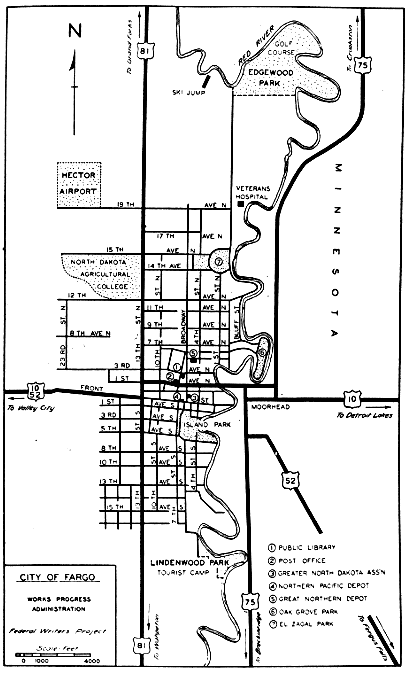
CITY OF FARGO
Golf: Municipal 18-hole course, Edgewood Park, 3 m. NE. of city limits (greens fee 35c).
Tennis: Courts at Oak Grove Park, E. end of 6th and 7th Aves. N.; Island Park, S. end of Bdwy.
Swimming: Outdoor, Red River bordering Island Park at E. end of 1st Ave. S.; indoor, Central High School, 3rd Ave. S. bet. 10th and 11th Sts., open during summer; Y. M. C. A., 632 1st Ave. N.
Baseball: Barnett Field, Fairgrounds, 19th Ave. N. and Bdwy., Northern League.
Skating: Island Park; Pershing Park, 14th St. at 8th Ave. N.
Skiing: Dovre Ski Club, highest artificial jump in United States (1936), 1½ m. N. of 19th Ave. on N. Bdwy. Rd.
Tobogganing: Island Park.
Hockey: Island Park, Commercial League and high school teams.
Annual Events: Ice Carnival, Island Park, January 1; Farmers' and Homemakers' Week, agricultural college, 3rd week in January; Bison Brevities, agricultural college, March, no fixed date; May Festival, agricultural college, 1st week in May; Northwest Norwegian Whist Tournament in connection with Norwegian Independence Day, May 17; Lilac Festival, agricultural college, May, no fixed date; State Fair, Fairgrounds, Bdwy. at 17th Ave. N., June, no fixed date; Valleyland Music Festival, June, no fixed date; State Golf Tournament, Fargo Country Club, July, no fixed date; Harvest Festival and Homecoming, agricultural college, October, no fixed date; 4-H Club Boys' and Girls' Achievement Institute, agricultural college, December, no fixed date.
FARGO (907 alt., 28,619 pop.) is on the Red River of the North at the entrance of two transcontinental railroads into the State. A small, youthful city, whose varied activities give its business section a somewhat disorderly air, it is the largest town in North Dakota. Over the flatness of an old lakebed, where ten thousand years ago the water of the melting glacier stood 200 feet deep, the city now widely spreads its homes, manufacturing plants, wholesale houses, trees and parks, schools and hospitals.
The trail which in 1871 led west from the Red River ferry, across the level floor of prehistoric Lake Agassiz, is now Front Street, which enters Fargo from the east to be greeted by the city's slum district, where dilapidated, unpainted frame shacks near the river give way westward to better buildings in a wholesaling district, until Broadway is reached. Broadway is the very heart of Fargo, a busy, crowded thoroughfare whose appearance often causes visitors to believe the city larger than it actually is. From its wide south end where it intersects Front, Broadway runs north, flanked for six blocks by two-and three-story store and office buildings. Two of North Dakota's four "skyscrapers" are on Broadway.
Fargo first appeared on the horizon in the 1870's as an outfitting point, the last outpost of settlement for those tens of thousands who pioneered in the State, and through the years of its growth has retained its first excuse for being, for it still serves as chief distributing point for a large agricultural area. Farm implements, foodstuffs, petroleum products, automobiles, and automotive equipment to the value of more than $45,000,000 are handled annually.
Although from a North Dakota standpoint it is an old city, Fargo is young enough to have a few of its founders still alive to tell of how they first advertised their spindly little city by boasting that its volunteer fire company, the Yerxa Hose Team, was the world's fastest; or of how, in later years, Fargo gloried in being the "Gateway City" to the "bread basket of the world," the fertile Red River Valley which real estate agents compared to the valley of the Nile. The Valley is no longer the intensive wheat-raising area it was, but the Fargo Chamber of Commerce will tell you that this very fertile flat land, through which meanders one of the few rivers that flow north, is literally a land of milk and honey, and others no less cognizant of their surroundings have changed the old slogan to the "food basket of the world."
Because it is the distributing point for an agricultural State, changes in farming methods have been reflected in the business life of the city. With the introduction of diversified farming to supplement wheat growing, Fargo became an important shipping center for grain, potatoes, dairy, and poultry products. In 1936 it was the largest primary sweet clover market in the world. Seed companies, creameries, a flour mill, bakeries, and implement distributors are evidence of the relationship between the city and the large farming area it serves. As late as 1927 Fargo was the world's third largest farm machinery distributing point, and, although it undoubtedly does not retain this position, as a shipping point it has become even more significant. A change in freight rates granted in 1925 by the Interstate Commerce Commission boosted Fargo volume. Two of the three railroads into the city are transcontinental lines which, with their branches, cover almost the entire State of North Dakota. Several "feeder lines" converge at Fargo and in addition there are a large number of trucking companies. The Minneapolis Star said in 1936:
"Fargo stands in exactly the same relationship to the northwest that Minneapolis has always stood.... The significant point is that it is some 250 miles nearer the western point of consumption. Goods that used to stop at Minneapolis for distribution now flow on to Fargo to be piecemealed out."
The largest single part of the wholesale trade is carried on by automotive distributors, including the Ford and Chevrolet Motor Companies. Processing accounts for the next largest part of the city's industry, and, although meat packing and creameries are important, there is a constant increase in the manufacture of steel, wood, and glass products. Fargo is likewise a banking and insurance center, and has the home offices of two insurance companies.
Its situation, at the point where railroads first entered the State, in what Stuart Chase has characterized as perhaps the richest farming region in the world, has combined with the North Dakota Agricultural College to make Fargo the natural agricultural headquarters for North Dakota. Results of experimental work conducted at the college station and its substations, extension work through 4-H and Homemakers clubs, and judging of farm produce at State and county fairs by college instructors, all contribute to the improvement of agricultural and rural life in the State.
Fargo's percentage of home ownership is far above the national average. Homes clustered around the business district are of early twentieth century frame vintage, while farther out newer cottages and bungalows, in English and Colonial style, behind small young trees and newly sprouting lawns, are characteristic of the more recent residential additions. Some of Fargo's finest homes are on Eighth Street South.
Fargo's public school system consists of 11 elementary schools, 3 junior high schools, and a senior high school; privately owned are 3 Catholic schools, a Lutheran school, 3 business colleges, 2 music conservatories, and 5 trade schools. The first Protestant church services in the southern Red River Valley in North Dakota were held in Fargo, and now more than 30 denominations have churches in the city. St. Mary's Cathedral is the seat of the diocese of the Roman Catholic Church for the eastern half of North Dakota, and Fargo is likewise the seat of the North Dakota diocese of the Episcopal Church.
The city's best-known musical group, the Amphion Male Chorus, composed of Fargo and Moorhead, Minn., singers, has toured nearby cities and eastern United States, giving concerts in New York and Philadelphia. Community singing is popular in Fargo, and during the summer months Island Park is the scene of outdoor concerts and singing contests. In June each year the music-minded of the Red River Valley gather in the city for the Valleyland Music Festival.
The agricultural college, always prominent in the cultural life of the city, has become even more important in late years with the increased number of college lyceum programs and the growth of the community theater movement. The Little Country Theater, the outstanding players' group in the State, has become a virtual authority on community theater organization and has received favorable notice nationally.
The city is named for William G. Fargo, a director of the Northern Pacific Railway and founder of the Wells-Fargo Express Company, and its early history is closely linked with that of the railroad. In 1871 the announcement that a railroad would be built "from Lake Superior to the Pacific Ocean" aroused much speculation as to where it would cross the Red River, and the untouched land along the river suddenly became populated. Three settlers, Jacob Lowell, Jr., Henry S. Back, and Andrew McHench, formed a triumvirate and patrolled the Red from the mouth of the Wild Rice to the Elm River from April to June 29 in an effort to discover "the first indications of the railroad crossing."
Meanwhile, Thomas H. Canfield of the Lake Superior and Puget Sound Company, a town site company auxiliary to the Northern Pacific, worked with the railroad engineers in seeking the best point for the line to cross the Red, since he wished to secure title to the land for his company before it was snatched up by some speculator in the hope of selling it to the railroad for a large sum. He and his engineers chose the present crossing because it was the highest point on the river and therefore in the least danger from floods. Andrew Holes, who with his wife had been touring the country in a covered wagon, was sent to Alexandria, Minn., to purchase the land on the east side of the river from its homesteader-owner, Joab Smith. In order to locate on the lands west of the Red it was necessary to plow a half acre of each section. Aided by Maj. G. G. Beardsley, Canfield secured the necessary farm equipment, hid it until Holes returned with the deed to the Minnesota property, and by moonlight secretly made the required improvements.
On June 29, while on his patrol, Lowell found a "Farmer Brown" squatted with three Scandinavian settlers on what became the Fargo town site. Although Farmer Brown was clothed in well worn overalls with a brown hat and hickory shirt and "sat with such ease and unconcern upon the handles of his plow," Lowell doubted his being a farmer. He hastily summoned Back and McHench, and the three, after a consultation, located near Farmer Brown on July 1 and 2, 1871. Shortly afterwards Farmer Brown's identity as Beardsley became known and a stampede of settlers followed. Since Beardsley and his party were in the employ of the Lake Superior and Puget Sound Company, and were not bona fide settlers, their prior occupancy was disregarded and later, after much litigation, the company withdrew its claim to the Fargo land, retaining only the purchased Moorhead area.
In September 1871 G. J. Keeney was appointed postmaster of Centralia, the little settlement that sprang up at the railroad crossing. Keeney was also a lawyer and real estate agent and his office was somewhat of a community center, according to one author, who wrote,
"He placed over the door of his 10 × 12 office the sign 'Post Office', on the door the sign 'Law Office', and in the window 'Land Office.' He raised lettuce on the earth roof of his log shack, and decorated the inside walls with papers sent by the folks back home. On entering, one was at once impressed with the air of cleanliness and comfort which pervaded the sanctum of this enterprising limb of the law, and it became a popular reading and rest room, but ... one assumed a risk in becoming interested in a story as some chapter of it was certain to be found on the ceiling."
During the winter following the location of the site, the settlement divided into two communities. "Fargo on the Prairie", headquarters of the Northern Pacific engineering department (near the corner of Broadway and Front Streets), was a tent town, home of the railroad engineers and surveyors and their wives and children. Although crude, the tents of "Fargo on the Prairie" had all the luxuries and conveniences that money could bring into the frontier settlement. In sharp contrast to this was "Fargo in the Timber," a town of huts, rough log houses, dugouts, and caves dug in the river banks, which stretched along both sides of the trail leading up from the ferry crossing. The two communities had nothing in common and residents of one would never be mistaken for residents of the other. The Timber used great quantities of whiskey, and popping revolvers made the night dangerous. The postmaster resorted to "double planking" the sleeping bunk of his tent for safety, and it was well that he did, for in later years he could show a board of the bunk with a bullet embedded in it.
A typical Timber sense of humor was displayed by the resident who, when buying a load of wood from two young Moorhead, Minn., men, had them haul it over to Fargo, and then drew his revolver and ordered the men back across the river without troubling to pay for the wood.
The difference between Fargo in the Timber and Fargo on the Prairie engendered a rivalry which both sides seldom neglected to intensify. Once when a wagonload of potatoes arrived for Gen. Thomas L. Rosser of the Prairie, residents of the Timber loosened the end-gates of the wagon and shot off revolvers to frighten the horses. As the team dashed wildly up the road, the potatoes rolled out of the wagon, to be picked up with relish by residents of the Timber, for many of whom those were the only potatoes obtainable all that winter.
On another occasion, as a sleigh-load of dressed turkeys and chickens bound for military headquarters drove through the one street of the Timber, with the driver muffled in a heavy buffalo-robe coat, residents of that community gradually lightened his load, audaciously picking off the fowls one by one, until all were taken. The driver did not know his loss until he reached the mess tent.
Whiskey "in a tin cup" was generally supposed to be more enlivening than if taken otherwise. One Sunday, as the time for church neared, a disappointed minister found only a small group gathered to hear his sermon. One of the men assured the clergyman, however, that there would be more in a few minutes. Taking a bell, he went up and down the street, ringing it and exhorting all Christians to attend an address by Rev. O. H. Elmer of Moorhead, "whiskey in a tin cup to be served free immediately after the service." A large crowd heard the sermon.
The law in early Fargo had its amusing moments. H. S. Back, justice of the peace, after performing the first wedding ceremony, invested his $3 fee in drinks for the crowd. The next day he tried his first case, found the prisoner guilty, and fined him $15 and costs. Informed by the prisoner's attorney that there was only $5 in sight, he changed the fine to $5 and no costs.
At this time Fargo was still Indian territory, and the Lake Superior and Puget Sound Company, hoping to regain possession of the town site, informed the Government that residents of the Timber were illegally located on Indian lands, and were also selling liquor. On the evening of February 16, 1872, troops passed through the city and camped for the night near General Rosser's headquarters on the Prairie. The troops, it was said, were on their way west to fight Indians, but a commotion before daylight the next morning awakened the Timber to find soldiers stationed before the door of each dwelling. All residents of the community were arrested and taken to the tent that served as a temporary jail, and those for whom the soldiers had warrants for selling liquor were removed to Pembina for trial. The others were ordered to leave the city lest their property be confiscated and burned and they be removed by force. They were not so easily defeated, however, and appealed to the Government for their land rights. A treaty was made with the Indians whereby the land was opened to settlement and those residents of the Timber who were guilty of no other offense were allowed to hold their land according to their original claims.
From a virgin prairie land where the Sioux battled the Chippewa, the terrain around Fargo became a rich farming country, well peopled and with acres of land sown to wheat. As late as 1868 the Red River Valley was generally believed to be a barren country, and in the early seventies Cass County was still a Sioux reservation. The first wheat sown by the acre was harvested in 1872, and there was barely enough grain to make bread for the few people in the vicinity. James Holes, whose farm was one mile north of the Northern Pacific depot in what is now Holes' addition to the city of Fargo, complained to the railroad that the exorbitant freight rate of 30c a bushel from Fargo to Duluth made wheat raising unprofitable for anything but local consumption. Freight rates were reduced in 1873, and Holes' 175-acre crop brought him nearly $5,000 in 1876 and by 1893 he was harvesting a 1,600-acre tract.
Bonanza farms, demonstrating the profit in large scale wheat raising, were largely responsible for the enormous increase in acreage and the equally large gain in population through immigration.
The influx of new settlers who came on the first train of the Northern Pacific across the Red River June 8, 1872 brought law and order to the city. Even the saloons felt the difference—one of them closed every Sunday, and an admonition printed on its curtains read, "Remember the Sabbath and keep it holy."
The Father Genin Mission House on the Red River above Fargo, established in 1866, was the only place of regular Christian worship until the Episcopal church was built in 1872. The first school was a private one, presided over by Miss Mercy Nelson, aged 15.
As the Yuletide season of 1873 approached, Fargo residents laid plans for a community Christmas celebration. A tree purchased for the occasion was stolen, however, and at a mass meeting of protest the suspected culprits, Moorhead, Minn., residents, were hanged in effigy from the railroad bridge. Next morning a mock funeral was held; a locomotive and boxcar draped in mourning proceeded slowly to the bridge, the effigies were cut down and buried in a snowdrift. That night the tree was returned. It was set up at 27 Front Street, and decorated with silver half dollars, one for each child under 14. A locomotive headlight was used to illumine the tree. Most of the children had never seen a half dollar, as the coins, intended as souvenirs of the occasion, were new at the time.
Although there was traffic on the Red River as early as 1857, not until the railroad crossed the Red, and Fargo became the southern terminus of river transportation, did steamboating boom. In the season of 1872 three steamers of 100-ton capacity reported carrying 1,000 passengers and 4,000 tons of goods on trips north. Bonanza farming brought greater need for transportation of grain and merchandise and by 1879 river traffic was at its height. There were several boatyards at Fargo, and Government engineers were employed in clearing and improving the channel of the river. The Kittson Line, owned by the Hudson's Bay Company, was the largest line on the river. It successfully outlived all competitors and enjoyed a monopoly a large part of the time. The income from a single eight-day trip of the steamer Sheyenne from Fargo to Fort Garry (Winnipeg, Manitoba) is said to have resulted in a profit large enough to cover the entire cost of building the steamer and the three barges it towed. Construction of the Great Northern Railway northward through the Red River Valley in 1880, however, inaugurated the decline of river transportation at Fargo.
By 1880 the city had a population of 2,693. An interesting cross-section view of the community is given by Finlay Dun, a British agricultural expert who toured the Red River Valley in 1879:
"In Fargo, built of stone and brick, there are already three good hotels, and another in contemplation; rather too many drinking saloons; a concert and ball room, where recently a grand subscription ball was given for which gentlemen's tickets were stated to be $25. There is a courthouse and two portly courteous judges, and a provost marshall or commandant of police, all those important officers holding their appointments from year to year; a successful daily newspaper, two corn-merchants, a thriving school, while preparations are being made for building churches. An Opera-Comique is in successful operation ... (and) from an area of many miles the dark-visaged farm-fellows with slouch hats, many with blue guernseys, some lumberers in red flannel jackets, and occasional Indians, and many half-breeds, congregated in large numbers to this opera-house in Fargo.... The immense and varied collections of agricultural implements are strikingly indicative of the breaking in of new lands. The light wagons are drawn by horses, mules, and oxen, but the ox teams are rather the most numerous."
Even as he wrote, Fargo was rapidly changing from a frontier village to a city, for he says, "But Fargo is a metropolis compared with the 'primordial cells' of towns budding at roadside stations...." While almost everyone in the city owned a buffalo-robe coat, and one of the duties of locomotive engineers was to use their steam whistles for fire alarms, a horse-car line was in operation during the winter of 1879 and 1880; unfortunately the track layers failed to prepare a firm bed for the rails and when spring came the track disappeared into the mud.
Early in the city's life William G. Fargo offered a premium of $500 for the establishment of a newspaper to be called the Fargo Express. In order to secure the bonus A. H. Moore and Seth Boney started a paper under that name in June 1873, but payment was withheld for the reason that it was printed on the press of the Glyndon, Minn., Gazette. On January 1, 1874, the Fargo Express, the first paper actually printed in Fargo, was published and received the promised bonus. From a combination of the Express and seven later papers has emerged the Fargo Forum, today leading the newspaper field in Fargo and the State. The Normanden, a Norwegian weekly, successor to the Red River Posten established in 1886, is the only foreign language paper published in the city.
Fargo had a private college as early as 1887, but when North Dakota was preparing for statehood in the late 1880's, and each of the various cities in the State was trying to annex at least one State-maintained institution, progressive Fargo citizens succeeded in getting the promise of an agricultural college. There was one close call, when only a veto by the governor averted transfer of the school to Valley City, but in the fall of 1889 Fargo saw the opening of the North Dakota Agricultural College. The prairie-land which had been designated as a campus boasted not one building, so rooms were rented from Fargo College until 1891, when the administration building was erected.
On a hot windy day in June 1893 the most severe fire in the city's history broke out on Front Street. Burning almost the entire business section and northeast part of the city, it left many homeless. Although the four to five million dollar loss was a serious setback, the fire marked the end of the wooden era, and rebuilding with brick began at once. For many years a fire festival was held on June 7 to celebrate the anniversary of the event which resulted in so many civic improvements.
Four years later, March 31, 1897, the Red River, dammed by an ice jam north of Fargo, began rising, and continued until April 7. Conditions became appalling. Residents who had moved from the first floor of their homes were forced to leave for still higher spots via second story windows. Merchants carried their stocks up to top floors and attics, and groceries and the necessities of life were delivered by boat. When the Great Northern and Northern Pacific railroad bridges were in danger of being swept away, locomotives and threshing machines were run out on them to hold them down. The Fargo Forum wrote,
"A. N. Hathaway's family left Island Park by crawling out of the second story windows. Colonel Morton decided that discretion was the better part of valor and retreated ... from his Oak Grove residence Saturday night. Passengers from the east this morning saw three horses and four cows on the roof of one barn."
Later the paper complained editorially when Congress appropriated only $200,000 for flood sufferers in the Mississippi and Red River Valleys, saying, "Fargo before the world begging for a handout.... It wouldn't buy a good dose of quinine for each resident of the inundated district to stave off the chill he's sure to have." When the waters had subsided it was found that 18 blocks of sidewalk and 20 blocks of wooden street paving had floated away. During the flood and the six weeks while the debris was being cleared away and the damage repaired, the Forum was published without interruption. A temporary office was set up with a threshing machine engine furnishing power to operate the presses, and deliveries were made by boat.
The attractions of open farm lands and expanding industries brought thousands of settlers to North Dakota, and by the turn of the century Fargo had a population of 9,589. Important among the industries listed in a 1901 paper were two harness and horse collar factories, one of which issued a 300-page catalogue of its merchandise. One of the larger wholesale houses was Brown's Bicycle House on Broadway at N. P. Avenue.
The city was taking on a metropolitan air. An opera house, seating 1,000, was built in 1893, and belonged to the "Bread Basket Circuit" which included Winnipeg, Grand Forks, Crookston, and Brainerd, with headquarters at Fargo. Fargo was a favorite "stopover" for theater companies, and among the celebrities who thrilled those early audiences were Mrs. Fiske in Becky Sharpe, and Blanche Walsh and Chauncey Olcott in A Run Away Girl. In 1899 an item in the Record, a magazine published in Fargo, remarked, "It is considered quite the thing to drop in at the Coffee House on Broadway ... between one and five p. m. and spend a few moments drinking coffee and chatting, etc." This fad may have been due to the divorce colony which flourished in Fargo then. A 90-day divorce law was in effect, and the city became the temporary abode of many wealthy people who came to establish residence and obtain a separation from their mates. Lawyers, hotels, cafes, and bars did a rushing business.
In the 30 years between 1900 and 1930 Fargo tripled its population. Almost half of its residents are of Norwegian descent. Feeling the effects of an economic depression in their own country in the late nineteenth century, thousands of Norwegians, exhorted by transportation companies and influenced by the glowing tales of their countrymen in the United States, emigrated to North Dakota. Taking advantage of the free lands opened to homesteading, they became some of the first farmers in the upper Red River Valley and helped settle Fargo. Those who made their homes here are today well mingled with the rest of the population and few of their Old World customs are kept alive with the exception of the preparation of Norwegian foods such as lefse, lutefisk, fattigmand, and flad broed. (See Racial Groups and Folkways.) Not forgotten, however, are important national holidays such as May 17, Norwegian Independence Day, which is celebrated with parades and appropriate ceremonies. The Norse influence is further seen in the statues and sculpture of and by noted Norsemen found throughout the city.
POINTS OF INTEREST
1. THE NORTH DAKOTA AGRICULTURAL COLLEGE, 13th St. at 12th Ave. N., occupies a level, 100-acre campus in the northwest outskirts of the city. The large tree-enclosed square is cut by graveled driveways curving between rows of hedges, trees, and clumps of shrubbery connecting the irregularly placed, architecturally heterogenous buildings.
Under the Enabling Act of 1889 North Dakota, upon entering statehood, became possessed of a Federal grant of 40,000 acres for an agricultural college. A year later the first State legislature took advantage of the earlier Morrill Land Grant Act, and acquired an additional 90,000 acres of Federal lands. Proceeds from these lands, together with Congressional appropriations, have created an endowment fund that enables the school to offer courses at a minimum tuition fee and to conduct extensive agricultural experiments.
A group of only five students under the supervision of eight instructors gathered October 15, 1890, for the opening classes, held in quarters rented from Fargo College, but before the end of the term the enrollment was 122. Elaborate dedication services for the college were planned in connection with the laying of the cornerstone of the administration building the following spring. After the program had begun it was discovered, to the consternation of the participants, that there was no flag available for the ceremony. A quick-witted student saved the day by contriving a makeshift pennant from a pair of overalls.
From the entrance at 12th Ave. N. and 13th St., a graveled road makes a loop through the campus. Past the Tennis Courts (R) is a Tablet (L) of Norwegian granite, in which is set a medallion of Bjornstjerne Bjornson, Norwegian poet and patriot. Best known as author of the Norwegian national anthem Ja vi elsker dette landet (Yes, I love this land), Bjornson was also a prominent exponent of scientific agriculture. The medallion is the work of Sigvold Asbjornson, Norwegian sculptor.
Administration Building (R), a two-story red brick and sandstone structure, shows architectural influence of the Medieval and Romanesque periods. On the second floor is the Little Country Theater, founded in 1914 as a country-life laboratory by Prof. A. G. Arvold, head of the department of public discussion and social life. With facilities available in the average rural community, students are taught to present entertainments which will provide recreation and education for the communities in which they expect to live.
The Library (L), of Classic design, contains nearly 55,000 volumes, and is a depository for United States Government documents. The Engineering Building (R), including the engineering and architectural departments, is a neoclassic structure of pressed brick with sandstone trim. As the road turns R., Science Hall, a rambling brick structure, is L. It houses the schools of science, literature, and education, and the laboratories of the experimental station where research is conducted in botany and plant pathology. A three-section Greenhouse (L) is maintained in connection with this department.
The Agriculture Building (L), a three-story tile-roofed structure showing influences of Roman and Spanish architecture, houses the school of agriculture, offices of the experimental station, and the extension division.
Right is the Chemistry Building. Frances Hall (L) houses the farm management division and the school of pharmacy. The Dairy Building and the old Barracks are R.
At the next curve of the road are the Farm Buildings of the agriculture division (L and R). Just before reaching 13th St. the road passes the Physical Education Building (L), erected in 1930. It has an indoor track, swimming pool, and auditorium with seating capacity of 3,600. Athletic events featured today at the college with its modern gymnasium and floodlighted football field were impossible during early days at the school, for even if enough students had been enrolled to allow football and basketball teams, there was no athletic coach, and lack of transportation facilities prohibited games with other colleges. In those days one of the chief pastimes of the students was bronco busting, facilities for which were readily available.
Right on 13th St. is the Men's Dormitory (R) and the home economics Practice House (R). The School of Religion (L), of modern design in white stucco, originally conducted as a branch of Wesley College, has been turned over to the agricultural college under a 99-year rent-free lease of its buildings and equipment, together with a charter for conferring degrees in religion.
Right on a campus road is Ceres Hall (R), named for the goddess of grain, and housing the women's dormitory, gymnasium, and the home economics department. Festival Hall (R) is used for R. O. T. C. drill, college entertainments, proms, and informal dances. The Football Field is R. of Festival Hall.
An outstanding organization on the campus is the Gold Star Band which is part of the college R. O. T. C. unit. Directed since 1902 by Dr. C. S. Putnam, it participates in special military events, appears at athletic contests, and has made several tours through North Dakota and Minnesota.
With its campus on the plains of the Red River Valley where great herds of buffalo once roamed, it is appropriate that the school should have the bison as its insignia. The college emblem is a green and yellow shield (the college colors) bearing the letters "N D" surmounted by a bison. The traditional Homecoming banquet held each fall features a bison barbecue.
The college maintains an extension division and experimental stations. The extension service includes the formation of agricultural clubs in rural communities and at the college, and administers Federal funds allotted the State for agricultural education. A primary function of the experimental department is the study of plant diseases and the development of disease-resistant grains. H. L. Bolley, a member of the faculty, discovered the formaldehyde treatment of seed for the prevention of smut on wheat and other grains and perfected a wilt-resistant flax while using these experimental facilities.
2. UNITED STATES VETERANS ADMINISTRATION FACILITY (visiting hours: 2-5 and 7-9 p. m.), 19th Ave. at the NE. edge of the city, is generally referred to as the Veterans' Hospital. Erected in 1929, the three-story brick veneer hospital contains 100 beds, 92 percent of which are filled throughout the year. The grounds cover 50 acres; they are beautifully landscaped, with sunken gardens, ivy arbor, sundial, and Japanese gates. A rock garden was partially financed by the "40-and-8," a veterans' organization.
3. BLACK BUILDING, 114-118 Bdwy., is one of the few buildings in North Dakota of skyscraper proportions. Designed by Lang, Raugland, and Lewis of Minneapolis, with Brasseth and Houkom of Fargo as associates, it is constructed of concrete, steel, and white brick faced with blocks of Indiana limestone with contrasting black spandrels between the windows. Consisting of eight floors and basement, it rises 122 feet above the ground.
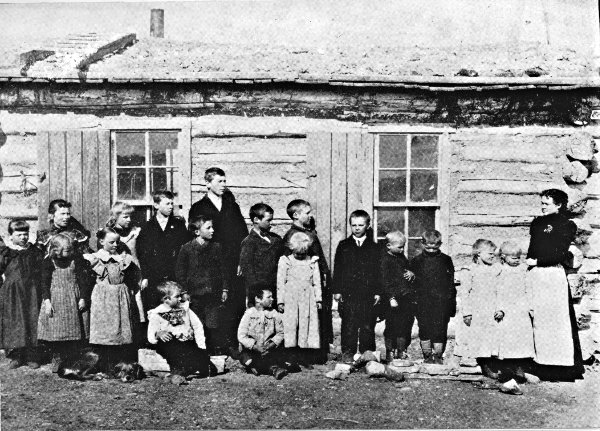
AN EARLY SCHOOL (Oliver County, 1885).
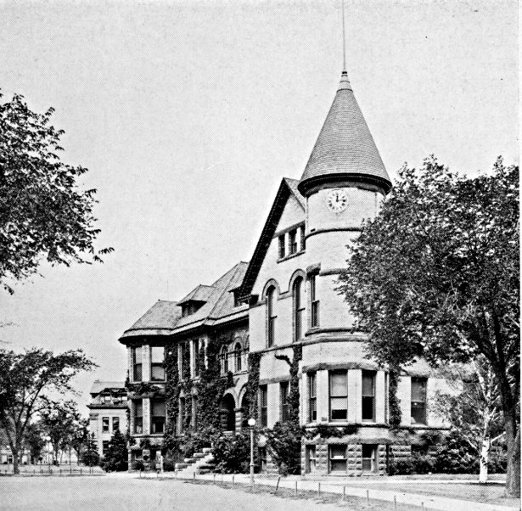
ADMINISTRATION BUILDING, AGRICULTURAL COLLEGE, FARGO
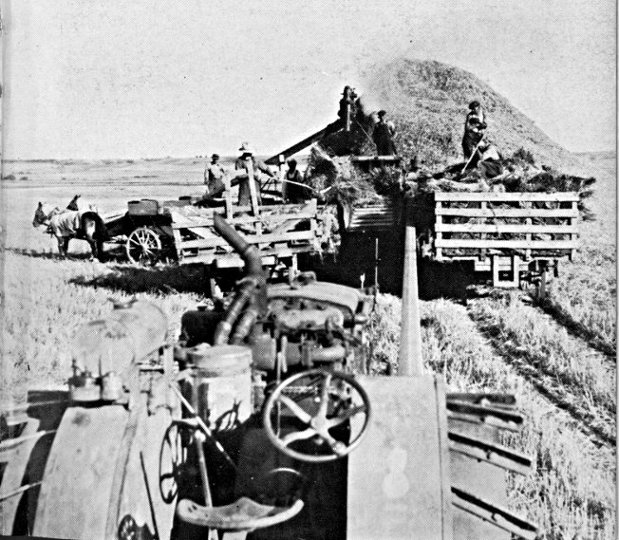
THRESHING
Photo by Kermit Overby
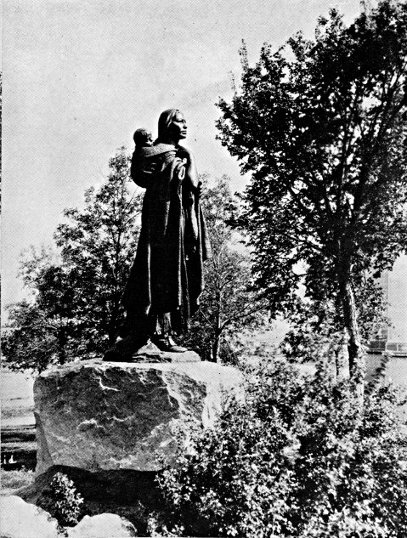
SAKAKAWEA, BISMARCK
Radio Station WDAY has its studios on the top floor. The oldest commercial station in North Dakota, it began to function in May 1922, operating on 100 watts. In March 1931 it became an associate member of the National Broadcasting Company, and a number of chain programs, including several from the agricultural college, have originated in its studios.
4. FIRST LUTHERAN CHURCH, 619 Bdwy., is of English Gothic architecture, a modern adaptation of the cathedrals erected in northern Europe in the sixteenth century. It was designed by Magney and Tussler of Minneapolis. The interior appointments are simple and severe, following the traditional arrangement for formal Lutheran services. In an arched sanctuary is the altar of golden Sienna marble. The congregation represents a consolidation of two church groups, the Norwegian Evangelical Lutheran Church founded in Moorhead in 1874 and moved to Fargo four years later, and St. Paul's Evangelical Lutheran, organized in Fargo in 1903.
5. FIRST PRESBYTERIAN CHURCH, cor. 8th St. and 2nd Ave. N., in modified English Gothic style, is of Faribault gray sandstone with slate roof, in cruciform construction. It was designed by Lang, Raugland, and Lewis of Minneapolis, with William F. Kurke of Fargo as associate. The altar was hand-carved by a cousin of Anton Lang, the Christus of the Passion Play at Oberammergau.
The three-manual pipe organ is a gift of Mr. and Mrs. Norman B. Black of Fargo. A stained glass window, designed by Homer L. Huntoon and presented by him in 1932 in memory of his wife and infant son, contains three panels, the central one of which depicts the sacrifice of motherhood, showing a young mother with her baby kneeling before an angel who holds the chalice and host, symbols of redemption. Art and music are represented in the two side panels.
6. UNITED STATES POST OFFICE AND COURTHOUSE, 705 1st Ave. N., erected in 1929-30 at a cost of $600,000, is in Italian Renaissance style, built of reinforced concrete faced with limestone. Ninety tons of steel were used in the first floor, making it strong enough to support 10 stories in addition to its present three.
7. FARGO'S FIRST HOUSE (private), 119 4th St. S., is the home of Mr. and Mrs. Henry Hector. It was built in 1871 of oak logs cut in what is now Island Park, and, although used for two years as a hotel, it was originally intended as the home of A. H. Moore, United States marshall.
8. CASS COUNTY'S FIRST COURTHOUSE, 708 1st Ave. S., has been remodeled into the DeVolne Flats. This two-story gray frame building has had a varied existence. Built in 1874, it served for 11 years as the seat of the county government. It was then moved to the corner of Seventh and Front Streets and used for a Government land office until October 4, 1886, when the construction of a new Northern Pacific depot made it necessary that the building be again moved, this time to Eighth Street. It remained there for a few months, then was sold for $500 and moved to its present location where it became the first club rooms for the Fargo Y. M. C. A.
9. MASONIC GRAND LODGE MUSEUM (open weekdays 9-5), 501 1st Ave. N., houses the Masonic Library, the only lodge library in the State. The museum includes exhibits ranging from Indian artifacts and historical relics to religious articles. Fargo's first sewing machine was donated to the lodge because its owner found it so "noisy to run."
The library specializes in genealogical research for Masonic families. Originally it was part of the museum and contained only copies of rare books. The lodge members became interested in a State-wide program of adult education, and began a lending library of non-fiction books. A collection of 800 rare volumes, a gift to the library of T. S. Parvin, secretary of the Iowa grand lodge, was destroyed in the Fargo fire; the library later bought Mr. Parvin's entire private collection. Important items include Orationes Philelphi printed in 1491; a collection of Bibles dating from the time of King Christian III of Denmark (1503-1559); a copy of the first printed constitution of Freemasonry, dated 1723; and histories of some of the early guides.
10. MONUMENT TO GANGE ROLF, Bdwy. at 5th Ave. N., stands in the Great Northern depot park. Rollo, as Gange Rolf was also known, entered France in 909 with a band of Northmen, and founded Rouen. Two years later he installed himself Duke of Normandy. His line through William the Conqueror became the royal house of England in 1066, and the reigning family of Norway in 1905. The statue, a gift of the Society of Normandy to the Norse people of America, was unveiled in 1912 on the 1001st anniversary of the founding of Normandy.
11. ISLAND PARK, Bdwy. at Red River, Fargo's first park, was donated for a recreational center in 1877 by the Northern Pacific Railway. It was undeveloped until the early 1880's when the city council undertook the task of landscaping. In the attractive grounds are various athletic facilities and a building that serves as a community center.
A granite Monument in a fenced plot near the south driveway was intended for a sundial but was never completed. The oddly phrased religious sentiments on the sides are by O. W. Lien of Breckenridge, Minn., donor of the shaft, who said they were dictated to him by a voice.
Near the west drive is a bronze Monument to Henrik Wergeland, a Norwegian poet noted for his efforts in opening the doors of Norway to the Jews and the naming of May 17 as Norwegian Independence Day. The monument is a gift of the Norwegian people to North Dakota and was presented during the Wergeland centenary in 1908.
12. OAK GROVE PARK (tennis courts, horseshoe courts, playground apparatus, soft-ball diamonds, wading pool, picnic facilities), on the Red River, has entrances at the E. end of 6th and 7th Aves. N., known as South and North Terrace. So sharp are the curves of the river that at one point one can look from North Dakota west into Minnesota. Oak Grove covers 39 acres.
13. EL ZAGAL PARK (private), 1411 Bdwy., is the property of the El Zagal Shrine Club. On the nine-hole golf course is the El Zagal Bowl, a natural amphitheater, used during the summer months for concerts and dramatic presentations. Programs each year include recitals by the Amphion Male Chorus of Fargo and Moorhead. North from the park are North Drive, which follows the Red River, and Memorial Drive, leading to Edgewood Park.
14. DOVRE SKI SLIDE, 1½ m. N. of 19th Ave. on N. Bdwy., when completed in 1935, was the highest artificial ski scaffold in the United States. At its highest point it is 140 feet from the ground. Reaching their maximum speed at the end of the runway, 300 feet from the top of the slide, skiers land on a hillside leading to the Red River, and complete their slide in Minnesota.
15. GOOD SAMARITAN SCHOOL FOR CRIPPLED CHILDREN, 716 7th St. S., stands on the site of a log cabin, the birthplace on August 27, 1871, of Anna Thoresen, later Mrs. Anna Roe, first white girl born in Fargo and Cass County. The school is housed in the buildings once occupied by the first college in the city, Fargo College, founded in 1887 as a Congregational school. The campus and main building had a beautiful setting overlooking Island Park. A shrinking income closed the school in 1919. In 1933, sponsored by the Good Samaritan Society, it became a school for crippled children, a private organization dependent upon donations from churches, fraternal societies, and other sources. It operates as a boarding school, with vocational training and academic courses from the first grade through high school.
16. On the SITE OF THE HEADQUARTERS HOTEL, between Bdwy. and 7th St. S., N. of the Northern Pacific Railway, stood a large two-story frame building which was the railroad station, hotel, and social center of Fargo during its early days. Built by the Northern Pacific in 1872, the hotel was formally opened April 1 the following year. After a disastrous fire in 1874 it was rebuilt by Fargo business men at a cost of $45,000. The new three-story combined hotel and depot was a prominent landmark, visible for many miles on the flat prairie. Around it flowed the life and business of the little frontier settlement and through it filed the men and women who helped make the history of the West. Its register carried the names of such notables as President U. S. Grant and Gen. William T. Sherman. Gen. George A. Custer and Gen. Nelson A. Miles often stayed there on their way to and from the frontier. A menu preserved from the hotel's Christmas dinner in 1887 lists the following game dishes: "wild turkey, stuffed chestnut dressing; possum with browned sweet potatoes; partridge with English bread sauce; baked squirrel; saddle of venison, currant jelly; young black bear; antelope, game sauce; buffalo steak; reed birds a la provencale; broiled quail on toast"—and any of these for 50 cents. One of the few buildings to escape the fire of 1893, the hotel burned in 1899.
17. ST. MARY'S CATHEDRAL, Bdwy. at 6th Ave. N., seat of the diocese of Fargo since 1891, is a red brick structure showing influences of Classic and Gothic style. A prominent feature is a 190-foot bell tower and steeple topped with a bronze cross. On the northeast corner of the building a small tower forms a niche and canopy for a heroic size statue of the Virgin Mary. In bas-relief on either side of the east window over the entrance portals are figures of SS. Peter and Paul. The cathedral, completed in 1899, was dedicated by Bishop John Shanley, first Roman Catholic Bishop of North Dakota.
POINTS OF INTEREST IN ENVIRONS
Armour Packing Plant and Union Stockyards, West Fargo, 5 m. (see Tour 8). Wild Rice River, 7 m.; Holy Cross Cemetery, 8 m. (see Tour 1).
GRAND FORKS
Railroad Stations: Great Northern, DeMers Ave. bet. 6th and 7th Sts. N., for G. N. Ry.; Northern Pacific, 202 N. 3rd St., for N. P. Ry.
Bus Stations: Union Station, Dacotah Hotel Bldg., 1st Ave. N. at N. 3rd St., for Checker and Triangle Transportation Companies, Northland Greyhound, and Liederbach Lines; Columbia Hotel, 624 DeMers, for Triangle Transportation Co.
Airport: Municipal airport, 1 m. W. of city, ½ m. S. of US 2, for Northwest Airlines; taxi fare 75c, time 10 min.
Taxis: Fare 25c first m., 10c additional each ½ m., 50c to university.
City Bus: Throughout city, to university, and East Grand Forks, Minn., fare 10c.
Traffic Regulations: Left and inside turns permitted at all intersections. N. 5th St. and Belmont Rd. (US 81) and University Ave. are through streets. W. from N. 5th St., 60 min. parking limit from noon to 6 p.m. No U-turn in business district. Traffic signals on DeMers Ave. at 3rd, 4th, and 5th Sts.
Accommodations: 8 hotels; municipal tourist camp, Riverside Park, NE. outskirts of city.
Tourist Information Service: Chamber of Commerce in City Hall, 2nd Ave. N. at 4th St.; Travelers' Aid Bureau (operating part time), Great Northern depot.
Theaters and Motion Picture Houses: City auditorium, 5th Ave. N. at 5th St., and Metropolitan Theater, 116 S. 3rd St., occasional road shows, local and university productions, concerts; Masonic Temple, Central High School Auditorium, local and university plays, concerts; 4 motion picture houses.
Golf: Municipal 18-hole course, Lincoln Park, SE. outskirts of city on Belmont Rd. (greens fee 40c); Nodak 9-hole course, University Ave. at Columbia Rd. (greens fee 20c for 18 holes).
Tennis: Courts at Riverside and Lincoln Parks, university campus (small fee).
Swimming: Outdoor pool, Riverside Park, open June to September, charge for adults; indoor, Y.M.C.A., 15 N. 5th St.
Hockey: Winter Sports Bldg., university; Riverside Park; and 1st Ave. N. at Washington St.
Skiing: 105 ft. and 30 ft. scaffolds at Lincoln Park. Cross country trails through park and up Red River.
Tobogganing: Central Park, S. end of 3rd St., toboggans (small hourly charge); small slides at Riverside and Lincoln Parks.
Skating: Winter Sports Bldg., university; lighted outdoor rinks at Central and Riverside Parks; neighborhood rinks throughout city.
Trap Shooting: Grand Forks Sportsmen's Association, range just outside city limits on University Ave.; Eckman rifle range, 1½ m. N. and ¼ m. W. of city off US 81.
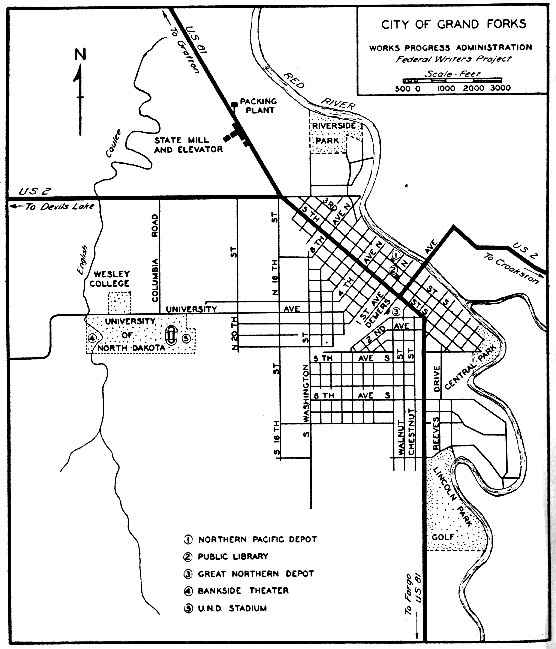
CITY OF GRAND FORKS
Annual Events: All-American Turkey Show, City Auditorium, usually last week in January; Snow Modeling Contest, city parks, January; Winter Sports Carnival, city parks and Winter Sports Bldg., university, 2nd week in February; Carney Song Contest, university armory, February 21; Flickertail Follies, March; Engineers' Day, university, 4th Friday in April; Norwegian Independence Day, May 17; Interfraternity Sing, Bankside Theater, university, 4th week in May; High School Week, university, May; State Fair, fairgrounds, NW. outskirts of city on US 2, June; Water Carnival, Riverside Park, July; State Peony Show, June; Harvest Festival, 3rd week in September; Homecoming, university, October.
GRAND FORKS (830 alt., 17,112 pop.), seat of Grand Forks County, is named for its situation at the confluence of the Red River of the North and Red Lake River. The broad low profile of the city, dominated by the State Mill and Elevator and the radio station towers, is visible long before it is reached. Even the many trees do not obstruct the view, for they grow chiefly along the river, roughly paralleling the highway.
Like other small Midwest cities, Grand Forks is a heterogeneous mixture of nineteenth century and modern architecture. The south part of town, along US 81 and its neighboring streets, is the finest residential district. University Avenue, lined with rooming houses and quiet homes, culminates in an architectural spectacle along Fraternity Row, an impressive group of houses vying for prominence and grandeur.
Meat packing, milling, and processing of other agricultural products constitute the city's chief industries. The largest railroad terminal between St. Paul and Seattle, Grand Forks is headquarters of the Dakota Division of the Great Northern Railway, the largest division in the world, containing more than 1,800 miles of main line track. The Northern Pacific Railway and several truck lines add to the shipping facilities.
The State university is not only a material asset of the city, but is a vital part of its intellectual and social life. University musical and dramatic performances are popular with townsfolk, college parties and proms are leading society events, and athletic contests draw a large attendance, not only from the city but from the entire northeast section of the State.
It is thought that the early French-Canadian explorers of North Dakota may have given this site the name of Grandes Fourches; by this name it was commonly known to the French fur traders of the late eighteenth century. In 1801, under direction of Alexander Henry, Jr., John Cameron established a North West Company depot here. Where Henry's men traded furs with the Indians, Grand Forks stands, the second largest city in the State, and hub of a rich agricultural region in the Red River Valley.
Nothing is known of the occupants of the first house in Grand Forks, a tumble-down shack discovered by travelers near the shores of the Red River in the early 1850's. The site is now occupied by the warming house of the Central Park skating rink.
In 1868 Nicholas Hoffman and August Loon, carrying mail from Fort Abercrombie to Fort Pembina, built a log cabin at the present corner of Eighth Avenue South and Almonte. They used it as an overnight shelter on the long trip across the prairies.
Following his expedition by dogsled through Dakota in 1860, James J. Hill, who later built the Great Northern Railway, sent Capt. Alexander Griggs to explore the Red River. By the fall of 1870 Griggs had built up a good freighting business, using flatboats to carry his cargoes. George Winship, later publisher of the Grand Forks Herald, also went into the flatboat freight business and a friendly rivalry developed between the two commanders and their crews.
On one occasion Winship loaded two flatboats with merchandise at McCauleyville, scheduled for Pembina. At the same time Captain Griggs was loading a fleet of flatboats destined for Fort Garry (Winnipeg). Winship set out a half day before Griggs finished loading, but Griggs' crew boasted they could overtake the rival fleet. At the Goose Rapids Winship was forced by low water and the rocky channel to reload his entire cargo to a "lighter," a two-day task. Toward evening of the second day shouts up the river announced Griggs' arrival at the head of the rapids. Confident of keeping their lead, Winship and his crew tied up for the night. Before morning a violent storm washed overboard several kegs of beer which were part of their cargo. All were retrieved but one, which floated unnoticed downstream, to be salvaged by the Griggs crew. As a result of the ensuing party most of Griggs' men were incapacitated, and he was forced to tie up his fleet at Grandes Fourches to await recovery.
Winship reached Pembina safely, but before Griggs could proceed the river froze, and he was forced to unload his cargo and store it in improvised sheds. His crew, with no alternative but to spend the winter here, were the first white people known to have domiciled on the site of Grand Forks.
Captain Griggs built a squatter cabin at the mouth of the Red Lake River, and after a trip to St. Paul in 1871 built the first frame house in the settlement on the bank of the Red River, at the foot of what is now Kittson Avenue, and brought his family to the new community.
In its early years Grand Forks was a typical river town, developing into an important station for the heavy river and oxcart traffic on the St. Paul-Fort Garry trail. Dwellings began to dot the prairie beside the river, log huts and crude frame structures built from the product of Captain Griggs' sawmill. A post office was established in 1871, and mail arrived once or twice a week by dog team. In the same year a telegraph station was established, on the first line in the State, running between Fort Abercrombie and Winnipeg. It was about this time that the English pronunciation of the community's name came into general use.
In the winter of 1872 there was much unemployment and saloons were filled with idle men. During this winter "Catfish Joe," a half-witted Frenchman, murdered a local character known as Old Man Stevens who, while intoxicated, called him uncomplimentary names. The saloon crowd decided on a lynching, and all through the night plans were discussed, but with so many rounds of drinks that action was impossible. Catfish Joe was tried for murder at Yankton, spent two years in prison, and returned to terrify Grand Forks by strutting about the streets decorated with a bowie knife and a Winchester. One courageous townsman, Bert Haney, seized the gun and struck Joe a terrific blow on the head, breaking the rifle barrel from the stock, but with no damage to Joe's head. Catfish Joe later went to Montana where he murdered his partner for refusing to get up in the night and prepare breakfast.
By the spring of 1872 Captain Griggs' sawmill was doing a flourishing business, turning out lumber for building and repairing river boats and barges. Logs were cut and floated down the river to Winnipeg. When Frank Viets opened the first flour mill in the Red River Valley at Grand Forks in 1877, he added another industry to the growing settlement. The Hudson's Bay Company operated a store, managed by Viets, who purchased it when the company moved to Winnipeg in 1877.
Since five families in the city had children of school age in 1873, it became necessary to establish a school. As some of the families lived on North Third Street and others in the Lincoln Park area, they could not agree on a suitable location, and each faction held a school of its own. Claim shanties served as school buildings, and a drayman, one of Captain Griggs' hired men, taught the north end school.
There was no dentist in the community in the early days of Grand Forks. Alex Walstrom, a blacksmith, used a pair of homemade tongs about two feet long to pull aching teeth.
On October 26, 1875, Captain Griggs filed a plat of the original town site of Grand Forks, covering 90 acres of his claim. The following spring Viets filed the plat of his first addition. In 1879 the village of Grand Forks was organized and three years later was incorporated as a city.
Although life at the little river post lacked many refinements, the social aspect was not entirely neglected. Weddings were carried out with pomp and ceremony, and anniversaries appropriately celebrated. A popular social custom, New Year calling, was introduced on January 1, 1876. Groups of men rode together in sleighs to call on their friends, and then drove to the Hudson's Bay Company store, purchased flour, sugar, tea, and other necessities, which they took to the homes of the destitute.
Until 1879 traffic moved by steamboat or stage, but the coming of the Great Northern Railway in that year brought the rapid decline of both these early modes of transportation. Their end was hastened by the extension of the Northern Pacific Railway from Crookston, Minn., to Grand Forks two years later.
George Walsh founded the Plaindealer, the first newspaper northwest of Fargo, in 1874, and published it without competition for five years until George Winship started the Herald. There began a continuous quarrel between the two editors which was at times decidedly heated, although when the plant of the Plaindealer burned in 1884 Winship shared his equipment with Walsh. While acknowledging the courtesy, the Plaindealer continued to attack the editorial policies of its benefactor. Winship eventually purchased his rival's paper and merged it with the Herald, which since 1881 has been published as a daily. The late J. D. Bacon, when publisher of the Herald, established the Lilac Hedge Farm northwest of Grand Forks to demonstrate the practicability of diversified agriculture and the value of using purebred stock.