CITY NEIGHBORS (continued 2)
Reading edition
Colonel Viets' mill on South Third Street was one of the first industries established in the city, and was the only flour mill until 1882, when John McDonald founded a mill at the present corner of Fifth Street and Kittson Avenue. This was operated later by the Diamond Milling Company and then sold to the Russell-Miller Milling Company.
Cream of Wheat was first processed in Grand Forks and was manufactured locally for a number of years about the turn of the century, before the manufacturer moved to Minneapolis.
In Grand Forks politics and the weather were of great importance. Elections were always exciting. When D. M. Holmes ran for mayor in 1886 his friend James J. Hill ordered all Great Northern trains of the north, south, and west lines to run into Grand Forks so that the train crews could vote for Holmes. Against such odds Holmes' opponent withdrew.
A tornado that struck Grand Forks in June 1887 killed two women and wrecked many buildings. Ten years later the city experienced one of the worst floods in its history. The Red River made an all-time record by flowing four miles an hour. Houses along the river flats were floating or completely submerged. The piers of the west approach of the Minnesota Avenue bridge were swept by ice, and the Northern Pacific tracks were under water. When water filled the basement of the Herald building, the staff was forced to resort to hand composition to continue publication. Many families lived in second stories, and on nearby farms platforms were built on the roofs of barns and fenced in for the livestock, which was fed from boats.
In 1890 a brick plant was established in Grand Forks, and another in 1900. Other industries which sprang up during this period were bottling works, breweries, and foundries. Besides the Grand Forks Herald, two weeklies were established, the Red River Valley Citizen and the Normanden, the latter in the Norwegian language.
In 1919 a group of farmers and business men from Grand Forks and the surrounding territory opened the Northern Packing Company, designed to handle 500 hogs and 150 cattle and sheep daily, with a plant one and one-half miles north of the city (see Tour 1). The State Mill and Elevator began operation in 1922 (see Tour 1). A candy company that uses locally produced beet sugar has an annual output of about 1,000,000 pounds. A large potato warehouse with laboratory and experimental department was constructed in 1935 at the corner of North Third Street and Lewis Boulevard.
The population of Grand Forks has increased from 200 in 1873 to 17,112 in 1930, and is composed of many nationalities, although more than 75 percent of the native whites are of Norwegian or Canadian descent. A small section of the city bounded by Sixth and Eighth Avenues North and Twentieth and Twenty-third Streets North is a Scandinavian community designated locally as "Little Norway." Here Norwegian is spoken almost exclusively by the older people, although the children have acquired American speech and habits. Norwegian Independence Day, Syttende Mai (May 17), is celebrated by the residents of this district and their homes are then decorated with Norwegian flags. Much political activity of an earlier period centered about this little community, since it generally voted as a bloc. Politicians of that day believed that the candidate who was most liberal with ale would receive the community's vote, and on the eve of election torchlight parades marched through the streets of this district and candidates for office generously dispensed both oratory and beer.
POINTS OF INTEREST
1. FEDERAL BUILDING, 1st. Ave. N. at N. 4th St., houses the post office, United States courtroom, a branch of the United States Immigration Service, and the Federal Reemployment office. The superstructure is of white Bedford stone and pressed brick, with a base of solid granite. It has a 12-foot cornice of stone with carved and blocked ornaments. The lobby has marble floors and high wainscoting of marble, contrasting shades being used for borders. Fixtures are of quarter-sawed oak.
2. CENTRAL HIGH SCHOOL, 1st and 2nd Aves. N. between 4th and 5th Sts., has an auditorium unit constructed entirely without windows. It was the first public building in North Dakota to utilize indirect lighting throughout. It was erected in 1936-37 with WPA assistance at a cost of $275,000, and includes a pipe organ, the gift of the Grand Forks Music Association.
3. SORLIE MEMORIAL BRIDGE across the Red River connects Grand Forks, N. Dak., and East Grand Forks, Minn., on US 2. It is dedicated to the late A. G. Sorlie, former Governor of the State, and was built in 1929.
4. RADIO STATION KFJM (open daily 2:30-5 p.m.), top floor of the First National Bank Bldg., cor. DeMers Ave. and N. 4th St., is one of the few State-owned university radio stations in the United States. It is leased to a local company. A studio is maintained at the university.
5. TRIANGLE APARTMENTS, 5th and Chestnut Sts. and 5th Ave. S., mark the site of two of the most important buildings in early Grand Forks history. The city's first school building stood across the street from this triangle, on the courthouse site. In 1883 the old building was moved into the triangle and converted into the Park Hotel. The Arlington House, a hotel built by the Hudson's Bay Company in 1873, was also moved to this lot and in 1906 Col. Andrew Knutson purchased both buildings and operated them as the Arlington-Park Hotel. This hotel was torn down in recent years and the lumber used in the construction of the apartment building that now occupies the site.
6. GRAND FORKS COUNTY COURTHOUSE, 4th and 5th Sts. S. between Kittson and Bruce Aves., was erected in 1913 and designed by Buechner and Orth of St. Paul. It is a three-story Indiana limestone building of modified Classic design, with a figure of Justice surmounting its dome. The halls are finished in white marble with mural decorations. Embellishing the upper part of the rotunda are four painted lunettes showing typical North Dakota scenes.
7. SOLDIER'S MONUMENT, 6th St. S. and Belmont Rd., was donated by George B. Winship, early newspaper publisher, as a memorial to 168 local Civil War veterans, whose names are engraved on a bronze tablet. Mounted on a square base of Vermont granite, the monument represents a Union soldier "at rest."
8. CENTRAL PARK (picnicking not allowed), Red River bank, S. end of 3rd St., is a beauty spot and playground. The flower gardens, a mass of brilliant bloom, are lighted at night. At the bandstand in the center of the park concerts are presented, usually each week, during the summer months. In front of the bandstand are millstones from the first flour mill in the Red River Valley, which was built on the site of the city waterworks plant in 1877. An outdoor skating rink is lighted for winter skating. The warming house is on the site of the first building erected within the present boundaries of the city. Across the drive from the ball diamond are the toboggan slides, partially hidden from view by evergreen trees and shrubs.
9. UNIVERSITY PARK (playground equipment and supervised play), University Ave. bet. 24th and 25th Sts., has a children's library at the clubhouse, and children's band concerts (weekly, June-July) are given by the university band.
10. LINCOLN PARK (municipal golf links, tennis courts, ski slide, picnic and play equipment), Belmont Rd. at S. edge of city, contains the old Red River Oxcart Trail (see Tour 1) which crossed the little hill on which the clubhouse stands. Later, when the settlement became a stage station on the St. Paul-Fort Garry Trail, the Stewart House was built here and housed Grand Forks' first post office. This old log building is now the kitchen of the clubhouse.
11. UNIVERSITY OF NORTH DAKOTA is at the W. end of University Ave. 2 m. from the principal business section of Grand Forks. (University bus at 3rd St. and DeMers Ave., fare 10c.)
The campus facing the avenue is bordered by a low hedge, and the two main entrances are marked by large brick pylons. Tree-shaded roads wind past the buildings and along the banks of English Coulee. In the spring and summer the wide expanses of green lawn are broken by plots of flowers and clumps of lilacs, spires, and flowering almond. All of the buildings erected since 1910 are in modern collegiate Gothic style, a modification of true English Gothic architecture adapted especially for educational institutions.
The University of North Dakota was established by the Territorial Legislature before North Dakota became a State. The cornerstone for "Old Main" was laid October 12, 1883, on the prairie beside the banks of the winding English Coulee, and September 8, 1884, the university opened classes with 79 students and a staff of 4 instructors. Enrollment now numbers almost 3,000 students and the school has more than 130 instructors.
Selection of a site two miles from the city was opposed by many of the townspeople who thought the university should be located at the south end of Third Street, on the present site of Central Park. During the tornado of 1887 the roof of Old Main, then the only building on the campus, was blown almost to the south end of Third Street. Agitation was begun to bring the remainder of the building to join the roof, but State officials refused to consider the plan, chiefly because the property originally used was school land. Old Main was remodeled and a women's dormitory erected near it. That settled the controversy.
For students who were unable to live on the campus, transportation was a troublesome problem. Only a country road of sticky Red River Valley gumbo connected the campus with the city, and, except for the fortunate few who caught rides on horse-drawn vehicles, city students walked to classes. During severe weather it was often necessary to flag a freight or passenger train of the Great Northern to make the trip to town. About 1900 a trolley line was established to the university, and despite its erratic service it greatly facilitated attendance of nonresident students.
Although given an endowment of 86,080 acres of public lands in 1889 when it became the University of North Dakota, there were many years when the school derived no revenue from this source, but had to depend entirely upon legislative appropriation. In 1895 Governor Allin vetoed most of the appropriation, leaving money for the janitor's salary but none for the faculty. The institution was kept open through private contributions, and President Webster Merrifield and other professors served without salary during a trying two-year period. Despite financial difficulties, attendance at the university in its first 15 years increased more than 40 percent and in 1898 President Merrifield reported to the legislature that the facilities of the institution were inadequate. Continued expansion added law, premedical, and commerce schools, and mechanical, electrical, and mining engineering departments at the university by the end of the 1901 term.
During the first six years of university history there were only two buildings on the campus. The main building, later known as Merrifield Hall, contained classrooms, book store, post office, and men's dormitory. The other building, later named Davis Hall for Hannah E. Davis, one of its early matrons, housed the girls' dormitory, and, in the basement, the university dining hall. Alumni of those days relate that the dining hall was a very popular place. When meals were ready to be served a napkin was hung out the basement window, and the first student in the main building who spied the sign, regardless of whether he happened to be in a class or not, yelled, "Rag's out!" The shout was taken up and a stampede to the dining room followed. This custom prevailed for several years. One day President Merrifield was showing some of his Eastern friends through the institution when suddenly "Rag's out" reverberated through the halls. The visitors wondered if there was a riot, and the mortified president realized for the first time how the dinner call sounded to outsiders. He suppressed it with difficulty, after many student debates on the sacredness of college traditions.
With the advent of football teams, "Odz, odz, dzi," an imitation of a Sioux war cry, became the college yell, and has continued to the present.
When a delegation from the first North Dakota legislature visited the campus on a tour of inspection in 1889, residents of the girls' dormitory held a tea in their honor. In order to improve upon the barrenness of the sparsely furnished parlor, pieces were borrowed from the girls' rooms and from friends. The expedient was more successful than the girls had anticipated, for the legislators considered the furnishings more than adequate and thereupon decreased the amount allowed in the budget for dormitory equipment.
Although the University of North Dakota has been in existence only 55 years (1938), it has had its share of distinguished alumni, among whom is Maxwell Anderson (class of 1911), playwright, author of What Price Glory, Mary of Scotland, Winterset, and other dramas. In 1933 his play Both Your Houses was awarded the Pulitzer Prize.
Vilhjalmur Stefansson, explorer, attended the university from 1899 to 1902, and left at the request of the faculty. His escapades, though doubtless improved upon with the years, are quite typical of him. It is said he attended classes as seldom as possible, yet always received the highest grades. The story goes that he went to his calculus class only on the first day of the term, then returned for the final examination, which the professor allowed him to write, with gloomy prophecies of his ruin. Stefansson's mark was 98. The professor could not help remarking that he had done well considering that he had attended only one class. "And," retorted Stefansson, "if I hadn't come here the first day I'd have got one hundred."
The Arctic explorer has been credited with pranks such as releasing a small pig on the speaker's platform at convocation, and rolling a keg of beer across the campus to win a bet when North Dakota was a very dry State. There was then no trolley from Grand Forks to the campus, and President Merrifield was driven the two miles to and from town in his private carriage. One day Stefansson saw the carriage parked downtown. The driver was old in service, and when Stefansson stepped into the carriage and said "Home, Peter" in a good imitation of the president's voice, Peter suspected nothing. Stefansson rode in comfort to the campus, while President Merrifield, it is said, walked. Expelled in 1902, Stefansson was called back to his Alma Mater in 1930 to have the LL. D. degree conferred on him in recognition of his contributions to science.
The east campus road passes the Law Building, Woodworth Hall, Chemistry Building, and Babcock Hall. In Woodworth, the school of education, is the campus broadcasting studio. The University of North Dakota was the second university in the United States to offer courses in radio administration, and engineering students use the KFJM transmitter, adjacent to the campus, for practical class work in technical radio instruction. Just S. of the Chemistry Building are the university tennis courts, and a nine-hole golf course is E. of Memorial Stadium (L) erected in 1927. The university athletic department is a member of the North Central Conference and books games with schools from coast to coast. The University Museum on the top floor of Babcock Hall (open 9-5 daily) contains a large collection of Indian artifacts and geological and historical items.
The road curves back of Babcock and the Commons past Camp Depression (L), established in 1933, where railroad cabooses are fitted up for enterprising students to provide cooperative accommodations at a minimum cost. Left of Camp Depression is the shiny arched steel Winter Sports Building. Around the curve is the Armory (L) where athletic and social events and weekly convocations are held. The road to the R. passes Budge Hall (R), men's dormitory, built in 1889; Old Merrifield Hall (L), generally known as "Old Main," the first building on the campus and now occupied by administrative offices, post office, book store, and offices of the extension division; New Merrifield Hall (L), the liberal arts college building, completed in 1929; Science Hall (R), housing the medical school and State Public Health Laboratories; and the Library (L), containing 77,000 catalogued books and periodicals and about 17,500 uncatalogued Government documents.
Curving L., the road passes the President's House (R), a spacious Georgian Colonial brick residence. Next is Macnie Hall, a cooperative men's residence hall, named for John Macnie, for 20 years a member of the faculty, and composer of the university Alma Mater. Vine-covered Chandler Hall (R), named for Elwin Chandler, dean emeritus of the school of engineering, is headquarters during Engineers' Day held the last Friday in April each year. Davis Hall (R), women's dormitory, is the second oldest building on the campus, erected in 1887. It houses the home economics department.
English Coulee (R), so-called because an Englishman is said to have drowned in it, borders the campus on the W. Between Davis Hall and the Women's Gymnasium the stream curves, creating the impression that the opposite bank is a wooded island. This far bank is the stage of the Bankside Theater, and the concave bank facing it is used to seat the audience. The theater is the scene of an Interfraternity Sing held the last week in May.
The original Bankside Theater, about one block N. of the present site, was dedicated in 1914 and is said to have been the first open air theater to make use of the natural curve of a stream to separate the stage from the auditorium. The initial performance given here, A Pageant of the Northwest, was written by students of the Sock and Buskin Society (now the Dakota Playmakers) under the direction of Prof. Frederick Koch, who is distinguished for his work in American folk drama.
The banks of English Coulee have fostered both drama and romance. College sweethearts spend their evenings by this stream, admiring the reflection of the moon in the water. The custom is known locally as "coulee-banking."
Thirteen social fraternities, including 11 national groups, are represented at the university, and there are 10 sororities, 9 of them national. The houses along Fraternity Row on University Avenue and the other streets near the campus present the architecture of many nations and periods. A French chateau shouldering a stucco cottage, a graceful Georgian Colonial residence standing between an English country house and an Italian mansion, and houses of Spanish and English design form a quaint architectural democracy that is, perhaps, a fitting background for the social life of a student body representing various nations.
12. WESLEY COLLEGE, N. of University Ave. opposite the University of North Dakota, is the first of the Methodist schools in the United States designated by that name and the first church school to affiliate with a State university. Its residence halls are open to students of all church affiliations, as are the classes in religion, music, and expression. Work in any department of Wesley College is credited toward university degrees.
The campus contains four buildings, Corwin, Larimore, Sayre, and Robertson Halls, constructed of white brick with trimmings of white glazed terra cotta in Grecian style. Robertson Hall, the newest building, contains the administrative offices, school of religion, and expression department. This building, costing $40,000, was made possible by the contribution of an alumnus, John M. Hancock, and his family of Hartsdale, N. Y., and was completely furnished by Mrs. Hancock. Corwin Hall houses the well-equipped music department. Larimore Hall, the women's dormitory, is immediately behind Corwin, while the men's dormitory, Sayre Hall, adjoins Robertson Hall.
POINTS OF INTEREST IN ENVIRONS
North Dakota State Mill and Elevator, 1 m.; Red River Oxcart Trail, 1.5 m.; Northern Packing Plant, 1.5 m.; Grand Forks Silver Fox Farm, 4 m. (see Tour 1). American Sugar Refining Co. plant, 2 m. (see Minn. Tour 7).
MINOT
Railroad Stations: Great Northern Station, W. end of Central Ave. across viaduct, for G. N. Ry.; Minneapolis, St. Paul & Sault Ste. Marie Station, 17 N. Main St., for Soo Ry.
Bus Stations: Union Bus Depot, Front at 3rd St. SE., for Checker, Interstate, and Northern Transportation Co. bus lines; Stearns Bldg., 2nd St. SW. at 1st Ave., for Minot-Crosby Bus Line.
Airport: Municipal airport, 1¼ m. N. of business district on outskirts of city, E. of US 83, taxi fare 35c, time 10 min.; no scheduled air service, no public hangars.
Taxis: 25c to any point in city, 10c for each additional passenger.
City Bus Line: Throughout city, to State Teachers College, fare 10c.
Traffic Regulations: Valley St. (US 52), 4th Ave. SE. and SW. (US 2), 2nd St. SW. and NW. (US 83), are through streets. No U-turn on through streets and no left turns out of alleys. Turns may be made in either direction at intersections.
Accommodations: 10 hotels; municipal tourist camp, Roosevelt Park, 4th Ave. SE. at 11th St.
Tourist Information Service: Association of Commerce, 205-207 1st Ave. Bldg.
Theaters and Motion Picture Houses: McFarland Auditorium, State Teachers College, 9th Ave. NW., college productions and lyceum programs; Minot high school auditorium, 2nd Ave. SE. between 1st and 2nd Sts.; 3 motion picture houses.
Athletics: Baseball, football, track, skating, and hockey rinks, Roosevelt Park Recreation Field.
Golf: Municipal 9-hole course SW. edge of city on US 2 (greens fee 25c); Riverside 9-hole course, E. of city limits on US 2 (greens fee 25c).
Tennis: Courts at Oak Park, W. end 3rd Ave. NW.; Lincoln Park, 4th St. at 5th Ave. NW.; and Roosevelt Park.
Swimming: Municipal outdoor pool. Roosevelt Park.
Skating: Rinks at 2nd St. and 8th Ave. NE., 1st Ave. at 3rd St. NW., Lincoln Park, South Hill residential district, and Roosevelt Park; all floodlighted.
Curling: Rink near Fairmount Creamery, 701 4th Ave. SE.
Annual Events: Winter Sports Carnival, February, no fixed date; Northwest State Fair, fairgrounds E. end of 4th Ave. SE., week of July 4; Homecoming, State Teachers College, October, no fixed date; The Messiah, State Teachers College, December, no fixed date.
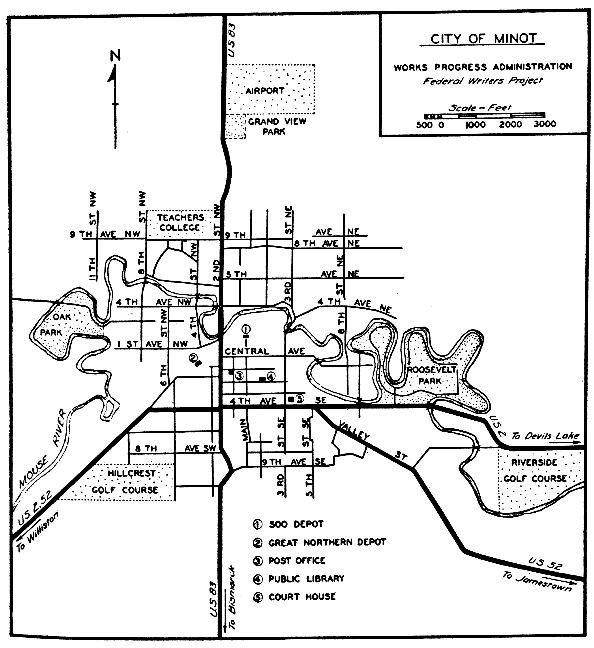
CITY OF MINOT
MINOT (1,557 alt., 16,099 pop.) is still young and growing, although past its fiftieth birthday. Its name (pronounced MY-not) was given it to honor Henry D. Minot, young Eastern capitalist and college friend of Theodore Roosevelt. Situated in the deep valley of the Souris (Mouse) River, the town overflows the level mile-wide flood plain to thrust itself up the south slope of the valley onto the open prairie. Rough, well worn block pavement in the business section evolves into smooth, tree-bowered asphalt avenues lined with fine homes in the residential districts. The twisting, sluggish river winds through the center of the city, in some sections its banks scarred with piles of refuse, in others rimmed by trim lawns.
The hills that rim the Souris at Minot are evidences of the mighty force of the raging waters that during the glacial period poured from the melting edge of the great Dakota ice sheet to plow deep valleys and lay the basis for the town's future prosperity. The products of the geological past yield valuable returns. One, the rich, fertile bed of glacial Lake Souris, provides good crops. The other is lignite, the soft brown peat-like coal that underlies much of the northwestern portion of the State, and for which Minot is an important shipping point.
James J. Hill's Great Northern Railway was pushing west through Dakota Territory in 1887 when it was found necessary to stop near here and build a bridge across a coulee. Where construction halted there immediately sprang up a large tent town, which was generally assumed to be the start of a permanent settlement. The railroad company, however, had selected a town site to the east, on the Souris River, and when this became known the exodus was sudden and complete; almost overnight the tent town was transplanted to the new location. This mushroom-like appearance, coupled with an almost phenomenal growth to 5,000 population during its first year, earned the new frontier settlement the title of the Magic City.
The first white man to settle on the ground now incorporated into the city of Minot was Erik Ramstad, who in May 1885 had come from Grafton, N. Dak., and settled by squatter's right on a quarter section bisected by the Souris. Late in the summer of 1886 he relinquished 40 acres south of the river to the town site people, and this land together with another 40 acres to the south became the original site of Minot. On July 16, 1887, less than a year after settlement, Minot was an incorporated city. A few weeks later an entire slate of city officers was selected in a campaign which set a high standard for many heated city elections of later years. Principal interest centered about the candidates for mayor, and with typical frontier camaraderie the defeated man was the first to sign the bond of office for his victorious opponent. At its initial meeting the newly elected city council selected as the city's first police chief William Flumerfelt, a saloon-keeper.
When Minot's first Christmas arrived, in 1887, not a church graced the town. To observe the season a Christmas tree was set up in Jack Doyle's saloon, which stood on the site of the present Woolworth store at the corner of Central Avenue and Main Street. Most of the town turned out for the celebration, gifts were hung on the tree, and everyone was given candy.
Many early residents were buried in a cemetery in southwest Minot, although no markers remain. This burial place on one occasion almost saw the interment of a person who, by virtue of being very much alive, was quite undeserving of inclusion here. It happened that a local character known as Spider had gone to his reward, and "the boys" had taken over his obsequies, stopping on the way to the cemetery to fortify themselves at a saloon. Reaching the grave, they attempted to lower the coffin, but one end dropped down and the other caught on the side of the grave. John J. Powers, a well-known rancher, was selected to straighten the coffin, but in getting down he was caught between it and the wall of the grave. Disregarding his protests, the high-spirited pallbearers proceeded to shovel in dirt, and he was covered except for his head and shoulders when passersby, hearing his cries, arrived on the scene and effected a rescue.
It was events like this that earned Minot the name of a wild town; and, considering the type of people who flocked into the new city—transient railroad workers and hangers-on, horse and cattle thieves who at that time infested the west and northwest sections of the State, gamblers who saw opportunity in the new settlement, and criminals who had escaped across the boundary from Canada—it is hardly remarkable that the town soon had a reputation for lawlessness and iniquity. Many pioneer residents of Minot still remember a certain railway passenger conductor who would call the name of the station, "MINOT, this is M-I-N-O-T, end of the line. Prepare to meet your God!"
In spite of the disreputable element, many dependable citizens selected the boom town for their permanent homes, and to them the development of the city has been due. As early as 1887 Marshall McClure was publishing the first newspaper, the weekly Minot Rustler-Tribune. The city had its first wooden sidewalk in 1888, and the same year Main Street was lighted with kerosene lamps. The city council passed an ordinance against speeding with horses, the limit being set at eight miles per hour. Apparently the council of that day believed that actions speak louder than words, for on one occasion it adjourned to go out in a body to grub stumps and fix a road that needed repair. In 1889 this same progressive body voted that the city pay 50 cents per barrel for the first 10 barrels of water delivered at any fire in the city. The first fire wagon was John Strommen's dray, which was used to haul water every time an alarm was turned in.
Burlington (see Tour 7), the first community in the Souris region, had confidently expected that the Great Northern would be routed past its door, but instead the road chose the Minot site. The Magic City thereupon set out to deprive its rival of the county seat as well. Arrangements were made for the railroad company to sidetrack an old freight car at Lonetree 28 miles west of Minot. Telegraph wires were strung into it, and the roadmaster presented an affidavit to the county commissioners stating that a station had been opened. Burlington protested: Lonetree belonged in the Burlington precinct, it claimed, and there were not enough residents to open the polls. The railroad installed two operators, a station agent and a helper; Lonetree was declared a precinct, and it is said that railroad crews as far west as Glasgow, Mont., voted. Minot became the county seat.
Settlers rushed into "Imperial Ward" County when it was surveyed and opened to homesteading in 1896. The origin of the county's nickname is apparent from the following description in Colonel Lounsberry's Record: "... a small sized empire of 5,000 square miles rich in soil, clays, coal, and the energy of its people, immigration unequaled, steady and firm like the flow of a river." Land entries at Minot during the first nine months of 1905 were said to be greater than at any other U. S. land office in the country. Homesteaders slept on the floor of the office to avoid losing their turn in filing for land.
Imperial Ward remained intact until 1910, when its ample acres were carved into Renville, Burke, Mountrail, and present Ward Counties.
Deer, antelope, prairie and timber wolves, foxes, mink, otter, beaver, ducks, and geese provided early settlers of the Minot area with food, furs, and sport. In the winter, when water holes were opened in the frozen river for stock, fish would come up to the openings in such numbers that they could easily be speared with pitchforks, and it was not uncommon at these watering places to see fish frozen and stacked up like cordwood.
Since the Souris winds through Minot for a distance of eight miles, its overflow can cause great damage, and several times there have been severe floods. The worst occurred in 1882, 1904, 1916, 1923, and 1927. The 1904 flood took the town by surprise, as there were no telephones in the territory upstream from Minot by which the alarm could be given, and small houses were torn from their foundations as the crest of the flood hit the city. Railroad tracks were under water and traffic on the Great Northern and Soo was at a standstill. The flood continued for about three weeks, and children rejoiced as school was discontinued. People went about their business in boats, using their front porches for piers. Many north side residents moved in with friends living on the higher south side.
In recent years dikes have been built to keep the Souris within bounds, and Federal works on the river above the city, the subsistence homestead project at Burlington, and the Upper Souris migratory waterfowl project (see Tour 7) have constructed dams which enable engineers to control the flow of water.
While the Great Northern was responsible for Minot's origin and early growth, several factors have shared in the city's later development. Extension of the railroad westward added to the trade territory, all of which is agricultural, and the city became the logical wholesale distribution point for northwest North Dakota. The arrival of the Soo in 1893 tapped untouched areas southeast and northwest, again enlarging the trade region. The first bus line in the State began operation between Minot and Bismarck in 1922. Truck and bus lines now radiate from Minot to serve the many outlying communities not on the transcontinental railroads. The city is a center for an area of 22,500 square miles, extending north to the Canadian line and west into Montana. In 1930 Minot had the second largest volume of wholesale business in the State, with transactions totaling $18,500,000.
Its location in an extensive agricultural area has established Minot as a farm market. During both pre-war and post-war periods of heavy crop yields and high prices, Minot boomed as a grain shipping point. Two flour mills have been a factor in maintaining cash grain prices at higher levels than in other communities. Processing of dairy and poultry products has become an important industry, and a cash livestock market has brought additional returns and marketing facilities in the past few years. A plant of the poultry cooperative maintained by the North Dakota Farmers Union is situated in Minot. The recent droughts lessened grain marketing, but pushed forward in another direction the production and stability of diversified farm products, as indicated by the expansion of one and the erection of another creamery and processing plant.
Like other cities, Minot has felt the depression period, but outwardly there remains only one prominent scar—"Sparrow Hotel," the steel skeleton of a 10-story hotel building. Begun in 1929, construction was halted by the market crash of that year, and the framework now houses only a multitude of twittering, chirping sparrows.
Its rail facilities have helped to make Minot a natural shipping point for the great quantities of lignite mined in this vicinity. The Truax-Traer Company, with headquarters here, is one of the largest lignite strip mining companies in the United States, and operates the three largest strip mines in the State.
Out of the Rustler-Tribune, which reported Minot's earliest events, there grew the Minot Optic Reporter, which is now the Minot Daily News. The Democrat, a political publication, has grown into the Dakota State Journal, and the weekly Ward County Independent is also published in Minot. A radio station, KLPM, maintains studios in the Fair Block on South Main Street.
With improved transportation facilities and good roads, Minot has become a medical center for the northwest section of the State. Two large hospitals, two smaller private hospitals, and medical and dental clinics are maintained.
POINTS OF INTEREST
1. MINOT STATE TEACHERS COLLEGE, 9th Ave. NW. between 2nd and 8th Sts., with an average quarterly enrollment of 525, is the largest normal school in the State. It is an accredited four-year college with a teachers training school in connection.
Its 70-acre campus, 60 acres of which were donated by Erik Ramstad, Minot's first settler, lies at the foot of the hills bordering the Souris valley on the N. and contains six brick buildings of modern construction, including a main educational building with auditorium and gymnasium, two dormitories, two training school buildings, a powerhouse, and a floodlighted athletic field.
The college offers a two-year standard teachers course as prescribed by State law, a two-year junior college course, and a four-year curriculum leading to a B.A. degree in education. In the training school a model primary, grade, and high school is maintained, enabling prospective teachers to secure actual experience in their profession. Many children in the northwest section of the city attend the college school.
2. WARD COUNTY COURTHOUSE, 3rd St. SE. between 3rd and 4th Aves., was dedicated May 31, 1930. It is said to be the first North Dakota public building of modern design. A motto inscribed upon the front elevation reads: "Let Us Develop the Resources of Our Land, Call Forth Its Power, Build Upon Its Institutions and Promote All Its Great Interests."
This austere spacious structure, designed by Tolz, King and Day of Minneapolis, and erected at a cost of $450,000; succeeded an old-fashioned brick courthouse built in 1891 and razed in 1928. The old courthouse, built after Minot had won the county seat from Burlington, was by no means adequate, but the commissioners feared to submit the question of a new courthouse to a vote, since the county as a whole was not reconciled to Minot's county seat victory. As the law allowed repairs without popular approval, the commissioners "repaired" the $8,000 courthouse to the extent of a new $25,000 addition.
3. PUBLIC LIBRARY (open 9-9, except July and Aug., 9-6), 101-107 2nd Ave. SE., is a buff brick Carnegie institution containing more than 18,000 volumes.
4. ROOSEVELT PARK (swimming pool, playgrounds, picnic grounds, athletic field, tennis courts, tourist camp), E. end of 4th Ave. SE., on the S. bank of the Souris River, is an 85-acre tract beautified by rustic bridges, lagoons, flower beds, and sunken gardens. A Zoo containing many species of foreign and domestic animals attracts thousands of visitors annually.
In the park is a bronze Equestrian Statue of Theodore Roosevelt, depicting him as a Rough Rider. The base of the statue is a reproduction of the Badlands formations along the Little Missouri River where Roosevelt once lived. This memorial, designed by A. Phimister Proctor of New York and presented to the city in 1924 by Dr. Henry Waldo Coe, pioneer North Dakota physician and life-long friend of Roosevelt, is dedicated to the school children who contributed the cost of the base.
Coe Drive, a scenic two-mile route through the woods bordering a loop of the Souris River, connects with a mile drive through Roosevelt Park. It is reached by driving one block into the park from the entrance and turning right.
5. OAK PARK, W. end of 3rd Ave. NW., has more than 50 acres of wooded land. Provided with tennis courts, wading pool, and picnic tables, it is a favorite spot for Sunday picnickers from the surrounding country.
6. ROSEHILL CEMETERY, 3rd St. SE. at 11th Ave., contains the nine-foot marble World War Memorial Shaft and the Daughters of Union Veterans of the Civil War Memorial.
POINTS OF INTEREST IN ENVIRONS
Burlington underground lignite mines, 8 m.; Burlington Subsistence Homestead Project, 8 m.; Velva lignite strip mine, 32 m. (see Tour 7).