The Crown Prince in the Argonne
Reading edition
An Associated Press dispatch from Paris stated on June 30 that the German attempt to divert the attention of the French from the latter's offensive in the region north of Arras has been productive of gains in the Argonne, where a three-days' bombardment of the French trenches was followed by the capture of French positions near Bagatelle. Elsewhere, particularly on the Yser, to the north of Arras, north of Verdun and near Metzeral in Alsace, there have been artillery exchanges without notable results.
The dispatch recorded the following French official communication, issued June 30:
In the Argonne, after a bombardment lasting three days, the Germans attacked our positions on the road between Binarville and Le Four de Paris, but were twice repulsed. They succeeded only in their third attack in gaining a foothold in some parts of our lines near Bagatelle, and they were everywhere else thrown back after a violent engagement.
There has been a bombardment on the front north of Verdun, in the Bois d'Ailly, as well as in the region of Metzeral.
On July 4 Berlin's official report said:
In the Argonne the Germans continue their offensive. Our booty has increased considerably, and amounted on July 1 and 2 to 2,556 prisoners—among them 37 officers—25 machine guns, 72 mine throwers, and one revolver gun.
It was reported from London on July 14 that the attack of the German Crown Prince's army in the Argonne, having for its objective the investment of the French forts of the Verdun area, had resulted in an advance of two-thirds of a mile and the capture of 2,581 prisoners and several pieces of artillery, according to German official reports. A communique issued in Paris, while admitting the German success, asserts that nowhere did the assailants gain more than a quarter of a mile and announces that the Crown Prince's offensive had been definitely checked.
Following is the text of the German official statement of July 14:
In the Argonne a German attack resulted in complete success northeast of Vienne-le-Château. Our troops took by storm the enemy positions in the hills extending over a width of three kilometers (about a mile and three-quarters) and a depth of one kilometer. Hill No. 285, La Fille Morte, is in our possession. Two thousand five hundred and eighty-one uninjured prisoners, including fifty-one officers, fell into our hands. In addition, 300 wounded were taken under our care. Two field cannon, two revolver cannon, six machine guns, and a large quantity of tools were captured. Our troops advanced as far as the positions of the French artillery and rendered eight cannon useless. These are now standing between the French and German lines.
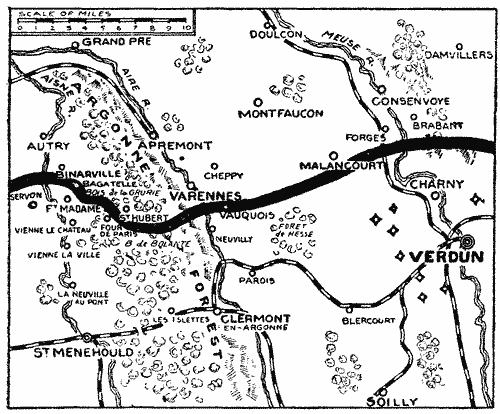
Scene of the German Crown Prince's drive in the Argonne.
[Enlarge]
The official statement issued at Berlin on July 15 says:
The French made repeated attempts yesterday, which lasted into the night, to recapture the positions we took from them in the Forest of Argonne. Notwithstanding the employment of large quantities of ammunition and of strong forces recently brought up, all their attacks broke down. In many places there was bitter fighting with hand grenades and encounters at close quarters.
The enemy paid for his unsuccessful efforts with extraordinarily heavy losses. The number of French prisoners has been increased to 68 officers and 3,688 men.
The success of our troops was all the more remarkable as, according to corresponding statements made by prisoners, the French had prepared for a great attack against our positions on the Argonne front on July 14, their national festival day.
The text of the German official statement published July 16 is as follows:
French attacks delivered yesterday and the day before to the west of the Argonne Forest failed in the face of the North German Landwehr, who inflicted large and sanguinary losses on the enemy in bitter hand-to-hand fighting. We captured 462 prisoners.
Since June 20 our troops have fought continually in the Argonne and to the west of that forest, with the exception of short interruptions. In addition to the gain in territory and booty in materials a total of 116 officers and 7,009 French prisoners has been reached up to the present.
On our front which joins the Argonne to the east, lively artillery battles are in progress. Attacks made by the enemy in this region were repulsed without difficulty.
In a dispatch from Berlin, dated July 16, by Wireless to Sayville, N.Y., it is reported that in the news items given out by the Overseas News Agency was the following:
German military tacticians point out that the German victory in the Forest of Argonne, in France, is of special importance, as it shows that the connections toward Western France are gradually being cut.
The large amount of war materials captured by the Germans in the last battle illustrates the importance attributed to the positions by the French commanders. The French, however, were unable to resist the terrific offensive of the Crown Prince's army.
