Inferences from Eleven Months of the European Conflict
Reading edition
By Charles W. Eliot, President Emeritus of Harvard University
Asticou, Maine, July 16, 1915.
To the Editor of the New York Times:
THE inferences of the first importance are military and naval. In the conduct of war on land it has been demonstrated during the past eleven months that success in battle depends primarily on the possession and skillful use of artillery and machine guns. The nation which can command the largest quantity of artillery in great variety of calibre and range, has developed the amplest and quickest means of transporting artillery and supplies of all sorts, and whose troops can use mortars, howitzers, and cannon at the highest speed and with the greatest accuracy will have important advantages over an enemy less well provided, or less skillful. Before every assault by infantry artillery must sweep and plow the position to be captured, and so soon as the enemy has lost a trench or a redoubt the enemy's artillery will try to destroy the successful troops with shell and shrapnel, before the enemy's infantry makes a counter-attack. Whenever troops have open ground to cross before they reach the intrenchments of the enemy, they encounter a withering fire from machine guns, which is so effective that assaults over open ground have, for the most part, to be undertaken at night or in fog, or by some sort of surprise.
In general the defense has great advantage over the attack, as regards expenditure of both men and munitions. So decided is the advantage of the defense, that Germany can dismiss all those apprehensions about invasion by the Russian hordes with which she set out on this war. Success in military movements on a large scale depends on the means of transportation at hand; and these means of transportation must include railroads, automobiles, and horse wagons, the function of the automobile being of high importance wherever the roads are tolerably good. There is little use for cavalry in the new fighting; for aeroplanes can do better scouting and more distant raiding than cavalry ever could, and large bodies of infantry with their indispensable supplies can be moved faster and further by automobiles than cavalry could ever be.
The aeroplane also defeats the former use of cavalry to screen from the enemy's view the movements of troops and their trains behind the actual fronts. Moreover, cavalry cannot stand at all against the new artillery and the machine gun. An old-fashioned cavalry charge in the open is useless, and indeed impossible. Aerial warfare is still undeveloped, but the war has proved that the aeroplane, even in its present imperfect condition, is a useful instrument. The Zeppelin, on the other hand, seems to be too fragile and too unmanageable for effective use in war. Rifle fire is of far less importance than artillery and machine gun fire; and, indeed, the abandonment of the rifle as the principal arm for infantry is clearly suggested.
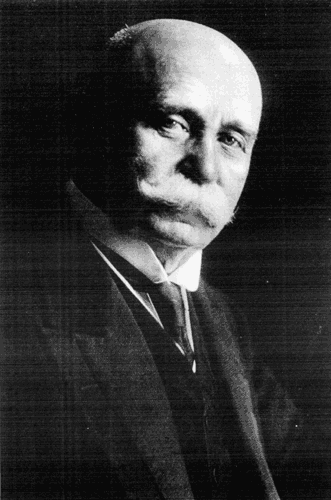
COUNT ZEPPELIN Inventor of the Air-ship that has Still to Demonstrate its Efficiency as an Engine of War
Elaborate forts made of iron and concrete are of little use against a competent invader, and fortifications round about cities are of no use for protection against an enemy that possesses adequate artillery. For the defense of a frontier, or of the approaches to a railroad junction or a city, a system of trenches is immeasurably superior to forts, particularly if behind the trenches a network of railways or of smooth highways exists. Wounds are often inflicted by jagged pieces of metal which carry bits of dirty clothing and skin into the wounds, and the wounded often lie on the ground for hours or even days before aid can reach them. Hence the surgery of this war is largely the surgery of infected wounds, and not of smooth aseptic cuts and holes. A considerable percentage of deaths and permanent disabilities among the wounded is the inevitable result. Surgeons and dressers are more exposed to death and wounds than in former wars, because of the large use of artillery of long range, the field hospitals being often under fire.
From these changes in the methods of war on land it may be safely inferred that a nation which would be strong in war on land must be strong in all sorts of manufacturing, and particularly in the metallurgical industries. A nation chiefly devoted to agriculture and the ancient trades cannot succeed in modern war, unless it can beg, borrow, or buy from sympathizers or allies the necessary artillery and munitions. No amount of courage and devotion in troops can make up for an inadequate supply of artillery, machine guns, shells, and shrapnel, or for the lack of ample means of rapid transportation. Only in a rough country without good roads, like the United States in 1861-65, or Serbia or Russia now, can the rifle, light artillery, and horse or ox wagons win any considerable success; and in such a country the trench method can bring about a stalemate, if the combatants are well matched in strength, diligence, and courage.
The changes in naval warfare are almost equally remarkable. Mines and submarines can make the offensive operation of dreadnoughts and cruisers near ports practically impossible, and can inflict great damage on an enemy's commerce. Hence important modifications in the rules concerning effective blockade. In squadron actions victory will probably go to the side which has the gun of longest range well-manned. Defeated war vessels sink as a rule with almost all on board. Commercial vessels can seldom be taken into port as prizes, and must therefore be sunk to make their capture effective. There have been no actions between large fleets; but the indications are that a defeated fleet would be sunk for the most part, the only vessels to escape being some of the speedier sort. Crews would go down with their vessels. Shore batteries of long-range guns can keep at a distance a considerable fleet, and can sink vessels that come too near. Mines and shore batteries together can prevent the passage of war vessels through straits ten to fifteen miles wide, no matter how powerful the vessel's batteries may be. Every war vessel is now filled with machinery of various sorts, much of which is delicate or easily disabled. Hence a single shell exploding violently in a sensitive spot may render a large ship unmanageable, and therefore an easy victim. A crippled ship will probably be sunk, unless a port is near.
To build and keep in perfect condition a modern fleet requires dockyards and machine shops of large capacity, and great metallurgical industries always in operation within the country which maintains the fleet. No small nation can create a powerful fleet; and no nation which lives chiefly by agriculture can maintain one. A great naval power must be a mining, manufacturing, and commercial power, with a sound banking system available all over the world.
The war has proved that it is possible for a combination of strong naval powers to sweep off the ocean in a few months all the warships of any single great power, except submarines, and all its commerce. Germany has already suffered that fate, and incidentally the loss of all her colonies, except portions of German East Africa and Kamerun, both of which remnants are vigorously assailed and will soon be lost. Nevertheless, she still exports and imports through neutral countries, though to a small amount in comparison with the volume of her normal trade. Here is another illustration of the general truth that colonies are never so good to trade with as independent and prosperous nations.
Again the war has proved that it is not possible in a normal year to reduce by blockade or non-intercourse the food supply of a large nation to the point of starvation, or even of great distress, although the nation has been in the habit of importing a considerable fraction of its food supply. An intelligent population will make many economies in its food, abstain from superfluities, raise more food from its soil, use grains for food instead of drinks, and buy food from neutral countries so long as its hard money holds out. Any large country which has a long seaboard or neutral neighbors can probably prevent its noncombatant population from suffering severely from want of food or clothing while at war. This would not be true of the districts in which actual fighting takes place or over which armies pass; for in the regions of actual battle modern warfare is terribly destructive—as Belgium, Northern France, Poland, and Serbia know.
A manufacturing people whose commercial vessels are driven off the seas will, of course, suffer the loss of such raw materials of its industries as habitually came to it over seas in its own bottoms—a loss mitigated, however, by the receipt of some raw materials from or through neutral countries. This abridgment of its productive industries will, in the long run, greatly diminish its powers of resistance in war; but much time may be needed for the full development of this serious disability.
Because of the great costliness of the artillery, munitions of war, and means of transportation used in the present war, the borrowings of all the combatant nations are heavy beyond any precedent; so that already all the nations involved have been compelled to raise the rates of interest on the immense loans they have put upon the market. The burdens thus being prepared for the coming generations in the belligerent nations will involve very high rates of taxation in all the countries now at war. If these burdens continue to accumulate for two or three years more, no financier, however experienced and far-seeing, can imagine today how the resulting loans are to be paid or how the burden of taxation necessary to pay the interest on them can be borne or how the indemnities probably to be exacted can be paid within any reasonable period by the defeated nation or nations.
It follows from these established facts that a small nation—a nation of not more than fifteen millions, for example—can have no independent existence in Europe except as a member of a federation of States having similar habits, tendencies, and hopes, and united in an offensive and defensive alliance, or under guarantees given by a group of strong and trustworthy nations. The firm establishment of several such federations, or the giving of such guarantees by a group of powerful and faith-keeping nations ought to be one of the outcomes of the war of 1914-15. Unless some such arrangement is reached, no small State will be safe from conquest and absorption by any strong, aggressive military power which covets it—not even if its people live chiefly by mining and manufacturing as the Belgians did.
The small States, being very determined to exist and to obtain their natural or historical racial boundaries, the problem of permanent or any durable peace in Europe resolves itself into this: How can the small or smaller nations be protected from attack by some larger nation which believes that might makes right and is mighty in industries, commerce, finance, and the military and naval arts? The experience gained during the past year proves that there is but one effective protection against such a power, namely, a firm league of other powers—not necessarily numerous—which together are stronger in industries, commerce, finance, and the military and naval arts than the aggressive and ambitious nation which heartily believes in its own invincibility and cherishes the ambition to conquer and possess.
Such a league is the present combination of Great Britain, France, Russia, Italy, and Japan against the aggressive Central Monarchies and Turkey; but this combination was not formed deliberately and with conscious purpose to protect small States, to satisfy natural national aspirations, and to make durable peace possible by removing both fear of invasion and fear of the cutting off of overseas food and raw materials. In spite of the lack of an explicit and comprehensive purpose to attain these wise and precious ends, the solidity of the alliance during a year of stupendous efforts to resist military aggression on the part of Germany and Austria-Hungary certainly affords good promise of success for a somewhat larger league in which all the European nations—some, like the Scandinavian and the Balkans, by representation in groups—and the United States should be included. Such a league would have to act through a distinct and permanent council or commission which would not serve arbitrary power, or any peculiar national interest, and would not in the least resemble the "Concert of Europe," or any of the disastrous special conferences of diplomatists and Ministers for Foreign Affairs, called after wars since that of 1870-71 to "settle" the questions the wars raised.
The experience of the past twelve months proves that such a league could prevent any nation which disobeyed its orders from making use of the oceans and from occupying the territory of any other nation. Reduction of armaments, diminution of taxation, and durable peace would ensue as soon as general confidence was established that the league would fairly administer international justice, and that its military and naval forces were ready and effective. Its function would be limited to the prevention and punishment of violation of international agreements, or, in other words, to the enforcement of treaty obligations, until new treaties were made.
The present alliance is of good promise in three important respects—its members refuse to make any separate peace, they co-operate cordially and efficiently in military measures, and the richer members help the poorer financially. These policies have been hastily devised and adopted in the midst of strenuous fighting on an immense scale. If deliberately planned and perfected in times of peace, they could be made in the highest degree effective toward durable peace.
The war has demonstrated that the international agreements for the mitigation of the horrors of war, made by treaties, conferences, and conventions in times of peace, may go for nothing in time of war; because they have no sanction, or, in other words, lack penalties capable of systematic enforcement. To provide the lacking sanction and the physical force capable of compelling the payment of penalties for violating international agreements would be one of the best functions of the international council which the present alliance foreshadows. Some years would probably be required to satisfy the nations concerned that the sanction was real and the force trustworthy and sufficient. The absolute necessity of inventing and applying a sanction for international law, if Europe is to have international peace and any national liberty, will be obvious to any one who has once perceived that the present war became inevitable when Austria-Hungary, in violation of an international agreement to which she was herself a party, seized and absorbed Bosnia and Herzegovina, and became general and fierce when Germany, under Prussian lead, in violation of an international agreement to which she was herself a party, entered and plundered neutralized Belgium.
A strong, trustworthy international alliance to preserve the freedom of the seas under all circumstances would secure for Great Britain and her federated commonwealths everything secured by the burdensome two-navies policy which now secures the freedom of the seas for British purposes. The same international alliance would secure for Germany the same complete freedom of the seas which in times of peace between Germany and Great Britain she has long enjoyed by favor of Great Britain, but has lost in time of war with the Triple Entente. This security, with the general acceptance of the policy of the "open door," would fully meet Germany's need of indefinite expansion for her manufacturing industries and her commerce, and of room "in the sun" for her surplus population.
It is a safe inference from the events of the past six months that the longer the war lasts the more significant will be the political and social changes which result from it. It is not to be expected, and perhaps not to be desired, that the ruling class in the countries autocratically governed should themselves draw this inference at present, but all lovers of freedom and justice will find consolation for the prolongation of the war in this hopeful reflection.
To devise the wise constitution of an international council or commission with properly limited powers, and to determine the most promising composition of an international army and an international navy are serious tasks, but not beyond the available international wisdom and goodwill, provided that the tasks be intrusted to international publicists, business men of large experience, and successful administrators, rather than to professional diplomatists and soldiers. To dismiss such a noble enterprise with the remark that it is "academic," or beyond the reach of "practical" politics, is unworthy of courageous and humane men; for it seems now to be the only way out of the horrible abyss into which civilization has fallen. At any rate, some such machinery must be put into successful operation before any limitation of national armaments can be effected. The war has shown to what a catastrophe competitive national arming has led, and would probably again lead the most civilized nations of Europe. Shall the white race despair of escaping from this hell? The only way of escape in sight is the establishment of a rational international community. Should the enterprise fail after fair trial, the world will be no worse off than it was in July, 1914, or is today.
Whoever studies the events of the past year with some knowledge of political philosophy and history, and with the love of his neighbor in his heart, will discover, amid the horrors of the time and its moral chaos, three hopeful leadings for humanitarian effort, each involving a great constructive invention. He will see that humanity needs supremely a sanction for international law, rescue from alcoholism, and a sound basis for just and unselfish human relations in the great industries, and particularly in the machinery industries. The war has brought out all three of these needs with terrible force and vividness. Somehow they must be met, if the white race is to succeed in "the pursuit of happiness," or even to hold the gains already made.
CHARLES W. ELIOT.