Hudson Maxim on Explosives
Reading edition
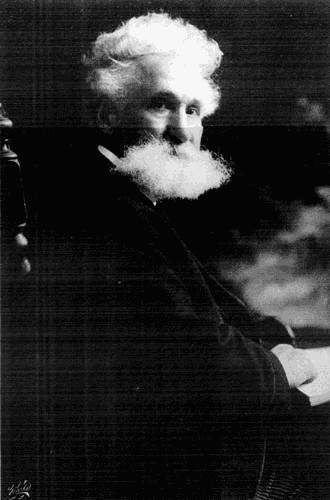
HUDSON MAXIM American Inventor of High Explosives and Other Materials of War (Photo by White.)
The New York Times on July 11 printed an interview with Hudson Maxim, the inventor of explosives, in which Mr. Maxim said:
Modern war is a warfare of explosives. The highly developed methods of defense, designed especially against explosives, are practically proof against everything but them.
Attacking forces must disemburrow the defending forces; they must be blasted out of the ground. This warfare amounts, literally, to that. It is as if boys hunted woodchucks with dynamite.
Each of the hard-won successes of the war has been a victory for well-placed high explosives. In the last fight around Przemysl the Germans fired in one hour, from field guns, 200,000 shells carrying high explosives.
Reports indicate that the result of this was literally unprecedented. It actually changed the topography of the country. Valleys were dug and hills razed.
Recently Lloyd George used an expressive phrase. "The trenches," he said, "were sprayed with exploding shells."
Such "spraying" only could be possible through the use of an incredible number of explosive projectiles.
America's plants for the production of explosives, cartridges, shrapnel, and rifles have so increased their capacity that we have today ten times the capacity which we had at the time of the war's outbreak, and, for certain things, the increase has been even greater. By the middle of next winter our capacity will be thirtyfold what it was at the beginning of the war.
Thus the fighting among other nations has done much toward preparing us for war, and, therefore, much toward insuring international peace for us, but even our tremendous contribution to the supplies of the Allies amounts to only about 2 per cent. of what they are consuming, and the war has not been running a year.
This indicates that if we should suddenly be involved in warfare with a great power we should be whipped unless we devised means for the increase of our productivity of war supplies, especially explosives and all ammunition materials, by a hundredfold.
The consumption of war material has been unprecedented, and this indicates what may be expected in future wars. In trench fighting, for example, it is estimated that four times as many rifles as men are required. The fighting man must have two because one quickly gets hot and becomes unusable; he must have a third so that he may still have two if one is hit by the return fire or otherwise rendered inefficient; he must have the fourth so that at least one of his weapons may be in the arms hospital undergoing repairs if necessary, and be ready for him in case one of his others is demolished. This development of modern warfare means that a million modern soldiers need four million modern rifles.
This indicates the enormous necessities which would devolve upon this country in case we were forced into a war. During the past week I have received a cable from an old friend in England who has been selling war munitions to the Allies. He asked me how quickly I could get a million rifles made in the United States. The best bids I have been able to obtain have guaranteed a first delivery at the end of one year and final deliveries at the end of three years.
One of the chief developments in the matter of explosives has been the fact that the United States has found it possible to teach Europe much during this war in regard to smokeless powder. Several years ago the du Pont Powder Company developed a smokeless rifle powder which permits the firing of more than 20,000 rounds from an ordinary army rifle without destroying its accuracy.
When the du Ponts developed their new rifle powder the best European powder destroyed the rifling and accuracy of the gun at about 3,000 rounds. This American invention, therefore, has increased the life of military rifles by sevenfold. Say that an equipment of military rifles cost at the rate of, say, $20 each, and we will find that this means a saving of, roughly, $100,000,000 in the equipment of a million men with one rifle each, and, as they need four rifles each, it means a saving of $400,000,000.
American smokeless powder for cannon also has its advantages. It erodes the guns much less than any European powder except, possibly, that of the Germans. They have a pure nitro-cellulose powder somewhat similar in quality to that of the United States, but ours has an advantage in being multi-perforated, whereby a higher velocity is insured at a lower pressure with, in consequence, a lessened erosive effect upon the guns.
In the early nineties I made the discovery that tri-nitro-cellulose, when combined with pyro-nitro-cellulose, could be much more readily gelatinated and made an excellent smokeless powder, while powder made from pure nitro-cellulose would warp and crack all to pieces in drying. The present German powder is made from such a compound of tri-nitro-cellulose and soluble nitro-cellulose.
Nevertheless, this compound is a makeshift as compared with the nitro-cellulose used by this Government. Ours is a far better explosive, and is less erosive on the guns, because the gases which it generates are not so hot. We have the best smokeless powder in the world, and, after this war is over, our powder will be universally used.