France’s “Eyewitness” Reports
Reading edition
HILGENFIRST
The following details published in Paris on July 11 by an official "Eyewitness" with the French army of the desperate fighting which resulted in the capture of the summit of Hilgenfirst, more than 3,000 feet high, in the Langenfeldkopf region, in the Vosges Mountains, are given in an account of the struggle written by an official eyewitness with the French army.
In the fight for the capture of the eminence of Hilgenfirst, one company of our advance guard which forced a breach in the German lines was cut off from its battalion as the result of a German counter-attack. This company, nevertheless, succeeded in maintaining the conquered position four days until finally relieved.
On June 14 the Sixth Company of the Seventh Battalion crawled from its trenches and deployed toward a clearing in the woods opposite. It then charged, taking the German trenches. The Germans fled to the woods, leaving a quick-firer. Our men immediately began fortifying the position, but our sentries reported that German patrols had been seen encircling the French. Other companies were ordered forward immediately to support the one in the trench.
Meanwhile large German reinforcements had been brought up, making it impossible to reach our men. The captain in the trench, realizing that he was surrounded, ordered some of his men to form a hollow square and defend the position while others dug trenches on four sides. The Germans attacked in great force with quick firers and rifles, but withdrew at nightfall after a battle lasting two hours. Our men defending the position numbered 137, including five officers. One officer and twenty-seven men were wounded.
The following day, despite a well-directed fire from our main positions, the Germans again attacked in large numbers, advancing in columns of four. The situation now began to look critical, but at the crucial moment a hail of shrapnel from our 75.8 completely decimated one advancing column. The edge of the wood out of which the column advanced was piled high with German bodies and the remainder of the force scattered in flight.
In the afternoon the Germans again prepared for an attack, but the attempt was frustrated by our infantry fire. During the night the captain told off men to rest in squads, the others being constantly on the alert. At dawn a second lieutenant and a few men surprised a small German scouting detachment of twenty men commanded by a non-commissioned officer. Our men threw themselves upon the Germans, killing the officer and two men, the others taking to their heels at top speed.
At 10 o'clock the main body of our troops succeeded in establishing communications with the isolated company which called for help in the provincial dialect. We answered that we would attack at nightfall, but that the attack would be preceded by a heavy bombardment.
Accordingly, they constructed heavy bomb-proof shelters on the four sides of the square and anxiously waited. At 9 o'clock the attack was begun with artillery, quick firers and rifles, but it was insufficient to drive out the Germans, who had in the meanwhile established well-protected trenches and, with an excellent telephone system, made any surprise movement impossible.
The company's rations were now becoming very low. Delirious cries of the wounded added to the discomfiture of the men. The following morning a German patrol tried to take the position by storm, and some of the men succeeded even in mounting the parapet. These were driven off by a quick firer which had been captured from the Germans. On other advancing troops of the enemy huge boulders, dug from the hillside, were rolled down and we succeeded in dispersing the attack.
Another attack was prepared by us for that night, but the danger was great on account of the narrowness of the position occupied by the company. The captain of the company was ordered to light fires at the opposite ends of his position, so that our artillery could better regulate its fire, as there was great danger of killing our own men.
The artillery opened a crushing fire, and the Germans began to retreat. As they passed the company's position their men were mowed down by the exactness of the fire of our troops, and finally the brave company was delivered.
The general in command of the army in the Vosges said, in complimenting the men for their bravery, the company henceforth should be called "Company Sid Ibrahim."
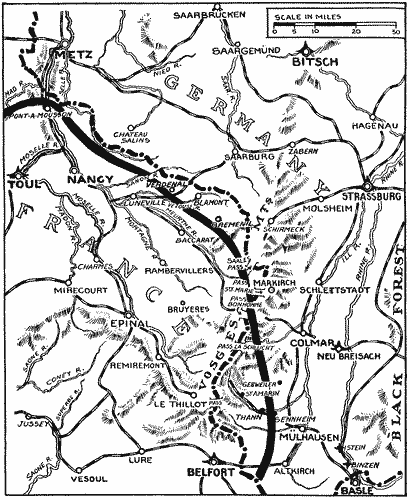
Battle line in the Vosges, July 20
[Enlarge]
BATTLE OF FONTENELLE
The official French "Eyewitness" at the front reported on July 18 giving details of the French success in the battle of Fontenelle, in the Vosges. The scene of the conflict is in the neighborhood of the village of Senones and the forest of Ormont, and the ground is described as undulating and cut by deep ravines.
It was in this region, says the observer, that the Germans, after the battle of the Marne, look up a position on a summit commanding the surrounding countryside. This hill was Height 627, which is known as Fontenelle.
On June 22, after severe losses, the enemy succeeded in occupying Fontenelle, says the observer. Although we counter-attacked vigorously, taking 142 prisoners, the enemy held the summit. General Van Kuderzen, in a report dated July 3, said that after a careful inspection of the German works and trenches he finally believed that the hill had been transformed into an impregnable fortress, and that its capture would necessitate tremendous losses.
On July 8 all necessary preparations for the attack had been completed. The same day, at nightfall, three columns, aided by a remarkably accurate artillery fire, took a portion of the enemy's trenches. In the center we also attacked, forcing the enemy to the west of Launois in ten minutes. The attack on the left proceeded more slowly, but, aided by gathering darkness, we took possession of the northwestern portion of the hill.
At daybreak not only the whole of the summit had been retaken, but a majority of the German defenses as far as the road from Launois to Moyen-Moutier. Thanks to our artillery, all preparations for counter-attacks were immediately stopped.
During the battles of July 8 and 9 we took 881 prisoners, including 21 officers. When questioned the prisoners gave great praise to our excellent artillery marksmanship, saying: "We did not believe there could be such a hell of fire."
BETWEEN BETHUNE AND ARRAS
An Associated Press dispatch dated on the heights of Notre Dame de Lorette, near Arras, July 10, gave the following account of the 120 days' fight ended successfully by the use of high explosives:
After fighting 120 days for the hill country between Bethune and Arras, the French forces are in possession of all the eminences looking out upon the plain of Flanders. Lille, Douai, and Chambrai all are visible from here.
Every position along the broad national road between Arras and Bethune has been won except Souchez, and last night another quarter mile of trenches in the Souchez web was torn away. The attack was made under parachute rocket lights, the French burning bluish white and the Germans greenish white, covering the scene of the desperate conflict with a ghastly glow.
The most desperate fighting has been along the short ten-mile front from Arras to Aix-Noulette, which began March 9 with the taking of a few hundred yards of trenches on the watershed of Notre Dame de Lorette, where there are the ruins of an old Merovingian military road. Every day since then some section of the German trenches has been taken, lost, or retaken.
Each side has been employing formidable artillery both of small and heavy calibre, the French guns being somewhat more numerous and served with unlimited quantities of high explosive shells.
A correspondent of The Associated Press today went through five or six miles of the trenches formerly held by the Germans and reconstructed by the French, who now have abandoned them to move forward. Upward of 100,000 Germans have fallen or been captured in these trenches, according to the French official count, since the second week of March. The French losses, the correspondent was confidentially informed, while serious, have been much smaller than those of the Germans. There are thickets of little crosses made of twigs tied together, marking the graves between the trenches. Some of these graves have been torn up by the shell fire.
Almost every square yard of this region is marked by miniature craters caused by exploding shells. Spots where shells penetrated the earth without exploding are indicated by signs bearing the words "Live Shell."
One line of the German works was just below the summit of a steep slope which, from the nature of the ground, could not be shelled without danger to the French position a little higher up. The Germans were sheltered in dugouts under the hillside, and their French assailants, sliding or jumping down into the trenches, were shot or bayoneted from caves. The line was finally taken by tossing grenades by the basketful into the trenches until most of the defenders in the concaved shelters were killed or wounded. Every curve or angle in the miles of labyrinthine cuttings has its story of tragedy and heroism.
In the party which went over this ground and into the firing trenches within calling distance of the German lines with The Associated Press correspondent were Owen Johnson, Arnold Bennett, Walter Hale and George H. Mair, the last representing the British Foreign Office. As they approached the lines one shell from a four-inch gun burst within twenty-five yards of them, while others exploded only thirty or forty yards away. This incident seemed greatly to amuse the soldiers in the trenches, who laughed heartily at the embarrassment of the civilians.
The visitors were invited by the soldiers into their shelters, which are dry caves with narrow entrances and with clay floors covered with matting or sacking and faintly illuminated by the light which filters in from the entrance or by bits of candle on the inside. Men who had been on duty throughout the night were sleeping in these caves.
The men on the firing line express the utmost confidence that what was done yesterday and this morning they can keep on doing until the war has been won. They never hear the vague, unverified reports circulated in Paris, sometimes of tremendous and impossible victories, sometimes sinister hints of disaster. They know what they have done since March 9, when they were ordered to act on this part of the Aisne. They talk as a matter of course of another winter campaign, because, they say, it will take another year to break the German power.
ARRAS’ GRASS-GROWN STREETS
An Associated Press dispatch of July 9 from Arras via Paris reads:
Shells have been dropping into Arras at intervals today, as they have been for 250 days. Each twenty-four hours a few more buildings crumple or burn, although the Fire Department still is efficient in extinguishing flames.
One thousand civilians out of a former population of 35,000 are still here. There were 4,000 in December when The Associated Press correspondent first visited the town. A few scores of the inhabitants have been killed or wounded, while the others have been persuaded by the military authorities to go away. None of those remaining thinks of sleeping anywhere except in a cellar. The rest of their time they spend out of doors, when no shells are falling.
The streets, which formerly were filled with traffic, are now grass-grown. Two postmen deliver the mail, which comes regularly once a day by military post. Several shops located underground are open for business. Displayed on cellar doors are baskets of fresh vegetables, which can be bought at about the same prices as in Paris. Inside the principal grocery are many standard brands of American, French, and British canned goods.
About half the outer walls of the beautiful City Hall are still standing, but there remains only one jagged corner of the imposing belfry which once adorned the great square of Arras. A citizen occupying a cellar on the other side of the square counted the shells which struck the belfry, and says it took 360 to shatter the beautiful bit of architecture.
ARRAS CATHEDRAL
An Associated Press dispatch from Paris dated July 13 reports:
Since June 27 the Germans have systematically bombarded various parts of Arras with projectiles of all calibres, says an official communication given out today by the French War Department.
On June 27 the bombardment was extremely violent and was executed by six-inch, eight-inch and seventeen-inch guns, between the hours of 8 A.M. and 2 P.M., and between 6 P.M. and 7:30 P.M. The fire was directed particularly at the citadel and neighboring streets.
On July 3, toward 6:30 o'clock in the evening, a further bombardment took place in which incendiary shells were used, and they started a most violent fire.
On July 5 at 4:30 P.M., the statement continues, the enemy recommenced its bombardment of the city, concentrating its fire upon the environs of the cathedral, more especially upon St. Vaast, the ancient Bishop's palace, which had been transformed into a museum. Incendiary shells set the building on fire, and the use of fuse shells from three-inch and four-inch guns prevented our organizing to combat the fire, which soon assumed great proportions and completely destroyed the palace. During the night there was an intermittent bombardment.
On July 6, about 7 A.M., shells fell on the Cathedral, the roof of which took fire, and, despite the efforts of our troops, was entirely consumed, as were the Cathedral organs.
The departmental archives, which had been deposited in the Palace of St. Vaast, had been placed in the cellar of the palace before the bombardment and were saved. The sacred ornaments and part of the furnishings in the Cathedral were removed.
IN THE FECHT VALLEY
The French official "Eyewitness" reported on July 15 the French victory in the battle of Metzeral in upper Alsace, as follows:
The operations by which our troops captured the towns of Metzeral and Sondernach, which are situated in the Fecht Valley, have been remarkable because of the means employed and the results obtained, and as the Alpine troops have been forced to surmount all possible difficulties.
Metzeral, the eyewitness explains, is situated in a valley surrounded by high hills, the sides of which dropped precipitously down to the Fecht region. On these hills was stationed artillery, to the rear of which, within easy access, large reinforcements could be massed and brought to the front when needed. He continued:
From prisoners we learned that the Germans considered their position impregnable. It was surrounded by several lines of trenches and barbed wire entanglements. We made long preparations for the attack, concentrating troops and bringing supplies up the Vosges through winding, narrow, and hastily constructed roads, twenty miles in length. New trenches were dug, mines laid, and various other details attended to.
On June 15, after prolonged and heavy artillery fire on both sides of the valley, the attack was begun against Hill 830, on which we captured trenches situated on the slopes, taking two companies prisoners. A portion of the trenches on Braunkopf also fell into our hands.
At Eichwald we gained less, as here the German fortifications were strongest. At Anlass, also, although many grenades were thrown, the fortifications were of such a character as to make it impossible to break through.
On the day following the attack was resumed, with the purpose of gaining us all the positions on Braunkopf and Hill 830. We began at this point to encircle Eichwald, as the road to Metzeral now lay open. The Germans remained at Anlass, where our attack always stopped, and with their fire across the valley on Braunkopf made it impossible for us to proceed.
All our efforts were now concentrated on Anlass. We attacked on June 18 and 19, and on the 20th the German positions fell into our hands. Our troops continued on down the valley, capturing 6 officers, 11 non-commissioned officers, and 140 men.
An attack directed at the same time against Winterhagel, situated to the south of Anlass, was marked by a sad incident. A small group of chasseurs who succeeded in breaking through the barbed-wire entanglements found themselves under a crossfire of quick-firers. The men tried to construct a shelter with the tools they carried. The Germans cried "Surrender!" Not one man answered. The quick-firers accomplished their work, and the men were found lying with faces to the ground, as if they had dropped when drawn up in line for parade.
Our attacks were now centred on Metzeral. The factory at Steinbruck was taken on the night of June 17, and a battalion entered Altenkof the day following. On June 21 our men came down from Braunkopf, surrounded the village on the north, and took the railway station. The Germans in Metzeral, threatened with capture, placed quick-firers in several houses to protect their retreat and prepared to set the place on fire. Our artillery quickly demolished the houses in which German artillery had been placed, and our troops entered the flaming streets from the north and west. The village was burned.
On the two following nights, while our troops harassed the retreating enemy, Winterhagel and Sondernach fell into our hands and our line was established along the length of the valley of the Fecht as far as Sondernach.
The action resulted in the capture of 20 officers, 53 non-commissioned officers, and 638 men.