Armenian, Orduna, and Others
Reading edition
The diplomatic significance of the sinking of the Leyland liner Armenian on June 28 off the northwest coast of Cornwall is thus dwelt upon in a Washington dispatch to The New York Times, dated July 2, 1915:
The lessons to be derived from the destruction of the Leyland liner Armenian off the English coast are expected to have a most important bearing upon the diplomatic controversy between Germany and the United States over the safety of human life in the submarine warfare.
It is believed here that the Armenian affair demonstrates that it is possible for German submarines of the latest types, when equipped with outside rapid-fire guns, to comply with the demand of President Wilson that the belligerent right of visit and search must be complied with before merchantmen and passenger ships are torpedoed.
Whatever the facts as to minor detail, the outstanding lesson of the affair is that a merchantman tried to escape capture and was finally forced to halt and surrender by a pursuing submarine, and the destruction of the liner by torpedo was not attempted until after those on board who survived the chase had an opportunity to take to the boats. It is evident that if the Armenian's Captain had heeded the warning shots of the submarine and halted the steamer he could have submitted to visit and search and in all probability the destruction of the Armenian could have been effected without loss of life. All international law experts agree that a vessel that refuses to halt when challenged by warning shots from a properly commissioned belligerent war vessel proceeds at her own peril.
In its broader aspects, the Armenian incident presents the most important lesson that has come out of the German undersea campaign for consideration by those engaged in the diplomatic controversy over the various acts of the German submarines—and the lesson is considered extremely vital in its bearing on the pending negotiations, because, if it is at all possible for submarines to exercise the right of visit and search and they actually proceed in accordance with that rule, the Germans may proceed with their warfare against merchantmen carrying contraband without running counter to the expectations of the United States Government. Occasional merchantmen may try to escape capture or destruction by disregarding warning shots, but that will be their affair and the responsibility for loss of life due to efforts to elude submarines, and caused during the period of continued efforts to escape, would not then rest upon the submarines.
The effective use of rapid-fire guns mounted on submarines in bona fide efforts to halt merchant steamers for purpose of visit and search is the important factor in the situation. A submarine not so equipped would find it difficult, if not impossible, to apply the rule of visit and search. Without the outside guns such a submarine would possess no other effective weapon than the torpedo. The submarine that carried no exterior armament could not compel obedience to its mandate for the merchant Captain to stop without firing a torpedo and thus risking the destruction of life with the sinking of the steamer, and a submarine with no outside armament might run the risk, as frequently contended by the German Admiralty, of bomb attack from the rails of the merchant steamer when going alongside of such a vessel.
A submarine like the U-38, which sank the Armenian, carrying one or more outside guns, capable of discharging various kinds of shell, from blank shots to shrapnel, represents an important evolution in the development of marine warfare. Such a craft has the equipment to enable her to visit and search a passing merchantman, and to provide for the safe removal of officers, crew or passengers from a challenged steamer, before the destruction of the vessel. It is only necessary for such a submarine to fire her torpedoes as a last resort for the destruction of the steamer. With her exterior guns a submarine like the U-38, upon meeting a merchant vessel, may fire one or more warning shots, as Captain Trickey of the Armenian says the U-38 did.[1] The raider, he said, fired two warning shots, and when he turned away from her and put on speed, the submarine's guns opened fire on him with shrapnel.
THE ANGLO-CALIFORNIAN
Like the Armenian, the British merchantman Anglo-Californian refused to lie-to when signaled by a German submarine on July 2. Her crew of ninety-five included fifty Americans and Canadians. A Queenstown dispatch of July 5 gave the following account of the action:
The Anglo-Californian left Montreal for the British Isles on June 24. The submarine was sighted at 8 o'clock last Sunday morning. Captain Parslow ordered full steam ahead and wireless calls for aid were sent out. The submarine on the surface proved to be a far speedier craft than the steamer and rapidly overhauled her, meanwhile deluging her with shells. One shot put the wireless apparatus on the Anglo-Californian out of action. Finding that he could not escape by running for it Captain Parslow devoted his attention to manœuvring his ship so as to prevent the submarine from using torpedoes effectively.
"Our Captain was a brave man," said one of the narrators. "He kept at his post on the bridge, coolly giving orders as the submarine circled around us vainly seeking to get a position from which it could give us a death blow with a torpedo. All the while the under-water boat continued to rain, shot and shell upon us, and at times was so close that she was able to employ rifle fire effectively.
"At last one shell blew the Captain off the bridge, killing him outright and terribly mutilating him. Just before that he had given orders to launch the boats, but this was very difficult under the shell fire. Several men were struck down while working at the davits. Ultimately four boats were got overboard and were rowed away until picked up."
The son of Captain Parslow, serving as second mate, was standing by his father's side when the Captain was killed. The son was knocked down by the violence of the explosion. Springing to his feet, he seized the wheel, and, as ably as his father had done, continued dodging the submarine. Another shell burst alongside him, shattering one of the spokes of the wheel, but young Parslow retained his post.
The wireless SOS calls that had been sent out at the first alarm had reached those able to give more than passive assistance, however, and British destroyers appeared. On their approach the submarine abandoned the attack and submerged. Young Parslow was still at the wheel when the destroyers came up.
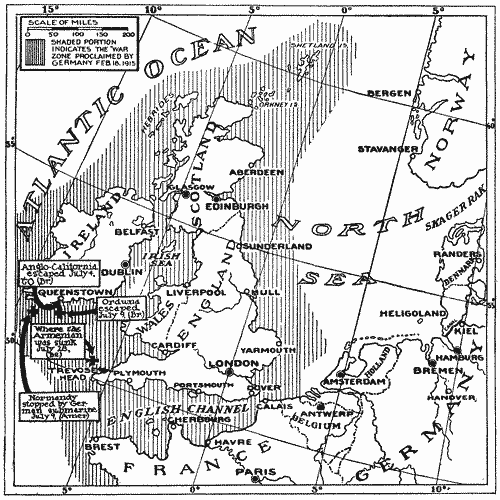
War zone area showing where the Armenian, (British); Normandy, (American); Anglo-Californian, (British), and Orduna, (British) ships were attacked during the month of July.
[Enlarge]
THE NORMANDY
An Associated Press dispatch from Liverpool, dated July 13, 1915, reported:
How an American ship is alleged to have been used as a shield by a German submarine for the sinking of another vessel is related by members of the crew of the American bark Normandy, which has arrived here from Gulfport, Miss.
The story is that the Normandy was stopped by a German submarine sixty miles southwest of Tuskar Rock, off the southeast coast of Ireland, Friday night. The captain was called aboard the submarine, whence his papers were examined and found to show that the ship was chartered by an American firm January 5.
The captain of the bark, it was asserted, was allowed to return to the Normandy, but under the threat that his ship would be destroyed unless he stood by and obeyed orders. These orders, it was stated, were that he was to act as a shield for the submarine, which lay around the side of the bark, hiding itself from an approaching vessel.
This vessel proved to be the Russian steamer Leo. Presently the submarine submerged and proceeded around the bow of the Normandy, so the story went, and ten minutes later the crew of the Normandy saw the Leo blown up.
Twenty-five persons were on board, of whom eleven were drowned, including three stewardesses. Those saved included three Americans, Walter Emery of North Carolina, Harry Clark of Sierra, and Harry Whitney of Camden, N.J. All these three men when interviewed corroborated the above story. They declared that no opportunity was given those on board the Leo for saving lives.
The Leo was bound from Philadelphia for Manchester with a general cargo.
The Captain of the Normandy told the survivors that he would have liked to signal their danger to them, but that he dared not do so, because his uninsured ship would then have been instantly sunk.
In a Washington dispatch to The New York Times, sent July 13, appeared the following:
The State Department received a short dispatch late this afternoon from Consul General Washington at Liverpool, confirming the report that three Americans were among those rescued by the American bark Normandy at the time of the sinking of the Russian merchant steamer Leo by a German submarine off the Irish coast Friday night. This is the case in which press dispatches asserted that the submarine commander forced the Captain of the Normandy to use his bark as a shield behind which the submarine hid before firing the torpedo which sank the Leo.
The cablegram from Consul General Washington makes no mention of this phase of the affair, and does not show whether the German submarine gave any warning to the commander of the Russian merchant ship before firing the shot which destroyed the latter vessel. The official message says that the Normandy was stopped by the submarine, that the Normandy's papers were examined, and that she was allowed to proceed. The message added that the Normandy rescued three American citizens who were members of the crew of the Leo, and names them as Walter Emery, seaman, of Swan Quarter, N.C.; Harry Whitney, steward, of Camden, N.J., and Harry Clark, fireman, of 113 East Fifty-second Street, Seattle, Wash.
THE ORDUNA
This is the official statement of Captain Thomas M. Taylor of the Cunard liner Orduna, concerning the attack made on his vessel by a German submarine off Queenstown, westbound, on the morning of July 9:
At 6.05 A.M., July 9, the lookout man on the after bridge rang the telegraph, at the same time pointing his hand downward and out on the port beam. The third officer was immediately sent aft to inquire what was seen. He returned quickly and reported both men had seen a torpedo pass across the stern from port to starboard, only ten feet clear of the rudder. In the meantime both the chief officer and myself distinctly saw the trail of the torpedo, extending from the stern to about 200 yards out on the port beam. About eight minutes afterwards the chief officer and I saw the submarine come to the surface about two points on the starboard quarter, a distance of about three-quarters of a mile, with five or six men on her deck, getting her guns ready.
I immediately ordered all possible steam, altered the course, and brought her right astern, when they began shelling us. The first shot struck the water abreast of the forecastle on the starboard side, about thirty feet off. The second dropped just under the bridge; third, abreast of No. 5 hatch, quite close alongside; fourth, under the stern, sending up a volume of water forty feet high; fifth and sixth and last shells all fell short. The firing then ceased, and the submarine was soon left far astern.
Marconi distress signals were sent out at once. We were thirty-seven miles south of Queenstown. I got a reply that assistance would be with us in an hour, but it was four hours before the small armored yacht Jennette appeared. I account for the torpedo missing the ship to their misjudging the speed, allowing fourteen knots instead of sixteen, which we were doing at the time. The torpedo passed only ten feet clear.
It was an ideal day for torpedo attack—light wind, slight ripple, clear weather. The periscope could only have been a few inches above water, for a very strict lookout was being kept at the time by chief and third officers and myself and four lookout men. However, we failed to see her before she fired the torpedo.
Not the least warning was given, and most or nearly all the passengers were asleep at the time. It was almost another case of brutal murder.
We had twenty-one American passengers on board.
A Washington dispatch of July 20 to The New York Times announced:
The President and the Cabinet decided today to have an investigation made in the case of the British steamer Orduna, which was attacked by a German submarine on July 9 while on her way from Liverpool to New York. This action was taken following the receipt of a statement from W.O. Thompson, counsel of the Federal Industrial Commission, who was a passenger on the ship.
Mr. Thompson did not see any torpedo fired at the Orduna by the German submarine, and was unable to give first-hand testimony that the Orduna had been fired on without notice. It was determined, however, that the report of Mr. Thompson justified the Government in making an investigation.
Accordingly, Secretary Lansing wrote a letter to Secretary McAdoo, requesting that his department undertake the investigation, which will probably be intrusted to the Collector of Customs at New York.
At the State Department it was said that the attention of the German Government had not been called to the charge that the Orduna was fired on by a German submarine without warning. Any action of that sort, if taken, will follow the investigation which is now ordered.
NEBRASKAN’S CASE
Ambassador Gerard on July 15 formally transmitted to Washington Germany's admission of liability and expression of regret for the attack by a German submarine on the American steamer Nebraskan.
Secretary Lansing's announcement of the German memorandum follows:
Ambassador Gerard has telegraphed to the Department of State the following memorandum from the German Foreign Office relative to the damaging of the American steamer Nebraskan by a German submarine:
"The German Government received from newspaper reports the intelligence that the American steamer Nebraskan had been damaged by a mine or torpedo on the southwest coast of Ireland. It therefore started a thorough investigation of the case without delay, and from the result of the investigation it has become convinced that the damage to the Nebraskan was caused by an attack by a submarine.
"On the evening of May 25 last the submarine met a steamer bound westward without a flag and no neutral markings on her freeboard, about 65 nautical miles west of Fastnet Rock. No appliance of any kind for the illumination of the flag or markings was to be seen. In the twilight, which had already set in, the name of the steamer was not visible from the submarine. Since the commander of the submarine was obliged to assume from his wide experience in the area of maritime war that only English steamers, and no neutral steamers, traversed the war area without flag and markings, he attacked the vessel with a torpedo, in the conviction that he had an enemy vessel before him. Some time after the shot the commander saw that the vessel had in the meantime hoisted the American flag. As a consequence, he, of course, refrained from any further attack. Since the vessel remained afloat, he had no occasion to concern himself further with the boats which had been launched.
"It results from this that without a doubt that attack on the steamer Nebraskan was not meant for the American flag, nor is it traceable to any fault on the part of the commander of the German submarine, but is to be considered an unfortunate accident. The German Government expresses its regret at the occurrence to the Government of the United States of America and declares its readiness to make compensation for the damage thereby sustained by American citizens."