Results of Submarine Warfare
Reading edition
LIVERPOOL’S EXPERIENCE
A London cable dispatch to The New York Times, dated London, July 8, said:
Nearly 20,000 vessels have entered or left the port of Liverpool since the German submarine blockade began. This, said Sir A. Norman Hill, Secretary of the Liverpool Steamship Owners' Association, speaking at Liverpool yesterday, showed that the Germans had failed in their attempt to blockade British ports.
On these 20,000 voyages the Germans had captured or destroyed only twenty-nine ships, he continued. What did that represent? Ships which had sailed in and out of Liverpool had completed in safety 998 out of every 1,000 voyages upon which they started. That was a magnificent record, he held, of perils faced and overcome.
FIRST WEEK WITH NO LOSS
An Associated Press dispatch of July 22 from London remarked:
So far as British vessels were concerned, the German submarines drew a blank during the week ended yesterday. Not a single British merchant ship or fishing craft was sunk.
It was the first week since the war began that some loss to British shipping had not been occasioned by German cruisers, mines, or submarines.
During the week 1,326 vessels of more than 300 tons each arrived at or departed from ports of the United Kingdom.
The German war-zone decree went into effect on February 18. Since then the weekly losses of ships and lives from torpedoes have been as follows:
Week EndingVessels.Lives.
February 25119
March 410
March 11738
March 18613
March 2572
April 113165
April 8813
April 1540
April 22310
April 2930
May 6245
May 1321,260
May 20713
May 2777
June 31932
June 103621
June 171919
June 2431
July 1929
July 8152
July 151213
July 2220
————
Total2181,652
Of the two vessels torpedoed in the week of July 22, the Russian steamer Balwa was attacked on July 16. On the following day another Russian steamer, the General Radetzky, was torpedoed. Both hailed from Riga, and the crews of both were saved.
WARFARE MODIFIED?
A record reported to have been compiled chiefly from British Admiralty sources since the sinking of the Lusitania was published by The New York American on July 13, showing that out of 122 ships sunk by German submarines in the war zone, every passenger or sailor was saved on all but 14. Following is The American's summary:
Total number of ships definitely reported sunk by German submarines in sixty-four days, since the Lusitania was torpedoed 122
Number of ships on which any loss of life occurred 14
[Note: Some of these fatalities occurred, according to British Admiralty reports, either from explosion of torpedoes or from upsetting of lifeboats, or from gunfire of submarines while the enemy ship was trying to escape.]
Total loss of life on 122 ships, from all causes 131
GERMAN ACCOUNTS
In a Berlin dispatch of July 14, by wireless to Sayville, Long Island, the following was given out by the Overseas News Agency:
During the month of June twenty-nine British, three French, one Belgian, and nine Russian merchantmen were sunk by German submarines.
The total loss of the Entente Allies by submarines, including fishing steamers, which mostly were armed patrol boats, aggregated 125,000 tons.
The loss of human life was remarkably small, the submarines using every precaution and giving ample warning and time for crews to leave their ships if no resistance was attempted.
The total of losses in ships of the Allies' merchant marine around the English coast in the period between February 18 (the beginning of the German submarine war zone) and May 18, as compiled from German data, was published in the Frankfurter Zeitung of June 6. This publication, the first issue from German quarters, contains also a list of the various allied ships sunk, totaling 111, together with the nationality and tonnage of each, and a charted map of the British Isles showing where each ship was sunk.
In describing the achievements of the German submarine against their foes—the neutral ships sunk are not included—the Frankfurter Zeitung's article says:
In the period of three months since the 18th of February, a day memorable for history, our submarines have inflicted on the enemy merchant shipping, in the first place the English merchant marine, a total loss of 111 ships with a displacement of 234,239 tons. The figures may, perhaps, not seem especially large in comparison with the gigantic number of merchant ships flying the flag of the enemy. But in this method of warfare the percentage loss of ships of our opponent as compared with his total does not count, but rather the fact that through the regularity and inevitableness of the marine catastrophes the enemy shipping shall be disturbed as poignantly as possible, and that there should as a result of this disturbance appear in the economic life of England phenomena similar to those which the English plan of the isolation of Germany aims at without, however, having succeeded in getting any nearer to its goal, owing to the inherent strength and power of adaptation of German business.
The rise of prices now prevalent in England, and the paralyzing of great branches of trade which could not occur in an England that really ruled the sea, may be attributed in chief part to this war of the submarines. The advantage of the insular position of England has been greatly lessened, thanks to this excellent German weapon, even if it cannot be completely eliminated. But if one compares with the total voyages of the English merchant shipping the losses of the English merchant marine, amounting to more than 100 ships in a period of exactly ninety days, and a tonnage of 216,000 tons, (from the totals mentioned above there must be deducted the shares of France and Russia,) then we must consider only that part of the British merchant marine that entered ports of the island kingdom in this period or left them; and one must bear in mind further that a large number of those ships is contained several times in the English statistics, since they do coast service.
But as valuable booty for our submarines particularly those ships are to be regarded that import any kinds of commodities to England. And statistics will later be able to show on the basis of these figures the great success of the German submarine warfare, as indicated by figures.
A glance at the map that accompanies the list of losses suffices to show that mine fields as little as great distances are factors of decisive importance in the activities of our submarines. The closing of the English Channel and of the North Channel (between Ireland and Scotland) has not prevented our boats from penetrating wherever there was booty. Even on the northwest coast of Scotland and out in the west of Ireland the German submarines have carried on a successful hunt. The numbers in the little circles on the map represent the successive ships on the list.
The Frankfurter Zeitung adds figures given by the British Admiralty on the same subject. These, it says, total 130 merchant ships with a registered tonnage of 457,000 tons, from the beginning of the war to May 26. Added to these, it says, are 83 fishing vessels with a tonnage of 13,585 tons, making a total of 213 ships with 470,585 tons. It says:
These figures, however, are certainly incomplete, inasmuch as up to March 16 there had already been announced 145 ships with a total tonnage of 500,000 as lost, and the figures published by us above, based upon authentic material, concerning the victims of our submarines in three months, contradict beyond any power of dispute the euphemistic presentation of the British Admiralty. Even so, however, the English list still shows that since the beginning of the submarine warfare, although in that period there was little to speak of in the way of activities of the German cruisers abroad, the damage done to the English fleet has risen according to the confession of the Admiralty itself. Since Feb. 18, that is to say, since scarcely more than a quarter of a year, according to the English figures, no less than 56 British merchant ships with a tonnage of 187,000 tons (that is to say, more than 40 per cent. of the total number of merchant ships designated as lost) have been sunk. But if instead of these English figures the German compilation, which is indubitably correct, be accepted, then the entire picture changes considerably in our favor.
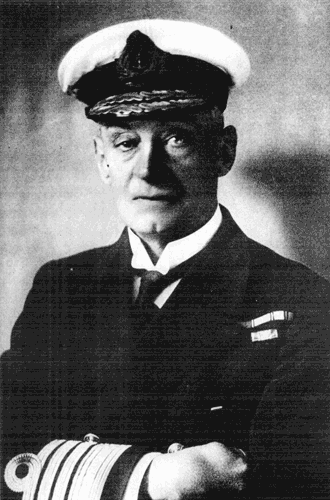
ADMIRAL SIR HENRY B. JACKSON Who Succeeded Lord Fisher as First Sea Lord of the British Admiralty (Photo by Elliott & Fry.)
