Second Month Closes with Offensive Operations in Swing Against Gorizia
Reading edition
On July 23, after two months of her war against Austria, an appraisement may be taken of Italy's extensive and business-like preparation for the conflict. Rapidly the passes leading to the Trentino, Carinthia, Friuli, and the valley of the Isonzo were secured, almost over night; and then, with the regularity of a railway time-table, the Italians began their hard, patient work, in hitherto impassable regions, of neutralizing the Trentino, so as to make impossible an invasion from that territory, and of linking up their columns along the Isonzo, so that now, at the beginning of August, a battle-front of seventy-five miles extending from Tarvis to the Adriatic, is ready to move eastward in the direction of Klagenfurt, beyond which there are no Austrian fortifications until Vienna is reached, 170 miles away—about as far as Cape Cod is from New York City. The right flank of this battle-front has been developed along the Carso plateau so as to neutralize, as the Trentino was neutralized, the Peninsula of Istria with the great commercial port of Trieste, the naval base of Pola, and the Hungarian Free City of Fiume.
THE Italian field of activity saw during the week ended July 24 the blazing out of the Italian offensive. Italy apparently was then satisfied that all the passages by means of which Austria could pour troops to attack her rear are effectively stopped and has therefore begun a determined advance along the Isonzo front from Tarvis to the Adriatic, with the object of breaking down completely Austria's first defensive screen. The battle is, as is natural, centring around Gorizia.
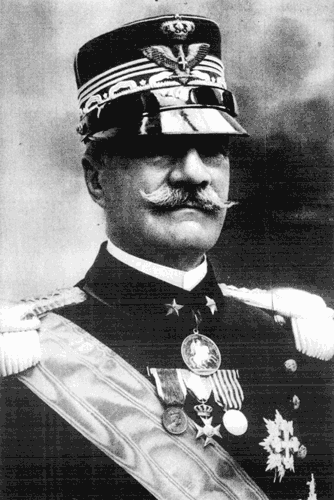
GENERAL CARLO CANEVA One of the Most Conspicuous of Italian Military Commanders (Photo from Central News.)
Once Gorizia falls, the Italian problem in so far as Trieste is concerned, will be near solution. The Italians have made notable advances in Cadore and along the Isonzo, on the plateau of Carso. But Gorizia must be taken before a decided local victory can be recorded. The fighting has not progressed as yet to the point where definite information is available, but in late July it seemed to have reached the culminating stage. The surroundings of Gorizia, which is the key to the Isonzo district and the junction of five main roads and four main railway lines, are protected with all manner of fortifications. The official report from Rome on June 25 recorded the Italian occupation of Globna, north of Plava, and of the edge of the plateau between Sagrado and Monfalcone. From that date reports from Vienna recorded continuous and heavy Italian attacks from the bridgehead at Goritz to the sea. The correspondent of the Berliner Tageblatt at the Isonzo front reported on July 7 that the second great Italian offensive had forced its way into the Austrian line at Podzora—a height covering the bridgehead at Goritz—and at Vermegliano, between Doberdo and Monfalcone. A Geneva dispatch, dated July 14, reported the capture by the Italians of two miles of trenches in the Carnic Alps, the Alpine troops dragging their artillery to an altitude of 6,600 feet near Roskopel, and capturing to the south of Gorizia two important forts. On July 16 a dispatch from Rome told of a war council at the front held by King Victor Emmanuel and Premier Salandra, with Count Cadorna, Chief of the General Staff, and General Porro, his chief assistant. A Vienna official dispatch of that date reported increased artillery activity in the coast district and in Carinthia. Two passes at a height of over 10,000 feet were taken by the Italians at Venerodolol and Brizio, as reported July 17, and on July 18 they began an advance in Cadore, attacking a ring of powerful forts at a great height at Paneveggio, San Pelegrino, Monet, Livinallongo, and Tresassi, while Goritz was shelled from land and air.
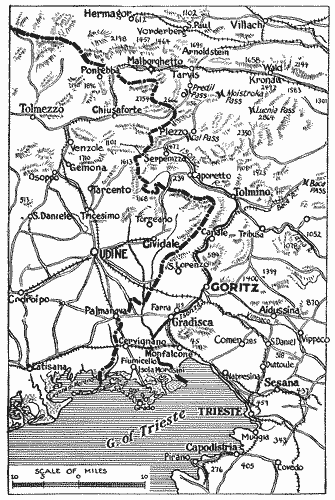
The Austro-Italian frontier, the scene of the fighting.
[Enlarge]
Then began, on July 20, a great general Italian assault on a 75-mile line from Tarvis to the Adriatic shore. A dispatch from Turin from the correspondent of The London Daily Chronicle announced a victorious advance by the Italians on the Carso plateau, east of Sagrado, with the capture of 2,000 Austrian prisoners. The War Office in Rome reported on July 21 that while the Italian defense continued to develop energetically in Cadore, and the artillery was effectively working in Carnia, the struggle in the Isonzo zone continued with increasing intensity. Toward Goritz the Italians gained part of the line of the heights which form the right bank of the river commanding the town and the Isonzo bridges. On the Carso Plateau the Austrians were reported driven from some trenches, and 3,500 prisoners and much material captured. On July 22 the fall of Goritz and Tolmino was reported to be near, the War Office in Rome announcing a development of the offensive "along the whole front from Monte Nero to the Carso Plateau. Vienna reported that the heavy attacks were being repulsed. But on July 23 the official report from Rome for the first time declared that the Italian armies in the battle along the whole Isonzo front were achieving success," which was "constantly becoming more clearly apparent." On July 24 a dispatch from Udine said that General Cadorna was personally directing the battle in the presence of King Victor Emmanuel and the Duke of Aosta. A Milan dispatch to The London Daily News on July 25 reported the evacuation of Goritz by the Austrian General Staff in view of the imminence of its fall. Below appears a prospective account of Italy's formidable task, written on July 1 by an Italian correspondent of The London Morning Post.