URTICACEAE
Reading edition
SUMMER KEY TO THE SPECIES OF ULMUS
a. Leaves essentially smooth on both sides; branches often with corky, wing-like ridges; lowermost branches usually short and strongly drooping; main trunk usually continuous into the crown without dividing, giving to the tree a narrow-oblong outline. U. racemosa, p. 129.
aa. Leaves usually rough on one or on both sides; branches without corky ridges; lowermost branches not short, not strongly drooping; main trunk usually dividing into several large limbs, giving to the tree a more or less vase-shaped outline.
b. Leaves usually rough above, but smooth beneath, with petioles glabrous; bark of trunk gray, deeply fissured into broad, scaly ridges; inner bark not mucilaginous. U. americana, p. 127.
bb. Leaves usually rough both sides, with petioles hairy; bark of trunk dark red-brown, shallowly fissured into large, loose plates; inner bark mucilaginous. U. fulva, p. 125.
WINTER KEY TO THE SPECIES OF ULMUS
a. Buds conspicuously rusty-tomentose; twigs more or less pubescent; inner bark very mucilaginous when chewed. U. fulva, p. 125.
aa. Buds not conspicuously rusty-tomentose; twigs glabrous; inner bark not mucilaginous.
b. Bundle-scars usually 3; buds 1/8 inch long, glabrous; twigs without corky ridges; outline of tree vase-shaped. U. americana, p. 127.
bb. Bundle-scars usually 4-6 in a curved line; buds 1/4 inch long, somewhat pilose; twigs often with corky ridges; outline of tree narrow-oblong. U. racemosa, p. 129.
Slippery Elm. Red Elm
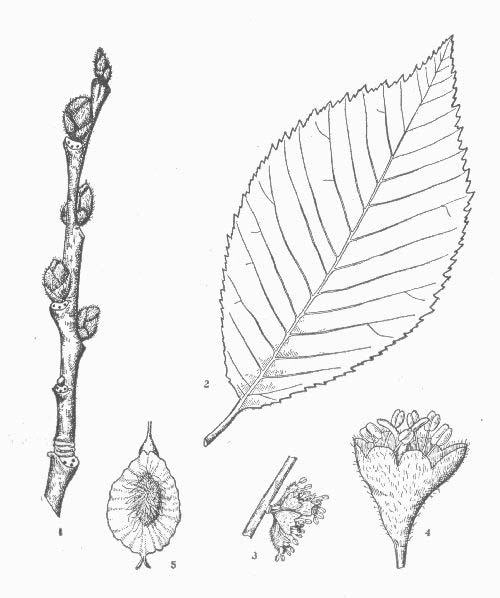
1. Winter twig, × 2. 2. Leaf, × 1. 3. Flowering branchlet, × 1. 4. Perfect flower, enlarged. 5. Fruit, × 1.
URTICACEAE
Slippery Elm. Red Elm
Ulmus fulva Michx. [Ulmus pubescens Walt.]
HABIT.—A medium-sized tree 40-60 feet high, with a short trunk 1-2 feet in diameter; spreading branches form a broad, open, flat-topped crown.
LEAVES.—Alternate, simple, 4-7 inches long, about one-half as broad; ovate-oblong; coarsely doubly serrate; thick and firm; dark green and rough above, paler and somewhat rough beneath; petioles short, stout, hairy.
FLOWERS.—March-April, before the leaves; mostly perfect; borne on short pedicels in crowded fascicles; calyx campanulate, 5-9-lobed, green, hairy; corolla 0; stamens 5-9, with dark red anthers; stigmas 2, reddish purple.
FRUIT.—May; semi-orbicular, 1-seeded samaras, short-stalked in dense clusters; seed cavity brown-tomentose; wings smooth, nearly 3/4 inch long.
WINTER-BUDS.—Terminal bud absent; lateral buds ovoid, obtuse, dark brown, rusty-tomentose, 1/4 inch long.
BARK.—Twigs at first bright green and pubescent, becoming light to dark brown or grayish; thick on old trunks, dark red-brown, shallowly fissured into large, loose plates; inner bark mucilaginous.
WOOD.—Heavy, hard, strong, very close-grained, durable, easy to split while green, dark red-brown, with thin, lighter colored sapwood.
DISTRIBUTION.—Of frequent occurrence throughout the state.
HABITAT.—Prefers stream-banks and bottom-lands; rich, moist hillsides; rocky ridges and slopes.
NOTES.—Grows more rapidly than U. americana.
White Elm. American Elm. Water Elm
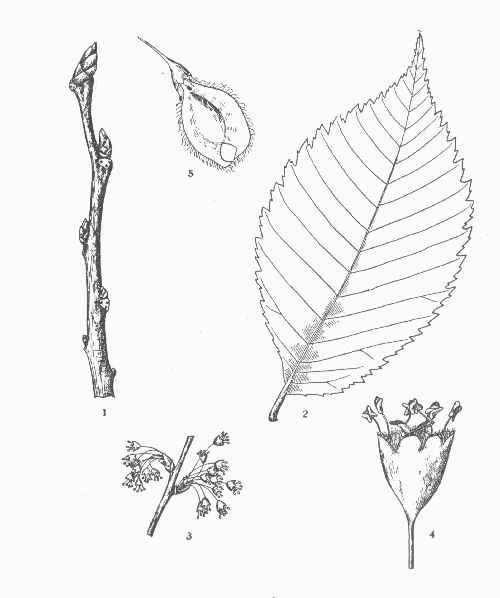
1. Winter twig, × 2. 2. Leaf, × 1/2. 3. Flowering branchlet, × 1/2. 4. Flower, enlarged. 5. Fruit, × 2.
URTICACEAE
White Elm. American Elm. Water Elm
Ulmus americana L.
HABIT.—A tree 75-100 feet high, with a trunk diameter of 2-6 feet; commonly dividing 20-30 feet above the ground into a few large branches which rise upward and outward to form a vase-shaped outline.
LEAVES.—Alternate, simple, 4-6 inches long, one-half as broad; obovate-oblong to oval; coarsely doubly serrate; thick and firm; dark green and rough above, pale and pubescent or glabrous beneath; petioles short and stout.
FLOWERS.—March-April, before the leaves; mostly perfect; small, brown to red; borne on slender pedicels in loose fascicles; calyx campanulate, 5-9-lobed; corolla 0; stamens 4-9, with bright red anthers; ovary 2-celled; styles 2, green.
FRUIT.—May; ovate, 1-seeded samaras, smooth both sides, hairy on the margin, 1/2 inch long, long-stemmed in crowded clusters.
WINTER-BUDS.—Terminal bud absent; lateral buds ovoid, acute, flattened, glabrous, brown, 1/8 inch long.
BARK.—Twigs at first light green and downy, becoming glabrous, red-brown, finally ash-gray; on old trunks thick, ash-gray, deeply fissured into broad, scaly ridges.
WOOD.—Heavy, hard, strong, tough, difficult to split, coarse-grained, light brown, with thick, lighter colored sapwood.
DISTRIBUTION.—Common throughout the state.
HABITAT.—Prefers deep, rich, moist loam; bottom-lands; stream-banks.
NOTES.—Grows rapidly. Long-lived. The roots run along near the surface of the ground for a great distance. An ideal street tree.
Cork Elm. Rock Elm
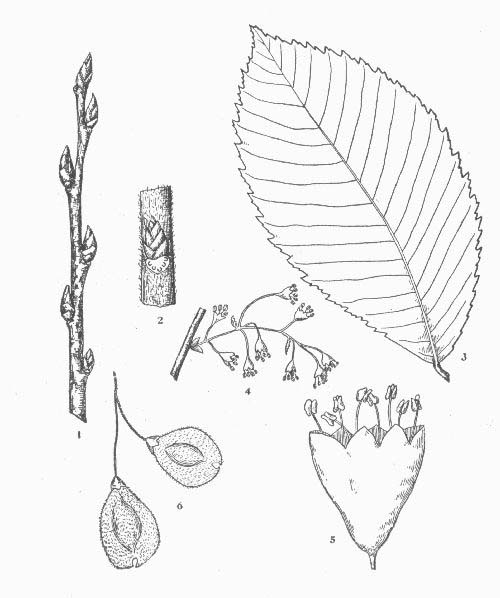
1. Winter twig, × 1. 2. Portion of twig, enlarged. 3. Leaf, × 1. 4. Flowering branchlet, × 1. 5. Flower, enlarged. 6. Fruit, × 1.
URTICACEAE
Cork Elm. Rock Elm
Ulmus racemosa Thomas [Ulmus Thomasi Sarg.]
HABIT.—A large tree sometimes reaching a height of 100 feet and a trunk diameter of 5 feet, but usually somewhat smaller; strongly drooping lateral and lower branches form a narrow, oblong crown.
LEAVES.—Alternate, simple, 3-6 inches long, one-half as broad; obovate to oblong-oval, more or less dished; coarsely doubly serrate; thick and firm; lustrous, dark green above, pale-pubescent beneath; petioles pubescent, 1/4 inch long.
FLOWERS.—March-April, before the leaves; mostly perfect; greenish; borne on slender, drooping pedicels in loose racemes; calyx campanulate, 7-8-lobed; corolla 0; stamens 7-8, with purple anthers; ovary hairy, 2-styled.
FRUIT.—May; ovate, 1-seeded samaras, pubescent all over, 1/2 inch long.
WINTER-BUDS.—Terminal bud absent; lateral buds ovoid, acute, brown, pilose, 1/4 inch long.
BARK.—Twigs at first light brown and pubescent, becoming lustrous, red-brown, finally gray-brown with corky, wing-like ridges; thick and grayish on the trunk, with wide fissures separating broad, flat, scaly ridges.
WOOD.—Heavy, very strong and tough, close-grained, light red-brown, with thick, lighter colored sapwood.
DISTRIBUTION.—Frequent in the southern third of the Lower Peninsula.
HABITAT.—Dry, gravelly uplands; rocky ridges and slopes; heavy clay soils; river-banks.
NOTES.—A good street tree, but less graceful in habit than U. americana.
Hackberry. Nettle-tree
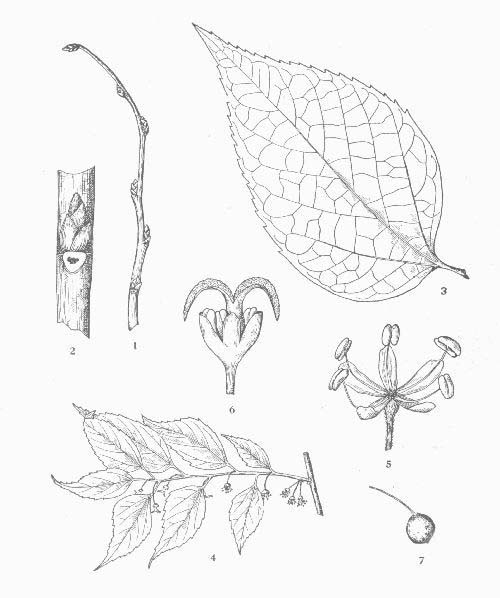
1. Winter twig, × 1. 2. Portion of twig, enlarged. 3. Leaf, × 3/4. 4. Flowering branchlet, × 1/2. 5. Staminate flower, enlarged. 6. Pistillate flower, enlarged. 7. Fruit, × 1.
URTICACEAE
Hackberry. Nettle-tree
Celtis occidentalis L.
HABIT.—A medium-sized tree, 40-60 feet high, with a short, straight trunk 1-2 feet in diameter which branches a few feet from the ground into a few large limbs and many slender, horizontal, zigzag branches, forming a broad, rounded crown.
LEAVES.—Alternate, simple, 2-4 inches long and one-half as broad; ovate to ovate-lanceolate, oblique at the base, usually long-pointed; coarsely serrate above the entire base; thin; glabrous, light green above, paler beneath, turning light yellow late in autumn; petioles short, slender, hairy.
FLOWERS.—May, with or soon after the leaves; polygamo-monoecious; greenish; inconspicuous; on slender pedicels; the staminate in clusters at the base of the shoot, the pistillate usually solitary in the axils of the upper leaves; calyx greenish, deeply 5-lobed; corolla 0; stamens 5; ovary 1-celled.
FRUIT.—September-October, remaining on the tree through the winter; slender-stalked, fleshy, globular drupes, 1/4 inch long, dark purple; edible.
WINTER-BUDS.—Terminal bud absent; lateral buds light brown, 1/4 inch long, ovoid, acute, flattened, the tip appressed.
BARK.—Twigs greenish, puberulous, becoming lustrous, red-brown in their first winter; on old trunks thick, light brown or silvery gray, broken into deep, short ridges or warty excrescences.
WOOD.—Heavy, soft, coarse-grained, weak, light yellow, with thick, whitish sapwood.
DISTRIBUTION.—Common throughout the Lower Peninsula.
HABITAT.—Prefers rich, moist, well-drained soil, but will grow on gravelly or rocky hillsides. Common along river-banks.
NOTES.—Hardy throughout its range. Grows slowly and irregularly in youth. Easily transplanted. Not desirable as a street tree, but appears well in ornamental grounds. Very tolerant of shade.
Osage Orange
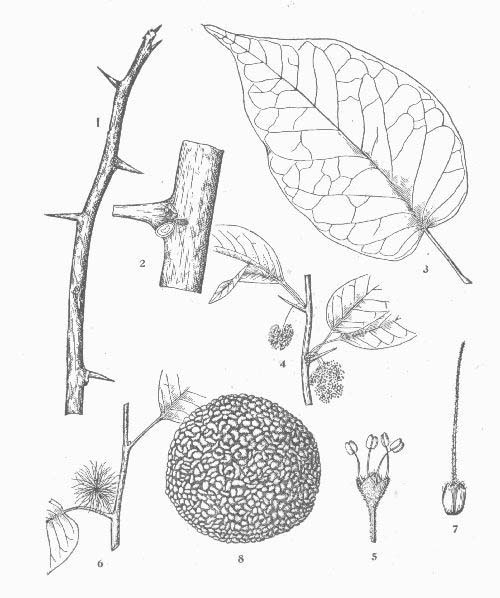
1. Winter twig, × 1. 2. Portion of twig, enlarged. 3. Leaf, × 1/2. 4. Staminate flowering branchlet, × 1/2. 5. Staminate flower, enlarged. 6. Pistillate flowering branchlet, × 1/2. 7. Pistillate flower, enlarged. 8. Fruit, × 1/4.
URTICACEAE
Osage Orange
Maclura pomifera (Raf.) Schneider [Toxylon pomiferum Raf.] [Maclura aurantiaca Nutt.]
HABIT.—A tree 20-30 feet high, with a short trunk 1-2 feet in diameter; divides into a few large limbs with curving branches, forming a symmetrical, rounded crown.
LEAVES.—Alternate, simple, 3-5 inches long, 2-3 inches broad; ovate to oblong-lanceolate; entire; thick and firm; dark green and shining above, paler beneath; petioles slender, pubescent, 1-1/2-2 inches long.
FLOWERS.—June, after the leaves; dioecious; the staminate slender-pedicelled, borne in a dense raceme at the end of long, slender, drooping peduncles; the pistillate in dense, globose heads at the end of short, stout peduncles; calyx 4-lobed, hairy; corolla 0; stamens 4; style covered with white, stigmatic hairs.
FRUIT.—Autumn; pale green, orange-like, 4-5 inches in diameter, composed of numerous small drupes, crowded and grown together.
WINTER-BUDS.—Terminal bud absent; lateral buds depressed-globular, partly hidden in the bark, pale brown.
BARK.—Twigs at first bright green, pubescent, becoming orange-brown and armed with stout, straight, axillary spines; dark orange-brown on the trunk and deeply furrowed.
WOOD.—Heavy, very hard and strong, flexible, coarse-grained, very durable, bright orange, with thin, lemon colored sapwood.
NOTES.—A native of the South, but hardy throughout Michigan. A desirable ornamental tree. Extensively planted for hedges.
Red Mulberry
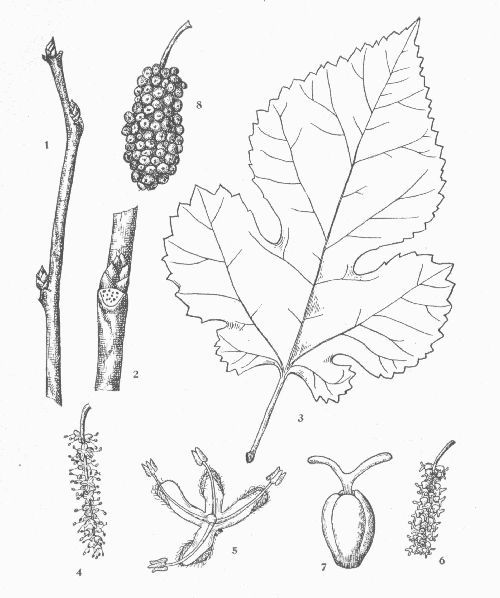
1. Winter twig, × 1. 2. Portion of twig, enlarged. 3. Leaf, × 1. 4. Spike of staminate flowers, × 1. 5. Staminate flower, enlarged. 6. Spike of pistillate flowers, × 1. 7. Pistillate flower, enlarged. 8. Fruit, × 1.
URTICACEAE
Red Mulberry
Morus rubra L.
HABIT.—A small tree 20-30 feet high, with a short trunk 10-15 inches in diameter; forming a dense, round-topped crown of stout, spreading branches and more or less zigzag, slender branchlets.
LEAVES.—Alternate, simple, 3-5 inches long, nearly as broad; outline variable, ovate to semi-orbicular, often 3-5-lobed; coarsely serrate; thin; dark blue-green and smooth or rough above, pale and more or less downy beneath; petioles 1-2 inches long, smooth, exuding a milky juice when cut.
FLOWERS.—May, with the leaves; monoecious or dioecious; the staminate in dense spikes 1-2 inches long, on short, hairy peduncles; the pistillate in dense spikes about 1 inch long, on short, hairy peduncles; calyx 4-lobed, hairy; corolla 0; stamens 4, with green anthers; stigmas 2, spreading.
FRUIT.—July; 1 inch long; consisting of drupes about 1/32 inch long, each inclosed in a thickened, fleshy calyx; berry-like; bright red at first, finally blackish; sweet, juicy, edible.
WINTER-BUDS.—Terminal bud absent; lateral buds ovoid, abruptly pointed, 1/4 inch long, lustrous, light brown.
BARK.—Twigs greenish and more or less downy, becoming smooth and brownish; trunk dark brown tinged with red and more or less furrowed.
WOOD.—Light, soft, weak, rather tough, coarse-grained, very durable, pale orange, with thick, lighter colored sapwood.
DISTRIBUTION.—Southern portion of the Lower Peninsula, as far north as the Muskegon river.
HABITAT.—Prefers rich soil in river-bottoms.
NOTES.—Easily transplanted. Grows rapidly in good, moist soil.