JUGLANDACEAE
Reading edition
SUMMER KEY TO THE SPECIES OF JUGLANS
a. Leaflets 11-17, the terminal usually present; pith of twigs chocolate-brown; bark of trunk rather smooth, or fissured, with broad, flat, whitish ridges; fruit elongated, sticky-downy. J. cinerea, p. 63.
aa. Leaflets 13-23, the terminal often lacking; pith of twigs cream colored; bark of trunk rough, brownish or blackish, deeply furrowed by broad, rounded ridges; fruit globose, not sticky-downy. J. nigra, p. 65.
WINTER KEY TO THE SPECIES OF JUGLANS
a. Pith chocolate-brown; leaf-scar with downy pad above; fruit elongated, sticky-downy; terminal bud 1/2-3/4 inch long; bark rather smooth, or fissured, with broad, flat, whitish ridges. J. cinerea, p. 63.
aa. Pith cream colored; leaf-scar without downy pad above; fruit globose, not sticky-downy; terminal bud 1/3 inch long; bark rough, brownish or blackish, deeply furrowed by broad, rounded ridges. J. nigra, p. 65.
Butternut
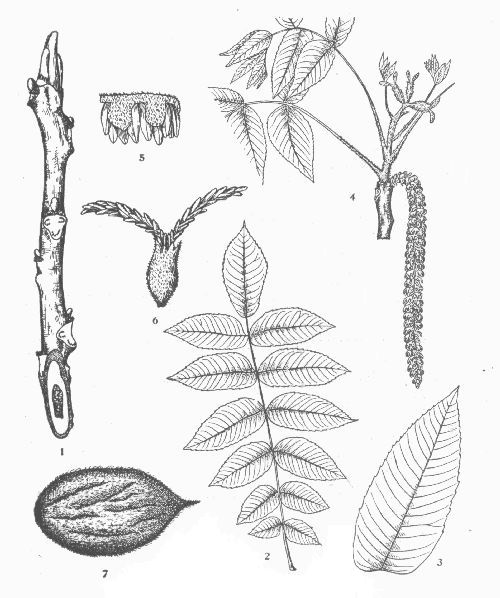
1. Winter twig, × 1. 2. Leaf, × 1/6 3. Leaflet, × 1/2 4. Flowering branchlet, × 1/2. 5. Staminate flower, enlarged. 6. Pistillate flower, enlarged. 7. Fruit, × 1/2.
JUGLANDACEAE
Butternut
Juglans cinerea L.
HABIT.—A medium-sized tree 40-60 feet high, with a short trunk 2-3 feet in diameter; forming a wide-spreading crown of large, horizontal branches and stout, stiff branchlets.
LEAVES.—Alternate, compound, 15-30 inches long. Leaflets 11-17, 2-4 inches long and one-half as broad; sessile, except the terminal; oblong-lanceolate; finely serrate; thin; yellow-green and rugose above, pale and soft-pubescent beneath. Petioles stout, hairy.
FLOWERS.—May, with the leaves; monoecious; the staminate in cylindrical, greenish, drooping catkins 3-5 inches long; calyx 6-lobed, borne on a hairy bract; corolla 0; stamens 8-12, with brown anthers; the pistillate solitary or several on a common peduncle, about 1/3 inch long, their bracts and bractlets sticky-hairy; calyx 4-lobed, hairy; corolla 0; styles 2; stigmas 2, fringed, spreading, bright red.
FRUIT.—October; about 2-1/2 inches long, cylindrical, pointed, greenish, sticky-downy, solitary or borne in drooping clusters of 3-5; nuts with rough shells, inclosing a sweet, but oily kernel; edible.
WINTER-BUDS.—Terminal bud 1/2-3/4 inch long, oblong-conical, obliquely blunt, somewhat flattened, brownish, pubescent.
BARK.—Twigs orange-brown or bright green, rusty-pubescent, becoming smooth and light gray; gray and smoothish on young trunks, becoming brown on old trunks, narrow-ridged, with wide furrows.
WOOD.—Light, soft, weak, coarse-grained, light brown, with thin, lighter colored sapwood.
DISTRIBUTION.—Of common occurrence in the southern half of the Lower Peninsula.
HABITAT.—Prefers low, rich woods; river-banks; low hillsides.
NOTES.—Leaves appear late and fall early. Pith chambered, chocolate-brown. Large trees usually unsound. Not easily transplanted.
Black Walnut
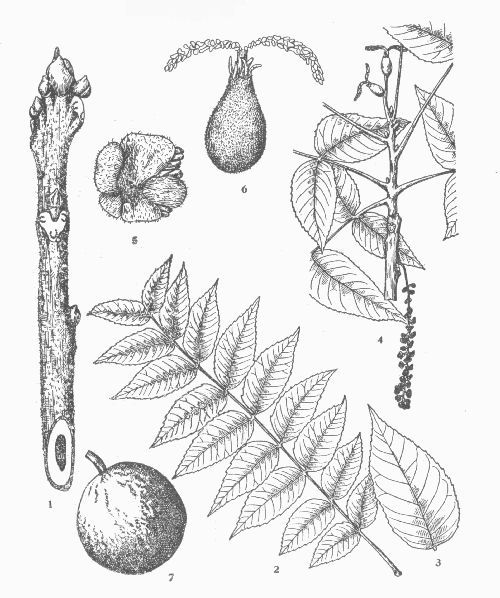
1. Winter twig, × 1. 2. Leaf, × 1/6. 3. Leaflet, × 1/2. 4. Flowering branchlet, × 1/2. 5. Staminate flower, back view, enlarged. 6. Pistillate flower, enlarged. 7. Fruit, × 1/2.
JUGLANDACEAE
Black Walnut
Juglans nigra L.
HABIT.—A large tree 60-80 feet high, with a massive trunk 2-5 feet in diameter; forming an open, capacious crown of heavy branches and coarse branchlets.
LEAVES.—Alternate, compound, 1-2 feet long. Leaflets 13-23, the terminal often lacking, 2-4 inches long and one-half as broad; sessile; ovate-lanceolate, taper-pointed; sharp-serrate; thin; yellow-green and glabrous above, lighter and soft-pubescent beneath. Petioles stout, pubescent. Foliage aromatic when bruised.
FLOWERS.—May, with the leaves; monoecious; the staminate in cylindrical, greenish, drooping catkins 3-5 inches long; calyx 6-lobed, borne on a hairy bract; corolla 0; stamens numerous, with purple anthers; the pistillate solitary or several on a common peduncle, about 1/4 inch long, their bracts and bractlets hairy; calyx 4-lobed, pubescent; corolla 0; styles and stigmas 2.
FRUIT.—October; globose, 1-1/2-2 inches in diameter, smooth, not viscid; solitary or borne in clusters of 2-3; nuts with irregularly furrowed shell, inclosing a sweet, edible kernel.
WINTER-BUDS.—Terminal bud 1/3 inch long, ovoid, obliquely blunt, slightly flattened, silky-tomentose.
BARK.—Twigs brownish and hairy, becoming darker and smooth; thick, brownish or blackish on the trunk and deeply furrowed by broad, rounded ridges.
WOOD.—Heavy, hard, strong, close-grained, very durable in contact with the soil, rich dark brown, with thin, lighter colored sapwood.
DISTRIBUTION.—Lower Peninsula as far north as Bay City, but more abundant in the southern portion of its range.
HABITAT.—Prefers rich bottom-lands and fertile hillsides.
NOTES.—Leaves appear late and fall early. Fruit very aromatic. Pith chambered, cream colored. The juices from the husk stain the hands brown. Not easily transplanted. Often infested with caterpillars.
SUMMER KEY TO THE SPECIES OF CARYA
a. Bark of trunk essentially smooth, not deeply furrowed nor shaggy; husk of fruit less than 1/8 inch thick.
b. Leaflets usually 5-7, glabrous beneath; buds dome-shaped, greenish; kernel of nut sweet.
c. Twigs long-hairy; fruit less than 1 inch long. C. microcarpa, p. 75.
cc. Twigs glabrous or nearly so; fruit 1-1/2-2 inches long. C. glabra, p. 77.
bb. Leaflets usually 7-11, more or less downy beneath; buds elongated, bright yellow; kernel of nut bitter. C. cordiformis, p. 79.
aa. Bark of trunk deeply furrowed or shaggy; husk of fruit more than 1/8 inch thick.
b. Twigs more or less pubescent; leaflets 5-7, more or less pubescent beneath.
c. Twigs brownish; buds densely hairy; fruit 1-1/2-2 inches long. C. alba, p. 73.
cc. Twigs orange; buds merely puberulous; fruit 1-3/4-2-1/2 inches long; (leaflets usually 7). C. laciniosa, p. 71.
bb. Twigs tending to be glabrous; leaflets usually 5, glabrous beneath. C. ovata, p. 69.
WINTER KEY TO THE SPECIES OF CARYA
a. Bark of trunk essentially smooth, not deeply furrowed nor shaggy; husk of fruit less than 1/8 inch thick.
b. Terminal bud narrow, long-pointed, flattish, bright yellow; kernel of nut bitter. C. cordiformis, p. 79.
bb. Terminal bud broad, dome-shaped, not bright yellow; kernel of nut sweet.
c. Buds greenish; twigs glabrous; fruit 1-1/2-2 inches long. C. glabra, p. 77.
cc. Buds red-brown; twigs long-hairy; fruit less than 1 inch long. C. microcarpa, p. 75.
aa. Bark of trunk deeply furrowed or shaggy; husk of fruit more than 1/8 inch thick.
b. Twigs more or less pubescent; buds more or less pubescent.
c. Buds 1/2-3/4 inch long, densely hairy; outer bud-scales deciduous in autumn; twigs brownish; fruit 1-1/2-2 inches long. C. alba, p. 73.
cc. Buds about 1 inch long, merely puberulous; outer bud-scales persistent until spring; twigs orange colored; fruit 1-3/4-2-1/2 inches long. C. laciniosa, p. 71.
bb. Twigs tending to be glabrous; buds glabrous or nearly so. C. ovata, p. 69.
Shagbark Hickory. Shellbark Hickory
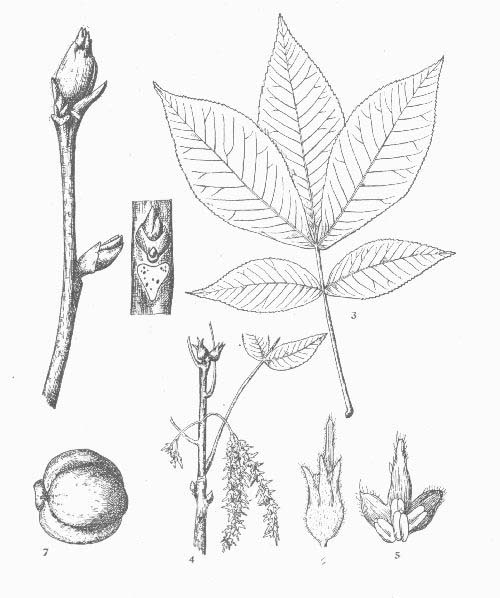
1. Winter twig, × 1. 2. Portion of twig, enlarged. 3. Leaf, × 1/3. 4. Flowering branchlet, × 1/2. 5. Staminate flower, enlarged. 6. Pistillate flower, enlarged. 7. Fruit, × 1/2.
JUGLANDACEAE
Shagbark Hickory. Shellbark Hickory
Carya ovata (Mill.) K. Koch [Hicoria ovata (Mill.) Britt.] [Carya alba Nutt.]
HABIT.—A tree 60-80 feet high, with a slender, columnar trunk 1-2 feet in diameter; forming a narrow, somewhat open crown of stout, slightly spreading limbs and stout branchlets.
LEAVES.—Alternate, compound, 8-14 inches long. Leaflets usually 5, the upper 5-7 inches long and 2-3 inches broad; sessile, except the terminal; obovate to oblong-lanceolate; finely serrate; thick and firm; glabrous, dark green above, paler beneath and glabrous or puberulous. Petioles stout, smooth or hairy. Foliage fragrant when crushed.
FLOWERS.—May, after the leaves; monoecious; the staminate hairy, greenish, in pendulous, ternate catkins 4-5 inches long, on a common peduncle about 1 inch long; scales 3-parted, bristle-tipped; stamens 4, with bearded, yellow anthers; the pistillate in 2-5-flowered spikes, 1/3 inch long, brown-tomentose; calyx 4-lobed, hairy; corolla 0; stigmas 2, large, fringed.
FRUIT.—October; globular, 1-2 inches long, with thick husk separating completely; nut usually 4-ridged, with thick shell and large, sweet, edible kernel.
WINTER-BUDS.—Terminal bud 1/2-3/4 inch long, broadly ovoid, obtuse, dark brown, pale-tomentose or nearly glabrous.
BARK.—Twigs brownish, more or less downy, becoming smooth and grayish; thick and grayish on old trunks, separating into thick strips 1-3 feet long, free at one or both ends, giving a characteristic shaggy appearance.
WOOD.—Heavy, very hard and strong, tough, close-grained, elastic, light brown, with thin, whitish sapwood.
DISTRIBUTION.—Common in the Lower Peninsula as far north as Roscommon County.
HABITAT.—Prefers light, well-drained, loamy soil; low hillsides; river-banks.
NOTES.—Hardy throughout its range. Moderately rapid in growth. Difficult to transplant.
Shellbark Hickory. King Nut
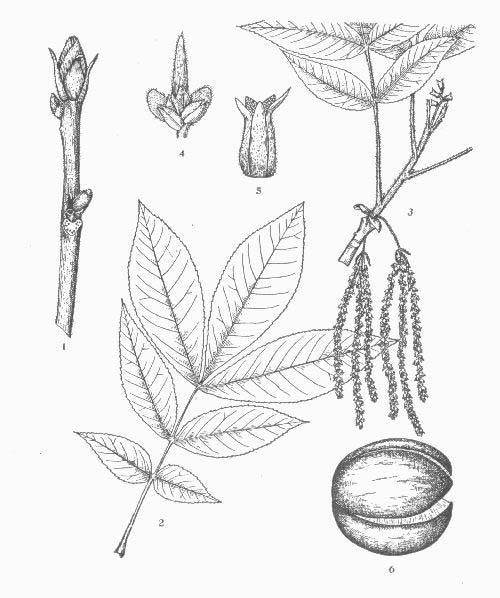
1. Winter twig, × 1/2. 2. Leaf, × 1/4. 3. Flowering branchlet, × 1/2. 4. Staminate flower, enlarged. 5. Pistillate flower, enlarged. 6. Fruit, × 1/2.
JUGLANDACEAE
Shellbark Hickory. King Nut
Carya laciniosa (Michx. f.) Loud. [Hicoria laciniosa (Michx. f.) Sarg.] [Carya sulcata Nutt.]
HABIT.—A tree 60-80 feet high, with a tall, slender trunk 2-3 feet in diameter; forming a narrow, oblong crown of small, spreading branches.
LEAVES.—Alternate, compound, 1-2 feet long. Leaflets usually 7, the upper 5-9 inches long, 3-5 inches broad, larger than the lowest pair; sessile or short-stalked; oblong-lanceolate to obovate, taper-pointed; finely serrate; thick and firm; lustrous, dark green above, paler and soft-pubescent beneath. Petioles stout, glabrous or pubescent, often persistent on the branches during the winter. Foliage fragrant when crushed.
FLOWERS.—May, after the leaves; monoecious; the staminate in pendulous, ternate catkins 5-8 inches long, slender, yellow-green, on common peduncles 1 inch long; scales 3-lobed, tomentose; stamens 4, with yellow, hairy anthers; the pistillate in crowded, 2-5-flowered spikes, tomentose; calyx 3-toothed, hairy; corolla 0; stigmas 2, light green.
FRUIT.—October; oblong to subglobose, 1-3/4-2-1/2 inches long, with very thick, woody husk, splitting to the base; nut 4-6-ridged, with thick, hard shell and large, sweet kernel.
WINTER-BUDS.—Terminal bud about 1 inch long, ovoid, obtuse, dark brown, puberulous.
BARK.—Twigs orange and more or less pubescent, becoming darker in the first winter, and finally grayish; on the trunk 1-2 inches thick, light gray, separating into broad, thick plates 3-4 feet long, persistent on the trunk for many years.
WOOD.—Heavy, very hard, strong, tough, close-grained, very elastic, dark brown, with thin, whitish sapwood.
DISTRIBUTION.—Occurs in the southern portion of the Lower Peninsula, but is rather a rare tree.
HABITAT.—Prefers deep, rich bottom-lands.
NOTES.—Rapid in growth. May be distinguished from other hickories by orange colored branchlets.
Mocker Nut Hickory
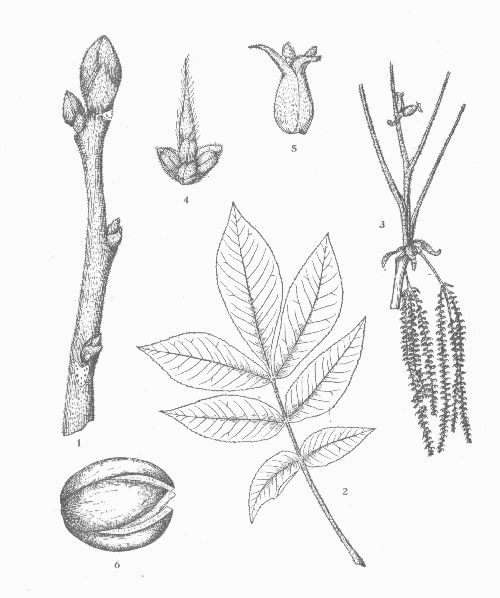
1. Winter twig, × 1. 2. Leaf, × 1/3. 3. Flowering branchlet, × 1/2. 4. Staminate flower, enlarged. 5. Pistillate flower, enlarged. 6. Fruit, × 1/2.
JUGLANDACEAE
Mocker Nut Hickory
Carya alba (L.) K. Koch [Hicoria alba (L.) Britt.] [Carya tomentosa Nutt.]
HABIT.—A tree 50-70 feet high, with a trunk diameter of 1-2-1/2 feet; forming a wide crown of strong, upright branches and stout branchlets.
LEAVES.—Alternate, compound, 8-12 inches long. Leaflets usually 5-7, sometimes 9, the upper 5-8 inches long, 3-4 inches broad; sessile, except the terminal; oblong- to obovate-lanceolate; minutely or sometimes coarsely serrate; thick and firm; lustrous, dark yellow-green above, paler and more or less pubescent beneath. Petioles pubescent. Foliage fragrant when crushed.
FLOWERS.—May, after the leaves; monoecious; the staminate in pendulous, ternate catkins 4-5 inches long, slender, green, hairy; scales 3-lobed, hairy; stamens 4-5, with red anthers; the pistillate in crowded, 2-5-flowered, tomentose spikes; calyx toothed, hairy; corolla 0; stigmas 2, hairy.
FRUIT.—October; globose to globose-oblong, 1-1/2-2 inches long, with thick husk splitting nearly to the base; nut 4-ridged, red-brown, with very thick, hard shell and small, sweet kernel.
WINTER-BUDS.—Terminal bud 1/2-3/4 inch long, broadly ovoid, red-brown, pilose; outermost scales fall in early autumn.
BARK.—Twigs at first brown-tomentose, becoming smooth and grayish; on the trunk thick, hard, grayish, slightly ridged by shallow, irregular fissures, becoming rugged on very old trunks.
WOOD.—Very heavy, hard, strong, tough, close-grained, elastic, dark brown, with thick, whitish sapwood.
DISTRIBUTION.—Southern Peninsula as far north as Grand Rapids and Flint. Infrequent.
HABITAT.—Prefers rich, well-drained soil, but grows well in various situations, if they are not too wet.
NOTES.—Hardy throughout its range. Difficult to transplant.
Small Pignut Hickory
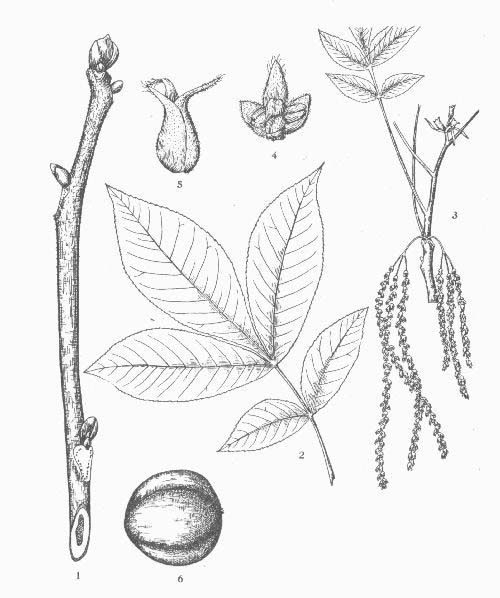
1. Winter twig, × 1. 2. Leaf, × 1/3. 3. Flowering branchlet, × 1/2. 4. Staminate flower, enlarged. 5. Pistillate flower, enlarged. 6. Fruit, × 1.
JUGLANDACEAE
Small Pignut Hickory
Carya microcarpa Nutt. [Hicoria odorata (Marsh.) Sarg.] [Hicoria microcarpa (Nutt.) Britt.] [Hicoria glabra, v. odorata Sarg.]
HABIT.—A tree usually 50-70 feet high, with a trunk diameter of 1-3 feet; forming an oblong or sometimes rounded crown of slender, spreading branches.
LEAVES.—Alternate, compound, 8-12 inches long. Leaflets usually 5-7, the upper 3-6 inches long, 2-2-1/2 inches broad; sessile, except the terminal; oblong to ovate-lanceolate, long-pointed; sharply serrate; thick and firm; glabrous, dark yellow-green above, lighter beneath. Petioles long, glabrous. Foliage fragrant when crushed.
FLOWERS.—May, after the leaves; monoecious; the staminate in pendulous, ternate catkins 3-7 inches long, slender, greenish, glabrous; stamens 4, with orange anthers; the pistillate in 2-5-flowered spikes, 1/4 inch long; calyx 4-toothed, hairy; corolla 0; stigmas 2, yellow.
FRUIT.—September; subglobose or globose-oblong, less than 1 inch long, with thin husk splitting nearly to the base; nut obscurely 4-ridged, with thin shell and small, sweet kernel.
WINTER-BUDS.—1/4-1/2 inch long, dome-shaped, red-brown, smooth.
BARK.—Twigs greenish, long-hairy, becoming reddish and finally gray; thick, hard and grayish on the trunk, divided by shallow fissures into narrow plates, and more or less shaggy.
WOOD.—Heavy, hard, strong, tough, close-grained, elastic, dark brown, with thick, whitish sapwood.
DISTRIBUTION.—Confined to the most southern portions of the Lower Peninsula.
HABITAT.—Prefers well-drained slopes and hillsides.
NOTES.—Resembles C. glabra, but the nut is much smaller.
Pignut Hickory
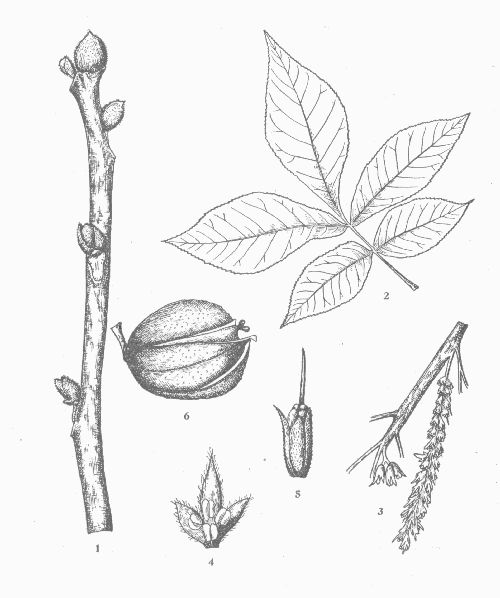
1. Winter twig, × 1. 2. Leaf, × 1/4. 3. Flowering branchlet, × 1. 4. Staminate flower, enlarged. 5. Pistillate flower, enlarged. 6. Fruit, × 2/3.
JUGLANDACEAE
Pignut Hickory
Carya glabra (Mill.) Spach. [Hicoria glabra (Mill.) Britt.] [Carya porcina Nutt.]
HABIT.—A tree usually 50-65 feet high, with a trunk diameter of 1-3 feet; forming a low, rather narrow, open crown of slender, often contorted branches.
LEAVES.—Alternate, compound, 8-12 inches long. Leaflets usually 5-7, the upper 3-6 inches long, 2-2-1/2 inches broad; subsessile, except the terminal; oblong to obovate-lanceolate, taper-pointed; sharply serrate; thick and firm; glabrous, dark yellow-green above, paler beneath. Petioles long, slender, glabrous or pubescent. Foliage fragrant when crushed.
FLOWERS.—May, after the leaves; monoecious; the staminate in pendulous, ternate catkins 3-7 inches long, slender, yellow-green, tomentose; scales 3-lobed, nearly glabrous; stamens 4, with orange anthers; the pistillate in crowded, 2-5-flowered spikes, 1/4 inch long; calyx 4-toothed, hairy; corolla 0; stigmas 2, yellow.
FRUIT.—October; variable in size and shape, 1-1/2-2 inches long, with thin husk splitting half-way and sometimes nearly to the base; nut obscurely 4-ridged, with thin or thick, hard shell and small, sweet or slightly bitter kernel which is hard to remove.
WINTER-BUDS.—Terminal bud 1/4-1/2 inch long, dome-shaped, greenish or grayish, smooth or finely downy.
BARK.—Twigs greenish, nearly glabrous, becoming reddish, and finally grayish; thick, hard and grayish on the trunk, with a firm, close surface divided by small fissures and sometimes broken into plates.
WOOD.—Heavy, hard, very strong, tough, close-grained, elastic, dark brown, with thick, whitish sapwood.
DISTRIBUTION.—Occurs only in the extreme southern portion of the Lower Peninsula. Common within its range.
HABITAT.—Prefers deep, rich loam, but grows in any well-drained soil; dry ridges and hillsides.
NOTES.—Hardy and desirable for ornamental purposes. Difficult to transplant. Not adapted to street use.
Bitternut Hickory
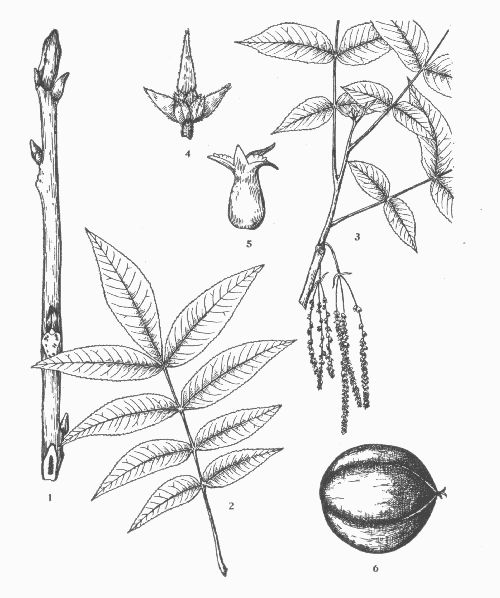
1. Winter twig, × 1. 2. Leaf, × 1/3. 3. Flowering branchlet, × 1/2. 4. Staminate flower, enlarged. 5. Pistillate flower, enlarged. 6. Fruit, × 1.
JUGLANDACEAE
Bitternut Hickory
Carya cordiformis (Wang.) K. Koch [Hicoria minima (Marsh.) Britt.] [Carya amara Nutt.]
HABIT.—A tall, slender tree 50-75 feet high, with a trunk diameter of 1-2-1/2 feet; forming a broad crown of slender, stiff, upright branches, widest near the top.
LEAVES.—Alternate, compound, 6-10 inches long. Leaflets 5-11, the upper 4-6 inches long and one-fourth as broad; sessile, except the terminal; lanceolate to oblong-lanceolate, long-pointed; coarsely serrate; thin and firm; glabrous, bright green above, paler and more or less downy beneath. Petioles slender, hairy. Foliage fragrant when crushed.
FLOWERS.—May, after the leaves; monoecious; the staminate slightly pubescent, in pendulous, ternate catkins 3-4 inches long, on a common peduncle about 1 inch long; scales 3-lobed, hairy; stamens 4, with bearded, yellow anthers; the pistillate in 2-5-flowered spikes 1/2 inch long, scurfy-tomentose; calyx 4-lobed, pubescent; corolla 0; stigmas 2, greenish.
FRUIT.—October; obovate to globular, about 1 inch long, coated with yellow, scurfy pubescence, with very thin husk splitting half-way to the base, with sutures winged at the top; nut quite smooth, with thin shell and small, bitter kernel.
WINTER-BUDS.—Terminal bud about 3/4 inch long, long-pointed, flattish, granular-yellow; lateral buds more or less 4-angled.
BARK.—Twigs greenish and more or less downy, becoming brownish, and finally grayish; gray, close, smooth on the trunk, often reticulately ridged, but rarely broken into plates.
WOOD.—Heavy, very hard, strong, tough, close-grained, dark brown, with thick, lighter colored sapwood.
DISTRIBUTION.—Of common occurrence in the southern half of the Lower Peninsula.
HABITAT.—Prefers a rich, loamy or gravelly soil; low, wet woods; along the borders of streams; but also found on high, dry uplands.
NOTES.—Grows most rapidly of all the hickories, but is apt to show dead branches. Should be propagated from the seed, as it is not easily transplanted.