BIGNONIACEAE
Reading edition
SUMMER KEY TO THE SPECIES OF CATALPA
a. Leaves 5-8 inches long, thick; flowers 1-1/2 inches across, prominently yellow-spotted; seeds with pointed, fringed wings at each end; branches rather crooked and straggling; bark thin, separating into thin scales on the trunk. C. bignonioides, p. 227.
aa. Leaves 8-12 inches long, thin; flowers 2-1/2 inches across, not prominently spotted; seeds with rounded, wide-fringed wings at each end; branches not crooked and straggling; bark thick, separating into thick scales on the trunk. C. speciosa, p. 225.
WINTER KEY TO THE SPECIES OF CATALPA
a. Fruiting capsules about 1/4 inch thick; seeds with pointed, fringed wings at each end; branches rather crooked and straggling; bark thin, separating into thin scales on the trunk. C. bignonioides, p. 227.
aa. Fruiting capsules about 1/2 inch thick, seeds with rounded, wide-fringed wings at each end; branches not crooked and straggling; bark thick, separating into thick scales on the trunk. C. speciosa, p. 225.
Hardy Catalpa
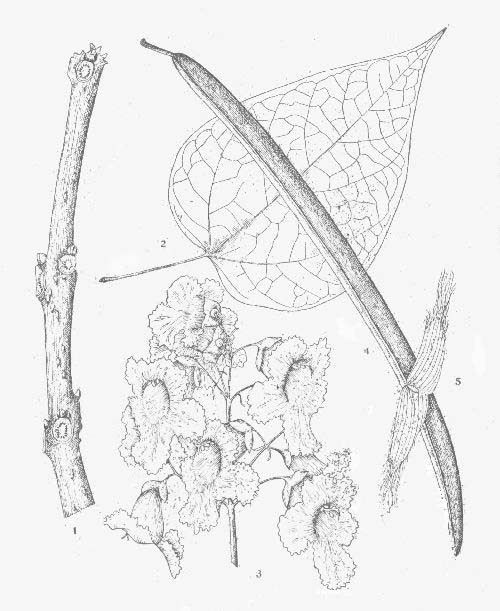
1. Winter twig, × 1. 2. Leaf, × 1/4. 3. Panicle of flowers, × 3/8. 4. Fruit, × 1/2. 5. Seed, × 1.
BIGNONIACEAE
Hardy Catalpa
Catalpa speciosa Warder.
HABIT.—A tree 50-75 feet high, with a short, often crooked trunk and a broad, rounded crown of slender, spreading branches and thick branchlets.
LEAVES.—Opposite or whorled, simple, 8-12 inches long, 6-8 inches broad; heart-shaped; entire or sometimes slightly lobed; thick and firm; glabrous, dark green above, downy beneath, with clusters of dark, nectariferous glands in the axils of the primary veins, turning black and falling with the first severe frost; petioles long, stout, terete.
FLOWERS.—June-July, after the leaves are full grown; perfect; borne on slender, purplish pedicels in open, few-flowered panicles 5-6 inches long; calyx 2-lobed, purple; corolla white with inconspicuous yellow spots, campanulate, 5-lobed, 2-1/2 inches broad; stamens 2, staminodia 3; ovary 2-celled.
FRUIT.—Ripens in early autumn; slender, 2-celled, cylindrical capsule 10-20 inches long and about 1/2 inch thick; hangs on tree all winter, opening in spring before falling; seeds light brown, 1 inch long, with rounded, wide-fringed wings at each end.
WINTER-BUDS.—Terminal bud absent; lateral buds brownish, globose, inconspicuous.
BARK.—Twigs greenish, often with purple tinge, becoming orange or red-brown and covered with a slight bloom the first winter, finally darker with age; thick, red-brown, broken into thick scales on the trunk,
WOOD.—Light, soft, weak, coarse-grained, light brown, with very thin, almost white sapwood; very durable in contact with the soil.
NOTES.—A native of Illinois, Indiana, and the states adjoining on the south, but much planted in Michigan as a shade and ornamental tree. Closely resembles C. bignonioides, but is a larger and hardier tree.
Catalpa
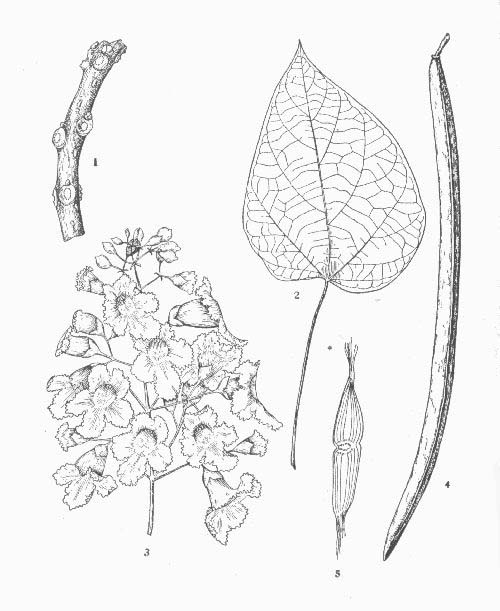
1. Winter twig, × 1. 2. Leaf, × 3/8. 3. Panicle of flowers, × 1/3. 4. Fruit, × 1/2. 5. Seed, × 1.
BIGNONIACEAE
Catalpa
Catalpa bignonioides Walt. [Catalpa catalpa (L.) Karst.]
HABIT.—A tree 40-30 feet high, with a short, thick trunk and a broad, irregular crown of long, crooked branches and coarse, upright branchlets.
LEAVES.—Opposite or whorled, simple, 5-8 inches long, 4-5 inches broad; heart-shaped; entire or sometimes slightly lobed; thin and firm; glabrous, light green above, downy beneath, with dark, nectariferous glands in the axils of the primary veins, turning black and falling with the first severe frost; petioles long, stout, terete.
FLOWERS.—June-July, after the leaves are full grown; perfect; borne on slender, hairy pedicels in compact, many-flowered panicles 8-10 inches long; calyx 2-lobed, green or purple; corolla white with yellow spots, campanulate, 5-lobed, 1-1/2 inches broad; stamens 2, staminodia 3; ovary 2-celled.
FRUIT.—Ripens in early autumn; slender, 2-celled, cylindrical capsule 8-20 inches long and about 1/4 inch thick; hangs on tree all winter, opening in spring before falling; seeds silvery gray, 1 inch long, with pointed, fringed wings at each end.
WINTER-BUDS.—Terminal bud absent; lateral buds, brownish, globose, inconspicuous.
BARK.—Twigs greenish purple, becoming red-brown and marked by a network of thin, flat ridges; thin, red-brown on the trunk, separating into large, thin, irregular scales.
WOOD.—Light, soft, weak, coarse-grained, light brown, with very thin, whitish sapwood; very durable in contact with the soil.
NOTES.—A native of the Lower Mississippi River Basin, but naturalized in southern Michigan, where it is a popular shade and ornamental tree. Foliage appears very tardily in spring.